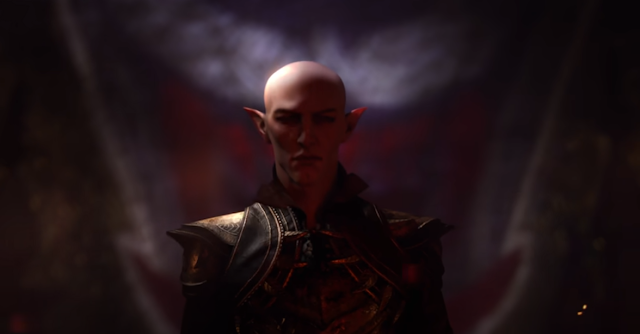
Happy Dragon Age Day 2019, everyone!
It was a huge privilege for me this past weekend to
interview Karin Weekes, Lead Editor at BioWare, and Patrick Weekes, Lead Writer
on the Dragon Age franchise at BioWare. Karin has been involved with Dragon Age since Dragon Age: Origins (as well as on other BioWare properties), while Patrick did some work on Origins, then returned as a senior writer for Dragon Age: Inquisition after work on other BioWare properties, and moved into the lead writer position after Inquisition for the DLCs that followed.

Both of the Weekeses took time out of their busy schedules to talk to me, and they had some terrific insights to
share in celebration of Dragon Age Day 2019. I'm so excited to share their
thoughts and comments in the transcribed interview below (and in additional installments to follow)!
ANGELA: Patrick and Karin, greetings to both of you! As you
hopefully already know from my walls of text, I'm so privileged and proud to be
talking to you both. Thank you for taking part this Dragon Age Day to benefit
Able Gamers.

I love all of Dragon Age, but wow, Inquisition is such an
achievement—over a million words, right? And it's so gorgeously written,
presented and rendered! It's kind of the writer's writer RPG to me.
KARIN: It’s almost a million.
PATRICK: It’s pretty close.
And I swear, I think I’ve heard or read all of them! And enjoyed
every one.
Aside from the considerations of lore, graphics, voice
acting, animation, direction, rendering and more, what's it like for the two of
you, as wordsmiths, managing a million words of pure content?
KARIN: It takes a lot of people. It takes hundreds of us
to manage the whole game. And a smaller but not insignificant number to wrangle
the word parts.
PATRICK: Does one actually manage a very
fast-flowing, slightly flooded river?
KARIN: Yes, with desperate
dam-building!
PATRICK: And with hopes that it goes mostly in the right direction…?
KARIN: And of getting it vaguely
to follow the course you want it to take!
PATRICK: Yeah, I mean, these
games are huge. And on Inquisition, I
was a senior writer but not the lead, and so for my part, writing the
followers, for me it was an experience of getting to see Cole, Bull and Solas
from start to finish, and that by itself was huge. Being able to shepherd that
many storylines, that many words, on top of “Hey, this line you wrote a year
ago, now contradicts something that’s changed on level, we need a quick revision on that…”
And when you move from doing that, to doing all of the DLC – we did "Jaws of Hakkon," and "The Descent," and "Trespasser" – it only gets bigger and
harder to manage.
And, hypothetically, were we working on something that
someday in the future may be 'A Thing,' that would be an even greater learning
experience. That would show exactly how difficult this stuff is to manage and
it would show how much it relies upon and really depends upon large groups of
people all working with the same goal in good faith.
Right.
KARIN: Yeah, and for me, because
Inquisition was my third Dragon Age game, when I went to work on Origins, it
was to do exactly what you’re talking about – I always say that my first task was to
try to get all of the lore out of David Gaider’s head and onto a Wiki where the
rest of the team could experience it and know what was going on.
And so by the
time you’re on the third game into a series, there is a lot of stuff to
wrangle, so just from a technical standpoint, it’s trying to remember, to – you
know, to write down everyone’s names, to go and get it again and tease Dave and
figure out which of the five characters he’s named the same thing because he
really likes that name…
And then just... remembering and tracking what could
have happened to different characters because when you’re making choices, you
have to be keeping track of different possible scenarios. So we kind of – I’ll
just say we do our best. We do have to have big, very large, share points or
conflict pages or Wikis to try and remember all of the things that we do, and
that works most of the time. And some of us remember things, but… it’s tricky!
(laughs)
PATRICK: We’ll let you know when
we succeed, is I think the real answer.
KARIN: Yeah, and I mean,
honestly, a lot of it, there is such an active community – people like you all
definitely keep us on our toes, and occasionally remember things that we can’t
remember ourselves! (laughs) I’ve been grateful for that on more than one
occasion.
And that was very
diplomatically put, considering the assortment of potential reactions on the
Internet… (I mean it with love!)
(laughter)
After a decade since
Origins, and 5 years since Inquisition, what's the most satisfying thing for
each of you that fans are still passionately celebrating Dragon Age through
events like Dragon Age Day?
KARIN: It’s kind of phenomenal! You know, when you think
about it—when you’re thanking us for being here and doing this, but we’re
really thankful for all of you, the Dragon Age Day founders and fans, because without people who care about these
characters, who are invested in these characters, we wouldn’t really have a
reason, beyond self-entertainment, to do any of this. Creating
these games and these characters and these stories – it means a lot to us
personally, and we put a lot of ourselves into it, and it’s really… it’s hard
for me to find the right word for what it means when the people who are playing
the games do the same thing.
It’s a really neat way to connect with people.
Like, we love when we go to conventions somewhere, and we see people – a visual
evidence, somehow, of people liking Dragon Age – a cosplayer, for instance –
and you automatically have a thing to talk about.
You have a shared knowledge
and backstory, that you can cut through some of the social niceties that you
have to move through to get to know people, and just – to have people that
immersed in the story that we’re making is really cool, and it’s really
humbling. And it’s an experience I’ve never had in any other job I’ve had.
That’s wonderful. You
know, I would imagine, if you’re at a convention, and someone walks in, and
they’re the most magnificent Flemeth, or Bull, or Dorian that you’ve ever seen,
you already know that you’ve got something to talk about.
KARIN: It’s amazing. It’s hard to describe. But I think
Patrick wants to describe it too, so I’m going to let him.
PATRICK (laughs): So I agree with everything you said. But I
have an additional answer that is a tiny thing… For me, the thing I love most…
I mean, I love all of it. But in addition, a thing I love is that I am not a
great artist. I make really good stick figures when I attempt to illustrate
something. Hands remain a mystery to me. Faces are not very good. So for me, I
am always touched when I see art of characters.
KARIN: Yeah.
PATRICK: Because that is someone showing that they care
about the characters we helped make in a way that I’m not capable of doing
myself, so that always means a lot to me. The thing in particular – there’s a
banter between Bull and Sera in Inquisition, and Bull suggests throwing Sera –
I don’t know if you know it –
Oh, I know it well!
(laughs)
PATRICK: So – I wrote this banter. We had no ability to
support that in-game ourselves. That was not something – we didn’t have the
two-person animations for that, we didn’t have art for that, all I could do was
this little banter. But every time I see someone has drawn that as fan art,
what that – for me, that means, is that they
were with us. They helped us make the game right there. I don’t know if
that makes sense.
KARIN: Yeah, exactly.
PATRICK: For me, it always – it’s okay, great, we’re all in
this together. We’re all seeing the same vision and moving forward.
KARIN: A collective consciousness.
Yes! It really is.
And the other thing is – I mean, I’m sure you’ve seen the GIF of that moment as well –
PATRICK: Oh, I love it.
It’s the best thing
in the world. And I think the other thing is that – speaking as one of the
fans, I would actually throw this back to you guys and say, even though for you
it’s just a banter, I am a passionate advocate of the banters, I think they're so important, and you make us see it in our minds.
So
to me you’re describing something that you may not have been able to animate at
the time, but for us it happened. We saw it in our heads. The same goes
with Krem and the catapults and nugs with wings, right?
So you guys helped us
see it, and then the amazing Dragon Age fan artist community – and they are
unbelievable – they take it even further and give us something even more
amazing than those mental images you gave us. It’s pretty great.
KARIN: It’s pretty cool, too, in-house, as the ideas for the
characters are created, to be working with our art teams…
I mean, much like
Patrick, I can’t even draw stick figures, so all of the artists and everything
they do is just the most amazing magic from my perspective. And so, working
with them, they’ll have ideas as the characters in the back and forth gain
physical form, too, and it’s really exciting.
The thing that’s so
amazing about fan artists – alongside the fanfiction writers, the bloggers,
etc., is all of these people taking this incredible amount of time just to
celebrate something purely for the joy of it.
PATRICK: Yes.
I wanted to ask you
guys… what's your own message to Dragon Age fans for Dragon Age Day 2019?
KARIN: Okay, we’re smiling right now. Because we had a run
at this a bit earlier, the two of us. People will see in a couple of days! (laughs, to PATRICK) Do you know yours?
PATRICK: Well, yeah.
KARIN: So do you want to say it?
PATRICK: You mean, me first? Okay.
KARIN (laughs)
PATRICK: I just want to say thank you. Thank you for
sticking with us across three games. I was on Origins, but everything I wrote
was cut. I wasn’t on Dragon Age II, except for occasionally tossing advice to people at
lunch. And then Inquisition.
But the Dragon Age franchise has been so different across the three
games, and the one thing that has remained the same has been our commitment to
telling stories about flawed but lovable characters finding each other and kind
of becoming a found family. And not solving the world, but making the world a
little better for their efforts.
And the fact that that has resonated with
people means so much to us. And whatever comes in the future, that’s something
that we are passionate about and so, so grateful that others are passionate
about as well.
KARIN: That was very well said. You know, you should be a
writer! That was very well done!
I know! I think he
should take a stab at that, don’t you?
KARIN: I mean yes, thank you, obviously, would be my message
as well. It’s harder to say words than write them!
Well, wait, Karin, I can pause here so you can write them
down… and then edit them!
KARIN: Well, and that way I know I can sound like I know
what I’m talking about. See, for me, for instance – look, I like cosplay. I
just like cosplay. I’m not particularly good at it, but it’s really fun, and I
enjoy it, and it’s my silly fan thing.
PATRICK: She is
good at it!
I can’t believe
you said that, Karin, you’re great at cosplay, I’ve seen some of the tweets and
pictures.
KARIN: That’s my fan thing. That’s my nerd thing. And so when
I see other people cosplaying, I know how much work it takes to create
something.
And one of the things I love about cosplay is seeing how people can
portray one character in so many different ways. And part of the fun
conversation is, what did you use for the feathers, or how did you make this or
that thing? And seeing all the different ways people creatively tackle the
challenge of bringing this character to life.
To me, that’s kind of
representative of the way people take these characters – and this found family,
as Patrick said – and find parts of themselves in them, and find parts of other
people they know. And ideally, roleplaying and RPGs are about exploring parts
of the world that you can’t in real life. And exploring parts of yourself that
you can’t in real life.
And so just seeing all the different ways that people
embrace that setting and situation and support each other. Like, the Dragon Age
community is a family like I’ve never seen in any other community of people.
They prop each other up, they help each other out, they have amazingly
geektastic Dragon Age weddings… the commonality of it that brings people
together is just heartwarming and really amazing to see.
Karin, you were
talking about cosplay earlier, so I have to ask you – I remember from one of
your previous interviews that you had cosplayed Celene from The Masked Empire,
and one of my favorite things was that you were calling the artist to ask
“What’s this thing she’s wearing here? What is it? What does it do? Is it a
shawl?” and the artist was like, “I don’t know!”
KARIN (laughs): Yeah, they said, “I don’t know what it is, I
just did it for the visuals!"
And that has been something that has been really
fascinating, that community involvement has really affected a lot of the ways
in which the outfits that the characters wear evolve in the games themselves.
For instance, Matt Rhodes has talked about this multiple times, but we did a
BioWare Base at Pax this one time, and he talked about how seeing people in
cosplay affected the way he designs character clothes, so that people can
actually wear them. For instance, one of my favorite things is that, in
Inquisition, all of the default Inquisitor class outfits have some kind of
pouch or bag or something in which cosplayers can hold their cell phones, because
that was what people asked for (we need a place to put our stuff!)
That’s great!
PATRICK: Yeah, because Matt Rhodes did a lot of Mass Effect,
and you’ll notice, as part of his growth as an artist, after watching all of
the Commander Shepards earlier… I believe most Inquisitors… can actually sit.
KARIN: That’s right, because the Shepards couldn’t before.
PATRICK: Yeah, a lot of the Shepards couldn’t sit in
accurate cosplays, so at conventions Matt saw this and described it and said,
“There’s this lean they all do. So we
have to make sure – we have to make sure that for Inquisition, they can all
sit!” (laughter)
What's most exciting
for each of you about supporting Able Gamers, our charity this year for Dragon
Age Day?
KARIN: I’m personally very excited about it because I’ve
become friends with Steve Spohn, and we’ve gotten to know each other over
Twitter. And, just the work that he’s done and
that the organization has done is just heartwarming and so impressive.
It's also changed how I think about games and how we make our games – and making sure we
are reaching the widest audience that we possibly can. Because like you were
just saying, one of the best things about roleplaying games is transporting yourself
somewhere else, so anything we can do to support as many gamers as possible so that everyone can have that experience is
really important.
So thank you all for picking Able Gamers to support this
year! We’re really excited about that.
PATRICK: I think Karin said it better than I could.
KARIN: What, you mean, you don’t want to just ramble on like
me?
PATRICK (laughter): Well, if you want a three-hour
interview…
I would happily sit
here for three hours! But I do think games give us such an
opportunity to escape – like the best books or the best movies – but even
better, they’re immersive and they let us kind of – look, for me, y’all, on a
really bad day, sometimes I just start up Inquisition and go into the tavern
and listen to Maryden for awhile. Because it truly feels like an escape.
PATRICK: And you know, Karin and I, through other… through
donations and charitable giving, we try to support people with disabilities and
accessibility for things they need – for healthcare, for workplace
accessibility, other things like that.
But. There is an easy temptation in modern
society for us to think of entertainment as just entertainment – as the light,
silly thing you’re doing when you’re not doing something important. But
entertainment is how you stay sane sometimes.
KARIN: Or how you forget about pain for awhile.
PATRICK: Exactly. It allows you to forget the fact that
you’re hurting, or how you process emotions that you’re not ready to process
directly or consciously that you need a kind of metaphor to get through. And so
if we can make our games more accessible, that is important. So for us that’s a
major issue.
That’s beautifully
put. It’s kind of like… we all need sleep. But we also all need dreams.
KARIN: Well, that was beautifully said too.
Thank you! You guys
inspired me. (laughter)
I’d imagine the fact
that you both work together as spouses long-term must be both wonderful, satisfying, and challenging. What's the most fun part about that for you guys?
PATRICK: Well, Karin is a great editor, and at least on my
end, I’m really grateful because there are times when I don’t know how to
explain what I’m trying to do, and Karin as a benefit of 19 years of marriage,
will turn to me and say “Are you trying to do this?”
KARIN: (laughs)
PATRICK: And it’s funny. I think a lot of people have asked
questions assuming that, “Oh, I bet Karin doesn’t edit you very hard,” or...
KARIN: Yeah, or they assume that it’s super-awkward, but
it’s really the opposite.
PATRICK: She’s edited every short story and every novel I’ve
ever written before it’s gone off to agents and editors. She’s comfortable with
calling BS on anything I’ve said, and probably with a lot more comfort than
with other writers, because she doesn’t have to dance around the issue. She can
just come in and say, “Okay, you’re doing a ‘you’ thing right now.”
KARIN (laughs): Yeah. You know that thing you do? You’re
doing it.
PATRICK: So that part is amazing and I really – look, no character
I’ve written on any game would have been as strong without me being able to
bounce stuff off her sometimes.
Or sometimes it’s outside work hours, and I’ll
be at home, and I’ll say, “So okay, I’m up, and I’m wondering about this, but if I do something like this, would this work?” and then she’ll
answer, “Okay, but have you thought about this?” and all of that just – for me,
that is a little intangible that always brings benefits.
KARIN: And I feel
like I’ve gotten better at that. Part of the craft of editing by having that
relationship is, because when you’re an editor, there’s the physical fixing and
making suggestions, but we editors also kind of say that it’s 50% the editing,
and 50% your relationship with that person.
Because (to Patrick) living with you, watching you write, I see how much of yourself you put into it, and I see how potentially painful it is to have your words harshed upon. So it helps me figure out how to phrase things in ways that aren’t unnecessarily hurtful.
There are
an unfortunate number of editors out their who feel like that position makes them the boss, and
that’s not how it should be. As an editor, with Patrick or with any of the
writers, my favorite thing is when I edit something, and they say “Yes!
That’s what I was trying to say!”
It’s my responsibility not to write my own
stuff, but to get into their heads and try to figure out where they’re going,
and that’s why it’s so important that we have the documentation, and we have a
lot of meetings figuring things out – themes, and goals, and issues – so that
anyone working on this project – not just the writers and editors – but anyone
else who’s doing anything related to that character, can all be moving in the
same direction.
And then there were a couple of times with David Gaider,
particularly, I was always so proud when he’d get back to me and go, “Did you
do anything? Did you change anything?” and I’d go, “YES!” because I’d cut
twenty percent and he hadn’t even noticed. That’s where you know you’ve gotten
it right.
So your job is
actually helping the writers get where they want to be.
KARIN: I need to buy into what they’re trying to do. And
sometimes, part of that buy-in is to say, “This is the goal, but I don’t think
this part is quite getting there,” or on the other hand, “Yes, this is where
you want to be – don’t change a word of that.”
A good editor is there to
support them and help get them there. Because, you know, when you’re writing,
you are very in your own head, and you know what you want it to be, and
sometimes, especially if you’ve had to work on something several times for new
iterations or changes, you can sometimes lose a little bit of sight of the
objective placed, and how other people coming into it for the first time will
be viewing it, as opposed to the view in your head.
You’re there to help
with the forest view, when a lot of them may just be focused on the trees.
KARIN: Essentially. We call it that "second set of eyes" – to
just come in and see something. But as far as Patrick, it makes things weird very
rarely.
PATRICK: For me, the biggest drawback is what happens when
both of us are dealing with home or deadlines at the same time…
KARIN: It’s easier now that our kids are older – they’re 12
and 15 now – but when they were younger, that was trickier if we had to go in,
then someone comes home for dinner, then has to go back, and in those moments,
keeping things on the rails is not always possible.
We do try really hard to
remove ourselves, and to not talk about work all the time. We have to kind of
force ourselves to let go of it, as we can get too caught up in it.
PATRICK: Depending on the state of the project, sometimes
the bedroom becomes a “We don’t talk about work” zone. So once we are in the
bedroom, there’s time for chat about family stuff, and about how frustrating
the level of this game you’re playing on your phone is, and stuff like that. It
becomes a no-work zone.
KARIN: Yeah, I think the benefits, at least for me, definitely
outweigh the negatives. And with things like working late, or when a project’s
in a particular phase, you really get it, and you know what’s going on. So even
though we may be tired, we can also really empathize with each other, and go,
“Okay, what do you need? Do you need food, do you need me to do laundry? Do you
need to talk? Do you need to be alone?” etc.
PATRICK: Yesterday, John Epler and I gave an hour and a half
presentation about some narrative stuff. And I was told it went fairly well...
KARIN: It did go very well!
PATRICK: ...And then I worked for the rest of the day and I got
home and I was just kind of on the edge of not being able to form coherent
sentences anymore, and Karin, just incredibly politely and supportively, said, “Do
you just want to go back to the bedroom, and just kind of ‘cave time’ for
awhile?”
And I went, “Is that okay?” And she said yes, because
she knows. She knows what an hour and a half presentation to a roomful of
people does to most people, and to me.
So it sounds to me
like it’s very unforced and organic. It’s just something that really works for
both of you.
PATRICK: Yeah, it’s not something I would recommend that
everyone try…
KARIN: No.
PATRICK: But it works well for us.
KARIN: And, too, because we’re not always on the same
project. At those moments, it can get a little… for instance, we were both on Mass Effect 3 together, and we were in
the same office, and that was a little bit…
PATRICK: Yeah.
KARIN: That was… (laughs)
You possibly got a
little sick of each other at certain points?
KARIN: Oh, no. For example – I just remember, this time when he
got rear-ended by a bus one day… and (to Patrick) I can’t even remember what
you told me, but you left out…
PATRICK: I said I got rear-ended. That I braked, and that I
got rear-ended, and that it wasn’t a big deal. I was trying not to make a big
thing out of it… and I may have neglected to mention that it was by a bus.
KARIN: And apparently the rest of the room knew. And there
we were, IMing, and he says, “When the bus hit me,” so I stand up and say,
“You got HIT BY A BUS?!” and everyone else was, like, “Dude, you didn’t tell
her about the bus?”
PATRICK: And I was watching the entire rest of the room go,
“Yeah, Karin has a point, man. You really should’ve mentioned the bus.”
You buried the lede!
KARIN: Yeah, it was pretty funny. The whole rest of the room
scooted their chairs back from the table all at once.
Patrick, can you
share any fun little moment or detail you were surprised that players either
caught – or missed – when it came to Bull, Solas, or Cole?
KARIN: Nothing. There’s not going to be anything. Fans catch
everything and they are amazing.
PATRICK: Yeah, I used to think “They’ll never get this, and
it’ll be our little secret!” And then I'd realize they found it right away.
KARIN: Yeah, we think we’re so clever, but you’re all so
much smarter than we are.
PATRICK: Ooh, but okay! I have one. I have one. I can’t
remember if I’ve told this one already, and if so I apologize. But if I’m
remembering from one of your articles talking about the Solas cadence.
Yeah, Solas’s“Hallelujah” cadence…
PATRICK: Have I shared with you the fact that… let’s see…
but when Solas in the Prologue has you close the first rift, and then says “It
seems you hold the key to our salvation…”
(Here, I gasped so
dramatically – realizing what he was about to say – that somewhere, the ghost of Agatha Christie rolled her eyes, Patrick and Karin
started giggling, and it was really pretty funny AND embarrassing…)
PATRICK: Did I tell you about this already?
No, I’m just so
tickled to realize this. It’s a new thing I didn’t know!
(more laughter)
PATRICK: Well, see, that one is in cadence, BUT – it’s in cadence specifically not for inside the
Prologue, but so that when you go back and have the dream talk with Solas in
Haven, the branch where Solas goes and says how it seemed to him – if you go
back and do his explanation including “It seems you hold the key to our
salvation” – that bit reappears, and it is in
“Hallelujah” cadence, too.
So I actually… Dave was kind of mystified, but incredibly
tolerant of me going, “Hey, Dave, I have this line, and I’m going to call back
to it later, and I need this line to have this particular style because it’s
going to be incredibly poetic for the few people who ever see it in this
cadence when they get to this part and recognize what it’s doing.”
KARIN: Dave was incredibly tolerant of that.
I never caught the
foreshadowing aspect of that, when he says it in the Prologue. That’s
wonderful.
PATRICK: Dave was incredibly tolerant of my nerditude
overall.
KARIN: And I have to credit Cori May, our editor, with
editing all of that, because… I just could not. (laughter) And well, Cori was
our resident Solasmancer.
Cori's fabulous! I always call Cori Solasmancer Prime, ever since I found out about how involved she was in his character (like, with the "I agree with your goals" option in "Trespasser").
KARIN: She really is!
PATRICK: Cori’s great, and Cori is the person who when I
explain, “Here’s this ridiculous thing I’m doing,” she’ll give me an incredibly
intense look, and I’ll think, “Oh, no, she’s preparing to tell me it’s stupid,”
and then she'll say, “Well, okay, but then you need to change this word so
that it works correctly in the rhythm.” And I’ll go, “You’re right!”
I love how diabolical
you were with that, so that in the epilogue of a Solas-romanced Lavellan, even the end caption titles are in that
same "Hallelujah" cadence again. It’s so great, you guys. Also, sorry, I’ll
stop plotzing all the time. Really. I’ll calm
down and be normal.
KARIN: No, but it’s so exciting! Because we’re sitting up in
the cold and the snow doing this, and feeling like giant nerds, so when other people
get it, it’s the coolest thing.
PATRICK: Because the other part of it is, we’re looking at
it now with the benefit of hindsight…
KARIN: Yeah.
PATRICK: Because, at the time, it was 2012 or 2013, and when
I worked on Solas, and I didn’t know.
KARIN: And you’d had to take Solas over from Dave (David Gaider).
PATRICK: Right.
KARIN: Solas as a character, and Cole, both.
PATRICK: That’s right, yes. And I didn’t know. I didn’t know if people
were going to hate Solas, I didn’t know how it was going to come across… in
reality, it is performance art, but it’s performance art that you perform one
to two years in advance, and that you simply hope people eventually like.
KARIN: And there are so many people – like the voice actors –
who have to buy in, and our VO department has to buy in… so many people. Everyone
needs to understand what it is and embrace it enough to make the character
work. And when it does, it’s incredible.
PATRICK: I’ve been very lucky. And it’s also funny because it’s
been a learning experience for me so often as well. I do have an English
degree, but I was fortunate that I had people willing to trust me at the time,
because, talking about it with Dave or with Mike Laidlaw, I’d just basically said,
“Okay, I can’t tell you exactly why this needs to happen, but when Solas is talking
about the Fade or about memories, I want him to do this thing. He’s gonna talk like
this because it’s gonna make it sound sadder, and it’s gonna make it sound a
little mystical. Like, not full-on Lord
of the Rings voice, but a little bit different in a way that – some people
won’t actually know why they’re feeling it – but if I do it right, it’ll make
people feel it a little bit more.”
And that was about the level I could explain it at, and then
they were willing to go with me on it. And then here in-game, I still remember
the time when both Mike and Dave both responded the first time they heard it, and
they just went, “Yes, it makes him sound a little bit more – it makes you
believe later and understand that ‘Yep, that was an elven god, and I kind of
got a hint of that there,’ even though at the time, I just went ‘Huh, that’s a
little bit more than a normal person would say.’”
In the time since Inquisition
shipped, I’ve tried to get better at coming up with reasons for the ridiculous
things I try to do like that, rather than, “I don’t know, this will make people
feel more,” which maybe isn’t the best explanation when you’re trying to
explain something.
KARIN: When one works, you can then say, “Well, it’s going
to be like the Solas ‘Hallelujah’ thing,” and people will go, “Oh, okay, got it!”
I do think it adds a
kind of hidden musicality and poetry to that dialogue. It adds a
formality as well. And all of these little elements
that you’re talking about add a literary quality, and I would apply that to the
writing across all of the games. There are so many beautiful dialogue moments
across the trilogy – not just from you, Patrick, but from so many of the
writers.
PATRICK: I love that we have so many writers with different
styles, and all of them in their own ways are as nerdy as I am about stuff. For
instance, every time Sheryl does a character – Sheryl Chee has a degree in
Philosophy – and every time she writes a character, she’s always trying to answer
a question for herself with that character.
KARIN: And Sheryl’s equal parts that philosophical aspect,
mixed in with as many dirty puns as possible too. And that is what the
magnificent thing about Sheryl’s writing is, honestly, because it has both of
those components, and they’re both so real. And she words them in a way that
just super resonates with me. It’s just great.
PATRICK: And then you take someone like Luke – Lukas Kristjanson
– who for Sera invented his own slang, using Cockney as a basis, but it’s not actually
Cockney, and he would get actively annoyed when people called it Cockney, correcting them that it’s actually 17th
Century slang terms... and we were like, “Write it down,” and he’d answer, “Oh,
yes, yes, I’ve gotten it written down, here’s what everything means…”
And that is – it’s not a thing that I would do, but it’s
awesome that he could do that. And let’s face it, not all characters need to be
written by me.
KARIN (laughs): And so when I would go in and edit Sera,
there was a lot of “Okay, I’m just assuming Luke knows what’s going on there…”
And
what’s fun is that the other part of my job is to liaise between us and the
translators that work on our games, in EA Madrid, for example. Our games get
translated into a lot of different languages which requires not only fairly
copious explanations of all the weird crap that we make up, but also, you know,
having to explain things like English puns.
(to Patrick) And I always feel like you and Luke, the two of
you, usually – and Sheryl – are the ones…
PATRICK (laughs): Well, I talked about this on Twitter recently
– on just what it's like having to try to explain your dirty jokes to the foreign language
team, and it is both hilarious and mortifying, because no joke survives being
explained.
And it goes from feeling “This is great,” to “I am the
dumbest, most sophomoric writer who has ever existed, because I have to tell
France, the country in its entirety,
that I was referring to oral sex in this scene.”
You’re talking about
the “Loosening the lid” banter between Bull and Sera, right?
PATRICK: Yeah, that whole “I loosened the lid for ya.” And
both France and Germany come back with, “What does this mean?” and I’m going, “Um…”
KARIN: And Patrick has done this multiple times, in multiple
games. (laughter)
A lot of times, the editors can answer questions if we know
what they are, so we’ll do that. But we do refer all of the oral sex questions
back to the writers! (laughter)
But yeah, here, I get, “What’s Sera talking about here? We
don’t know what Sera’s talking about!” and I just write back, “Neither do I! I
have no clue what she’s talking about, and I don’t think we’re supposed to!
Good luck!”
PATRICK: Yeah, it was that for Sera, while Solas they
usually got, but Cole was another one they had trouble with sometimes. About
half the time, they’d go, “What’s going on here? Who is the ‘they’ Cole is
talking about here?” And I would go, “Oh, that would be a spoiler. And also, I
may have been referencing a television show from the Eighties that involved
angels.”
KARIN: Luckily, I am a very, very hardy and patient woman.
(laughter)
End of Part 1. Stay tuned for Part 2 to follow shortly!