|
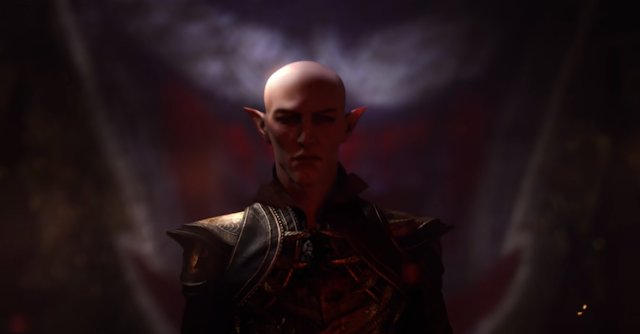
| The new teaser is out! And as always, BioWare is AMAZING at giving us everything we want... in a way guaranteed to break our hearts. For those of us who love Solas, hearing that voice again is fantastic... until we realize how desolate he sounds. |
Every once in awhile, dreams come true. And the dreams of a ton of Dragon Age fans (including yours truly) came true during Thursday's telecast of The Game Awards when BioWare, at long last, teased fans with a Dragon Age 4 announcement, hashtagged #TheDreadWolfRises.
Now, right away I'm gonna go ahead and have a nice meal of crow, because it looks like my prediction that Solas will NOT tear down the Veil is implied to be pretty seriously wrong. The red lyrium idol (from Dragon Age II) that features in the video shared by BioWare, along with (most especially) that haunting and forbidding fresco, implies to me that the Veil is probably coming down.
Mmmm... crow! So tasty. Delicious.
Now let's talk about what this might mean.
Why I Think It's Solas
EDITED TO ADD: I'm getting a lot of questions about my assumption that the figure is Solas, so I'll address that first in an update:
The reason I assume it's Solas and not one of the other Evanuris is because of the repeated elements from past depictions of Solas in DAI and the "Trespasser" murals.
As far as the elements of the image here (Solas alongside the Dread Wolf, if in fact it's him), Solas is frequently (commonly) depicted in both his man and Dread Wolf forms together in many of those past images, so to me this is simply more of the same. The images have always been heavily symbolic and metaphorical to me, and often seemed to demonstrate Solas's state of mind, his inner self. For instance, on the romance Tarot, the 'Dread Wolf' is white, fuzzy, and adorable (and with two bright red eyes, but without the Pride Demon eyes the darker version carries). Then, in the infamous final "Tower" Tarot image for Solas, there he is, heading off into darkness with his branchy staff, the massive shadowy Dread Wolf (complete with Pride Demon eyes) looming over him, but also following obediently behind him.

This theme continues in "Trespasser," where Solas is repeatedly shown alongside his Dread Wolf self almost in moments of joy and freedom, as in one of my favorites, where he appears to be leaning forward in flight, face uplifted, with the Dread Wolf running placidly behind him. Basically, we can see Solas's mood or state of mind from looking at the wolf in the paintings. The wolf we see in the new teaser is potentially terrifying and tragic indeed.
In short, Solas appears alongside the Dread Wolf all over the place, from Inquisition to "Trespasser" to (I believe) this new mural. And to me, the baldness doesn't necessarily mean it's him, but the canon branchy staff from his Tarot, the repeated robe pattern, and presence of the Dread Wolf are all familiar elements we've seen in his frescoes before. Even the stance, the quiet denial of the gesture, says "Solas" to me.
And I don't think it's Elgar'nan, because of the Solas-staff and cloak, but also because he was reported to wield light or fire, and while yes, there is fire in the image, to me it is a representation of the burning of the "raw chaos" -- it doesn't appear to be a weapon and stream of magic. And the figure with its upraised palm seems calmer, cooler, and is not emanating anything. I also don't think it's Falon'Din, because Falon-Din carried a shepherd's-hook staff in his mosaic in the Temple of Mythal. And the cloak's dark ruff of fur is somehow 'wolfy' to me.
I just think it's Solas, at the dark end of his journey. If I'm wrong, I'll eat more crow. (Yum! Delicious metaphorical crow!)
"When He Rises, Everyone Will See..."
Why I Think It's Solas
EDITED TO ADD: I'm getting a lot of questions about my assumption that the figure is Solas, so I'll address that first in an update:
The reason I assume it's Solas and not one of the other Evanuris is because of the repeated elements from past depictions of Solas in DAI and the "Trespasser" murals.
As far as the elements of the image here (Solas alongside the Dread Wolf, if in fact it's him), Solas is frequently (commonly) depicted in both his man and Dread Wolf forms together in many of those past images, so to me this is simply more of the same. The images have always been heavily symbolic and metaphorical to me, and often seemed to demonstrate Solas's state of mind, his inner self. For instance, on the romance Tarot, the 'Dread Wolf' is white, fuzzy, and adorable (and with two bright red eyes, but without the Pride Demon eyes the darker version carries). Then, in the infamous final "Tower" Tarot image for Solas, there he is, heading off into darkness with his branchy staff, the massive shadowy Dread Wolf (complete with Pride Demon eyes) looming over him, but also following obediently behind him.

This theme continues in "Trespasser," where Solas is repeatedly shown alongside his Dread Wolf self almost in moments of joy and freedom, as in one of my favorites, where he appears to be leaning forward in flight, face uplifted, with the Dread Wolf running placidly behind him. Basically, we can see Solas's mood or state of mind from looking at the wolf in the paintings. The wolf we see in the new teaser is potentially terrifying and tragic indeed.
In short, Solas appears alongside the Dread Wolf all over the place, from Inquisition to "Trespasser" to (I believe) this new mural. And to me, the baldness doesn't necessarily mean it's him, but the canon branchy staff from his Tarot, the repeated robe pattern, and presence of the Dread Wolf are all familiar elements we've seen in his frescoes before. Even the stance, the quiet denial of the gesture, says "Solas" to me.
And I don't think it's Elgar'nan, because of the Solas-staff and cloak, but also because he was reported to wield light or fire, and while yes, there is fire in the image, to me it is a representation of the burning of the "raw chaos" -- it doesn't appear to be a weapon and stream of magic. And the figure with its upraised palm seems calmer, cooler, and is not emanating anything. I also don't think it's Falon'Din, because Falon-Din carried a shepherd's-hook staff in his mosaic in the Temple of Mythal. And the cloak's dark ruff of fur is somehow 'wolfy' to me.
I just think it's Solas, at the dark end of his journey. If I'm wrong, I'll eat more crow. (Yum! Delicious metaphorical crow!)
"When He Rises, Everyone Will See..."
Because of the phrasing here, for me this title instantly of course calls back, first and foremost, to Sandal's Prophecy in Dragon Age II, when he says:
SANDAL:
One day the magic will come back. All of it.
Everyone will be just like they were.
The shadows will part and the skies will open wide.
When he rises, everyone will see.
Now, damned if that doesn't sound like the events of Dragon Age: Inquisition, paired with Solas's plans for the future as openly presented by him to us in "Trespasser."
 |
| Solas calm, certain and ascendant in "Trespasser." This is not the voice we hear in #TheDreadWolfRises. |
The skies certainly opened wide thanks to Corypants's use of the Orb, causing the Breach in Inquisition. And the magic coming back ("all of it") is certainly one logical outcome if Solas indeed tears down the Veil he created all those millennia ago. Because if the Veil does come down, magic will be as common, as indistinguishable, as air.
Solas once described it to us in great detail at Haven in the following selected snippets:
SOLAS:
- Without [the Veil], imagine if spirits entered freely. The Fade was not a place one went, but a state of nature, like the wind.
- A world where imagination defines reality, where spirits are as common as trees or grass.
- Imagine if spirits were not — a rarity — but a part of our natural world… like a fast-flowing river. Yes, it can drown careless children, but it can also carry a merchant’s goods or grind a miller’s flour. That is what the world could be, if the Veil were not present. For better, or worse.
- Imagine ..... palaces floating among the clouds. Imagine beings who lived forever, for whom magic was as natural as breathing. That is what was lost.
This is important stuff, because it may very well be describing the environment (and alteration in powers and physics) caused if the Veil comes down. The Fade will become real, and dreams and visions will be a part of daily life. Spirits will be common companions and demons will be constant potential threats. Magic will be part of everyone and everything, and will even be able to negate gravity where desired.
Meanwhile, Sandal's "everyone will be just like they were" seems to me to imply:

- The return of immortality for the elves
- All elves will have inherent magical abilities (can you imagine Fenris or Sera reacting to this?)
- A return to balance for spirits and demons (no longer trapped in the Fade)
- That magic filling the air will return people to their core selves
- Solas will use that magic to further restore the ancient glory days of the elven people as reflected in Arlathan
Now, Solas notes that he "had plans" for dealing with this in "Trespasser," but still... that's a huge thing for him to address so casually!
Questions to Ponder:
Biological Reactions to a Veil-less World
My bet would be that all elves will find some degree of potential magic unleashed, while all latent mages will also manifest. I'd imagine there might also be a high number of horrifying and almost instantaneous Abominations, as well.
Ultimately, we have no idea how humans will react biologically to such an environment, as humans have never existed, as far as recorded history tells us, in a world without the Veil.
My guess, based on the reactions of non-elves and humans to travel through the Crossroads (thanks to Patrick Weekes's beautiful and evocative descriptions in The Masked Empire) is that humans facing a Veil-less world may find their perception of color slightly dimmed or weakened. They may feel slight vertigo and disorientation. The elves, will, conversely, feel stronger, more awake and alive, the magic tingling on their skin. They may actually see colors more intensely and experience emotions and sensations more acutely.
And that's if he rises... and everyone sees.
Tantalizing Questions
 |
| Notice Solas's distinctive cloak here. And he's, as always, carrying that branchy staff. Interestingly, the staff is dark here in "Trespasser," yet when we saw it in DAI, it was always light in color. |
- Will the removal of the Veil (and Solas's "Fade Prisons") free the Forgotten Ones, as well?
- Will the freed Evanuris be in spiritual or physical form? If they are in fact tied to the physical archdemons (five of which are destroyed), will their counterparts behind the Fade still exist?
- Will the two remaining—if tied to the remaining archdemons—then awaken in their holy (dragon) form?
- And if these archdemons awaken, two at once, does this mean two concurrent Blights?
- The implication in the past has been that the archdemons aren't exactly sentient, but instinctual. What if the Evanuris are freed? Does that mean we're left with two sentient, thinking and aware archdemons?
- And what if they shapeshift back into humanoid form? The Evanuris were dragon shapeshifters, after all.
- Whose side will the Forgotten Ones be on? It's implied that Solas was actually a friend to them... which would make sense if he was actively attempting to free the slaves and bring the corrupt and tyrannical Evanuris down.
 |
| Apostle, apostate, Fade King, fool for love, and hierophant: Portrait of Solas. |
My bet would be that all elves will find some degree of potential magic unleashed, while all latent mages will also manifest. I'd imagine there might also be a high number of horrifying and almost instantaneous Abominations, as well.
Ultimately, we have no idea how humans will react biologically to such an environment, as humans have never existed, as far as recorded history tells us, in a world without the Veil.
My guess, based on the reactions of non-elves and humans to travel through the Crossroads (thanks to Patrick Weekes's beautiful and evocative descriptions in The Masked Empire) is that humans facing a Veil-less world may find their perception of color slightly dimmed or weakened. They may feel slight vertigo and disorientation. The elves, will, conversely, feel stronger, more awake and alive, the magic tingling on their skin. They may actually see colors more intensely and experience emotions and sensations more acutely.
And that's if he rises... and everyone sees.
Tantalizing Questions
So, based on the trailer, we still don't know if events are actually set within the Dragon Age at all. As my friend Stefanie wondered in our recent Twitch chat, what if there's a time skip to the next age?
If so, that's a pretty big skip.
When last we left Dragon Age in "Trespasser," we were in 9:44 Dragon. The events of some of the epilogue plot points seem to occur within two years of that ending, so let's say they complete by 9:46.
That leaves 54 years. If the game does skip forward like this, just think of the implications. Will Lavellan still be alive (I'm betting yes, because Magic)? Will our beloved Dragon Age: Inquisition companions? Will Alistair still be King? Will Sten still be Arishok?
It's all good fodder for wondering.
And then we wonder of course... what is the next age? My vote: The Elven Age.
Onward. Or maybe we're not too long after the events of "Trespasser," after all. That's still my guess—because it also increases the possibility for returns from companions whose arcs would be powerfully fulfilled in DA4 (if, as implied, it's set in Tevinter), including Dorian, Fenris, Calpernia, Maevaris, Varric, and Sten. Not to mention additional elven characters whose returns would be fascinating for how they might interact with Solas—me, I'd love to see a single conversation between Merrill and Solas, and also suspect there's more than meets the eye to Dalish (from the Chargers) and Leliana's faithful Charter.
The Idol in the Teaser
Plenty of people recognized the red lyrium idol shown in the teaser trailer, because it was a major plot point in Dragon Age II as the idol uncovered by Bartrand during Hawke's expedition into the Deep Roads.
Forged of red lyrium, the idol was reportedly created by the dwarves of the Primeval Thaig long ago, and after its fall, the idol was lost to history for thousands of years, until Bartrand discovered it on an altar inside a room of the Primeval Thaig.
Bartrand abandoned the party, then later went insane, saved a fragment of the idol, and sold the idol itself to Knight-Commander Meredith, who reshaped it to be her sword (which she named "Certainty"). Like Bartrand, Meredith too went mad, and was eventually defeated by Hawke and their companions.
Now here's where it gets interesting: During our final battle with Meredith, the idol (her sword) explodes into dust and she herself turns to solid lyrium.
So what is the idol we're seeing in the trailer? The original is gone.
Or is it?
Because, remember, in Dragon Age: Inquisition, on a Templar playthrough, Samson is wielding Meredith's very sword, Certainty. Other conversations later tell us that the sword was reforged, using a dark combination of elven, Tevinter, and Blight magic.
But... either way, the idol doesn't seem to exist anymore. So why is it featured here? Is it a vision of the past, or a harbinger of the future?
My take: It's there because it's when Everything Changed. We just didn't know it yet. But, as with the Ring of Power in The Hobbit, this little idol signified the discovery of something Mythal had (I believe) tried to keep hidden and suppressed for millennia.
The idol is the moment when Red Lyrium entered Dragon Age, stage left. And Thedas was doomed.
So let's go back in time and explore how this is all coming together...
(TARDIS WHOOSHES)
(YES, I can mix fandoms. This is my blog!)
If so, that's a pretty big skip.
When last we left Dragon Age in "Trespasser," we were in 9:44 Dragon. The events of some of the epilogue plot points seem to occur within two years of that ending, so let's say they complete by 9:46.
That leaves 54 years. If the game does skip forward like this, just think of the implications. Will Lavellan still be alive (I'm betting yes, because Magic)? Will our beloved Dragon Age: Inquisition companions? Will Alistair still be King? Will Sten still be Arishok?
It's all good fodder for wondering.
And then we wonder of course... what is the next age? My vote: The Elven Age.
Onward. Or maybe we're not too long after the events of "Trespasser," after all. That's still my guess—because it also increases the possibility for returns from companions whose arcs would be powerfully fulfilled in DA4 (if, as implied, it's set in Tevinter), including Dorian, Fenris, Calpernia, Maevaris, Varric, and Sten. Not to mention additional elven characters whose returns would be fascinating for how they might interact with Solas—me, I'd love to see a single conversation between Merrill and Solas, and also suspect there's more than meets the eye to Dalish (from the Chargers) and Leliana's faithful Charter.
The Idol in the Teaser
 |
| The original lyrium idol as depicted in Dragon Age: II. |
Plenty of people recognized the red lyrium idol shown in the teaser trailer, because it was a major plot point in Dragon Age II as the idol uncovered by Bartrand during Hawke's expedition into the Deep Roads.
Forged of red lyrium, the idol was reportedly created by the dwarves of the Primeval Thaig long ago, and after its fall, the idol was lost to history for thousands of years, until Bartrand discovered it on an altar inside a room of the Primeval Thaig.
Bartrand abandoned the party, then later went insane, saved a fragment of the idol, and sold the idol itself to Knight-Commander Meredith, who reshaped it to be her sword (which she named "Certainty"). Like Bartrand, Meredith too went mad, and was eventually defeated by Hawke and their companions.
Now here's where it gets interesting: During our final battle with Meredith, the idol (her sword) explodes into dust and she herself turns to solid lyrium.
So what is the idol we're seeing in the trailer? The original is gone.
Or is it?
Because, remember, in Dragon Age: Inquisition, on a Templar playthrough, Samson is wielding Meredith's very sword, Certainty. Other conversations later tell us that the sword was reforged, using a dark combination of elven, Tevinter, and Blight magic.
But... either way, the idol doesn't seem to exist anymore. So why is it featured here? Is it a vision of the past, or a harbinger of the future?
 |
| The Lyrium Idol sword "Certainty," as carried by Samson in DAI. |
The idol is the moment when Red Lyrium entered Dragon Age, stage left. And Thedas was doomed.
So let's go back in time and explore how this is all coming together...
(TARDIS WHOOSHES)
(YES, I can mix fandoms. This is my blog!)
The Throughline: Theories from the Ancient Days
First off, I could be completely wrong. So, so, so wrong.
But hear me out.
I believe that in the days before the Great War between the Evanuris and the Forgotten Ones, the Forgotten Ones may have attempted to defend themselves by hiding themselves (either Blight-infected on their own, or wielding some kind of Blighted potential weapon or bioweapon) in the nothingness of the Void. And that this place eventually ensnared and infected Andruil, who then brought the Blight up and out of the Void and into the light of Thedas.
For those who believe Chantry teachings, the Void is basically Hell—a hell of nothingness and obliteration. For the elves, the Void is the mythical home of the Forgotten Ones themselves, who are the gods of spite, pestilence and malevolence.
Me, I think it's just another (special) pocket of the Fade. A dark pocket.
Andruil and the Void
But hear me out.
I believe that in the days before the Great War between the Evanuris and the Forgotten Ones, the Forgotten Ones may have attempted to defend themselves by hiding themselves (either Blight-infected on their own, or wielding some kind of Blighted potential weapon or bioweapon) in the nothingness of the Void. And that this place eventually ensnared and infected Andruil, who then brought the Blight up and out of the Void and into the light of Thedas.
For those who believe Chantry teachings, the Void is basically Hell—a hell of nothingness and obliteration. For the elves, the Void is the mythical home of the Forgotten Ones themselves, who are the gods of spite, pestilence and malevolence.
Me, I think it's just another (special) pocket of the Fade. A dark pocket.
Andruil and the Void
Getting to the Void was easier for immortal superbeings like Andruil, who as a superb huntress was evidently able to come and go at will. When she tired of hunting Thedosian beasts or even her own people, she escaped to hunt the scattered Forgotten Ones lurking in the Void.
Soon, she was the queen of its domain. She even created powerful armor made of the Void itself—powerful, yes, but all who saw it forgot Andruil's true face.
If we drank from the Well, we are able to translate the following from Veilfire writing transcribed from a ruin in the Arbor Wilds:
"She shook the radiance of the stars, divided them into grains of light, then stored them in a shaft of gold. Andruil, blood and force, save us from the time this weapon is thrown. Your people pray to You. Spare us the moment we become Your sacrifice."
In "Trespasser," when rewarded with the unique bow Andruil's Gift (after the Aiding Kirkwall/Annexing Kirkwall War Table Operation), the Codex on the bow offers additional insight, and this translated further text is pretty terrifying and sad—a mournful plea for mercy to one from whom mercy is doubtful:
"She took the gathering storm, trapped its fury in golden limbs, and strung it with the screams of the south wind. Andruil, blood and force, your people pray to you. Grant that your eye may not fall upon us. Spare us the moment we become Your prey."
"She took the gathering storm, trapped its fury in golden limbs, and strung it with the screams of the south wind. Andruil, blood and force, your people pray to you. Grant that your eye may not fall upon us. Spare us the moment we become Your prey."
Echoes from the Abyss
Increasingly, Andruil (the "Lady of Fortune" to the Dalish) went from being a tough if fair ruler of her lands, to a mercurial cruelty and madness. Once upon a time, it seems she loved an elven woman, Ghilan'nain, in real joy, and adored her so much she eventually elevated Ghilan'nain to fellow 'goddess' status. But then she began to exhibit signs of corruption. She hunted her own people. She went to the Void and forgot herself, glorying in slaughter. She brought back disease and madness with her—darkness visible.
But the Void exacted a heavy price, and each time Andruil returned from its empty darkness, she brought madness with her. And let's face it, Andruil was already pretty hardcore. You know the golden bow I referenced earlier, Andruil's Bow? It's referenced as being crafted from the "gathering storm and the screams of the south wind."
Andruil did not mess around.
Then I think she went too far... and awoke... and infected... a titan. And then in desperation, I think that the following events occurred:
But the Void exacted a heavy price, and each time Andruil returned from its empty darkness, she brought madness with her. And let's face it, Andruil was already pretty hardcore. You know the golden bow I referenced earlier, Andruil's Bow? It's referenced as being crafted from the "gathering storm and the screams of the south wind."
Andruil did not mess around.
Then I think she went too far... and awoke... and infected... a titan. And then in desperation, I think that the following events occurred:
- Mythal intervened
- She mindwiped Andruil
- She removed Andruil's ability to enter the Void again
- She killed the (infected?) Titan
- And buried it deep within the earth
I also suspect that these events directly led to the murder of Mythal, and they're also why she is whispered as being the source of the Calling (if we drink from the Well). Because the Calling, I believe, emanates from the infected Titan Mythal killed and buried so long ago. It may even have infected Mythal in some ways, or created some kind of mental link with her—let's face it, red lyrium has been known to do that!
The Way to Hell
As far as the Void's location, it appears that while you'd assume it would be located outside of the Fade, just as Hell is located outside of Heaven, as I noted earlier, a significant amount of theory suggests that the Void is actually located within the Fade, not outside of it.

It's an intriguing idea, and it works for me because, most of all, it signifies that the Void is almost a state of mind; a nothingness, a despair, and yet something people can come back from, if that makes sense. Someday.
From the Canticle of Andraste (specifically, the Canticle of Threnodies), it's almost presented in a beautiful way, as an abyss from which there is a return (BioWare fans, of course, will recognize the sly callback to Mass Effect):
Here lies the abyss, the well of all souls.
From these emerald waters doth life begin anew.
Come to me, child, and I shall embrace you.
In my arms lies Eternity.
—Canticle of Andraste, 14:11
I would note that not everyone agrees this is the Void and that others believe it refers to the Fade.
The Fresco Illustration as The Dread Wolf Rises
 Thanks to the always-communicative Patrick Weekes and John Epler, we now know that concept artist Nick Thornborrow created the incredible new fresco image of Solas. And there are so many potential secrets hidden within!
I'm going to deconstruct as much as we see there in a series of points, below:
If this is a depiction of reality (and not a nightmare of Solas or the Inquisitor), then Solas has indeed torn down the Veil, because this sure as heck looks like the world "burning in raw chaos" to me. There are visible flames both in the fresco, and (in a neat and very dramatic effect) actual embers flying up before the fresco as well.
As Jen and Brian noted in Stefanie's Twitch chat the other night, the red lyrium idol in the center sure has the subtle shape of a key... if you squint at it. What could it unlock? The corrupted titan deep beneath the earth—and source of all red lyrium?
The idol is reportedly Andraste, but I've always wondered if it was someone else. Upon reflection, I now wonder if it is not in fact Mythal—holding, perhaps, Andruil, the daughter she had to defeat and punish? Or is it Mythal holding Solas, just as Solas once held Mythal in his own arms, grieving at what he had to do?
Another reason I think the idol is Mythal (or even possibly Andruil) is the serpent/dragon circle behind her. Remember that the dragon form was a 'sacred' form to the Evanuris. Complicating matters is the appearance of a third person on the idol, down on the lower-right side, partly hidden at almost all angles. I'm still pondering who I think that figure might be... the enslaved elves, underfoot?
The strong fresco motif of repeated circles (which seem to represent the Fade, as in Solas's Tarot, and even in the Dread Wolf mosaic) is once again present, as are the representations of the elven orbs. Also, if you look closely at the Dread Wolf, it too is made up of swoops and circles and swooshes, especially around its red Pride Demon eyes. And there is that deep red circle around Solas. Signifying the Fade? Divinity? Power? Even on his Tarot card, Solas there, too, wears a kind of halo.
There are seven orbs studding the central circle around the red lyrium idol, corresponding to the seven Evanuris imprisoned by Solas, but that all but two orbs are now "dark" and lifeless. I'm assuming this is because of the deaths of the five archdemons. (I talk about this elsewhere, but I wonder if killing an archdemon actually freed the corresponding Evanuris from its metaphysical prison, versus killing it?) Also, as we've seen in other representations, the 'orbs' presented here have seven intersecting lines.
The little downward triangles we've seen on other frescoes are repeated here. I can't quite figure out why, can you? (Edited to add: My friend T thinks the repeated downward triangles may be an evocation of the female, whether Andraste or Mythal or (potentially) Morrigan or even Andruil.
Solas appears to be carrying the same "branchy" staff he carries in his original Dragon Age: Inquisition Tarot card. Most notably, however, the staff is now black (has it been 'burned' in the raw chaos?). Or is it simply darker after the events of DAI? The staff we see in the mural in "Trespasser," for instance, is also noticeably darker.
Solas also appears to be wearing the same robe he wore in the "Removing the Vallaslins" fresco from "Trespasser," only reversed! It can't be an accident, by the way, that the pattern on his robe is of a series of crucifixes. Solas is already a subtly sacrificial figure even in his original Tarot, and let's face it, nobody wears regret as eloquently, as beautifully or as openly, as Solas. Also, speaking of Solas's wardrobe, he's also "wolfier" here than we have ever seen him, and for the first time he is wearing a full-on furred cloak.
Solas's eyes are red here, and I believe it's the first time we've seen them this way. To me this is incredibly important, because I believe the red eyes in the frescos and Tarot cards signify connection to the Fade (they may also signify some kind of corruption but I'll address that another time). Please note that Solas's white wolf in the "romanced" Tarot also has red eyes, as of course does the Dread Wolf with the red Pride Demon eyes (as does SERA in her "romanced" Tarot). Are Solas's eyes red because of the removal of the Veil? Or because he has now been corrupted by red lyrium?
Side note: Remember when I called out the fact that Falon'Din and Dirthamen's eyes are the only black eyes in the mosaics at Mythal's Temple? What if those eyes were actually RED (but the mosaics are basically only created in gold, black, and white)?
Solas is holding up his left hand (interesting—echoes of the Inquisitor and the Mark?) as if in denial. It is not an antagonistic pose, exactly, but almost mournful, sorrowful.
The Dread Wolf here is rampant and on the attack, complete with lolling tongue and upraised head (keep in mind that even in his final Tarot ("The Tower"), Solas's Dread Wolf appears brooding but obedient, overshadowing him but following him. Then, in "Trespasser," the wolf almost appeared to be running joyfully behind a Solas in flight, as if supporting him. Yet here it is confronting him, absolutely. They are divided, perhaps forever.
Is this a literal representation or a sign that Solas will be at war within himself? If it's literal, my guess is that what we're seeing is Solas fighting his own monster-self in the Fade (I've written about this before, but I believe Solas's Dread Wolf is an actual aspect of Solas that he is capable of wearing within the Fade).
 |
| Denial, abnegation, anger, or grief? A red-eyed Solas confronts his hidden self. |
Last but not least, here's a quick rundown of high points I'd offer from the mysterious teaser:
The initial gorgeous closeup of the idol is wonderfully misleading and resembles, at first, the sun rising over a distant mountain range. This may be a subtle reminder of the Titans or a bigger-picture evocation that the story to come will affect all of Thedas.
When viewed in 3D, it's more apparent than ever that the idol carving is a kind of 'Pieta,' an image of a woman in grief or torment cradling the ravaged body of what may or may not be a man (or son). Again: Mythal and Solas? (But who is the hidden third figure, way down on the lower right? I haven't figured it out yet...)
It's interesting and (I'm certain) deliberate that the first face we see is not the face of the female figure, but the hidden face, turned inward, of the male figure she embraces.
Our POV appears to be in a cave, as we view the fresco even as live sparks fly into the air before us. Who is looking at the fresco? Our new protagonist?
The lyrium idol, stylistically, strongly resembles the burned figures the Inquisitor encounters in the aftermath of the explosion of the Conclave. Lines of red lyrium then slowly begin to appear and 'crack' the idol. Do they signify destruction, or awakening?
 |
| Andraste and Shartan? Mythal and Solas? Mother and Son in a tragic pieta? |
SOLAS: So. You've found me at last. I suspect you have questions.
Now, a lot of people are speculating that this means what we're seeing is most likely the prelude or preface to the next game.
I disagree. And if it is in the prelude or preface, I think it's one of those flash-forward moments we'll revisit in the end, because Solas sounds absolutely terrible here.
This is not the cool, confident, and amused voice of the ascendant elven god we met in "Trespasser." This is the ragged, exhausted voice of a Solas who has reached the end of his road into hell, his dinan'shiral. This is the voice of a Solas who wants to die. And it already breaks my heart.
(Exits to pursue some sort of alcohol-based sustenance against eternal heartbreak and delicious angst. Mmm, angst! It's even better than crow...)
I disagree. And if it is in the prelude or preface, I think it's one of those flash-forward moments we'll revisit in the end, because Solas sounds absolutely terrible here.
This is not the cool, confident, and amused voice of the ascendant elven god we met in "Trespasser." This is the ragged, exhausted voice of a Solas who has reached the end of his road into hell, his dinan'shiral. This is the voice of a Solas who wants to die. And it already breaks my heart.
(Exits to pursue some sort of alcohol-based sustenance against eternal heartbreak and delicious angst. Mmm, angst! It's even better than crow...)
But I do not think this is the voice of an antagonist, of a villain. I still stand by my theory that I do not think Solas will be our main focus in Dragon Age 4: I think rather that when Solas tears down the Veil (if in fact he does so) that both Tevinter and the Qunari will swoop in, eager for the chance to use this vulnerable moment to achieve world conquest even while the world burns (and we all know what Alistair says about swooping!).
If Solas and the elves do not act to tip the balance (as I suspect they will), all of Thedas may break irrevocably.
Just like my heart at hearing that voice.
But what do you think? And what did I miss? Please share in the comments!
Also, please do check out part 2 of my analysis for new secrets uncovered here!
Just like my heart at hearing that voice.
But what do you think? And what did I miss? Please share in the comments!
Also, please do check out part 2 of my analysis for new secrets uncovered here!