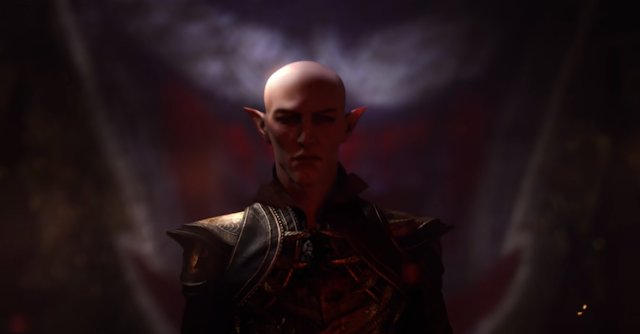
VARRIC: "That’s the world. Everything you build, it tears down. Everything you’ve got, it takes. And it’s gone forever. The only choices you get are to lie down and die or keep going. He kept going. That’s as close to beating the world as anyone gets."
Well, shit.
What do you do when you start to put together a blog post about the person who is arguably the most beloved character in the Dragon Age universe?
Sure, fans may be divided on characters like Solas, or Sera, Anders, Isabela, Merrill, Morrigan, and more. But if there's one thing that ninety nine out of one hundred Dragon Age fans seem to agree on, it's the fact that the furry-chested dwarf with the fancy crossbow is the Companion they'd most like to hang out with at the local tavern. And, for quite a few, he's also the Companion they'd also like to do a variety of, er, additional things with. Most involving a bedroom.
Note: I'm now expecting the flurry of tweets and comments from people who do NOT like Varric to land in three... two... one...
I've always loved Varric myself, for his sheer complexity and richness—and for what is easily some of the most beautiful, lyrical and thoughtful dialogue in the games, thanks to writer Mary Kirby.
Beyond his magnificent chest hair (and yes, it is an especially cruel joke that such an openly sexy character is unromanceable), Varric's most visible trait is his status as the perpetual observer. As Dragon Age's resident scribe and storyteller, it's a role that perfectly encompasses Varric's complexity as a character, as well as his divided nature in general.
So let's take a look at our favorite dwarf—and apologies for the incredible length of this post, as it's all Kirby's fault for making him so darned fascinating!

Varric's role in Dragon Age II provides a perfect introduction to our merchant prince and the shifting nature of his role, as he both narrates Hawke's story and features as one of its main characters. As he tells the story to a stern, then increasingly rapt, interrogator Cassandra, we're also given a close-up and intimate view of Varric's role in Hawke's gang of misfits, as he also participates in its many years of love, violence, intrigue, and tragedy.
As the events in Kirkwall unfold, Varric shows up on the scene after the first year, when Hawke has begun to build a life and find success in a minor way. Varric joins the expedition to the Deep Roads, and right away (even before the discovery of the red lyrium idol) we witness the conflicts between Varric and his brother Bartram. There's affection there, sure, but there's also exasperation as well as a disconnection that doesn't look like it will ever be able to be overcome. Varric's path and Bartrand's are simply too estranged, with Bartrand feverishly working to repair their family's fortune after disgrace, still focused on the Orzammar life they lost, while Varric has no interest in life beneath the surface, and walks with his eyes on a sky he has never had to fear.
Then Bartrand, under the influence of the idol, betrays and abandons Varric and Hawke in the locked darkness of the Thaig, and Varric, upon his escape, swears vengeance on a brother who will either die or go mad. Suddenly, Varric finds himself in a position that will become all too familiar to him (and us) much later on—in which he's forced to lead, even if he doesn't want to. In which he has to choose a side, even if he'd rather not. The guy in the shadows now becomes a mover and shaker in the Merchant's Guild in earnest, grudgingly admitting his place as one of the elite, even though he still manages to fudge the rules and do things his way, over a tankard or a goblet at the Hanged Man tavern. He even uses his skills as a storyteller to support the mystery of his role, as he notes to Aveline:
Aveline: You know the Tethras family businesses are registered in your cousin Elmand's name?Varric: You don't say?Aveline: But I can't find any record of you having a cousin Elmand.Varric: I'll introduce you some time. He's a little on the shy side.Aveline: Varric. He's imaginary.Varric: Which makes him a much better head of the household than I am. He never misses the Merchants Guild meetings, for one.
The saddest part here is that this role as keeper of his family's legacy is one that Varric will adopt permanently, whether he wants to or not, as by the end of Dragon Age II, Varric will have either killed his lyrium-maddened brother out of pity, or left him to his madness.
Varric has, meanwhile, built a new found family alongside Hawke and the other companions here, never joining them in their interconnected romances, but instead serving as their supportive, periodically worried, friend and confidante. As he relates their adventures, we occasionally get glimpses of Varric's purple prose and talent for pulp fiction, through occasional thrilling (and very funny) moments in which Varric mows down hordes of evildoers singlehandedly. It's exciting and fun stuff, and I can't help but wonder if this is when Cassandra became a fan of Varric's writing, because she may start out as his captor, but she ends up absolutely starry-eyed and entranced with the romance and adventure of the Champion's tale. So after she questioned Varric here, did she run right out and buy his books? I'm betting that answer is absolutely yes. Anyone who spends more than half an hour with Varric must surely walk away with the opinion that, hey, this guy can really tell a story.
Varric as the unreliable narrator also helps to explain Dragon Age II's occasional rough edges (and I love them all) arising from its incredibly fast output. The Dragon Age fandom has further adopted an affectionate take on the game's somewhat repetitive tunnels and dungeons by explaining that it's all due to Varric's specific point of view that, well, they all looked pretty much the same to him. It's an amusing, creative, and certainly believable take! After all, a hallway is a hallway is a hallway.
I also believe that Varric's viewpoint as a biased and untrustworthy narrator means that there are other elements we can headcanon as well—like, I'll never believe in Orsino's last-minute heel turn, OR that he knew that Quentin was murdering women—not the guy who was so willing to give his life for us to save the city under the Arishok's attack. Instead, I'll always believe Varric was protecting Orsino with that Harvester story, and that Orsino is alive and well and living in peace somewhere in Seere.
The Hometown Boy
One of the things I love about Varric's arc as a character is that Kirkwall is not just his birthplace, but it also seems to be his destiny. The old adage "You can't go home again," it has always seemed to me, becomes increasingly likely to be flipped into "You'll have to go home again," depending on how much you actually fear to do so.
Time and again, Varric admits to complicated feelings for his birthplace—emotions that involve more than a little reluctance and distaste. Yet deep down, in spite of everything, Varric genuinely loves Kirkwall. I remember being shocked at some of his dialogue in Dragon Age II, in which he genuinely expresses love for the place, and I just stared at my computer screen: "This shithole? Really, Varric?"
I mean, come on, if there's a single possible contender for Worst Place in Thedas, my money would be on Kirkwall. But it's in Varric's heart, regardless. And while Kirkwall seems like a cesspool of corruption, stinking of blood magic and echoing with the cries of the slaves of the Imperium, for Varric it's home. Sure, it's a city with problems, but it's a place he knows and loves, a place where his brother rebuilt his family's fortunes on the surface, and where Varric discovered he had a knack for words, stealth, and secrets.
Varric leaves Kirkwall repeatedly, but he always comes back, so that by the time we encounter him again in "Trespasser," he seems to have finally accepted this fact—he's wryly accepting of his status as the Viscount of Kirkwall, and even invites the Inquisitor to come back there to live, if they ever need a home. The rascally wanderer has reluctantly admitted to himself that, love it or leave it, there's no place like home.
That's why it hurts him so much when that home is corrupted, first by Meredith, and then by the events that follow. The destruction of the Chantry by Anders shakes Varric deeply, to the point that he still alludes pointedly to those events (and his anger at Anders) in Dragon Age: Inquisition. For Varric, what Anders does here is grotesque, an abomination against the city he loves.
And let's not forget—Varric doesn't talk about it often, but he is a person of faith. He believes in Andraste and the Maker, and to some extent is a true follower of the Chantry's teachings, compounding the sacrilege and ugliness of Anders' act for him.
There's Something About Bianca
If Varric is mostly beloved in the Dragon Age fandom, surely there's no character who is more hotly debated—and loathed—than the woman who is the object of Varric's affections, Bianca Davri.
In Dragon Age II, Varric warns Hawke against the dangers of love, and if there's anyone who understands those dangers, it's Varric, whose passion for Bianca once nearly led to all-out warfare. Varric doesn't just love Bianca, he also deeply respects her genius as a smith and inventor, and it is Bianca, we discover, who designed Varric's unique repeating crossbow. But their affair crumbled under the pressure of the Merchant's Guild, as Bianca chose to acquiesce to politics and family pressures, married someone else (Bogdan Vasca, or, as Varric refers to him, "What's-his-name") and gained stability and clout that would put her on the road to becoming a Paragon.
There's definitely a Shakespearean aspect his relationship with Bianca—they're magnificently star-crossed, fatally entwined, and they know it. Yet even though they both seem to know that they can never truly be together, they also can't quite quit one another, either. Take this little exchange during our quest into Valammar with Varric and Bianca:
Bianca: You'll have to stop by before Bogdan gets back. You should see my new workshop.Varric: I'll see what I can do. You know your family will kill me if I stop by, right?Bianca: They're not gonna kill you.Varric: You always say that, and they always send assassins.

I love how clearly Varric sees Bianca—he doesn't seem to romanticize her imperfections or her pragmatism, for instance—he sees all, but those flaws don't matter to him. Even years later, at their meeting at Skyhold, Varric makes a faux-casual remark to Bianca that he's "the expendable one" of the two of them, and it's a pretty powerful punch to the gut, when you think about how easily he says it.
There's another raw moment when, confronted by Varric over her attempts to atone for her role in the red lyrium secrets they discover, Bianca answers, "I can try, can't I? Or am I supposed to wallow in my mistakes forever, kicking myself, telling stories of what I should have done?" "Ha!" Varric shoots back. "As if I would tell stories about my own mistakes!" He can try to make jokes all he wants, but as always, there's an undercurrent of bitterness and loss there that rings, again, painfully true.
I find Bianca fascinating—and yes, I'll do a whole blog post about that fact one of these days. For the moment, however, I will simply point to a line of dialogue that many fans detest, in which Bianca departs Skyhold, but not before she quietly threatens the Inquisitor. "Get him killed," she says icily, "and I'll feed you your own eyeballs, Inquisitor."
I know many fans hate this moment, seeing it as an undeserving Bianca making a posturing threat against the Inquisitor—an Inquisitor many see as more deserving of Varric's love and loyalty at this point.
Yet I see something different here. As delivered by voice actress and "Critical Role" performer Laura Bailey (one of my favorite people on the planet, and who most recently won a BAFTA for her performance in The Last of Us Part II), for me there's a desperation to Bianca there, a sense that it's all bark and no real bite. For me, the power of the moment isn't that Bianca is threatening the Inquisitor, it's the fact that her facade has cracked. For just a few seconds, we clearly see how much she loves Varric, and how much she fears to lose him. For this reason, her threat to Inky doesn't bother me at all—I'm so much more interested in what's driving it. From everything we've seen in this quest, Bianca doesn't get serious often, and she's very good at maintaining an arch, deliberately bantering "aren't we amusing?" kind of mood between the two of them. So I wish Varric had seen this rare glimpse of the fact that if anything ever happens to him, it's going to absolutely wreck Bianca.
Still, Varric doesn't need anyone to tell him who Bianca is. He's always known—the good and the bad, the practical and the clinical, and he loves her deeply anyway—a love so encompassing that he named his crossbow after her. There's something funny and cute about this, yes, but to me it's also truly romantic. Varric can't be with his lover day to day, but he can carry the gift she designed expressly for him, and say her name constantly as tribute, tasting it on his tongue.
But most of the time, the couple's details remain vague. Varric, like Bull later on in Inquisition, is adept at deflection and dissimulation:
Merrill: Is there a story behind Bianca?Varric: There's a story behind everything, Daisy.Merrill: So tell me!Varric: I can't.Merrill: Why not?Varric: There was a girl, and I made a promise. Bianca is the only story I can never tell.Merrill: You can't say that! Now I want to know even more!Varric: That was the idea, Daisy.
I think that long ago breakup between Varric and Bianca was incredibly important—a definite milestone in Varric's life. I wonder if it's where he decided love hurt too much to pursue again—or did he simply decide that love was forever, and he'd take whatever scraps of it he could? Either way, I think it's also the point where Varric, meanwhile, doubled down on his desire to go the opposite route from Bianca—he didn't want stability or conformity. He wanted to tell stories, drink ale, live life his way.
But that's easier said than done. If you start to care too much about people, if you put down roots, suddenly things get complicated. I think Varric wants to be detached in theory, but that he finds it hard to do so in practice. He's a shrewd, perceptive guy who sees people clearly, and he remains generous and clear-eyed even as he grows to love them. Which is why I think Varric loses objectivity and detachment, first in Kirkwall in Dragon Age II, and then again in Dragon Age: Inquisition. Once again, it's all about love.
The Weary Captive
By the time we meet Varric again, as Inquisition begins, it's been a tough three or four years, and he's noticeably a quieter, more subdued dwarf than the rollicking storyteller we met in Dragon Age II.
And no wonder. He went through the events of the graphic novel trilogy The Silent Grove, Those Who Speak, and Until We Sleep, adventuring with Alistair, Isabela, and Sten (now the Arishok) and discovering the brutal truth about King Maric's whereabouts—an adventure that included enough fear, danger, revelation, and death for three lifetimes. The escapade also led to a cruel nightmare temptation in which Varric was faced with a dream vision where Bianca had told him everything with the Guild had been resolved, and that happiness was finally possible for them. Varric being Varric, he rejected this nightmare as the lie it was—he knew already too well that there would be no happy endings with Bianca. Still, it had to have hurt him nevertheless.
Then, just when he thought he was safely out of all the big-picture intrigues, they pulled him right back in.
Losing Detachment
Not long after Varric's return to the scarred landscape of Kirkwall, Cassandra returned, and, desperate for a way to find Hawke and help Justinia, she took Varric prisoner (again!) and brought him back to Haven and the Temple of Sacred Ashes. Varric evidently took his newfound captivity with wry patience, writing and thinking, and occasionally signing copies of his books (Justinia was evidently a fan). Of course, it's typical that Cassandra had multiple reasons for bringing him back and that those included a genuine wish for Varric to join her efforts voluntarily, yet in her usual blunt way she just hauled him back with her by force, and hoped he'd understand later:
Varric: You never did tell me why you dragged me to Haven, Seeker. I mean, what could I have told the Divine that you couldn't say yourself?Cassandra: I thought she needed to see the chest hair for herself.Varric: Er... Say again?Cassandra: I thought she needed to hear it from the horse's mouth, as it were. I also knew she would ask you to help us.Varric: Help the Inquisition? Me?Cassandra: A crazy thought, I know, yet here you are.
Then, with the Conclave destroyed, Varric was no longer even a nominal prisoner, and Cassandra's attention was now focused on the Inquisitor and the aftermath, on solving the issue of the Breach and catching Corypants. What's interesting here is that Varric could have left, and we know he was actively concerned about the situation in Kirkwall, but he stayed around, watching, thinking, and fighting beside his new companions:
Cassandra: Have you heard from any of your Kirkwall associates, Varric?Varric: You're asking me? So you don't read my letters?Cassandra: You're no longer my prisoner, much as you like to act like it.Varric: Yet I still get all the suspicion.Cassandra: I am not without sympathy, especially given recent events.Varric: Why, Seeker, I would never accuse you of having sympathy! By the way I tend to refer to my "associates" as "friends." Maybe you're not familiar with the concept.Cassandra: (sigh)
Me, I think he stayed because he cared. Because he was genuinely sorry at the death of Justinia, upset at the destruction of the Conclave (and no doubt thinking back to the destruction of the Kirkwall Chantry), and wanting in some indefinable way to help... and to see what happened next. After all, Varric loves a good story—and he may not always admit it, but he's also a good person who's consistently driven to help people, which is why he greatly approves if we save all the villagers as Haven is burning. His talent for compassion is effortless, as shown here in his conversation with Blackwall after we find out his real identity:
Varric: Maybe I've been too hard on you.Blackwall: Oh, so you don't think I'm dreadful now?Varric: Actually, I thought you were boring before. Completely different. We're all dreadful. Every one of us, fundamentally flawed in a hundred different ways. That's why we're here, isn't it? Take all the risks, so the good people stay home where it's safe. With the whole "Blackwall" thing, you told a story so compelling even you started to believe it.Blackwall: That's much nicer than saying "You're a dirty liar.", I'll take it.Varric: A storyteller's got to believe his own story, or no one will.
The chance to do good, to help others, and to tell a great story? There was no way Varric was leaving the Inquisition. Speaking of which...

When he's not smuggling, spying, or battling demons, abominations, monsters, or downright bad folks, Varric enjoys fame as one of Thedas's most famous bestselling authors—a pursuit he began early, publishing his first book, The Dasher's Men, when he was just seventeen years old.
While Varric's novels often deal with the issues of life in the criminal world, they otherwise seem to have little relation to battle and adventure in real life—battles Varric knows all too well. Instead, they're presented as charming intrigues filled with world-weary heroes, sultry dames, shadowy spies, and—backflips. Lots and lots of backflips!
In one of my favorite conversations, Bull perfectly sums up why this kind of stuff appeals to him, especially in a violent and grim reality:
Iron Bull: By the way, Varric, you write some nice fight scenes.Varric: Well, thank you. I'm surprised you think so. They're not exactly realistic.Iron Bull: I figured that out when the good guy did a backflip while wearing a chain mail shirt.Varric: And that didn't bother you?Iron Bull: Back in Seheron, I fell on a guy who tried to stab me in the gut. I felt the blade chip as it went through my gut and hit my back ribs. But I was alive, and on top. I sawed through the armor on the rebel's neck, back and forth, until it went red. I don't need a book to remind me that the world is full of horrible crap.Varric: Impossible swashbuckling, it is.
Varric's bestsellers include Hard in Hightown (his most famous work), Darktown's Deal, The Viper's Nest, The Tale of the Champion, and his popular (and infamous) romance series Swords and Shields. Not only do we discover that Cassandra is a passionate fan of this last title, but she's basically obsessed with the entire thing, a fact Varric is delighted to needle her about:
Varric: Seriously? Swords and Shields? How did you find that serial? Scrape it off the bottom of a barrel in Dust Town?Cassandra: It was research! I thought I might learn more about the Champion.Varric: I did write a book about the Champion. You might remember it. Had your knife stuck through it, last I saw.Cassandra: I already read that one. Twice.
It's about this point in Inquisition, watching the two bicker at lightning speed like Skyhold's very own Roz Russell and Cary Grant in His Girl Friday, that I begin to wonder just how much her feelings have begun to include the author himself. It doesn't help that Cassandra's writer and former Lead Writer David Gaider has a gift for flirtatious banter, as we also saw in his writing for Dorian, so between Gaider and Kirby, Cass and Varric are an irresistible ship for me, and curiously poignant:
Varric: Think you'll ever go back to Nevarra, Seeker?Cassandra: Why? Are you eager to see me go?Varric: I wasn't, actually. But, now that you mentioned it...Cassandra: How do you know I wouldn't just drag you along?Varric: Be still, my heart. I've grown on you.Cassandra: Like fungus.
My favorite detail about Varric's books, however, is the touching story behind The Mercenary's Price, a novel that a very young Varric wrote during his mother Ilsa's terminal illness (a liver ailment probably brought on by her alcoholism after their disgrace and her husband's death) in 9:26. He read the book faithfully to her at her bedside, and then when she died, he quietly burned it. It's a testament to his love for his mother and a sad and lovely thing for me to imagine (burning his own book! ack!), so of course it's true. It's too painful not to be.
It's tempting to wonder about the plotline to The Mercenary's Price, especially knowing that it was Varric's private and final gift to his mother, who was obviously someone Varric loved deeply (he even mentions her in Dragon Age II, remarking that the Grand Cleric reminds him of "a really tall version" of his mother, but "with a nicer hat"). So was Mercenary a story he wrote to give his mother peace about their fall from grace? Perhaps in that case, it was a tale about an Orzammar of Noble caste who was framed for rigging a Joining—and then later vindicated. Or was it less specific, and simply a story of fortunes regained, of honor and redemption?
We'll never know. Varric, like all of us, deserves his secrets.
Griefs and Fears
Speaking of secrets, perhaps there's no greater secret Varric carries than that of his deepest fear. When the Inquisitor, Hawke, and the rest of the adventuring party are thrown into the raw Fade in Inquisition, we're given a powerful and poignant glimpse of their greatest fears on an assortment of gravestones in the shadows, and among the fears etched there, answers to an unspoken question, is Varric's own, which reads: Become his parents.
This makes sense to me on multiple levels. Varric's father, Lord Andvar Tethras, was high among the Orzammar Noble caste, before he brought disgrace and exile to his entire family by attempting to fix Provings. This was considered a massive sacrilege, an offense of the highest order, and it resulted in the catastrophic fall of House Tethras and its expulsion from Orzammar—including all those remotely connected to it. In one fell swoop, House Tethras—as well as its servants, warriors, artists, and craftspeople—had plummeted into disgrace and infamy.

Still, it's obvious that the merchant prince of Kirkwall was still haunted by his family's fall from grace in a very real way, and it's notable that the plots of his novels often hinge on tragic mistakes and sudden downfalls. I also suspect that this is why Varric becomes the capable spymaster in the shadows—information is power, and Varric doesn't like surprises, especially nasty ones. Of course, this spy network Varric builds will go on to serve him well in the disastrous aftermath of his affair with Bianca (when he is a marked man), in his travails in Kirkwall, and even later on in his dealings with the Inquisition.
Although it's not something he addresses directly, that headstone in the Fade emphasizes how much Varric has been haunted by his parents' fates—by his father's sudden disgrace (a father he may very well not remember at all), and by his mother's slow death to alcoholism. It's notable in Mary Kirby's short story, for instance, that Varric reveals to us that he does not drink while he expertly fleeces his companions at cards—he just keeps a cup of wine beside him for show. And that distinctive, thick chain necklace around Varric's neck? Kirby disclosed that it's actually an inherited piece from the father he barely remembers. Since Varric is never without it, again, for me this emphasizes how constantly Varric's parents are on his mind, and it's something he seems to cultivate in his drive to avoid their fates.
What I find especially poignant about Varric's greatest fear is that he carries such a heavy burden as a son... and shows so much joy as one of Cole's many honorary fathers in Inquisition.
Life Lessons
Varric can't help it—he's one of those people who's constantly assembling a family around himself, and it's something at which he excels. This is why, alongside Bull's good-natured joshing and Solas's gentle, more spiritual communion, it's no surprise that it's Varric who brings out Cole's humanity, and who attempts to share with Cole what it truly means to be mortal and alive. Varric affectionately calls him "kid," listens to Cole's musings and questions, and talks to him about life, teaching him about cards and jokes and shoelaces—and you haven't lived until you've seen one of Cole's attempts at knock-knock jokes:
Varric: Okay, try it again, you'll get it.Cole: Knock, knock.Varric: Who's there?Cole: Me.Varric: (Sighs.) Me who?Cole: Me. And I'm telling a knock-knock joke.Varric: Um... that was... closer. Keep trying.
These little parenting moments bring Varric a joy that is that much more painful to him, later on, if Cole chooses to become more spirit, versus more human, after confronting the truth about his origins. Varric is crushed at the choice, seeing it as a step backward for a Cole who had so nearly become an organic and truly living being.
After the choice, and in an unusually cruel moment for him, he responds grimly to a questioning Solas that Cole's choice is a tragic one, as a more human Cole "could have been a person." Varric is usually kinder, but then again, he is caught in a moment in which he is bitterly mourning what feels like the loss of a son. While I don't agree that Cole becoming "more spirit" is an actual loss of Cole (in fact, I would argue that it is the purer of the two choices), I do understand Varric's point of view in that it does remove Cole's lovable and bumbling human aspect, leaving him once more detached and distant, with thoughts that flit like fireflies, no longer concerned with shoelaces or knock-knock jokes. It's key that out of all of our Companions, it's only Varric who mourns the human Cole might have become.
The Pragmatist
Still, despite his griefs, cares, and fears, I still think Varric is one of the lucky ones, one of those people who manages to find a rare kind of internal balance, happiness, and acceptance. He's tough and self-aware, and as a writer he's a natural observer who's seen all too clearly what happens when people pass by an opportunity for companionship, kindness, or beauty.

Take the conversation between Varric and Solas about the status of the dwarven people. Solas is frustrated at Varric's apparent lack of ambition, at the fact that he isn't fighting for some great resurgence or reckoning.
But Varric turns the tables, and the lesson Solas attempts to give Varric instead becomes a wise and subtle teaching moment from Varric instead:
Solas: Is there at least a movement to reunite Orzammar and Kal-Sharok?Varric: What is it with you, Chuckles? Why do you care so much about the dwarves?Solas: Once, in the Fade, I saw the memory of a man who lived alone on an island. Most of his tribe had fallen to beasts or disease. His wife had died in childbirth. He was the only one left. He could have struck out on his own to find a new land, new people. But he stayed. He spent every day catching fish in a little boat, every night drinking fermented fruit juice and watching the stars.Varric: I can think of worse lives.Solas: How can you be happy surrendering, knowing it will all end with you? How can you not fight?Varric: I suppose it depends on the quality of the fermented fruit juice.Solas: So it seems.
Solas continues to spar with Varric about the fall of the dwarven empire, but Varric refuses to be goaded into a show of anger or resentment. Finally, an exasperated Solas asks for understanding:
Solas: You truly are content to sit in the sun, never wondering what you could've been, never fighting back.Varric: Ha, you've got it all wrong, Chuckles. This is fighting back.Solas: How does passively accepting your fate constitute a fight?Varric: In that story of yours—-the fisherman watching the stars, dying alone. You thought he gave up, right?Solas: Yes.Varric: But he went on living. He lost everyone, but he still got up every morning. He made a life, even if it was alone. That's the world. Everything you build, it tears down. Everything you've got, it takes. And it's gone forever. The only choices you get are to lie down and die or keep going. He kept going. That's as close to beating the world as anyone gets.Solas: Well said. Perhaps I was mistaken.
I wish Solas had listened more closely to Varric, here. If he had—if he had really listened—then Solas would have given up his hidden quest then and there. Because Varric is right—you can't beat time itself; the world will always win. It's a bitter lesson that Solas refuses to acknowledge, that what's gone is gone, and nothing will bring it back. All anyone can do is enjoy the beauties the world still has to offer, from the glittering night sky, to the taste of fruit on the tongue. The tragedy of Solas is that he is so busy looking back, he's missing every other glorious possibility still before him.
Varric doesn't fall into that trap. His father had, and his brother had, and it had ultimately destroyed them. But Varric's at peace with what he's lost, and he understands that part of dealing with loss is accepting that loss, in savoring whatever is left.
The Secret-Keeper
It's amusing when you think about it, how absolutely full Skyhold is, not just of spies, but of spymasters. Surely it's unusual for a single Keep to hold not just one or two adept spymasters, but three: Leliana, The Iron Bull, and Varric. (Heck, an argument could be made that Solas is one, as well.)
Varric has a lot of secrets, and like Bull, he's often able to hide them in plain sight. It's easy to underestimate that aspect of Varric's life, since he's such a genial and likeable guy, and since he seems so up-front when we talk to him.

It's an aspect of Varric that I think is too often unexplored—his keen ability to watch, listen, delegate, and hide. A rogue's stealth is his bread and butter, but with Varric it's his way of protecting an entire enterprise—or, sometimes, simply those he loves. While Bull spies for the Qun and Leliana spies for the Divine, it's touching in Dragon Age II that Varric is using his super-duper spy network for kinder, more personal reasons—to keep the gangs and Templars off Anders's back while he runs that free clinic in the sewers, or to sweetly ensure Merrill is safe (and able to find her way home) in the Kirkwall alienage.
Anders: I just realized it's been a while since any of the gangs in the Undercity came to my door.Varric: They're busy people. Places to go, throats to cut. Maybe you've slipped their minds.Anders: Right. The apostate running the free clinic in the sewers. Easy to forget. You didn't have anything to do with this?Varric: You must have me confused with someone else! I'm just a businessman and a storyteller.
Finding Peace
Varric goes through a lot in the events of Inquisition and Trespasser, and some of those moments are genuinely devastating to him. He's horrified by what he discovers about red lyrium, and the fact that it now runs rampant through Thedas. The realization that Bianca has been secretly studying its effects and lying about it is another blow to him.
But I believe we also see Varric returning to life here—that during the events of the Inquisition, there's a point at which he seems to wake up, to come back to himself. He admits that he's been standing on the sidelines, but the Inquisitor can truly win his loyalty, and if so, it's my belief that Varric is once more back within the kind of group he understands—the found family, much like the one he lost back in Kirkwall.
The journey was rough, but as Corypheus's defeat looms, depending on our choices within the story, Varric may very well find himself back in form, teasing Cassandra with Swords and Shields updates, running games of Wicked Grace for his friends, and rediscovering his capacity for contentment. When he becomes the Viscount of Kirkwall not long after the Inquisition's victory, he's enough of his old self to generously offer the Inquisitor a forever home in Kirkwall (one, in my mind, right next door to Varric's), because that's what you do for family.
He's lost a lot, but he kept on going. And as Varric knows, better than most, that's as close to beating the world as anyone gets.