Showing posts with label dragon age analysis. Show all posts

Thursday, June 10, 2021

Dragon Age 4 Trailer (Game Awards Teaser), Shot by Shot Analysis


Hello, brave Thedosians!

Here's another late and potentially useless Dragon Age 4 trailer analysis by me, this time of the 2020 Game Awards Dragon Age Official Teaser Trailer posted on December 10, 2020.

What do we already know? We know Solas will be back from the previous trailers, and that red lyrium and that central Dread Wolf conflict are going to remain paramount. From the recently released book BioWare: Stories and Secrets from 25 Years of Game Development, we know that Dragon Age 4's primary setting will be Tevinter, and from the hints of writers like Patrick Weekes, that the main story will explore the imbalance of power along with a hero who has none. 

We've also gotten confirmation fairly recently that there will NOT be a multiplayer element this time around, and that the hero will not be the Inquisitor, but as always, will be someone new. Although I absolutely think the Inky will be back as a guest participant, probably very similarly to Hawke's appearance in Inquisition (although I'm guessing it may even be a guest first-person appearance, given the potential romance resolution).

So here we go!

Fade from black.

We hear the SOUND OF a blade being drawn.


Now we see some atmospheric frescoed images on walls: Close-ups of a spiky red figure with golden eyes and mouth, and a very distinctive crown/helmet. And look at those distinctive "veins" of gold running through her. Veins of Titan blood -- lyrium. Or corrupted blood -- Red Lyrium.

And who's the figure? It sure looks like Red Lyrium Meredith to me! She's even holding a big old sword that sure looks like Meredith's Red Lyrium sword Certainty—at least, the later depictions of it.

Now, another interesting thing to note here is that Certainty used to look like the image above, as of Dragon Age II and even Inquisition. But later BioWare art depicts Certainty as looking like this spikier image below, as seen in this art from Heroes of Dragon Age. And that thing's a dead ringer for what the figure in the latest fresco is carrying.

So my long-winded point here (sorry!) is that I think this figure is meant to echo both the Red Lyrium idol figure and also Red Lyrium Meredith, both important facets of where the story began. And, of course, Varric was there for all of it.

But more on that farther down.

Meanwhile here's another old friend, what looks to be a symbolic representation of Corypheus, old Corypants from Dragon Age Inquisition. It's just a guess, but the big red shards of lyrium sticking out of the head are very distinctive, and of course, we saw that same motif with Cory's mug. And here, Cory's holding up that orb that caused all the trouble to begin with, way back in Dragon Age Inquisition's inciting incident, leveling the Conclave and splitting the skies of Thedas. Here, however, I'm pretty sure we're seeing that orb's destruction, and as with Meredith, we're seeing Corypheus's final defeat as the orb breaks.

Notice that the only gold on this image is on the orb itself, not on Cory. So the use of the gold seems to imply a magical or magic-infused item. 

All of the images on the walls flicker in firelight or torchlight, just like they did a few years back when we saw that first fresco teaser with Solas.

And then we hear a wonderful, familiar voice. It's our old friend Varric!

Varric: I've faced tyrants and would-be gods. 

Well, that certainly includes Meredith and Corypants! So -- nicely done, BioWare.

Varric continues.

Varric: Seen friends lose life and limb.


(First off, you can practically hear the Inquisitor wince from here.)

Meanwhile, this image shows up, and it absolutely stumped me for the longest time until I flipped it upside-down. Then, hello, mysterious figure!

Now let's look at a clean, graphical version that's much easier to analyze -- I've cropped and rotated this version from that BioWare banner version they posted.

It's pretty exciting, because I do believe we're saying hello to one of the Evanuris here.

While I could see this possibly symbolizing Andruil, for me the details mean this is absolutely Ghilan'nain. Notice the shape of the head, which is exactly like what we see in the clearer concept art from BioWare of that giant centipede (hey, who does that remind us of again?) -- we first glimpsed a bit of it in the last trailer, farther below...

But also, beyond the head shape, that matches between both figures, look at the wavy lines that fall from the goddess's head -- these have historically, in the frescoes, symbolized magic. Here, however, while I still think they're symbolic of magic, they also kind of resemble physical strings hanging off her helmet -- seaweed? Ghilan'nain is certainly heavily associated with the sea!

Meanwhile, her pose is calm and serene, arms crossed in the manner of Egyptian sarcophagi. Is she sleeping here? Or imprisoned?

Our first glimpse of giant centipede, above, didn't reveal some important clues. However, in the more fully revealed concept art, sure enough, that centipede has a humanoid, female torso (and FOUR arms)!

This ties to Ghilan'nain again -- the giant monstrous centipede form, the rise from the ocean depths (don't forget that Ghil created many creatures of the ocean, and when she killed all of those animals for her ascension, she left the creatures of the "deep waters, for they were too well-wrought"). Then "Horror of Hormack" brings it all full circle with that distinct smell of "brine" and the sea as the Grey Wardens delve deeper into the ancient mysteries in the forest (and eventually, in the ancient elven monster-shrine). And let's not forget the crackling lightning and "vengeance of the gods/goddesses" aspect, and of course as we can see, that unmistakable headpiece. 

Let's also not miss that note from the BioWare 25th celebration, which notes, "The Evil Gods have Thedas in their sight and only heroes can stop them." Which certainly implies gods (plural) and evil ones, at that. I'm definitely becoming convinced that monster-maker Ghil and her onetime lover, the merciless Andruil, qualify.

Next, we see that male godlike figure I mentioned off to the right, as follows:


Once again, let's FLIP this sucker for a really good look.


And even better, here's the cleaned-up graphical one from the improved version posted by BioWare, which I've cropped and rotated as with the previous one.

The Mysterious Male God...

Now, to me, this image of the male god at right implies a rather kingly image that resembles the robe-wrapped god figure we saw in one of Solas's frescoes in "Trespasser." 

The shape of the head or crown here, meanwhile, is one we have seen a few times in some of the ancient statues and frescoes, although I haven't found a common thread on those yet. I do think the shape of the head against the golden circle behind it heavily remind me of the sun, and of course, Elgar'nan is in fact the one who played the "sun god" among the elven pantheon.

Now remember that fresco I mentioned from "Trespasser?" Look at this image here -- a male god wrapped in a robe, emanating darkness. Above his head? A golden "sun" of magic.

However, as always, nothing is certain, so it could also be the frequently mentioned Falon'din. The reason it may be Falon'din is that Falon'din in some ways echoes Solas and could be seen as representing a dark mirror of Solas -- not a freer of slaves, a Prince of the Fade, but instead as a tyrant enslaving and killing millions for fun, the dark King of the Dead. Is this who will awaken, and challenge Solas?

Or will it be both of these, seeking vengeance? 

And if so... what will Mythal do, if her wisp is ensconced presumably and symbiotically in her new physical identity? (Morrigan. It's gonna be Morrigan.)

Varric: But there's always someone bent on breaking the world. 

Cue the darkness, and BioWare logo glowing against a sunburst.


A New Cast of Characters

Then our view of a blue, cloud-swept sky pans down to reveal what may be a desert—or beach? And a bunch of spiky-armored animals like giant turtles, which approach threateningly as our view goes down to the armored feet of the hero. (Side note: I love turtles and their little old-man faces. If we have to kill them, I'll be a real wimp about it in-game!)

The fact that this figure is wearing armor means that it could be that Grey Warden we've caught glimpses of in our past trailers, perhaps Davrin? And if it's a Grey Warden, that means this is more likely a desert than a beach, especially given our pretty clear concept art of what I believe is Weisshaupt in the previous trailers. Which would mean this is still probably in the Anderfels in some way, so I wonder if the "water" we see here is a mirage. Or a watering hole.

Next, a golden idyllic landscape seen through a central ivy-festooned, pillared archway. A delicate fence runs across the exterior of this pillared place. Through this main archway, meanwhile, we can see a still lake of water, with a city either on an island or peninsula above and through the water. Or, as I think is more likely after reviewing the rest of this trailer -- it's Antiva City and those are the more Venice-like canals David Gaider once referenced as inspiration for Antiva, which is mentioned as far back as Origins as being one of Thedas's most beautiful cities. Rising above the village, we can see a very pretty, very pointy castle, covered in molten sunlight. Rising steeply above the castle, we can see gentle, curving mountains.

Given what we see next in the nighttime shot, I feel comfortable with the Antiva City pick, just seen in glorious daylight. And it sure looks pretty -- it's got a downright fairytale quality. But notice in the above image that even in daylight, we can see rays or emanations of what are most likely magic coming from the castle. Is the castle enchanted? Magically protected? Or is this after some more harmful spell has been cast?

Crows and Rooftops

Next we see a gloved right hand gently swirling an etched golden goblet of wine. 

And... yep. We pull back to reveal a reclining figure on a rooftop at night, JUST at the very end of sunset beneath a streaked sky. The figure is looking down on this same castle from another, much closer perspective, and its windows glow against the darkness. The figure is hooded and dressed roguishly all in leather, but with wide sleeves and fancy details. 


As we pull back, we get an alternate view of our enchanted castle from the daytime shot, the spell clearly glowing magically in blue rays beneath the setting sun.

If it is Antiva City, I love this vision and its design. There's a touch of that Byzantine flair to the surrounding buildings -- sharp angles and corners, lots of delicate ironwork detailing, even in the arched glowing windows. Small, sharp balconied towers rising around the city -- but it's not super-ornate like I'd expect to see in Tevinter. And it's so much fun to see that Crow in the rooftops, lounging with those black winglike sleeves, enjoying the view from the heights. And of course, Antiva is also where the Crows originate, and we got a LOT about the Crows in Tevinter Nights. So does this once again hint at someone from those stories, like Lucanis?

Last but not least, if we zoom in really close here, I swear that's a crow and not a gargoyle -- definitely a bird -- jutting out from the building opposite the figure here, slightly to the right of center.

Another thing this instantly reminded me of was the wonderful art that was posted with one of the stories that BioWare released for Dragon Age Day back in December 2020. One of those, Mary Kirby's "The Wake," was about the memories of a drunk and bitter Illario as he looks back on good times with Lucanis the Crow, whom we first met in Tevinter Nights. Unfortunately, we quickly realize poor Lucanis is no more.

As here, the story's illustration shows the Crows on the rooftops of  Antiva City.

I love the fact that the art here sure seems to confirm those above Antiva City locations -- notice the pretty pointy castle in the background, and the "Crow" accents on the buildings (right down to the "feathered" shingles!).

"The Wake" may offer some additional clues as well—Teia as illustrated above sure reminds me of the popular concept image we saw of the pretty redhead with the sword in trailer 2. Surrounded by crows! 


In addition, yes, this is further proof that my last post on Trailer 2 aged badly, where I wondered if we might see Lucanis again! So maybe we'll see Illario? And Teia? It could happen.

Varric: No magic hand. No ancient prophecy.

Tevinter, Baby!

We cut (to drumbeats) to a MASSIVE city, very gothic noir here. 

Of course, this HAS to be Minrathous, right? Tevinter prime.

It's full-on night, and we can see what may be this (or another) city, rising in multiple towers and buildings on all sides, and high ahead. More sharp and pointed towers, ironwork, and other architectural details that in this context almost have a slightly Mandarin feel, while high above the glowing towers ahead, we see a floating, towered structure in the shape of a horseshoe (but rounder). I'm guessing the big floaty place is perhaps where the Magisterium meets?

We can also see spangles of glowy rune or glyph light punctuating the night here on all sides that are pretty obviously spellwork. Which makes perfect sense given that Minrathous has to be chock-full of magical castings 24 hours per day. Tevinter is built on magic and its citizens eat sleep and breathe it (or, well, its elite magical ruling class does). I love the look of these magical punctuations -- there's almost a neon Blade Runner punk noir feel to the way they punctuate the dark city walls and streets, appearing in blue and green at four different points, and with a pinkish glowing cluster of runes to the right.

On the right-hand side, near the pink glyph, we see a building from whose balcony we can see two visible tapestries, we can see what I'm pretty sure is the Tevinter symbol -- a stylized serpent in very dark red. Except here it appears to have been flipped horizontally? See the previous symbol for Tevinter (also used by the Venatori) at right.

More Clues to Companions...

We now see a different hooded figure -- we're close enough that we can see a scaled pattern on the hood, which has a bronze patina here. We can also see gold or bronze detailing on the figure's chest as they whip out a dagger that has a bird shape with downward facing wings as a hilt guard. Another Crow? Seems different from the previous figure though, and while I've been speculating on Executors and other exciting folks that we've glimpsed since "Trespasser," I don't feel like we're given enough information to know here yet.

Varric: The kind they'll never see coming.

As the figure finishes drawing the dagger, we cut to...

A horned figure in silhouette, running through an evergreen forest against the moon. We can see that they carry a leaf-edged weapon that at first appears to be a staff, but which is then revealed to be a bow. To me, this is most likely a Qunari figure, given the Arishok-like horns, and most likely the female Qunari companion we've glimpsed in previous DA4 trailers. If she's a companion for us in DA4, she's most likely a Tal Vashoth, although she could be another Adaar. 

But what a cool idea, if she is in fact a rogue? We haven't seen a Qunari rogue before. And this also backs up the previous concept art, in which she appeared to be wielding dual blades, as seen below.


Also, a magical "leafy" staff that delightfully turns out to be a magical, "leafy" bow? Somewhere, let's face it, Bull's Charger companion Dalish is smiling: Finally, It's a bow! (Yes, she's alive, you people who sacrificed the Chargers, yes you, I'm ignoring that entire alternate storyline. Bull is alive and well, thank you, and undoubtedly raising happy hell all over Thedas.)

A Pleasing Mystery

But what's the significance of this plainly magical and pretty obviously elven bow? And why does the Qunari wield it? To me the bow has to be Dalish -- it actually resembles the Dragon Age symbol of the Dalish as seen here at right.

So at some point, does this female Qunari rogue befriend the Dalish, who give her this bow? Or does she acquire it during her adventures with our new hero for Dragon Age 4? I can't wait to find out.

Meanwhile, Varric continues: We've got your back. I've got your back.

I'm going to detail what I think this means as far as Varric in the big picture farther down, but this definitely means he's going to be an integral part of Dragon Age 4, and the way this is worded means he's probably going to be a leader or advisor. Which fits perfectly with the way the games have gone so far -- I firmly believe that just as Cullen and Leliana became advisors in Dragon Age Inquisition, so now will Dorian and Varric become advisors to us in Dragon Age 4. It makes total sense.

A Familiar Image in a Nightmare World

The Qunari figure emerges from the forest and is faced with a tall, steep dark structure that appears to be coated in red-lyrium. Red lyrium appears to glow everywhere around them on the right-hand side, while ahead of them is a doorway (or broken eluvian?). Within the doorway or eluvian space, we see more red lyrium ledges, and a threatening figure crouched there ahead that shakes itself threateningly as the qunari raises her bow. 

It's only here that we see that her bowstring seems to be wholly magical (and how cool is that?) as is the arrow! This is exciting for me for a number of reasons—first off, the magic looks a heck of a lot like Rift magic. It's the same shade of green, the same buzzing, crackling energy. So is this another manifestation of Rift magic, now in Dragon Age 4? And if so, is this Qunari archer a rogue, or a mage—or both? As someone who prefers playing rogues and mages, and doing crowd control stuff versus melee, I would adore some kind of new combination class option here.

Varric: Demons. Dragons. Darkspawn.

The archer lets fly her magical green arrow and it flies (flashing green). 

The Vhenadahl

Now, before that sparkly green magic arrow reaches the figure's head, it's almost too fast to see, but if you pause it, we can see this very familiar landmark -- the vhenadahl that has featured in every single trailer so far, so it's going to be extremely important!

Here's that all-important fleeting glance:


And here's what we were shown in trailer 1 (this is the fully uncropped version by Nick Thornborrow), below. Flames, the vhenadahl, red lyrium, and magic. And now Solas, standing before that vhenadahl, that symbol of the elven people, as if to stop whatever threatens. It may be another clue that Solas will (as I believe) be redeemed in the final chapter. We'll see!

But what we also know from the above, pretty unmistakably, is what the earlier image below foretold -- that the vhenadahl would be burning in the flames of Red Lyrium, and that it may already be too late to save it.


And in trailer 2 here:


And here.


And here. Possibly? (If so, the vhenadahl is just out of sight but it really looks like the same location.) This concept art image looks a lot like the hurlock who's about to get shafted by the Qunari archer shortly (see a bit farther down) in this latest trailer, but here it's certainly a heck of a lot bigger. So is it the same creature? We don't know yet.


Which means we now know, from this latest trailer and the Qunari's run with the bow, that there's a forest nearby that leads directly into this space. And that this area, this land, and possibly all of Thedas, is horribly corrupted with Red Lyrium.

It's an interesting cycle of images which are, to bring it full circle, awfully evocative of this image from the Origins DLC The Darkspawn Chronicles.


So this tree as well as its location is obviously going to be a major setting in the new game.

I also think this is going to be a pattern we see a lot in the new Dragon Age 4 -- a return full-circle to earlier themes, moments, and settings, from both Dragon Age Origins to Dragon Age 2, to (of course) Inquisition and all of those DLCs. 

The arrow finds its mark, and after a heck of a lot more patient pausing, we can see clearly that this is in fact a darkspawn, a Hurlock Alpha. Who is now toast. Rest in Peace, sweet Hurlock Alpha.

Then our screen cuts to super-dramatic dramatic darkness. Boom.

Varric: Even the Dread Wolf.


What His Pride Had Wrought 

Fade from black on the fresco from the opening sequence, now seen as a MASSIVE red fresco painted with what looks like black, white, silver, and gold.

First, to help us really look closely at the mural, I'm gonna insert the alternative banner version of this from BioWare/EA, below:

So here we go. It's a lot less atmospheric, but a LOT easier to view and analyze!

First off, I've already talked earlier about those two bottom figures at left (Meredith) and right (Corypants), as well as those fascinating upside-down, possibly Evanuris, figures above each. 

Notice the positioning on the frescoes -- Meredith on the left, and above her, the upside-down female goddess figure in all her final Red Lyrium glory. Corypants is on the right, holding the orb even as it breaks and dooms him for once and for all, and above him, we see the horned upside-down god figure. 

There are a couple of things this parallel placement could mean -- among them, to me, that the female goddess echoes the vengeful or cruel aspects of Meredith (and which brought her down), but also -- her status in the story as very close to the discovery of Red Lyrium? Which would strengthen the belief of those who think that the goddess above her is Andruil, who may have brought the Blight up from the Void. 

And as far as Corypheus, what was his great sin? Pride and arrogance -- he wished to ascend to godhood, to ascend to the Golden City and confront the Maker himself. So what if that's Elgar'nan above him? 

I still think goddess at left is Ghil. Although I'm still divided on the god at right. 

The positioning of the six-eyed Dread Wolf's head (what I call the Pride Wolf) is really important here, because it's breaking like a dagger or arrowhead violently through a barrier or bubble covering the city below, as if... breaking the Veil? Destroying the Veil? 

More on this in a moment. First, let's look at the city itself.

Red City, Black City

Notice those red veins, so distinctive, in the city below the wolf, implying that the city has been Blighted or corrupted with Red Lyrium. Now look at the teeth -- the Dread Wolf's teeth here being red now seem to imply that the breaking of the Veil/barrier -- the Wolf itself (Solas, inadvertently?) has infected the city -- from the "bite" of the Wolf, to the lyrium now everywhere below. To emphasize this, we also see shards of red lyrium jutting out from the buildings themselves.

Or is this what Solas plans to do? I'll get to that when I discuss the metaphorical aspects farther down.

Meanwhile, there are two ways we can go with the city image -- it could be the Black City (and if we look at the actual fresco image farther down, we can see the underside, implying that it's floating. Which means, hello, Black City!

But as we look at those towers it's also easy to wonder if it's yet another doomed city we've been hearing so much about -- Arlathan. 

Ancient Wonders Lost

I've gone back and forth on the popular notion that Arlathan is simply the Black City, removed to the Fade from the circles of the living world. My question is still, then who removed it? Did it happen when Solas created the Veil? And if it is a doomed, Blighted version of Arlathan, can it be saved or restored to its former self -- purified somehow? 

Why, if it is Arlathan, is it filled with Red Lyrium? I remember the detail from previous Dragon Age lore that the Black City was so incredibly toxic and Blighted that people were infected just by approaching it in the Fade, before they even reached it.

It's easy to imagine that this "Blight" was of course Red Lyrium, which is in itself simply Blighted Titan's blood. 

Does this mean that the elves doomed themselves, as we've already discovered so many times from the revelations of Solas and "Trespasser?" For instance, did Andruil, venturing in the Void, bring back the Blight not just to Thedas (and, I believe, at least one sleeping Titan), but to the perfection of Arlathan itself, at the very height of the ancient elven empire? Was it, in other words, Andruil who doomed Arlathan -- and were Solas's actions at any point an effort by him to save it? 

What if, for instance, as King of the Fade, Solas managed to not only imprison the Evanuris tyrants, but to remove Arlathan into the Fade in order to protect Thedas and freeze it in stasis? If so, no wonder he slept for several thousand years afterward.

I always love imagining Arlathan because it reminds me of the stories of the rise and fall of Numenor from Tolkien's Akallabeth. I was always thrilled at that first doomed step by the arrogant Ar-Pharazon on the shores of Valinor... and then that rumble of doom as the Valar wreaked their vengeance, and the towering wave destroyed the jewel that was Numenor, sinking it forever -- innocent and guilty alike. (Including Hot Sauron, who was supposedly ridiculously attractive, although once killed by the wave, he was never able to inhabit a "fair and charming" physical form again.)

Was it as shocking and sudden for the people of Arlathan? I wonder. I'd love to hear Solas tell the tale!

Portents for Cities of Thedas

I also think there may be some really interesting foreshadowing happening here, implying the wholesale corruption and/or destruction of a major physical Thedosian city due to the Red Lyrium as well.

With that in mind, on the foreshadowing front, I think it's meant to represent Minrathous. Although it could be Antiva City, which looks so delicate in what we see here, and so beautiful. But my money's on Minrathous, because of the Tevinter element, and because this would certainly be one way to bring down Tevinter -- which let's remember is already seriously battling (and losing to) the Qunari as of Tevinter Nights.

But there's a larger metaphor here that's absolutely brutal. Let's look again at that image. The Dread Wolf tears or breaks the Veil. And Red Lyrium is loosed, infecting and possibly dooming the world. Once again? All because Solas insisted upon "fixing" his past actions. Is it an image of a future that is set? Or of a past that Solas is aware may repeat itself? After all, that Wolf is Solas and Solas is the Wolf. Thanks to Tevinter Nights, we even know Solas can inhabit that shape both in and outside the Fade itself.

So which part of the timeline are we looking at?

For me, it would be both appropriate and tragic if Solas's belief that tearing down the Veil will fix the world and bring back the ancient atmosphere of his people... when instead it's one more step toward utterly dooming all of Thedas. Just as before, with the orb and the Breach.

Solas needs to stop trying to fix things. Varric tried to tell him, but he never listens.

Eyes On the Past

As far as some kind of Veil obliteration or fragmenting (like we saw in "In Hushed Whispers"), I definitely don't think this is what Solas wants. But it would be interesting albeit terrifying if that's what happens. Worse even than what he fears—which is that the Veil's removal will benefit elven lives and biologies but hurt or even kill other post-Veil latecomers like humans, Qunari, and other races. 

I don't think dwarves are going to be impacted, personally, and I also don't think a clean removal of the Veil would do what Solas fears, although I do think it would flood Thedas with a torrent of spirits and magic, and unlock any magical potential currently dormant within people across Thedas, which would still create plenty of chaos. 

But it's Solas who has the power, and Solas who is key. Even those blue eyes on the Wolf (which appear silver in the actual video) echo directly back to Solas. As I've already mentioned, Solas is exclusively associated with blue magic -- from the removal of the Inquisitor's vallaslin, to the draining of Flemeth, to his petrification of the Qunari in "Trespasser," Solas's magic is always depicted as blue. We even see it in blue waves in those frescoes in "Trespasser" when he removes the vallaslin of the slaves he frees. And we saw it once again in the second DA4 trailer, with that gorgeous image of Solas and the Wolf.

Is this what the blue-eyed Wolf signifies? Solas's power, contained and uncorrupted? But if the teeth are red (corrupted), does that also signify that Solas will not remain corrupted forever? Remember that initial teaser, and Solas's exhausted, subtly changed voice at the end. Does Solas become infected as well, or deliberately infect himself? I'm guessing yes. (Y'all, there is no way this is going to end happily, but I promise to cry with those of you who need company.)

I also think there's another clue to the eyes here, as they remind me very much of the peering spirits from the Fade on his very first fresco way back in Skyhold. 

So perhaps the eyes symbolize Solas's divided nature -- his spiritual and physical self, his elven and wolflike guises, and even his hinted power to walk all worlds at once -- Fade, waking world, the ancient fastnesses in between. I'm sure there's more I'm missing here, but I think it's a noteworthy detail. 

What the differently sized pupils mean, however, I'm still at a loss -- I tried reordering the eyes according to size, reordering them according to pupil size, etc., while scanning a variety of images and all of Solas's drawings, and well, I give up.

The other potential plot option here is, of course, that it's very possible that either one or both of these Evanuris "gods" pictured breaks free from prison, shattering the Veil in Superman Forbidden-Zone style, and therefore they infect Thedas somehow. 

And Solas (ironically) has to stop them, possibly by repairing the Veil or putting that sucker back up.

The Dread Wolf's Wardrobe Changes


But back to our video, and my doomed future ex-husband.

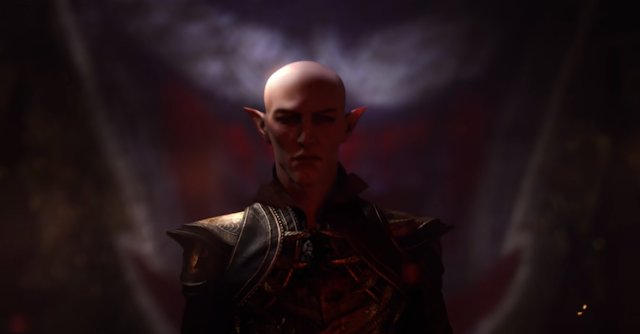
Standing in the center, now robed in black, is Solas, whose back is to us. He's wearing a long black robe of what looks like black leather, with shoulders that are almost armor-like or epaulettes in gold-etched leather, and with spikes enclosing the robe at front. He looks like he's possibly wearing some kind of silvery brooch or fastener at his chest that also suggests a wolf-head shape, but I also may be reading too much into things. He does appear to be wearing a breastplate under the robes as well, so fingers crossed that the Ancient Armor of Elven Hotness makes another appearance. (Sorry.)

Meanwhile. It's pretty interesting that Varric refers to Solas by his true identity here, so obviously the Inquisitor talked to their companions after "Trespasser." I'm betting that every companion and major character close to the Inquisitor who's still involved in the Inquisition (or whatever they're calling themselves now) after "Trespasser" is now fully briefed on Solas's identity. 

This isn't really a surprise when you come to think of it, because we already saw that Charter knew all of the details as of "The Dread Wolf Take You," and she was respectful enough and scared enough of Solas's powers (that include that ultra-terrifying, silent and instant petrification ability of his) that she did nothing but sit utterly still and ask him for mercy at the end of the tale there. Which Solas granted.

The fresco presents that massive, familiar image I discussed above, here seen real and shadowed. image. Solas stands dead center, his head and shoulders within the teeth of the Pride Wolf's mouth. (Yeah. He's doomed.)

We zoom in closer. Notice Solas's left hand. (If you want to get super-poetic, he may even be thinking of a romanced Inquisitor, here.)

Just as we zoom in close, there's a cut to Solas in a closer view, now rendered in a more three-dimensional representation, as he glares forbiddingly at us.

As before in the very first Dragon Age 4 teaser from a few years ago, golden sparks are flying in the air between us and Solas, as if from firelight or torchlight.

It's interesting to note that as I noted above, Solas is first shown above as standing almost pensively with his left hand against the fresco, and when he turns, his hand drops slowly. He didn't appear to be painting, just touching it. This is significant to me -- I think this could be seen as a continuation of his regret or sorrow. As well as, again, the possibility that he is remembering his romanced Inquisitor.

But of course, with Solas, Pride wins in the end, and that's how he confronts us at the video's end.


We zoom closer subtly and Solas's expression changes a little -- he's not quite so scowly, and his eyes open wider. He almost looks like he's on the verge of a smile.

As far as Solas's new and updated, more three-dimensional image here, it's awfully early, so I'm not gonna nitpick too much. He looks fantastic in the big-picture sense, and that first glimpse from behind is electrifying. As far as his face goes, I'm divided—it's interesting because it looks completely like Solas, and yet also completely unlike him, too. I think my main complaint of what we get here is that the eyes are a bit too squinty, and for me his lower lip is too thin. His expression here is also definitely more openly villainous than anything we've seen from Solas so far. Even when he petrified the Viddasala in "Trespasser," he looked merely regretful, not arrogant.

It's not bad—it's arresting, and I don't hate it, but it will take some getting used to if that's our new Dread Wolf, especially since I'll have to mourn the gorgeous image they teased us with previously, of Solas striding along with the Dread Wolf at his side, exuding blue magic.

Cut to black again, and now that same ornate sunburst shape glows around the Dragon Age logo. I think that sunburst, by the way, is gonna be significant, but I can't figure it out as yet. (What's your theory?)

Varric then speaks the final, exciting words: This is YOUR story.

Yes, please!

The music surges. There's a nice subtly Eastern feel to the music here, almost Indian, due to the use of what sounds like a sitar on the soundtrack. Again, this vibes wonderfully with the new game's potential focus on settings like Tevinter for me, since I associate Tevinter with a mixtures of artistic influences that would include both Eastern Asian as well as central European and Roman.

Last but not least... there's that narration. Let's talk about Varric and what that narration could really mean... 

But you'll have to go to my next post for that! I'll post it shortly -- meanwhile, I'll look forward to your thoughts as always!

Monday, July 13, 2020

TEVINTER NIGHTS Analysis: The Dread Wolf Take You

"The Dread Wolf arrived. It was no elf, no mortal mage. It was a beast unlike any I had ever seen. Lupine in appearance, but the size of a high dragon, with shaggy spiked hide and six burning eyes like a pride demon, and it came to us on wings of fire..."
—From "The Dread Wolf Take You," DRAGON AGE: TEVINTER NIGHTS

WARNING: SPOILERS on TEVINTER NIGHTS! Please read at your peril!

Happy Summer, you beautiful Wardens, Hawkes and Inkies!

As always, I hope this finds you safe and well, despite our increasingly crazy world. And apologies for the lag in posting this latest analysis—between an incredibly lore-centric piece here by Ser Weekes that took me a month to annotate and research, I admit I may also have escaped into Hamilton a few times too. (I mean, come on. Hamilton! Up close and personal! We can see Lin-Manuel Miranda's tears—and everyone else's!)

So this took some time, but I really felt like it was important to do this piece before I addressed the tantalizing possibilities of the images we glimpsed last month from BioWare that appear to be from Dragon Age 4.

Meanwhile, let's escape back to Thedas once again, shall we? And please do forgive a few formatting weirdnesses here—Blogger is clunky when it comes to bullet-points but I felt they were essential for this analysis, so you'll be seeing the occasional wonky image,  bullet- or number-point here.

Welcome to the latest in my series of analyses on Tevinter Nights, concentrating on the stories that I feel add substantially to the lore, and which may give us potential clues to Dragon Age 4. Today, I wanted to share my notes and thoughts on Patrick Weekes's elegant and mysterious "The Dread Wolf Take You," the final story in the collection. Please do check out my previous Tevinter Nights analyses, also, on "Three Trees to Midnight," "The Horror of Hormak," and "Callback."

New clues from TEVINTER NIGHTS, in Patrick
Weekes's "The Dread Wolf Take You"
And here we go!

The Story at a Glance

It's a year since the events of "Trespasser," so by my estimates we're roughly around 9:45 Dragon at the moment.

This story is different than any of the others in the compilation, as it's presented as a tasty puzzle box full of enigma-wrapped cipher-chocolates and sprinkled with delectable mystery-sugar. And you don't really appreciate this dessert until you get to the end.

It starts on a dark and stormy night, like all the best stories. Well, okay, it's dark. We don't know that it's stormy. But it should be. And let's face it, it's stormy somewhere.

At a tavern called The Teahouse near the docks in Hunter Fell, our old friend Charter shows up to what is obviously a clandestine meeting. Persons of interest at the meeting include such minor characters as a knowing Qunari doorman (a survivor of the Qunari occupation of Kirkwall years back), the Nevarran dwarven bartender Sage, a middle-aged human serving-woman, plus consummate spies who, in addition to Charter, include a Carta assassin, a Mortalitasi, an Executor from "across the sea," and an Orlesian Bard, outfitted in golden curls and an Orlesian dragon masque.

Charter reveals the code word for the meet as "Gauche, party of five." I found this amusing, because it could be Orlesian (in which case, it means "left"), or literal—in which case, it might mean "awkward," or "lacking grace." 

The order for the table is one black tea, one herbal, one spiced wine. Charter, missing her girlfriend Tessa, adds to this by ordering a tea of Anderfels mint, two sugars (which Sage effortlessly remembers even after ten years—there's obviously a warmth between the two of them). 

The meeting is quickly revealed to be a strategic "state of the union," in which major players on the world stage reveal their recent experiences in the international chess match against Solas (now revealed to all involved as Fen'Harel). 

The Players

The Carta Assassin is a tough, weathered man drinking coffee. He's also snappish and stressed, and mocks Charter for the Inquisition's sheltering of "The Wolf" for over a year.

The Orlesian Bard is slender, dressed in bright silks, and has curly golden hair. His mask is ornate and covers his whole face. Before him is a cup of tea, drops still present in the spoon. He speaks with the accent of Orlais.

The Nevarran Mortalitasi mage is a pale, cruel woman drinking mulled wine, lazily using magic to stir it (more on this farther down). She is cold but unerringly polite.

The Executor known only as one of those from "across the sea" is a dark, hooded figure whose face is hidden by a kind of mesh. They are genderless, chilling, mysterious and scary; even the patterns in their robes are painful to Charter's eye. They smell faintly of the ocean and are drinking red wine.

Charter is a lot of fun throughout this story—as always, she comes across as smart, poised, and observant, and beyond this, she's a true pupil of Leliana in every way—an actress playing a part flawlessly, pretending emotions, hiding others, eliciting reactions for the benefit of the mission. Her role in this story makes me pretty certain we're going to see her in Dragon Age 4, as well (possibly taking on Leliana's former spymaster role, or as an advisor).

The story is broken down into a series of fireside tales, and each reveals a new aspect of Solas's mission and goals (I'll get into what each reveals in the section to follow). As a brief recap, the Assassin reveals that Solas wants the lyrium idol taken from the heart of Meredith's statue, and that the idol was stolen after the smugglers were killed in their dreams by a mysterious force and attacking vallaslin-less elves. The Mortalitasi reveals that she was present at a Tevinter ritual aimed at opposing Solas, a ritual destroyed by the appearance of a monstrous six-eyed Dread Wolf the size of a High Dragon, which attacked accompanied by warrior-spirits, and then continued to persecute the mage in her dreams. The Bard meanwhile tells of how he saw Solas steal the idol from a hidden chamber in an auction house in Lomerryn, and then escape with it through an eluvian.

The meeting breaks down into a series of recriminations and quiet threats, led first by the malevolent Executor, who is quieted by a touch from the Bard. After the rest of the tales, emotions run high again, and Charter, rather shockingly, simply turns to the Bard and quietly begs for her life. The others are oblivious, and easy prey as the Bard, now revealed as Solas, grants her her life, but kills the other two (the Executor he'd petrified many minutes before, with a single touch).

The story ends with Solas asking Charter for understanding (and forgiveness from the Inquisitor), but with clear expression that he has not given up on his plans. Charter is more determined than ever to stop the Dread Wolf, and begins to write her report for the Inquisitor.

What it Adds to the Lore


There are some terrific little nuances to this story that I felt were especially worth noting in the introductory section, and which I'll further organize by tale to follow:

  • The fact that the meeting is at the Teahouse is an exquisite irony, given the revelations we get. I love it so much. You just know the Bard chose the location.

  • Charter is interestingly referred to as "the elf currently known as Charter." As Charter is, of course, elven, and elven names have meaning and purpose, what I'm wondering is, has Charter taken on a different name (even privately) since the traumas of Inquisition or beyond? As it's implied Abelas may do after the Well of Sorrows, or as Solas may once have done after avenging Mythal? One that denotes a new quest or self-definition in penitence (which is what I think Solas did all those millennia back)?

  • The Executor is a fascinating new race we first heard tantalizing hints about (and may have received messages from, depending on our choices) briefly in Dragon Age: Inquisition. All we know is that they watch, they are superb spies, they are disquietingly creepy, and are from "across the sea" and possibly outside known Thedas. I love the idea that they are perhaps unknowable—as male or female, as old or young, or as anyone specific beyond that faint scent of the sea.

    I love this moment of description, for instance: "It was less a voice than the idea of a voice, rendered acceptably but no more." I am dying to know more about the Executors!

  • Interesting that the Qunari Ben-Hassrath and Tevinter Siccari were also invited and declined to send emissaries to the meeting. I'm so bummed right now that we don't get The Iron Bull's take on all the revelations about Solas after "Trespasser." I'm just sayin'. You know the analysis would be sharp and the language would be colorful. (And I would be here for that. Sigh.)

  • I love the revelation that the Carta agent shows up only as a favor to "Viscount Tethras," who has also (it's revealed) been protecting Kirkwall from the effects of Meredith's red lyrium statue ever since). That's our Varric. Although he'll probably feel a bit bad for the guy, given the outcome of this meeting...

The Assassin's Tale Revelations


There are so many delightful little details as we dive back into this world:
  • Among my favorites are the revelations about Varric's attention to the red lyrium situation after Kirkwall (and after the events of Inquisition).

  • I love how self-aware it turns out people were after Meredith went mad. And that (while she was a lyrium statue) Varric was so conscientious in making sure nobody else chipped off, er, pieces of her (which was something I'd wondered about—a radioactive statue just sitting out there). The statue is confirmed as being guarded AND behind barriers for people's protection. But the dwarves still hear it singing as they approach, which, sheesh, Kirkwall doesn't need any of those additional negative vibes, folks!

  • We know Red Lyrium is Blighted, but it's nice to hear the facts emphasized and confirmed here. I still think it's important to point out those hints of a Red-Lyrium-Blighted future from those "Dread Wolf Rises" teasers and images, and how they may curiously echo back to that "In Hushed Whispers" quest for the Redcliffe mages (and where we meet a Red Lyrium-infected Solas and companions in an alternate universe where Solas's belief that he is living in an unreal world and timeline is actually true).

    Also nice to know the Carta also won't touch the red variety (which of course creepily whispers in the Kirkwall square, reminding everyone of its malevolence). More of Varric's protective influence?

  • We also learn that the Carta has kept on selling lyrium to former Templars in Kirkwall, but only as long as they "kept trouble to a minimum." 

Idol Confirmations and Details


Speaking of which: Nice to have confirmation of a few points that have embattled Dragon Agers since the "Dread Wolf Rises" teaser came out: 

  1. Yep, the idol was in fact Meredith's Sword (this was hotly debated in some quarters)

  2. The sword exploded (recreated of course, depending on your options, in Inquisition).

  3. An elf's dreams (cough, cough, wonder whose?) told the visiting elf that the idol could be drawn from the remains of Meredith's statue (using a special potion to soften the lyrium). Note: The elf is not apparently Solas, since he wears a vallaslin, and I don't see Solas doing that, even to disguise himself.

  4. Timewise, this is of course while the statue was still in the square in Kirkwall, and not an addition to the shadows of the Black Emporium.
     
  5. Further, it can't be a coincidence that the idol was removed from the statue's chest (where her heart resided). He pulled out her heart, and hidden inside was this image of two figures in comfort or grief or both.

  6. And what a metaphor for Solas's situation and romance, if you romanced him.

  7. But... keep in mind... Meredith's statue is the alchemical outcome of her transformation/corruption by red lyrium. How the heck did the statue GET INTO HER HEART?

Describing the Idol

We also get an incredibly telling confirmation of the idol physically here as well as its removal. The description gives us several clues and confirmations we could only guess at by looking at it previously, so I'm going to collect ALL those descriptions from across the tales here, in one place:

  • "It’s not much to look at—a couple hugging, too thin to be dwarves—but it’s sitting there, glowing softly like a ruby lit by the grace of the Maker himself..."

  • "When I hefted it in my hand, it was like it wanted to keep moving, like it was liquid inside."

  • The Mortalitasi's tale adds this aspect: "...we saw it clearly—an idol crafted from red lyrium, which seemed to show two lovers, or a god mourning her sacrifice, depending upon how it caught your fancy."

  • In the Bard's tale, even though we cannot of course trust ANYTHING he says, he does let slip a detail at the end about the idol that intrigues me, because it provides us new context on the idol and what it may mean to Solas:
     

    "He whispered something as he picked it up, tracing his gloved fingers gently along the crowned figure who comforted the other, but I could not make out the words, for I fear they were elven."

    This description is unlike the others, as if Solas himself knows more about what the statues are actually depicting. And it's interesting that he describes this moment as an almost holy one for Solas—certainly one involving deep emotion and perhaps memory?

    I thought the woman was wearing a sort of helmet (interestingly mirroring those of both Andraste and Meredith), but the word 'crowned' now makes me think more than ever that it's the "Queen" of the Evanuris, Mythal, perhaps being held by Solas even as her body died. Which is why I'm more convinced than ever that the statue depicts some variation on Solas and Mythal after her murder by the Evanuris (echoed yet again when Solas held Flemeth's body in the epilogue of Inquisition), but that it may also foreshadow that one day Mythal will hold Solas's body to her in the same pose—perhaps this time, in grief and regret after his own death.

Back to the Assassin's Tale

Additional interesting aspects to note from this tale:

  • Given later revelations, I enjoy that the Bard moves like a bard, liquid and graceful. It adds believability and context to the person we have met.

  • The chest with the idol is taken by a Tevinter agent of the Tevinter house Quintara, who pays a hefty bag of gold to the rogue Templars and departs. I can't find any information about these guys—anyone? Bueller?

  • After the initial Templar attack, there's a far more terrifying attack, in which someone attacks everyone with nightmares—nightmares that even affect the Carta dwarves! The dreams are so horrible that all the sleeping dwarves and guards die, bleeding from the ears. The attack is supported, notably, by elven archers. But I'm still stuck on the fact that Solas can kill people of all races en masse in their dreams. What a terrible ability (petrification would've been kinder).

  • The elves who show up are without vallaslin, and are decidedly un-humble or servile, and are wearing "fancy armor" (cough, ancient elven armor).

  • The accents are "normal Ferelden," according to the assassin. Then another leans down to say a prayer over the dead elf, and this one DOES sound Dalish, even if he's without vallaslin, saying, "The Dread Wolf guide your soul to peace, brother."

  • After this tale, everyone gets more refreshments. I think it's a wonderful sly detail that the only ones to thank the servant are Charter and the Bard, who politely declines more tea. This additional detail is delicious given who the Bard actually is, of course.

  • As they all sip their beverages, we realize the Mortalitasi has enslaved a wisp spirit to inhabit the stirring stick that stirs her wine, and it's really effective and gross (she threatens it for slowing down).

  • The Executor meanwhile notes that House Quintara fell when the city of Ventus was conquered by the Qunari. Yet another reminder (bookending the opening story) that the Qunari are relentless and are very much pursuing that far-off day Sten once envisioned.

  • Charter smiles, able to refute this, noting that according to her spies, the idol was sold or traded to the Danarius family before the city fell. (Okay, of all the people to touch the idol, this one is the grossest to me. Danarius is a terrible, horrible, no-good, very bad person. Who also—it's worth pointing out, based on what we learned about his experiments on Fenris—knows a heck of a lot more about lyrium (and lyrium magic) than most people in Thedas do.)

  • The Assassin is irritated that Charter already knew, while the Bard simply enumerates the facts as they currently stand. He tosses his golden locks effectively, but a little clumsily—it's a terrific subtle detail here, given later revelations.

  • When the Assassin and Executor nearly come to blows, the Bard intervenes calmly and coolly, resting a pale, long-fingered hand on the glove of the now-quiet Executor. Ever observant, Charter notes that the Bard's rings have no tan lines, so they are not daily wear for him. Again, it's such a fun, subtle detail, and it's a great way to show us how smart Charter really is.

The Mortalitasi's Revelations


The Mortalitasi's Tale is fascinating, and reconfirms what we learn about Nevarran practices from across this entire short story compilation, as well as providing several additional enjoyable secrets and revelations:

  • I also love the haughty reminder that they disdain Tevinter's need for mages to rule, and it's true—the Mortalitasi are more efficient. They simply control the King. And everything else falls into place.

  • The Mortalitasi basically starts by admitting that the Mortalitasi had communicated a message from our darling Dorian, who has admitted that Dragon's Breath (the Antaam Qunari plot) had dangerously destabilized the entire world of Thedas.

  • The loss of various priests and other destabilizing influences have crushed Tevinter and progressed the Qunari plans without regard for other outcomes for regular citizenry. So the Mortalitasi admits that the Antaam splintering off is now common knowledge, and that, further, "I fear everything east of Vyrantium will be under their control inside a year, and northern Antiva as well." Yep. Sten was right.

  • One more reason, by the way, that I feel like Dragon Age 4 will involve a time jump of at least a few years. Maybe more.

  • The Mortalitasi notes that "The mage who came to us had a way to drive back the Antaam: he would perform a ritual with our help, directing the course of the Fade against the Antaam, so that every dream, every demon, every half-interested spirit would urge them back to the north, away from humanity. Their resolve would weaken, their invasion would crumble, and all would go back to the way it should be."

  • I love how the plan is "unsubtle" because, well, that's how Tevinter rolls. Bull would have a fit over so many aspects of this.

  • The ritual is deeply upsetting and Solas would have been shrieking. I mean, it involves Mortalitasi, the catacombs in the Grand Necropolis, slaves (bound and sacrificed), bound spirits, and ancient artifacts. I mean, OH MY GOD. (NOTE: I thought at first the elven mage might be Solas, but there's no way he's gonna stand by while they sacrifice slaves. Just no way.)

  • The ritual grows in strength and nears its climax, then the Tevinter mage raises the idol, and "a spike of lyrium spring[s] from the base of the idol, so that all at once, it was not merely an idol, but a ritual blade." Okay, THIS IS SO COOL. And creepy!

  • Then there's "a great booming roar" that's powerful enough to shake the Fade itself (and it appears to echo back even from the Black City itself), and my lore geekness knows no limits, because yes, folks, it's happening, THE DREAD WOLF APPEARS. The actual Dread Wolf. Like, NOT A METAPHOR! But the wolfiest wolf ever!

  • In other words, YES, SOLAS IS A FREAKING SHAPESHIFTER!

    (I pause to do a Snoopy dance around my apartment, then return. AWOOO! Look, I'm probably getting 75% of this stuff wrong, so anything I guess that turns out right, I am one ecstatic lore nerd...)

    And it's a FREAKING PRIDE DEMON DREAD WOLF—basically, the six-eyed avatar we have seen so many times on Solas's Tarot cards and on the Dread Wolf Rises teaser! It's described as follows:

    The Dread Wolf arrived. It was no elf, no mortal mage. It was a beast unlike any I had ever seen. Lupine in appearance, but the size of a high dragon, with shaggy spiked hide and six burning eyes like a pride demon, and it came to us on wings of fire that resolved themselves into a horde of lesser demons as the Dread Wolf landed before us.

    And then the awesomeness gets even better, as the Dread Wolf SPEAKS—and IT'S IN THE "HALLELUJAH" CADENCE! Meaning, pairs of iambs ("heartbeats"), repeating, and ending each stanza in an amphibrach.


The Dread Wolf's Dialogue in "Hallelujah" Cadence

Here you go, as follows, presented in-rhythm (as usual, I've divided up syllables where needed to mimic the song format):

YOU MEDDLE PAST YOUR UNDERSTAN-
DING, FOOLISH MORTAL MAGES, AND IN
DOING SO, YOU THREATEN ALL CREATION.

YOU USE MY IDOL CARELESSLY 
TO VANDALIZE THE SEA OF DREAMS
NOW FEEL THE PAIN OF WHAT YOU HAVE CREATED

FROM THIS MOMENT,
SHOULD YOU EVER 
BIND A SPIRIT,
THEN YOUR LIFE IS MINE

Y'all, I almost cried. In a good way. It was delightful to see this cadence again! Solas is still singing one of the world's saddest and most beautiful songs in secret.

Sniffle.


Back to the Mortalitasi's Tale
  • There's an interesting further revelation here by the way from the Mortalitasi, who notes that the "lesser demons" that attacked presented as if they were actually "spirits of Valor or Justice," but she then scoffs at this idea and assumes that they are bound demons, as "no kindly spirit would tear into us as these creatures did."

    Not even if the ritual was attempting a desecration of the Fade? Come on. Of course they were spirits. And they wield blades forged from the raw Fade itself.
     
  • This is another really incredibly important detail. Solas has not one, but two armies: He has the army of elves he has been calling and amassing for the three years since he absorbed Flemeth's essence. And he has an army of spirits in the Fade that love him and are loyal to him—and they will fight for him (and for the Fade).

  • Meanwhile, in the midst of all this fabulous drama, a young noble's son among the Mortalitasi grabs the Lyrium Idol (whose lyrium blade is either retracted or shattered—it's not clear), throws it into the chest, and runs off with it, fleeing into Tevinter.

  • The Mortalitasi may be arrogant, but she ends her tale with grudging admiration: "Whatever fear the name of the Dread Wolf carries, he has earned. While we might visit the Fade, it is his natural home, and the spirits there serve him gladly. They whisper in my dreams now, accusing me of crimes I never committed and promising vengeance if my wards fail."

    She also adds that the Dread Wolf may be seeking to kill her or drive her mad, and that she now realizes they had with the profane ritual somehow messed up whatever he was planning.

  • There's a slight intermission here, where there's a discussion of Corypants and his alliance with a fear demon back at Adamant as a way to trap the Grey Wardens, and the Bard's voice betrays his disapproval when he notes that "the Grey Wardens trapped themselves." Given the revelations to come, I love these little clues about who the Bard really is. Solas has always disliked the Grey Wardens, even though we still don't know why (I'm guessing it's something to do with the archdemon/"Old God" blood aspect and the melding/corruption involved in the Joining).

  • The Assassin asks the Executor for their tale, but the Bard interrupts, and offers his own revelations. Of course, again—rereading this is so much fun, because it becomes very clear by the end why the Bard interrupted here. The Executor's tale-telling days are done.

The Secrets of the Bard's Tale


Okay, first and foremost, the best part of the Bard's Tale is all the affectionate allusions to beloved characters from across the trilogy:

  • The Avvar augur (if it's the guy we met in the Frostback Basin, I love him and he's totally on my crush list)
  • The Rivaini pirate captain (a nod to Isabela)
  • The disapproving Starkhaven noble (Sebastian, is that you?)
  • The red-haired Ben-Hassrath agent (definitely Tallis!)
  • Xenon the Antiquarian from the Black Emporium (still shrieking at his urchins for "a moist towelette!"—which always makes me think of Cassandra from "Doctor Who")
  • Divine Victoria herself (whoever we chose, although for me it's most delicious if it's Leliana for various reasons)

The Bard describes these wonderful little glimpses, then tells the story of his following some Ben-Hassrath agents down to a clash between Qunari warriors, Tevinter mages ("Siccari"), and a golem. It's an ancient elven ritual chamber complete with a working eluvian. The idol lies on a stone pedestal between the two factions. When you realize this is all Solas's fanfiction, it's even more fabulous. Like, the idol's just sitting there. Waiting on a fancy pillow to be picked up and cherished.

  • The Bard then pretty accurately describes Solas himself as we last saw him, in the ancient elven armor of super-hotness, wolf pelt over his shoulder. Solas then instantly petrifies everyone with the glowy-eyed magic we saw in "Trespasser," then picks up the idol.

  • The most important thing we should remember here is that everything the Bard (cough, Solas) tells us here could be a lie, a feint. And probably is.

  • The Assassin and the Mortalitasi begin to bicker over the Bard's account, and I enjoy the fact that the Assassin is smart enough to scent the lie in it.

  • Charter however, sighs, and goes very still. She agrees that there are many liars at the table, then, in a revelation that hit me like a sledgehammer, she quietly begs for her life.

  • The others continue to bicker, and Charter asks for her life again. There's something really moving about this for me. She knows she has zero weapons at her disposal here against the real person behind the Bard's mask.

  • It's pretty heartbreaking when Charter, who is very aware that she may be just moments from death, reveals that she will regret not recognizing Solas for who he was back at Haven for the rest of her life.

  • When Charter asks for her life a third and final time, Solas responds in elven with "Ar lasa mala," which I translate as "I give [it to] you," and which Solas translates as "I grant it to you." (I love the detail that his ancient elven accent is not quite the same as that of the Dalish, which is something I've always enjoyed as as headcanon).

  • It's so in-character that of course the first thing Solas does after petrifying the other spies is to free the enslaved wisp from the Mortalitasi's stirring stick. He even uses his old catchphrase: "You are free."

  • Solas admits that he called this meeting so he could learn what the Inquisition knew about his plans and movements. He also admits to Charter that his honesty to the Inquisitor in "Trespasser" was "a moment of weakness."

    See, but I don't think so. I think he wants Charter to stop him.

  • Just like I think he wants the Inquisitor to stop him. And that's why he spoke honestly to the Inky back then. And of course, if romanced, it also enabled him to pull back the lie implied when he ended their romance and to give her the comfort of truth—that he'd never stopped loving her, he just could not do so while lying to her. So the honesty freed him. It's still one of my favorite things about that final scene there.

  • And I think the real reason he called this meeting was that he's lonely. Sure, he's a semi-god leading two armies, spiritual and elven, but he's also alone. Three years ago, he had friends, companions, a beloved. Now he's an archvillain on an inexorable road to death. And, as I always believe is the case on some level with Solas, he's lying to himself constantly.

    Now obviously, I could be headcanoning like a madwoman here, but, as before in "Trespasser," when he moved heaven and earth to foil a Qunari plot and spend 15 minutes with the Inquisitor (also saving their life in the process), there's something touching to me about Solas arranging all of this if he did do so for a brief reminder of what he had lost. If he'd done it just for these few moments of companionship with someone he genuinely respects.

    There's a melancholy and real sense of regret to Solas. It's always a quality that I love in the character, whether we see him as a villain or antihero. Above all, there's still that lonely or yearning quality to him that always affects me, and that makes it easy for me to believe, sure, he'd do all this just to hear how the Inquisitor is doing. And his friends.

    And I admit it, as a Solasmancer? It totally slays me when his voice breaks at the end, as he asks her to tell the Inquisitor that he is sorry. 
    DAMMIT SOLAS.

  • Charter asks him to reconsider his plans, thinking of Tessa, her lover, who would not survive. Solas admits he feels this way as well, and once again refers to himself as "prideful, hotheaded, and foolish"—words very similar to many he has used about himself in the past, to both Blackwall in Inquisition banters, and to the Inquisitor at the end of "Trespasser."
     
  • He still says he's committed to his path. He still thinks his plans will save, not damn, the world, and that he has no choice. He still thinks the elves will have a better life once his ritual is complete.

  • Charter notes the new details we learned about the idol—especially that "crowned figure comforting another," and ends by recommitting to stopping the Dread Wolf.

And then I go off and hug a fluffy pillow, my cat, and weepily drink a large glass of wine.

Meanwhile, what did you think of the story? And did I miss anything cool here? Please share in the comments!

NOTE: Hey all, I updated a few of my bullet points in that final section, because the most important ones on Solas's loneliness and meeting justifications somehow got deleted. Sorry for the post update!


"Dragon Age: Dreadwolf" Predictions & Ponderings (and "What's in a Name?" Redux)

He doesn't call, he doesn't write, but finally, it looks like we might be hearing from Solas at last (2023?), as BioWare announces t...