Monday, August 6, 2018

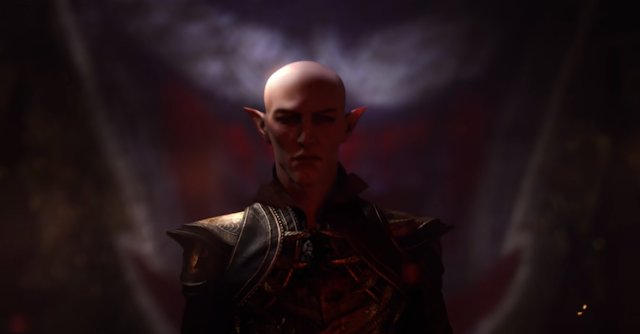
Solas and the Waking Nightmare

Solas is, I believe, half-mad, and existing in a waking nightmare. We excuse our choices in "In Hushed Whispers" because that world "isn't real." But, well, to Solas...? Neither is this one.

ALICE: He was part of my dream, of course — but then I was part of his dream, too. 
—Lewis Carroll, THROUGH THE LOOKING-GLASS

FELASSAN: They’re stronger than you think, you know.
—Patrick Weekes, THE MASKED EMPIRE

I've been writing several posts about Solas and his romance over the past few weeks, which means that I've also been thinking a lot about dreams, and about Solas's powers within the incredible and richly textured dream-world of the Fade. 


I've been thinking especially hard on how his long sojourns there may have impacted his waking life and actions in Inquisition, as well as upon how they may also have impacted his sanity.

After all, if you think about it, at the starting point of the events centered around Dragon Age: Inquisition, after his long sleep, Solas may have spent more of his life in the Fade (by a sizeable margin) than in the real and waking world. He has most certainly spent most of the last 8,000 years there—in a world where all knowledge is accessible to him, where he can shape his reality, his landscape, his environment, with exquisite detail. Where he has total control and wields an unbelievable amount of power.

Once Upon a Dream

But a dream-world is also notable for other aspects. A dream is a dream is a dream. The lighting is a little rosier. The air is sweeter. There's no sweat or blood or dirt or bad breath in a dream. All the little rough spots smoothed over. All the ugliness—even in the nightmares—simplified.

Part of me even wonders if Solas's first kiss with the Inquisitor takes place in the Fade because, well, everything and everyone is prettier there, easier to take. If he has been thousands of years without a touch upon living skin, of a kiss upon the lips of a living woman, it's no wonder that the Fade kiss is his easiest entrance into waking life just when he's finding the real world at all palatable.

Even time would be flexible in the Fade, as time doesn't matter in dreams, after all—it speeds or slows as needed. Distance is equally irrelevant. All that matters is perception, emotion, feeling. And power—dreams are incredibly powerful, and we are often incredibly powerful within them, ourselves. And we aren't even dream-masters.

So is it any wonder that Solas enters the stage with a massive superiority complex? This is someone used to things going his way, someone who has spent most of the past eight thousand years in a universe that he can command, control and shape to his will. His visible disgust with the world in which he finds himself, in the beginning, is therefore not so much a symptom of Solas's bigotry as it is of his difficulty with acclimating to the real world, as well as of his open yearning to go back to where things make sense.

No wonder all Solas talks about when we first meet him is the Fade. He's homesick.

The Place of Power

To me, it's all too understandable that Solas is, to some degree, addicted to that world of dreams in which he wields so much power—not least because it lacks the limits imposed by the physical world.

It's also why I think he speaks of the Fade with such longing and frequency when we first meet him, as well—he's left that beautiful kingdom where he holds such supremacy and command, and for the past year or two now has found himself walking a world of waking nightmare. He would love to go back, but he has things to do here in the ugliness of reality... things he would rather not do.

Lucky for Solas, then, that all he has to do to get through this interlude is to tell himself that this is simply another, more distasteful dream. (Note: I'm not the first to posit this, so shoutout in particular to this mention of the idea—which I deliberately didn't read until I'd written this post, because I wanted to make sure I'd kept my own POV clear beforehand.)

Solas's brutal capacity for tough choices is due, in no small part, I believe, to his belief that the world he walks through after
awakening from his long sleep isn't actually real. Just one possible universe among many.
The Nightmare Reality

The thing is... I think this is the key to who Solas is when we meet him. He may be walking in the living world, but his mind is still back in the Fade. And so is his perception of the reality in which he finds himself—and of its beings. And of the choices he makes here... and that he allows himself to make.

In other words, I think part of Solas still feels like he's dreaming. The reality in which he finds himself is no more permanent than the reality of a dream.

To me, this is the single most dangerous and terrifying secret to who Solas is in Dragon Age: Inquisition, and even, to some extent, through "Trespasser."

Sure, Solas is by all appearances awake now. Present, living, interacting. He seems awake. But I think he's still acting like everything's not quite real. Like things are changeable, impermanent... dreamlike. And so are lives within that reality. And so he can gamble them with impunity.

A Task, Timed and Temporary

I've even wondered if, after wandering the Fade for thousands of years, Solas has sometimes forgotten how to tell the difference between the dream and waking worlds at all. To be fair to Solas, his dialogue about those moments is sharp, present, and keenly attuned to the situation at hand. He is certainly aware that he's dreaming, for instance, when he visits the Fade with a romanced or high-approval Inquisitor.

Doesn't matter. I still think Solas is, ever so slightly, not in his right mind. He's certainly (justifiably) traumatized, and I'd argue that he's also become destabilized and unbalanced by the cataclysm he unleashed, and all he can do now is pull himself through the unpleasantness and pain of the waking world while thinking feverishly of the best way to discard this reality and bring back the universe where things made sense.

This is also why I believe he's so calm when sent physically into the Fade... because I think there's literally nothing the Nightmare can say to upset him there.

He's lived it all, a thousand nights or more already. A thousand, thousand nights. And he remembers every moment. And every time, I guarantee that he tells himself, "It's not real." As a reminder. As comfort. Whenever these pesky fragile creatures get to him. Whenever they make him think they may have lives and feelings of their own.

Conversations with the Nightmare

It's always interesting when you've played DAI at least once, to play through later on and to see the Nightmare's sly comment to Solas. The Nightmare seems abrupt and blunt, barely trying. As if it recognizes (as it should) that it cannot sway this particular object.

The Nightmare speaks to Solas: "Dirth ma, harellan. Ma banal enasalin. Mar solas ena mar din."

Which, for me, translates literally to: "Talk to me, Rebel. Your victory was nothing. Your pride begins your death." I've seen some who interpret it instead as "your pride appears dead." But I think given the syntax and phrasing here, that it is more ominous than that.

I could also make a case for "Tell me, Rebel, of your empty victory. Your pride will lead you to your death." I could further make a case for "Your death emerges from your pride." To me, this interpretation also works better with Solas's response.

And Solas brushes it away almost peremptorily. He responds with, "Banal nadas" ("Nothing is inevitable/certain"), but which again I feel is more Solas being sly and speaking in multiple meanings, depending on emphasis. He's not just saying "nothing is inevitable." He's also, I would argue, saying that nothingness itself is inevitable, that he knows he is doomed to failure but that he can allow himself to walk no other path. Like, not just "We can't know anything," but alternatively, and more terrifyingly, "Nothing we do matters."

Meanwhile, no worries, either way... it's all a dream.

What is real? If you're going to ask anyone in Dragon Age: Inquisition, don't ask poor Solas. I believe he hasn't a clue.

Ancient Elven PTSD

I think Solas was very aware of what his pride had wrought centuries before his official awakening, as he'd seen it all from the Fade. I suspect he thought he had mastered his reactions, that he thought he was okay about things (or that he could fix them), until his physical awakening. When it all hit him more powerfully than he could have expected.

And here's where I think the temporary insanity kicked in, in earnest. Where he became focused on righteousness and restitution. His answer in fury and disbelief was simple: This isn't real.

Once he fixes things, he thinks, the world will be right again. The way it should be.

It's why Solas's first truly villainous action, that of getting the Orb to Corypants in order to unlock its power, probably doesn't affect him much, at first. And it should—after all, it's the first time in his entire journey when he does something that is evil and indefensible. Did he think the Breach and catastrophe of the rifts would occur? No, I don't. I genuinely think he thought Corypants would unlock the Orb, and die in the attempt. Solas would have then used the unlocked Orb to "fix" reality and restore the past.

And yet.

Sliding Doors

Either way, if this reality is simply temporary for Solas, much like the one in which the Inquisitor finds herself in "In Hushed Whispers," then nothing he does here is blameworthy—as long as he can get back to the point where everything changed. If he can reset this world back to where things made sense, all will be forgiven. Nobody will even remember otherwise.

I think it's worth pointing out that in "In Hushed Whispers," the Inquisitor never has to question whether what they are doing is right. Her companions urge her on even at the spending of their own lives. Death is immaterial. All that matters is 'fixing' the world back to how it should be.

Is Solas's situation any different? He himself would certainly argue that it's not. The only difference is that he's not the hero of this story.

I'd simply say: To his credit, he knows that.

What would it be like to see yourself memorialized in sculpture and song, to find yourself a villain thousands of years after
you had attempted to free the slaves, fight for your people, and avenge the murder of the one you loved most?

The New Reality

Meanwhile, dreams are tricky things. Dreams are dangerous, ephemeral, seductive. Dreamscapes are places where nothing is necessarily permanent. Where actions may not have consequences. Where everything is centered on us, ourselves. Where the question "What is real?" may not matter at all.

Which makes it richly ironic that one of the greatest lessons Solas must learn in the story of Dragon Age: Inquisition is the nature of reality; and that the beings he meets in living Thedas are as real, vital and worthy as those of the civilization he has lost.

I mean, yeah, it's an obvious lesson for someone to have to learn, especially given Solas's brilliance, but then again, the brilliant are often the most blind. Solas has spent thousands of years trapped in his own dreams (and nightmares), then awakened, traumatized, to the terrifying and agonizing fresh realization that he'd doomed what he tried to save, killed what he tried to protect, and that he was now nothing more than a joke, a maligned and forgotten relic—a simplistic villain, hated by his people and used as a warning to frighten naughty Dalish children.

And when he approaches those very Dalish, the vestiges of the elven people in this terrible new reality, they turn him away. His most loyal friend and lieutenant is dead by his own hand. He's no longer a ruler, a rebel, a wolf, or a god—at least, not in this place. And at first, he's so weakened after his long slumbers that he's barely even a mage anymore.

And he's alone—more alone than he's ever been.

That's a hell of an awakening.

Is it any wonder that, trapped in his own waking nightmare, Solas speaks of the Fade with such yearning? That he
holds himself solitary and apart?

Dawning Awareness

This is why I can forgive Solas, especially early on, for the ice of his condescension, and for the rage of his own regret and powerlessness. Is it any wonder he speaks of the Fade with such yearning? That he holds himself solitary and apart?

Then the dream softens. His trauma begins to heal. He begins to allow himself to be vulnerable, to react to things, to feel things. Everything changes when he meets the Inquisition... when he recognizes Cassandra's faith, Bull's vulnerability, Varric's acceptance, and Cole's compassion. When he watches the people of Thedas and recognizes their courage... and how they refuse to submit—even to a world raining demons.

And most of all, he changes because of her... when he allows himself to fall in love. And he only allows that all-important first touch, that first moment, because it occurs where he is most himself... In the Fade. Where everything is allowed. Where everything is permissible. Where he feels safest. Where nothing he does matters.

In looking back here, I was reminded of the wonderful and underrated show "Angel," and the conundrum, quoted above: "Nothing we do matters." And of the show's incredibly moving response, the only one possible for thinking beings: "If nothing we do matters, then all that matters is what we do." 

It's a lesson Solas, alas, has yet to learn. But I believe that he will. Even if he must visit a dream to do so. Or a nightmare.

It's where he's most comfortable, after all...

Defending Fiona

Fiona is a rather chilly, reserved character whose pragmatism can make it difficult to like her. But I respect her choices,
and I pity the quiet pain she carries.

FIONA: The Warden you brought to Skyhold... his name is Alistair?

INQUISITOR: Yes. Didn't you meet him?
FIONA: No, there's...no point in that now. He seems a good man.
INQUISITOR: Yes, he does.
FIONA: It's not important. I'm simply musing on the clever tricks the Maker plays.

She has pale eyes and a slightly kittenish face, although when she was young, her eyes were reportedly darker. She is strong in the face of adversity, and is able to maintain an impressive coolness even in the face of torture or certain death. She does not expect to be liked, accepted, or forgiven. That's Fiona.

Most Dragon Age fans know the character of Fiona well, and most also have widely diverging opinions about her. Those who know her from The Calling, David Gaider's poetic journey into darkness about the Grey Wardens (and it also serves as a sneaky first warning of how terribly far they can be led astray), tend to like Fiona for her courage and unexpected vulnerability in the Deep Roads. Those who meet her in Dragon Age: Inquisition, meanwhile, often judge her harshly for her leadership of the mage rebellion in Ferelden and for the choices she makes there.

Depending on your choices in the game—most specifically, whether you support mages or Templars—Fiona either becomes an enigmatic and sorrowful presence at Skyhold... or she leads Corypheus's army against you, and you kill her (and most of her followers) at Haven.

Early Life

As I noted above, we first meet Fiona in the Dragon Age novel The Calling, and when we learn about her upbringing, the only word for it is tragic. I'm talking, make-a-movie-about-her-and-then-cry-through it, tragic. It's breathtakingly sad. And that's just talking the first 15-20 years or so. It arguably gets worse afterward. Fiona can be chilly and off-putting, but there's ample reason for that: she doesn't trust people because, for her entire life, people abused whatever trust she gave them. I'm estimating that Fiona was born in 8:92 Blessed Age (give or take), based on the events of The Calling and later, of Inquisition.

In The Calling, we learn that Fiona was raised in an Orlesian alienage until the loss of her family when she was just seven years old. She was then sold into slavery to a Comte Dorian (not, of course, any relation to our darling DAI mage companion), who abused the child both sexually and physically. When she manifested and recognized her own magical abilities, Fiona used them to kill the Comte, nearly dying herself in the process. Somewhat surprisingly (and I can't tell you how much I love this detail), the Comte's widow didn't punish the child, but sent her to the mage circle at Montsimmard instead. It's certainly implied that the Comte's widow was, in fact, just another victim who could not bring herself to kill the brave child who had risked death to destroy her abuser.

Fiona eventually begged to be allowed to join the Grey Wardens, and was recruited by Commander Genevieve. She survived the Joining, alongside key later major players Duncan and Riordan.


Fiona is a quiet figure when we encounter her in the Skyhold library, but there's also a subtle humor to her, and a gift for
acceptance, that makes me pity her.

The Calling and Asunder

In the events of The Calling (9:10-9:11 Dragon Age), Fiona accompanies the group of Grey Wardens under Commander Genevieve who descend into the Deep Roads. During this mission, one fraught with conflict, danger and increasing awareness of the inevitable sadness of the fates of the Grey Wardens who have reached their Callings, Fiona becomes close to King Maric Theirin. The two are drawn to one another in danger and darkness, and they eventually become lovers. Later on, after death, loss, battle and redemption, both return to their lives on the surface. 

Then, slightly unexpectedly, Fiona returns in 9:11 to speak to King Maric to let him know that she has given birth to his child, and to get his promise that he will tell the boy his mother was a human who died, hiding his real origins. That child, of course, is Alistair, who becomes a world-changing Grey Warden, and who potentially ascends the kingship and who is so integral to the events of Dragon Age: Origins during the events of 9:30-31. 

It's ironic that in a story that centers around The Calling, Fiona is the only Grey Warden in history who will never have to hear it. 

But her son will. If he lives that long.

The Quiet Rebel

In the next Dragon Age novel, Asunder (also by Gaider), it's the year 9:40, and as we backtrack slightly, we discover that Fiona has left the Grey Warden order because it was found that she could not be re-Tainted from further Joining rituals. This caused anger and resentment from the other Wardens, so she returned to the Montsimmard Circle of Magi, where she ascended rapidly to the roles of First Enchanter and then to Grand Enchanter (9:37 Dragon). 

Fiona's return to the Montsimmard Circle marks the point when Fiona began to kindle her heart in earnest against the Circle system, and especially against the rampant abuses she witnessed by the Templars against imprisoned mages (and this wasn't even one of the worst). The same year, not long after Fiona was made Grand Enchanter, elected leader of all Circle mages in Thedas, she led a motion before the College of Enchanters at a Conclave (the first held to try to save off hostilities between mages and Templars) to dissolve the Circle of Magi. 

What's interesting to note here is that when making her plea, Fiona directly addressed the inaction of Grand Cleric Elthina on behalf of the mages at Kirkwall, despite years of open corruption and abuse in the Circle there before the apostate Anders took radical action and destroyed it.

Fiona's motion was denied after a passionate plea by Senior Enchanter Wynne to maintain the Circle system, but despite this vote to maintain the system, the Templar order immediately disbanded the College of Enchanters in retaliation.

Shots Fired

Not too long after this, in 9:38, while Felix was making the trip back to Hossberg from the university with his parents (going home for a visit during the winter holidays), hurlocks attacked their party, killing Livia and wounding Felix, also infecting him with the Blight sickness (a slow death sentence).

Meanwhile, Divine Justinia V helped to set up a new Conclave in order to investigate abuses (and specifically, the Rite of Tranquility), and to once again attempt to broker peace between mages and Templars. Fiona attended and once again called for the Circle of Magi to disband, but before a vote could take place, Lord Seeker Lambert labeled the entire Conclave to be an act of treason, launched an attack, and captured Fiona along with several other mages (and, notably, First Enchanters). They were eventually released, at which point Fiona gathered the mages at Andoral's Reach and called for yet another vote of separation. 

At this point, the mages were angry enough to agree, and the Mage-Templar War had officially begun.

Alexius's use of time magic means that Fiona's perception of choice is simply an illusion. In reality, he can continue to shape events over and over again until she agrees to his terms—simply because she has no other remaining options.

Paths Converging

At this point, events all seemed to converge in tragic ways. Justinia managed to call for the new Conclave at the Temple of Sacred Ashes, hoping to bring together mages and Templars in some sort of new peace. Both Fiona and Lord Seeker Lucius Corin sent intermediaries, suspecting potential foul play, so both survived the explosion to follow. The war continued, and in the devastation Fiona led the surviving mages to Redcliffe in hopes of finding some sort of haven.

When the Inquisitor meets Fiona in Val Royeaux, the Chantry has publicly disavowed the Inquisitor (as the Herald), and the Templars have also publicly reinforced their departure from the Chantry, as has Lord Seeker Lucius, brutally and publicly striking down poor Revered Mother Hevara to make his point. We then encounter Fiona mysteriously as we exit Val Royeaux, and she asks us to come to Redcliffe in order to discuss a possible alliance.

Questions in Redcliffe

This is where things get interesting... and where I get truly invested in Fiona's situation.

If we select the quest "In Hushed Whispers," and choose to support the mages, when we show up in Redcliffe, Fiona seems genuinely surprised to see us, showing no knowledge of our previous discussion or meeting arrangement. She visibly distrusts the meeting, and implies that it's a setup (and it's reasonable, given her circumstances, why she might think so).

Fiona then discloses to us that things have changed since that unremembered initial meeting. She has relinquished her role as Grand Enchanter and all privileges associated with it, and has traded the servitude of the mages to Tevinter for a period of ten years in response for assurances of their safety and protection. She now answers to a mysterious magister named Gereon Alexius, who at this point also reveals he is changing the terms of their agreement, and that the mages will now be subject to military rule and service. She protests, and he answers rather coolly and smugly, dismissing her to speak to the Inquisitor and Dorian.

At this point, Alexius springs his trap, using the time magic he has been manipulating all along, and the Inquisitor and Dorian are thrown one year forward into an alternate and hellish universe where Corypheus has won, and the world is a nightmare beyond all recognition. When Dorian and the Inky explore the castle, they find their former companions imprisoned and dying of Red Lyrium exposure, as well as poor Fiona, who is horrifically actually being physically transformed into the mineral itself. Fiona accepts her fate as a consequence of her actions, and simply warns the Inquisitor against Alexius.

In the end, we defeat Alexius (of course) and the current Fereldan monarch arrives to kick the mages out of Ferelden (and this is extra-heartbreaking if it's Alistair who's king, for... reasons). They then have no other option but to take whatever we offer—alliance, or servitude, with the Inquisition.

Alexius has spent incredible energy, vast amounts of magic and money, as well as countless lives and futures, in order to save his son. It's understandable. And grotesque.
Springing the Trap

Here's the deal: I like and pity Fiona. She has had a terrible life by any standards. She fought bravely when asked to do so by her country, joined an organization offering a limited lifespan, a guarantee of a terrible death, and with a 1-in-3 chance she wouldn't survive the initiation.

She then had a momentary glimpse of love that was (of course) impossible to sustain (given his, ahem, kingship), was kicked out of the Grey Wardens for something that she had zero control over, then finally seems to have achieved a little freedom and happiness as a mage. But that, too, was an illusion. 

She spends the rest of her youth in attempting to provide better lives and just outcomes for her fellow mages, until we meet her in the early events of DAI. And Fiona then again tries to take action for justice but all her choices are circumvented, all her power taken away. She reaches out and tries to join the Inquisition, but her visit is literally removed from time itself by Alexius, using additional time magic, so that she is further cheated of any knowledge or awareness of that choice. 

Then we go to Redcliffe. And I've seen many, many people who hate her for agreeing to serve Alexius and Tevinter. Who blame her for conscripting the mages to them.

I understand this. But I don't share it. Because she's been used, and her mages herded into a trap from which there is no emergence.

A Stacked Deck

When Fiona agrees to join Alexius, she is already the visible and open victim of his enchantments and time manipulations. We are blatantly shown that Alexius has the ability to shift what he needs to, to get what he wants. Time magic, for instance, has already completely erased Fiona's outreach to us in the Inquisition. It has removed the help we could have provided there. It has further driven her and her contingent of mages into an inescapable narrow space as they attempt to avoid full-on warfare.

Keep in mind—these aren't the mages wreaking havoc across Thedas. Nor is Fiona advocating violence. These aren't the mages murdering civilians and stealing goods, glorying in death and destruction, burning villages. These are, rather, the mages who peacefully voted to govern themselves, only to find themselves at the center of an armed conflict. These mages have not lifted arms against anyone and simply wanted to remove the requirement of perpetual imprisonment, control, and surveillance, of life under the eye of a Templar. Keep in mind that a mage cannot maintain family contact. A mage cannot have a long-term relationship in the Tower or give birth to a child they can parent. A mage can be executed at any time with zero repercussions. They have no agency over their lives, bodies, or choices. They can be tortured with zero repercussions. Raped. Put in solitary confinement. Abused. Made Tranquil for, say, turning down a Templar's advances (and then subsequently giving said Templar a future of unlimited access to a compliant and empty body for his enjoyment).

If this sounds gross, it is. It upsets me. It should upset anyone. Yet Fiona's mages aren't out there burning down Ferelden. They're holding votes, speaking in calm voices, trying to use the system to change the system. In return, they have been driven from place to place to place. Each potential path of safety has disappeared.

Plenty have criticized Fiona for choosing to serve Tevinter. But I'd make an alternate case: That she has only done so when she literally had no other options left.

Because of the time magic. 


My favorite thing about Fiona is that she has zero apologies or justifications to make about her actions. She is calm, flat,
and accepting of any outcome. She does what she can and then accepts the reality that follows.
Impossible Choices

Alexius's use of time magic is why I believe that Fiona has no actual free will here, only its illusion. We're even given proof firsthand, as I noted before, when her attempt to reach out to us is erased completely as if it had never happened.

Alexius's goal here is to remove her hope. To make sure Fiona believes she has no options. To make sure she does what he wants her to do. And I think a case can be made that Alexius is methodical and careful, and that he does what he needs to do repeatedly to reinforce her perception here, and so he is able to make these small tweaks to the timeline with ease. And cruelly, in which case, each attempt she enacts to save her mages is met with a new obstacle until all that is left is indentured servitude (that is really more slavery and captivity).

As my eagle-eyed reader Teresa further points out here, "If you talk to some of the NPC mages in Redcliffe," she notes. "There are rumors of a 'massive Templar army' coming to wipe them out, and also rumors that Arl Teagan was going to kick them out to protect the 'muggle' residents of Redcliffe if that came to pass. All of that was thanks to Alexius manipulating time to plant agents in the ranks." I love this observation and it's one more way to emphasize the insidious ways in which Alexius is actively seeking to remove agency from the mages' choices. Fiona is therefore not only contending with the time manipulations Alexius is constantly enacting against her and the mages, but with the very real power of propagandized terror, as Alexius expertly scares the mage population in Redcliffe into the realization that he and Tevinter are their only hope.


In other words, Alexius has removed every other branch from Fiona's path, from the path of the mages, that might have led her anywhere else but to Alexius and Tevinter. 

After all, Fiona leads a potential army; a group of prodigious power, and he needs this desperately to get what he wants for poor doomed Felix. 

The Fear that Drives Fiona

Let's look back and remember that Fiona is the victim of enslavement and hellish abuse as a child. She refused to take that abuse forever, and eventually and righteously killed her abuser, even at the potential price of execution.

She was still able to forge a path for herself. She became a Grey Warden, proudly risking her own life simply to join the order, and then to do her part against the Darkspawn. When the time came, she stood true. It's also worth noting that she was the leading voice against the Architect, in the events of The Calling.

When she realized her situation after the fact, she could have taken many actions. She was after all pregnant by the King himself. Yet she simply kept his secret and still managed to quietly, politely, let him know the outcome later on, in a way that would not jeopardize his political standing, and that would provide protection and a future for her child.

Then no matter what she had done, or how heroically... she was kicked out of the Grey Wardens simply for overcoming the Taint. She rejoined the Circle system, pragmatic to the end. Only to find that this, too, was a room without an exit.

Full 'Circle'

Ultimately, I can't blame Fiona for becoming a voice for the mages. I can't blame her for becoming a voice against imprisonment. Everything we know about Fiona already tells us that she was willing to do so no matter what the risk to herself.

The fact is that some Circles, many Circles, were hell on Earth. The White Spire. Kirkwall. Even Kinloch Hold wasn't exactly a bed of roses, given that it put Anders in solitary confinement for over a year. Add in to this a system that included the forced removal of mage children from their families, imprisonment, distrust, constant scrutiny by people who can kill or imprison you at any time (Anders, for instance, and the repeated solitary confinement I mentioned), and let's not forget the daily, ongoing threat of harassment, rape, violence, or Tranquility.

I'll close my defense of Fiona by noting that her fears of retribution were justified. The Right of Annulment was carried out on 19 different Mage Circles through recorded history through DAI (942 Dragon), with many many being shown later to have been staged or manufactured by corrupt Templars. That's the slaughter of thousands of imprisoned mages by their captors. Look at what Anders went through. Look at what Wynne went through—even if she supported the very system that victimized her, she herself wasn't allowed to fall in love. She wasn't allowed to keep her child. And that was in a "nice" Circle!

I just find this so upsetting. I've talked a lot about how much I hate the Qun, which doesn't allow romantic attachment or even familial bonding. That removes children from their parents and raises them in a communal setting to become what will be most useful to the system. Well, the mage Circles are just as barbaric. Sure, some Circles were evidently okay, but to me the whole system is fatally flawed (and by DAI hopelessly corrupt). Even Cullen seems to know it at that point (even if Viv remains pointedly, deliberately, blind).


In the end, whether the mages win or lose, Fiona is unmoored from the world, a woman without a friend, a home, or a place.
And she's okay with that. Because it's the price that was required.

Oaths Kept

In the end, Fiona can only choose from the options available to her in DAI. If she has no options? Servitude to Tevinter begins to look pretty damn good. So I deeply pity Fiona and respect her for trying to stand up for a population of people who lived their entire lives as captives with zero power over their own bodies, lives or choices. She's not violent. She's not waging outright warfare. She tries to use politics, to use the civil and peaceful choices her government has ostensibly provided. In doing so, she's trying to protect people she cares about; people locked away to be wielded as weapons, people hated by the populace and victimized by their 'protectors' over and over again.

I think the most terrible aspect of Fiona's choices is that even in Skyhold, it's like her options are ended. There's nothing left for her. She admits in conversations with the Inquisitor that she is no longer the Grand Enchanter. She doesn't seem to know what she is, just that it's all over. She has no plans, no hopes, no anything. And if poor Alistair is a Grey Warden left in the Fade, she simply and poignantly disappears without a word.

What's ultimately most tragic to me about Fiona is that she's totally, brutally focused on outcomes. She joins the Grey Wardens because it allows her the greatest access to action and honor. She finds momentary solace with Maric yet immediately understands its transitory nature and never attempts to use that against him (even bearing his child in secrecy). She has no reaction at all to losing her status as leader of all of the mages of Thedas beyond a few moments of wry humor in the Skyhold library. Even in the alternate future, her body slowly transforming into Red Lyrium, she's only focused on how you can fix things.

In Peace, Vigilance

Fiona never comes across as a warm person to me, exactly. She's rather cold, detached, and difficult to access. Perhaps her damage has made her understandably slow to trust others. Perhaps that abuse has also made her careful about those she lets into her life. Perhaps there's another Fiona, a warm and giving person underneath the quiet mask, that we'll never get to see, only given to us in a rare glimpse, as a gift in prose by the talented Gaider. But all we meet is the quiet, accepting public servant—the mage who does what she's required to do no matter what the cost:

In War, Victory.
In Peace, Vigilance. 

In Death, Sacrifice.

Ultimately, I think she did the best she could. It's terribly sad and yet appropriate to me that Fiona lived up to the Grey Warden motto even when they kicked her out. In the end, whether the mages win or lose, she is alone, adrift, and unmoored from the world—a woman without a friend, a home, or a place. 
And she's okay with that. Because it's the price that was required. 

It seems to me that if life has taught Fiona anything, it's that everything has a price. She recognizes this, and pays. She's just so used to paying it, she no longer even asks herself if it hurts.

Tuesday, July 31, 2018

Solas's Romance Part 2: Flirting with the Dread Wolf

Solas's early flirtations are especially delightful because they're unfailingly polite and yet also, quietly naughty.

INQUISITOR: You have an interesting way of looking at the world, Solas.
SOLAS: I try. And that isn’t quite an answer.
INQUISITOR: I look forward to helping you make new friends.
SOLAS: That should be… well.
INQUISITOR: That isn’t quite an answer, either.

First off, I have an admission. After weeks of wrestling with them, I just can't consign Solas's romance to a specific number of posts! So he'll be searchable under "Solas's Romance" in the future, as well (and I'll continue to designate them that way once I finish moving blog platforms). 

One of the greatest pleasures of Dragon Age: Inquisition surely has to be the ways in which we're able to flirt with our companions, whose reactions are almost always both revealing and (more than occasionally) incredibly funny. For instance, watching Cullen stammer in awkwardness or Cassandra blush in confusion at a flirtation from a female Inquisitor will never, ever get old for me. Neither will the shy delight from Blackwall and Josie, or the more sophisticated, amused reactions of Sera and Dorian. Bull, of course, doesn't react at all, aside from those blasted "The Iron Bull slightly approves" notifications. (Although in my mind, he accompanies them with a smile and a raised eyebrow. Dammit.) The end-all, be-all reaction to our flirtation attempts, however, comes from Vivienne, whose response of open laughter and disbelief are so devastating I'm still not okay even years later.

But out of all of our companions, my favorite flirtations are those with Solas, who is by far the smoothest companion in the bunch when we flirt with him. His responses are absolutely delightful—sexy, smart, and suave. I remember how surprised I was with that when I first played through DAI—and how appropriate I found it upon replay, knowing who Solas actually was.

Some of Solas's most notable and direct flirtations occur early on at Haven—like this series of variations, below:

Rogue Inquisitor:

SOLAS: You train to flick a dagger or an arrow to its target. The grace with which you move is a pleasing side benefit. You have chosen a path whose steps you do not dislike, because it leads to a destination you enjoy. As have I.
INQUISITOR: So you’re suggesting I’m graceful?
SOLAS: No, I am declaring it. It was not a subject for debate.

Mage Inquisitor:

SOLAS: You train your will to control magic and withstand possession. Your indomitable focus is an enjoyable side benefit. You have chosen a path whose steps you do not dislike, because it leads to a destination you enjoy. As have I.
INQUISITOR: Indomitable focus?
SOLAS: Presumably. I have yet to see it dominated. I imagine that the sight would be… fascinating.

Warrior Inquisitor:

SOLAS: You strengthen your body to deliver and withstand punishment. The muscles are an enjoyable side benefit. You have chosen a path whose steps you do not dislike, because it leads to a destination you enjoy. As have I.
INQUISITOR: You find the muscles enjoyable?
SOLAS: I meant that you enjoyed having them, presumably.
INQUISITOR: Ah.
SOLAS: But yes... since you asked.

These flirtations are especially delightful for me because they manage to be both polite and quietly mischievous (the mage comment especially!), while also conveying a real sense of enjoyment in both the Inquisitor and Solas here. All of the above dialogues then end with the female Inquisitor giving an amused "Mmhmm" along with a slight chuckle (and Alix Wilton Regan's performance is particularly charming to me, because it manages to convey both amusement at his daring along with a slight hint of shyness). Either way, let's face it, I'm assuming she then had to go off and fan herself, because holy cats, that's hot.

And of course Solas is a smooth flirter. He ought to be, considering that he's actually been flirting for millennia at this point, in terms of his actual age. 

Solas's unusual and often archaic speech patterns are some of my favorite things about the character from a writing standpoint, because they emphasize the fact that Solas is a man out of time.
Love, Godhood, and Carbon-Dating

(Okay, first off, sorry about the carbon-dating/dating pun. BUT I HAD TO DO IT. It was just sitting there, taunting me!)

Onward. (And yes it was bad. And no, you're right... I'm not really sorry.) 

Where were we? Oh, right, flirting with my ancient almost-god digital elven boyfriend...

At a conservative guess, Solas is at least 9,000-10,000 years old (the Veil was erected before humans had ever even showed up in Thedas at all, 8,000 years ago), and my personal guess is that he spent several thousand years as an Evanuris before that, AND as you may know from my other blog entries on the subject, I believe that, before that, he spent perhaps uncountable millennia existing as a spirit of Wisdom, in the Fade.

In other words, the cute guy we're flirting with at Haven here could be as much as 20,000 years old. Hahren, indeed. I love this, and the way it dwarfs any of those vampire/human romance tropes, for instance (Angel/Buffy, Lestat/Louis, Edward/Bella, etc.), or even the age gap between the Doctor and his Companions (although I think those come close). The distance is so great that it's difficult to imagine.

But Solas gives himself away every now and then, nevertheless, in his language and conversation choices (both flirtatious and otherwise). 

Verbal Clues and Turns of Phrase

One of the many things I love about the care taken with the characters in Dragon Age: Inquisition is that they encourage us to look closer, to find the complexities and (perhaps) disparities that may lie within them. Characters who for me especially embody unexpected depths, surprises and capabilities include The Iron Bull, as well as Flemeth, Varric, Leliana, Blackwall, Cabot, Dagna, Dorian, Dennet and more.

But for sheer surprise and revelation, Solas beats them all. And his unusual and archaic speech patterns, those subtle words and phrases that remind us of the ancient being he truly is, are some of my favorite things about the character from a writing standpoint, because they emphasize the fact that Solas is a man out of time. He is many things at once—ancient and young, mortal and immortal, spirit and flesh... and the product of a time and place that were so long ago that his compatriots are now myths and legends, and the collapse of his entire civilization is simply a cautionary bedtime story.

Solas's writer Patrick Weekes communicates that subtle sense of age and rigidity with these little verbal cues, these ornate and formal phrasings throughout his dialogues, as well as with general verbal tendencies such as Solas's absolutely exquisite manners.

Weekes further emphasizes Solas's slight oddness of speech with phrases such as those like, "whose steps you do not dislike," for instance, in the flirtations above. I mean, sure, Solas could totally have just said "whose steps you enjoy" or "whose steps you like," but that use of the double negative adds this wonderful spin, to me—a little quirk of strangeness that allows him to be both candid but also a bit detached, perhaps. I also love Solas's visible fondness for the prim, slightly antiquated phrase "one assumes," which is again just that little tip of the hat to Solas's tendencies toward overformality as his happy place.

Solas's ornate and tricksy language skills also demonstrate another one of my favorite hidden aspects to Solas for me as a character—that subtle, sly wit. I know people seem to think of him as humorless (especially those who don't care for Solas as a character), but I'm telling you, that subtle wit is actually almost always present, and it's so much fun, especially when delivered by the always-superb Gareth David-Lloyd, who not only gives Solas one of the most impossibly beautiful and emotive voices in this or any game, but who also imbues him with a delicate and decidedly wicked streak that makes Weekes's elegant dialogue that much more fun to listen to. And it's every bit as individual and recognizable as the delightfully Shakespearean turns of phrase that David Gaider gave to Morrigan, or as the poetic alliterations of Weekes's Cole.

Watching Solas emerge from his shell to tease, flirt, and talk, is always moving to me in an odd way, perhaps because we're not just seeing him reawaken after long sleep; we're also seeing a dead man realize he's actually still alive. The almost-god of ancient times now walking the mortal world.

Even if he shouldn't be.

All the times Solas is flirting with Lavellan, the grim reality is that he should've been moldering in a dusty grave for thousands of years now. Yet somehow he's still here. So he might as well feel something more than pain or grief.
The Wolf in the Sun

See, that's the tragedy of Solas, to me. He's a living fossil. He's thousands of years out of date. By all rights, when Solas is flirting with our darling Inky, the grim reality is, he should've been moldering in a dusty grave millennia past. But somehow he's still here, but cut off, lonely, yearning to unspool time and fix the mess he's made of the world. And yet he's just as driven to stay solitary, to protect the lies he's told and the pretense he's created.

Enter Inquisitor Lavellan, stage right. Bewildered and seeking reassurance and connection. She's courageous, smart and powerful, impossibly young, and with absolutely no preconceptions. She speaks to him in the words of his people and quickly becomes the one good thing to come of his impulsive decision to manipulate the Orb to Corypants, the part he cannot bring himself to regret. And before it even all begins, he calls her back to life from the Fade, sitting by her side all night in Haven. Fearing death and hoping for recovery. A tacit and unspoken tenderness growing simply in his guilty vigil to keep this woman from death.

No matter that to Solas, Lavellan is as fragile and transitory as a firefly. No matter that she will only live a brief scattering of years before mortality takes her. No matter that he himself may eventually be the cause of her death—what difference does that really make, after all? Everyone, everything, here is dying anyway. He can almost see it happening before his eyes.

So he shuts all of that away. Solas begins to relax into his role as the lonely apostate. He banters with Lavellan and remembers how to smile. He begins to feel something good, something beyond rage or guilt. Or maybe he simply begins to feel again, period. And so he begins to play with her verbally, and she plays back, in conversations that are as mannered and elegant and ornate as any dance at Halamshiral.

Even if he's still a man in a dream. Even if the world in which he walks is not quite real to him, and is instead something doomed, transitory and fragile—an alternate universe of possibility and wrong choices. Even if she herself is not quite real.

What harm, then, to take her to the Fade? All of this is just a dream in the end, either way. Or a nightmare.

"Dragon Age: Dreadwolf" Predictions & Ponderings (and "What's in a Name?" Redux)

He doesn't call, he doesn't write, but finally, it looks like we might be hearing from Solas at last (2023?), as BioWare announces t...