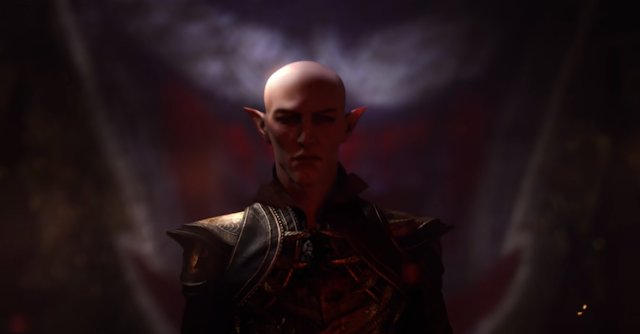
Showing posts with label uthenera. Show all posts

Friday, May 4, 2018

Meet the Evanuris: The Mother, the Spirit and the War of the Gods

When you consider what life was like in the ancient days when spirits and
physical beings lived together in a magical world, it's easy to see why Solas
reacted in horror to his awakening after millennia in the Fade.
The pages of this book—memory?—describe an elf approaching a city of glass spires so deeply blue they ache. The city's outskirts are wrapped in lakes of mist, and figures stroll along the pearly, glowing strips as if they walked on solid ground. Groves of trees woven into enormous parks shelter elves in quiet hollows, while other elves walk below a river churning along an invisible shoal in the air.

The scene hums with quiet talk and contentment as the memory's maker reaches the city's gates, already thrown open wide.
—Dragon Age: Inquisition "Trespasser" DLC ("Vir Dirthara" Codex: Homecoming).


SPOILERS as always, for all of Dragon Age!

Welcome! We're on to my second post in my series on "Meet the Evanuris" (please do check out my first post here, for a general overview of Dalish myths and gods back when we were young and naive and oh, so trusting). 

Our knowledge is darker now, however, and far more complex, thanks to Dragon Age: Inquisition and especially "Trespasser." 

So here we go... as we try to separate fact from myth.

Let's set the scene: In the very farthest reaches of the past, it appears that there was a great war, between the immortal Elvhen people, led by the Evanuris, and a force of unnamed foes (the Forgotten Ones, to me, are the likeliest candidates here). They won, and the Evanuris prospered, and, I suspect, drew power from their defeated foes much like Solas would do to Mythal, countless ages later.  (Please note that I'm going to use the 'Elvhen' connotation for the ancients here, to differentiate from the modern elves).

Incredibly powerful in magic and accepted as leaders by a presumably grateful people, the Evanuris were the ruling body for millennia. According to most Dalish myths about the elven pantheon, they were led by Mythal and Elgar'nan, who had five children: the twins Falon'Din and Dirthamen, as well as Andruil, Sylaise and June. 

Yet as we travel through Thedas and into mysterious areas like the Temple of Mythal, the Tomb of the Emerald Knights, the Lost Temple of Dirthamen, and into the hidden Elven Ruins in Solas's ancient valley, we begin to find that Andruil, Sylaise and June are also depicted as being potentially completely unrelated. Further, there are even implications that Falon'Din and Dirthamen were not biological twins, but something more complex.

Me, I'm not so sure about the family issue. At least in this moment, I'm on the side of the fence that thinks they were all related.


Mythal and her brood of little nestlings,
before the world went wrong.
The Spirit and the Flesh

I think the five were Mythal's actual children because of, first off, the golden mosaic portrait of Mythal in her hidden Arbor Wilds temple. Look at it—she looks for all the world like she's adorably holding a basket of chicks... FIVE OF THEM!

And it also does appear to me from the stories and implications that Mythal, at the very least, loved these people and considered them offspring. Or, at least, family. Biological connections or no.

But even if they were all family, this doesn't have to mean that they were all physical beings. 

Think about it. We know from the revelations of "Trespasser" that they were all powerful mages, but it's also entirely possible that, in a universe in which spirits and physical bodies inhabited the world together, pre-Veil, not all of Mythal's children may have been of the flesh. (Or her companions, for that matter, but I'll get to that farther on...)

For instance, based on the original Dalish legend that Falon-Din could go beyond the Fade (or, let's say, into the spiritual realm pre-Veil) in ways Dirthamen could not, I wonder if Dirthamen was a physical being, an elf, while his 'twin' Falon'Din, who was able to walk both worlds, was in fact a spirit all along. I mean, it would make sense. No mortal could cross and recross into the purely spiritual world beyond the physical as Falon'Din does, so the discrepancy makes perfect sense. They may even have been able to share Dirthamen's physical body on occasion, in a more benign version of the way Justice piggybacked on poor Anders's soul.

And while I'm on the subject... I want to point out that it's this, as I mentioned briefly in my previous post, that may answer the mystery of why Falon'Din and Dirthamen are the only Evanuris depicted in the Temple of Mythal with black, black eyes. (Yes, I'm still wondering about this...)

(Please note that throughout this discussion, when I refer to "the Fade," I am referring to the spiritual side of the Elvhen world, pre-Veil, and more specifically, to the place from whence spirits are born, and to which the souls of the dead return.)

I think this is an important detail to note because of the time period we're addressing—the time of the Evanuris was an age in which the spiritual and the physical were not precisely interchangeable, maybe, but in which they coexisted in perfect harmony. Spirits and fleshly beings were both equally considered to be people and treated, it seems, without a specific prejudice for either. In fact, I wonder if spiritual beings weren't in fact more prized for their input because it had the potential to come from experiences across distances and years far beyond those of living beings, even immortal ones. 

I'll go into more of the potential for both physical and spiritual Evanuris members in Mythal's entry to follow... and farther on in this post, as well.

Meanwhile, our journeys through DAI and "Trespasser" certainly teach us many things about the elven pantheon that seem to be less rooted in legend and more based in fact (and please note that anything I refer to here as "facts" is simply my assumption of what we learn in "Trespasser"—everything we know may very well of course be flipped again in Dragon Age 4). 


I do think that in the glorious early days of the Evanuris, there was
real love and affection among them, even if it wasn't sustainable.
Myths, Lies and Truths

What's most interesting to me is that, fairly quickly into Dragon Age: Inquisition, our own accepted assumptions upon visiting the story of the elven pantheon are up-ended, and radically so. It is, after all, Mythal and Fen'Harel we eventually come to associate with vengeance, not Elgar'nan, even though it becomes apparent that Elgar'nan's temper was his defining quality (he certainly doesn't sound like a very pleasant guy, and much like Zeus it's implied that he may have been a pretty terrible husband, father and ruler). Take this pleasant little excerpt from the "Song to Elgar'nan" found in the Temple of Mythal:
Elgar’nan, Wrath and Thunder,
Give us glory.
Give us victory, over the Earth that shakes our cities.
Strike the usurpers with your lightning.
Burn the ground under your gaze.
Bring Winged Death against those who throw down our work.
Elgar’nan, help us tame the land.
In the above, don't miss what may be veiled references to a threatening Titan (in the shaking of the Earth), and to the divine dragon shape-shifting form that was apparently the ability common to all of the Evanuris (not just Mythal)—I'll address this in more detail farther on. In the references to lightning, are they referring, meanwhile, to Elgar'nan's mage abilities? Or did he, like Zeus and Thor, profess to use both lightning and thunder against his foes?

With these and many other tantalizing little revelations, in other words, we quickly come to realize through the Codices and scraps of knowledge we accumulate in DAI that the Evanuris weren't all-knowing, powerful deities. They were, in fact, an arrogant, quarrelsome, corrupt and conflicted lot who frequently warred and fought within themselves, enslaved their own people, and who just as frequently abused their powers simply for amusement's sake.

I frequently play for Dalish Inquisitor protagonists in my DAI playthroughs, and if I headcanon for my heroine during the story's events and discoveries, I always find the revelations about the Evanuris to be incredibly powerful on an emotional level. Imagine Cassandra finding out that the Maker was not only never real, he was just some arrogant mage guy abusing his power. I mean, the implications are huge for the elven participants in DAI. Imagine the loss of belief in a profoundly Dalish believer... it might be enough to cause you to doubt everything you thought you knew. And it just might be enough to send you dashing off into the world to follow the silent call of an ancient almost-god...

But things were different long ago, after all. And maybe it wasn't always bad. In fact, I'm sure it wasn't.

A Paradise of Magic and Knowledge

In the beginning, despite the high passions and prideful immortals, it truly seems that there was harmony among the Evanuris, and I do believe, at first, that these beings did love one another, and glory in the beautiful world they inhabited. Andruil hunted and killed, yes, but at first I think she did so out of a real desire to celebrate and protect the beasts of the world and to pit herself only against their very greatest strengths (and to then, I would assume, feed her people). She who hunted the beasts also protected them, something we see in the fragments of stories of Ghilan'nain as well. 

I also think that Falon'Din, the 'shadow' of Dirthamen who may have been a terrifying spirit, at first really did probably treat his work as a shepherd of sleepers in uthenera, and later, of souls, with honor and respect. I would imagine that in the beginning, Falon'Din  would have experienced real wonder at each new soul and its passage to the Beyond, whether in dreams and uthenera, with the potential to return, or whether as a final journey into the Fade upon death, in a return from physical form to spiritual.

In other words, for a time I think it all really was wonderful, magical, beautiful and peaceful—perhaps for millennia the mortals of Thedas would be unable to count or even imagine. 

The story is certainly sadder if these beings all began as good, and I believe it's plausible that for many thousands of years, even, the Evanuris were truly wise in their rule over the Elvhen people. I think they created and nurtured a paradise of wisdom, magic and thought, in which gravity was optional, conversations lasted for decades, relationships evolved over centuries, and the magic was as simple as a word or a breath. A world that Solas later mourns to us in Haven:
“Imagine ..... spires of crystal twining through the branches, palaces floating among the clouds. Imagine beings who lived forever, for whom magic was as natural as breathing. That is what was lost.”
Passions Before the Veil

Speaking of Solas, I think it's important to bring up the fact here that, based on his dialogues and interactions with a romanced Inquisitor, these were intensely, deeply feeling people—beings who were both wise with millennia of learning, conversation and exploration, but who were also shown time and again to be quick to feeling, emotion and passion. 


Solas, seen here just before he utterly stomps all over my poor Inquisitor's heart,
is a sensual, passionate, and intensely emotional person. Were these qualities
common to all Evanuris in a world without a Veil? I think they were. 
Look at Solas in Dragon Age: Inquisition—even under the 'blanketing' presence of the Veil, he reveals himself to be a passionate and emotional person—not at all the cold-seeming mage apostate we first talked to at Haven. Solas's emotions run high and his fires are undimmed once he becomes freer to talk to our Inquisitors (if high in approval), and especially with a romanced Inquisitor, it's easy to see why he initially felt depressed and confined by the world under the Veil. This is also subtly emphasized by the fact that Solas is at his most romantic and passionate either in the Fade, or where the Veil is thin (as it is in his excursion to Crestwood with a romanced Inquisitor). He even admits this openly after the first kiss: "Such things have always been easier for me in the Fade."

With this in mind, it's all too easy to see why Solas awakened after long millennia and looked around himself in horror, seeing all those around him as beings who, to him, seemed muted and fragile, transitory and barely alive—he'd awakened, as he eloquently describes it in "Trespasser," to "a world of Tranquil." (I love this description, thanks to the always-superb Patrick Weekes, and have frequently felt since hearing it that this is also what it is often like to be an artist, as well...)

Anyway. When this consideration enters the picture, that this entire people were intense, emotional, deeply feeling and passionate, it's easier to see that the Evanuris were, in all likelihood, doomed by the very passions that sustained them. 

And let's not discount the very real potential for the most insidious enemy of all... boredom.

After all, a few millennia go by, and hey, you've seen it all, done it all. Perhaps the Evanuris, in the end, were no different from the many RPG players who, having done their share of 'paragon' playthroughs, decide to go renegade just to see what would happen next. (I'm only partly kidding, here...)

The Inevitable Corruption of Power

Because, let's face it: People change. Or, as Anne Rice's ancient vampires discovered, perhaps it's a more subtle thing—that people who can exist for centuries do not so much change as become more and more who they always were at their core. 

In other words, immortality may actually kind of suck.

Either way, after however many ages or millennia, every one of the Evanuris seems to eventually gone slightly mad (and then some) at a certain point, corrupting in each case the very talent, ability or love that had originally moved and shaped them. So Dirthamen became obsessed with secrets. Andruil went bonkers and hunted earth, skies and the Void itself to such an extent that even her fellow "gods" expressed fear that they might be next. Falon'Din no longer just ferried souls, he harvested them, glorying in death and lakes of blood, and amassing armies of spirits to do his bidding (that is, when he wasn't clashing with Elgar'nan for dominance). Elgar'nan, meanwhile, was evidently the same lovely guy he'd always been, just intensified, enslaving countless numbers of his people to serve and honor him, and to erect massive tributes and statues to his might—and very possibly doing so by carving those tributes into the bodies of his slain enemies, which in one memorable case he seems to have done on the mountainous corpse of a Titan itself (or, well, he had his slaves do it). Here's a quote from that moment:


The pages of this book—memory?—describe a monument made in a single afternoon by a thousand-thousand toiling servants swarming over a lump of fallen stone as large as a collapsed mountain. By the end of the day, the stern figure of Elgar'nan stares down into a valley, carved out from the foothills of the rock. The slaves have disappeared. Light radiates from the eidolon's narrowed eyes and its open, snarling mouth.

(Side Note: As they were in DAI, the Codices in "Trespasser" aren't just incredibly informative, they're also gorgeously written, so kudos to the writing team on those, which included the intrepid and talented Brianne Battye, Mary Kirby, and @Sylvf.)


The Evanuris were likely always doomed. Even in a world of magic,
I suspect that gravity will eventually always win out.
In short, immortality was no longer enough. Power was no longer enough. Magic was no longer enough. Only an unquestioned dominion over all, with tributes of death and enslavement, could satisfy the Evanuris. Vanity, jealousy and a refusal to abnegate power seem to have been the fatal flaws of the once-harmonious group.

It was both tragic and inevitable. They'd seen it all, done it all. It appears that, at a certain point, the only thing that would satisfy them was to make the world their playground, a place in which they could enact the darkest tableaux of fear, war, death, corruption, decadence, plague (cough, BLIGHT, Andruil, cough), and enslavement.

The Arrival of Solas...

My own interpretation is that here, watching Andruil slay for fun, breaking her own sacred rules as she hunted earth, abyss and sky while poisoning both herself and the world, watching Elgar'nan and Falon'Din delight in slaughter and power, and watching even Dirthamen and Ghilan'nain plot against her, that Mythal just got scared, depressed, and tired.

I think that for awhile here, she tried for peace nonviolently at first, and sometimes it even worked. But then that wasn't enough. People weren't listening. So then she went into full-on Warrior-Queen battle mode—in Dragon Age: Inquisition and especially in "Trespasser," we find so much evidence of Mythal's physical attempts to stop the carnage! She subdues Falon'Din in his own temple. She overpowers Andruil and removes the knowledge of the Void from her to protect the world. She even may defeat a Titan simply for one more tool in her hand to use to protect her land and people (I'm still trying to figure out what her motive was here, but I'm convinced it has something to do with helping the elves—I just don't see Mythal killing a Titan for sheer gain).

Either way, she does all this, and it's still not enough.

So I think she calls for help. She calls on a friend from the Fade—a friend I believe she knows and deeply loves—someone she trusts to be both friend, companion and protector: Solas. A spirit.

The Case for Solas as Spirit

This is it. I think this is the point when Mythal calls Solas into the physical world, and I believe wholly and utterly that when she does so, she is calling on someone she has known since the world was young, a spirit of wisdom and grace.

And I think he answers out of love for her, and does as she asks, entering the world of Thedas as a slender, quiet young man, as a being who is utterly unique—both spirit and body, old and young, servant and master, guardian and trickster. Who walks in all worlds, both dark and light. I think their bond is one of love, but that it is not romantic; in fact, I think it actually transcends romance.

I'll talk about this more later, but it's intriguing to consider that Solas, already impossibly old in spirit form, may enter the world of the living here, becoming enfleshed at the request of Mythal (much as Cole would do, albeit involuntarily, ages later), in the body of the man we meet millennia beyond this time in Dragon Age: Inquisition. 

I think this is what Solas means when he says he has always been the person we see before us, and that he's telling the truth; he is who he appears to be. He doesn't carry a wisp or vestige of a god; he is the god himself, the god who knows he's not one and never was; the elf and man who was once a spirit. I think all of this is true, and that the only change to that physical form of his is that the vallaslin that signified his service to Mythal, a symbol that became one of enslavement among his people, he eventually removed with her blessing, leaving only the tiniest scar upon his face as evidence (hey, it was probably his first try), as Cole later remarks obliquely in "Trespasser."

I love the idea of Solas beginning life as a spirit who is then called into the physical world (accepting that call by choice, and with love). It explains so much about him—his passionate embrace of all things fleshly, from the "frilly cakes" he once loved back in the ancient days of Orlais, to his open and fiery sensuality with a romanced Inquisitor. 

It also explains his passionate support of spirits as fellow individuals, his empathy for Cole, as well as his deep grief over the loss of the spirit Wisdom. This isn't just someone he may have known during his long sleep in the Fade, after all, but someone he may have known for ages beyond counting. Someone who is a reflection of who he himself once was. 

It even explains his painting style on the beautiful frescoes in his Rotunda, which I believe are accomplished not only in the finest artistic tradition of the ancient Elvhen masters, but that they also depict the events of DAI as seen not in real life, but instead as if... seen by someone from the Fade. That's my theory, anyway.

So... Enter Solas, stage left.

The idea that Solas may have entered the world solely at the request of
Mythal, and as a testament of his love for her, makes the end of their
journey all the more tragic and ironic.
Choosing Sides

I suspect that, for awhile, maybe even a few more thousand years or so, that Solas's entry onto the scene helped to stabilize things. He was brilliant, with a knowledge of the Fade/Spirit world beyond any ever seen, and with prodigious magical powers and a gift for diplomacy, a passion for justice and free will, and a slight glint of both rebellion and humor now and then. I think Solas would have fascinated the other Evanuris, and that he may even have grown to love his fellow 'gods' and truly helped Mythal to stem the tide of corruption, at least for awhile.

My suspicion, however, is that, even then, the one thing Solas could not stand was the existence of slavery. As someone who may have existed for countless previous ages and civilizations in the Fade, Solas would have seen the tragedies of slavery in years beyond the telling, and he would have seen the enslavement of their own people by the Evanuris as the height of evil. Either way, he began to fight it, first covertly, and then in open defiance.

At around this same time (or so I hypothesize), we know from the Codices that Mythal stepped in between the conflicts of Falon'Din and Elgar'nan, and that she eventually openly defeated Falon'Din, bloodying him in the sacred place of his Temple itself (an insult I'd imagine he never got over). We also know that Mythal openly defeated Andruil after her final trip to the Void, and that she may even have taken some of her power just as Solas later does from Flemeth, as the Codex notes that Mythal "sapped Andruil's strength and stole her knowledge." Again, Andruil may have taken awhile to recover, but as with Falon'Din, I do not see her licking her wounds and reconciling herself to peace, and it's definitely implied that she had personal reasons to begin to hate and fear Solas, as well, in her own right.

The eventual war within the Evanuris was, for this reason, unavoidable. Eventually, despite Solas's brilliance and trickery, despite all of Mythal's attempts at peace, the oldest and most powerful mages ever seen set themselves up as gods, opposed only by an increasingly desperate Mythal and Solas, who was now making a name for himself by freeing slaves and toppling tyrants in his own right. And so they began to call him Fen'Harel, the Dread (or 'Rebel') Wolf, as the being who could stalk them in all worlds and take them down, and whose magical powers exceeded even their own. 

The Divine Shape

We learn some interesting things in DAI and "Trespasser" about the escalation in tensions at this point. From still another Codex from elven writing found in the Arbor Wilds, we learn that the 'divine' form of the dragon-shapeshifter may not have been solely the province of Mythal herself, but (it's implied) was the province of the Evanuris or 'gods' themselves:


"His crime is high treason. He took on a form reserved for the gods and their chosen, and dared to fly in the shape of the divine. The sinner belongs to Dirthamen; he claims he took wings at the urging of Ghilan'nain, and begs protection from Mythal. She does not show him favor, and will let Elgar'nan judge him."
For one moment there is an image of a shifting, shadowy mass with blazing eyes, whose form may be one or many. Then it fades.

This, to me, is a huge clue fraught with significance. It's really exciting!


While we now associate Mythal as the figure associated with the dragon,
there's a distinct possibility that shape-changing to the 'divine' dragon-form
was in fact possible for all of the Evanuris at some point
.
Basically, from this scrap of information, it appears to me that Ghilan'nain and Dirthamen seem to have teamed up at some point (which also, to me, implies at least some alignment with the already ferocious Andruil) to support a dragon shapeshifter of their own. Created, perhaps, to battle Mythal? The outcome for the 'sinner' in question did not go well, however, and Mythal allowed Elgar'nan to enact a brutal judgment—again, setting the stage for betrayal, as we already know how close Dirthamen and Falon'Din are supposed to have been.

So... if we follow this logic even further, it would seem to me that Andruil, Falon'Din, Dirthamen, and Ghilan'nain were openly opposed to Mythal, and that (based on Mythal's parallel rage to Flemeth's) Mythal's mate Elgar'nan also aligned with them eventually (overcoming his previous antagonism with Falon'Din). And based on the implications of our final talk with Solas, it appears that Sylaise and June, too, joined in, as all of the 'gods' were judged by him as complicit in the betrayal. I've even wondered if Elgar'nan only pretended to judge the 'sinner' mentioned above, and if instead the criminal wasn't actually freed instead. If so, this 'sinner' could in fact be the entity who eventually committed the actual murder of Mythal.

At the same time, I wonder if this isn't also when the Forgotten Ones, renewed in strength and awaiting their chance, sensed the schism and warfare among the Evanuris, and used the situation to make another attempt to conquer the Elvhen people once more. It would make sense, and also explain why Solas took action against both sides of the conflict, as well.

Either way, with their fellow immortals aligned against them, and war threatening from the Forgotten Ones, Mythal and Fen'Harel could not stand against them all. But it seems they tried.

But it was not enough. They were betrayed, and Mythal was murdered.

And after Mythal fell, as we know, Fen'Harel's vengeance tore apart the heavens, created the Veil, destroyed both the safety, culture, and immortality of the elves, and cast both the Evanuris and the Forgotten Ones into imprisonment for the ages. He did this both to save his people and to avenge the murder of the person he loved most in all worlds, but as we already know within the world of Dragon Age, by doing so he also inadvertently doomed his own people to mortality, defeat, diminishment, and eventual enslavement by humans.

And all because he answered the cry of Mythal.

A Closer Look

Thanks as always for reading! I'll be taking a closer individual look at each member of the Evanuris in further posts, following the hints and revelations of Dragon Age: Inquisition and "Trespasser."

And of course, for me, the pantheon must begin not with the cliche of the Father, but with, instead, the Mother... so I'll be posting on Mythal soon to follow, as the first of many more to come in the series intermittently over the coming months.


Meanwhile: what do you think of the Evanuris? What are your thoughts about the theories I've posted here? Do you think it's possible that Solas and Falon'Din may have been spirits in the first place? I'd love to hear what you think, so please do share your reactions in the comments!

Sunday, January 14, 2018

The Real Hidden Question for Dragon Age 4...

Solas: I will save the elven people. Even if it means this world must die.

SPOILERS, on ALL of Dragon Age: Inquisition and Trespasser (and beyond) as always!

At the end of "Trespasser," Solas is so powerful that he could defeat
massive armies singlehandedly in a few eyeblinks (in between naps)
.
Now that we've taken a look at Solas's masterwork (the Veil), its slow and possibly inexorable decline, and where it stands at the end of the latest chapter of the Dragon Age story (Dragon Age: Inquisition's DLC "Trespasser"), let's return to the end of "Trespasser" in a slightly different way, in order to examine the questions about the fate of that very Veil that appear to lie before us as we dream, hope and wait for Dragon Age 4.

So here we go... We're back at the end of "Trespasser," and you've just had the Solas chat that spawned a zillion fanfics. And... well, if you're like most of us out here, no matter what your feelings about Solas or his agenda, there are some complex emotions and very specific questions that may be haunting you in this particular moment.

For instance, for me, as Solas walked away from our final, fateful chat (dressed in his, cough, fantastically hot ancient elven armor), once my Inquisitor let go of his leg I wondered the following questions:
  1. How can we dissuade Solas from tearing down the Veil?
  2. How can we defeat Solas if we can't talk him out of it?
Then I had an epiphany: Those aren't the right questions.

Because I believe (as I posted previously) the Veil is already almost certainly doomed.

Where Things Stand as of "Trespasser" (944 Dragon)

I've kept thinking about "Trespasser" and that last informative, emotionally charged conversation—a conversation that reveals who Solas is (and was), what he wants, and that emphasizes in no uncertain terms that his ultimate goal is to tear down the Veil, undoing his act of approximately 4,000 years before that inadvertently doomed his people.

This appears to set us up for a satisfyingly rich struggle in Dragon Age 4, in which we'll presumably have to counter Solas in his quest to redeem the elven people and bring back their golden age. We're even further asked to choose, specifically, what our next goal will be—to kill Solas, or to redeem him.

There's just one problem: Solas is too powerful to fight.

The God Who's Not a God (but Who's Totally a God)

This is why I think the setup of having to kill or redeem Solas at all is ultimately going to prove to be a masterful job of total misdirection.

Do I think the "kill" or "redeem" choice will be useless? No—I do think it will have real effect on how the DA4 protagonist, and possibly the returning Inquisitor, chooses to deal with Solas when they encounter him again in DA4  (I suspect our Inkies will return much as Hawke did in DAI, as featured guest companions, although I'd certainly love an actual first-person interlude).

But back to the end of "Trespasser": Look at how powerful Solas is here! He's unbeatable. The brief glimpses of his abilities that we're given at a distance, as we pursue him through the eluvians, secret valley fortresses, Darvaarad, and through the remnants of the Vir Dirthara, are staggering. As Solas battles the Qunari who are defiling his ancient hideouts and expels them from the pathways through his network of eluvians, he releases explosions of magic that are epic in diameter—they're almost atomic.

Then comes the revelation of Trespasser's final chapter, that Solas can now, like some ancient vengeful god, actually turn people to stone with a thought.

Abelas is an ancient elf who abandons his post at Mythal's Temple
after our meeting. My bet is that he joins Solas... and gets a new name
.
And keep in mind—this is before he takes in his final power-up—absorbing the power of the Anchor to save the Inquisitor's life.

In addition, even without his magical superpowers, Solas's list of assets is pretty formidable at this point. Let's take a look at what they are as "Trespasser" ends:
  • Assorted ancient castles and strongholds (from his hidden valley in the Vimmark Mountains to, presumably, many others connected through the eluvians)
  • Control of the Crossroads and the vast eluvian network
  • Knowledge of how to use and control the statue power sources at ancient elven shrines
  • A powerful secret force of elven spies that has evidently infiltrated all or most political circles across Thedas
  • The potential support of Abelas and the remaining ancient elven sentinels from shrines and temples across Thedas
  • The potential support of the Mythal-loyal elven spirit guardians
  • A silent, ever-growing army as elves from across Thedas flock to his banner
In other words, if you chose "Kill Solas" at the end of "Trespasser," your odds aren't exactly looking too favorable. 

Solas may claim he's not a god. But isn't that just semantics at this point? At the end of "Trespasser," even without the assets above, he's so powerful that he could destroy entire opposing armies all by himself, in between naps.

For these reasons, to me, there's just no way the main plot of Dragon Age 4 is going to be us versus Solas.

The Real Question for DA4

This is the point where it's worthwhile to go back and think about the entire trilogy of Dragon Age: Origins, Dragon Age II, and Dragon Age: Inquisition. In each story, a few common themes have always emerged—the struggles against evil (and corruption) from within and without; the fights against prejudice (both racial and magical), the struggle for justice in a system in which justice can be defined as multiple things by multiple people, organizations, and even religions. 

And percolating beneath all of this has been the persistent idea that every single one of these wars, calamities, Blights and other tragedies has physically harmed the world and weakened the Veil. And if the Veil is slightly tattered in Dragon Age: Origins from the centuries of violence, Blights, and carnage across Thedas, it is pretty much shredded to bits by the time Dragon Age: Inquisition rolls around.

To me, there's just no saving the Veil. Unless—in the best irony ever—Solas decides to help us do so.

Looking Back at the Veil's Creation 

The Chantry teaches that the Veil was erected in -3100 Ancient by the Maker. While this tallies roughly with other timelines, I definitely enjoyed picturing the look on Solas's face when he heard this assertion for the first time. Solas, however, confirms in "Trespasser" that it was he himself who created the Veil, as punishment against the Evanuris for their murder of Mythal and as his final attempt to protect the world from those tyrants among the Evanuris who were pretending godhood, enslaving their own people, and slaughtering mortals across Thedas. 


In each new single installment of the DA trilogy, we've learned more and more
about Flemeth and Mythal, whose murder inspired Solas to create the Veil.
What will we learn in DA4? (And yes, I think she'll be back.)
 
My picks for the Evanuris Big Bads here would include Falon'Din and Andruil, both of whom were famously bloodthirsty (and not a little crazed with power), and both of whom were also actively antagonistic to both Mythal as well as to Fen'Harel. I'd also definitely think Elgar'nan had to have been a primary antagonist (and the idea that it was Mythal's semi-divine husband who wronged her certainly ties with the stories of betrayal and rage hinted at from Flemeth, previously), as his tyrannical exploits are also mentioned specifically in the beautifully written Codices for "Trespasser," as well.

Either way, the Veil went up, the false gods were silenced, and the elves doomed, all at the very same moment. Not only did the Veil sunder the elves from their magic and immortality, I also believe it is the one thing that actually allowed humans to enter (and survive) in Thedas. It's referenced numerous times in DAI that the Veil went up before the first humans appeared in Thedas. It is therefore entirely possible that a world without a Veil would not be survivable for humans at all. The elven kingdom of Elvhenan, meanwhile, would have stood in glory for well over 5,000 years at that point. 

How ironic is it that it was Solas, of all people, who made it possible for humans to rise to greatness?

Where the Sky Was Held Back...

Skyhold's original name during the days of Elvhenan was Tarasyl'an te'las, translated roughly to "Sky-Place-Held-Back," or "the place where the sky was held back" and this pretty much confirms that this is where the creation of the Veil took place (I suspect that this was also the name of the ritual Solas accomplished in doing so, as well). Solas also confirms that it was once his castle (interestingly, only admitting this to a low-approval Inquisitor). So, as I've noted elsewhere, Solas's arrival at Skyhold is not only a homecoming for him, it's him literally returning to the site of his greatest act and most terrible regret.

Where was Solas while he was in uthenera at Skyhold? My bet is that he
wrapped himself in spells, hid himself in the depths, and haunted the dreams
of those who attempted to occupy the Keep for long...
Solas's creation of the Veil millennia back was a feat of prodigious magical skill. It's no wonder, then, that the act of doing so blasted the foundations of Skyhold, depleted his powers and sent him into a sleep of millennia. While Solas implies it was a sleep of a thousand years, it seems as if it was actually over 4000... unless he awakened occasionally? That's my theory—that he awakened, roamed the Fade, watched movies, had the occasional fling with a spirit, and maybe occasionally walked within the consciousnesses of mortal elves (like perhaps Shartan).

This is also a good time to ask... where was Solas in uthenera at Skyhold, which was occupied many times during those millennia? My bet is that he wrapped himself in spells and hid himself in the depths. I also think he was able, while dreaming in the Fade, to frighten the dreams of those who occupied the castle, perhaps giving local dreamers a taste of the Dread Wolf and, ahem, encouraging them to depart. This would also explain why Skyhold never seemed to stay occupied for long, and if the occupiers tended to leave in a hurry, this would also account for why there's so much beautiful, usable stuff around the castle when our faithful team arrives there.

Either way, Solas enacted his vengeance, wrapped himself in shadows, and slept for millennia. And even as he did so, the Veil almost immediately began to weaken and decay.

It's an interesting thought to realize that Solas created the Veil, then slept through all its best years. It's like he gave someone a comfy blanket, took a nap, then woke up and the blanket had been ripped, torn, gnawed, and nearly destroyed in the meantime.

Either way, the Veil is in pretty dire shape. So what next? And can it be saved?

Tarasyl'an te'las Redux?

This brings me back to my original epiphany: As "Trespasser" ends, the implication is that we must find a way to stop Solas.

But to me that's richly ironic. From what I can see of the Veil's current situation, there's absolutely no saving it. In other words, Solas actually doesn't have to do a thing to return the world to the state of its former Fadetastic glories... except sit back and wait.


I don't think Solas is going to be very happy with the choices
before him in Dragon Age 4
.
Which is why I'm convinced that this is all a deliberate and brilliant piece of misdirection by the Dragon Age writers. The writers are waving those shiny, shiny questions at us off over there... when we really need to be looking over here.

In other words, to me, no matter what the Inquisitor does to try to assuage the damage to the Veil going forward, there's no way to strengthen what Solas created, or to save it...

Unless Solas decides to do so himself. 


To me, there's a beautiful irony and symmetry to the idea—that the one person in all of Thedas who could actually save the Veil is the very man who is determined to tear it down.

And I think Solas will save the Veil, after (I'm guessing) another huge conflict to shake Thedas to its foundations. My personal bet for the next Big Bad isn't Solas, but one of the Evanuris or Forgotten Ones, with maybe some new revelations about the Titans, and along with some massive upheavals as both Tevinter and the Qunari make their moves to try to conquer the world once and for all. Meanwhile, I suspect that Solas will haunt the perimeter of DA4, judging and watching, perhaps even subtly helping the Inquisition (or whatever the new movement calls itself). Then I think he'll finally choose a side—ours. And that he will then use those incredible powers of his to recreate a brand-new Veil, this one perhaps even stronger than before. 

I don't think he'll survive it (I hope I'm wrong). But that's my bet. 

Of course, I could be absolutely and hilariously mistaken about all of this. But what do you think?

Saturday, January 13, 2018

The Paradox of the Wounded Veil

Solas: Great battles thin the Veil. This region will be home to demons for ages to come.


NOTE: For an updated and expanded map of Veil weakness (and additional analysis), please visit my later follow-up piece here.

At the current pause in our story of Thedas after both Dragon Age: Inquisition (DAI) and "Trespasser," as of 944 Dragon, the Veil is the object at the very center of some of the biggest and most urgent questions now connected to the fate of its world and peoples. 

So in this post, let's take a closer look at the Veil—at what it is, how it works, and at what its state appears to be as our story stands now.

The State of the Veil

As most Dragon Agers know, the Veil is the artificial, metaphysical barrier that separates the physical world of Thedas from the magical dream world of the Fade. 

While it's mostly referred to in metaphor as if it was a fabric separating the worlds, it's actually more of a magical vibration that covers Thedas. On the real-world side are physical beings, like elves, humans, dwarves, Qunari and others. On the other side, in the Fade, are metaphysical, spiritual beings like spirits and demons, and dream-consciousnesses.

According to various sources (Vivienne, the Chantry, and implications from Solas himself), the Veil was created before humans ever touched Thedas. And, perhaps somewhat ironically, it's what enables the current world of Thedas to continue to function in a logical way several ages later. It's also, presumably, at least one part of the magical construct that has imprisoned both the arrogant, tyrannical Evanuris and The Forgotten Ones in separate, millennia-long, time-outs.

But most importantly, the Veil allows each side of that barrier to exist in relative peace, keeping the physical world on one side and the dangers of the Fade precariously upon the other. 

The Allure and Danger of the Fade

Infinitely close (just a dream away) yet eternally distant, the Fade is a complex landscape—dangerous, alien and hostile, yet it's also beautiful and seductive. It's the home of all the purely spiritual beings, including demons, ghosts and maybe even the souls of Thedas (and perhaps of worlds beyond). It's also where the selves of mages and dreamers go each night when they sleep (only dwarves do not visit the Fade, except in the case of a dwarven Inquisitor, whose Anchor connecting them to Fade energies allows them to do so on a limited basis).

Most crucially, perhaps, the Fade is also the essence and source of all magic. So mortal beings with magical abilities are all slightly connected to it (or near to it) at all times, and must learn to consciously manage and finesse those connections to manifest their spells and powers. Yet they must also do so without opening a wide enough channel to allow the entrance of demons—when this happens, in an event known as "Abomination," the mage is immediately possessed and transformed by a powerful demon, and must then be killed before further catastrophe or bloodshed can take place (Abominations have been known to be powerful enough to decimate entire villages). The possibility and fear of Abomination is the single biggest reason for the existence of the Mage Circles (and wary Templars) across Thedas.

Despite its dangers, I've loved the idea of the Fade since the moment I heard it, and to me it's the metaphorical home of artists, thinkers, writers, and dreamers... in Thedas, and everywhere else. I love the idea of a communal, creative, and infinitely accessible dream world and wellspring—it's quite Jungian.

Of course, it's worth noting that the Fade is also the place where Solas just happens to spend most of his time as its magical king and ruler; the place where Solas's power is at its height. Solas doesn't just walk the Fade, after all—he can work with its substance, craft and warp its very air like clay, and create whole new environments for those he interacts with there—settings that can be both seductive, or, perhaps... terrifying? 

There's still so much to learn.

The World Before the Veil

And this is how it's been for ages of men... at least, since the world before (-3100 Ancient, or around 4,000 years before the Dragon Age setting of 941 Dragon as Inquisition begins). 

Many thousands of years or no, the Veil is still a relative and recent anomaly, a magical framework the world has battled to kill ever since. Since the time when magic was a part of life, when magic was as unconscious as breathing, as Solas notes to the Inquisitor early on at Haven:

“Imagine... spires of crystal twining through the branches, palaces floating among the clouds. Imagine beings who lived forever, for whom magic was as natural as breathing. That is what was lost.”


The Fade is a nightmare to some. But almost never, I suspect, to Solas.
I always love this moment because it's one of the times Solas shows the greatest emotion—he actually speaks quickly and loudly, almost shouting. It's fun to revisit the scene (especially after "Trespasser") and realize that he totally gives himself away here on a number of levels. 

Yet his desperation is both tragic and understandable. Solas is, after all, half-drowning and barely out of panic mode. What happens when you lose the air... yet you're somehow still alive and breathing? This is the tormented reality Solas is living during DAI, and it's implied that his only relief is found in his romance or friendship with Lavellan, in his brief period of friendship with his adventuring companions (especially Cole), or most of all when he can revisit those past glories in his journeys in The Fade. 

Walking in "a World of Tranquil"

The people of Thedas are, of course, used to the protective muffler of The Veil. But to Solas it feels oppressive and suffocating—I actually wonder if a physical side effect of this disconnection is why it takes him such a long time to regain his powers upon awakening. After all, he no longer has access to the magic that he could once have pulled from the very air. Now he's got to access tiny tendrils of magic through the barrier of the Veil into the Fade, stuck high and dry like everyone else. 

This is why it makes so much sense that Solas is not a remarkable mage at this point—not just because he's still weak from his long sleep even a year after his awakening, but because he's also literally having to relearn magic in a world in which the magic has been locked away. The progression as he reattains that power is especially notable (and subtly perfect) when he attains Rift Mage status at Skyhold. (I further headcanon that he continues to grow in power and capability from there, but that he hides his abilities, successfully, for the most part.) It also explains his prodigious abilities in the Fade even weakened and still awakening, as in the Fade there would be little to no recovery needed. He can and does kill there (with regret, and with impunity) as the god he is.

In other words, when we first meet Solas, in fact, in the Frostbacks, he's still arguably in the throes of PTSD, and walking in a muted, horrified silence, passing through, as he describes it, "a world of Tranquil."

It's a pretty grim idea when you think about it, and it definitely gives me some empathy for the somewhat proud, prickly and distant Solas we meet at the beginning of DAI. But if you explore it further, Solas's words also give us an idea of how fiery, emotional and passionate the elven people must have been in the ancient days of Solas's youth. No wonder he tells the Inquisitor he loves her after just two kisses (albeit there's a year of potential interaction to precede that, including subtle implications of many other interactions and conversations, as well)... Solas comes from a time in which passions and tempers both burned hot and fierce.

Of course, the down side of all that emotion was that, in Elvhenan, you not only had access to wonders untold, you also had arguments that lasted centuries, lovers who frolicked openly in the skies for years, and would-be gods who slaughtered and enslaved their own people out of their need for conquest and adulation. But it would still have been extraordinary to witness. (Note: my family has notoriously had arguments that lasted for years too, but that's just because we're Scottish... no magic required...)

Meanwhile, this is what Solas has taken away... from his people, and from himself. But for Solas to fix his mistake, for him to redeem his past actions and rescue his people... for them to breathe that heady mixture of magic and air again? No matter how much he abhors the idea... this world must burn. 

But I'm betting it won't.

The Separate Worlds of Magic and Muscle

For the most part, living beings and spiritual beings cannot pass through the Veil very easily, so each is mostly stuck to living on one side. Every rare while, spirits are called or push through benignly, like Cole (or... Solas? But more on that another time...) to gain physical form. And once in a rare while, living beings survive actual, physical time in the Fade—like the Inquisitor, after the Temple explosion. And again (with their companions), after Adamant.

Ultimately, more or less, as far as the Veil's functionality is concerned—it works as designed. It's nearly impossible for spirits nor mortal beings, for the most part, to pass physically through the Veil, so each side is protected from the other. 

The consciousnesses of most mortal dreamers and all mages are a different matter (though the average dreamer is unlikely to ever be more than vaguely aware of such 'travels').  Elven Dreamers or Tevinter somniari can come and go at will, while elves in uthenera exist there in a constant wave of color, knowledge and impression. Mages visit more warily, most of the time in their tests of magical skill (for Circle Mages, the test known as the Harrowing). 

The Wounded Veil

As the main storyline of Dragon Age: Inquisition progresses, the health of the Veil is a constant source of discussion—logically, of course, since we're walking around healing Rifts with our Inquisitorial superpowers.

However, let's take another look at the subtext of DAI. At first, all the talk of the Veil seems to be focused on the Rifts. But that's not actually the case. Instead, as we journey across Thedas and the story moves forward, we're constantly made aware that the Veil itself is thin and fragile in hundreds of spots, and furthermore, actually torn everywhere, in a thousand places—places of battle, of Blight, of great death or dying. And every time, spirits cluster at these places, hungering to enter our world.


The skies above Thedas in DAI are as torn and frayed as the Veil itself.
These thin or weakened places in the Veil can evidently be sensed with a greenish tint to the air—something poor Tamlen references in Dragon Age: Origins, in the Dalish Elf origin, also explaining that the Dalish call such thin places in the Veil setheneran (which roughly translates to, "land of waking dreams"). Sera also hesitantly echoes this idea in multiple ways when she describes what she sees to Solas later on, in DAI, when he encourages her to describe what she sees when she looks up into the Breach. Elves who visit areas where the Veil is thin may feel energized and strengthened, and Solas implies this as well, in his scene with a romanced Inquisitor in the ancient elven shrine in Crestwood.

Speaking of which: It's somewhat ironic, but I can't help but wonder if that lovely and subtly thrilling presence of the thin Veil may not have been the very thing that ultimately doomed the Inquisitor's relationship with Solas, right there and then. Solas comments on the wonderful, charged quality to the air, like "a prickling on your skin," and I can't help but wonder if this tantalizing glimpse of his former world (in which he felt more awake and alive) didn't subtly remind him of his real quest... and strengthen him enough to end his relationship with the Inquisitor he deeply cared for.

Veil Damage at a Glance

As Solas notes repeatedly throughout Dragon Age: Inquisition, the Veil is thinner, weaker or downright torn in places that have encountered extensive battle, magic, or death (especially blood magic). The Veil is evidently thinner at night than by day, and the thin spots are further weakened by spirits and demons who press against those places, attracted by the violence and death that took place.

If you take a look at the rather clumsy infographics I've created here in the image at top (using the map of Thedas courtesy of Bioware and the Dragon Age Wiki as my base), I've attempted to give a snapshot of the Veil's health as it stands now (944 Dragon) at the end of the events of "Trespasser." (Update: Again, please be sure to check out my updated version of this map here.)

That snapshot attempts to provide a look at just how damaged the Veil actually is—in not just dozens but potentially hundreds of locations across Thedas. 

Note: I want to thank the following Dragon Age community members on social media for their generous insights and suggestions on identifying and notating Veil tears and thin spots across Thedas, including, on Twitter: @LadyIolanthe, @JoGirlieGirl, @ImaSithDuh and @Idunasappl, as well as, from the Dragon Age Universe, Steve Cornelius, Vernon Swain-Nisbet, Sarah Chung, Michael Sawyer, and more. 

Notable Instances of (Heavily Implied) or Confirmed Veil Damage:

Rift locations across all of Southern Thedas
Locations Across Tevinter (wherever blood magic was used in large amounts)
Darkspawn entrances or exits
Major Blight locations
Arlathan
Kirkwall
Dairsmuid
Minrathous
Marnas Pell
Vyrantium
Weisshaupt
Ostagar
Brecilian Forest
Fereldan Circle Tower
Starkhaven
Redcliffe
Denerim
Soldier's Peak
Blackmarsh
The Breach (Frostback Mountains)
Giant spider locations (Storm Coast, Kirkwall, The Western Approach, The Forbidden Oasis, The Hinterlands, The Hissing Wastes, Crestwood, The Emerald Graves)
Felandaris areas (Emprise du Lion—especially Suledin Keep and Pools of the Sun—the Arbor Wilds, the Frostback Basin)
And many more

Additional Mage Circle Locations

Hossberg
Jainen
Lake Calenhad
Ansburg
Hasmal
Markham
Ostwick
Starkhaven
Cumberland
Perendale
Ghislain
Montsimmard
Val Royeaux
Carastes
Vyrantium

And let's not forget Dalish encampments (hard to track due to their secretive and wandering ways), plus all those little bloody spots on my infographic... which detail every single place I could document across Thedas as offering battles or bloodshed at catastrophic levels. When we factor those into our portrait of the Veil, it's almost impossible to find a place that would be conceivably strong. 

The creation of the Veil was an act of almost unthinkable strength, accomplished by a mage at the height of his powers. But it was nevertheless the act of just one man, no matter how extraordinary, and it has permanently changed and warped a world in which it was never meant to exist at all.

Meanwhile,  beyond all of the damage I've detailed here, that Veil has also deteriorated, year after year, in several other implied and subtle ways since its creation. 

Take a look at this pure contrast graphic version I did of the Veil chart above, now reversed below. It details major damage only, not including the potential thousands of additional weak spots that presumably exist, as well.


If this was a roof, you couldn't sleep under it. If it was a blanket, you'd throw it away.

The point I'm getting to here is a simple one: The Veil wasn't meant to last forever. And currently, it's doomed. It's not just wounded, it's on life support (support provided, rather ironically and repeatedly, by Solas himself, along with those mystifying "ancient elven artifacts." When I first played DAI, I thought Solas was trolling us with those... but what if they were, in fact, placed across Thedas because he realized the Veil was fragile? Because he knew it was something that would need to be strengthened and maintained in order to function? If this is the case, then his relief at knowing "the wards are working" isn't hypocrisy anymore, it's genuine.

Based on the information I've presented here, with or without a scattering of artifacts—and with or without Solas eventually yanking the whole thing down like a magician pulling a tablecloth—I think the Veil is doomed. 

So what happens next? Well, now that you mention it... let's examine those possibilities. Because I think they're less obvious than they seem... but that's my next blog post. And you can read it here!

Meanwhile, did I miss anything? Please share your thoughts on the state of the Veil in the comments, and let me know if there are locations I didn't cover in my chart here, as I'll be continuing to update it periodically!

"Dragon Age: Dreadwolf" Predictions & Ponderings (and "What's in a Name?" Redux)

He doesn't call, he doesn't write, but finally, it looks like we might be hearing from Solas at last (2023?), as BioWare announces t...