Showing posts with label Flemeth. Show all posts

Thursday, December 23, 2021

'Twas the Night Before Wintersend... (A Visit from Ashe'bellanar...)


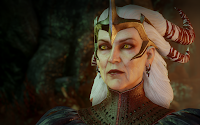
A visit from Flemeth for the holidays
Just a silly little confection, hug, and thank you to you Dragon Age friends who have made my life so rich and meaningful, especially in one of the toughest years of my life (and, I know, so many of our lives).

It's goofy, but I hope you enjoy...

Note 1: I have been schooled that I should have used Satinalia, not Wintersend here, but I still think "Wintersend" sounds better. Oops! Oh well.)

Note 2: I've broken up the poem thematically if clunkily, so it's easier to read—it's just meant to be a fun exercise so I'm totally not keeping things formal, here...


A Visit from Ashe'bellanar (The Night Before Wintersend)


'Twas the night before Wintersend, and all through the Keep

Not a creature was stirring, all Skyhold asleep!

A stillness and silence filled all Herald's Rest

While up in the Rookery ravens did nest

Both mages and templars were snug in their beds,

As gingerbread Fade spirits danced in their heads

Meanwhile, up in my quarters, in halla PJ's

I'd just gone to bed for the first time in days,

When out on the steps there arose such a clatter,

I sprang from my Free Marches bed -- "What's the matter?"


Then I ran to my balcony quick as a dance

Just hoping that I wouldn't see Corypants

The moon on the battlements shone with a glow

Gave the luster of Veil-Fire to objects below

When, what to my wondering eyes should appear,

But a dragon and sleigh, it was actually here!

As it circled, it changed, and then oh, Maker's Breath,

I knew in a heartbeat that this was Flemeth! 

More regal than gods with her Hair Horns of Awesome

Her armor with touches of Arlathan blossom


"Now, Solas, now Seeker, now Varric," she called

"Now up, Iron Bull, Sera, Vivienne and Blackwall!

Get you up Leliana, and Josie, and Cullen

I bring Wintersend cheer, so you'd best not look sullen!

Up, Inky and Cole, and up, Dorian, boo!

And oh come all ye Chargers, and Maryden, too!

Sutherland and Scout Jim, come away from your stalking

I've got trinkets galore, so you better get walking!

But I won't wait forever, I've got things to do!

I just thought that I'd stop with a present or two.

So come down now to greet me or off I will fly!"

And so downstairs we tumbled, with our hair all awry.


And there in the courtyard, she stood with her sleigh

And eight tiny halla, already munching some hay

With a big bag of presents, at least twelve feet tall

She handed them round to us, Chargers and all!

There were goodies and treats and delectable things

And funny gifts too, like small toy nugs with wings

There was cocoa for Bull, and a dragon-tooth pile

That was perfect for weapons or one kadan's smile

There were kittens for Cole and a hat even wider

Plus a fine quill for Varric and a barrel of cider

A beard kit made Blackwall give Flemeth a blush

As he'd never seen anything nearly as plush

Fine thieves' tools gave Sera new chances for mayhem

And a fresh deck of cards tempting those that would play them

A new Swords and Shields to thrill Cass with each word

Plus new lute strings for Maryden's unsecret chord.


For Dorian, some fine ancient tomes of enchantment

To inspire him to further magical advancement

There were new paints for Solas in colors divine

And glasses just perfect for sweet elven wine

There were bangles and lutestrings and slippers for Leli

And tea cakes for Josie with Antivan jelly

There were potions for Inky and salve for the Mark

And an elfroot bouquet for when times got too dark

Then for Cullen a how-to on quick roof repair

And a silverite brooch for one Madame de Fer

For Lace Harding some beautiful blooms to bemuse

And bright armor for Sutherland's personal use

For gruff Cabot some barrels of Orlesian mead

While new runes gave Dagna the magic she'd need

There were new raven cages for Plucky's elites

New blankets for Schmooples and dracolisk treats

Plus a barrel of mint to make cats play with zeal

And cheese to give mice a more sumptuous meal


The bag it was endless and obviously magical 

Filled with fine gifts and not one of them tragical

For Skyhold's found family it was a delight

Filled with comfort and joy (and no plaidweave in sight!)


And then giving a nod and a wink from her eye

Flemeth leaped to the sleigh and then took to the sky

The Skyholders all cheered as the Witch took a lap

Round the battlements high where the brave banners flap

Observed Dorian, "The magisters had up their sleeves

Rare spells such as Flemeth has shown us this eve."

Yet as the sleigh vanished ('twas just before twelve, then)

She called back, "It is not Tevinter, but elven."


So let us heed Flemeth's wise seasonal call

And cry, "Happy Wintersend!" and ar lath ma to you all!


Sunday, October 17, 2021

Heads, Hearts, and Headcanons in Dragon Age Origins


OGHREN: Let's show them our hearts, and then show them theirs.

One of the greatest things about RPGs is how personal they feel, and of course that's by design. They're role-player games by definition, after all, and the best of them, like those in the Dragon Age series, allow us to immerse ourselves in their world, creating characters, atmospheres, relationships, and more. We feel like we're there; we feel like we're them. And that's fantastic.

If you read this blog, you already know I'm a headcanoning fool, and I know from my fellowships with many of you out there that I'm not unique in this! As with the greatest fiction, I love the feeling that I can transport myself and feel like I'm somewhere else while I play—that wonderful sense of escape the moment that opening music starts up, whether it's Inon Zur's haunting and delicate melody, or Trevor Morris's more somber, thoughtful overture. And right away, just from those first few music notes, I'm the Warden, I'm Hawke, I'm the Inquisitor, I have fabulous mage powers, I'm surrounded by a found family of cool, interesting companions, and (of course) I'm instantly attractive, fascinating, and talented. What's not to love?

So let's talk headcanons, and all those little things you find yourself thinking and imagining that add texture to your Dragon Age world as you play. Each of us has our favorites—so here are some of mine!

I'll start with Origins in this post, but I'll be looking at each game to follow, in separate posts, too. I was going to do all of them in one post, but—incredibly!—I am actually not going to put them all in one giant post for once. (I KNOW! WHAT'S HAPPENING TO ME??)

But onward.


Imagining Origins

I have some odd little headcanons when it comes to Origins. 

First off, when it comes to the effects of drinking from that cup for the Joining, I always felt like it was, a little bit... personal. I felt like, when your Warden undergoes the Joining, that they not only get that connection to the Archdemon that we hear about, but that the Archdemon also gets that connection to you. I mean, personally. That the Archdemon sees you in those nightmares, knows you, and you are now on a very short list. 

That's the reason—to me—for that piercing moment during the Joining when the Archdemon looks right at you. Because it does. It sees you. It hates you. You, personally, among the others on that very short list. And it is going to get you. That's pretty damn terrifying.

I also headcanon that there's a LOT of guilt to Duncan over the Joining, or there should be, because he's pretty morally damn shady there on a number of levels. It's a situation where the Wardens are actively suppressing the actual danger of the ceremony, because (understandably) if it were common knowledge that the Joining was lethal, even fewer would volunteer than already do (although they also conscript people, but that's a discussion for another day). So instead, we get that heartbreaking ceremony where people like Daveth don't survive the sip, or where Ser Jory says, "Um, WHAT JUST HAPPENED? And... er... what are the odds again?!" and then gets skewered to preserve the secret, etc.

And to be fair to poor Jory (who gets a lot of flack from the fandom), I don't think he's a coward. I think there's a world of difference between volunteering for a straight-up fight with a sword against an enemy —and volunteering for a service that also involves undergoing a secret mystical ceremony in which your odds of survival have been hidden from you for PR reasons until now. I always feel sorry for him, and for Daveth, and for poor Mhairi in Awakenings (I adored her), another who simply doesn't survive the sip... and countless others. 

Want a different take on the Grey Wardens? Play a conscripted Cousland—it's an interesting and more complex point of view to play a protagonist who didn't volunteer for this or choose it in any way (although the Circle Mage origin is basically a "do this or die" situation as well). Suddenly, Duncan and even Alistair are a little darker around the edges.

I do appreciate that Duncan is all quietly regretful and nobly sad about Jory and everything, but let's face it, once you get past the hotness and Shakespearean magnificence of Duncan and his beard and voice and general hotness (wait, I said that already), he's still maybe not walking on the side of the angels, here. I just think, knowing  if he's the good man he presents himself to be (or seems to want to be, if we want to talk semantics), that he's probably suffered his share of guilt-stricken sleepless nights. 

(In which case, CALL ME, DUNCAN! Wait, oops, did I say that out loud? Never mind...)


Messages in Roses...

And then there are the companions who become our Warden's family. I definitely headcanon that we see the last vestiges of innocence for both Alistair and Leliana in Origins, and I find that especially moving in hindsight. Leliana might be an experienced bard in DAO, but there's still enough innocence and belief to her that a simple rose can inspire her to an odyssey that will change all of Thedas. And for Alistair, a different rose may inspire his feelings of first love.

It's especially fun for me to think about Alistair's internal journey in Origins too, because he's such a contradiction—someone we really see finish growing up. The Alistair as the story begins is an innocent young man who still has a lot of the boy to him—he's sweetly unsure of relationships and is still full of awe and wonder about a lot of the world. 

But while Alistair is wide-eyed and naive in some ways, he's a contradiction in others. He's lighthearted and funny, true, but there's real sadness underneath—this is a guy who was hated and resented by his stepmother and sent out to sleep with the hounds. 

I'm always affected by the idea that, even in the Blight, part of Alistair is living the dream for much of Origins. At last he's free to be the hero he dreamed of being in all those cold nights, and he's finally free to travel like the heroes he imagined, and stand right alongside his adored father figure Duncan. Being a Warden is all Alistair has ever wanted, and when I think about this, and about the lonely little boy he must have been, it's no wonder that he falls so hard for a female Warden, or bonds so quickly with his companions. I also get a kick out of how quickly Alistair bonds with Wynne as the instant adoptive Mom he probably always wanted but never had, so I headcanon some homely moments at camp like Wynne teaching Alistair how to wash his own socks, or the basics of camp cooking, and more.

I also think about Leliana here... she's someone whose faith is so deep and profound that I have no doubt she's talking to the Maker on the regular in those quiet evenings when she's alone and thinking about her path.


The Quieter Moments at Camp

I always love going back to camp in Origins, and it's where I have the most fun imagining the relationships playing out as our companions evolve through the story.

First off, after seeing his expression during Leliana's song at camp, I absolutely think Sten's tent is always somewhat near Leliana's, simply because he is starved for things like music and art and softness, and he loves to sit and listen to her play or sing, even if he won't admit that out loud. I think the DAO party trails a constant stream of rescued cats and kittens that Sten feeds, pets, and plays with at camp (gruffly, of course, and loudly claiming he is "training" them), and that Alistair is a sucker for Barkspawn—I think he'd always have a fondness for them, so my headcanon is that Alistair would give Barkspawn lots of treats and playtime, while Sten watched disapprovingly, worrying loudly about Barkspawn being "spoiled"—but then of course he'd sternly lecture Barkspawn about all of this later on... and then give him treats.

I also like to imagine that Morrigan's little witchy separate campsite moves closer and closer and closer to the main campsite night after night as they travel, so that eventually it's right there next to leliana's, while she's still loudly protesting that she doesn't really like any of these people, and 'tis laughable that they'd ever accuse her of such madness.

I also privately believe that Oghren is more upset about Branka than he appears to be, and that there may have been some quiet tears in the late nights over at his side of the campsite. This is also why I think he's so constantly drunk, as well—as a way to manage his grief.


Shipping Origins

Romantically, do I have ships? Oh, yes, so many ships. Starting with the fact (and yes, this will shock those of you who read this blog regularly) that Sten means "kadan" in the romantic sense when he uses the word for his Warden. It doesn't help me that not only does he do this, and it's enormously affecting on that front, but Sten also has that ridiculously beautiful voice (thank you Mark Hildreth), which makes it even more swoonworthy.

Interesting side note: I've written a fanfic about this (yes, be afraid, be very afraid), but I will note that while I think Sten loves the Warden (and vice versa), for me there's even a headcanon reason why he's not a romanceable choice in-game. There's a reason he doesn't speak. It's hopeless. This isn't a situation for happy endings. Sten will leave after all of this and go back to Seheron (or Par Vollen). 

I've written about this before, but Sten is an interesting character to me precisely because he is a series of contradictions. He falls in love with the wide world outside of Seheron in DAO, and falls in love with its kittens and cookies and art and new cultures... but he is not a convert. He still sees these things from the point of view of the future conqueror. So he will not stay here. He will go back home. And even if he loves the Warden—he's still leaving if he survives. Unlike Bull, I believe nothing can sway Sten from belief in the Qun.

But on to happier ships. Most importantly, when it comes to my internal headcanons, if Zevran does not hook up with the Warden? I think Zevran totally hooks up with Wynne instead. This is a headcanon for me on the same level of belief as Adoribull. It's real for me, and it makes me profoundly happy. Nobody talks that much about somebody's bosom without being actively interested in seeing and touching said bosom. And I think they'd be good for each other. She'd drop some of that overly prim exterior (methinks the lady protests too much), and he'd have an emotional relationship that went beyond political expedience, work, or momentary pleasure.


The other little sort-of romance happening in Origins for me is Shale and her feelings for Sten. Now, this isn't exactly headcanon since it's something that we actually see via the banter dialogue (and it is funny, charming, and oh-my-God so subtly heartbreaking), but that dialogue leads to some headcanons for me, too. We know from those banters that Shale and Sten evolve their friendship to "kadan" levels of comradely affection, and we also know that Shale slips up at a later moment to reveal that she actually has feelings for Sten that not only seem to be romantic, but genuinely physical and sexual.

The fact that she feels these things almost 1200 years after her transformation, with her spirit confined to a hulking body made of stone, is really sad to me, especially because it seems to me that Shale doesn't seem to feel anything on a sensory level, to the point that she casually references being "whittled down" during her time in Honnleaf, for instance. She's truly a prisoner of stone. Since a sensual life is denied to Shale as part of the tragedy of being a golem, the revelation that she does in fact desire Sten physically is even sadder to me.

Which means that I headcanon that there are plenty of nights at camp where Shale contemplates the stars, unsleeping, listening to the small noises of the sleepers around her, and feels ancient and separate... and very, specifically, lonely. Although she will of course never admit it.

(Note: for some reason, the Dragon Age Wiki on Shale is currently referring to her as "it," and I'm very confused by whoever made this change, since Shale openly identifies as female in her dialogue. Or is she now considered nonbinary? In which case, shouldn't her pronouns be "they"? Sound off if you know!)

The Witch and the Bard

So many ships, so little time!

Let's see... yet again, there's the obvious fact that, as with Sten, the game won't let me romance someone I want to romance (Morrigan with a female Warden), which means I immediately ship that, and I always will. I'm still sad about that female Warden/Morrigan romance not being possible, because I do think (as with Cass in DAI) we're given glimpses of an interest in our heroine that goes beyond friendship, at least in moments. And I think there would be something soft and charming to it, and it would illuminate Morrigan in ways that a more stereotypical heterosexual romance (where she seems more focused on dominance and gamesmanship) does not.

Beyond that, I also ship Leliana and Morrigan a little in Origins. They're both so prickly with each other, and Morrigan is so completely over the top in her venom if they're rivals for the Warden that I feel like there's more than simple envy there. Especially since Morrigan relentlessly implies that Leliana is  inexperienced and frigid, and I'm sorry, it seems to me like Morrigan is forgetting that Leliana is a bard, and by her own accounts a skilled one in every sense of the word. She slyly talks about assassinating a mark after taking them as a lover, so Leliana even in Origins is certainly not the blushing nun Morrigan rather hilariously insists she must be. 

But beyond this, I do feel like there's real interest there as well, a spark between the two women. Leliana talks openly about Morrigan's beauty, and wants to take her shopping! I mean, I admit that this isn't exactly "go on a date with me," but come on, shopping with Leliana could totally be a date. Besides, we're in my mind, anything goes.

Meanwhile, while we're talking about ships here, let's face it, there's enough open snark, bickering and banter between Morrigan and Alistair that they're practically begging to be a rom-com and are inches away from realizing that all their arguing was actually just love in disguise. In some other universe, they realize their mutual attraction, throw themselves at each other, have surprisingly good sex for about two weeks, then break up, to both of their mutual relief.

Now none of us has to see the movie! You're welcome.

Schmooples, Barkspawn, and a Dash of Pounce

Meanwhile, I also headcanon that Barkspawn takes a little while to get used to Schmooples, but eventually plays with him, that Oghren is constantly secretly plotting to eat Schmooples, and that Schmooples has to sleep in Leliana's tent with her, curled up at the foot of her bedroll, so that Oghren won't make bacon out of him. Even if/when Leliana hooks up with anyone else in the party.

I also think Sten would have played with Schmooples secretly (since he's a softie about animals), and we already know he talked to Barkspawn, so of course he played with him as well (which I've already detailed earlier here too). My favorite mental image is of Sten getting Barkspawn to practice fetching in all these sort of gruesome scenarios, like, Barkspawn brings him a skull and he's all, "You are a good and honorable creature. I will boop the nose." 

Still, as far as animal headcanons, my favorite one in all of Dragon Age, however, has to be the mental image of sweet, brave little Ser Pouncealot leaping at the faces of Anders's enemies in Awakenings. Because in my head, he's basically riding around in Anders's backpack, and in battle, he crouches on Anders's shoulder, then jumps right out at people. Mrreowrr! Attack!

Goddesses and Archdemons

I adore Flemeth as a character, although even three games in, I'm not sure if I trust her, so I love every single scene we get with her, and especially listening to the gorgeous combination of violin-meets-rusty-gate that is Kate Mulgrew's fabulous voice. And I especially love her subtle amusement at our complete befuddlement at the greater events of Thedas. I mean, here's our young Warden, who depending on the chosen origin story is varying levels of traumatized, scared, tired, and new to all these great matters, talking to what we will later realize is basically an ancient queen and demigoddess. 

Flemeth sees all of Thedas as a chessboard and, for good or ill, is moving those pieces. Meanwhile, we're just trying to get through all this with a little nightmare-free sleep and a clear idea of the next 24 hours, and most of the time, we're failing at both. Flemeth's operating at a whole other level, and so, it turns out, is Morrigan. Morrigan may hate her mother, but she, too, still seems to serve that larger picture, because even if we kill her mother in her dragon form, she will still show up in the end to offer the Dark Ritual.

When it comes to Flemeth and Morrigan, it's interesting that Flemeth sends Morrigan off as her Official Swamp Witch Representative of sorts, even while knowing (it's pretty clear) that Morrigan will not only betray and attempt to supplant her, but that on some level Flemeth deserves that betrayal. Seriously, listen to the stories Morrigan tells about her childhood. Flemeth was a truly horrific mother, and Morrigan's tearful gratitude over the beautiful little mirror as the first actual freely given gift in her life will always enrage me.

So it's interesting for me to headcanon that Flemeth expects Morrigan's betrayal and may have even orchestrated it as a necessary next step. And whether or not we try to kill Flemeth on Morrigan's behalf (which I pretty much don't do anymore, because the fight's a tough one, and it's much more interesting to talk to Flemeth instead), I always imagine that afterward, when we leave, she goes back into that lonely little hut, and maybe she finally allows herself to realize what she did to her daughter. Flemeth may be ancient and cold, but yes, I think there are tears.

I don't love Anora, meanwhile, although I think she's an interesting character, but her instant pragmatism and willingness to betray us if we rescue her always makes me laugh. There's not even a break in the action, she's just, "Nope! They are not my rescuers, and I am not a part of this in any way!"

Nevertheless, when I imagine the Landsmeet, if Loghain is executed, from the Origins gore that instantly sprays across her face as her father dies, I definitely headcanon that poor Anora went off afterward, had the appropriate breakdown, and thereafter lost most of her taste for statecraft. Or, in an alternate universe, it's fun to imagine the moment sending Anora into a cinematic-level revenge spiral.

Meanwhile, the final battle with Urthemiel is sort of comical for me in some ways, because I spend the entire thing divided between my attacks on the Archdemon and spamming heals to protect my adorable Hot Young Teagan from harm. (I used to protect First Enchanter Irving too, but after Dragon Age II and what Kinloch Hold (keep in mind, reputed to be one of the "kinder" holds) put Anders through, honestly, Irving can fuck right off.)


Aftermaths

Depending on how that last battle goes, I have a number of minor headcanons. We get some sketchy details on life after the events of Origins, and of course most of those are presented as rumors (a very smart choice, once the game became part of a series).

If the Dark Ritual is refused and the Warden dies, like most of us I usually imagine the lives of their Companions afterward—not just the obvious sadness of the romanced Companions who have lost their love, but the effects of that loss on the lives of the others, too. There's some incredible fan art out there that explores some of these, and one of my favorites, by Remington-Zero, involves Zevran talking with the Warden, for instance, and it turns out he's making the latest visit to their gravestone.

Of course, we can also end Origins not just with the loss of our hero and avatar, but with the potential loss of so many of our friends—with the loss of Alistair or Sten as companions, with the deaths of Sten, Leliana, Wynne, Zevran, Shale, or poor Barkspawn (NEVER HAPPENING! Don't "at" me!), and in every case that loss is potential fuel for imagined grief.

We do know some of the fates of our friends who survive, and see many of them again in later game story chapters. Among those we don't hear much about... among the aftermath stories I imagine with Origins is the idea that Shale goes and finds the secret to unlocking her dwarven female form again, and while I don't think she goes and romances Sten and finds true love or anything, I do like to think that she meets up with him again in some far-off time and place, probably after he's Arishok, and that he smiles when he realizes who she is, and hugs her. (Yes, I headcanon that Sten hugs people, albeit grudgingly, and that he gives great hugs, although no, probably not quite at The Iron Bull-level of hug greatness).

As far as Barkspawn, after I saved him (since I always save him) I imagine that he had a long, long life, and that even as a Grey Warden canine, he was old but still alive at the time of Inquisition's events. I also absolutely know, with certainty, that after all the adventures of Origins are done, that when he returned to Par Vollen, Sten carried a rescued cat in his satchel... as well as a recipe for cookies.

What are your favorite Origins headcanons? Please share them in the comments!
Saturday, January 19, 2019

The Complete Guide to the Dalish Vallaslin (and Their Potential Meanings)

Cole: She is bare-faced, embarrassed, and she doesn't know. She thinks it's because of her.

Face paint? Or hidden secrets? Wait and see...
We see them so often... but what do the Dalish vallaslin designs represent? 

First off, let me state: I think or suspect Solas is being deliberately simplistic in the big "vallaslin scene" at Crestwood (also known as The Worst Date Ever). Probably deliberately so. He loves games, after all.

Like: Yes, I think he's telling the truth. The vallaslins became slave markings. But were they always? 

Evidence suggests not. Codices and other references, to me, seem to imply that the vallaslins may have started as markings of simple allegiance, of tribute. Which to me makes the idea of the vallaslins of Solas, Abelas, Ameridan, etc., a lot more believable. And which, to me, also ties with Legion of the Dead markings. I think they are linked: visibly. And ethically. Elves came first. But I also think those dwarven markings were, well, slave markings. DAMMIT ELVES.

And as far as Solas, if we buy his scenario, it's pretty clearly canon (per Cole) that he had and then removed Mythal's vallaslin for love and later for ethical reasons. Which again fits Solas.

But let's go further.

Are there secrets to be found in their images and icons? I've always wondered if they were simply beautiful abstractions or whether each vallaslin meant something else, tying the image to the god or goddess it represented.

Me? I vote yes... there are secrets to be found there.

I definitely think we can see real images and symbolism in the beautiful lines of the vallaslin that correspond to the personalities and aspects of the Dalish pantheon. Here we go! 

Mythal


Mythal's alternate (cheek-wings)
Mythal's vallaslin is a beautiful flowing of interlocking roots or veins that in the simplified versions either flower across the forehead alone or curve up each cheek like wings.  The simplified "wings under the eyes" Mythal vallaslin is probably most famous among the fandom as that of incredibly talented fan artist Nipuni's "Solavellan" Lavellan character, Nalia.

Mythal combined
In the complex version, it flowers up like a tree from the nose across the forehead, with the "wings" connected and gracefully circling back around and beneath each eye. There's also a separate pattern on the chin that is almost a smaller, mirrored reflection of the forehead piece (and if you look closely, the two may actually be linked in canon, down across the nose, through the lips, and straight down into the chin piece. The most obvious interpretation of the chin aspect is of roots for the "tree" of the forehead. I also want to update this post to note the lovely observation by Tee on Twitter that this beautiful branching vallaslin also obviously echoes the description of Mythal's grimoire, which features "a leafless tree" on its cover. Thanks, Tee!

However, to me, if you look closely at Mythal's vallaslin, it's not just roots or branches, but an actual, highly stylized dragon, with the pointed head over the wearer's nose, and with the wings enveloping the eyes.

In which case, is the chin pattern... the fire breathed by the dragon? Maybe.

Most important of all, though, is (I feel) the idea of roots, of tendrils, of growing things. Mythal is not about abomination or tyranny but about growth, life.

Elgar'nan Version 1
Elgar'nan

Elgar'nan's vallaslin variations are both interesting. The first is a bold, spiky interlocking series of branches almost like thorns that cover most of the face from chin to forehead.

The more complex version includes this same, heavily graphical and thorny branch configuration, but then adds a deep, dark tattoo covering half of the face vertically, with the 'thorns' pattern reversed (uninked).

Elgar'nan Alternate
To me, this is a clear visualization of darkness and light both literally (Elgar'nan was created out of the moment the sun hit the land), as well as figuratively (Elgar'nan was also violent and vengeful). 

There is even the slightest visual hint of forked lightning (another thing associated with Elgar'nan) as well here.


Falon'Din Version 1
Falon'Din

As the God of the Dead, and one I've surmised may be an actual spiritual entity rather than a physical twin to Dirthamen, this vallaslin is interesting and suggestive.
It's very clearly a tree (it almost looks like one of Fillory's clock-trees from Lev Grossman's The Magicians series), which to me is a clear evocation of the vallasdahlen, the life-trees planted by the Dalish on the graves of those who die.
Falon'Din 2 (complex)

I also think there's a potential owl-shape in there on the forehead as well, in the very center of the tree, along with a hidden figure-eight symbol within the forehead-tree that may symbolize both eternity/infinity or The Fade, since circles in elven graphics seem to reference the Fade or Beyond. This could be significant since, as I've noted elsewhere, it's very possible Falon'Din was born a spirit, not a fleshly being (which would also explain his ability to travel to and from the farthest reaches of the Fade with ease). And speaking of the Fade, that circle with the dot at its center is undoubtedly an image of the Fade, just as a similar circle and dot represented the Fade on Solas's fresco on The Siege of Adamant.

The central clock-tree element also strangely reminds me, just a little, of part of Solas's mural -- this time, the one that occurs after the Temple of Mythal. The rather spiky, stylized figure there is meant to represent Abelas. The "tree" here could almost be a similarly spiky figure, arms outstretched. Or perhaps I am again looking far too closely!

Meanwhile, the alternate Falon'Din vallaslin features those tendrils that reach toward the eyes, cheeks, neck, hairline, and around the eyes. Symbolizing the inexorability of death? Or of dreams?


Dirthamen Vallaslin
Dirthamen

As the Keeper of Secrets and Master of Ravens, as well as the god of Knowledge, Dirthamen's is fascinating because it's one of the easiest to parse -- the forehead graphic is fairly obviously a very stylized raven  in flight (Dirthamen famously had two ravens that he mastered, Fear and Deceit).

If you look closely, you can see the head and "beak" of the raven stretches down across the nose, with the wings arched back in flight on the forehead. Or... if you interpret differently, are the "wings" arched back on the cheeks? I do think either way, that this is a bird in flight.

And look at all the downward-facing triangles!

Are the triangles symbolic of secrets? Is that what all the countless downward-triangles may signify on the many frescoes we witness across Dragon Age: Inquisition and "Trespasser" (and now, in the new #TheDreadWolfRises teaser)?

Andruil
Andruil Version 2

I love Andruil's and it's so easy to figure out too, since it's a big, honking, giant bow right in the middle of the wearer's face with the readied arrow pointing up. 


Andruil Version 1
Yet. The more complex version of Andruil's vallaslin, with its branching, flowing lines, could actually also reference the Vir Tanadhal, the Way of Three Trees.

Andruil Mosaic
And those flowing 'rays' meanwhile that we see emitting from the bow in the complex version to the left -- I think these are another representation of the squiggly lines or "rays" we previously witnessed on Andruil's mosaic in the Temple of Mythal.

As for me, I think they may symbolize instability, insanity... or Blight.

Sylaise version 2

Sylaise

As the provider of fire, rope, and herbs among her gifts, Sylaise's beautiful simplified vallaslin looks to me like the curling smoke from a flame, which would be fitting since she brought fire to the people. 

The intertwining curls could also be a subtle reference to a graceful growing herb, as well—appropriate to her identity as a kind of spring or fertile goddess figure.
Sylaise version 1

The more complex version, meanwhile, turns these curves into a few very clear yet intertwining ropes or vines, some of which actively appear to be budding or flowering. These "vines" are leafier than those of the other gods, and are also multiple shades from light to dark. There's also something almost "dragonlike" about the vines at the top of the forehead, but I could be reading too much into things there (I usually do!).

June

First off, this one's notable as it's one of the only ones to go all the way down the neck of the wearer. To me, it's stylistically very evocative of the Legion of the Dead tattoos among the dwarven people -- could this be a hidden clue to add to that growing list that the lives of dwarves and elves in ancient times were intertwined? 


June Version 1
After all, June is the god of crafts and weapons (I'm picturing a very Hephaestos-like figure)... both beloved of the dwarves (especially those "fine dwarven crafts... direct from Orzammar!"). Even his mosaic in the Temple of Mythal includes a huge anvil glowing right before his figure. And yet it's also implied he didn't just craft weapons... remember the Anvil of the Void questline with Caridin in Dragon Age: Origins? What if June's was something similar -- but far more powerful? What if he actually forged... people, like Caridin? The dwarves themselves?


June Version 2
The rest of June's design could be seen as being a skeletal tree with roots, but to me the entire shape and the repeated curving lines at the forehead are reminiscent of armor, and specifically, of a faceplate. I love how the interlaced lines across the forehead actually evoke the lines of an armored visor.

And the strong vein that runs down the neck isn't plantlike to me, so much as veiny or blood-like. To me, it may represent heart's-blood. Or, the blood of the stone... lyrium?

Ghilan'ain Vallaslin
Ghilan'nain

Here we find one of my favorite vallaslins, the lyrical and stylized, flowing diadem that is a gorgeous abstraction of a halla head and its branching, flowing horns.

It's a very pretty and delicate vallaslin, and it's usually my favorite for my Lavellan Inquisitors. I used to choose it because I loved the look of it, and I felt that Ghilan'nain was among the gentler of the Dalish gods.

Of course, after heavy research on my part, I'm not entirely sure this is true. But I was so much younger then, a sweet summer child who had no idea that I'd eventually be one of those people who uses elven swear words or who is still microanalyzing everyone's dialogue for clues.

But that's Dragon Age for you! Meanwhile... what do YOU think the vallaslin symbolize? What have I missed?

Sunday, September 2, 2018

The Dragon Age Timeline: Part 2: From the Divine Age to the Towers Age


Welcome to the next installment on my own personal take on the Dragon Age Timeline, taking us from the Divine Age through the Glory Age and then on to the Towers Age.

And unlike my previous look at the Ancient Age, I'm restraining myself from babbling about my love for Tolkien lore, The Lord of the Rings, or just, like, babbling in general... 

(Oops... DAMMIT.) 

But onward! Here we go. As always, let me know what's missing or wrong here, so I can fix it!

The Divine Age:

  • 1:01 Divine - Justinia I elected as Divine.  She takes up residence at Val Royeaux's Grand Cathedral, which is still in the process of being built.
    The Chantry declares that the use of magic is illegal throughout Orlais unless by mages on the Chantry's behalf. 
  • 1:05 Divine - The Second Blight begins. Awakening of Archdemon Zazikel in the Anderfels. Slaughter of the city of Hossberg.
    Emperor Drakon calls on mages to use their magic against the Blight, and their powers turn the tide of battle.
    The Tevinter Imperium abandons the Anderfels to the Blight, a decision the Anders people never forget. 
  • 1:10 Divine - The Chantry is officially founded.
  • 1:16 Divine - Drakon wins a key victory against the darkspawn in the Battle of Cumberland.
  • 1:20 Divine - Signing of the Nevarran Accord between the Chantry and the newly founded Inquisition.
    Formation of the Seekers of Truth by senior members of the Inquisition.
    Formation in Ferelden of The Circle of Magi and The Templar Order as its overseers. The first Circle is led by Grand Enchanter Lothaire Hardouin.
  • 1:22-24 Divine - Ameridan departs on his mission to the Frostbacks.
  • 1:25 Divine - Montsimmard is nearly destroyed by the darkspawn. Nearby elves take no action for rescue.
    Ameridan traps Hakkon in dragon-form and goes into stasis.
    ~(Estimated) Deaths of Telana, Orinna, and Haron
  • 1:31 Divine - Darkspawn attack but do not take Minrathous.
  • 1:33 Divine - Emperor Drakon relieves the siege of Weisshaupt and Grey Wardens convert to Chantry worship. Together, both save the Anderfels from the Darkspawn, bringing it under the rule of Orlais. The Anderfels convert to the Chantry.
    Elves of the Dales continue to refrain from action against Blights.
  • 1:40 Divine - Hafter, an Alamarri warrior, unites the tribes of Ferelden and defeats the darkspawn.
  • 1:45 Divine - Death of Emperor Drakon of old age in Val Chevin. Drakon is succeeded by Kordillus II, his son.
    The teachings of Andraste and the Chantry come to Antiva, where they quickly become popular.
  • 1:50 Divine - Hafter is proclaimed Teyrn after defeating both Chasind and Avvar to take the Fereldan valley.
  • 1:65 Divine - The Anderfels declare their independence from Orlais.
  • 1:79 Divine - Birth of future king of Nevarra Caspar Pentaghast.
  • 1:95 Divine - Last battle of the Second Blight at Starkhaven. Destruction of Zazikel.
    Astyth the Grey becomes the first female Paragon of the Warrior caste after sacrificing her life for the King. Formation of the Silent Sisters order in her honor.
  • 1:99 Divine - Divine Hortensia I names the Glory Age.


The Glory Age:

  • 2:05 Glory - Tension increases between elves and humans on the borders of Orlais and the Dales.
  • 2:09 Glory - Elven forces attack and hold Red Crossing in Orlais, reportedly committing atrocities against the humans there. Orlais declares war on the elves of the Dales.
  • 2:10 Glory - Teyrn Caedmon, the grandson of Hafter, declares himself king in Alamarri lands, sparking a civil war.
  • 2:10–20 Glory - The elves capture Montsimmard and march on Val Royeaux. In retribution, Divine Renata I calls for a holy war against the elves, which becomes known as the Exalted March of the Dales. 
  • 2:14 Glory - The elves sack Val Royeaux.
  • 2:15 Glory - The rise of Starkhaven. Starkhaven's king, Fyruss, allies with Tevinter and attempts to conquer neighboring regions to create an empire of his own.
  • 2:18 Glory - Caedmon is killed at the Battle of Valmorn Hills. The power struggles during this period become known as the War of Crowns.
  • 2:20 Glory - The elves are overwhelmingly defeated, Halamshiral is conquered, and the Dales fall under Orlesian rule. Elven settlements are wiped out, worship of elven gods is forbidden, and the elves themselves are forced to live in human cities in ghettoes known as alienages (established under Divine Renata I), or to wander the countryside as nomads.
  • 2:21 Glory - Sister Amity, a human Champion of the Exalted Marches, lays the foundation stones of a village Chantry.
  • 2:22 Glory - Sister Amity's Chantry is completed
  • 2:30 Glory - Halamshiral's Winter Palace becomes the regular choice for retreats by the empress and Orlesian nobility.
  • 2:33 Glory - Antivan cities to the north unite under a common banner to defend themselves against Fyruss's advance.
  • 2:34 Glory - The fortress of Soldier's Peak is completed after a decade of construction.
  • 2:45 Glory - Fyruss is betrayed by Tevinter, and Starkhaven is conquered and annexed by the Imperium.
  • 2:46 Glory - Caspar Pentaghast of Hunter Fell takes over city-state Nevarra to become its ruler.
  • 2:64 Glory - Death of Sister Amity. Her ashes are interred in the Chantry's vault.
  • 2:80 Glory - A second Exalted March is declared, and Starkhaven is freed from Tevinter rule by the Chantry.
  • 2:83 Glory - An abomination rises in the Nevarran Circle, slaughtering both mages and Templars, and then wreaking havoc in the surrounding countryside. As a result, Divine Galatea grants the Right of Annulment to all Chantry Grand Clerics, allowing them the power to purge Circles of Magi and execute all mages within.
  • 2:84 Glory - The Nevarran abomination is killed by Galatea's Templars.
  • 2:99 Glory - Completion of the Grand Cathedral in Val Royeaux, and The Towers Age is named in honor of the city's towers.
    Archon Vespasian is assassinated.


The Towers Age:

  • 3:00 Towers - (Estimate) Flemeth is born in Highever.
  • 3:06 Towers - Death of King Caspar Pentaghast at the age of 127, after a reign of sixty years over the Nevarran people.
  • 3:09 Towers - For the third time in the history of Thedas, the Right of Annulment is invoked in the Circle of Antiva. Hundreds of mages are executed.
  • 3:10 Towers - Awakening of the Old God Toth. The Third Blight begins.
    Darkspawn attack Marnas Pell and Vyrantium, as well as Arlesans and Montsimmard. Grey Wardens manage to fight off the attacks.
  • 3:18 Towers - Darkspawn attack cities across the Free Marches.
  • 3:20 Towers - ~(Estimated) Flemeth marries Bann Conobar Elstan. 
    ~(Estimated) Flemeth falls in love with poet Osen and leaves Conobar, fleeing to the Korcari Wilds
  • 3:21 Towers - ~(Estimated) Flemeth receives word that Bann Conobar Elstan is dying and desires to see her again before death. She goes to him and is promptly imprisoned and Osen is slain. Flemeth uses magic (and perhaps Abomination) to kill Conobar.
  • 3:25 Towers - Orlais and Tevinter armies join the Grey Wardens to battle the darkspawn in Hunter Fell, killing Toth and ending the Third Blight.
    Afterward, Orlais takes the city of Nevarra, and Tevinter takes Hunter Fell.
  • 3:41 Towers - The Canticle of Silence is declared dissonant by Divine Amara I.
  • 3:44 Towers - The 'Rebellion of Three Dragons' begins near Qarinus.
  • 3:49 Towers - Hunter Fell rebels and breaks away from the Tevinter Imperium.
  • 3:65 Towers - Nevarra rebels and achieves independence from Orlais.
  • 3:86 Towers - Divine Joyous II becomes head of the Chantry.
  • 3:87 Towers - Schism of the Chantry. Tevinter elects their own Divine, a male mage named Valhail, at the Minrathous Cathedral.
    In Ferelden, the local Circle of Magi moves to Kinloch Hold after the razing of their original mage tower in Denerim.
  • 3:99 Towers - The death of the Divine Joyous II in Val Royeaux. The Divine's death is celebrated in Minrathous and declared a holiday by the Imperial Divine.
    The Black Age is named as the Chantry calls for retribution against the "false Divine."


Monday, June 4, 2018

Meet the Evanuris: The Mysteries of Mythal the Great Protector


One symbol is associated with Mythal above all others: that 
of the dragon itself.

FLEMETH: I nudge history, when it's required. Other times, a shove is needed.

MERRILL: It's never wise to ignore Mythal.


SPOILERS as always, for all of Dragon Age!


I've recently been taking a closer look at the Evanuris, both in the accepted mythology of the Dalish, as well as in the more potentially realistic (and disturbing) revelations of Dragon Age: Inquisition and its DLC "Trespasser."

For me, any discussion or analysis of the Evanuris must begin with Mythal, whose very symbol—the dragon—is a source of fear and wonder, and which stands for the age in which most of our story now takes place.

The Dalish Myth

The benevolent protector of the elves who was born of the sea (the tears of the wounded Earth), Mythal, the All-Mother and Great Protector, was seen by the Dalish as the mother of the gods, the dispenser of justice and love, and the partner of Elgar'nan. Mythal brought peace, and saw into hearts and minds in order to dispense true justice, sorting the wheat from the chaff, the true from the false.

Although Elgar'nan defeated the Sun (his father), Mythal persuaded him to allow it to return, and created the Moon (that most feminine of celestial objects) to reflect his light.

What's interesting is that even though Elgar'nan is the nominal leader of the Evanuris, he's by all accounts, even in myth, pretty terrible at it. He starts out as judge, but this quickly becomes a disaster as his inability to control his temper means that he is incapable of rendering calm, cool justice. All his reactions seem to start at rage (I keep picturing Elgar'nan 'hulking' out on a constant basis). Eventually, it appears to me that even among the Dalish myths, Elgar'nan quickly passed the mantle of actual rulership to his mate, Mythal. I mean, he was still the ruler in name, he just didn't seem to want to do the work.

With Mythal, the people could call for justice, she would listen and judge, seeing into hearts and minds, and only then would she take her judgments to Elgar'nan—which he would then dispense according to her verdicts. Until it all went wrong, and she ended either in death or imprisonment.

Among the Dalish, Mythal is assumed to have been either killed by Fen'Harel or exiled with the others due to his treachery.

As the archetypical mother-goddess, Mythal is inherently
associated with powerful symbols of the feminine divine
.
The Facts


Evidently, the myths were true in their deepest sense: Among her fierce companions in the Evanuris, Mythal was evidently the kindest and most just, the one offering protection to her people and who constantly attempted to make and keep the peace among her arrogant and constantly warring companions.

Mythal's most famous achievements were almost always those of peacekeeping. She averted a war between Falon'Din and Elgar'nan at one point, and also brought down Falon'Din (with the rest of the gods behind her) when he began to pursue war simply for even more blood and death in which to revel. Mythal also defeated Andruil after her disastrous trip to the Void (a moment that may have had lasting effects upon all of Thedas, possibly bringing the Blight) and is even reported to have defeated at least a Titan or two, although the information we get on that is both sketchy and decidedly hazy.

Mythal and the Titans

When it comes to Mythal's deeds in the very deeps of the world, I'm interested in her ties to the Titans because I feel like there's something very obviously changed or missing there. Mythal is historically not a conquerer, even if her story is framed that way here, but then again, it also sounds an awful lot like more of the propaganda the Evanuris were so good at disseminating about those who fought them. The kind of propaganda that turned a freer of slaves, for instance, into a Dread Wolf of nightmares and cautionary tales.

As far as Mythal, I just don't think she'd head down and conquer beings as vast as the Titans simply to expand the lands of the People or to amass power, since Mythal doesn't seem to be all that interested in power for power's sake.

So, why, then?

Mythal's all about the big picture. Actually, make that Big Picture. She's the one, above everyone else in the trilogy, that I feel is looking out for the world as a whole. She may be cruel at times, but it overwhelmingly appears, for the most part, that this is out of necessity (after all, Mythal is pretty forgiving and non-judgmental even if the Warden and Morrigan go so far as to kill her in DAO!). So as far as the Titans and her conquering one or more of them, my feeling is that it has to be for reasons beyond expansion or greed for lyrium; that instead, she does this because Thedas needs her to. I even wonder if she was responsible for burying all access to the conquered Titan, as a later Codex implies—if it was Blighted, she may have been trying to forestall the entry of the Taint into the world (or simply access to the Blighted (red) lyrium, a separate if parallel deadly poison).

Alternatively, Mythal may have known that the elves would need this power in the future. I'll expand on this in a full later post that will simply address the ties between Mythal, the Titans, the dwarves, the Wardens, Lyrium... and the Blight.

Signs and Symbolism

As the archetypical mother-goddess, Mythal is inherently feminine, and is associated with unshakably feminine symbols, from her birth from the sea, to her creation of the Moon itself.

It is also widely speculated that the constellation Silentir may in fact represent a dragon figure (and Mythal). While some (many) have associated the constellation with the Old God Dumat over the ages, it's worth noting that the elven gods factually predate the Old Gods by millennia—in other words, Mythal came first, but as with so many elven signs and symbols in Thedas, she was once again supplanted, mercilessly, and her origins obscured once again with those preferred by the human Tevinter conquerers.


With its quietly alien dragon face atop the body of a naked female figure, the
winged statue of Mythal that we find frequently across her Temple area in
 the Arbor Wilds is both beautiful and forbidding.
One symbol, of course, is associated with Mythal above all others: that of the dragon itself, and statues and images of dragons appear frequently around her temples and sacred spaces, both in graceful full dragon form (with massive serene, almost mournful figures depicted, heads lowered in either grief or acceptance), and in a woman-dragon form consisting of a womanly figure with dragon wings and a pointed dragon head. The woman-dragon figures are especially striking, because they beautifully reflect the duality of Mythal and Flemeth—the goddess and the witch, the woman and the dragon.

The figures also evoke, for me, a strong visual echo of the Nike of Samothrace (my favorite real-world sculpture, and—true story—when I saw it in person at the Louvre, I burst into tears. Someday I plan to steal it in a nonviolent, high-stakes crime caper and to then put it in my living room, where I will sit and gaze adoringly at it until my inevitable arrest by, of course, the French detective with whom I will be having a doomed but passionate affair). 


Where was I? Oh, right—dragons!

Appropriately, Flemeth (who carries the wisp of Mythal's spirit and awareness within her) is also able to shapechange into the form of a high dragon at will. There are also more subtle parallels—when Mythal confronts Andruil (who has gone mad after her trip to the Void), she fights her in the shape of a giant serpent (which is, once again, a frequent synonym for 'dragon' in high fantasy).

But the dragon isn't just Mythal's symbol. It is a sacred creature, a sacred form, and not only does it look like it may have been a shapeshift all of the Evanuris were capable of accomplishing, but it was also evidently an act of sacrilege for others to attempt.

Retribution and Judgment

Flemeth may be vengeful against those who wronged her so long ago, but she's not, as I mentioned, terribly judgmental in actual temperament. Going back a few millennia, however, it appears that Mythal did indeed have her moments. Based on the Ancient Elven Writing Codex from the Arbor Wilds, Mythal could be fierce in her judgment and retribution against those who took the sacred dragon form, as here:
"His crime is high treason. He took on a form reserved for the gods and their chosen, and dared to fly in the shape of the divine. The sinner belongs to Dirthamen; he claims he took wings at the urging of Ghilan'nain, and begs protection from Mythal. She does not show him favor, and will let Elgar'nan judge him."
For one moment there is an image of a shifting, shadowy mass with blazing eyes, whose form may be one or many. Then it fades.
Even before we get the revelation that she's a living vessel for the spirit of
Mythal, it was always apparent that Flemeth was watching Thedas from a
much larger point of view than anyone else
.
So let's look at this fascinating little tidbit: It's directly telling us some really exciting things: That shapeshifting to dragon form is a talent reserved only for the gods themselves. This could mean that all of the Evanuris were capable of the dragon shape-shift, or that (from Mythal's angry reaction and denial of protection), that it's specifically left to Mythal alone. It's not really clear, but would be a wonderful tie right back to Flemeth, and if Morrigan drinks from the Well and becomes  a servant of Mythal, she is then able to shapeshift into a dragon for the final battle, just as her mother once did.

However, the idea that the Evanuris are ALL able to shapeshift into dragon form also adds weight to the frequent argument of some that the Old Gods in dragon form are actually simply the trapped or cursed forms of the Evanuris, themselves, with each (Dumat, Lusacan, Razikale, Toth, Andoral, Zazikel, and Urthemiel) corresponding directly to an elven god or goddess. Of course, this also lends both motive and urgency to why Flemeth (Mythal) is so set on preserving the Old-God souls through the Dark Ritual.

Which would actually be very character-appropriate, if that's the case—that Mythal wished to see the Evanuris punished, but not killed, and that she would still seek to preserve their ancient souls.

It doesn't quite work for me, but it's a cool idea. I still believe the Evanuris are, rather, together and imprisoned somewhere high in the Fade, even as the Forgotten Ones were banished to the abyss... trapped by Solas in the greatest act of retribution the world had ever seen.

Choosing Sides

Let's look back again at that Codex quoted above. It's also implied, at least, according to the defendant, that Ghilan'nain goaded the 'sinner' into the transgression (which fits in perfectly with my perception that Andruil and Ghilan'nain her lover were actively opposed to Mythal). The criminal 'belonging' to Dirthamen can also be interpreted in many different ways, since this may imply that they were a follower of Dirthamen, or may even have been captured by Dirthamen. Some even speculate that the sinner was Dirthamen himself, but I don't get that at all here. "Belonging" to Dirthamen seems far different than "being" Dirthamen, after all.

Then Elgar'nan's judgment there seems to curse the sinner into darkness (into the Void?), possibly transforming them into a monstrous dark form, or perhaps we are simply seeing one of the Forgotten Ones (the enemies of the Evanuris) shifting back into his true form as he is obliterated?

See how each little note or Codex seems to lead to a thousand more questions? It's all so rich and fascinating, but so difficult to pare down! (Right now, even as I write this, I have 18 tabs open on my browser, to different Codices, Wiki entries, elven language translations, and interviews with David Gaider and Patrick Weekes.

Not that I'm complaining. Mythal is an amazingly rich character. But after writing this single post, I'm really thinking we need a whole novel about her! (Hey, I'll do it if nobody else will!)

Sacred Places and Associations


Places sacred to Mythal include an Altar to Mythal in Sundermount, outside
Kirkwall. It's a nice spot—certainly more restful than anywhere else in the area!
Places sacred to Mythal include an Altar to Mythal in Sundermount, outside of Kirkwall, as well as the Temple of Mythal (still guarded by the ancient Sentinel Elves) in the Arbor Wilds (also the location of a second Altar to Mythal nearby, as well as the home of the fire elemental high dragon that is the Guardian of Mythal). There are also statues of Mythal in the Tomb of Fairel and a disquieting, corrupted version in the Tomb of the Emerald Knights.

And let's not forget the Well of Sorrows. Last, but certainly not least, the Well of Sorrows is a pool at the Temple of Mythal where, as Abelas reveals to the Inquisitor and Morrigan and their party, each servant of Mythal passed along his or her knowledge. This was done near the end of each servant's lifespan, for uncounted years, resulting in the Well. It's a deeply tempting object for those seeking knowledge, offering a wealth of information about the ancient elves and days, and yet, with a heavy price, as the drinker from the Well will be bound to serve Mythal without choice or consent going forward for all eternity.

The Well is one of my favorite locations in DAI, as well as posing one of my favorite conundrums. To drink, or not to drink? For my first several playthroughs, I simply could not let my Inquisitors drink. It just felt abhorrent to me to willingly surrender their free will to Mythal (even if I adore Flemeth so much I'd basically fall at her feet if I ever met her).

Then, however, I let an Inquisitor drink from the Well... and it's AMAZING. The benefits are immediately real and tangible. You're able to see and hear things nobody else can see or hear; you can translate things nobody else can translate. You even get some fascinating further translations on the Evanuris and (most disquieting of all) get a tantalizing hint that there may in fact be a link between Mythal and the Calling (but more on that in a separate post).

Best of all, if you drink from the Well, you don't even have to fight the Sentinel Spirits in "Trespasser" (and they're pretty tough), cutting down your fighting time in the DLC by almost half. Nowadays, wherever character-appropriate, I almost always drink from the Well—it's too wonderful not to (and let's face it—no scholar or librarian would ever judge me).

Yep. My Inquisitors are now forever enslaved. Yay! All hail Mythal!

All in the Family


One little detail that I found interesting in the Temple of Mythal is that, in her golden mosaic portrait there, Mythal is depicted as a heavy-breasted, fertile female maternal figure with a radiant glowing halo, and whose arms embrace five little figures, for all the world like chicks in a nest. To me, this is clearly an image of a goddess holding her children, which would suggest to me as I noted in my previous post that, despite conflicting reports, in addition to twins Falon'Din and Dirthamen, as well as Andruil and Sylaise, that the mysterious June was in fact a child of Mythal's and not the husband of Sylaise.

So this means it's truly a family, made up of Mythal, hubby Elgar'nan, and their five children: Falon'Din, Dirthamen, Andruil, June, and Sylaise. As well as the non-familial gods Ghilan'nain, who was raised to godhood from mortality, perhaps as the lover and mate of Andruil, and the mysterious Fen'Harel, who, as I've noted, I believe was originally a spirit and Mythal's closest friend, and who came through at her plea for him to lend her aid when she had no one else to turn to.

To me, this potential family connection is vital to the big picture of the schism within the Evanuris that was to come, because if they're all related (with Ghilan'nain the beloved of Andruil and Fen'Harel closely connected to Mythal, almost as her spirit son made flesh), this adds to both the tragedy of their internal war to come, as well as to the devastating effect it would have had on Mythal. Because, if it's true, this means that Mythal wasn't just betrayed by her arrogant and anger-prone husband, she was murdered by the people she loved and trusted most—her husband and their children, who conspired together to end her life.

Mythal's Fate

Mythal was murdered by the other "gods" and her temple destroyed (and to me, it's certainly heavily implied from Flemeth's tale that Elgar'nan, Mythal's husband, was key in that betrayal, just as Flemeth's husband once betrayed and sought to destroy her). Speculations abound, and I'll be delving into Mythal's murder more deeply in the future, but for now here's what I think, in a nutshell:

I think for many ages (millennia upon millennia to us mortals), that there was peace and joy among the immortal Evanuris, who delighted in their gifts and talents, who loved one another, and who explored the world with passion and curiosity, each finding his or her own joys, pursuits and obsessions. As mother of her eternal and fiery children, Mythal was the judge and justice-keeper, as we know, and she did not hesitate to discipline them when they transgressed.

But I think, for many years, overall, they were happy. I suspect that problems only began to arise out of sheer boredom; beings that live for thousands of years are naturally going to seek out different experiences, and I think that was a major factor here among the Evanuris. A mortal lifetime is a fragile thing of wonder and transitory beauty. But it's all too easy for me to imagine immortal beings who grew restless as the centuries and millennia passed.

Ennui and Despair

These were, as I've noted elsewhere, prickly, passionate and highly emotional beings. Such attributes do not point to a peaceful, ripple-free existence, especially among beings whose powers were literally godlike. I think to address that potential boredom and that sense of ennui, that they would have become seekers of ever-new and unique experiences, prizing the new and unexpected eventually above all other experiences. It's pretty easy to see the ancient elves (and the Evanuris most of all) therefore being, I would imagine, pretty flexible about such matters as sexual orientation and gender identification, even simply in a spirit of experimentation.

The boredom of the Evanuris appears to me to have been in large part due to a rather myopic point of view. They were bored with the world because for them the world was an extension of themselves. People were uninteresting and only useful as potential tools, slaves, or playthings. There is no sense that they delighted in watching the progress of their world or civilization in any kind of higher sense. Just that ever-deepening sense of egotism and arrogance.

This is where I think the evil crept in—the evil of arrogance and boredom, of hubris and vanity. The Evanuris were the saviors of their people, raised on high, and mightier than any who dared to challenge them. They began to believe their own stories, began to assume they deserved more, and slowly they descended into decadence and war, into ridiculous challenges and monuments simply for the momentary thrill of the experiences.

This is when I think Mythal called Fen'Harel into the flesh, and I think not only did he emerge to support and strengthen her, but that he may have forestalled any tensions for many years. Bright and beautiful, and offering an almost limitless knowledge thanks to millennia in the Fade, it's not difficult to imagine that Solas would have enthralled his fellow Evanuris, and that he would have been able to help Mythal maintain peace, at least for awhile.

Until the decadence became darkness. Until the Evanuris began to seek death and war for the sheer pleasure of watching the sacrifice—until they began to enslave and hunt their own people, until they began to scheme and vie for power among themselves, to hunt the darkest depths of the Void, to senselessly destroy the Titans, to (just perhaps) assail the forbidden places high and low for the delight of cruelty and pestilence. 

Here's when I think Solas and Mythal mounted their last, doomed effort to try to protect the People from their fellow "gods." Solas went full-on rogue, freeing the slaves and rallying the people to cast off their chains and fight tyranny. Mythal, perhaps too trusting or unwilling to abandon her family, I think kept up the fight, but from within, not without.

And then they killed her.

Echoes of Past and Future

In retribution for this act, as Mythal's closest companion and friend, Fen'Harel took vengeance upon Mythal by banishing the Evanuris and erecting the Veil. Yet, even millennia later, as Flemeth admits, her spirit still cries out for vengeance.


The past is the future is the past. Solas once mourned for the loss of Mythal
and avenged her murder by separating reality and Fade. I believe he painted
this both in tribute to the past and as penance for the future to come
.
Remember that unfinished fresco in Solas's Rotunda? I've been thinking more about it. What if it's not just Solas's regretful foreshadowing of the event to come (in which he must take Flemeth's life-force, given willingly to empower him to save their people), but a flashback to Solas's discovery of Flemeth's murder? The Dread Wolf faces the body of the murdered dragon, the blade still standing in the dragon's bloody back. The wolf's head is bowed in grief. 

The revelation that this could be both a flashback and a flash-forward is one of my favorite little details in the entire story of Dragon Age. And I think it is.

A Wisp of an Ancient Being

Mythal's fate is a tragic one, and it's no less tragic because she was able to find a small scrap of continued life when she joined her wisp to the consciousness of Flemeth. Within the Dragon Age universe, wisps are generally evidently limited in presence and awareness.

The wisp of Mythal that Flemeth carries, however, seems to be something different—something more complex, a consciousness that not only joined symbiotically with Flemeth's, but which also enhanced her powers and awareness, allowed her to maintain an independent persona, and yet which made her something more, something greater. 

Someone greater. Someone who watched over the world, and gave it a nudge now and then. Someone who helped us against the Blight in DAO, and who then donned her fantastic armor and Hair Horns and outfitted herself from that point on for the wars to come (and kudos to Matt Rhodes and the rest of the Dragon Age creative team for the wonderful redesign of Flemeth's character in Dragon Age II—the Hair Horns! The fabulous armor!).


The wisp of Mythal that Flemeth carries seems to be unique among wisp
essences—something sentient and genuinely complex.
Flemeth's account of the experience is one of my favorite pieces of writing in Dragon Age: Inquisition—a poetic account of rage, powerlessness, vengeance, and ascension, and I transcribed it in near-entirety in this post here. 

The important thing is that Flemeth's anger echoes back and overlays nicely with Mythal's own thirst for vengeance. The most important aspect here is that, however much Mythal was once a peacemaker, and however much Flemeth may quietly and benignly (or not-so-benignly) "nudge" the events of the world with her powers and awareness, the rage is also ever-present, simmering beneath the surface. Solas isn't the only one who couldn't get over Mythal's murder and betrayal. The one who felt it even more deeply was, of course (and quite understandably) Mythal herself:
Flemeth: She was betrayed, as I was betrayed—as the world was betrayed! Mythal clawed and crawled her way through the ages to me, and I will see her avenged!
The important thing here isn't just Flemeth's anger (and the anger of Mythal that she's channeling here), but that she calls the betrayal of Mythal a betrayal of the world itself. This is a major clue, right? That Mythal is speaking for the world itself?

Watching Over the World

Flemeth's words there remind me a little of Gandalf in The Lord of the Rings, actually—when he confronts Denethor in The Return of the King and reminds him, "For I also am a steward. Did you not know?" 

Perhaps Mythal is, in some strange way... a steward herself. A protector of Thedas—not just of its old ways or Old Gods, but of its roots and mountains, its peoples and lives. I think she might be. And if she is, she must make decisions that others will find cruel, doing so as she does from an impartial and difficult vantage point. As with her decision to save the Warden and Alistair while dooming Cailan and Duncan, among many other transitory and difficult judgments. But the love, nevertheless, is always there.

The irony is, this care, this real fascination with and attention to the world at large is why I also believe Mythal was never prey to the boredom and corruption of her peers among the Evanuris. She wasn't focused inward, but outward. She didn't want to find the world within herself, but to explore and celebrate its beauty where it lay. You never get the sense, in hearing or reading about Mythal, or in talking to Flemeth, that she finds people anything less than fascinating and worth loving. She delights in being alive, both as a sensual being, and in her place as a part of something larger than herself, in serving as a vivid thread in a massive tapestry. 

This sense of herself as serving something bigger, however, also, I believe, contributed to Flemeth's abuse of Morrigan. Flemeth, in seeing through the eyes of Mythal, was too focused outward to be a good mother to her child. She was too busy mothering Thedas, or rather—its fate.

It's always how I've seen Flemeth—that via Mythal she answers to a higher allegiance. One that is not always kind.

The Dragon and the Wolf

Ultimately, Mythal's goals may be somewhat aligned with Solas's, but I don't believe they are the same. I believe Mythal cares deeply for Solas and sympathizes with his cause—after all, that final scene between the two of them is fraught with real, palpable affection and deep love. Mythal may even feel some slight (or not so slight) sense of guilt—after all, the elven people were inadvertently doomed because Solas sought to avenge her.

However, I also think she sees farther and aims higher than that. I think she'll help him, to a degree (as when she willingly gives him her power at the end of DAI).

But I think ultimately if it comes down to it, she will act against Solas if he truly threatens Thedas. And while I'd hate to see these two who love each other forced into a battle that could only be tragic for both of them, I also admit... the Dread Wolf versus the Dragon? Man, that's a boss battle I'd pay all kinds of money to see.

Hints from the Dialogue

Flemeth's dialogue snippets through the trilogy are both illuminating and genuinely exciting, thanks in no small part to the unmistakable performance of Flemeth's talented longtime voice actress Kate Mulgrew, whose deep, purring and instantly distinctive drawl imbues Flemeth with a real sense of dignity and knowledge that is also tempered constantly by sorrow, love, amusement, and even rage. Thanks to Mulgrew, Flemeth may hiss with malevolence in one moment, chuckle at the ironies of the world seconds later... and then cry out in regret and sorrow the next. She's gloriously complex.


Is Flemeth (and through her, Mythal) a sort of steward
or caretaker looking out for Thedas?
 
But what do Flemeth's words mean? How far is she willing to go? My take on Flemeth/Mythal is that there's a core, a foundation, of unshakable purity there. That she is, again, acting for a cause greater than herself. 

I don't think there's a single word spoken by Flemeth in Dragon Age that won't turn out to be incredibly important in some way. Here's a look at just a few of her more mysterious and fascinating pronouncements:
Dragon Age: Origins: "You are required to do nothing, least of all believe. Shut one's eyes tight or open one's arms wide, either way, one's a fool."
Dragon Age II: "Regret is something I know well. Take care not to cling to it, to hold it so close that it poisons your soul."
"We stand upon the precipice of change. The world fears the inevitable plummet into the abyss. Watch for that moment... and when it comes, do not hesitate to leap. It is only when you fall that you learn whether you can fly."
Dragon Age: Inquisition: "I nudge history, when it's required. Other times, a shove is needed."
"Truth is not the end, but a beginning."
These dialogue snippets are fascinating in every way. What's she really telling us? Is she warning us in a spirit of kindness or generosity? Or simply giving us an advance look at the irrevocable doom that hovers over Thedas's future?


Mythal better be back after this. She'll be fine. She just needs some more
time at the spa where she got her Hair Horns of Awesomeness, dammit!
We know from the legends that Mythal has taken extraordinary action before, going all the way back to the oldest days of the world, when she constantly battled her mate and her children from actions that might irreparably harm Thedas. I'll always like that she tried. And I admire that she disciplined them when their actions were terrible and impactful enough that they needed to be stopped from wreaking further havoc—that she held back Elgar'nan and Falon'Din, stopped Andruil and Ghilan'nain, that she appears to have tried to leave space for the other creatures of their world—elves, dwarves, Titans and who knows what else—to find their way. And then she died for it.

But here she still is, all these years later, death or no death. Goddess and witch, elf and mortal. Ancient and eternal, maiden and crone. Death or no death, loss or no loss, Mythal never gives up. She's the woman with a dragon's spirit, the person with the eye on the big picture of Thedas as a tapestry only she can read. Even in her final, fateful meeting with Solas, she is wise, prepared, accepting and sorrowful. She's still trying to nudge events the right way, to help Thedas find the light. Still dancing to a song that only she can hear.

Is that song really over, as Solas takes the power she offers, as she submits to at least the facsimile of death from the one being in all of Thedas who once loved, obeyed and tried to avenge her? Even as Solas gently and reverently lowers Flemeth's blackened corpse to the floor of the temple, is Mythal's story finally done? 

Or has Mythal's story and awareness simply been reborn, as occurred so long ago in ages past? After all, she calmly sent a wisp of herself into that eluvian before her final meeting with Fen'Harel, knowing he would appear and what would occur. Can we, from this, hope that Mythal (and hopefully still in her guise as Flemeth) will still return? Solas himself implies that death for Mythal, as "the First of his People," is not an easy matter. And what's death, after all, to an ancient goddess, but one more obstacle to be overcome?

After all, it is only when you fall that you learn whether you can fly...

"Dragon Age: Dreadwolf" Predictions & Ponderings (and "What's in a Name?" Redux)

He doesn't call, he doesn't write, but finally, it looks like we might be hearing from Solas at last (2023?), as BioWare announces t...