Saturday, September 16, 2017

Actor, Lover, Soldier, Spy: The Iron Bull at Skyhold

Cole: You can use sadness?
Iron Bull: Ben-Hassrath, Kid. We can use anything.

"You don't need blood magic or demons to change
someone's mind," observes Bull. "We're a lot more
fragile than we'd like to believe."
Note: This is part two of a series of analyses on the DAI character of The Iron Bull. Meanwhile, for my initial introduction to and overview of his character, please check out part one here. As always, beware of spoilers!

You've survived Haven. You've reached that lonely and miraculous castle that holds up the sky. What do you need next, as you move forward at the Inquisition? Chances are, to roughly quote the famous lines spoken by Morgan Freeman in The Shawshank Redemption, The Iron Bull can get it for you. Or give it to you.

Long story short? Bull's here to help. It's in your best interests, after all... and his.

If you've reached Skyhold, this is the point where the Iron Bull ramps up his potential usefulness and begins to engage with you for the first time. He's immediately a terrific asset—you're able to deploy his lovable mercenaries, the Chargers, on a variety of useful and subtly beneficial missions, while Bull continues to show his usefulness as a warrior, companion and captain.

However, if you pay attention, you'll note that, like any good spy, while Bull manages to seem transparent and open, he actually gives away very little personal insight—just a few bits and pieces of information (often misleading) that only slightly help us to understand him. He's brisk and professional, a cipher in the beginning—genial, helpful, and formidable in a fight, but he doesn't say much that actually tells us who he is in any specific individual sense.

Painting the Big Picture

Back at Haven (or early at Skyhold, depending on your choices), the first insights into Bull that he does provide to us about himself are mostly big-picture vantage points, and fairly deliberately so: He explains the concept of the Qun, and gives an idea of life under Qunari rule. He's frank if fairly general about everything from parenting and childhood under the Qun, to sex, which in Qunari culture is casual and clinical, useful for breeding, but which is otherwise treated routinely and therapeutically via tamassran sex workers as if remedying a stray symptom for release on an as-needed basis ("We don't have sex for love," Bull chuckles).

Although Bull does also touch upon his own previous wartime activities in embattled locations like Seheron, it's visibly a sensitive subject for him. However, as our conversations continue, he does indeed tell us about that experience in further detail, and even about his breakdown and ensuing voluntary re-education after he was traumatized there: "One day I woke up and couldn't think of a damned reason to keep doing my job," he admits. "Turned myself in to the re-educators. I wanted them to fix me like they'd fixed [others]."


Early on, Bull's really good at giving the impression of candor
while not actually revealing all that much about himself
.
My favorite thing about this interlude in our conversations with Bull is that so much of what he describes is, pretty frankly, alien and appalling: Children raised without families. People named for and used as literal tools. Sex as detached, clinical physical therapy and release. Trauma as a reason for brainwashing. Individuality as an opportunity for torture.

And you can tell he expects this reaction, acknowledges it, and is amused by it, noting that this is all routine in his society, and that it's not so hard to break or mold a mind. He doesn't see this as an immoral thing, just a necessary one—an altered mind, he reminds the Inquisitor, is preferable to execution (and keep in mind, he's speaking as someone who happily handed his own mind over for manipulation at a key moment). 


"Keep a man awake long enough, ask the right questions, give the right potions, and you can get him to say anything," Bull notes dryly, although not without humor. "You don't need blood magic or demons to change someone's mind. We're a lot more fragile than we'd like to believe."

A Shakespearean Touch

As we accumulate approval points from Bull—mostly for simply helping the poor and common folk we encounter, by battling Venatori or by succeeding at a variety of measurable, useful soldiering skills such as horse racing, Bull begins to thaw and show real affection. One of the first ways in which he demonstrates liking and friendship for us after the arrival at Skyhold is to take us out among our own soldiers, in a direct homage to a key scene from Shakespeare's Henry V, to meet and talk with a few of our own ordinary people incognito, and to listen to their hopes and fears.

"From camp to camp through the foul womb of night, the hum
of either army stilly sounds." Bull's first personal interlude
with us, as a tour of the common Inquisition soldier's plight, is
downright Shakespearean.
It's a great scene thanks to Dragon Age: Inquisition's writers and artists—cozy and comical, yet moving. Bull's deliberately attempting to inspire the Inquisitor and to provide a welcome reminder that these very soldiers will put their lives on the line for you tomorrow.

Yet there's more to it. The dialogue also can be taken as evidence that Bull's using this situation as a primary opportunity to evaluate your reactions and susceptibility. Do you do as he suggests, and stay silent when listening to the soldiers? Do you speak up and ask them questions? Are you inspired when the encounter is done, or are you worried or depressed? If you're someone who immerses themselves into the game and its story interactions, everything about how you react tells Bull a little more about who you are and how he might be able to utilize the Inquisitor to the benefit of the Qunari. And of course, he's also using the moment to move in closer, to say, "Look at how much I care about your mission, down to the smallest pawn on the chessboard. I can be trusted; I should be trusted."

The thing is, and where it gets truly complicated, is that I think Bull's absolutely telling the truth in almost every conversation we have here. Just... you know, not the whole truth (a talent Bull shares, among many, in abundance with Solas—and it's not a coincidence).


Power Plays

This first approval interlude is where Bull's relationship with a high-approval Inquisitor changes, because it leads to additional approvals and milestones, and to relationships that operate on multiple levels.

I will be addressing Bull's entire romance in a separate post (because it deserves a greater analysis on its own, and is truly fascinating), but, meanwhile, to simplify: My personal belief is that Bull is forging links in a chain... links that will lead to a trusting Inquisitor... or (better yet) to an Inquisitor who actively seeks to pursue a romantic relationship with him. 


And that's the jackpot. Just imagine all those secrets, suddenly right out in the open and available. If Bull's seeking to regain credibility with Par Vollen? This is it. Right here. A romance with the Inquisitor could provide Bull with the leverage for a life-changing amount of security and power back with the Qunari.

It's an uncomfortable revelation if you're invested in Bull's romance. But it's also a really pivotal and interesting moment in the game, honestly. Because Bull's sexual relationship with the Inquisitor is the reverse formula of almost all of the usual relationship formulas I've seen in games or pop culture. It's paradoxical just like Bull—hot, yet cold. Intimate yet reserved. 

But more on that later. Let's just say... he very deliberately puts himself in a situation in which he not only holds all the power, he uses that as something to both entice and tantalize the Inquisitor.

With Bull, it's all about control. Ironically, still, he'll make sure you get what you need. Because that's how he's built, as a person.

The Caregiver Who Lies

For both good or ill, Bull's defining impulse is to give those
around him what he thinks they need. It's an aspect of his
character that exemplifies Bull at his absolute best... and worst.
From his central relationship with the Inquisitor to his interactions with his daily companions, Bull's dialogues and banters are intriguing because of their deceptive transparency. In the end, every single one of his interactions can be boiled down to an attempt by Bull to give people what he perceives them to require. Partly because it's what he's been driven since childhood to do—and partly because it's the best way to potentially manipulate them now or in the future.

This approach—this attention to what people need, is Bull's defining characteristic and here it's of course both lovable and deeply unsettling, because the Qun has, to some extent, warped Bull's positive core instincts as a caregiver into something negative; into something that he can use to manipulate and control others. 


Bull is a superb spy, a great warrior, and a smart strategist. However, I would argue that his most profound gift is that of a great actor—one who always seems to be flawlessly in-character, always apparently the same persona, yet who can play infinite variations on that character without blinking, and who can improvise at a moment's notice.

The unfolding story and banters with the Inquisitor and companions all reveal Bull as a person who effortlessly and delicately adjusts his personality for each social situation. With Varric and Sera, he's funny and companionable; with Vivienne, he's subservient, urbane and respectful; with Cole, he overcomes his initial fears of demons and spirits to quickly become affectionate and downright paternal. With Blackwall, he's professional and friendly, a fellow soldier, an approach he also takes with Seeker and female warrior Cassandra (along with a little respectful flirting).


The Trickster and the Vint

The only two companions who seem to be genuinely difficult for Bull to bond with at first are the handsome Tevinter mage Dorian, and, predictably, the secretive elven apostate Solas. Bull clashes with Dorian because there's genuine sexual tension there, and also because Bull, with his utter lack of sexual hangups or repressions, represents everything Dorian, a sensitive outcast of Tevinter nobility, hates and fears about himself as a man who loves other men.

Meanwhile, Bull clashes most of all with Solas, the (secret) rebel trickster and ancient, because the rigid militaristic strictures of life under the Qun represent everything Solas hates as a passionate believer in free will (he would, after all, happily burn down the world in order to free those trapped within it). It is interesting to note, meanwhile, that like almost everyone else, Solas underestimates Bull at first, as shown in one of my favorite early banters between the two characters:

Solas: Hmm.
Iron Bull: Something wrong?
Solas: A man in the last village. Something in his manner troubles me.
Iron Bull: The baker with the squint and the red nose? Yeah, spy. Probably Venatori.
Solas: Why do you say that?
Iron Bull: He watched all of us. A normal guy would focus on you, because staff, or me, because horns. He had a dagger up his sleeve, which no baker needs, and the knot on his apron was tied Tevinter style. I sent a message to Red. She'll investigate.
Solas: You are more observant than you appear.
Iron Bull: The good spies usually are.

However, early direct attempts by Bull to befriend Solas don't go so well. As someone who fears demons and the Fade, Bull's attempts to bond with Solas over how goshdarned fun the Fade can be constitute some of his few visibly forced or false moments:

Iron Bull: Hey, Solas, you ever do your Fade thing and pretend you can fly? Just flap your arms and zip around in there? Then maybe bang some hot Fade ladies?
Solas: No. Such behavior attracts the attention of demons.
Iron Bull: Aww. Demons shit up everything.

However, Bull and Dorian eventually reach a friendly detente (and if neither is romanced by the Inquisitor, they eventually may become lovers), while, if the Inquisitor chooses Bull's side and saves the Chargers in "The Demands of the Qun" (Bull's crucial central loyalty quest), Solas at last thaws and becomes genuinely friendly and caring with Bull. Solas's attempts to comfort and distract a terrified Bull after he goes rogue (Tal-Vashoth) against the Qun constitute some of the best conversations in the entire story, complete with a fantastic and detailed game of mind-chess between the two. (Meanwhile, if we don't make the right decisions in Bull's loyalty quest, then Bull's story takes a decidedly colder, darker turn that ends tragically, years later, in the DAI DLC "Trespasser"—but more on that outcome in another separate later post. Also, please forgive me while I go ugly-cry for a few minutes...)

All right. I'm back.

High Stakes

Ultimately, Bull's conversations and relationships are all by turns thought-provoking, complex, brutal, moving, and (usually) delightful. They are unfailingly the product of keen observation and a careful attention to identifying and then giving people what they need (and yep, this directly applies to his decidedly edgy and complex romance, as well). It's both the most endearing thing about him... and the most unnerving, depending on your choices as the game story progresses. 

Because, see, at this moment... right up until "The Demands of the Qun," Bull is two people. He is adeptly playing two storylines at once, and dancing as fast as he can the entire time. 

The irony is that our Qunari liar, the famed Hissrad, is just as adept at lying to himself as he is at lying to others.

Bull is a man waging a war inside. Sure, it's pretty apparent that he's at least on some levels working to re-ingratiate himself with his Qunari superiors in Par Vollen... or at least to give himself those options. As Gatt notes later on, Bull's very much aware that he's running out of time if he wants to remain an accepted or valued part of the Qun.

Flipping the Equation

Yet I also believe that Bull is at Skyhold in a last-ditch attempt at rescue—the rescue of himself, of the little boy who once protected his fellow classmates from harm. Of the man who singlehandedly avenged his entire unit, then broke inside because he was more than a mindless implement of violence. 

I think the Bull at Skyhold is therefore subtly and even desperately trying to create a place where he can find solace, companionship, a foothold, and real safety. Where he is valued not just for what he can do, but for who he is. Where he can preserve the family he has built for himself. Where he has a name. Where he can experience love that goes beyond superficial pleasures and extends to true intimacy. Where he can stop playing a part, reading the room, being the spy in the center of it all. Perhaps, where most of all, he can simply relax.

And where he can, ultimately, be himself. The part of his own equation that the Qun considers irrelevant. After all, the Qun does not value the individual. How tragic is it then, that Bull himself is such a magnificent individual in his own right, one constantly stamped out by the heel of his own government? Everything, everything, that makes Bull special is pretty much disregarded by his own culture. If Par Vollen had its way, they would cut out the loving, funny, selfless, generous guy Bull truly is... and gut that person for scraps, leaving only a cold and easily replaceable fighting machine without a soul. 

Ultimately, what moves me about Bull is that I think this is really why he's here, why he joined the Inquisition. Not to recover his career under the Qun, but to recover the sense of hope, joy and love that was broken long ago in Seheron. I think he knows deep down that he's broken. He knows he cannot follow the Qun forever, no matter how loyal he tries to be. Bull is a man who has provided himself with a life that involves a host of attributes that the Qun already directly forbids: independence, a name, a family, a cause, and (potentially) even a romantic relationship that's (whether with the Inquisitor or Dorian) about more than meaningless satisfaction and release. And last but not least, Bull's not stupid. He's a strong person, a warrior, but life has already shown him that, at a certain point—and after a certain number of losses—he doesn't bend; he breaks.

Bull's so close to freedom. He's already rescued himself and he's 90% there... but he can't quite cut those ties. He can't quit. He can't quite burn that bridge behind him. He's built for loyalty. He's built to stay the course.

That's why he needs us.

And for me, that's the secret of Bull's throughline in the DAI story. Ultimately, Bull's arc is not actually about what we need at all. In the end, it's about what Bull needs. From us. And the fact is, the power to provide what he needs is ours in the end. As it always was. Bull hoards control at virtually every single story moment, then comes the one, pivotal, crucial decision that he hands over to us—will we damn him, or save him?

It's appropriate and ironic to realize that, despite the fact that Bull is perhaps the most superb student of human nature in the entire story of Dragon Age: Inquisition, he's still capable of incredible blindness. In the end, the only person he doesn't recognize or understand... is himself.

Monday, September 4, 2017

Skyhold: The Gift of a Castle

"There is a place that waits for a force to hold it. There is a place where the Inquisition can build, grow...
"Skyhold."


NOTE: As always? SPOILERS SPOILERS SPOILERS on everything in the game, its story, conclusion, revelations, and identities. Seriously. SO many spoilers. You can't even imagine. Read at your own risk.


There is a place that waits for a force to hold it. There is a
place where the Inquisition can build, grow... Skyhold.
(Thank goodness we just happened to stumble upon it!)
The sequence in Dragon Age: Inquisition that takes place from "In Your Heart Shall Burn" through "The Dawn Will Come" and then, finally, through the discovery of Skyhold, represents an extraordinary series of unforgettable and powerful moments that propel the game and its storyline into a bold new reality.

And if Dragon Age: Inquisition is an interactive novel at its heart (and I truly think it is) then this is where the novel's first section ends, and the next begins. 

After the word "Skyhold," everything changes, yet again.

But let's not get ahead of ourselves. In the meantime, the conversation with Solas in the darkness in the previous scene, after "The Dawn Will Come" and under the ghostly glow of the blue mage torchlight, fades away into a pale, pink and brilliant new dawn in the mountains (a lovely, subtle callback to the hymn of the previous scene), as the strings of Trevor Morris's beautiful score surge up in a theme of epic hope and discovery. The Inquisitor starts this day by literally looking to the sky (as the hymn demanded), and yes, the dawn is here.

And Solas is just getting started. His moving and eloquent voiceover (another high point for voice actor Gareth David-Lloyd), as he urges the Inquisitor forward and onward to lead their people to safety, is one of the most striking and emotional events in the game. It also lives up to the whammy of the previous two sequences in a new yet very big way. And it's important on a story level, given what we discover later, that it is Solas telling us these things, that it is Solas orchestrating events. That it is Solas saying, "Oh, wow, a castle yonder, just empty and waiting! Talk about timing. Good thing I managed to wander over to it in my dreams last night!" 

Cough. The quiet elven mage, indeed.

Solas: By attacking the Inquisition, Corypheus has changed it, changed you. Scout to the North. Be their guide...

The long trek by our companions. And let's hear it for Mother
Giselle, who's obviously kept up with her cardio.
As Solas speaks, we see our followers walking slowly and thoughtfully through the snow, watching the Inquisitor, yet now serene and trusting to their faith. They are making steady progress, although honestly, I'd be hyperventilating, crawling dejectedly and asking to die—look at the slope of that mountain path. It's just not right.

Cassandra leads the pack, just steps behind the Inquisitor and Solas, then comes Cullen, trudging solidly and thoughtfully off to the side (although if this moment were truly portrayed accurately, there would also be a pretty long line of men and women walking behind Cullen, checking out that view). Then comes Leliana, lovely and calmly regal in her warrior-nun armor. Not far behind Leliana, next, is Mother Giselle, whose previous stint in the Hinterlands obviously included some cardio, because she's doing a bang-up job of hiking in the mountains despite wearing the equivalent of a confining cylindrical tent from head to toe.

I wish we could've seen Bull here, carrying a tired villager on each shoulder (or perhaps Sera!), or Dorian, distastefully picking his way through the snowdrifts and lamenting their effects on his outfit. But our focus is on our advisers and the survivors, as we then glimpse the rest of the villagers, the hundreds who survived Haven, as far as we can see... and all is quiet, orderly, and bright. The people walk calmly, supporting one another and shepherding their pack animals along. Somehow, everyone can feel that things are going our way once more.

As the music soars, we see the image of a hawk flying high
above the mountains. Revelation is near. And hopefully,
so is salvation.
Then at Solas's urging, the Inquisitor is running tirelessly forward, watching and analyzing the terrain and the majestic peaks around them. We're making progress, and Solas's stirring voice urges us irrepressibly forward. Then the score changes again, as a gorgeous solo female voice lifts above the music as a delicate harbinger of hope, as a single hawk flies high in the misty early sunlight. Then a warm, low surge of strings (very Coplandesque) signals the next change, as the people of the Inquisition walk together across the bare ground (an ancient path through its all-important, hidden mountain pass). We're close. We're almost home. 

Solas: There is a place that waits for a force to hold it. There is a place where the Inquisition can build, grow... Skyhold.

As Solas speaks, the confluence of words, voice, triumphant music and soaring imagery all combine to create a moment that is downright cinematic. It's easily one of Trevor Morris's most notable and lovely moments, among many in his beautiful and sweeping score for the game. For me, it's my favorite musical sequence in the entire game, barring the final devastating minutes of "Trespasser."

Meanwhile, I absolutely love the way this sequence ends, with the gorgeous sweeping view of the beautiful waiting castle, then the moment as the Inquisitor leaps forward right past Solas in their eagerness, as he pronounces the single, resonant name of this new home: "Skyhold." Followed by his rather pleased, secretly satisfied expression as he watches them.

What do my elven eyes see? Is that Mount Doom, far ahead?
And that expression... it's almost smug. Solas might as well be skywriting I DID THIS.

Just another reason why replaying this game is even more fun than the original playthrough. So many secrets and revelations! 
It truly is a pretty subtle, amusing moment that you can only truly appreciate on replay. Solas is in full control here. He's not surprised, he's cool, privately amused,  and perhaps charmed at the Inquisitor's eagerness. And I think he's also going, "Well that went well." He may also, if on a romance path with the Inquisitor, be thinking about how everything comes full circle, since he just gave the woman he loves a powerful and ancient stronghold. And not just any castle. His castle.

The place where it all went so terribly wrong. And where he now hopes to try again.

Hidden Memories, Hidden Meanings

That's right—Solas's castle. 

If you've played through DAI at least once before, this scene has layers upon layers. Because Solas isn't just helping the Inquisitor find a conveniently abandoned castle in the mountains. Again, he's leading her his very own ancient stronghold. 

There are numerous reasons to find this both lovely and also oddly tragic.

It's a terrific bit of symmetry. It's also quite wonderful metaphorically, if you believe, as I do, that this is another way in which Solas is seeking potential atonement. Or self-recrimination? Both are possible. 

Since his awakening, we know from The Masked Empire and DAI (and Trespasser) that Solas has been weak, terrified, grieving, and enraged, wandering and homeless for the past year or two since his physical awakening. That's why this moment affects me so much. Solas spent that time alone, homeless, sleeping under the stars or nestled in ruins, on hard stone beds and rejected by his own people. Then what does he give us? His very own ancient fortress, presented like a jewel in the heights, as if he's saying, "Here. Take it. Use it well."

Well, maybe. Hopefully. But I'll get to alternate meanings in a moment.

It's a spectacular contribution to the puzzle that is Solas. Yes, he is seeking to accomplish decidedly bad things in many ways. But he's also one of those people who—even in dueling you to the death—would pause to let you pick up your sword if you dropped it.

That's Solas. And there's a vulnerability to it, one I'm not sure he's even entirely aware of (although he does speak to a romanced or high-favor Inquisitor of his inclination to trust and say too much, in "Trespasser" later). This behavior—giving away the advantage to even the field—it's not Bull, and it's not Leliana. And I say that without judgment. Bull and Leliana are simply more ruthless, more jaded, and more absolutely willing to be more brutal when necessary because that's just part of waging war. For them, a win is a win. 

But, despite all the rumors and myths of his duplicity and tricksy tendencies... despite his confusion and despair at what he created... it is Solas. He will pause, extend the sword, then and only then resuming the fight. There is some kind of intrinsic and unbreakable honor there.

The Dread Wolf's Den

How do we know that Skyhold once belonged to Solas? The game gives us several subtle clues throughout...

In a note to us that can be reviewed from the Codex, the Archivist of Skyhold notes a fragment, an elven legend, perhaps, that was found scratched beneath a pillar:

Var'landivalis him sa'bellanaris san elgar
Melanada him sa'miras fena'taldin (word missing)
Nadasalin telerevas ne suli telesethenera
Tarasyl'an te'las vehn'ir abelath'vir (word missing)

He translates it, brokenly, as:

Our belief transformed into everything. (assertation/problem? uncertain)
All time is transformed into the final/first death (uncertain).
Inevitable/threatened victory and horrible/promised freedom in the untorn veils, (uncertain)
Where the sky is held up/back, where the people give/gain love that is an apology/promise from/to… (missing subject, uncertain)

Even brokenly translated, there are exciting implications here. An apology and a promise? Sounds about right, given the situation.

A Letter from Solas

Shortly afterward, we experience another Codex entry and a rather unusual event—a letter from Solas himself, to the Inquisitor. One imagines that his handwriting is, of course, as exquisite as his frescoes:

Your archivists have asked me how I came to know the name and location of Skyhold. To the latter, I may speak easily: when one walks in the Fade, any fortress that has seen enough battle shines as a beacon for spirits drawn to death and struggle, even after centuries of disuse. 

Side Note: I read this part, and yeah, I was facepalming all over the place, going, Oh, Solas. In the words of the immortal Leslie Knope, Solas, you beautiful, rainbow infused space unicorn... This is one of those rare moments where you're not deflecting or deceiving through omission or implication. You're just lying. Lying lying lying. WHY DO I STILL LOVE YOU.

Please excuse a slight pause here, for hugs, chocolate, an infusion of coffee (oh, all right, it's wine), and Dalish mantras.

Okay, great. I'm back. I can do this. Onward, and back to Solas's note:

As to the former, I myself cannot say for certain. The whispers of old memories carry a thousand such names upon their breath, and it is possible that this name belonged to some other keep in some other land. Still, it seems an auspicious name, for there is one peculiarity of language that your scholars seem to have missed. When the words reached my dreaming mind, Skyhold was not simply a fortress near the sky, nor was it some simplistic allusion to holding up the sky. Skyhold—Tarasyl'an te'las— was "the place where the sky was held back." Given your efforts against the Breach and our battle against a madman who seeks to assault the Black City in the Fade, I can only hope that the Inquisition’s new stronghold lives up to its name.

Again, I love all of this from a dramatic standpoint (and always think Bull would find it both fascinating and amusing as well, as our superlative lifelong spy). Why? Simply because how someone chooses to lie to us can sometimes be just as revealing as the truth they're actively trying to hide.

What does Solas reveal? What does he partially reveal? What does he omit outright?

You shouldn't have. I love it. Thanks, honey!
Well, a lot. He's subtly letting us know that, first off, Skyhold is certainly older than we perhaps assumed at first glance, and it appears to have metamorphosed or evolved over the years, to some extent. He doesn't address its possible ancient elven status (reinforced by other discoveries around the keep, such as the ancient elven arrow on one rooftop) nor what may have shaken its very foundations millennia back (the imprisonment of the Evanuris and formation of the Veil?).

And I'm fascinated by how bothered Solas seems to be by the idea that we may have mistranslated or misconstrued the meaning of "Skyhold." He seems genuinely irritated and worried that we may assume some simplistic human translation for the name. He wants us to know that the name isn't about our fortress being near or metaphorically holding up the sky. He seems intent that we understand that, instead, it was a place that physically held back that sky. That it is a place of magic. Force. Power. Barriers. Delicate manipulations from the Fade.


I can't help but also think that Solas is trying, perhaps, to tell us that Skyhold itself is magic (something Morrigan later basically implies from her research as well, while noting that even the walls of Skyhold are absolutely steeped with protective magic). That it carries special powers that will keep it pure and safe from harm. I even wonder if Solas isn't actively attempting to buffer or support that magic, on the sly. It's definitely possible. Or is there something self-serving about it, and is Solas using his return to this perhaps vital and magical location, to help himself recover and recharge his power? Those frescoes could be more than mere paint and plaster.

Meanwhile, all of this conjecture by Solas about Skyhold is great and helpful and fascinating despite the fact that darling Solas is once again, of course, lie-lie-lying his bald little head off. Skyhold is his place, a place he knows down to its bones. He once stood where we stand, breathing the crisp keen mountain air, tasting the snow on his tongue. While the structure may have changed, he once viewed these very peaks as their lord and master (and it may comfort him that this, at least, has changed little in the millennia in which he lay dreaming and in despair).

I think it's very telling that, as Solas begins to truly awaken to this new world, and all of its horror as well as its hidden beauty; as he begins to tentatively reach once more for companionship and even for love or desire, I think it's vital and elegantly plotted that it all begins with this moment—when he comes home.

There's No Place Like Home

As an elf noble of the ancient days, Skyhold wasn't Solas's first home, certainly, but it appears to have been one of the important ones, and in a vital and hidden way that we can't yet wholly define. Homecomings are popular scenarios in books and films for a reason. They bring out characters' vulnerabilities, strip them down, and show us who they really are—as well as who they were. Where we come from, after all, frequently shapes who we become. 

Home is also an emotional touchstone, a place where we're most defenseless. Where we may experience an emotional cocktail of love, loss, yearning, humor, confusion, anger, regret, and more... all at the same time. It's also, of course, why a simple Thanksgiving dinner can become a minefield. (Come on, we've all been there...)

As we discover Skyhold, Solas's plans are functioning well. But he's now more vulnerable, open, emotional and undefended, than he's been for a thousand years.  

Oops.

More Proof

In the DAI Trespasser DLC, the Archivist in the Sundered Hall of the Shattered Library shares with us the following crucial fragment of memory: "After he held back the sky to imprison the gods, the Dread Wolf disappeared." 

Which is pretty interesting for a number of reasons. It means, for one thing, Skyhold got its name from the very act that doomed the elves—and confirms that it was also the place where Solas created the Veil and caused a titanic cataclysm (as evidenced, as mentioned earlier, by the vestiges of some massive explosion in Skyhold's lower/prison areas). The result was that Solas then found himself sleeping and adrift in the Fade for over a millennium.

It's a pretty big reveal, if you think about it. It makes me wonder even more what Solas is thinking when he sees it again. Is there sadness, or at least ambivalence? Is this why he spent the year following his awakening trudging through Thedas and getting turned away by the Dalish—instead of facing the place where it all went wrong? If the attack on Haven had never happened, would he still have led us there? 

So many questions.

A Little DIY... (About Those Frescoes...)

I think it's interesting, however, to note that when we do find and take over Skyhold, Solas does not make himself too comfortable. His gorgeous little tower room glows with light, but it is not a home. He doesn't even have a bed, instead evidently napping on a lovely and immaculate golden couch. (Do you ever think it's funny that we never actually see Solas, our companion and King of the Fade, actually sleeping?)

Instead, he immediately begins to create his breathtaking and beautiful murals, panel by panel, across the walls of his rotunda in order to commemorate the Inquisitor's story. Each major story point is a subtle new gift from Solas (even to an Inquisitor he dislikes or disapproves of) in a priceless and gorgeous series of frescoes in the style of the ancient elves. It's as if he's putting the bow on the gift of his castle, saying, "This was your story." The room was never truly his—he was readying it for us. I also can't help but wonder if there's magic in that plaster and pigment—one more attempt to protect this place and its people.

Alternatively, there may be a darker meaning there, as well. The frescoes may  in fact very well be Solas's actual obituary or tribute to the Inquisitor, a kind of epitaph—a final tribute to the person (and companions) regrettably sacrificed when and if his plans are accomplished. It would be a believable step for a foe who, if nothing else, seems prepared to bear the guilt and responsibility fully of whatever catastrophes his decision to tear down the Veil will bring. And after all, it would be very like Solas to return to Skyhold upon the upheaval of the world... and to steadfastly stare at those panels each and every day as penance.

My next question is whether he plans to return. Does he see Skyhold's occupation by the Inquisition as a temporary interval until he reclaims it once more? And if so, does that mean he's simply doing a little home improvement—literally prepping his return by decorating the walls of his past and future home with a few snapshots of things he cannot bear to forget when the world's present state no longer exists? 

Let's face it—if it's "steeped in magic" as Morrigan suggested, Skyhold would be a good place from which to—once again—attempt to stage his plans in tearing down the Veil. It survived the attempt once before, after all.


This is an image of Solas totally not being sneaky, subversive,
duplicitous, smug, self-satisfied, or arrogant. Also, I love his
eyebrows. They are so eloquent, like facial parentheses.
"It was Mine, Once."

The final and most definitive evidence that Skyhold was Solas's is spoken to us by Solas himself, in a fascinating dialogue moment from Trespasser that is only witnessed by Inquisitors with low approval from Solas.

If, in discussing the finding of Skyhold, the Inquisitor responds sarcastically (the dialogue choice, "Thanks, I guess?"), Solas will reply simply with, "Enjoy it while you can, Inquisitor. It was mine once."

It's the final confirmation that yes, undeniably, Skyhold once belonged to Solas. And I loved this actual confirmation and all the mental images it conjured for me. Oh, the headcanons possible from this final revelation! Did he sit on a throne? Which room was his, way back when? (The Inquisitor's? Surely not the rotunda?) How long did he live there? What intermediate campaigns or struggles against the Evanuris did he helm from those immaculate peaks in the Frostback Mountains?

His reasons for passing along his own former battlements were undoubtedly complex, along with his feelings. After all, Solas may have disliked or feared our Inquisitor, admired or even loved us. 

And even if he did love us... he left. 

But he gave us a castle first, ensuring that the Inquisition (and the Inquisitor most of all) would have the home that he would seemingly eternally continue to deny himself. A fitting setting for what his pride had wrought.

Everybody Sings! The Importance of "The Dawn Will Come"

Bare your blade and raise it high
Stand your ground, the dawn will come

Mother Giselle understands the motivational power
of a good song
.
Every good videogame (or story) has a pivotal moment. If it's especially good, it's one in which you get goosebumps and go, "Oh, my God, what just happened?" A moment in which you wonder how you went from detachment to utter investment... and suddenly those pixellated figures have become as lovely and moving as real people to you.

For me, that moment came in DAI, after the massive story break that occurred with the destruction of Haven and the Inquisitor's slow, painful journey back to her companions.

When Mother Giselle confronts us about life and courage and faith, and tries to encourage our Inquisitor and their tired companions and advisers with a song... right there, even though my character was an unbeliever, that's when I fell hard for DAI on a permanent level. 

Everybody Sings

First off, it hit me personally because, as an occasional singer/songwriter and permanent music theatre nerd, I truly believe that sometimes in this universe, our feelings can indeed become so large, so intense, that the only rational response to those moments is to sing your feelings, right out loud. (I practically sang this line of my blog post! Good times.)


The pivotal scene of "The Dawn Will Come" was envisioned
by Head Writer David Gaider, who was convinced it would
be deleted before the finalization of DAI. I'm so glad it lived!
Secondly, it's just so damn risky! Right in the middle of the game, right after we've experienced terror and loss, suddenly everyone is singing this big gorgeous song... and if you're me, you're gobsmacked and in tears. It was a pivotal moment for me in my journey through Dragon Age, and I'll always love the fantastic David Gaider for envisioning and championing it.

And I'll always love it. I love the complexity of the moment—the vital break so that we can pause, look around, and realize even our advisers are simply tired, scared people who have just lost everything—friends, belongings, their Haven (and their haven).

It's one of the most important scenes in the story, as the Inquisitor awakens after their near-death experience, to the sound of exhausted and bitter arguing among their advisors:

Mother Giselle: Our leaders struggle because of what we survivors witnessed. We saw our defender stand, and fall. And now we have seen her return. The more the enemy is beyond us, the more miraculous your actions appear. And the more our trials seem ordained. That is hard to accept, no? What we have been called to endure? What we perhaps must come to believe? 
Inquisitor: ["I didn't die and come back."]
Mother Giselle: Of course. And the dead cannot return from across the Veil. But the people know what they saw. Or perhaps what they needed to see. The Maker both in the moment and in how it is remembered. Can we truly know the heavens are not with us?
Inquisitor: ["Should we believe Corypheus?"]
Mother Giselle: Scripture says magisters, Tevinter servants of false old gods, entered the Fade to reach the golden city, seat of the Maker. For their crime they were cast out as darkspawn. Their hubris is why we suffer Blight and why the Maker turned from us. 
If such is the claim of this Corypheus, he is a monster beyond imagining. All mankind continues to suffer for that sin. If even a shred of it is true, all the more reason Andraste would choose someone to rise against him.

After a little more conversation, the Inquisitor, sad and tired, and possibly not too sure on the subject of faith here, walks away. As they do, we see our advisers, and Josie looks tired and sad. Cullen and Cassandra, too, look angry and hopeless.

And then something truly amazing, lovely, and yet seriously cynical happens: A song. Out of the blue. "The Dawn Will Come" is a beautiful piece, a soaring reinforcement of faith and belief in the uncertain darkness. 

Minor Side Note: I know that "The Dawn Will Come" has gotten some criticism in the DA fandom community, as some fans have endlessly debated the melodic similarity of its opening line to Pippin's Song (a beautiful moment in The Lord of the Rings: The Return of the King as created by Billy Boyd and writer Philippa Boyens), but I feel like that's actually coincidental and deceptive. My long answer: For what it's worth, my take is that the first few bars are similar melodically, but that the songs ultimately go to different places. Pippin's song is also a single refrain with no chorus, while TDWC ultimately evolves to something different and more fully realized. Short answer: I love them both.

The Night is Long, and the Path is Dark

For those who played Dragon Age: Origins, hearing Leliana
sing once more is a genuinely meaningful story moment
.
So back to my topic. Everyone's tired and depressed. Then Mother Giselle sings. It's a beautiful song, but it's also vital to note that it's a hymn. It's a religious piece, a song everyone in the Chantry presumably knows. And it's metaphorical, of course—the dawn comes every day, after all, but in our souls, we've all had times when we could not see an actual dawn upon our future horizons. And yet maybe if someone had sung this, we might have felt a little bit better.

Mother Giselle sings:

Shadows fall and hope has fled
Steel your heart, the dawn will come
The night is long and the path is dark
Look to the sky, for one day soon
The dawn will come

As Mother Giselle's voice falls into the silence, Leliana looks up from her sadness, and Josie visibly brightens, sitting up straight and smiling. Cass, too, stops brooding and looks up from her maps. Then Leliana joins in with her high, girlish voice (and it's such a big moment for any of us who played DAO, and who still remember the loveliness of the young Leliana's song beside the campfire). Then Cullen joins in, along with the survivors, soldiers, and onlookers (and thanks to Jonny Rees, Cullen's voice is just as predictably beautiful as his hair).

The Shepherd’s lost and his home is far
Keep to the stars, the dawn will come
The night is long and the path is dark
Look to the sky for one day soon
The dawn will come

By the end of the hymn, the camp's people—those we can see—are singing as one, serene, happy... and kneeling before a visibly astonished Inquisitor. (In my Dalish Inquisitor's case, honestly, she is not just surprised, but horrified, but that's a whole other topic. Let's just say she was yelling, "OH MY GODS STOP KNEELING!")

As the song winds to its close, we see Cole tending quietly to Roderick, who has passed away. I always headcanon that he lived to hear the song, since it would have meant so much to him as a man of faith, and that he died even as it soared around him. Slipping into darkness while listening to a beautiful song, holding Cole's compassionate hand? I can imagine worse deaths.

Bare your blade and raise it high

Stand your ground, the dawn will come
The night is long and the path is dark
Look to the sky for one day soon
The dawn will come

Farewell, Chancellor Roderick. You were an asshole, but
you came through when it counted in the end.
My absolute favorite aspect of the song, aside from Cole's quiet and gentle moment of compassion for the unnoticed passing of the petty little man who saved every life there, is the revelation at the end that Solas is watching all of this take place, and his expression of "What the hell am I witnessing?" is just priceless. 

But, in all seriousness, Solas is seeing the big picture. He recognizes that the Inquisitor—perhaps the elven Inquisitor—is shaping extraordinary moments whether they choose to or not. And he's mystified, intrigued and ultimately even slightly pleased.

Mother Giselle caps the moment emphatically and smartly: "An army needs more than an enemy. It needs a cause."


The absolutely mystified, slightly amused look on Solas's
face as he watches everyone participate in the impromptu
singalong is worth the price of the entire game.
Beyond the Song


Her final words solidify the fact that Mother Giselle has just done something deliberate and complex, acting with full awareness of what the song would do for the people at camp. I believe that, as the good person she is, she believes what she says, but I also think she's being just as savvy and opportunistic as Leliana or Josie or... Roderick. She is being both genuine and subversive, political and religious.

But I love that. I love the fact that Mother Giselle is doing something pretty blatant and cynical here—but she knows it will work, and that it is necessary and vital in order to get people motivated, hopeful and cheerful again.

A Little Analysis

It's useful to note, by the way, that in this intensely religious and Andrastian moment that may or may not be shared by the Inquisitor, we see very few of our companions.

This makes sense upon reflection, because the moment is really about communion, about Chantry belief, about bringing the Inquisition's primary advisers together. As a religious organization at its heart, any fractures after Haven would be both painful and nonproductive. So Mother Giselle has reminded Leliana, Cullen, Josie, and Cassandra to cast off fear and exhaustion, to look forward, and to rediscover hope.

I would have found it fascinating if we had indeed seen Sera here. I think Sera might actually have joined in with the song. I think Bull, Blackwall and Dorian might have been moved by the warmth and sheer beauty of the moment (wholly aside from its religious connotations), and that, further, Bull would've been buoyed, simply enjoying the moment, even as Blackwall's feelings of guilt would have made him feel worse than ever on the inside. Viv, I feel, would have been privately dismissive and amused, although approving in a political sense.

Meanwhile, the companion I most miss here is Varric, a man of real if hidden faith. What would he have done here? I don't quite think he would have sung along—as a skeptical and intelligent man, I think he wouldn't have wanted to put the Inquisitor in the position. But I wonder if he might have wanted to, secretly on some level.

A Little Magefire in the Night

After the song dies away, Solas walks quietly up to the Inquisitor. "A word," he says. It is not a request, but a command. She follows.

Then Solas sashays over to the solitary torch, and lights it with magefire and a casual, graceful wave of his hand. (By the way, I could watch Solas walk over to that torch a dozen times and not get tired of it. And maybe I already have. Don't judge me.) Anyway, Solas lights the torch, casting a lonely blue glow over the snow around them, then looks to the Inquisitor.

The differences in Solas's comments here, depending upon your Inquisitor's race, are intriguing.

Solas Discussion (Humans/Other Races):

"A wise woman," he says. "Worth heeding. Her kind understand the moments that unify a cause. or fracture it. The Orb Corypheus carried, the power he used against you, it is elven. Corypheus used the Orb to open the Breach. Unlocking it must have caused the explosion that destroyed the conclave. I do not yet know how Cory survived, nor am I certain how people will react when they learn of the Orb's origin.

Solas Discussion (Elven Inquisitor):

"The humans have not raised one of our people so high for ages beyond counting. The faith is hard-won, Lethallan, worthy of pride, save one detail. The threat Corypheus wields, the Orb he carried, it is ours. Corypheus used the Orb to open the Breach. Unlocking it must have caused the explosion that destroyed the conclave. We must find out how he survived. And we must prepare for their reaction, when they learn the orb is one of our people."

When asked about what he knows, Solas again responds differently to Inquisitors whether elven or other races, and each offers intriguing glimpses of the Solas within:

Further Examination (Other Races):

See the guy to the left? I love him, but he is a lying liar who
lies and his pants are constantly ablaze.
"They were foci, used to channel ancient magics. I have seen such things in the Fade. Old memories of older magic. Corypheus may think it Tevinter. His empire's magic was built on the bones of my people. Knowing or not, he risks our alliance. I cannot allow it."

Solas's response to a Dalish Inquisitor is highly interesting and suggestive, and again, here is one of the rare occasions on which he is actively lying to us. If, as we eventually learn, there were no actual elven gods, Solas is certainly putting on a good act here. Although, to be fair, it may also simply be the easiest way for him to explain the foci and how they work (note that he neglects to mention that this particular foci is tied to Fen'Harel). 

Further Examination (Elven Inquisitor):

"Such things were foci, said to channel power from our gods. Some were dedicated to specific members of our pantheon. All that remains are references in ruins, and faint visions of memory in the Fade, echoes of a dead empire. But however Corypheus came to it, the orb is elven, and with it, he threatens the heart of human faith."

(Me: Liar, liar, pants on fire.)

A Dalish Inquisitor will then agree with Solas that no matter what, the elves will be blamed if the truth about the foci emerges.  A sympathetic non-Dalish Inky will agree that he is right to be worried. Solas will then note that there are actions that can be taken so that such needless distractions are prevented.

Then Trevor Morris's beautiful music surges... and off we go. Next stop, Skyhold.

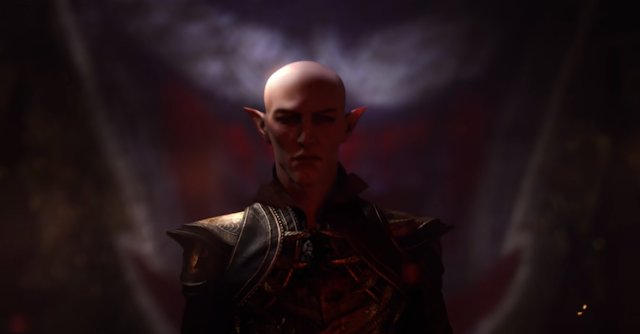
"Dragon Age: Dreadwolf" Predictions & Ponderings (and "What's in a Name?" Redux)

He doesn't call, he doesn't write, but finally, it looks like we might be hearing from Solas at last (2023?), as BioWare announces t...