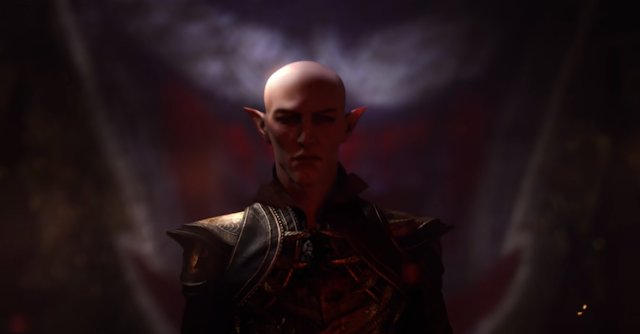
|
| Freddie Prinze Jr., David Gaider, Mike Laidlaw, and the NYU Game Series moderator Frank Lantz talk about BioWare's approach to storytelling in gaming, and it is fabulous. |
So here's this guy who loves this world, loves humanity, loves drinking, loves having sex, loves having fights. Bull embraces that lifestyle and he's not ashamed of it. He's a mercenary. That's his philosophy...
So if you're familiar with the franchise, and if you know the enemies you're fighting? And if you know the types of weapons that you're using because you've actually used them? I would rather do that than She's All That any day of the week.
—Freddie Prinze, Jr.
Hey guys! So this is gonna be a bit roughly transcribed and put together, and also incredibly lengthy. I'm just working on so much exciting stuff, including my upcoming Dragon Age "Tale of Years" that goes from the founding of Arlathan through "Trespasser."
However, this remains one of my favorite video panels on Dragon Age, and it just holds so much good stuff for those who check it out! Which is why I thought you might enjoy a discussion and transcription here, because it's just so detailed and insightful, so passionate, and because it illuminates these terrific folks in so many unexpected ways. I also found it very inspiring as a writer and artist, and thought it might also do the same for others. I'd especially note the panel's genuine enthusiasm for story and character, and the deep humility of each of the participants. Each—Mike, David, Freddie, and Frank Lantz, the moderator—comes across as a caring and generous person invested in helping others.
Onward!
Celebrating Storytelling in Gaming
Like most Dragon Age fans, I've watched my fair share of panels and interviews with BioWare writers, editors, directors, producers, artists, actors, and more in order to learn more about their processes, their takes on the characters. What always touches me about these, to an overwhelming degree, is how humanistic BioWare people seem to be. They come across as caring individuals who are genuinely interested in presenting inclusive characters and relationships where players can connect and relate.
Which is why we're here now. Since one of my favorite insights into Dragon Age: Inquisition came through the 2015 NYU Game Center Lecture Series ("BioWare's Approach to Storytelling"), which featured former Dragon Age: Inquisition creative director Mike Laidlaw, along with former DAI lead writer (and Dragon Age novelist) David Gaider, and actor Freddie Prinze, Jr., who voiced The Iron Bull. I was pretty psyched at this, since Bull is, as readers here will already know (thanks in no small part to Prinze's fabulous vocal performance), one of my absolute favorite characters across not just Dragon Age, but across the entire fantasy universe. Speaking of which, I certainly invite you to check out my additional character and romance analyses on my darling Bull here, here, here, here, here, here, and here.
(Ahem. I do not have a problem. Bull is a fabulous but deeply complicated character, darn it.)
So it was great to watch this, and to get to listen to Mike, David, and Freddie talk at length about their inspirations and creative goals for the game, as well as to hear their stories about favorite moments that made it into the final launch of DAI. Mike and David have left BioWare since this interview, but I still think it spotlights a wonderful moment in time, so here we are.
And please do watch the lecture, because it's absolutely wonderful, and you'll get to watch Freddie enthuse about The Iron Bull, David address the hurdles and tribulations of writing for games, and Mike discuss the big-picture choices across the game (and in the funniest moment in the lecture, he also reveals his wife's fabulous reaction to Patrick Weekes's suggestion for the Iron Bull's romance direction—see the Q&A farther down!).

A Million Words...
Meanwhile, since I really think it's one of the best and most insightful interviews out there, I'll go through the interview and call out some of my favorite moments here and there, and then transcribe the final Q&A with just a little smoothing for cohesion purposes. For instance, one of the first and coolest discussions by the three addresses the sheer amount of writing that goes into the Dragon Age games, as noted here:
David: The amount of writing that we put into our games... Dragon Age: Origins had upwards of 800,000 words. Inquisition I think is a little bit smaller than that, I think it was about 600,000...?
Mike: No, it was 750,000.
David: Was it 750?
Frank (Moderator): I didn't know there were that many words.
Freddie: Well, I add a lot... (laughter)
Mike: And that's just voice—because there's another 300,000 in the books, journals, Codex entries...
Freddie: A lot of us nerds read those Codexes.
David: I wrote Cassandra, I wrote Dorian, I wrote the prologue. SEVEN TIMES.
So there you go. Dragon Age: Inquisition alone encompassed over a million words. That still amazes me. A million words.
The Dawn Will Come
Not long after this, in another of my favorite moments, there's a great anecdote by David in which he describes his inspiration for "The Dawn Will Come" as a serious dramatic beat. He also addresses the importance of the question of faith (and treating it seriously within the story of the game), which I took a further look at in this blog post awhile back, as well.
"This is the scene I was certain was going to get cut and did not," David comments. "When we started off—and this is a little bit spoilery because it is the midpoint, it is The Empire Strikes Back portion of the story—the Inquisition has a setback." At this point (the destruction of Haven), David notes, the team wondered whether they could have a midpoint where the player (Inquisitor) basically lost everything, where "they're put back on their ass, and they have a low moment where everyone's like, 'Oh my God, we're done, we're defeated?'"
David then discusses the importance of faith within the game. "We wanted to be even-handed. Because you have Chancellor Roderick, who comes off as this sort of mwa-ha-ha kind of villain. And it's like, we could paint faith and religion as villainous if we wanted to. As in, 'Oh, they're always obstructionists, what's the point, what's the use of them?'" Gaider instead wanted to go a different route. "I thought, what if we could find a way to show that there is value in faith, that there is value in hope?" he asks. "And that hope could be what sort of propels the player on in the second half of the game?" David says that this is where the player will realize they're now playing a whole new game, which was why he wanted to do something really daring.
"This was the first time I thought, 'Can we... try a song?'" he notes. "And somehow through all the iterations, it actually survived."
Freddie and The Iron Bull
At about the 35-minute mark in the video, Freddie Prinze Jr. shares details on how he came up with Bull's voice, and then gives a thoughtful and emotional speech about how much the character came to mean to him. First off, it turns out that Bull's voice was a combination of Thunderin' Pete from The Mickey Mouse Clubhouse and Winston Churchill. Which is seriously the best combination ever (and I love that you can hear that in Bull's voice).
Freddie then admits that in the beginning, he found Bull's character daunting to approach. "So we sort of get this character that these guys came up with, and we get this dialogue that Patrick Weekes wants me to say," he comments. "And you're looking at some of these lines and it's just... like, if you've played the game, you know what I'm talking about..." he says, smiling at the audience. "And, I mean, all right, that's not James Vega (the character he voiced in Mass Effect 3) at all..."
He pauses for emphasis. "So the approach is one of trust with the director, and you just sort of go for it... and then it ends up being some of your favorite lines—the ones that you were the most afraid of, right?"
In my favorite moment from the interview, Freddie looks out at the audience. "And this is a good lesson for life," he says. "What you're most uncomfortable with, you should aggressively attack and pursue."
He goes on to note that fearlessness and forging straight ahead were the best approaches for him with the character. "And we came up with this voice that I had more and more fun with as the game progressed," he notes. "That he was this character that I fell in love with so much that—without spoiling—there's a scene that I'm literally avoiding like the plague in [playing] this game because I know the choice I'm gonna have to make, and it has to do with Bull."

Larger Than Life
Freddie then quickly became Bull's biggest fan. "You have to understand—actors, there are certain characters that they love, and there are certain roles that they couldn't care less about, or there are certain roles that they hated. And everything in between. And this was a guy that I loved."
Freddie doesn't want to spoil the audience on the moment he's trying to avoid in his own playthrough (it's pretty clear that he's talking about the terrible choice presented to us in "The Demands of the Qun"), so he stays vague. "It is a very special moment and you have to make that choice," he notes. "And I refuse to make it. Like, I'm literally doing every side quest I can around it just to not to have to put [Bull] in that position."
Meanwhile, if you watch the video, I love the expressions on both David and Mike's faces here. They're both watching Freddie speak and smiling with so much open affection—it's such a great, warm moment.
Freddie's description of Bull is another favorite moment. "So we kind of came up with this guy who loves this world, loves humanity, loves drinking, loves having sex, loves having fights," he comments. "[Bull] embraces that lifestyle and he's not ashamed of it. He's a mercenary. That's his philosophy." He goes on to note that it isn't until the Inquisitor proves themselves to Bull and gains his genuine approval and affection that Bull will respond back. "He wants you to feel good about the job you're doing," he notes. "So he introduces you to your soldiers without them knowing who you are, so that you can get a sense of how you're affecting the people who believe in you. And that's when you know you've got him, right?"
It's such a great perspective on Bull, and so accurate to what an emotional, big-hearted guy the character is.
Bringing Accountability Back
Another great moment in the lecture is when Freddie discusses what he finds to be the magic of BioWare games: "They brought accountability back," he notes. "Like, I'm old enough to be a part of the quarter generation, where videogames were designed for you to fail, so that they could get as many quarters out of your pocket as possible, right?"
This upbringing, however, brings with it a certain number of advantages, because Freddie notes that the latest generation is basically "god-mode generation," he comments. "Which is, like, I don't ever want to die. So we have easy mode, super-duper easy mode, we have codes that give us a million bullets and a million lives," he adds, "And now we don't know how to deal with failure." He pauses. "So when you guys play me in multiplayer games, and I kick your ass, that's why."
As a child, Freddie had loved the "Choose Your Own Adventure" books, so the first time he sat down with a BioWare game (Mass Effect), he dropped the controller because he realized immediately what he was seeing. "Oh my God," he cried. "It's Choose Your Own Adventure!" He was hooked from that moment on. "Because videogames had ZERO accountability," he explains. "You could kill, slaughter, hack, slash, smash, dragonball anything you wanted. There were no repercussions for your actions, nobody cared, and if they did, it didn't matter."
But in a BioWare game, Freddie realized, it did matter. "People will leave you. They'll be, like, 'I'm gone, I don't like the choices you make, I'm not fighting for you. Peace,'" he adds. "And you literally have to take a step back and reload and make different choices—" (the audience laughs) "or be cool with the choices you made, right? Because you're confident in that character."
Affecting Cultural Change
Bull, however, was something special for Freddie. "I love James Vega," he comments. "But this guy has so much more depth and so much more heart and soul that he's willing to give you once you earn it—that he's one of those guys I'll never forget." He pauses and smiles. "I mean, I'll be real with you guys, I'd do the voice just for fun. I'm not joking."
I have to break in to note that Mike's reaction here is priceless—his jaw drops and then he makes an evil twiddly-fingers gesture like "Ooooh," then he and David Gaider share this fabulous grin with each other, like, "We'll get him for this."
Freddie goes on to talk about his love for historic speeches, and how he used to memorize them as a kid simply for the fun of it. He still loves speeches so much that, when asked, around the time Dragon Age: Inquisition was released, he did Winston Churchill's "We Shall Fight on the Beaches" speech in Bull's voice just for fun, and it's still apparently floating around somewhere on Soundcloud.
"But he's that kind of guy to me," he adds. "He's Winston Churchill. He loves his drink, he loves to fight, he's had epic failures like Winston Churchill early in his life, if you're familiar with history—and if you're not, step it up." Freddie notes that for Bull to survive what he has, and to emerge as a rich character willing to take orders from someone who's earned it, "is what makes this game," he comments. "It's what makes BioWare games not just Triple-A—it makes them special, it makes them important, and it affects cultural change. Like, these are the types of games that change the way other videogames get made. And that kind of stuff is important. Like, you rank your 'Top 5' anything, and it should be because they affected cultural change."
He goes on to point out the lack of accountability in many other games, and how that makes the player not really care about the outcome. "But in these games, it matters, and you care, man." He goes on to criticize Mass Effect 3 for getting rid of the loyalty missions. "It freaked me out because in Mass Effect 2 it was such a way to get to know these characters, and if you didn't do the [loyalty missions] you were going to lose them in the end.
"But that's what it's all about for me," he adds. "I'm thirty-eight years old and I'm old enough to have played from the first videogame to this, and I've seen how they've evolved, and I have very strong points of view on them." He goes on to note, "And to get to have a game that's beautiful and gorgeous and it has story and it's character-driven? That's game over, man. Everybody's seen. Movies are now stealing from videogames. Whereas videogames used to steal from movies. But suddenly you're gonna be seeing dialogue in the third acts of action films—it's gonna be crazy!
"And that's because of games like this. It really is. And that's the long-winded version of why I love Iron Bull and why I love these games."

Drinks with Bull
He moves on to the introduction of Bull's scene (the fabulous maraas-lok drinking scene after taking down the dragon), and notes that the scene he wanted to show was "far too dirty and spoilery. It has a lot to do with safe words so you're not gonna get to see that one." (Note: I'll bet you anything it was the Bullmance pillow-talk scene, right? It has to be.)
Mike points out that you have to have Bull's approval here. "These characters grow in affection, and this only happens after you've gotten to know Bull," he notes. "There's nothing Bull wants more than to kill a dragon," adds Freddie, who also adds that when Bull just sees a dragon for the first time, "He's like a kid at Disneyland. So when you get a chance to drink with him, that's what you're celebrating. It's not just, 'Oh, let's have the random drink with The Iron Bull' like in a lot of other games."
Freddie goes on to remind the audience that "It's all character-driven," Freddie says. "He talks about story a lot"—and he gestures to Mike—"but what they do best is character-driven games." He goes on to talk about the lack of stakes on shows like "24," where the bomb may be counting down, but somehow everything is always certain to be more or less okay in the end, when Jack Bauer will save the day. "But in these games," he adds, "they're brave enough to say 'No. That guy died.'"
Freddie then shows the drinking scene (which hilariously features the 'Conan O'Brien' Inquisitor created for a previous presentation).
Also, the audience's reactions are so warm, and so much fun as the 'Conan' Inquisitor drinks with Bull, especially each time he takes another sip. The laughter really communicates how cinematic and fun the scene is as a whole. The drinking scene ends, as it should with a big, giant flirt from the 'Conan' Inquisitor, to the delight of the entire audience.
And Bull, of course, slightly approves. Hey. It's what he does.
Notes from the Q&A
Note: For the Q&A portion here onward, I think the best thing I can do is move to a more scripted format, so that's what I've done.
Frank Lantz, the moderator, asks about the process and the audience.
Mike: At its best, you make a game for the players, you don't make a game for yourself. It should be one you enjoy. It should be one you're proud of at the end of the day, but when you think about, as a player, 'What should I be experiencing?' it comes across better, and it helps you contextualize the decisions you make.
For Inquisition, we moved to the Frostbite 3 engine, which, at the time we received it, was exceptionally good at water, explosions, smoke, tracer fire, and lighting.
Freddie: Lots of tracer rounds in Dragon Age!
(laughter)

Mike: But it was not very good at save games, crafting, conversation systems, handling a million words of dialogue. It had challenges. So we had a bunch of work we had to do kind of from the fundamentals, and we knew that was going to be the case.
It also had a huge opportunity, which was to take Dragon Age and make it more open—it was an engine built so that guys could be fighting beside tanks and under jets, so it could do big spaces in a way we never could do before.
And so, we saw, obviously, the success of Skyrim, you look at open-world gaming and more, I guess, system-driven gaming, where it's like, "Hey, this is a thing you can go do and it doesn't really require story," and we saw a lot of appeal to bringing some of that back because it puts the onus back in the player's hands, so that was a factor for us. But the other really important part was not to lose the BioWare—not to toss out storytelling and not to make narrative a third-class citizen.
So the one we settled on was: Immerse yourself in a vast world of companions, choices, and consequences. So those are very important.
David and I talked about this a lot: We shouldn't offer a choice, unless we have some way of varying the experience based on having done so.
Worldbuilding, Lore, History, Politics
David then talks about the evolution of the Wiki, and also talks about how they manage the information and the lore, the worldbuilding, history and politics:
David: It's so many documents, and we produce them one at a time, and what happens, is they start to get out of date. And they get out of date really quickly.
So we basically have to hire someone, and we hired an editor—his name is Ben Gelinas [NOTE: formerly of BioWare, now one of the talents behind Speed Dating for Ghosts], he's an editor that we hired, basically just to wrangle all our lore, to go through all our pages we had, and then figuring out, is this out of date? Is this out of date? And then deleting that, organizing it so we could access it properly...
Freddie (joking): So tweet your questions to that guy!
David: I started the initial world, but I did not create all the lore—it's all agreed-upon but no single person could remember that much. Especially not with my memory.
So now we had somebody that we could run things by—and he might not know personally, but he could always fact-check. And the editors are—they're basically, they're not just our grammar checkers, they're our fact-checkers, they're our sort of our gut-checkers when it comes to the overall story, and we couldn't do without them.
Mike: I'm pretty sure that without the editing team, we would just collapse. They are kind of like this connective tissue across, for instance, our writing, going over to voiceover, to localizing the game to put it in French or German or Portuguese—they kind of are involved in every step of all of those processes.
David: We have so much writing to do that we just can't manage it all, or fact-check... like he was saying, the simple process of going through and preparing each line so that it enters the pipeline and gets recorded! That's a process—an engine-related process itself... I mean, we're writers. When something goes wrong with our computers, any one of us, we just sort of paw at it and say, "It doesn't work anymore..." so don't ask us to do really technical things because it's just not gonna happen. So it helps. A large part of it is to have editors who can wrangle it in, and the other part of it is just to make it piecemeal, to—it needs to be in digestible chunks for us.
And we also have writers that are sort of in charge of specific areas of the lore. Like, for a long time, I was "Mr. Elf." I was the guy that people would come to if they had a question about anything elven—elven language, elven history, the Dalish—I knew everything that had to do with an elf.
Freddie is then asked about the acting challenges involved.
Freddie: You're basically doing three performances. Like, when I did Vega, there was a lot more that we had in concept that made it to the game... Like, we had this idea where you could come down and drink with Vega, right? But if you didn't come down and hang out too much, his response to you wouldn't be as positive. It would be a little less. More (cynical voice), "Hey, man, you gonna slum it with the grunts tonight? Nice."
So you have sort of three different performances that you're giving. As the lead of the game, Shepherd is giving his paragon or badass or ambivalent answers to you—and you, you're giving those performances as well.
The challenges in voice work... You know, when I first got started in it, I wanted to be a stay-at-home dad, and there's not much work in L.A.
And voice work became an option. And I thought, well, I'm a pretty good actor, I can handle this. And it was way more challenging than I thought! I didn't book shit for the first three months. Because, in acting, if I'm uncomfortable with you, I can turn myself, (demonstrating) I can turn myself, I can fold my arms—I can show that I'm not wanting to be that close to you. But in a booth, I don't have that ability and it may not play.
So you have to really trick your brain not to force the performance. Because you can tell when a guy in a videogame who doesn't play videogames is forcing his character. And he literally will make me stop playing your game—I don't care how good it is, if the actor sucks, I'm gonna stop...
But as far as approaching it, it's different tools in your brain—you kind of have to trick yourself. It really is just you and a microphone. It's very rare that you get the other actors in the booth with you. It's very rare that your director is face-to-face with you. Like I said, Caroline [Livingstone]'s in Edmonton, so—we have a good relationship but it's still, you know, earphone-to-mic, which, you know, isn't ideal. You want that organic vibe, so anything you can do... I mean, they're not gonna give me a two-handed ax I can swing around—although that'd be really cool, by the way—
Mike (laughing): We'll see!

Freddie: But, yeah, I try to do things that can make it real and that won't affect the sound quality of the mic, because, you know, there's a lot of times when you're really going at it, and they're like, "Yeah, I can hear your pants moving," or "Can you take that change out of your pocket, Freddie?" Little things like that.
But as far as—is it a challenge for me to do this kind of game? Hell, no. I play games all the time. There's not a game that I wouldn't be able to voice... Except that, well—I don't do that (husky Batman-type voice) "tough-guy" voice that you hear in all those games—I'll just do my voice, which is kind of goofy and doesn't sound cool... (laughter)
Like, with Star Wars, like, you know Kanan is very serious, and handles things (serious Kanan voice) like this. And the Iron Bull is (Iron Bull voice) very different than I am!
But when you get character-driven games, so much is laid out for you. And if you're familiar with the franchise, and if you know the enemies you're fighting? And if you know the types of weapons that you're using because you've actually used them?" He pauses, and becomes visibly emotional. "I'd—I would rather do that than She's All That any day of the week. It's just more fun for me. It's more satisfying creatively."
(SIDE NOTE: It's a really nice, profound moment. How many times do you get to hear a guy talk about the thing that made him famous, an A-list talent adored by teenage girls everywhere—and he's actually saying he'd trade being a heartthrob in that big famous movie for playing The Iron Bull or James Vega in a moment? I think that's really damn cool.)
David: Just incidentally, when he mentions Caroline, that's Caroline Livingstone. She's the head of our voiceover department.
Freddie: She's the truth.
David: She's the one who makes it all come together. If you've played BioWare games, I think we do an excellent job of the voiceovers and I'm just gonna toot our own horn and say we probably do it better than any other game out there.
Freddie: Seth Green and I bow down to her, often, because she's—she's worthy of respect.
David: And Caroline is the one who pulls it all together.
Freddie: Yeah, man. She's a really solid director. We've all worked with her from Mass Effect to Dragon Age, and everybody loves her. And every voice actor I've worked with, apparently, has worked with her! I work with Steve Blum a lot, who's done every voice for every game or cartoon you've ever seen and he knows her on a first-name basis and he'd tell you the same thing about her and how lucky you are [at BioWare] to have her.
Question on the texture of the world—how much of that is an expression of your expression of your own values and of the reflection to player choice and player agency?
David: I think it has to be intentional. The majority of the people at BioWare and of the people who work at many games are, you know, white men, but we also have people of all ethnicities, all genders.
I think it's incumbent upon us to have our game intentionally reflect the people we want to invite to play our game.
Freddie: And you have to remember, videogames have been doing this, like you can go all the way back to Everquest. In Hollywood, if you go on an audition, and it says "minority," you'll see every minority there. Like, it's just like, "Yeah, whatever, as long as we get a minority in there and fill the quota, nobody'll complain..." And that's how Hollywood really is.
And games have always been braver than that. Like, if TV has a gay character, they're like, We have a gay character and we're gonna put it in entertainment news so everybody knows, we're cool with it...
Like, videogames don't do that. They go, "Yeah, he's gay." (shrugs) That's it. "Or he's asexual. Or he doesn't care." Like, it's... they do it intentionally, but they treat it with the proper respect...
Whereas the business that I came from really doesn't. It never did. Like, if you're Latino, you're gonna play a drug dealer, a lot. If you're black, you're gonna play a drug dealer. A lot, in Hollywood. That's just the way it goes. If you're Indian, you're gonna be working in a convenience store that the black guy or the Latino guy is robbing. It's just the way Hollywood works.
And videogames refuse to do that. They really do put forth a concerted effort of courage to actually do that, and to know that society won't freak out the way Hollywood thinks they will. And you don't! I mean, everybody plays. Everybody loves it. And it works.
Frank: But BioWare does it more... I think, than a lot...
Freddie: Games have had the bravery to do that. And I don't think my business always has.
Mike: And I think... one thing that we do very consciously, and we have for years, is, we're actively trying to broaden our internal horizons. Like Dave says, we struggle against that wherever possible.
I think that perspective is probably the most important thing. I mean, we're building fantastical alien races or fantastical fantasy races... there is no need to have a singular perspective on that. You want to be able to get as broad a perspective, as broad a voice as possible. I mean, thankfully, half our writing team is female, so we have a bunch of lady writers, and they're awesome at their jobs…
(applause)

Mike: And again, I go to a lot of PAXes, and I come to things like this, and it's nice to see that there's a mix of gender, and race is something that the whole industry has to work on. And I haven't met anyone who wants that, to go "Oh hey, we should get a white guy..."
And perspective's really important, and everybody's kind of walked their path, and they have something to bring creatively, and they've got something to bring technically (maybe just a solution to a problem). And when we look at how we approach it, is... the nice thing about something like fantasy or Sci-Fi is that we can explore themes of racism and sexuality and that kind of thing, which can be real hot-button issues for a lot of people. And the nice thing is, we can do that slightly through the lens of, "Oh, these people have pointed ears. They're actually a different race... and yet they are people."
And we keep that very consciously in mind. And so we can sort of explore some of those themes and at the same time do it in a way that I hope maybe just sidesteps some of the baggage and lets people get underneath it. And we struggle with it, and it's tough, because you always feel like you may be fucking this one up. And at the same time, it's worth the effort. It's worth trying, right?
All I need is a few people to come up to me and say, "Thank you, I saw myself in that character," or "I saw something I really needed to hear in that moment," and it kind of makes it worth it to me.
Freddie (to Mike): You've got to have people coming up and saying that! Because it's so prevalent in the games, and there are no race or sex boundaries... so if no one has, "Thank you."
David: I would say... I would add on... while it has to be intentional, it's not actually that difficult. It does take an effort but it doesn't take that much. I mean, there are people who object to it—there are people out there who don't want us to do that, who say, "Oh, you make it like an After-School Special!" As if, in order to deal with this one aspect, it has to take our entire focus—we can't do anything else but all day think about how we are going to, you know, put 'social justice' into our games, when really? It just takes a bit of time, when you stop, and say, "Is this okay? Would it change anything about this character if he were female? Or black?"
Freddie: For the record, I was in the very last After-School Special. It was called "Too Soon for Jeff," and I think... he was gonna be a father at fifteen... so it was, uh, too soon. (laughter)
Tabletop and Role-playing Impact
This segment encompassed a discussion of the influence of old-school role-playing on the design and creation of DAI...
Mike: One of my goals, when putting together the ideas behind Inquisition, was that the player should be able to play the way they want to, right? And still enjoy it. And part of that—well, we've all got pen-and-paper history here—David, Freddie, and me—and part of the thing about pen-and-paper games is, that based on partly who your GM is, and partly on who's playing, is that the games take on different colors and calibers, right?
So I've played games with guys who were, like, "I talked to the guy, but let's start rolling [the dice]." They don't want to role-play, they just kind of want to roll play.
(laughter)
And then you have other people who will be like, "Oh, no no no. We'll be doing no fighting tonight, it's intricate story time! Yay! I hate the fighting business!"
(laughter)
Freddie: It's like the first year of high school...
Mike: (mimes donning a cloak) It's like, "Well, I'll get my cloak!"
The difference between those two is that again, they're playing the same game. And the tabletop games are flexible enough that you can kind of do either, and quite successfully, and the rules are there for both sets.
So when I was looking at, "How do we take Dragon Age big? And, you know, do that, and be open? Because the biggest danger for us was losing our focus, and not being a story game, or in not having a coherence to the experience.
What we tried to do—and I had to work with a whole bunch of different groups—was to try and contextualize all the different systems we were building so that the player could still progress in the heart of the game via almost any means. And that was my best goal.
And I think that games that have always captured my imagination? Are the ones that do this. So the example I used when I first pitched this idea was, I was talking about, you know, "Let's do gameplay that's activity-driven,” was Sid Meier’s Pirates. I mean, that's a classic...
Freddie: Great game! What sword did you choose, of the three?
Mike: Oh, I was always a rapier. Always a rapier.
Freddie: Sorry! Nerd mode.
Mike: In Sid Meier’s Pirates, virtually everything you did was pirate-y. And that was a huge influence. So, I'm gonna go dancing. Why would I go dancing? Well, because I'm gonna get the hand of the governor's daughter who will give me more land so I can secure my fortunes as a pirate king.
Okay cool... Why would I do that? Well, partly because it contributes to success. But also because by doing all the things you do when you meet the governor's daughter, she whispers secrets in your ear and tells you where there are Spanish galleons, she tells you where you can go find information, she tells you where your missing family that was kidnapped by the evil Baron is...
All these—so suddenly it's a dating sim, sort of, but it's also a treasure-hunting sim, and a "Seven Cities of Gold" sim, and you're like, "Hold on, those are all related!" And when you go find your family, they tell you information about stuff you overheard, and it's like, "Wait, all of these things link back together!"
And I wanted to try to see what we could do in a fantasy context, to do that. And so that's where the idea of 'power' came in [to Dragon Age: Inquisition], and the idea that certain things you did earned you power, and power was the Inquisition's currency of being able to advance the story. That was really the core idea. So, by the time we finished—kind of, and that took about three years of tumbling to get all the rough edges off (and there's still a few)...
But, like, when you recruit a new character—well, that's a very story-driven activity! "Hey, Iron Bull's joining my party! I get power for that, because this band of mercenaries came and joined the Inquisition and he's my personal bodyguard. Cool!" That's power. Right? That makes perfect sense in the context of the game.
I go and close a Fade Rift. Well, I'm the only one who can do that, and I work for the Inquisition, so they must be cool. Power. I secure new camps—well, now I have forces in more positions, they're presumably feeding information back to my Spymaster, I can deploy forces more quickly, because I've got a front—boom. Power.
All of these things—and what we did was try to contextualize every single thing we did. Either in, I'm making the Inquisition stronger, or I'm pushing back those who stand against the Inquisition. And by doing so, I think we created a thing where, I can gain power by going and killing a dragon, and then Bull drinks with me, or I can gain power by collecting enough materials that I'm building tents, so that my men are safe, and better rested, and better equipped.
Those are very different activities. One is, you walk up to things and click, it's exploration-based and part of keeping a mid-range goal, and the other is, win this encounter. And that's a purely combat-driven activity—which, again—if you've crafted the right stuff, it's easier. If you've brought the right characters, it's easier. If you pick the right powers, it's easier. So again, those systems start to inter-relate, and just like Sid Meier's Pirates.
So, that for us was looking at old-school pen-and-paper, where the game can change based on the player—because they give you a venue to be social, to be scheming, to be the guy who just punches things in the face—and the game adapts to how you want to play. And—could we do that? And that's where I landed.

Games They Play
The panel then discussed some of their favorite games through the years.
David: Crusader Kings 2. I enjoy RPGs but they don't make me relax anymore… I analyze them. With Crusader Kings 2, it's strategic and story-based but it has an emergent personal story that the player forms in their head.
Mike: The ones that really sync with me are the ones that are RPG-adjacent. Be it a progression system in a shooter or... games like Starbound or Minecraft. They're definitely not RPGs but you can see where they touch. Those are incredibly compelling.
Or take some RPGs that aren't like ours. Like, The Dark Souls series—they're fucking spectacular. They are. They are the most brutally fair gameplay experiences you will ever have. Because there is always a way to beat it. There is always a way to learn and get better. The game teaches you by punishing you. Kind of like a dominatrix. (laughter) Or a drill sergeant. It hurts you so you get better.
But—games like that. Because they're in the RPG space—there's stats, there's progression, there's gear—but it doesn't do the same kind of story/choice-based stuff. But I still feel like that experience is still very much mine, because I went to the Tower of Flame before the Giant, etc.
From Grand Theft Auto to Zelda
Freddie: I'm a big Grand Theft Auto-head. I'm the guy in the parachute that is targeting you from above, that you see the dot on the map, and you don't know why you can't see me, and I keep killing you, and it's because I'm above you, floating...
(laughter)
So I used to play that a lot. I've been playing a lot of Dragon Age. And I like a lot of the turret-based games—Tower Defense—a lot of those. But Grand Theft Auto was something... the Red Dead Redemption series... those were very empowering to me, and I always had a natural ability to be good in the multiplayers of those... I played Call of Duty like everyone else, I played Destiny for a little while...
And I played World of Warcraft for SEVEN YEARS. That was, like, a soul-sucker... I was a dwarven healer, I had the fear ward, I was Metaxa, so if you were in my guild, hello. (waves) I'll give up my name now, as I don't play anymore, so...
Yeah, I was in a guild with, like, all actors. It was like, me, Macauley Culkin, Shannen Doherty, who was better than all of us, by the way—
Frank: The Screen Actors' Guild! (laughter)
Freddie: But I played that forever.
So I played a lot of Warcraft, and before that, I was an Everquest head, so I was a big roleplayer guy... and I like a lot of the old school arcade games. I loved Donkey Kong Jr.—I loved that game. And I play Zelda, the original Zelda, probably once a year, just to play it again, and in honor of my man Robin, who's no longer with us... (NOTE: I was unsure of whether he was referring to the wonderful late Robin Sachs, whose credits included "Buffy the Vampire Slayer," Mass Effect 2 and Mass Effect 3, Galaxy Quest, and more, or to the late, great genius Robin Williams, who worked with Freddie's longtime spouse Sarah Michelle Gellar on "The Crazy Ones") that was his favorite game ever... and my man Kieran Culkin's favorite game ever, too, so we kind of play it once a year just out of respect for that great title. I know Ocarina of Time is better but the original Zelda has just got a place in my heart. So I play that once a year.
And you know, to me every boss should be Bowser—should be hard, should be difficult. It's why I hated Force Unleashed 2 because you could fight Vader and take no damage. I know I work for LucasFilms now, but that game blows. If Vader can't hurt you, you've failed epically.
I try to grab everything that's out there that's good. I played Wolfenstein—I liked that, although I thought they mixed up their end bosses and that should have been inverted, because the last boss was too simple while the fight before that had a couple more challenges. I played a little Assassin's Creed—I didn't finish it, but I try to get my hands on whatever's out there.
Audience Q&A
The first audience questioner first thanks the team for its inclusivity, including The Iron Bull's romance, and then goes on to ask, "How do you design the characters and flesh them out? They don't seem to ever overlap."
Mike: The high-level goals... what we want is characters who are characters first. They shouldn't serve a role in the game, i.e., "This is the warrior who is straight." No, fuck that. I want someone with an intriguing history.... and so we start with character, rather than starting with stats... the big thing we do is, the characters that see the light of day, that make it and survive, they've "anted in." They have stakes in what's happening. So if we had a mage who, you know, was kind of 'whatever' about the Circles or Chantry, then why are you here?
Whereas Vivienne has absolutely firm views and they conflict with Solas's. And suddenly those are two excellent characters because they're opposite poles.
Freddie: And she gets mad at me all the time. And I love Vivienne—I wanted to romance her, and I was, like, "Man, I made her mad so much, I was like, 'I'm going with Sera.'"
And to go with what you're saying, all of those characters—and I can speak on this as an actor—it's all about motivation, right? They're all working toward the same goal, but they all have different motives on how they want to get there.
And it's the games when everyone's like, "That guy sucks, and it's because of A, B, and C," that you're kind of like, "Okay, I'll finish the game, but whatever." It's better when it's "That guy sucks, and it's A, B, and C," and someone else goes, "Yeah, but it's also, D, E, and F," and this guy likes "X, Y, and Z..."
I mean... It's just different motivations. And that's what makes it a character-driven game. That's what these guys do so great.
A Collaborative Process
David: Other than the obvious things—I guess the thing that people probably don't know is that it's very collaborative. It's not just the writers. I mean, a writer could go, 'I'll write this fantastic story for this character, and, you know, write ten tons of fanfiction about it, and hope that everybody loves the character enough to make it into the game," but it's a slower process than that.
We come up with ideas that grab us. I encourage my writers to come up with ideas of things they want to write. I mean, people—we might get someone in the audience asking, "So why didn't you write a character like this?" and then at the end of the day, sometimes it's just that "Nobody wanted to." It has to grab us first.
So we'll do these sort of brief ideas. And we'll throw them to the concept artists. And they come back with some things that grabbed them. And they'll do these pictures, and sometimes you'll see a concept artist who will do a concept for a character where it'll come back and you're like, boom.
Mike: Vivienne was like that.
David: Vivienne was exactly like that. The first concepts we got back for her, she was white and blonde and an ice queen and stuff... And "ice queen" was kind of the initial concept. But it didn't really grab us. And then one day, I think it was Matt Rhodes (Mike: "Yeah, Matt!") did a version of her where he made her black, super serious, and super stylish, that kind of Maleficent version, and he brought that back and said, "What about this?"
Freddie: She talks to you about your fashion!
Mike: But that's why! She didn't—until we got this concept.
Freddie: That is cool.
David: Mary Kirby, as soon as she saw that concept art, she was like, "I want to write this character."
So there's a lot of back and forth even after the fact. Because in order to make them fit, we'll be starting to write a character and realize, these two characters overlap too much, so I'll get the writers together, and we'll discuss it. And sometimes that means, that character is now cut. And then somebody goes off to the bathroom and cries for awhile.
But it's just a matter of us talking it out as a group. We're writing this all together, but it's not just the writers, it's people like Mike, it's the artists, and sometimes it'll be a programmer who comes into the room and says, "I have an idea!" and then I'll go, "That idea sucks... but that one piece of what you said is a really neat kernel of an idea..." And suddenly it'll later blow up into an entire plot on its own.
"Pitch it. Even if it's bad."
Freddie: And that's something that's important to remember, in all forms of art. Like, sometimes you may think an idea sucks: Pitch it. Because there may be one part in there that inspires someone else—that then inspires you. And then all of a sudden you guys have exactly what you thought you had in the first place, but didn't. So always—what he just said is super important, in screenwriting, in videogames, in whatever it is you want to do.
David: Unless it's that campaign you ran as a DM. Or that character you ran in that campaign... and you want to come and tell me alllll about it? (shaking head emphatically) Let me just break it to you: Telling other people about your D&D campaign is NEVER interesting.
(laughter)
Freddie: So you're gonna sit at the opposite end of the table from me at dinner tonight?
David: (laughs)
Mike: Patrick Weekes has a mantra he uses for that, which is—
Freddie: Patrick Weekes wrote everything I say, by the way...
Mike: Right, Bull, Solas, a bunch of characters, he's awesome. And anyway, so Patrick will say, "This is not a good idea. And I know that. But it might get us to one!"
And don't be afraid to use that. That's actually really powerful. Like, "I don't have any ego in this. I know this is dumb. But: Combat ballerinas."
(laughter)
Mike: You know? And you could probably make that work.
Freddie: Rambo and Degas!
David: Yeah, he'll do that. And you encourage people to talk. And he'll say, "Combat ballerinas," and I'll be in the middle of a meeting and I'll stop, and I'll be like... 'Oh, it's another one of these...' BUT...
Mike: But it breaks the ice.
David: Right. And it gets us talking! And by the time we're finished, it's neither combat nor ballerinas, but... we went through Sailor Moon and then down into that dirty movie we watched on the weekend, and then, boom, suddenly we're at the edge, and somebody will finally throw out something...
And it's, like, usually the quiet writer in the back of the room, like... Brianne [Battye], who will throw something out and we'll all stop. And she thought it was stupid or she was joking, but then we'll realize, we'll have that creative moment of lightning striking and go, "That might actually work," and everyone (nodding) goes... "Huh."
How do you balance larger worldbuilding and the intimacy of characters?
David: That's kind of my entire job.
Mike: The thing about lore is that, in and of itself, it's not there, and you can't count on players to engage with it. So, like, Freddie might read it. I might read it. But not everybody's going to, and you can't rely on people doing so. But you can put a lot of texture there, like deepening lore, and kind of more like, "if you want to" stuff. Like losing yourself and going into The Lord of the Rings wiki and realizing, "Oh, Barad-dur was built by the Numenoreans—I didn't know that!"
So you can do that kind of thing. But more importantly, what you need to do is have an arc that, in and of itself, has a clear objective, that has a clear purpose for the player to achieve.
Because if you have a player that isn't into the story and doesn't understand the kind of deep, meaningful blah-blah-blah of the politics, if you can still say, "But go there, and punch that guy in the face!" and then ideally give them a couple of different ways to go there, or any number of systems to allow them to go there—then players who aren't engaging on the lore level can still engage with the gameplay. And that becomes very important.
And what happens—and we find this very organically—and if you read certain reviews of Dragon Age, people might go, "Yeah, I didn't really know what was going on, and maybe that was bad, but then ten hours in I couldn't stop playing." And that's part of the process, of saying, "I knew what to do even though I wasn't engaged with the world or I was a new player—it was clear enough for me to proceed."
And over time, you start to absorb the world into your awareness, because we try to write very consistently. Where lore becomes important then is where the writing team or your design team or whoever you have that's touching it in any way, has to know it very well, and inside and out, because it's the glue that silently holds together the nucleus and the electrons; it's the thing that keeps your world coherent and self-consistent... because if you start breaking your own rules, then it falls apart.
David: That happens a lot. You'll play a game, and they've only designed the world that they need immediately. And you very quickly get a sense of—outside of that immediate area, there is no world. And I think it just happens—like the writers, the game-makers, need to know it, and even if they don't always bring it up, there'll be that little offhand reference...
Freddie: I'm not gonna say the name of the game, but I really want to say it right now... I really want to say it... But I'm not...
(laughter)
How do you balance the roles between creative director and writer at BioWare?
Mike: Well, first off, Dave's a much better writer than I am. He really is. I started as a writer, so I come from that background, but I recognize that guys like Dave, and Patrick, and the writing team, they're hands-on with it. They're working with it right now, and Dave's got a verve or a turn of phrase, and I have to recognize that if I were writing that path, that would actually damage it.
What I try to do, and this is really where our roles tend to balance—mine tends to be trying to harmonize all the parts.
So I will go wander over to the lead encounter designer and say, "I really need this one to sell this emotion, because the writers are building towards this, and the cinematic leading into your encounter is selling this. And I'd like you to work with me to help take that idea and that arc home because we're then going to run into the finale of this particular story arc. And I need that to accomplish X, Y, or Zed."
So, from his point of view, it might be, "Oh, I need an endless wave, and it's a survival kind of horde thing, so I feel like it's a desperate hold-out against blah-blah-blah..." But what that does is part of a larger harmonic kind of experience that ideally is supported by loot that is actually hand-placed, to be, like, "Oh, burnt teddy bear," and you're like, "Wow, I actually feel bad for opening that chest."
So, you know, it's all these different elements and trying to make sure they all kind of work together, and that you feel like the progression is all a part of one experience. And that's how I approach my role. I tend to look at it as one big narrative that's a narrative of play, as opposed to a narrative of story.
David: And it frees me up that my only concern is story. I mean, I don't always get my way. But I'm the one who's going to go to Mike and champion the needs of the story versus the rest of the project.
He has to keep the larger picture in the mind. So he's providing me guidance. A lot of times, it's—like, we talked about how the games begin. The notes, like, "Okay, Dave, we want a lot of exploration in this story so you're going to have to figure out how to put together a narrative that is not story-driven, that is exploration-driven."
And I'm... "That we've never done before."
So, okay, challenge one. And he'll give me a few things that maybe he wants to see. And that provides me the box in which I have to work. And then I go to the rest of my team. And my role to my team is to get them to the point where they feel ownership over what they're writing. And I support them. And when they have needs, I'm the one who has to go out and champion them, and what they need, to the rest of the team. Because they're the writers—they don't have the voice of, like, me or Mike, so we are the story warriors, I guess.
Next, a guy asks a question while noting "Something I absolutely love that also drives me crazy about BioWare games is certain game-shattering changes that are hidden so far into the decision trees that a lot of players won't ever get to them. How do I as a player get at those choices without playing the game literally a hundred times?"
David: It depends. If what you're trying to do is reverse-engineer an end result...?
Freddie: You are my cousin with "Choose Your Own Adventure" books. He literally reads every single page—and then decides the story that he wants to do. And it's awesome, by the way.
David: It's not necessarily a bad way to play. People play with different things in mind. For different reasons...
Freddie: I save before every judgment! And if I screw up? I start over.
David: Some people talk to followers trying to think of how to get them to higher approval. Or "How do I get to the romance?" Or another one is, "I'm just gonna play my character and give the responses that they would give." That's the version that we write from. And the minority content—the idea that there is content that not every player is going to see—we do that on purpose.
Now, that may annoy some people, it's true.
(Freddie silently points at himself.)
But there's also the matter of the discovery, as well. When you discover that there's this whole part of the game that maybe I didn't see, or this choice I didn't take that maybe gave me something else, it could annoy someone, but it could also be an element of "Oh!"
I mean, we're trying to have consequences for choices. So—choosing to play a dwarf [in Dragon Age: Origins] gives you the opportunity to have this child, which maybe you wouldn't have encountered, but then your friend online or whatever says, "Yeah, I had a child!" and you're like, "WHAT?"
And that's on purpose! That's on purpose. Because if the player can go through and hit 100% of the content, then they're done. And so... there's an element of replayability, there's an element of feeling like your choices have consequences, even though it is an artful illusion in many ways—that's the only way we can provide it.
Mike: And one approach we use... is that we try to avoid the sense that there is a "best" ending. Inquisition I think does a very good job of sidestepping which is the right decision, which is the best decision, because I think it engages you as a player to go, "I think what I did was right," and then ideally you get to talk to someone who totally disagrees. Because then you're in a place where you're like, "Oh, wow, we really came at that from completely different angles."
So there's one in Origins where there actually is a "best" way to resolve the Redcliffe dilemma with [Connor] the kid who's been possessed by a demon. There is a way to resolve it. And there is a "best way" to do it. And I actually see that as kind of a weak spot of that...
David nods.
Mike: Because then it's like, "Well, then the other options are bad..." And I think it tends to be "Well, this is the option that's best for me." It leads to a much better way. Like, "Should I play a mage or a rogue?" And it's like, "Well, what do you like doing? Do you like blowing dudes up from a distance or stabbing them? Both are good, but they're very different experiences." (laughter)
Next, a student asks a question about about the love interest process and how characters are chosen for romances.
Mike: Going back to what I said earlier, we do start with them as characters first. We never say, "We're going to need a straight male!" We instead build up this cast of characters and ask again, how do they react to the story. So we have characters who are characters first, rather than, we have love interests first. I think with 'love interest first,' it becomes, like, you're in this weird space where you're trying to fill all the boxes.
Freddie: And then Fabio's on the cover of your game...
Mike: Contrary to Patrick's assertion, we are not a "Save the World" mini-game with a dating sim as the core game—it's the other way around!
(laughter)
So we build our cast of characters and I think from there, we all have the admittedly, slightly uncomfortable talk where we're, like, let's talk about sex everyone. Right? And we close the door because we don't want the artists to freak out.
(laughter)
David: There is some negotiation. I mean, it ends up changing a lot of the time because we'll do our first pass and go, "What about... this character can be romanced... and this character can be romanced... and this character, and they're gay, and we do that, and then... we sort of look at it, and we go, "Okay, let's take those characters and look at them..." and then sometimes it's imbalanced or then the writer who has that character says, "But I don't want to write that character as a romance!" or...
Mike: Or, even better, "That isn't right for the character as I've been writing them." Which, at that point, that's probably the best possible reason to pull them out. Or to say, the alternate version, which is what Patrick does, which is, "Okay, I got an idea. For the romance..."
David (laughing): And I'll be like, "PATRICK, NO. Go back to your desk."
Freddie: But you didn't say no to the safe word idea!
David: Yes, I did! (laughter)
Mike: So, do you know why I said yes?
Freddie: Tell me!
Mike: Because when he pitched it to me, we were at lunch, and my wife was there. And she kind of went—
He widens his eyes and reaches out to clutch David's shoulder excitedly. (Laughter)
Mike: She went... "HE SHOULD DO THAT."

(laughter)
Mike: And I went... "I feel like there's a subtext here."
David: It's not that sub!
Mike: Neither is Bull! (rimshot)
(laughter)
Mike: So anyway, we start with characters, build them through, and Dave's right, that we do gut-check, because sometimes we'll go, "Yeah, that seems like that could really work," and then we'll look at each other and be like... "Oh, crap."
David: And sometimes it doesn't work because of what it says, like, they're too similar. Or maybe what are we saying about that sexuality with those characters or those choices? So there's—we'll never get it perfect...
Freddie: Qunari sex is perfect!
(laughter)
David: We can't let the tail wag the dog. We can't change all the characters and force writers to write something they don't believe in just to service these neat little boxes being checked. We've got to think about it and give it some consideration. And think about what we're saying even though we're not trying to say it.
Like, the original goal was to invite people and get them to play, and experience a game they might enjoy.
Mike: Can I say, though, the one thing we truly need to get right, though? Next time? Boy, we gotta get some dwarf romances!
(Outright cheers from the crowd)
David: I knew you were gonna say that.
Mike: So the people who keep tweeting me that, yes I'm aware. We will get on it!
David: But we're not gonna start with the box that starts with "Dwarf, romanceable."
Final Advice
A final general question on what advice each would offer to others on the industry...
Mike: So the thing that I think is probably the most valuable is something that comes from my background, which was as a critic writing reviews from 2000-2003... so I got to ride the dot-com explosion. And that was fun (laughter)...
But the thing that that helped me learn (and when I look back at it, I'm like, "Oh, I'd be so much better at that now!") is to be able to look at a game and go, "Okay, so this is what I feel it did really well, and this is what I feel it did somewhat poorly..."
That's step one. And that, I think, is a really valuable skill, to be able to be critical and to be able to be, you know, "Let's be honest and let's be polite about our critiques, right?" You don't have to be, like, "And you're bad."
You want to be able to articulate what didn't work and what did. But the thing that's really important then is to say, to go that extra step, especially as game design students, and say, "So if I were looking at it—first, can I figure out why that probably ended up shipping the way it did? Because there's always a reason—always a reason. No one ever goes (chuckling), "We'd like this to suck."
(laughter)
No one ever does that. There's always something...
And the other thing to say is that, "If you were given a moderate or modest amount of resources, not a thousand programmers or anything, what would you do? What kinds of things would you do to address it?"
Because that set of things I just outlined? Is going to impress the living heck out of me at an interview. "Let me tell you about the last game you worked on, politely—what I felt was particularly strong, what I think you should keep doing, what I think you had some weaknesses on, and what kind of thought process I have around how you could make that better."
And you may not be right. You may not understand. There's no way you can know why those decisions were made... but that.
David: You won't offend us. Nobody criticizes our games more than we do.
(laughter)
The Secret Superpower of Tabletop Experience
David: So if someone comes into an interview for writing, the thing that probably impresses me quickly, is that they did tabletop. That they ran tabletop. It's really amazing but I've found, while it's not a guarantee, but chances are, if they were a DM or GM, they've got a lot of innate storytelling which is player-driven. There are a lot of skills there that translate over—the building a story for the players, that's not necessarily your story, that has to change and adapt. Especially depending on whether or not you're a good DM.
Another one I always tell people—the other advice I always give, is to mod. Go out. Mod games. Get on mod teams. If there's any way you're going to demonstrate—regardless of your education—if there's any way you're going to demonstrate that you know what we need, modding means you can actually provide something. Two of my writers came to us through the modding community in Neverwinter Nights. Being able to provide something that they could show.
Being part of a mod team, if you can get on one—and if you're going to be a writer, that's hard, because everybody thinks that if they can write a sentence, they can be a writer—but if you get on one, you're demonstrating that you can work in a team environment. That's really important. Because we've had people that have come and wanted to be a writer, and they had an idea for the entire game, and were like, "I'll tell you how to do this, guys!"
And I went... "Okay thanks, door's that way." Because you have to be a team player and show that you're willing not only to critique... but to accept critiques. Within the team.
Embracing the Process
Freddie: You know, I can just speak to you artistically. Being an artist before you're successful is very lonely, as probably a lot of you already know.
I would say, embrace that. When I moved to L.A., everybody in my acting class that wasn't booking jobs was going out every night, and partying every night, and having sex with every other student in the class...
And I went home every night with scripts, and busted my ass on learning how to audition, and on learning how to break scenes down on understanding, you know, what my character's obstacle is, and how I want to approach getting around this obstacle to accomplish my goal. And that's just on a scene-by-scene basis... and you heard these gentlemen talk about that on a much grander scale as far as building videogames.
So embrace the loneliness. Use that time wisely. I didn't have a lot of friends, but I booked a lot more jobs than those guys did, and it wasn't because I was better than them—I was just more prepared than them. There were guys in my acting class that couldn't get an agent that could act circles around me. That were phenomenal. But they were out til 4 o'clock in the morning, and they had an audition at 10 a.m. the next day, and they sucked and I didn't, so... they didn't get the job and I did. You know what I mean?
So just... take advantage of the time that you have here. Be fucking humble. Be egoless. Walk in and say, "I don't know shit." Because that's how you learn.
And when I was a teenager, you know, I had a lot of male figures in my life that physically beat that into me. My godfather's Bob Wall, and if you don't know who that is, he's the guy that trained Bruce Lee when Bruce Lee came to America. He's no joke. If I didn't get something right the first time? I got hit.
So—be disciplined. Discipline yourselves. Understand that what you're trying to do isn't easy at all and if it was, every single person in here would already have a game out, and you'd already be successful, and you'd be sitting right here, and people would be asking you questions.
It's lonely. And it's tough. And it's hard. But embrace that time and make the most of it. And own it and make it yours.
Someone wants to call you a nerd? I got called a nerd a lot. I just took Jujitsu so those guys got choked out. (laughter) And I was a DM so if you made fun of my friends, that was your ass. That's just the way it went.
You guys are old enough that you don't have to deal with that now. We live in a wee bit more evolved society where we don't fight over everything. A little bit better than we used to be.
So just embrace what you're great at. And focus on it. And that way, when you do go in, and you do get to meet with guys like this and you want a job, you're prepared.
There is no such thing as luck. There is no such thing as luck. It's just about being ready.
So... take that time, take that advice, for what it's worth. If you don't understand it from me, speak to someone else and maybe they can break it down a different way, but... stay humble and embrace that alone time. Use it to your advantage. Don't use it watching reality TV unless you want to be a reality TV producer.
Be Willing to Work Hard
David: To speak to that, just really quickly—when I mentioned that part about modding—the most common reaction I get when I say to people to mod is, most people look at what it takes to do modding, and go, "Well, but then I would have to learn how to do scripting, and then maybe some C++, and then I'll have to figure out how to—that seems like a lot of work."
And I'll go, "Yes. It is."
Do you honestly think I go into work, scribble off a couple of paragraphs, and that's it, I'm done? It is a lot of work, and a lot of it is really unenjoyable. And tedious. And then it's eclipsed by moments of sheer awesomeness. But—you have to do the 99% of tedium, that is absolutely required, and if your response is, "Well, that seems like a lot of work," then wow, this job is so not for you.
(laughter)

Freddie: Picasso threw away a lot of canvases before he was selling stuff.
You know what I mean? It's the same for every artist, whether you're an actor or a painter or a game designer or a director or a director of photography... a photographer... Whatever it is, it can be a lonely life, because you're in your head a lot, and a lot of us are very introspective, and a lot of us become the shrinking violet in the room... we start to disappear when people are watching us.
Just... fuck that. My ego's over there somewhere (points off to a corner of the room). Just—I checked that out. If you guys think I'm cool, right on. If you don't, right on.
Like, just don't care. Focus on what your art is, what your craft is, and just kick ass.
(applause and end of the event)
LEGAL NOTE: I don't own ANY rights to anything noted here. Nor do I pretend to. Not to the linked/transcribed video, which is courtesy of the NYU Game Center, nor the screen shots I've included to spotlight a few moments. I'm simply referencing the interview because it's delightful and genuinely instructive and fascinating on the industry at large.
Onward!
Celebrating Storytelling in Gaming
Like most Dragon Age fans, I've watched my fair share of panels and interviews with BioWare writers, editors, directors, producers, artists, actors, and more in order to learn more about their processes, their takes on the characters. What always touches me about these, to an overwhelming degree, is how humanistic BioWare people seem to be. They come across as caring individuals who are genuinely interested in presenting inclusive characters and relationships where players can connect and relate.
Which is why we're here now. Since one of my favorite insights into Dragon Age: Inquisition came through the 2015 NYU Game Center Lecture Series ("BioWare's Approach to Storytelling"), which featured former Dragon Age: Inquisition creative director Mike Laidlaw, along with former DAI lead writer (and Dragon Age novelist) David Gaider, and actor Freddie Prinze, Jr., who voiced The Iron Bull. I was pretty psyched at this, since Bull is, as readers here will already know (thanks in no small part to Prinze's fabulous vocal performance), one of my absolute favorite characters across not just Dragon Age, but across the entire fantasy universe. Speaking of which, I certainly invite you to check out my additional character and romance analyses on my darling Bull here, here, here, here, here, here, and here.
(Ahem. I do not have a problem. Bull is a fabulous but deeply complicated character, darn it.)
So it was great to watch this, and to get to listen to Mike, David, and Freddie talk at length about their inspirations and creative goals for the game, as well as to hear their stories about favorite moments that made it into the final launch of DAI. Mike and David have left BioWare since this interview, but I still think it spotlights a wonderful moment in time, so here we are.
And please do watch the lecture, because it's absolutely wonderful, and you'll get to watch Freddie enthuse about The Iron Bull, David address the hurdles and tribulations of writing for games, and Mike discuss the big-picture choices across the game (and in the funniest moment in the lecture, he also reveals his wife's fabulous reaction to Patrick Weekes's suggestion for the Iron Bull's romance direction—see the Q&A farther down!).

A Million Words...
Meanwhile, since I really think it's one of the best and most insightful interviews out there, I'll go through the interview and call out some of my favorite moments here and there, and then transcribe the final Q&A with just a little smoothing for cohesion purposes. For instance, one of the first and coolest discussions by the three addresses the sheer amount of writing that goes into the Dragon Age games, as noted here:
David: The amount of writing that we put into our games... Dragon Age: Origins had upwards of 800,000 words. Inquisition I think is a little bit smaller than that, I think it was about 600,000...?
Mike: No, it was 750,000.
David: Was it 750?
Frank (Moderator): I didn't know there were that many words.
Freddie: Well, I add a lot... (laughter)
Mike: And that's just voice—because there's another 300,000 in the books, journals, Codex entries...
Freddie: A lot of us nerds read those Codexes.
David: I wrote Cassandra, I wrote Dorian, I wrote the prologue. SEVEN TIMES.
So there you go. Dragon Age: Inquisition alone encompassed over a million words. That still amazes me. A million words.
The Dawn Will Come
Not long after this, in another of my favorite moments, there's a great anecdote by David in which he describes his inspiration for "The Dawn Will Come" as a serious dramatic beat. He also addresses the importance of the question of faith (and treating it seriously within the story of the game), which I took a further look at in this blog post awhile back, as well.
"This is the scene I was certain was going to get cut and did not," David comments. "When we started off—and this is a little bit spoilery because it is the midpoint, it is The Empire Strikes Back portion of the story—the Inquisition has a setback." At this point (the destruction of Haven), David notes, the team wondered whether they could have a midpoint where the player (Inquisitor) basically lost everything, where "they're put back on their ass, and they have a low moment where everyone's like, 'Oh my God, we're done, we're defeated?'"
David then discusses the importance of faith within the game. "We wanted to be even-handed. Because you have Chancellor Roderick, who comes off as this sort of mwa-ha-ha kind of villain. And it's like, we could paint faith and religion as villainous if we wanted to. As in, 'Oh, they're always obstructionists, what's the point, what's the use of them?'" Gaider instead wanted to go a different route. "I thought, what if we could find a way to show that there is value in faith, that there is value in hope?" he asks. "And that hope could be what sort of propels the player on in the second half of the game?" David says that this is where the player will realize they're now playing a whole new game, which was why he wanted to do something really daring.
"This was the first time I thought, 'Can we... try a song?'" he notes. "And somehow through all the iterations, it actually survived."
Freddie and The Iron Bull
At about the 35-minute mark in the video, Freddie Prinze Jr. shares details on how he came up with Bull's voice, and then gives a thoughtful and emotional speech about how much the character came to mean to him. First off, it turns out that Bull's voice was a combination of Thunderin' Pete from The Mickey Mouse Clubhouse and Winston Churchill. Which is seriously the best combination ever (and I love that you can hear that in Bull's voice).
Freddie then admits that in the beginning, he found Bull's character daunting to approach. "So we sort of get this character that these guys came up with, and we get this dialogue that Patrick Weekes wants me to say," he comments. "And you're looking at some of these lines and it's just... like, if you've played the game, you know what I'm talking about..." he says, smiling at the audience. "And, I mean, all right, that's not James Vega (the character he voiced in Mass Effect 3) at all..."
He pauses for emphasis. "So the approach is one of trust with the director, and you just sort of go for it... and then it ends up being some of your favorite lines—the ones that you were the most afraid of, right?"
In my favorite moment from the interview, Freddie looks out at the audience. "And this is a good lesson for life," he says. "What you're most uncomfortable with, you should aggressively attack and pursue."
He goes on to note that fearlessness and forging straight ahead were the best approaches for him with the character. "And we came up with this voice that I had more and more fun with as the game progressed," he notes. "That he was this character that I fell in love with so much that—without spoiling—there's a scene that I'm literally avoiding like the plague in [playing] this game because I know the choice I'm gonna have to make, and it has to do with Bull."

Larger Than Life
Freddie then quickly became Bull's biggest fan. "You have to understand—actors, there are certain characters that they love, and there are certain roles that they couldn't care less about, or there are certain roles that they hated. And everything in between. And this was a guy that I loved."
Freddie doesn't want to spoil the audience on the moment he's trying to avoid in his own playthrough (it's pretty clear that he's talking about the terrible choice presented to us in "The Demands of the Qun"), so he stays vague. "It is a very special moment and you have to make that choice," he notes. "And I refuse to make it. Like, I'm literally doing every side quest I can around it just to not to have to put [Bull] in that position."
Meanwhile, if you watch the video, I love the expressions on both David and Mike's faces here. They're both watching Freddie speak and smiling with so much open affection—it's such a great, warm moment.
Freddie's description of Bull is another favorite moment. "So we kind of came up with this guy who loves this world, loves humanity, loves drinking, loves having sex, loves having fights," he comments. "[Bull] embraces that lifestyle and he's not ashamed of it. He's a mercenary. That's his philosophy." He goes on to note that it isn't until the Inquisitor proves themselves to Bull and gains his genuine approval and affection that Bull will respond back. "He wants you to feel good about the job you're doing," he notes. "So he introduces you to your soldiers without them knowing who you are, so that you can get a sense of how you're affecting the people who believe in you. And that's when you know you've got him, right?"
It's such a great perspective on Bull, and so accurate to what an emotional, big-hearted guy the character is.
Bringing Accountability Back
Another great moment in the lecture is when Freddie discusses what he finds to be the magic of BioWare games: "They brought accountability back," he notes. "Like, I'm old enough to be a part of the quarter generation, where videogames were designed for you to fail, so that they could get as many quarters out of your pocket as possible, right?"
This upbringing, however, brings with it a certain number of advantages, because Freddie notes that the latest generation is basically "god-mode generation," he comments. "Which is, like, I don't ever want to die. So we have easy mode, super-duper easy mode, we have codes that give us a million bullets and a million lives," he adds, "And now we don't know how to deal with failure." He pauses. "So when you guys play me in multiplayer games, and I kick your ass, that's why."
As a child, Freddie had loved the "Choose Your Own Adventure" books, so the first time he sat down with a BioWare game (Mass Effect), he dropped the controller because he realized immediately what he was seeing. "Oh my God," he cried. "It's Choose Your Own Adventure!" He was hooked from that moment on. "Because videogames had ZERO accountability," he explains. "You could kill, slaughter, hack, slash, smash, dragonball anything you wanted. There were no repercussions for your actions, nobody cared, and if they did, it didn't matter."
But in a BioWare game, Freddie realized, it did matter. "People will leave you. They'll be, like, 'I'm gone, I don't like the choices you make, I'm not fighting for you. Peace,'" he adds. "And you literally have to take a step back and reload and make different choices—" (the audience laughs) "or be cool with the choices you made, right? Because you're confident in that character."
Affecting Cultural Change
Bull, however, was something special for Freddie. "I love James Vega," he comments. "But this guy has so much more depth and so much more heart and soul that he's willing to give you once you earn it—that he's one of those guys I'll never forget." He pauses and smiles. "I mean, I'll be real with you guys, I'd do the voice just for fun. I'm not joking."
I have to break in to note that Mike's reaction here is priceless—his jaw drops and then he makes an evil twiddly-fingers gesture like "Ooooh," then he and David Gaider share this fabulous grin with each other, like, "We'll get him for this."
Freddie goes on to talk about his love for historic speeches, and how he used to memorize them as a kid simply for the fun of it. He still loves speeches so much that, when asked, around the time Dragon Age: Inquisition was released, he did Winston Churchill's "We Shall Fight on the Beaches" speech in Bull's voice just for fun, and it's still apparently floating around somewhere on Soundcloud.
"But he's that kind of guy to me," he adds. "He's Winston Churchill. He loves his drink, he loves to fight, he's had epic failures like Winston Churchill early in his life, if you're familiar with history—and if you're not, step it up." Freddie notes that for Bull to survive what he has, and to emerge as a rich character willing to take orders from someone who's earned it, "is what makes this game," he comments. "It's what makes BioWare games not just Triple-A—it makes them special, it makes them important, and it affects cultural change. Like, these are the types of games that change the way other videogames get made. And that kind of stuff is important. Like, you rank your 'Top 5' anything, and it should be because they affected cultural change."
He goes on to point out the lack of accountability in many other games, and how that makes the player not really care about the outcome. "But in these games, it matters, and you care, man." He goes on to criticize Mass Effect 3 for getting rid of the loyalty missions. "It freaked me out because in Mass Effect 2 it was such a way to get to know these characters, and if you didn't do the [loyalty missions] you were going to lose them in the end.
"But that's what it's all about for me," he adds. "I'm thirty-eight years old and I'm old enough to have played from the first videogame to this, and I've seen how they've evolved, and I have very strong points of view on them." He goes on to note, "And to get to have a game that's beautiful and gorgeous and it has story and it's character-driven? That's game over, man. Everybody's seen. Movies are now stealing from videogames. Whereas videogames used to steal from movies. But suddenly you're gonna be seeing dialogue in the third acts of action films—it's gonna be crazy!
"And that's because of games like this. It really is. And that's the long-winded version of why I love Iron Bull and why I love these games."
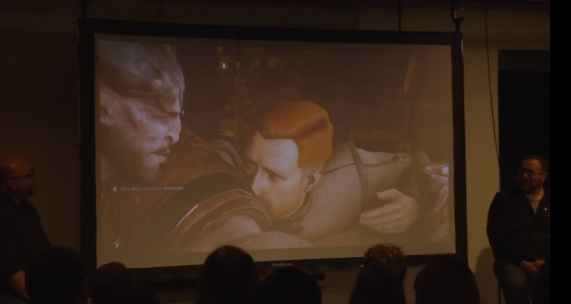
Drinks with Bull
He moves on to the introduction of Bull's scene (the fabulous maraas-lok drinking scene after taking down the dragon), and notes that the scene he wanted to show was "far too dirty and spoilery. It has a lot to do with safe words so you're not gonna get to see that one." (Note: I'll bet you anything it was the Bullmance pillow-talk scene, right? It has to be.)
Mike points out that you have to have Bull's approval here. "These characters grow in affection, and this only happens after you've gotten to know Bull," he notes. "There's nothing Bull wants more than to kill a dragon," adds Freddie, who also adds that when Bull just sees a dragon for the first time, "He's like a kid at Disneyland. So when you get a chance to drink with him, that's what you're celebrating. It's not just, 'Oh, let's have the random drink with The Iron Bull' like in a lot of other games."
Freddie goes on to remind the audience that "It's all character-driven," Freddie says. "He talks about story a lot"—and he gestures to Mike—"but what they do best is character-driven games." He goes on to talk about the lack of stakes on shows like "24," where the bomb may be counting down, but somehow everything is always certain to be more or less okay in the end, when Jack Bauer will save the day. "But in these games," he adds, "they're brave enough to say 'No. That guy died.'"
Freddie then shows the drinking scene (which hilariously features the 'Conan O'Brien' Inquisitor created for a previous presentation).
Also, the audience's reactions are so warm, and so much fun as the 'Conan' Inquisitor drinks with Bull, especially each time he takes another sip. The laughter really communicates how cinematic and fun the scene is as a whole. The drinking scene ends, as it should with a big, giant flirt from the 'Conan' Inquisitor, to the delight of the entire audience.
And Bull, of course, slightly approves. Hey. It's what he does.
Notes from the Q&A
Note: For the Q&A portion here onward, I think the best thing I can do is move to a more scripted format, so that's what I've done.
Frank Lantz, the moderator, asks about the process and the audience.
Mike: At its best, you make a game for the players, you don't make a game for yourself. It should be one you enjoy. It should be one you're proud of at the end of the day, but when you think about, as a player, 'What should I be experiencing?' it comes across better, and it helps you contextualize the decisions you make.
For Inquisition, we moved to the Frostbite 3 engine, which, at the time we received it, was exceptionally good at water, explosions, smoke, tracer fire, and lighting.
Freddie: Lots of tracer rounds in Dragon Age!
(laughter)

Mike: But it was not very good at save games, crafting, conversation systems, handling a million words of dialogue. It had challenges. So we had a bunch of work we had to do kind of from the fundamentals, and we knew that was going to be the case.
It also had a huge opportunity, which was to take Dragon Age and make it more open—it was an engine built so that guys could be fighting beside tanks and under jets, so it could do big spaces in a way we never could do before.
And so, we saw, obviously, the success of Skyrim, you look at open-world gaming and more, I guess, system-driven gaming, where it's like, "Hey, this is a thing you can go do and it doesn't really require story," and we saw a lot of appeal to bringing some of that back because it puts the onus back in the player's hands, so that was a factor for us. But the other really important part was not to lose the BioWare—not to toss out storytelling and not to make narrative a third-class citizen.
So the one we settled on was: Immerse yourself in a vast world of companions, choices, and consequences. So those are very important.
David and I talked about this a lot: We shouldn't offer a choice, unless we have some way of varying the experience based on having done so.
Worldbuilding, Lore, History, Politics
David then talks about the evolution of the Wiki, and also talks about how they manage the information and the lore, the worldbuilding, history and politics:
David: It's so many documents, and we produce them one at a time, and what happens, is they start to get out of date. And they get out of date really quickly.
So we basically have to hire someone, and we hired an editor—his name is Ben Gelinas [NOTE: formerly of BioWare, now one of the talents behind Speed Dating for Ghosts], he's an editor that we hired, basically just to wrangle all our lore, to go through all our pages we had, and then figuring out, is this out of date? Is this out of date? And then deleting that, organizing it so we could access it properly...
Freddie (joking): So tweet your questions to that guy!
David: I started the initial world, but I did not create all the lore—it's all agreed-upon but no single person could remember that much. Especially not with my memory.
So now we had somebody that we could run things by—and he might not know personally, but he could always fact-check. And the editors are—they're basically, they're not just our grammar checkers, they're our fact-checkers, they're our sort of our gut-checkers when it comes to the overall story, and we couldn't do without them.
Mike: I'm pretty sure that without the editing team, we would just collapse. They are kind of like this connective tissue across, for instance, our writing, going over to voiceover, to localizing the game to put it in French or German or Portuguese—they kind of are involved in every step of all of those processes.
David: We have so much writing to do that we just can't manage it all, or fact-check... like he was saying, the simple process of going through and preparing each line so that it enters the pipeline and gets recorded! That's a process—an engine-related process itself... I mean, we're writers. When something goes wrong with our computers, any one of us, we just sort of paw at it and say, "It doesn't work anymore..." so don't ask us to do really technical things because it's just not gonna happen. So it helps. A large part of it is to have editors who can wrangle it in, and the other part of it is just to make it piecemeal, to—it needs to be in digestible chunks for us.
And we also have writers that are sort of in charge of specific areas of the lore. Like, for a long time, I was "Mr. Elf." I was the guy that people would come to if they had a question about anything elven—elven language, elven history, the Dalish—I knew everything that had to do with an elf.
Freddie is then asked about the acting challenges involved.
Freddie: You're basically doing three performances. Like, when I did Vega, there was a lot more that we had in concept that made it to the game... Like, we had this idea where you could come down and drink with Vega, right? But if you didn't come down and hang out too much, his response to you wouldn't be as positive. It would be a little less. More (cynical voice), "Hey, man, you gonna slum it with the grunts tonight? Nice."
So you have sort of three different performances that you're giving. As the lead of the game, Shepherd is giving his paragon or badass or ambivalent answers to you—and you, you're giving those performances as well.
The challenges in voice work... You know, when I first got started in it, I wanted to be a stay-at-home dad, and there's not much work in L.A.
And voice work became an option. And I thought, well, I'm a pretty good actor, I can handle this. And it was way more challenging than I thought! I didn't book shit for the first three months. Because, in acting, if I'm uncomfortable with you, I can turn myself, (demonstrating) I can turn myself, I can fold my arms—I can show that I'm not wanting to be that close to you. But in a booth, I don't have that ability and it may not play.
So you have to really trick your brain not to force the performance. Because you can tell when a guy in a videogame who doesn't play videogames is forcing his character. And he literally will make me stop playing your game—I don't care how good it is, if the actor sucks, I'm gonna stop...
But as far as approaching it, it's different tools in your brain—you kind of have to trick yourself. It really is just you and a microphone. It's very rare that you get the other actors in the booth with you. It's very rare that your director is face-to-face with you. Like I said, Caroline [Livingstone]'s in Edmonton, so—we have a good relationship but it's still, you know, earphone-to-mic, which, you know, isn't ideal. You want that organic vibe, so anything you can do... I mean, they're not gonna give me a two-handed ax I can swing around—although that'd be really cool, by the way—
Mike (laughing): We'll see!

Freddie: But, yeah, I try to do things that can make it real and that won't affect the sound quality of the mic, because, you know, there's a lot of times when you're really going at it, and they're like, "Yeah, I can hear your pants moving," or "Can you take that change out of your pocket, Freddie?" Little things like that.
But as far as—is it a challenge for me to do this kind of game? Hell, no. I play games all the time. There's not a game that I wouldn't be able to voice... Except that, well—I don't do that (husky Batman-type voice) "tough-guy" voice that you hear in all those games—I'll just do my voice, which is kind of goofy and doesn't sound cool... (laughter)
Like, with Star Wars, like, you know Kanan is very serious, and handles things (serious Kanan voice) like this. And the Iron Bull is (Iron Bull voice) very different than I am!
But when you get character-driven games, so much is laid out for you. And if you're familiar with the franchise, and if you know the enemies you're fighting? And if you know the types of weapons that you're using because you've actually used them?" He pauses, and becomes visibly emotional. "I'd—I would rather do that than She's All That any day of the week. It's just more fun for me. It's more satisfying creatively."
(SIDE NOTE: It's a really nice, profound moment. How many times do you get to hear a guy talk about the thing that made him famous, an A-list talent adored by teenage girls everywhere—and he's actually saying he'd trade being a heartthrob in that big famous movie for playing The Iron Bull or James Vega in a moment? I think that's really damn cool.)
David: Just incidentally, when he mentions Caroline, that's Caroline Livingstone. She's the head of our voiceover department.
Freddie: She's the truth.
David: She's the one who makes it all come together. If you've played BioWare games, I think we do an excellent job of the voiceovers and I'm just gonna toot our own horn and say we probably do it better than any other game out there.
Freddie: Seth Green and I bow down to her, often, because she's—she's worthy of respect.
David: And Caroline is the one who pulls it all together.
Freddie: Yeah, man. She's a really solid director. We've all worked with her from Mass Effect to Dragon Age, and everybody loves her. And every voice actor I've worked with, apparently, has worked with her! I work with Steve Blum a lot, who's done every voice for every game or cartoon you've ever seen and he knows her on a first-name basis and he'd tell you the same thing about her and how lucky you are [at BioWare] to have her.
Question on the texture of the world—how much of that is an expression of your expression of your own values and of the reflection to player choice and player agency?
David: I think it has to be intentional. The majority of the people at BioWare and of the people who work at many games are, you know, white men, but we also have people of all ethnicities, all genders.
I think it's incumbent upon us to have our game intentionally reflect the people we want to invite to play our game.
Freddie: And you have to remember, videogames have been doing this, like you can go all the way back to Everquest. In Hollywood, if you go on an audition, and it says "minority," you'll see every minority there. Like, it's just like, "Yeah, whatever, as long as we get a minority in there and fill the quota, nobody'll complain..." And that's how Hollywood really is.
And games have always been braver than that. Like, if TV has a gay character, they're like, We have a gay character and we're gonna put it in entertainment news so everybody knows, we're cool with it...
Like, videogames don't do that. They go, "Yeah, he's gay." (shrugs) That's it. "Or he's asexual. Or he doesn't care." Like, it's... they do it intentionally, but they treat it with the proper respect...
Whereas the business that I came from really doesn't. It never did. Like, if you're Latino, you're gonna play a drug dealer, a lot. If you're black, you're gonna play a drug dealer. A lot, in Hollywood. That's just the way it goes. If you're Indian, you're gonna be working in a convenience store that the black guy or the Latino guy is robbing. It's just the way Hollywood works.
And videogames refuse to do that. They really do put forth a concerted effort of courage to actually do that, and to know that society won't freak out the way Hollywood thinks they will. And you don't! I mean, everybody plays. Everybody loves it. And it works.
Frank: But BioWare does it more... I think, than a lot...
Freddie: Games have had the bravery to do that. And I don't think my business always has.
Mike: And I think... one thing that we do very consciously, and we have for years, is, we're actively trying to broaden our internal horizons. Like Dave says, we struggle against that wherever possible.
I think that perspective is probably the most important thing. I mean, we're building fantastical alien races or fantastical fantasy races... there is no need to have a singular perspective on that. You want to be able to get as broad a perspective, as broad a voice as possible. I mean, thankfully, half our writing team is female, so we have a bunch of lady writers, and they're awesome at their jobs…
(applause)

Mike: And again, I go to a lot of PAXes, and I come to things like this, and it's nice to see that there's a mix of gender, and race is something that the whole industry has to work on. And I haven't met anyone who wants that, to go "Oh hey, we should get a white guy..."
And perspective's really important, and everybody's kind of walked their path, and they have something to bring creatively, and they've got something to bring technically (maybe just a solution to a problem). And when we look at how we approach it, is... the nice thing about something like fantasy or Sci-Fi is that we can explore themes of racism and sexuality and that kind of thing, which can be real hot-button issues for a lot of people. And the nice thing is, we can do that slightly through the lens of, "Oh, these people have pointed ears. They're actually a different race... and yet they are people."
And we keep that very consciously in mind. And so we can sort of explore some of those themes and at the same time do it in a way that I hope maybe just sidesteps some of the baggage and lets people get underneath it. And we struggle with it, and it's tough, because you always feel like you may be fucking this one up. And at the same time, it's worth the effort. It's worth trying, right?
All I need is a few people to come up to me and say, "Thank you, I saw myself in that character," or "I saw something I really needed to hear in that moment," and it kind of makes it worth it to me.
Freddie (to Mike): You've got to have people coming up and saying that! Because it's so prevalent in the games, and there are no race or sex boundaries... so if no one has, "Thank you."
David: I would say... I would add on... while it has to be intentional, it's not actually that difficult. It does take an effort but it doesn't take that much. I mean, there are people who object to it—there are people out there who don't want us to do that, who say, "Oh, you make it like an After-School Special!" As if, in order to deal with this one aspect, it has to take our entire focus—we can't do anything else but all day think about how we are going to, you know, put 'social justice' into our games, when really? It just takes a bit of time, when you stop, and say, "Is this okay? Would it change anything about this character if he were female? Or black?"
Freddie: For the record, I was in the very last After-School Special. It was called "Too Soon for Jeff," and I think... he was gonna be a father at fifteen... so it was, uh, too soon. (laughter)
Tabletop and Role-playing Impact
This segment encompassed a discussion of the influence of old-school role-playing on the design and creation of DAI...
Mike: One of my goals, when putting together the ideas behind Inquisition, was that the player should be able to play the way they want to, right? And still enjoy it. And part of that—well, we've all got pen-and-paper history here—David, Freddie, and me—and part of the thing about pen-and-paper games is, that based on partly who your GM is, and partly on who's playing, is that the games take on different colors and calibers, right?
So I've played games with guys who were, like, "I talked to the guy, but let's start rolling [the dice]." They don't want to role-play, they just kind of want to roll play.
(laughter)
And then you have other people who will be like, "Oh, no no no. We'll be doing no fighting tonight, it's intricate story time! Yay! I hate the fighting business!"
(laughter)
Freddie: It's like the first year of high school...
Mike: (mimes donning a cloak) It's like, "Well, I'll get my cloak!"
The difference between those two is that again, they're playing the same game. And the tabletop games are flexible enough that you can kind of do either, and quite successfully, and the rules are there for both sets.
So when I was looking at, "How do we take Dragon Age big? And, you know, do that, and be open? Because the biggest danger for us was losing our focus, and not being a story game, or in not having a coherence to the experience.
What we tried to do—and I had to work with a whole bunch of different groups—was to try and contextualize all the different systems we were building so that the player could still progress in the heart of the game via almost any means. And that was my best goal.
And I think that games that have always captured my imagination? Are the ones that do this. So the example I used when I first pitched this idea was, I was talking about, you know, "Let's do gameplay that's activity-driven,” was Sid Meier’s Pirates. I mean, that's a classic...
Freddie: Great game! What sword did you choose, of the three?
Mike: Oh, I was always a rapier. Always a rapier.
Freddie: Sorry! Nerd mode.
Mike: In Sid Meier’s Pirates, virtually everything you did was pirate-y. And that was a huge influence. So, I'm gonna go dancing. Why would I go dancing? Well, because I'm gonna get the hand of the governor's daughter who will give me more land so I can secure my fortunes as a pirate king.
Okay cool... Why would I do that? Well, partly because it contributes to success. But also because by doing all the things you do when you meet the governor's daughter, she whispers secrets in your ear and tells you where there are Spanish galleons, she tells you where you can go find information, she tells you where your missing family that was kidnapped by the evil Baron is...
All these—so suddenly it's a dating sim, sort of, but it's also a treasure-hunting sim, and a "Seven Cities of Gold" sim, and you're like, "Hold on, those are all related!" And when you go find your family, they tell you information about stuff you overheard, and it's like, "Wait, all of these things link back together!"
And I wanted to try to see what we could do in a fantasy context, to do that. And so that's where the idea of 'power' came in [to Dragon Age: Inquisition], and the idea that certain things you did earned you power, and power was the Inquisition's currency of being able to advance the story. That was really the core idea. So, by the time we finished—kind of, and that took about three years of tumbling to get all the rough edges off (and there's still a few)...
But, like, when you recruit a new character—well, that's a very story-driven activity! "Hey, Iron Bull's joining my party! I get power for that, because this band of mercenaries came and joined the Inquisition and he's my personal bodyguard. Cool!" That's power. Right? That makes perfect sense in the context of the game.
I go and close a Fade Rift. Well, I'm the only one who can do that, and I work for the Inquisition, so they must be cool. Power. I secure new camps—well, now I have forces in more positions, they're presumably feeding information back to my Spymaster, I can deploy forces more quickly, because I've got a front—boom. Power.
All of these things—and what we did was try to contextualize every single thing we did. Either in, I'm making the Inquisition stronger, or I'm pushing back those who stand against the Inquisition. And by doing so, I think we created a thing where, I can gain power by going and killing a dragon, and then Bull drinks with me, or I can gain power by collecting enough materials that I'm building tents, so that my men are safe, and better rested, and better equipped.
Those are very different activities. One is, you walk up to things and click, it's exploration-based and part of keeping a mid-range goal, and the other is, win this encounter. And that's a purely combat-driven activity—which, again—if you've crafted the right stuff, it's easier. If you've brought the right characters, it's easier. If you pick the right powers, it's easier. So again, those systems start to inter-relate, and just like Sid Meier's Pirates.
So, that for us was looking at old-school pen-and-paper, where the game can change based on the player—because they give you a venue to be social, to be scheming, to be the guy who just punches things in the face—and the game adapts to how you want to play. And—could we do that? And that's where I landed.

Games They Play
The panel then discussed some of their favorite games through the years.
David: Crusader Kings 2. I enjoy RPGs but they don't make me relax anymore… I analyze them. With Crusader Kings 2, it's strategic and story-based but it has an emergent personal story that the player forms in their head.
Mike: The ones that really sync with me are the ones that are RPG-adjacent. Be it a progression system in a shooter or... games like Starbound or Minecraft. They're definitely not RPGs but you can see where they touch. Those are incredibly compelling.
Or take some RPGs that aren't like ours. Like, The Dark Souls series—they're fucking spectacular. They are. They are the most brutally fair gameplay experiences you will ever have. Because there is always a way to beat it. There is always a way to learn and get better. The game teaches you by punishing you. Kind of like a dominatrix. (laughter) Or a drill sergeant. It hurts you so you get better.
But—games like that. Because they're in the RPG space—there's stats, there's progression, there's gear—but it doesn't do the same kind of story/choice-based stuff. But I still feel like that experience is still very much mine, because I went to the Tower of Flame before the Giant, etc.
From Grand Theft Auto to Zelda
Freddie: I'm a big Grand Theft Auto-head. I'm the guy in the parachute that is targeting you from above, that you see the dot on the map, and you don't know why you can't see me, and I keep killing you, and it's because I'm above you, floating...
(laughter)
So I used to play that a lot. I've been playing a lot of Dragon Age. And I like a lot of the turret-based games—Tower Defense—a lot of those. But Grand Theft Auto was something... the Red Dead Redemption series... those were very empowering to me, and I always had a natural ability to be good in the multiplayers of those... I played Call of Duty like everyone else, I played Destiny for a little while...
And I played World of Warcraft for SEVEN YEARS. That was, like, a soul-sucker... I was a dwarven healer, I had the fear ward, I was Metaxa, so if you were in my guild, hello. (waves) I'll give up my name now, as I don't play anymore, so...
Yeah, I was in a guild with, like, all actors. It was like, me, Macauley Culkin, Shannen Doherty, who was better than all of us, by the way—
Frank: The Screen Actors' Guild! (laughter)
Freddie: But I played that forever.
So I played a lot of Warcraft, and before that, I was an Everquest head, so I was a big roleplayer guy... and I like a lot of the old school arcade games. I loved Donkey Kong Jr.—I loved that game. And I play Zelda, the original Zelda, probably once a year, just to play it again, and in honor of my man Robin, who's no longer with us... (NOTE: I was unsure of whether he was referring to the wonderful late Robin Sachs, whose credits included "Buffy the Vampire Slayer," Mass Effect 2 and Mass Effect 3, Galaxy Quest, and more, or to the late, great genius Robin Williams, who worked with Freddie's longtime spouse Sarah Michelle Gellar on "The Crazy Ones") that was his favorite game ever... and my man Kieran Culkin's favorite game ever, too, so we kind of play it once a year just out of respect for that great title. I know Ocarina of Time is better but the original Zelda has just got a place in my heart. So I play that once a year.
And you know, to me every boss should be Bowser—should be hard, should be difficult. It's why I hated Force Unleashed 2 because you could fight Vader and take no damage. I know I work for LucasFilms now, but that game blows. If Vader can't hurt you, you've failed epically.
I try to grab everything that's out there that's good. I played Wolfenstein—I liked that, although I thought they mixed up their end bosses and that should have been inverted, because the last boss was too simple while the fight before that had a couple more challenges. I played a little Assassin's Creed—I didn't finish it, but I try to get my hands on whatever's out there.
Audience Q&A
The first audience questioner first thanks the team for its inclusivity, including The Iron Bull's romance, and then goes on to ask, "How do you design the characters and flesh them out? They don't seem to ever overlap."
Mike: The high-level goals... what we want is characters who are characters first. They shouldn't serve a role in the game, i.e., "This is the warrior who is straight." No, fuck that. I want someone with an intriguing history.... and so we start with character, rather than starting with stats... the big thing we do is, the characters that see the light of day, that make it and survive, they've "anted in." They have stakes in what's happening. So if we had a mage who, you know, was kind of 'whatever' about the Circles or Chantry, then why are you here?
Whereas Vivienne has absolutely firm views and they conflict with Solas's. And suddenly those are two excellent characters because they're opposite poles.
Freddie: And she gets mad at me all the time. And I love Vivienne—I wanted to romance her, and I was, like, "Man, I made her mad so much, I was like, 'I'm going with Sera.'"
And to go with what you're saying, all of those characters—and I can speak on this as an actor—it's all about motivation, right? They're all working toward the same goal, but they all have different motives on how they want to get there.
And it's the games when everyone's like, "That guy sucks, and it's because of A, B, and C," that you're kind of like, "Okay, I'll finish the game, but whatever." It's better when it's "That guy sucks, and it's A, B, and C," and someone else goes, "Yeah, but it's also, D, E, and F," and this guy likes "X, Y, and Z..."
I mean... It's just different motivations. And that's what makes it a character-driven game. That's what these guys do so great.
A Collaborative Process
David: Other than the obvious things—I guess the thing that people probably don't know is that it's very collaborative. It's not just the writers. I mean, a writer could go, 'I'll write this fantastic story for this character, and, you know, write ten tons of fanfiction about it, and hope that everybody loves the character enough to make it into the game," but it's a slower process than that.
We come up with ideas that grab us. I encourage my writers to come up with ideas of things they want to write. I mean, people—we might get someone in the audience asking, "So why didn't you write a character like this?" and then at the end of the day, sometimes it's just that "Nobody wanted to." It has to grab us first.
So we'll do these sort of brief ideas. And we'll throw them to the concept artists. And they come back with some things that grabbed them. And they'll do these pictures, and sometimes you'll see a concept artist who will do a concept for a character where it'll come back and you're like, boom.
Mike: Vivienne was like that.
David: Vivienne was exactly like that. The first concepts we got back for her, she was white and blonde and an ice queen and stuff... And "ice queen" was kind of the initial concept. But it didn't really grab us. And then one day, I think it was Matt Rhodes (Mike: "Yeah, Matt!") did a version of her where he made her black, super serious, and super stylish, that kind of Maleficent version, and he brought that back and said, "What about this?"
Freddie: She talks to you about your fashion!
Mike: But that's why! She didn't—until we got this concept.
Freddie: That is cool.
David: Mary Kirby, as soon as she saw that concept art, she was like, "I want to write this character."
So there's a lot of back and forth even after the fact. Because in order to make them fit, we'll be starting to write a character and realize, these two characters overlap too much, so I'll get the writers together, and we'll discuss it. And sometimes that means, that character is now cut. And then somebody goes off to the bathroom and cries for awhile.
But it's just a matter of us talking it out as a group. We're writing this all together, but it's not just the writers, it's people like Mike, it's the artists, and sometimes it'll be a programmer who comes into the room and says, "I have an idea!" and then I'll go, "That idea sucks... but that one piece of what you said is a really neat kernel of an idea..." And suddenly it'll later blow up into an entire plot on its own.
"Pitch it. Even if it's bad."
Freddie: And that's something that's important to remember, in all forms of art. Like, sometimes you may think an idea sucks: Pitch it. Because there may be one part in there that inspires someone else—that then inspires you. And then all of a sudden you guys have exactly what you thought you had in the first place, but didn't. So always—what he just said is super important, in screenwriting, in videogames, in whatever it is you want to do.
David: Unless it's that campaign you ran as a DM. Or that character you ran in that campaign... and you want to come and tell me alllll about it? (shaking head emphatically) Let me just break it to you: Telling other people about your D&D campaign is NEVER interesting.
(laughter)
Freddie: So you're gonna sit at the opposite end of the table from me at dinner tonight?
David: (laughs)
Mike: Patrick Weekes has a mantra he uses for that, which is—
Freddie: Patrick Weekes wrote everything I say, by the way...
Mike: Right, Bull, Solas, a bunch of characters, he's awesome. And anyway, so Patrick will say, "This is not a good idea. And I know that. But it might get us to one!"
And don't be afraid to use that. That's actually really powerful. Like, "I don't have any ego in this. I know this is dumb. But: Combat ballerinas."
(laughter)
Mike: You know? And you could probably make that work.
Freddie: Rambo and Degas!
David: Yeah, he'll do that. And you encourage people to talk. And he'll say, "Combat ballerinas," and I'll be in the middle of a meeting and I'll stop, and I'll be like... 'Oh, it's another one of these...' BUT...
Mike: But it breaks the ice.
David: Right. And it gets us talking! And by the time we're finished, it's neither combat nor ballerinas, but... we went through Sailor Moon and then down into that dirty movie we watched on the weekend, and then, boom, suddenly we're at the edge, and somebody will finally throw out something...
And it's, like, usually the quiet writer in the back of the room, like... Brianne [Battye], who will throw something out and we'll all stop. And she thought it was stupid or she was joking, but then we'll realize, we'll have that creative moment of lightning striking and go, "That might actually work," and everyone (nodding) goes... "Huh."
How do you balance larger worldbuilding and the intimacy of characters?
David: That's kind of my entire job.
Mike: The thing about lore is that, in and of itself, it's not there, and you can't count on players to engage with it. So, like, Freddie might read it. I might read it. But not everybody's going to, and you can't rely on people doing so. But you can put a lot of texture there, like deepening lore, and kind of more like, "if you want to" stuff. Like losing yourself and going into The Lord of the Rings wiki and realizing, "Oh, Barad-dur was built by the Numenoreans—I didn't know that!"
So you can do that kind of thing. But more importantly, what you need to do is have an arc that, in and of itself, has a clear objective, that has a clear purpose for the player to achieve.
Because if you have a player that isn't into the story and doesn't understand the kind of deep, meaningful blah-blah-blah of the politics, if you can still say, "But go there, and punch that guy in the face!" and then ideally give them a couple of different ways to go there, or any number of systems to allow them to go there—then players who aren't engaging on the lore level can still engage with the gameplay. And that becomes very important.
And what happens—and we find this very organically—and if you read certain reviews of Dragon Age, people might go, "Yeah, I didn't really know what was going on, and maybe that was bad, but then ten hours in I couldn't stop playing." And that's part of the process, of saying, "I knew what to do even though I wasn't engaged with the world or I was a new player—it was clear enough for me to proceed."
And over time, you start to absorb the world into your awareness, because we try to write very consistently. Where lore becomes important then is where the writing team or your design team or whoever you have that's touching it in any way, has to know it very well, and inside and out, because it's the glue that silently holds together the nucleus and the electrons; it's the thing that keeps your world coherent and self-consistent... because if you start breaking your own rules, then it falls apart.
David: That happens a lot. You'll play a game, and they've only designed the world that they need immediately. And you very quickly get a sense of—outside of that immediate area, there is no world. And I think it just happens—like the writers, the game-makers, need to know it, and even if they don't always bring it up, there'll be that little offhand reference...
Freddie: I'm not gonna say the name of the game, but I really want to say it right now... I really want to say it... But I'm not...
(laughter)
How do you balance the roles between creative director and writer at BioWare?
Mike: Well, first off, Dave's a much better writer than I am. He really is. I started as a writer, so I come from that background, but I recognize that guys like Dave, and Patrick, and the writing team, they're hands-on with it. They're working with it right now, and Dave's got a verve or a turn of phrase, and I have to recognize that if I were writing that path, that would actually damage it.
What I try to do, and this is really where our roles tend to balance—mine tends to be trying to harmonize all the parts.
So I will go wander over to the lead encounter designer and say, "I really need this one to sell this emotion, because the writers are building towards this, and the cinematic leading into your encounter is selling this. And I'd like you to work with me to help take that idea and that arc home because we're then going to run into the finale of this particular story arc. And I need that to accomplish X, Y, or Zed."
So, from his point of view, it might be, "Oh, I need an endless wave, and it's a survival kind of horde thing, so I feel like it's a desperate hold-out against blah-blah-blah..." But what that does is part of a larger harmonic kind of experience that ideally is supported by loot that is actually hand-placed, to be, like, "Oh, burnt teddy bear," and you're like, "Wow, I actually feel bad for opening that chest."
So, you know, it's all these different elements and trying to make sure they all kind of work together, and that you feel like the progression is all a part of one experience. And that's how I approach my role. I tend to look at it as one big narrative that's a narrative of play, as opposed to a narrative of story.
David: And it frees me up that my only concern is story. I mean, I don't always get my way. But I'm the one who's going to go to Mike and champion the needs of the story versus the rest of the project.
He has to keep the larger picture in the mind. So he's providing me guidance. A lot of times, it's—like, we talked about how the games begin. The notes, like, "Okay, Dave, we want a lot of exploration in this story so you're going to have to figure out how to put together a narrative that is not story-driven, that is exploration-driven."
And I'm... "That we've never done before."
So, okay, challenge one. And he'll give me a few things that maybe he wants to see. And that provides me the box in which I have to work. And then I go to the rest of my team. And my role to my team is to get them to the point where they feel ownership over what they're writing. And I support them. And when they have needs, I'm the one who has to go out and champion them, and what they need, to the rest of the team. Because they're the writers—they don't have the voice of, like, me or Mike, so we are the story warriors, I guess.
Next, a guy asks a question while noting "Something I absolutely love that also drives me crazy about BioWare games is certain game-shattering changes that are hidden so far into the decision trees that a lot of players won't ever get to them. How do I as a player get at those choices without playing the game literally a hundred times?"
David: It depends. If what you're trying to do is reverse-engineer an end result...?
Freddie: You are my cousin with "Choose Your Own Adventure" books. He literally reads every single page—and then decides the story that he wants to do. And it's awesome, by the way.
David: It's not necessarily a bad way to play. People play with different things in mind. For different reasons...
Freddie: I save before every judgment! And if I screw up? I start over.
David: Some people talk to followers trying to think of how to get them to higher approval. Or "How do I get to the romance?" Or another one is, "I'm just gonna play my character and give the responses that they would give." That's the version that we write from. And the minority content—the idea that there is content that not every player is going to see—we do that on purpose.
Now, that may annoy some people, it's true.
(Freddie silently points at himself.)
But there's also the matter of the discovery, as well. When you discover that there's this whole part of the game that maybe I didn't see, or this choice I didn't take that maybe gave me something else, it could annoy someone, but it could also be an element of "Oh!"
I mean, we're trying to have consequences for choices. So—choosing to play a dwarf [in Dragon Age: Origins] gives you the opportunity to have this child, which maybe you wouldn't have encountered, but then your friend online or whatever says, "Yeah, I had a child!" and you're like, "WHAT?"
And that's on purpose! That's on purpose. Because if the player can go through and hit 100% of the content, then they're done. And so... there's an element of replayability, there's an element of feeling like your choices have consequences, even though it is an artful illusion in many ways—that's the only way we can provide it.
Mike: And one approach we use... is that we try to avoid the sense that there is a "best" ending. Inquisition I think does a very good job of sidestepping which is the right decision, which is the best decision, because I think it engages you as a player to go, "I think what I did was right," and then ideally you get to talk to someone who totally disagrees. Because then you're in a place where you're like, "Oh, wow, we really came at that from completely different angles."
So there's one in Origins where there actually is a "best" way to resolve the Redcliffe dilemma with [Connor] the kid who's been possessed by a demon. There is a way to resolve it. And there is a "best way" to do it. And I actually see that as kind of a weak spot of that...
David nods.
Mike: Because then it's like, "Well, then the other options are bad..." And I think it tends to be "Well, this is the option that's best for me." It leads to a much better way. Like, "Should I play a mage or a rogue?" And it's like, "Well, what do you like doing? Do you like blowing dudes up from a distance or stabbing them? Both are good, but they're very different experiences." (laughter)
Next, a student asks a question about about the love interest process and how characters are chosen for romances.
Mike: Going back to what I said earlier, we do start with them as characters first. We never say, "We're going to need a straight male!" We instead build up this cast of characters and ask again, how do they react to the story. So we have characters who are characters first, rather than, we have love interests first. I think with 'love interest first,' it becomes, like, you're in this weird space where you're trying to fill all the boxes.
Freddie: And then Fabio's on the cover of your game...
Mike: Contrary to Patrick's assertion, we are not a "Save the World" mini-game with a dating sim as the core game—it's the other way around!
(laughter)
So we build our cast of characters and I think from there, we all have the admittedly, slightly uncomfortable talk where we're, like, let's talk about sex everyone. Right? And we close the door because we don't want the artists to freak out.
(laughter)
David: There is some negotiation. I mean, it ends up changing a lot of the time because we'll do our first pass and go, "What about... this character can be romanced... and this character can be romanced... and this character, and they're gay, and we do that, and then... we sort of look at it, and we go, "Okay, let's take those characters and look at them..." and then sometimes it's imbalanced or then the writer who has that character says, "But I don't want to write that character as a romance!" or...
Mike: Or, even better, "That isn't right for the character as I've been writing them." Which, at that point, that's probably the best possible reason to pull them out. Or to say, the alternate version, which is what Patrick does, which is, "Okay, I got an idea. For the romance..."
David (laughing): And I'll be like, "PATRICK, NO. Go back to your desk."
Freddie: But you didn't say no to the safe word idea!
David: Yes, I did! (laughter)
Mike: So, do you know why I said yes?
Freddie: Tell me!
Mike: Because when he pitched it to me, we were at lunch, and my wife was there. And she kind of went—
He widens his eyes and reaches out to clutch David's shoulder excitedly. (Laughter)
Mike: She went... "HE SHOULD DO THAT."

(laughter)
Mike: And I went... "I feel like there's a subtext here."
David: It's not that sub!
Mike: Neither is Bull! (rimshot)
(laughter)
Mike: So anyway, we start with characters, build them through, and Dave's right, that we do gut-check, because sometimes we'll go, "Yeah, that seems like that could really work," and then we'll look at each other and be like... "Oh, crap."
David: And sometimes it doesn't work because of what it says, like, they're too similar. Or maybe what are we saying about that sexuality with those characters or those choices? So there's—we'll never get it perfect...
Freddie: Qunari sex is perfect!
(laughter)
David: We can't let the tail wag the dog. We can't change all the characters and force writers to write something they don't believe in just to service these neat little boxes being checked. We've got to think about it and give it some consideration. And think about what we're saying even though we're not trying to say it.
Like, the original goal was to invite people and get them to play, and experience a game they might enjoy.
Mike: Can I say, though, the one thing we truly need to get right, though? Next time? Boy, we gotta get some dwarf romances!
(Outright cheers from the crowd)
David: I knew you were gonna say that.
Mike: So the people who keep tweeting me that, yes I'm aware. We will get on it!
David: But we're not gonna start with the box that starts with "Dwarf, romanceable."
Final Advice
A final general question on what advice each would offer to others on the industry...
Mike: So the thing that I think is probably the most valuable is something that comes from my background, which was as a critic writing reviews from 2000-2003... so I got to ride the dot-com explosion. And that was fun (laughter)...
But the thing that that helped me learn (and when I look back at it, I'm like, "Oh, I'd be so much better at that now!") is to be able to look at a game and go, "Okay, so this is what I feel it did really well, and this is what I feel it did somewhat poorly..."
That's step one. And that, I think, is a really valuable skill, to be able to be critical and to be able to be, you know, "Let's be honest and let's be polite about our critiques, right?" You don't have to be, like, "And you're bad."
You want to be able to articulate what didn't work and what did. But the thing that's really important then is to say, to go that extra step, especially as game design students, and say, "So if I were looking at it—first, can I figure out why that probably ended up shipping the way it did? Because there's always a reason—always a reason. No one ever goes (chuckling), "We'd like this to suck."
(laughter)
No one ever does that. There's always something...
And the other thing to say is that, "If you were given a moderate or modest amount of resources, not a thousand programmers or anything, what would you do? What kinds of things would you do to address it?"
Because that set of things I just outlined? Is going to impress the living heck out of me at an interview. "Let me tell you about the last game you worked on, politely—what I felt was particularly strong, what I think you should keep doing, what I think you had some weaknesses on, and what kind of thought process I have around how you could make that better."
And you may not be right. You may not understand. There's no way you can know why those decisions were made... but that.
David: You won't offend us. Nobody criticizes our games more than we do.
(laughter)
The Secret Superpower of Tabletop Experience
David: So if someone comes into an interview for writing, the thing that probably impresses me quickly, is that they did tabletop. That they ran tabletop. It's really amazing but I've found, while it's not a guarantee, but chances are, if they were a DM or GM, they've got a lot of innate storytelling which is player-driven. There are a lot of skills there that translate over—the building a story for the players, that's not necessarily your story, that has to change and adapt. Especially depending on whether or not you're a good DM.
Another one I always tell people—the other advice I always give, is to mod. Go out. Mod games. Get on mod teams. If there's any way you're going to demonstrate—regardless of your education—if there's any way you're going to demonstrate that you know what we need, modding means you can actually provide something. Two of my writers came to us through the modding community in Neverwinter Nights. Being able to provide something that they could show.
Being part of a mod team, if you can get on one—and if you're going to be a writer, that's hard, because everybody thinks that if they can write a sentence, they can be a writer—but if you get on one, you're demonstrating that you can work in a team environment. That's really important. Because we've had people that have come and wanted to be a writer, and they had an idea for the entire game, and were like, "I'll tell you how to do this, guys!"
And I went... "Okay thanks, door's that way." Because you have to be a team player and show that you're willing not only to critique... but to accept critiques. Within the team.
Embracing the Process
Freddie: You know, I can just speak to you artistically. Being an artist before you're successful is very lonely, as probably a lot of you already know.
I would say, embrace that. When I moved to L.A., everybody in my acting class that wasn't booking jobs was going out every night, and partying every night, and having sex with every other student in the class...
And I went home every night with scripts, and busted my ass on learning how to audition, and on learning how to break scenes down on understanding, you know, what my character's obstacle is, and how I want to approach getting around this obstacle to accomplish my goal. And that's just on a scene-by-scene basis... and you heard these gentlemen talk about that on a much grander scale as far as building videogames.
So embrace the loneliness. Use that time wisely. I didn't have a lot of friends, but I booked a lot more jobs than those guys did, and it wasn't because I was better than them—I was just more prepared than them. There were guys in my acting class that couldn't get an agent that could act circles around me. That were phenomenal. But they were out til 4 o'clock in the morning, and they had an audition at 10 a.m. the next day, and they sucked and I didn't, so... they didn't get the job and I did. You know what I mean?
So just... take advantage of the time that you have here. Be fucking humble. Be egoless. Walk in and say, "I don't know shit." Because that's how you learn.
And when I was a teenager, you know, I had a lot of male figures in my life that physically beat that into me. My godfather's Bob Wall, and if you don't know who that is, he's the guy that trained Bruce Lee when Bruce Lee came to America. He's no joke. If I didn't get something right the first time? I got hit.
So—be disciplined. Discipline yourselves. Understand that what you're trying to do isn't easy at all and if it was, every single person in here would already have a game out, and you'd already be successful, and you'd be sitting right here, and people would be asking you questions.
It's lonely. And it's tough. And it's hard. But embrace that time and make the most of it. And own it and make it yours.
Someone wants to call you a nerd? I got called a nerd a lot. I just took Jujitsu so those guys got choked out. (laughter) And I was a DM so if you made fun of my friends, that was your ass. That's just the way it went.
You guys are old enough that you don't have to deal with that now. We live in a wee bit more evolved society where we don't fight over everything. A little bit better than we used to be.
So just embrace what you're great at. And focus on it. And that way, when you do go in, and you do get to meet with guys like this and you want a job, you're prepared.
There is no such thing as luck. There is no such thing as luck. It's just about being ready.
So... take that time, take that advice, for what it's worth. If you don't understand it from me, speak to someone else and maybe they can break it down a different way, but... stay humble and embrace that alone time. Use it to your advantage. Don't use it watching reality TV unless you want to be a reality TV producer.
Be Willing to Work Hard
David: To speak to that, just really quickly—when I mentioned that part about modding—the most common reaction I get when I say to people to mod is, most people look at what it takes to do modding, and go, "Well, but then I would have to learn how to do scripting, and then maybe some C++, and then I'll have to figure out how to—that seems like a lot of work."
And I'll go, "Yes. It is."
Do you honestly think I go into work, scribble off a couple of paragraphs, and that's it, I'm done? It is a lot of work, and a lot of it is really unenjoyable. And tedious. And then it's eclipsed by moments of sheer awesomeness. But—you have to do the 99% of tedium, that is absolutely required, and if your response is, "Well, that seems like a lot of work," then wow, this job is so not for you.
(laughter)

Freddie: Picasso threw away a lot of canvases before he was selling stuff.
You know what I mean? It's the same for every artist, whether you're an actor or a painter or a game designer or a director or a director of photography... a photographer... Whatever it is, it can be a lonely life, because you're in your head a lot, and a lot of us are very introspective, and a lot of us become the shrinking violet in the room... we start to disappear when people are watching us.
Just... fuck that. My ego's over there somewhere (points off to a corner of the room). Just—I checked that out. If you guys think I'm cool, right on. If you don't, right on.
Like, just don't care. Focus on what your art is, what your craft is, and just kick ass.
(applause and end of the event)
LEGAL NOTE: I don't own ANY rights to anything noted here. Nor do I pretend to. Not to the linked/transcribed video, which is courtesy of the NYU Game Center, nor the screen shots I've included to spotlight a few moments. I'm simply referencing the interview because it's delightful and genuinely instructive and fascinating on the industry at large.