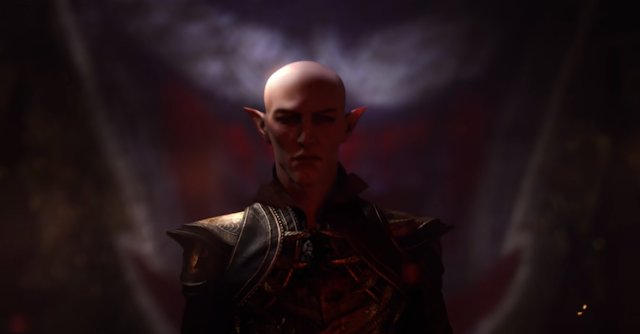
SOLAS: I was trying to determine some way to show you what you mean to me. So I am going to get a few smoochies, grab your highly toned elven posterior, and then cruelly dump you without a word of actual explanation, leaving you in a swamp full of hungry wyverns.
And so here we are, my fellow Solasmancer. That tragic, crucial point in Solas's romance when we've reached the last, worst date—when Solas realizes the cruelty of what he's doing and that there is only one solution: the cruelest cut of all.
I always knew it was gonna be a doozy, because the scene is so emotional and complex. But hey, since my heart right now looks and feels like a stomped orange, it's the perfect time to dive right into the lowest pit of Solavellan Hell, and get this party started!
I always knew it was gonna be a doozy, because the scene is so emotional and complex. But hey, since my heart right now looks and feels like a stomped orange, it's the perfect time to dive right into the lowest pit of Solavellan Hell, and get this party started!
NOTE: In the images here, I'm using those from my very first Solasmance, and as a little bit of trivia, I made her a redhead because I wanted to headcanon that Iron Bull (my previous romance, in my very first DAI playthrough) would see her and yearn after her from afar. I figured it was only fair after what Bull put me through in that first playthrough. So what you see is my poor little redheaded Lavellan, who was very sweet but had very little sense of humor, and here, she's about to get her heart absolutely obliterated by Solas.
Tissues? Check. Cynicism? Check. Capacity for emotional upheaval? 100%.
I'm ready. Let's do this.
Where We Are Now
So in Part 4 of my analysis of Solas's romance, I took a look at the balcony scene and declaration of love (I know the URL says Part 3, but it's truly Part 4, apologies). Then later, I discussed his state of mind after the Arbor Wilds... and how he seemed especially shaken on the brink of achieving everything he wanted.
But still, right now everything's beautiful as far as Solas and the romanced Inquisitor. They share a moment in the Rotunda after Mythal's Temple, after Solas asks her that pivotal question of what she would do with the power of the Well, and which leads right into the date...
SOLAS: Forgive my melancholy. Corypheus has cost us much. The Temple of Mythal did not deserve such a fate. The orb he carries, and its stolen power… that, at least, we may still recover. With luck, some of the past may yet survive.
A romanced Lavellan has a few potential options in her response here, so let's take a look at them:
First off, she can simply reaffirm that whatever happens, she and Solas will be together (I know. Ouch.):
LAVELLAN: Whatever comes, I will have you by my side.ME: Oh, sweetie...
Option number two here is one of the most hotly debated among "Solavellan" fans, or Solas romancers, because of the implication that they may already be sleeping together:
LAVELLAN: You’re being grim and fatalistic in hope of getting me into bed, aren’t you?SOLAS: I am grim and fatalistic. Getting you into bed is just an enjoyable side benefit.
I've already given my case for why I feel this is a simple, flirtatious misdirect, and that they do not have sex. His denial in "Trespasser" is so emphatic I just feel there's no way they were ever together in that way, and I feel like that point of view is further backed up by the fact that there are no kisses on demand, and no love scene.
But I know it can definitely be seen from both sides, and Weekes has also emphasized that it was written to encompass either point of view.
The third option in this conversation is a fairly strong echo of the romanced Inquisitor's last bedroom scene with Bull, where they may struggle with the idea that they may not survive:
The third option in this conversation is a fairly strong echo of the romanced Inquisitor's last bedroom scene with Bull, where they may struggle with the idea that they may not survive:
LAVELLAN: You’re talking like you’re going to die. Stop. We’re going to get through this.SOLAS: I hope you’re right.
No matter how the conversation has gone thus far, it ends with a plea from Solas for the two of them to escape for awhile:
SOLAS: Come with me, vhenan.
And then they're in an ancient elven shrine in Crestwood, where they wander through a breathtaking ancient series of paths and wide tunnels, culminating in two enormous hart statues of stone within.
We may have glimpsed this area earlier, if we did the "Wyrm Hole" quest given by Judith, which then led us to a wide pond overseen by the ram statues, and bordered by lush green swamplands.

Of course, it's even sadder and funnier if we picture the fact that—after the events here—Solas simply leaves Lavellan alone at the swamp. Surrounded by wyverns.
But before we jump into the delicious heartbreak and kissage ahead, let's take a look at this interesting choice of location for their date, shall we?

The Harts of the Ancient Shrine
Why this place, this shrine? What does it mean to Solas?
While many have casually referred to the statues here as halla, they are harts, which have great meaning to the elves, and especially for the Dalish. For instance, if we play an elven Inquisitor and we do the Red Hart mount quest available on the War Table, we're gifted the hart and given this note written in flowing script from "a distant clan of Dalish," as follows:
We find our kin in strange places. Though we know not if you will carry tradition with you, we would see you carry pride in some form. For the wounded sky is all of ours, whether belief is shared or not. Let all see this, and convey yourself as we should be.Emmasalin var suledin evanura.
If I break this down from a variety of Codices or notes, "emma" usually means "mine" but here I'm thinking it's plural and means "our." "Salin" seems to mean "again." "Suledin" means "endure," and "evanura" here may mean "honor." (If we get the sword Evanura in the Emerald Graves, it is noted as a "blade of honor" forged for Mathalin, the first of the Emerald Knights.)
So, considering that elven is a cipher, our elven note for a Dalish Inky could be something like:
Our - again - far - endure - honor.
So perhaps the sentiment could be, "With this gift, even from afar, our honor endures." Also, it's interesting, isn't it, that the note references the desire for the elven Inquisitor to "carry pride?"
Meanwhile, if the Inky is not an elf, they get a different note:
Perhaps you are not as we and do not share what we believe, but this threat is common to us all, for the wounded sky belongs to everyone. If nothing else, we would have you sure of foot in your journey toward victory.
Mas enasalin lasa revas evanura
This one may be a bit easier. "Enasalin" is "victory," "lasa revas" is "is/are free" and if "evanura" is again "honor," maybe this sentiment is "[may] - victory - be free - with honor" or, perhaps, "With this gift, we wish you freedom and honor in victory." Or, "with this gift, may victory be free with honor," perhaps?
What do you think? Please suggest your own interpretations, as mine are very stilted here and I'm sure I'm missing all sorts of wonderful potential messages.
And of course, this could be totally wrong.
More Ancient Details and Guesswork
If we look back to previous visits, there are familiar statues to both Fen'Harel and to Falon'Din outside the Crestwood shrine.

There's a mural inside the encircling walls here that also appears at the Temple of Mythal, with the addition at Mythal's temple of a dragon image flying above.
So what's the mural? Are these elven slaves or armies? They're riding harts—are they fighting each other? The Evanuris? The Forgotten Ones? Are they, perhaps, creatures of Ghilly's?

This very same dragon also appears behind the waterfall here...

We've seen this more complete image—with the dragon—in the Temple of Mythal. We also see it again, later on, in "Trespasser." And we also find this dragon image repeatedly across Thedas (and even at Skyhold).

Which also reminds me of the Codex about the "sinner" who was egged on by Dirthamen and Ghilan'nain to commit the crime of high treason by taking on "a form reserved for the gods and their chosen," who "dared to fly in the shape of the divine." And of course, as we know, it's a rare instance in which Mythal was not merciful and fully unleashed her wrath.
Given what we now know about Ghilan'nain being pretty monstrous, this will undoubtedly come up again so I'm noting it here in case it's directly relevant.
While the harts are not halla, this does seem to be a shrine to Ghilan'nain, and the Venatori codex nearby does note that this is an "elven ruin."
So why does Solas bring her here? My guess is, despite all of my intricate guesswork above, that it's a relatively simple thing: It is an ancient place holy to the elves. The Veil is thin. So Solas likes this place because it feels like he is momentarily back in his own time. Perhaps it even makes him feel, for a little while, like he is young and hopeful again.
The Truth (The First Sudden Swerve)
The date begins as we go to the cutscene. Solas and Lavellan walk into this ancient holy place, and Solas is visibly happy—he comments on the atmosphere as they walk, hands linked. "The Veil is thin here. Can you feel it on your skin, tingling?"
It's not entirely clear, by the way, that the Inquisitor does feel what he feels. She doesn't respond, merely looks down and away, then back to him, openly inviting. Then he touches her face tenderly, and speaks:
SOLAS: I was trying to determine some way to show you what you mean to me.
ME: Oh, awesome! What's it going to be? A poem? A piece of jewelry? Maybe a pony? Or... maybe... finally... SEX? Although I admit that a cave floor near a bunch of wild wyverns wouldn't be my preferred location, but beggars can't be choosers, so let's do this!
SOLAS: Hold your halla. It's not that. Because I gave it a lot of thought and I really felt that...
ME: Uh-huh...?
SOLAS: ...breaking your heart was the gift that would keep on giving.
ME: Oh.
SOLAS: We're talking absolute devastation. Pulverizing your heart into little tiny smithereens.
ME: Got it.
SOLAS: What do you think?
ME: Oof.
I may have made part of the above dialogue up. Yes, I'm fine.
So what Solas actually simply says is, "I was trying to determine some way to show you what you mean to me." And it's lovely and heartfelt. It is also where things get very interesting, fast.
The Inquisitor has a variety of potential responses, with Solas's replies varying from thoughtful, to flirtatious:
Option 1 ("I already know"):LAVELLAN: That’s not necessary, Solas. You’re my…SOLAS: That is the question, is it not?Option 2 ("Interesting!"):LAVELLAN: I’m listening, and I can offer a few suggestions.SOLAS: I shall bear that in mind.Option 3 ("You don't have to do that."):LAVELLAN: I know what we mean to each other.SOLAS: Even so.
And then Solas says, "For now, the best gift I can offer is... the truth."
He is presented as being open, loving, and wholly sincere. It's a big moment.
SOLAS: You are unique. In all Thedas, I never expected to find someone who could draw my attention from the Fade. You have become important to me, more important than I could have imagined.
And boom. This is where we have to commit and lock in the romance. Where we either tell Solas, "You know, I don't think this is going to work," in which case he is complimentary and courteous. Or we jump in happily with, "I feel the same way."
I mean, what could possibly go wrong?
It's diabolical, isn't it? For the unsuspecting and innocent Lavellan, for the player traveling this path for the first time, especially so. We have no idea what's just seconds away when we happily click "I feel the same way."
So we click. And he goes on, and there's still the smile there for "Then what I must tell you... the truth..."
And then he blinks—and changes direction. It's really notable, I think, that he stops smiling after "what I must tell you." It's right there, as he stumbles toward that phrase "the truth" again, that things get difficult.
He's brought her here, to this ancient place, to show her who he truly is. To tell her an impossible thing in a holy shrine to their lost people.
But he can't do it.
And he realizes this when? When looking at her face. Her beautiful face. And I think this is where it starts to go wrong, where reality starts to intrude for him. The dream begins to end and he's waking up whether he wishes to or not.
SOLAS: Your face. The vallaslin. In my journeys in the Fade, I have seen things. I have discovered what those marks mean.LAVELLAN: They honor the elven gods.SOLAS: No. They are slave markings, or at least, they were... in the time of ancient Arlathan.
Potential responses here:
That doesn't matter.That can't be right.We were wrong?That's a lie!
For me, the most interesting part of this is Solas's explanation, which is (as always) not entirely forthcoming:
SOLAS: A noble would mark his slaves to honor the god he worshipped. After Arlathan fell, the Dalish forgot.
Isn't the truth actually even more devastating and complex? That the nobles he's talking about were originally the Evanuris themselves? For me, this adds a whole additional layer of grotesqueness to what Solas is explaining, because there was no "honoring of gods," in that case—at least, at first—the vallaslin were simply practical symbols of ownership. Like a bar code on a can of peas.
Ugh.
Echoes of Past Revelations
The Inquisitor and Solas talk a bit more here, with the tone from Lavellan either sad, accepting, outraged or defiant at the revelation, but again, what's interesting to me is that while Solas tries to assuage her sadness or upset, and while he may even compliment the Dalish for simply spawning her, his anger at the Dalish is still very much present.
And again, it's complicated. Remember, Solas went to the Dalish as the very first thing he did upon awakening. It's the first thing he reveals to us when we meet him, way back after the Conclave. He went to them, his people, to tell them the truth—to tell them the truth he is telling Lavellan right this minute.
And they turned him away. They threw him out.
That's what he cannot accept. While I truly think Solas's humility is genuine in that he doesn't see himself as a god, he is nevertheless still a prideful and occasionally arrogant man, and (to be fair) he knows this about himself. He may not be divine, but he is ancient and knowledgeable, possessing the secrets of millennia... and they threw him and his knowledge out like trash.
No wonder he hates the Dalish. He loves them too much to be neutral.
Now he's told this truth again, to the woman he loves, but it's not the truth he meant to reveal.
The Vallaslin
Here's where we're faced with our next big choice... to keep or to remove the vallaslin? Lavellan, as before, can answer with an assured yes or no, or with uncertainty. Regardless, he is apologetic and gentle, noting in most cases that he didn't mean to cause pain, and that he feels selfish for doing so. Then she makes the choice.
What to do? There are powerful arguments on both sides here. Many who choose to keep the vallaslin point out that it doesn't matter what these markings meant thousands of years ago—it's what they mean now that's important. And they're not wrong about that.
If she chooses to keep it, Lavellan tries to explain it to him, but he truly doesn't seem to need it:
LAVELLAN: I know you told me because you wanted to help, but the vallaslin is part of who I am. I hope you can see past—SOLAS: Stop. You are perfect exactly as you are.
I like that those Inquisitors who choose to keep the vallaslin are treated with the same love and respect by Solas as those who do not. He reiterates that he finds her beautiful either way, and accepts that she is at peace with keeping this cultural part of her heritage.
However, for me, it's always an easy choice to remove them. Solas's revelation always makes me want to wipe them away as fast as possible. Luckily, he's got a spell for that, and he offers it immediately.
If she accepts his offer, Solas looks visibly pleased. He has his equanimity back, and he's happy and loving here—this is something he can tangibly do something about. He guides her over to a place beside the lake where they can sit together (and—speaking from the shallow end here, it has to be said—looks smoking hot while doing so).

Now, I'm going to be shouting out to the Dragon Age Inquisition artists for their genius again in just a few moments (as well as to directors Mike Laidlaw and Pierre Michel-Estival), but there's so much beautiful stuff already happening in this scene visually that I want to point out as notable already, and it's visible just from the screen capture I've included above. Look how tactile everything is. You can almost feel the rough texture of Solas's tunic, and see the silkier texture of the edging around the neck. Look at the delicate coloration of Solas's face here—the freckles, the slight blush to lips, cheek, and ear. You can actually see the slight glisten of moisture or sweat on his face in the light from the lake.
When they sit together, the lake is a soft, limpid pool behind them, with the falls distant but still visible (and gently adding to the ambiance of sound as well).
What I love about all of this detail is that it's immersive and overall, it's deliberately sensual. It's creating an atmosphere that lulls us into the romance as surely as Solas's smile or Trevor Morris's light and rippling romantic score.
Once Solas and Lavellan are seated together, he removes the vallaslin, in another visually stunning moment that is among my favorites in the entire game. I love the spark of illumination on Solas's eye here, the way his hands frame her face as he removes the marks. As is usual with Solas, the magic we see is blue-ish in hue.

Then the spell ends, and the deed is done.
Solas speaks as he looks at her then, once the light fades: "Ar lasa mala revas. You are free." They are the same words he spoke thousands of years ago, the words he spoke to the slaves he freed when he removed these same markings from them at his secret fortresses.
I think it's possible that writer Patrick Weekes included this dialogue not just as Solas's traditional close to the spell, as something he's used to saying there, but as a possible indicator that—for this brief few seconds—Solas is back there in his mind, back in the past where he was truly alive and happy. Where, one has to imagine, his choices felt easy in comparison.
But Solas can't actually free the Inquisitor. Or himself.
Still, for a few seconds, it's enough. They stand together, the Inquisitor silent and (in my own headcanon, at least) coming to terms with the moment, and with this incredible change to her reality in that she has either not removed the vallaslin but must adjust to its true meaning, or that she has removed the vallaslin, and things have changed forever in a different way.
A Permanent Shift
If Lavellan chose removal, I think this is a huge deal. Her face is no longer marked to designate her god or culture.
If you are a headcanoning fool (like me), if you are an overthinker who enjoys immersing yourself in this game, then this moment after vallaslin removal is truly so pivotal because she is no longer visibly Dalish.
If any of you play the Dragon Age tabletop RPG, one of my favorite things about it is the fact that, man oh man, you REALLY understand when playing that game what it is like to walk through Thedas as (in my character's case of the past two years) an apostate and a Dalish elf. As a mage, you carry a five or six foot staff that has zero reason for existing except for the casting of magic (no matter how your mage might protest that it is, er, a bow, a walking stick, or a fishing pole). Oh, to be Felassan, with his magical staff that changes to an easy-to-hide twig!
Beyond this, even beyond class, and even if you aren't a mage, you are Dalish to the world. Your face is tattooed, and depending on which god was honored, marked heavily and indelibly on forehead, cheeks, chin, and even neckline. Everywhere you go, you are recognized as Dalish, and potentially trusted or distrusted as a direct result. In the RPG, this means that even a simple walk through a town or city carries risk, if you pass a templar, for instance, or an unfriendly guard. I've been shocked at how stressful it is to play a Dalish apostate, and have often envied my companions simply for their abilities to walk into a place, or to talk to townspeople, without instant danger or prejudice. It's really beautifully done.
It's also an accurate representation of Lavellan's world state.
Now, in Solas's romance, her visible Dalishness has been removed for all time. Lavellan can go forth into the world wearing a hat or headband covering her ears and no one will even know she is elven at all. Or she can return to her clan (if they survived) only to be met with distrust and anger at what she has removed. She is more disconnected in some ways than ever before, and (I think) is consequently tied more closely to her found family in the Inquisition. This is why I am so glad that Josie, at least, recognizes the loss of her vallaslin and comments on it (and it's a perfectly acted moment by voice actor Allegra Clark there, as Josie is shocked at the change, but instantly attempts courtesy and apology, assuming wrongly that the vallaslin was always removable).
Even before the terrible break that is about to occur, everything has changed.

A Moment in a Dream
But let's get back to the date, where Lavellan is enjoying her last few seconds of relationship happiness.
Solas is euphoric and loving, and whether he does the spell or not, he tells her how beautiful she is. The strings of Trevor Morris's score surge, and we're right up close with the two of them as they kiss passionately again, and (oh, Solas) of course he goes right in for another ass-grab, and who can blame him, as those interminable steps at Skyhold's entrance (and up to her quarters) have certainly done their job in creating a truly enviable elven posterior.
After a lovely shot of the two of them before the lake and its waterfalls, there's a cut in to an intensely close point of view, and this is where I think the direction and animation of the scene is diabolical genius.
They kiss more, and it's SO close and intense. Deliberately so. Again, we can see the texture of their hair and skin in almost photorealistic detail. The slight glisten of sweat or mist. We can, if we care to, count every single visible freckle on this side of Solas's face. We can see the scar above his right eyebrow better than ever before, and even the fact that his eyebrows are, yep, slightly auburn.
It's notable that the focus here is on Solas's face during the kiss, not hers—his eyes closed, visibly lost in the moment. It's inviting us into the subtle perspective of the kissee, of Lavellan as the recipient.

They kiss for about seven seconds total, if you count the seconds, which obviously I do, since I did it before back on the balcony, so why stop now? Besides, I once counted the scars on Bull's back, so I'm obviously willing to do the hard work here for my art. It's a tough job, but someone's got to do it.
But yeah. That's all she gets. Six or seven seconds, and he draws away, and he looks absolutely lost, utterly in love, it's all wonderful, and then...
BOOM.

We're still in so close here, when his face changes. The animation is terrific—his expression becomes subtly sorrowful, and he raises his eyebrows slightly as he draws away.
SOLAS: ...And I am sorry. I distracted you from your duty. It will never happen again.
The upset on Lavellan's face is also beautifully done, as we, the players, review our potential emotional responses from poor Lavellan here that include:
Sad: I don't want to lose you.
Angry: Are you kidding me?
Stoic: If you must.
I have played Solas's romance several times. I have been pleading and I have been angry, but never in between. Let's just say that I have never, ever, ever chosen "If you must" for actual story or character reasons. I love that this choice exists, but I can't quite imagine picking it.
The Complete Dialogue Trees
Below, I'll outline every single dialogue option that's available to us in terms of Lavellan's potential reactions to Solas's unexpected pronouncement. I'm doing so for a few reasons—first and foremost, to establish the fact that yes, there's nothing we can say here that will fix this. We can be accepting, devastated, or angry, and it doesn't matter. He leaves. He will always leave.
Beyond that, this reaction also has lasting consequences within the game story, as how Lavellan responds here emotionally is also how she will later respond when facing Solas again years later, in "Trespasser." If she's sorrowful and gentle here, that's how she will appear to him then. Or if she wants to throw fireballs at his pants? She's going to appear angry and hurt when she sees him again on that distant day (and I am here for it).
Sad ("I don't want to lose you"):
It's not surprising that the "sad" reaction offers the most complex and detailed dialogue trees...
LAVELLAN: I don't want to lose you.
SOLAS: Please, vhenan.
Next tier:I love you.Don't do this to me.I believe in us."I love you."LAVELLAN: Solas... don't leave me. Not now. I love you.SOLAS: You have a rare and marvelous spirit. In another world—LAVELLAN: Why not this one?SOLAS: I can't."Don't do this to me."LAVELLAN: Tell me you don't care.SOLAS: I can't do that.LAVELLAN: Tell me I was some casual dalliance so I can call you a coldhearted son of a bitch and move on!SOLAS: (silence)"I believe in us."LAVELLAN: I'm not giving up on you, Solas.SOLAS: You truly should.LAVELLAN: Whatever you need, we can find together.SOLAS: No, we can't. You'll see.
SOLAS: I'm sorry.
He walks off, leaving her behind as we fade to black. Except in the case of "Don't do this to me," where SHE walks off and leaves him! And I love it so much.
Angry ("Are you kidding me?"):
LAVELLAN: Wait. What? You bring me here, take the vallaslin from my face, and now you just end it?
Stoic ("If you must.")
LAVELLAN: All right. If that's your decision, so be it.
SOLAS: I'm sorry. I never wanted to hurt you.
Next tier to both of the above:
You did: Everyone makes mistakes.Great job: Well, we don't always get what we want, do we?Your loss, asshole: Banal'abelas, banal'vhenan! (This translates from elven as: "Nothing-sorry, nothing-heart," which I'd essentially put as "You're not sorry, and you have no heart.")
SOLAS: I will see you back at Skyhold.
He walks off, leaving her behind as we fade to black.
As I mention, in most versions above, Solas leaves her behind in the swamp, with, as noted, the exception being "Don't do this to me," where SHE leaves him. And it is glorious.
Anyway, in my own personal headcanon, in all those endings where he leaves her in the swamp, a raging and tearful Lavellan then fights the three wyverns, traveling back at Skyhold thanks to, presumably, some eluvian or other fast-travel assistance from maybe Dorian or Morrigan. Either way, she arrives several hours later absolutely covered in blood, mud, slime, and wyvern dung. She then goes to the Herald's Rest and gets absolutely schnockered on maraas-lok.
But that's just me.
Regardless, it's all so well animated and depicted. The entire scene is a master class in voice acting, with a passionately emotional female Inky's responses in the American voice as acted by Sumalee Montano, or a softer, more anguished female Inky as acted in the English-accented Inquisitor by Alix Wilton Regan. And of course, the scene acutely demonstrates all of the sadness and conflict that actor Gareth David-Lloyd is able to put into his beautiful Welsh voice, as well.

Clues and Comfort from Patrick Weekes
I was not the only one to be unexpectedly devastated by my poor Inky's Solas dumpage, so I'll always appreciate that writer Patrick Weekes has been so accessible to Solasmancers who were similarly destroyed. Patrick has been sympathetic and kind to so many who were hurt or unhappy with Solas's actions (even when some people were rude to them—people, please be nice to Patrick, dammit!). And Patrick has also repeatedly emphasized that Solas indeed does truly love us. I mean, our Inquisitor. Aw, who am I kidding? It feels personal, doesn't it?
We're not mad because Solas dumped her. We're mad because Solas dumped us. Individually and collectively. And now we Solasmancers are now like this gigantic Blanketfort polycule cheering each other on, each of us going, "Solas will come back to you! I know it! He really does love you, hang in there!" And it's adorable.
Meanwhile, in their interview with Nerd Appropriate years back, Patrick revealed some of Solas's thoughts in this actual moment, as follows, and it's a gift for any of those Solasmancers who need comforting or reassurance that our fictional boyfriend did, in fact, care deeply:
WEEKES: If you want to see the utter sadness of Solas, it’s the playthrough where you romance him. You really get to see that he does care about you. It’s obvious, I hope, that his feelings for you are not fake. He cares about you deeply. He is always one step from telling you the truth about himself.Like, for instance, what came across so fantastically is that he’s about to tell you the truth, pulls out at the last second, tells you about the vallaslin instead, and then again he goes in on the kiss and is so ready to just lose himself and forget about the past...And then he has to push back. He knows that he has to break it off right there, or else he’s going to have betrayed himself. It is so sad, and it has broken the hearts of many players, and it broke my heart when I wrote him.
Come on, be honest. It's a little satisfying to hear that it broke Patrick's heart too, isn't it?
Or is that just me?
The Path of Sorrows
And there we are. And there she is, alone, and hurting. And she's still alone, arms wrapped around herself, staring off that balcony where he first kissed her in the real world, at the end of Inquisition. It's tragic enough to make a person go off and create the world's saddest playlist... and then listen to it on endless repeat.
It's a tribute to the writing, direction, and rendering that this final scene of Solas's doomed Crestwood date is so painful, and that it comes across with so much genuine emotion and heartbreak.
I do think it's apparent that Solas loves Lavellan, and that she is not the only one whose heart is breaking here. However, dramatically speaking, for me, the difference in their ages is never more important than right here, because to me, that experience protects him even as its lack emphasizes her vulnerability and capacity for pain. Solas has lived for millennia, at this point; he has been able to better protect his heart, to add a little armor. She, on the other hand, is a young woman who has overcome trauma, imprisonment, open racism and prejudice, and even the potential loss of her entire family—and she has met every one of those challenges with courage and willing sacrifice. She has allowed herself to trust this man... and his response was to destroy her heart.
She doesn't know why he's done that at this point; she doesn't get that it's precisely because he loves that courage of hers, and because he cannot face the expression she will wear when she discovers who he truly is, and what he truly intends.
I also think that, for Solas, his romance with Lavellan has been a respite, a healing thing that reconnected him to this world and showed him how much beauty still remained. Unfortunately on the other hand, I feel that for the romanced Inquisitor, what happens here creates instead a deep and abiding wound, a betrayal that will hurt for years to come. It is that much more ironic, therefore, that Solas's endearment for Lavellan, used even in many cases when he is ending their relationship, evokes home and heart itself—especially when his words shatter it to pieces.
When it came to Solas's romance, we whose Inkies fell for our quiet mage were always doomed. "Atish'all vir abelasan," Lavellan was told not so long ago, or "Enter the path of the Well of Sorrows."
Poor thing. She thought that sorrowful path was a metaphor.
Solas knew differently. He's always known it was real.