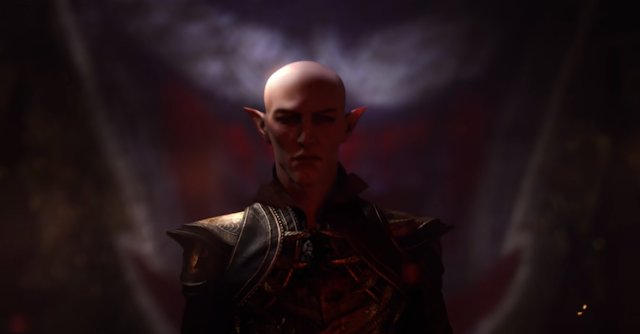
Showing posts with label Lavellan. Show all posts

Tuesday, October 29, 2019

A Taste of Lies and Sorrows... Talking with Solas After the Arbor Wilds

In his "You have impressed me" compliments, the idea that Solas is professing that love in response to having his worst impulses confirmed is deeply sad to me. That's why it's a brilliant lead-in to the next moment... that of our last, terrible date.

SOLAS: You honor the past and work to recover what was lost, even if the cost is high. I respect that, and I am indebted to you for the reminder.

So I'm on the home stretch to my analysis of Solas's romance, but before we get to the kisses, tears and regretful butt-grabs of The Last, Worst Date Ever, I want to take a closer look at one of the most pivotal companion conversations in Dragon Age: Inquisition—our talk with Solas after the events of the Arbor Wilds and the vir'abelasan (The Well of Sorrows). (Note: I've updated this slightly from the original post to fix a few typos, and added a reference to the fact that the epilogue scene may take place in the Crossroads, as posited by @LadyInsanity.)

Saying No to a Sip

If we didn't drink from the Well, Solas is calm and even mildly euphoric after the Temple of Mythal. There's something complacent and secretly pleased about his demeanor, and, as with the events of Halamshiral, he's playing his cards close to the vest. He comments that "The Temple of Mythal was extraordinary. In all my journeys, I never dreamed of finding anything like it."

Which, to me, isn't a throwaway comment but an observation that is worth examining. It's Solas writer Patrick Weekes being subtle with us again, giving us something potentially complex and layered within a seemingly innocuous, simple statement by one of their characters.

First and foremost, it's obviously a pretty disingenuous comment by Solas, since he would have to have seen far grander temples to the Evanuris back in the ancient days. Not to mention the fact that, right there at the Well itself, ancient elven sentinel Abelas had just told us that Mythal's Temple was destroyed by the very people who betrayed and murdered Mythal herself.

A Little Deception

Doesn't Abelas's job sound awful, by the way? He and the ancient sentinel elves evidently spend all their time sleeping, basically snoozing their way through millennia, only waking up on alert in time to fight or banish anyone who tries to enter the Temple of Mythal. If they survive after combat, they apparently just go back to bed until the next incursion. It's like the worst on-call fireman's job ever. And with no side benefits like a fireman's pole, dalmatians, communal cooking, riding around in a cool fire truck, or getting the thanks of a grateful community.

So it's another small moment of deception from Solas, if we examine it, because he has likely already been to the Temple of Mythal, even if it was millennia back. Wasn't it likely the site of Mythal's actual murder? Even though it's implied that Solas and Mythal were divided at that point (perhaps over differences on the issues of elven enslavement, the use of the vallaslins, or some other betrayal), we know that there remained deep love between them, to the point that Mythal's death sent Solas spinning into acts of revenge and retribution that would change the entire face of the world.

So it seems likely that Solas would have hastened there himself way back when, either to prevent her death, or to discover it on his own. The other Evanuris beings who killed her may even have hoped to pin the death on Solas himself, for all we know. Either way, I think he's been there before. Ironically, before most of his many journeys to come across both Thedas and the Fade.

And keep in mind that the Temple of Mythal is also strongly implied as the prearranged meeting-place for Solas and Flemeth in the shocking final epilogue scene in Dragon Age: Inquisition. (although there is also a persuasive case by LadyInsanity that it takes place in the Crossroads, as well). But I'd swear on my stuffed Emerald Graves Nug that both of them know the place all too well.

That's all we get if we didn't drink—it's a mild, quiet conversation with no surprises (yet).

However, the situation is, of course, much more fiery and emotional if we did, in fact, drink from the vir'abelasan.


What Inquisition has accomplished beautifully in a big-picture way with Solas's story is to constantly remind us that sometimes the worst fate you can suffer is to be trapped in your own guilt and regret.

The Taste of Sorrow

If we drank from the Well, the encounter is more volatile. Solas confrontational—frustrated, angry and scared at the implications of what the Inquisitor has done. As always, he cannot tell her what he knows about the immortal contract to which she has just agreed. As Inquisition's greatest champion of free will, Solas is predictably devastated that the Inquisitor is now bound to something she does not understand. He cannot tell her Mythal is real, the gods were real (at least, in some capacity), and that he himself walked among them, saving and dooming Thedas as a result.

Solas gets a lot of anger from many fans, and he undoubtedly deserves it. He's walked at our side for over a year now in the timeline of the game story, and he has reserved, omitted, and even obscured essential information from the Inquisitor and the Inquisition at large repeatedly in order to cover his own identity, motives and actions. 

Yet what the game has accomplished beautifully in a big-picture way with Solas's story is to constantly remind us that sometimes the worst fate you can suffer is to be trapped in your own guilt and regret (a fate Abelas understands all too well). It's something Weekes makes painfully acute in almost all of Solas's dialogues with companions, and especially with a beloved Lavellan. He wants so badly to speak. And yet he cannot do so. And because he is a true believer, because he truly thinks he is doing the right thing, his prison is binding. No moment of weakness or regret will salvage him because every moment of pain or loss simply provides him with the chance for further righteous sacrifice or abnegation.

And oh, The Last, Worst Date is looming, and I would argue that here's where we begin to see that fallout... even here.

So I like the scene a lot, because it's one of those moments in which I feel we're watching Solas have to face the bleak reality of his choices... and lose control. And justifiably so. He can't fix things, he can't go back, and he's caught in a cruel stasis in which he alone knows the miseries yet to come for those he has come to care for. Even though Solas seemed to tacitly want for us to drink at the time—or, at least, to do so instead of Morrigan, who he views as grasping carelessly for ancient power she does not understand ("She is right about only one thing: we should take the power which lies in that well")—he's nevertheless deeply, visibly upset.

This scene is instantly presented as intense and dynamic—we walk into the Rotunda with Solas, and he rounds furiously to confront Lavellan for drinking from the Well. Solas is about as emotional and unguarded as we've ever seen him.

SOLAS: I begged you not to drink from the Well! Why could you not have listened?
INQUISITOR: Solas…
SOLAS: You gave yourself into the service of an ancient elven god!
INQUISITOR: What does that mean, exactly?
SOLAS: You are Mythal’s creature now. Everything you do, whether you know it or not, will be for her. You have given up a part of yourself.

Solas and Lavellan can have more conversations here, but they're mostly variations in which Solas reinforces the danger of the decision (and her loss of agency) while emphasizing the fickle and potentially twisted nature of the original 'gods.' In one of my favorite moments, Lavellan calls him out on the fact that she knows he doesn't believe in gods, and Solas agrees, but clarifies that he believes that these powerful beings did exist in some fashion, whether gods or something else. Again, I always love these moments in which Solas tosses out an idea like a guess, when he knows the truth beyond a shadow of a doubt.

Regardless, within a few short moments, Solas seems to take a breath, and to accept that what's done is done, and he makes a visible effort to calm down.


SOLAS: And you are bound to one of them now. I suppose it is better you have the power than Corypheus, which leads to the next logical question… 

And... here we go.


Oh, sweet Creators, and oh dear and fluffy Maker, Solas, please do not thank us for this particular revelation. Shit.

The Hidden, Vital Question

This, this, is the big moment for Solas... where, in hindsight, we realize all realities for Solas collide. He asks the question that means more to him than anything in the world, I believe. Right here and right now, Solas must know the answer to a vital question: What will she do with this divine power now? How will she use it to affect the world?

SOLAS: What will you do with the power of the Well once Corypheus is dead?

Lavellan can reply in a variety of options, here. She can respond that she will undo the chaos Corypants caused, she may respond that she trusts her friends, say that she will attempt to stay humble and share her power, or (last but not least) that she will not look back, but try to move the world forward.

It's no surprise that Solas reacts most powerfully to two of these responses—to the Inquisitor's resolution to bring back the past, or to move beyond that past into something wholly new. 

"I am indebted to you for the reminder"

Every one of these options includes an important disclosure from Solas. But, in hindsight, his open happiness if Lavellan responds, "I'll bring back what was," should be a warning bell that clangs across the Frostbacks. Solas is openly euphoric at the idea that Lavellan would put things back "the way they were, because it's the affirmation he so desperately desires—confirmation from someone he has come to love and admire that undoing the past is a good and honorable thing. No matter what the cost:

INQUISITOR: I’ll use whatever power I have to undo the chaos that Corypheus and his allies have caused.
SOLAS: You would put things back the way they were before?
INQUISITOR: Yes. I mean, not exactly…
SOLAS: I know what you mean. Thank you.
INQUISITOR: For what?
SOLAS: You have not been what I expected, Inquisitor. You have… impressed me. You honor the past and work to recover what was lost, even if the cost is high. I respect that, and I am indebted to you for the reminder.

Note how Solas's final moment of appreciation here emphasizes Lavellan's willingness to honor the past and "recover what was lost, even if the cost was high." He's happily grateful for the reminder.

I adore Solas. But his goals scare and worry me, and this, in retrospect, is pretty terrifying.

"I trust my friends"

In response to Lavellan's desire to trust her friends, Solas answers with a differently, yet equally telling, revelation:

INQUISITOR: I trust my friends.
SOLAS: I know that mistake well enough to carve the angles of her face from memory.
INQUISITOR: Why is this so important to you?
SOLAS: You have not been what I expected, Inquisitor. You have… impressed me. You must not let false modesty allow you to pass your power to someone else. There are few regrets sharper than watching fools squander what you sacrificed to achieve.

Which—that's Mythal, isn't it? It has to be about Mythal. Whom he loved and trusted, who may have called him out of the very Fade itself and into flesh all those thousands and thousands of years ago... and yet, at some point, he felt that she betrayed him. Then their friendship was sundered, even if the love remained.

I like the way this version of Solas's "You have not been what I expected" compliment also subtly references the fact that he feels like whatever he achieved in raising the Veil and imprisoning the Evanuris was then squandered by "fools" who came after. Are these the Dalish, perhaps, who became a wandering and lost people unable to remember their own history? Or all of the modern elves, Dalish and city elves alike? Or simply all of Thedas?

Yet it's worth noting that the first thing Solas did upon emerging from the Fade was to go straight to the Dalish and attempt to share his knowledge with them. Knowledge they declined, before forcibly casting him out.

Perhaps it is only then that, to him, bitter in his isolation, they became fools. 

"The Lure of Power's Corruption"

In option three of Lavellan's potential answers here, she attempts to retreat into the safety of abnegating power and ruling by committee, while Solas is instantly skeptical:

SOLAS: You think to share your power, to avoid the temptation to misuse it. A noble sentiment… but, ultimately, a mistake.
INQUISITOR: Why?
SOLAS: Because while one selfless woman may walk away from the lure of power’s corruption, no group has ever done so.

I love the foreshadowing here, as this, of course, is a situation Trespasser directly addresses front and center, and it turns out to be the central question on which the entire Halamshiral hearing hinges: Will the Inquisition remain as an organization or will it be absorbed into the Chantry, to answer to the Divine? Or is now simply the time for the Inquisition as a formal political entity to end? Our choices for our Inquisitors there will surely have massive repercussions in Dragon Age 4.

As a last interesting little detail, this is the only answer to Lavellan's plans where Solas does not give some version of the "You have impressed me" speech.


And here we are again, making a massive mistake, and simply reinforcing Solas's terrible agenda even when we express the actual reverse of his current and determined path. Because all roads lead to the din’anshiral for him at this point.

"I'll help this world move forward"

I find it interesting that the last option in our responses to Solas—the one that is the flip side to the first option (to "restore what was")—is the one that also draws the most emotional response from him. Which makes sense, since both answers, bookends though they are, are intertwined: 

INQUISITOR: The war proved that we can’t go back to the way things were. I’ll try to help this world move forward.
SOLAS: You would risk everything you have in the hope that the future is better? What if it isn’t? What if you wake up to find that the future you shaped is worse than what was?
INQUISITOR: I’ll take a breath, see where things went wrong, and then try again.
SOLAS: Just like that?
INQUISITOR: If we don’t keep trying, we’ll never get it right.
SOLAS: You’re right. Thank you.
INQUISITOR: For what?
SOLAS: You have not been what I expected, Inquisitor. You have… impressed me. You have offered hope that if one keeps trying, even if the consequences are grave… that someday, things will be better.

All Solas takes from this is, "I just have to keep trying, even if the consequences are grave." It's basically the worst and most tragic possible lesson he could take from what the Inquisitor noted. Instead of being freed by the idea that he can and must let go of the past—that he should move on both literally and figuratively from what haunts him—Solas sees this conversation that if he wants to undo the past, he simply needs to keep trying.

All of which makes that final "You have impressed me" compliment he gives to a romanced or high-approval Inquisitor bittersweet, to say the least. Because for me it's a disingenuous end to a disingenuous beginning. And as I always do, I love Gareth David-Lloyd's performance, as he communicates the slightest undercurrent of instability here, of euphoria and excitement beyond the moment. Something is not quite right here. Solas may actually be trembling in the aftermath of revelation and... relief?

It's worth repeating that I believe that Solas does truly love and admire the Inquisitor. Yet here, the idea that he's professing that love in response to having his worst impulses confirmed is deeply sad. That's why I find it a brilliant lead-in to the next moment... that of that last, terrible date. 

Solas tells us he loves us many times, and I believe them all within the story of the game. Yet here, his proclamation of admiration is not only somehow unearned and hollow, it is a subtle harbinger of sadness to come. 

In falling in love with an ancient god, we are already on the path to the din’anshiral. Solas is already far ahead. The greatest tragedy of the situation is that it's a path he walks alone, and love or no love, he will not wait for us.

Saturday, February 23, 2019

Through the Eluvians: Recaps, Overviews, Explorations with Artifacts...

Merrill's eluvian is an important plot point in DA2. It may prove to be an even more important plot point if my suspicions about DAI are correct...

[Felassan] leaned over and poked at the stones. “It’s not the Fade. The runes are elven … If I had to guess, I would say that our ancestors actually created some sort of tiny world between the eluvians.”
—Patrick Weekes, The Masked Empire


As I move my quest and romance analyses toward the pivotal events of the Winter Palace and "Wicked Eyes and Wicked Hearts," I thought it would be useful to recap what we know when it comes to the ancient eluvians as of the world post-Trespasser—and what I suspect. Because for me, the eluvians are the heart of the entire situation of "Wicked Eyes" for Solas—and the pinnacle. The endgame. I realized I couldn't address his odd and fabulous demeanor at the event (or what I felt it meant) without dealing with the eluvians first). So, darn it, here we are. 

And... yes... bring on the wall of text!

The Ancient Eluvian Network: A History

Created and used by the ancient elvhen people during the heights of Arlathan, the ancient eluvian network has existed for millennia, even as it has also eluded the understanding of most who have attempted to discover its secrets.

After the raising of the Veil and the fall of Arlathan shortly thereafter, we know that the network remained largely locked and inaccessible, hidden away, and that Tevinter was only able to use a few eluvians, at some point, simply for communication (but not travel) across distances. During the Dalish elf origin in Dragon Age: Origins, Tamlen and Mahariel discover an ancient eluvian that has been tainted by the Darkspawn. Tamlen vanishes, only to reappear later, doomed and Blighted, and Duncan destroys the mirror to protect others from the potential Taint.


There's a curious and fantastic vindication for Merrill fans to seeing her completed eluvian either at the Winter Palace or in the Crossroads. It's a singular moment.

Dragon Age II companion Merrill, however, retains a tainted shard from the shattered eluvian, which she purifies through blood magic learned via a Pride Demon within Sundermount, and she begins to attempt to restore the mirror bit by bit, this time in a pure and untainted form. Merrill's choice to pursue this path means that she must abandon everything, both for ethical reasons (she needs to minimize the potential danger to her clan), as well as for political ones, as her Keeper Marethari actively opposes her choices. So Merrill, recognizing that there is only one option that satisfies all requirements here, leaves her clan and pursues her research on her own.

I'll be addressing Merrill's choices (and how unjustly maligned I think she is as a character) separately, but in the meantime, let's just say that ultimately, there are varying potential levels of both success or tragedy here. Either way, depending on our choices in Dragon Age II, the mirror is destroyed or fully restored by Merrill.

And if restored, we will later see it, or mirrors like it, in the Crossroads as well as potentially at Halamshiral. My question here is whether it's simply a repeated element (which sometimes happens in Dragon Age or pretty much any game) or whether it's a deliberate and meaningful object choice. 

Me, I vote meaningful choice—and that the eluvian is presented as intact, unshattered, and potentially active and usable. I think it is used, in fact... the night of the Masked Ball at Halamshiral.

But more on that in my post to follow.


And here, friends, is Merrill's completed eluvian, on full display at Halamshiral, stored away not far from an ancient elven artifact and Veilfire. Let fly the intrigue!
Meanwhile, Morrigan herself is obsessed with the secrets of the ancient network. Through research and outright theft from the Dalish, Morrigan discovers both an ancient treatise on the eluvians, and an intact eluvian she is able to activate.

Although the network remains largely dormant, she exhibits an ability to travel through at least a few eluvians on her own (specifically, the one in the Dragonbone Wastes, and later on, via a different eluvian that she brings to Skyhold).


Morrigan doesn't acquire her knowledge of the eluvians by honorable means, but it is an intriguing and potentially rich character element.
The Eluvian Network and The Masked Empire

But there are greater efforts to control the eluvians taking place elsewhere within a matter of years. 

As we learn in Patrick Weekes's beautiful and complex Dragon Age novel The Masked Empire, the Dalish Vernehn clan actually summon a Desire (or self-named "Choice") demon, Imshael, to attempt to reactivate the entire dormant eluvian network. Imshael has created a Keystone, a mysterious jewel like a huge ruby, that will lead its bearer to a central location connecting all eluvians across Thedas, and where the eluvian network can be activated and the password reset by the bearer (in a series of words or phrases they choose).


Nobody in Thedas has been as influential or as important in the modern history of the eluvians than Briala, especially via the events of The Masked Empire.
Imshael eventually tricks Ser Michel de Chevin into freeing him, and promptly massacres most of the clan, then almost casually gives the exiled empress Celene the Keystone in gratitude. 

The story moves along for several characters, them culminates after a series of exciting fights, intrigues, crosses, double-crosses and triple-crosses. All of which I'm basically convinced were part of Patrick Weekes's kindergarten years somewhere in Orlais as he brilliantly acquired the basics of the Great Game as well as how to wring maximum fan-tears from required plot points (LOVINGLY! I MEAN IT LOVINGLY!).

Then Celene, Briala, Felassan, Mihris, and Michel flee with their party from Gaspard into the tombs, intriguing and ancient chambers of magic or ritual, and through several eluvians, traveling in and out of the Crossroads, and eventually reaching that crucial central chamber. The journey reveals concretely that the eluvians are connected via the Crossroads, and that the Crossroads itself is a pretty exciting realm that is wholly separate from the Fade, a sort of pocket universe created by the ancient elves. 


The Crossroads is unpleasant for non-elves, but for elves it isn't just a pocket universe; it offers a tantalizing hub for connecting to worlds and locations across Thedas and—perhaps—beyond.
Navigating the Crossroads

While the Crossroads are colorless and physically sickening and disorienting for non-elves, they are comforting and filled with color for elves who travel them (a detail delicately and gloriously captured in "Trespasser," depending on the race of your Inquisitor). The story here also notes that elves can also move through the eluvian network at speeds that are near-supernatural, almost as if they are tessering through shorter ways much faster than a horse can gallop, for instance, on the surface of the actual world. This will be an important aspect I'll note later, relating to Solas's evening and potential actions at the Winter Palace at DAI's masked ball in Halamshiral.

Meanwhile, Briala's journey with Felassan, Celene, Mihris and the others takes them through countless tombs and mysterious rooms that reveal ancient and terrible crimes as typical then as now, in which class targeted class. They discover the brutal murders of the ancient elves while defenseless in uthenera, as well as the callous abandonment of ancient elven servants who were trapped and left to cruel lingering deaths (and terrible resurrections due to the protective spells on the tombs) by their so-called noble employers and masters.

In Masked Empire, once they reach the central chamber and defeat the ancient varterral guarding the pedestal, Briala takes the stage in a gorgeous bit of drama (after sexily stealing the keystone during a kiss with the empress) and reveals her knowledge of Celene's betrayal, as well as that the woman she loves colluded with Mantillon in the murder of Briala's own parents, then uses the jewel to traverse the labyrinth and take control of the eluvian network herself, speaking the passcode she has created: "Fen'Harel enansal," or "Fen'Harel's blessing."

Although Felassan dies shortly after, executed in the Fade because he will not reveal the passcode to Fen'Harel (who we now know to have been Solas), the irony is that Briala's passcode probably took Solas all of 60 seconds to guess, tops (if he even required it at all, given the extent of his growing powers as of DAI). (But more on this later...)


Inquisition takes it slow, but eventually eluvians show themselves as deeply important to the events in which we take part.

Eluvians and Connections in Inquisition

First off, I hardly hear anyone talk about this, but it's so interesting to me that we meet Mihris again in Dragon Age: Inquisition! The last of her clan, formerly possessed by Imshael himself (and freed by Felassan, who simply told the demon "Something bigger is coming"), Mihris is an important figure from The Masked Empire.


Mihris was a fantastically complex character in The Masked Empire, and it's a treat to encounter her again in Dragon Age: Inquisition.
And here she is, just quietly wandering the Hinterlands, looking for the very first of those elven artifacts that Solas loves to go around and activate (starting the "Measuring the Veil" quest series), triggering that phrase we will hear over and over again from Solas, sometimes almost comedically, in the adventures to come: "I can sense one of the artifacts of my people." Note the specificity of this particular phrasing—remember, Solas doesn't think that anyone is "his people," and he in fact denies this connection over and over again during the first half of DAI (he may soften on this subject if romancing a Lavellan who calls him out on his unfairness to both the Dalish and to Briala). But the ancient artifacts are a nice, subtle clue: The ancient elves are who Solas truly sees as his people. At least this far in the story.

Mihris is friendly, but also slightly insulting (she calls Solas "flat-ear," a slur for city elves). If the Inquisitor is Dalish, she'll tell us about what happened to the Vernehn clan during The Masked Empire, but if they are any other race, she'll say she was trying to research the Breach in order to help. If this happens, Solas does this amazing thing—he says, "Ma harel, da'len," or "You lie, child," and at that point Mihris quickly ends the conversation.

If she joins us to go fight the demons and activate the artifact (it is entirely possible for us to be antagonistic to Mihris, and to kill her at this point), Mihris then also discovers an amulet of power that she desires to keep for herself. We have the option to ask Solas to help, and when he says to her, "Ma Halani. Ma Glandival. Vir Enasalin" (which I translate as "(You) help me. You owe me. It will lead us on the path to victory.") she hands it over.

What I think is interesting here is that Solas knows everything about Mihris, and she knows nothing at all about him. Further, it's worth noting that Mihris is only one of a very few people across Thedas who possesses the password to the eluvian network given to her by Briala. And here she is, showing a lot of interest in these ancient elven artifacts...

Artifacts of Power

So. Is Solas just seeking the elven artifact here? Or is he seeking Mihris? Or is it possible that the elven artifacts aren't just about strengthening the Veil (you already know why I think he would want to do this) but are also a potential power source for Solas himself—and possibly the eluvian network?


A digression: What if elven artifacts are actually somehow part of this twisted web and woof?
What if every ancient elven artifact that is activated is actually empowering... SOLAS?

Because... I'd argue that Solas's primary mission throughout Dragon Age: Inquisition actually boils down to three very simple and important tasks:
1. Regain and unlock the Orb
2. Retake control of the eluvian network once and for all
3. Power up
It would therefore not surprise me at all to learn that the ancient artifacts are both empowering Solas and the Veil... and that, if desired, that Solas can also turn them into pretty daunting weapons if he chooses. 

Think about it. There are 25 artifacts that can be activated across Thedas, as well as, interestingly enough, three that cannot be activated (two in the Winter Palace, in separate storage rooms, and one in the study at the Darvaarad).

But let's get back to the eluvians.


Want to feel lonely at Halamshiral? Play a romanced Lavellan. Viewed as a 'rabbit,' an inferior, and vermin for hunting by Grand Duke Gaspard.
The Eluvians in Inquisition

Things get interesting in Inquisition... eluvian-wise.

Because... for a little while, there's a lull. We don't hear about Masked Empire, or eluvians, or anything like that. We're preoccupied with archdemons and Corypants and stuff, and whoever we're romancing who may or may not be falling at our feet or (of course) ignoring us. DAMMIT.

But it's quiet about eluvians, let's just say. For awhile. And it's brilliant misdirection.

For instance, when we finally end up at Halamshiral in DAI for "Wicked Eyes and Wicked Hearts," we don't hear crap about them. It's certainly a subtle and interesting story choice. But the best part of this is, once at the Winter Palace, we may—depending on our choices in Dragon Age II—discover Merrill's finished eluvian in one of the palace storage rooms (specifically, the one off the Library, with the Veilfire).

This discovery really thrilled me because it's always really special when the previous chapters of the game are echoed in the latest.

And also, because, dammit, it means Merrill was right. And that she did indeed finish her eluvian. As she deserved to do.

I'll stop there, for now. In the glow of something small achieved, even amidst a tapestry of impossible and magical and terrifying events.

I have more to say about the eluvians and their mysteries. But to do that, I'll need to take us back to our arrival at the Winter Palace... and we'll be looking closer at Solas's activities there on a specific night, as well... 

When—I think—he takes them back. For all time.

Sunday, October 7, 2018

Love, Lies and Kisses in the Fade: Solas's Romance, Part 3

I find it enormously telling and important that Solas kisses the Inquisitor not just in the Fade, but in the past... in a place and time that no longer exists. In a subtle way, he's showing her the emotion he lives each and every day.
Solas smiles, as Lavellan looks around, momentarily confused.

SOLAS: Where did you think we were?

INQUISITOR: ...this isn’t real...
SOLAS (teasing): That’s a matter of debate… probably best discussed after you wake up.

Where does Solas's romance truly begin?

With a simple kiss... upon a dream.

The scene where Solas takes the Inquisitor to the Fade is a charming and important moment if the Inquisitor is a high-approval friend of Solas's. But it's an incredibly vital dramatic beat if he's romanced, and it's both telling and interesting that this is where his romantic relationship with the Inquisitor truly begins. I'd say it's a great first date, except for the intriguing clear implication (to me, at least) that Solas takes the Inquisitor to the Fade all the time for in-depth talks and discussions about her fears and hopes, about what is important to her (and in my interpretation, she clearly remembers and acknowledges this in their dialogue as the scene begins). I've talked about this before, so I'll address it in a different way farther down.

Meanwhile, what I suspect (at least, in my imaginary headcanon, which is pretty much always in overdrive, as this blog certainly demonstrates) is that while they may have spent time in the Fade, even if Solas were beginning to have feelings for the Inquisitor, and vice versa, he would still, I think—to that point—have kept them to himself. So those Fade visits might have been important and intimate, but they would not have been openly romantic... until the kiss.

But of course, the kiss is just the inevitable outcome of a linked series of events that conspire to tip Solas off-balance and make him more vulnerable than he's been since his long-past youth.

Crossing Boundaries

If you analyze Solas's behavior across DAI, he's pretty formidable in terms of his ability to compartmentalize, and I'd put that ability right up near the capacity of Bull or Leliana (near, but not quite—Solas isn't an especially good liar). I think, however, that early events in Inquisition nevertheless set him off-balance, and he's therefore never quite able to regain that equilibrium when it comes to both the Inquisitor and the Inquisition (I'd even argue that he's still not 100% even as of "Trespasser," given the lengths he goes to in order to both give her the truth about himself and to save her life).

So let's conjecture and wonder a bit... 

It's certainly implied that Solas has no trouble staying on-mission before the events at the Temple of Sacred Ashes. He's quite able to be cold and dispassionate when operating Felassan as his agent from the Fade, as well as in meting out punishment later. Even upon awakening, wandering Thedas (planting those elven artifacts, by any chance?) in the year or so before the Conclave, he certainly seems to be able to keep his emotions at bay. However, this is also when everything once again seems on-track, and going according to plan.

Then the Temple explodes, the sky is a livid, apocalyptic green, and his Orb is now in the hands of a mad ancient magister who's also half-Darkspawn, and who's using it to do terrible things across Thedas.

And then there's the woman—the one who's suspected, who was Marked by a magical transference from his own artifact, and who has already been mocked, imprisoned and nearly executed. Remember, Solas has joined the Inquisition just days or even hours before he meets the Inquisitor. He knows that he is responsible for the Breach and for her Mark and is, I believe, truly horrified at both. He is also fully aware that the Inquisitor has been captured, imprisoned, and accused for something he had a hand in creating... and he alone knows right away that she is 100% innocent of any of the charges against her. So I think even there, she gets past his boundaries a bit because he feels genuine remorse (as he darned well should). 

And then he begins to feel again, something beyond rage and powerlessness. Allegiance. Indebtedness. Admiration. She handles her impossible situation bravely. She attempts to meet the challenge. She may accept or reject a divine influence. She may question him on dreams, on spirits, and the Fade. He may even be moved enough to allow himself to compliment her on her grace, strength or indomitable focus (words that are, ahem, seared on my brain). And he may admit his own recent bitterness and rejection—which she may counter by sticking up for her people, respectfully asking him to reconsider his anger against the Dalish. She may call him 'hahren,' and try to connect with him in Haven on their shared elvishness, to give him the companionship he so desperately desires and fears after his long loneliness and isolation.

He is cast adrift. He is in danger—not from fire and wrath, but from the possibility of love... and he knows it. 

Solas sees Lavellan more clearly than she sees herself; she's a hero because he's the villain in the story, even if
she doesn't know it yet.
 
"What Kind of Hero You'll Be..."

Either way, it's no wonder that he calls her "a hero" in one of their first conversations—because he already knows she is one, and he's judging her through eyes that have watched the passage of millennia, by her reactions to almost impossible circumstances that she herself doesn't even understand. At this point, Solas sees Lavellan more clearly than she sees herself; she's a hero because he's the villain in the story, even if she doesn't know it yet. Solas already knows who he is. He believes, through his own regretted and yet open-eyed choices, that he is doomed. But he also believes that she is not (or at least, not yet). 

Tentatively, he begins to try to connect with her, to help, to spare her the little agonies. To be there—not as a lover, but as a part of her fellowship, in the everyday cameraderie and companionship of war... and in doing so, he dooms himself. A door opens upon his emotions, not just to her, but to all the companions. He starts to care. And when it comes to Lavellan, he feels guilty, vulnerable. He  feels genuine liking. He feels respect and admiration, and perhaps more than that. 

In other words, he feels. It is Lavellan's first gift to him; one of which she is not even aware.

Whether he's romancing the Inquisitor or not (but especially if he is), Solas begins to feel an obligation to her, that he owes her something. He can't take back the Mark. He can't give her the truth, but there are things he can provide... a castle (a new home)... and a respite.

So he takes her into a dream. It's safe. It's lovely and ephemeral. It's not those seeping, frightening corners of the Fade we encounter physically either in the prologue or after the siege at Adamant. This is Solas, after all, and this is his kingdom. So instead, he takes her to a Fade location that he can build for her wall by shining wall, down to the smallest soothing molecule. An escape to the past, to where she once briefly felt at home.

Conversations in the Fade

To me, Solas taking Lavellan to the Fade is a really lovely and irresistible idea—Solas is a man who has reshaped the very warp and woof of the physical world with his power. Still, that's nothing compared to what he can do in the Fade.

And yet what does he do when he takes Lavellan to the Fade, when he can take her almost anywhere imaginable in the swirling mists of time and space? Does he take her to those intoxicating ancient days of his youth, to glory in the heights of power, enchantment and knowledge? Does she travel with him to visit those twining spires of crystal, to witness the shimmer of magic as breathable and accessible as air in the splendor of lost Arlathan?

Nope. 

He takes her instead to something simple, homely and devastating, to bright regret and loss... but in a way that's quiet and healing. He takes her back, in other words, to just a few weeks prior, to a place that has been wiped out of existence, and shows her just how much your heart can break when the home you loved now exists in memory alone. 

Solas knows this emotion well. He's lived it for millennia at this point, after all.

Going Home

To me, it's bittersweet to realize that what Solas does here is exactly what he does in his final excursion with Lavellan later on in their story at a crucial juncture: He takes her to a place where he can quite literally show her what she means to him.

Then, once within the perfection of his magically recreated Haven, Solas relives their relationship from its earliest moments for her, narrating in parallel storylines, with Lavellan as witness and shared participant, her story—and his. He tells her of his emotions and concerns for what the Inquisitor suffered (and manages not to make it All About Him), as well as revealing what he himself was also feeling for her at the same time. He reveals his frustration and confusion, that he was worried for her, that, even then... he felt something. That she had already become special to him. That she had, in fact, changed his world. 

Sometimes words are not enough. And this seems to be a theme with Solas. Despite his obvious eloquence and poetry, and despite his intelligence, I believe he sometimes dislikes words in moments that matter. Perhaps because he has had to lie so often since he awakened in this world. I think this is why, over and over again, he attempts to demonstrate his feelings at key moments in other ways — with a kiss or physical gesture, with a painting on a wall, with a revealing bit of magic, with the removal of the vallaslin. He has lied enough, been poisoned by them irrevocably. All he wants now is something real.

So of course he has to stage that moment in a place that is unreal. That's Solas. He's never one to do things the easy way.

Lavellan is a firefly when you compare her brief life to Solas's many millennia, but she is also bright, brave, and (the biggest relief of all) something genuinely new to Solas. It's no wonder, then, that he finally gives in to his feelings.
A Kiss in the Past

Meanwhile, here we are where it all begins.

And it's interesting, isn't it, that Solas kisses the Inquisitor in the past? In a place that no longer exists? It's a beautiful way for him to subtly reveal the secret of his own situation, his own conflict. He takes her back to a place she loved, to a place that is now obliterated, and he walks there with her as if to salute the fact that even if it no longer exists, he knows that she will always love it.

And although Lavellan doesn't know it at the time, of course, Solas is revealing something about himself, as well—showing her what he himself is literally feeling all the time. The constant regret and nostalgia. The longing for what has been lost.

It's a beautiful and subtle revelation. It is also a gift that, due to Solas's unique powers and circumstances, no one else could give her.

And I really think this is meant to be the whole gift he wants to give Lavellan here—that glimpse of brightness and mourning. He's not dreaming of kisses. 

But hey, dreams are where all things are permissible, after all. And despite thousands of years of life, he doesn't anticipate what Lavellan does next. 

Whoops. You go, girl.

The Lead-Up

And so there are the little moments of banter, of teasing, as Solas and the Inquisitor walk through this shiny new Haven. It's all really charming, as is the flirtation of a confident Lavellan with a suddenly awkward, uncertain Solas.

By the way, I absolutely love the way this scene is presented—especially the physicality of Solas and his discomfort and slight nervousness in the presence of Lavellan's ease and relaxed charm. For instance, when Solas turns away in sudden awkwardness here, he does so stiffly, with his whole body, as if his head doesn't move on his neck, and it's absolutely this thing someone would do in real life if uncomfortable and trying really hard to cover for that. Just so real and funny and beautifully rendered (he does it again later on, after "I never said it was a good plan"). Nothing to see here, everything's fine. As if he can't remember how to move naturally—kudos to the BioWare team. And then there's Gareth David-Lloyd's sneaky-funny vocal performance here—especially the way he laughs when the Inquisitor notes that "Cassandra's like that with everyone"—he gives this weird little awkward "Ha," like a bark! 

Anyway, awkward or not, the moment arrives, and they kiss... and it's great, and just beautifully directed and rendered by the team who brought it to life. And kudos to Solas (and to the Dragon Age team that created him) on the fact that he doesn't make the first move, which is respectful and ensures that there aren't any consent issues. He's the one, after all, who understands that this is all taking place in a dream. So I really like that it is Lavellan who acts first with the kiss.

The kiss itself comes across as being emotional and cinematic, in the best way. It's also genuinely hot (for me Solas's are easily the best kisses in the game, although Dorian's are a solid second)—especially since Solas finds himself unable to resist turning back to prolong the kiss, not once, but twice (after the original smooch). It's such a terrific externalization of his inner self, of who I think Solas actually is—not just because he's a fiery and passionate person beneath that cool exterior, but also because he genuinely loses control here, in desperation, in desire, in loneliness, and well, because it's allowable.

It's the Fade, after all.

Vulnerability is permissible in the Fade, where Solas can explore passions he may not be able to admit to in waking life.
"Not Even Here..."

Solas then says something fascinating in this scene, once the kiss is broken, and I think it's something that may tend to be overlooked. Let's take a look at the scene, below:

INQUISITOR (flirting like crazy): Felt the whole world change?
SOLAS (adorably awkward): A figure of speech.
INQUISITOR: I’m aware of the metaphor. I’m more interested in “felt.”
SOLAS: You change… everything.
INQUISITOR: Sweet talker.

She kisses him. He allows it, then steps back... and then returns to the kiss. And again. Then at last, with an effort, he stops the kiss a final time, and pulls away.


SOLAS: We shouldn’t. It isn’t right. Not even here.

INQUISITOR: What do you mean... "even here?"

Let's examine that odd little comment: "We shouldn't. It isn't right. Not even here."

The details are telling. To me, it's the opposite of what's expected—not "We shouldn't. It isn't right. Not here," but rather, "We shouldn't. It isn't right. Not even here."

The implication that's so fascinating, in other words, is that he's not saying it's wrong to kiss in a dream; he's saying the dream may be the only place it's actually allowable. Solas has just revealed that the Fade is where this kind of moment is actually okay with him (even if nowhere else). The Fade is, in other words, where vulnerability is permissible, where he can explore passions he may not be able to admit to in waking life.

And where he doesn't have to admit that he is playing an incredibly dangerous and hurtful game. It's the Fade, right? His place. His safe place.

And yet, he allows that it may not actually be a safe place for the Inquisitor. And that's intriguing.

Echoes of Felassan

If you've read The Masked Empire, the superb Dragon Age novel by Patrick Weekes about Briala, Celene, Gaspard, and Michel, then you've already met Felassan, who is one of my favorite characters across the entire world of Dragon Age.

Named for the 'slow arrow' from the brutal Dalish legend of Fen'Harel, Felassan is the mysterious and powerful elemental Dalish mage apostate who wanders the world and seems to belong to no clan, and who serves as Briala's friend and protector through the years even as he also secretly serves Fen'Harel in his dreams. Felassan is smart, charming and witty, and his humor can be as ruthless as his magic. Like Solas, Felassan begins by holding himself apart from the events around him, watching from the shadows, quick to amusement and yet carrying nevertheless an air of hidden power and detachment.

But in the end, Felassan succumbs to the beauty of the world, and to his respect and affection for his friend and student, gently refusing the gift of the eluvian access even when she offers it to him outright. As a Dreamer, he enters the Fade via a trance to lie about the situation with the password to his leader (whom we now know to be Fen'Harel... Solas). As the story ends, he begs the unknown leader to give the elven people their chance... and to no avail. The blow falls and he is killed. (Years later, Cole tells us in "Trespasser" that Solas regretted this action ("The Slow Arrow breaks in the sad Wolf's jaws.")

Yet while Felassan may be dead, his words live on, and they are echoed subtly more than once throughout DAI. Solas hears them when he kisses the Inquisitor. When he sees the goodness and beauty even in the muffled, maddening demon-haunted world in which he has found himself. When he realizes that the people are... "courageous" in their fight to survive. Cole sees it happening, and confides in the Inquisitor, after Solas has so cruelly and abruptly ended their relationship, "You're real, and it means everyone could be real," referencing once again the idea that Solas has fought for so long... the idea that this world is happening, is real, is full of light and life that will be destroyed, or at least forever changed, if Solas completes his plans.

Felassan was right. But Felassan can't be right. Or everything Solas is doing is monstrous.

Lavellan's just a girl. Standing on the desk of a boy. Asking him to love her.
"Yes, but They're People..."

For instance, there's another prickly little flirtation that I love, early on, where Solas and the Inquisitor talk about whether spirits are people. Again hearkening back to Felassan, the subtext of the conversation is wonderfully complex because, remember, we're first off listening to a man who may once have been a spirit himself, and because this man, still traumatized by the pain and sudden awareness that he doomed his own people, does not, actually, quite see the Inquisitor as a person herself, either. In other words, she may not quite believe that spirits are sentient beings worthy of respect, and Solas, we learn later, feels the exact same way about the companions around him, at least in the earliest days:

INQUISITOR: You trust these spirits not to possess you the first time you accidentally make a wish?
SOLAS: Do you trust your friends not to turn on you?
INQUISITOR: Well, yes, but they’re people.
SOLAS: Ah. Of course.
INQUISITOR: You know what I mean.
SOLAS: Are people only 'people' because they are flesh and blood?

Funny that Solas is speaking a lesson above that he himself has not really learned in a real or visceral way. Here, he's still just parroting words loftily from on high. But Felassan casts a long shadow, and it falls across the entire romance between Solas and the Inquisitor he comes to love—as it should. Felassan is the memory he cannot escape; another regret at the end of a very long list of them. He's ultimately both the echo of who Solas once was, and the presentiment of the person he will become as the world seduces him in spite of himself.

And yet unlike Felassan, it appears that Solas will not give them their chance. Not even when he realizes how wrong he was, and that yes, she's real, the world is real, everything he's planning to do will hurt or irrevocably change them, and there is no way out for him, and no one to whom he can speak about his predicament. Solas allows himself to dream as long as he can, and then he must awaken, losing himself in the kisses and moments, hoarding them like gems, because he knows they will have to end and that he will be left alone with only a memory.

It's what always happens to Solas, after all. There's fire and blood and chaos, he tries to do what he feels is right, the world falls down, and Solas is alone. It's the way of his world. Always.

And it's the only way the words of his friend can come back and haunt him with a vengeance. Solas did not understand the words before. Yet as the events of DAI wind down, oh, how well he comes to understand them. And they are bitter on his tongue.

Solas is utterly, fatally lonely—and that loneliness is beautifully externalized even in his surroundings.
The Lonely God

While each of our Dragon Age: Inquisition companions embodies diverse and fascinating character traits, the one thing I always associate with Solas is isolation, and of course, it's even hidden within his name itself.

As a character, Solas is so utterly, deeply lonely that it's almost a physically palpable thing—and that loneliness is beautifully externalized in both his surroundings, his character design, and even in his physical movement and expressions in the story's scenes and cutscenes. He is always, always alone, and in the lovely, lonely golden glow of his Rotunda, Solas is a figure that glows pale against the tower room's shadows and frescoes as he paints, works or paces in thought. As if he is already a ghost.

This is where we most often encounter Solas throughout the game story, but one of the cleverest things Dragon Age: Inquisition accomplishes is that our romance (or friendship) with Solas actually pulls him out of this space and into other areas of both Skyhold and Thedas. If you don't befriend Solas, unless it's for mission purposes, he almost never leaves his Rotunda (and it's even more true if you do not do Cole's loyalty mission, either).

It takes the Inquisitor, and his high regard or love for her, to coax him out of his self-created prison.

Visits to the Fade

Now let's go back to the moment I began with, and that I think is so vital to his romance.

We're back with Solas, in a Haven that no longer exists, so that he can share our story with us from a new angle, and because he understands perhaps better than anyone else that we're still quietly in mourning for what was lost there. "Haven is familiar; it will always be important to you," he notes, even as the Inquisitor answers, in slight confusion and irritation, "We talked about that already."

Have we, though? We didn't see it. We've never once heard even an echo of this idea from the Inquisitor, to Solas or to anyone. So the implication is clear to me that (as I explored a little bit previously here) not only has Solas talked to the Inquisitor in the Fade before, but that they have, as I implied earlier, spoken about the things that matter to her. What she loves, what she fears, and even perhaps how she was traumatized by the loss of Haven, and I really love how economically and subtly this is conveyed. It's one small, single comment from the Inquisitor, but it provides the potential for added richness and story immersion for those who seek it. And that's so much fun!

But there's more to it. Look at it from a character standpoint—Solas has brought the woman he loves to the one place he adores above all others. It's not an accident. He's sharing something truly private with her here, but he's also giving her strength and affirmation, a gift of approbation and acknowledgment. The entire story he tells her in Haven, after all, can be distilled down to, "You are brave. A survivor. You are unique... and I care what happens to you."

Even in his safe place, his kingdom of the Fade, Solas can only lie to himself for so long. At some point, he must awaken.
Myths, Signs and Symbols

That's why, for me, this scene in the Fade at Haven with Solas is especially important, and for reasons that go beyond the kiss, as delightful as that moment is. I actually think it's one of the most important sequences in the entire game story, for those truly want to know who Solas is. As with the final devastating scene in Crestwood (which bookends this one), this scene, too, is about Solas giving a hidden gift to the Inquisitor—the gift of truth—so every moment within is rich with a certain degree of subtext and symbolism.

Let's revisit with them. He walks her through Haven in the snow, on a beautiful winter's day, in the soft and gentle touch of snowflakes. Around them is the brilliance of the little village at its height, framed by the bright and bravely waving pennants.

He has given her back Haven, here. But he also wants to show her who he is, and the cage in which he himself is trapped. So when she pauses, briefly and tentatively as they arrive, he walks faster and leads her where he wants to go. And then in the darkness he says what he brought her there to say.

SOLAS: I sat beside you while you slept, studying the Anchor.
INQUISITOR (among the options): How long can it take to look at a mark on my hand?
SOLAS: A magical mark of unknown origin, tied to a unique breach in the Veil? Longer than you might think.

He pauses, remembering.

SOLAS: I ran every test I could imagine—searched the Fade, yet found nothing. Cassandra suspected duplicity. She threatened to have me executed as an apostate if I didn’t produce results.
INQUISITOR (among the options): Cassandra’s like that with everyone.
SOLAS: Ha. Yes. 

He laughs briefly, then turns away from her again.

SOLAS: You were never going to wake up. How could you? A mortal, sent physically through the Fade? I was frustrated, frightened. The spirits I might have consulted had been driven away by the Breach. Although I wished to help, I had no faith in Cassandra… or she in me. I was ready to flee.
INQUISITOR (among the options): The Breach threatened the whole world. Where did you plan to go?
SOLAS: Someplace far away, where I might research a way to repair the Breach before its effects reached me. 

He glances at her, then chuckles slightly.

SOLAS: I never said it was a good plan.

He turns away from her (once again in that wonderful, odd whole-body Solas-way), looking back to the Breach, still visible in the sky in this moment at Haven.

SOLAS: I told myself: One more attempt to seal the rifts! I tried, and failed. No ordinary magic would affect them. I watched the rifts expand and grow, resigned myself to flee, and then... 

A flash to the moment when Solas held the Inquisitor's hand skyward to seal the rift.

SOLAS: It seems you hold the key to our salvation.

What he doesn't say, and leaves unspoken, hanging in the air like old incense and prayers? Is the fact that she also holds the key to his.

And Solas says this as if it is the culmination of the story; as if it is the culmination of his story. And then of course there's the flirtage and smoochies I described earlier. 

But as lovely as all of that is, there's more to this dialogue than mere flirtation. The entire sequence is full of revelation and nuance, on levels that are both symbolic as well as mythological, with Solas retracing his steps as he leads Lavellan down into the grim, dark dungeons (the "Underworld") where he admits his uncertainty and fear to her in the shadows for the first time, before they return to light and life, and to the white brilliance of the winter day. 

The Hidden Gift

It's a striking and even amusing scene, as when he talks about Cassandra's threats and the Inquisitor may respond humorously that "[she's] like that with everyone" (an answer option I absolutely have to take every time, because come on, it's SO CASSANDRA). But what's most noteworthy of all here is the way that Solas is willing to reveal his own insecurity and fear, his doubt and weakness, in ways that are rare and even uncharacteristic for him in daily life. And yet he does so, because the scene has (I believe) been crafted by Weekes so that Solas is attempting, however awkwardly, to give Lavellan something—something real and honest, even if she doesn't understand it at the time. Every word he says to her in this exchange is therefore carefully chosen as the genuine truth—truth that is, for him (living a daily lie and hating it) the highest and best gift he can give her. 

But of course, he's not just telling her the story there, is he? There's somebody else he's talking to in this sequence, as there is throughout several moments in their early romance: himself.

The conversations between Solas and the Inquisitor feature some of the most beautiful and complex dialogue across the Dragon Age story, not only because both are eloquent and share the connection of heritage and loss. Their conversations are rich and evocative, in addition, because that poetry is what she brings out in him... but that's not everything. There's also the fact that Solas is not just talking to the Inquisitor, he is rationalizing to himself the inevitability of his own actions and feelings (and, given his plan for the Veil, it's safe to say that Solas is a master at rationalization)—even while already dreading the inevitable aftermath.

Because what Solas touches, dies. And what he saves, he inadvertently destroys.

He must not do this. And yet he does.

This is why the hidden poetry and syntax of sex, love and grief that Weekes weaves into the dialogue, with its lyrical touch of Leonard Cohen, is so important. Solas is the only person I can think of who could fall in love with a woman and mourn her loss at the exact same time. It's as if the entire romance is being experienced by him, in some terrible and quiet way, from a future in which everything has already been lost, and he is once again alone, and grieving.

I've talked about the fact that Solas isn't a consistently great liar, but that's not always true: He's superb, after all, at lying to himself. Which is why, in his relationship with the Inquisitor, Solas is able to convince himself for a short span of months that he can live a normal life, that he can allow himself passion, desire and love for a woman whose life is, in comparison to his, as brief and bright and fragile as a firefly's. A woman who would, by his own admission, be doomed anyway by her own mortality, even if she weren't destroyed by his secret plans and obligations (as she almost certainly will be). If of course he allowed that to happen. 

But—as "Trespasser" shows us later on—Solas is not one to allow the course of natural events to get in his way. It's something both to admire and to fear.

But none of that has to matter. Not now, at least—not now, not here, and not yet. They're in the Fade, and everything is safe, and sweet, and permissible. For now, it's all just part of the dream.

As long as he doesn't wake up.

"Dragon Age: Dreadwolf" Predictions & Ponderings (and "What's in a Name?" Redux)

He doesn't call, he doesn't write, but finally, it looks like we might be hearing from Solas at last (2023?), as BioWare announces t...