Showing posts with label Origins. Show all posts

Sunday, July 16, 2017

Games, Books and Comics in Order: The Fiction Timeline

It's a question that comes up a lot in fandom—in what order should people experience the Dragon Age franchise?

In case it helps, with this in mind, I've put together a kind of "Tale of Years" in terms of Dragon Age fiction, that I hope encompasses all (or most) of the games, novels, comics, and movies, as follows:

Last Flight‡
By Liane Merciel
Covers 5:12-24 Exalted Age in Flashbacks(Chapters 2-5, 7-8)
Also covers 9:41-9:42 Dragon Age in frame story
‡NOTE: This can be read after the events of DAI, since that's when the frame story takes place. But most of the book details the devastating decade-long Blight of the Exalted Age, and I feel it's far more moving and effective if read as a taste of just how bad a Blight can get, before the other works.

The Stolen Throne
Novel, by David Gaider
Covers 8:96-8:99 Blessed Age; 9:18 Dragon Age. Details the adventures of a very young Loghain and Maric.

The Calling
Novel, by David Gaider
Covers 9:10-9:11 Dragon Age. About the adventures of Maric, Duncan, Fiona and a band of Grey Wardens who brave the Deep Roads to solve the mystery of a missing Grey Warden.

Dragon Age #1
Comic
Covers 9:12-13

Dragon Age - Legends: Remix
Comic
Covers 9:21 Dragon Age

Dragon Age: Dawn of the Seeker 
Animated Film
Covers 9:22 Dragon Age. A prequel story on Cassandra before the events of DA2 or DAI.

Dragon Age II: Aveline ("Focus")
Covers 9:25 Dragon Age

Dragon Age II: Fenris
Covers 9:28 Dragon Age

Leliana's Song (Dragon Age: Origins DLC)
Game
Covers 9:28 Dragon Age
A prequel on Leliana's adventures before DAO.

Dragon Age: #2-6
Roleplaying Game
Covers 9:30 Dragon Age
  • Faces of Thedas: A Dragon Age RPG Sourcebook
  • Dragon Age - Dark Fantasy Roleplaying Set 1
  • Dragon Age RPG Core Rulebook
  • Dragon Age - Roleplaying Game, Core Rulebook:  "Invisible Chains"
  • Dragon Age - Quickstart Guide:  "An Arl's Ransom"
  • Dragon Age - Dark Fantasy Roleplaying, Set 1:  "The Dalish Curse"
  • Dragon Age - Game Master's Kit 1:  "A Bann Too Many"
  • Dragon Age - Game Master's Kit 2
  • Dragon Age:  "Duty Unto Death"
  • Dragon Age - Blood in Ferelden
    • Blood in Ferelden:  "Amber Rage"
    • Blood in Ferelden:  "Where Eagles Lair"
    • Blood in Ferelden:  "A Fragile Web"
    • Blood in Ferelden:  "The Sound Sleep of the Innocent"
    • Blood in Ferelden:  "All is Theft"
    • Blood in Ferelden:  "The Pilgrimage of Sister Stone"
  • Dragon Age - Dark Fantasy Roleplaying, Set 2:  "The Autumn Falls"
  • Dragon Age - Dark Fantasy Roleplaying, Set 3:  "Battle's Edge"
  • Dragon Age - Gamemaster's Kit (GM Kit) Revised
  • Dragon Age - RPG Set 1 (for levels 1-5)
  • Dragon Age - RPG Set 2 (for Levels 6-10)
  • Dragon Age - RPG Set 3 (for Levels 11-20)
  • Dragon Age Dice Set
Dragon Age: Origins
Webcomic, Penny Arcade
Covers Templars hunting Flemeth before DAO (the game) begins

Dragon Age: Origins
Dragon Age: Origins ("The Stone Prisoner" DLC)
Dragon Age: Origins ("Return to Ostagar" DLC)
Dragon Age: Origins ("Warden's Keep" DLC)
Game
Covers 9:30-9:31 Dragon Age

Dragon Age: The Revelation
Comic
Covers interaction between Morrigan and Alistair near the end of the final events of DAO.

Dragon Age: Warden's Fall (Parts 1-5)

Dragon Age: Redemption (Parts 1-6)
Web Series (6 parts)
Covers 9:31 Dragon Age. Written by and starring Felicia Day. A companion to her DLC in Dragon Age II ("Mark of the Assassin").

Dragon Age: Origins ("Witch Hunt" DLC)
Covers 9:33 Dragon Age, but flows better if done between DAO and DAO: "Awakening"

Dragon Age: Origins - Awakening
Webcomic
Covers Nathaniel Howe's attempt on Vigil's Keep before the DAO: "Awakening" DLC

Dragon Age: Origins ("Awakening" DLC)
Game
Covers Dragon Age 9:31

Dragon Age: Origins ("The Golems of Amgarrak" DLC)
As with "Witch Hunt," covers 9:33 Dragon Age, but flows better if done between DAO and DAO: "Awakening"

Dragon Age II
Dragon Age II ("The Black Emporium" DLC)
Dragon Age II ("The Exiled Prince" DLC)
Dragon Age II ("Mark of the Assassin" DLC)
Game
Covers Dragon Age 9:31-9:38 (and 9:40 in frame story & epilogue)

Dragon Age II ("Legacy" DLC)
Game
Best if played near the end of Dragon Age II -- and definitely before DAI, since it serves as a kind of direct prequel.

Dragon Age - The Silent Grove #1-6
Graphic Novel, by David Gaider
Covers 9:38 Dragon Age. Alistair, Isabela and Varric seach for a mystery in Alistair's past.

Dragon Age - Those Who Speak #1-3

Graphic Novel, by David Gaider
Covers 9:38 Dragon Age

Dragon Age - Until We Sleep #1-3
Graphic Novel, by David Gaider
Covers 9:38 Dragon Age

Asunder
Novel, by David Gaider
Covers 9:40 Dragon Age

The Masked Empire
Novel, by Patrick Weekes
Covers 9:40 Dragon Age. The story of the intrigue behind the throne of Orlais, with Briala, Celene, Gaspard, Michel, Felassan, and more.

Magekiller
Graphic Novel Series, by Greg Rucka
Covers 9:41-42 Dragon Age


The Last Court
Online Game
Enter via the Dragon Age Keep
Covers 9:41 Dragon Age

Dragon Age: Inquisition
Dragon Age: Inquisition ("The Black Emporium" DLC)
Dragon Age: Inquisition - Spoils Of The Avvar
Dragon Age: Inquisition - Spoils Of The Qunari
Dragon Age: Inquisition ("The Jaws of Hakkon" DLC—DAI Level 20-22)
Dragon Age: Inquisition ("The Descent" DLC—Best played by DAI players level 21-24 or so.)
Game
Covers 9:41-9:42 Dragon Age. 

Dragon Age: Knight Errant
Graphic Novel Series, by Nunzio DeFilippis
Covers 9:43 Dragon Age

Dragon Age: Inquisition ("Trespasser" DLC)
Game DLC
Covers 9:44 Dragon Age. DAI Level 22-24

Last Flight‡
By Liane Merciel
Covers 5:12-24 Exalted Age in Flashbacks (Chapters 2-5, 7-8)
Also covers 9:41-9:42 Dragon Age in frame story
‡NOTE: See my earlier entry, as this can be read after the events of DAI, since that's when the frame story takes place. But most of the book details the devastating decade-long Blight of the Exalted Age, and I feel it's far more moving and effective if read as a taste of just how bad a Blight can get, before the other works.

Did I miss anything? Please do share your own thoughts, corrections, or suggestions!

Monday, July 3, 2017

The Low Place in the Hedge: How Gaming Saved Me

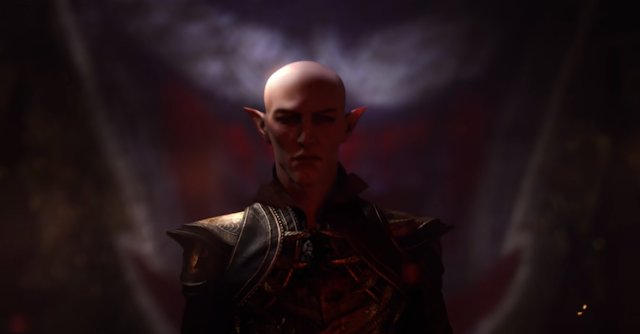
Solas: "Survive the first thirty heartbeats, and you'll already have won."

Did you ever try to go to Narnia? I did. Even in college, I never met a closet or wardrobe I didn't surreptitiously check for magical lands. And even before that, I'd always diligently explored any and all new ways to get to Middle Earth. 
Eluvians are magical portals in the Dragon Age world.
If I'd found one in the sixth grade? Or seventh? Eighth?
Yeah. You wouldn't be reading this.

Which existed, by the way. I knew this in my soul. Especially when it came to Tolkien's world. Even by 13, I'd tried and tried to find passage in every way I could. The certainty of his world felt like a knowledge thrumming just under my skin, a realization that magic in fact existed in the world, hidden only for the very most worthy. I couldn't give it up. The right combination, of course, would prove me vindicated.

Unfortunately, the world happened. And adulthood. And all the predictable yucky stuff. And ultimately, I realized, oh, right. This was what being a grownup was like. When you stopped looking into closets for Narnia. When the dawning awareness hit you that maybe you should stop elven calligraphy or Tolkien linguistics or Lewis research or just generally Doing That... if you ever truly wanted to succeed in life.

Mind you, I hadn't realized. I'd grown up an outcast. I'd been born with cerebral palsy and was a misfit who spent elementary school days wrapped in leg braces, corrective shoes, loneliness, occasional poverty, and the absolute best air of outward uncaring I could possibly manufacture. Inside, I was dying for connection. Outside, I was the human equivalent of a side-eye and a chilly shrug. People who attempted to connect with me were, ironically, most apt to be on the receiving end of a sarcastic quip and a dismissive glance. Hugs were not encouraged. I trusted few. My castle had to stay strong.

Further complicating my situation, from first to fourth grade, I had a series of eye surgeries that included a full year of wearing a real, actual, incredibly ugly and flesh-colored eyepatch to school. The eyepatch got sweaty in summer and the string made an indentation in my already terrible bowl-haircut hairline.


Being a nerd is only lonely on this side of the PC.
It's the foundation of all RPG games and fandoms.
It was hopeless. Even apart from the eyepatch, I was skinny when it was unfashionable and then fat when it was worse. I had straight mousy blond-brown hair that home perms did nothing to improve. I also had the worst buck teeth you've ever seen. The photo cube picture from my twelfth year (complete with Brownie Uniform and proud salute) is enough to make you weep.

In the big-picture sense, I was incredibly lucky overall—all of this was part of an incredibly mild case of CP (the brain damage I'd suffered at birth had been so much less severe than it might have been), and I valued and recognized that luck constantly. However, I still hated myself every waking minute. I looked funny. Walked funny. Thought funny. If I didn't monitor myself consciously, I walked like a chicken, hunched over and tentative, arms and legs drawn in close to my torso (and classmates often held contests to see who could best walk like me).

But fantasy saved me. Every time things got bad, I just closed my eyes and floated away to Narnia, to Meg and Proginoskes, to Arthur and Merlin, to Bilbo and Frodo and Middle Earth (where I was a capable, brisk and beautiful female hobbit named Falin who knew exactly how to avoid trolls and navigate Mirkwood). Even better was the time I discovered Eowyn, and she became my mental avatar and avenging angel.

And then I was okay.

The real world was stickier. Despite my efforts, everything was noticed. And until I reached the eighth grade and had learned some social skills Bull himself (and the Ben-Hassrath) would have valued, I honestly thought school was supposed to be as hellish as it was. In fact, I was so constantly thrown down stairs, knocked down, shoved in lockers, punched, hit, mocked, pissed on, and constantly abused in seventh grade that my principal apologized to me almost weekly, calling me into his office personally on an ongoing basis to apologize. Then I'd thank him, shrug, try to get through the rest of the day, and go home to read Tolkien or Poe in my bedroom while listening to ABBA (a strange yet potent combination). 

I eventually learned to adapt, to say funny things at just the right times, to deflect, and blend. Thank goodness. (Although I'm deeply grateful that I didn't live in a time of social media, because I cannot say that I would have survived if the bullying had proceeded 24/7.)

The Secret Hobbit Companion

The good news is, while I was learning how to get along, I had my books. I had my music. I knew the value of dreams.

In fact, until I was 11 or so, I'd actually kept a backpack packed deep within the recesses of my closet, positive I was another Jill Pole, in preparation for the certain day when Gandalf would ultimately rap on my door and tell me my destiny (which of course he would). And then, see, I knew... I knew I'd panic, yet still I'd hastily throw together my backpack and hooded cloak (you have to have one if you're going adventuring), and I'd follow him out and away, jumping over the low place in the hedge and chasing the magical destiny that I knew had always awaited me.

I think the secret power of being a nerd is... like Quentin Coldwater in Lev Grossman's The Magicians, you never quite outgrow that belief in magic. You're always looking for the glitch, the subtext, the secret that will take you away. It's there. It has to be there. And even when the trick is revealed, and you're told, over and over again, "No, it's just a book/game/film," you still privately always believe it exists. Even when the world has hammered it out of you (or so it thinks). Just ask Quentin.

Me, I still believed. At 20. At 30. At 40. And, ahem, beyond... So when Gandalf didn't show up, I waited. Wrote my own stories. Consoled myself with games, TV, movies, and all the fiction I could wallow in. But I was still waiting.

Then I played LOTRO (the lovely and lore-rich MMORPG of The Lord of the Rings Online), and later on, the Mass Effect and Dragon Age series (and most especially Dragon Age: Inquisition) and that's where the miracle happened. Time somehow unspooled and ran backwards. I was whole again, magical and hopeful. I remembered my secret wonderful hidden old hobbity/dwarfly backpack. And in a flash, I knew that long-ago backpack had been dark green in color. And that there had been a rough spot on the lower left-hand side. That I had stuffed it with random household foods that wouldn't be missed for the trip (from apple-pie filling to Cheetos). Everything flooded back in a moment of pure, visceral flashback. 

In other words, playing Dragon Age: Inquisition was the first time in my life I ever felt like, "Wait... I think I've actually found the magic wardrobe. Even if I don't quite get to go there." It wasn't just an escape. It enabled me to write a story and then enact its outcome, to create a hero or heroine that lived and breathed there, who fell in love, who lived and even (potentially) died. From there, I also found all sorts of wonderful discussion groups and boards, filled with people who were equally passionate about the world of Thedas, and who saw nothing odd in arguing about the hidden meanings of the quest "The Demands of the Qun," for instance, for hours at a time. 

I'd experienced this before, of course, to some degree, most especially with friends who were fellow Tolkien fans. But this went beyond that, in an odd and intense way. Because games are present-tense and of the moment, and because the DA fandom is almost always involved in a replay of some part of the trilogy, there's a part of you that's wherever you are in the game. You're out in the real world, doing real-world things, but somewhere, beyond the eluvian, your Hawke is attempting to make peace between the mages and the templars. Or your Warden's trying to decide whether or not to do the Dark Ritual. Or your Inquisitor is trying to get the hang of her spooky new ability to shoot green flame from her hand. Your hero or heroine is always out there, simply waiting for you to continue the adventure.

Thanks to Dragon Age, the low place in the hedge was right there in the computer. And it was real. A single RPG game had reminded me of the magic, reminded me of the little kid I'd been, the one who'd dreamed of adventures with Bilbo and who'd kept that backpack in her closet, ready and waiting for the knock at the green door.

I was not alone.


Saturday, June 24, 2017

Surviving the Joining: Thoughts on 'Dragon Age: Origins'

If you really want to understand the world of Dragon Age, then Dragon Age: Origins is simply essential, because when it comes to worldbuilding, DAO sets up the chessboard beautifully. It introduces you to Thedas, and to the Dragon Age universe's main regions and races, their politics, religions, and strifes. 

DAO also tosses you headlong into the fray by making your first protagonist a Grey Warden. 

The Burden of the Wardens

DAO features fascinating characters, like the lonely
slightly amoral hedge witch Morrigan (left), as well
as a world that's equally complex.

Grey Wardens are a grim, highly honored, elite cadre of fighters who either join the order out of ambition and pride, or who are forcibly conscripted. Much like GRRM's Night's Watch in the Game of Thrones universe, Dragon Age's Grey Wardens do an often thankless job around the fringes of Thedas's world, fighting darkspawn, haunted by the "Taint," and doomed to die within two or three decades. They're often a disparate mix of nobles and criminals and everything in between, because, as with the Night's Watch, once you become a Grey Warden, your past crime no longer exists.

Those wishing to become Grey Wardens must first undergo the Joining, a ritual that involves drinking a concoction of darkspawn blood, and which the majority of potential Wardens do not survive. Those who do survive are now Grey Wardens—respected throughout the land but doomed to live shorter lives due to the "Taint," and marred by a constant awareness of, and connection to, the darkspawn (a hellish, twisted, mostly mindless race that lives beneath the surface, and which can infect those in contact with them).

At least you're not alone in your newfound Grey Wardenship. You're immediately paired up with Grey Warden Alistair, a witty, slightly naive young man who has the potential to be either a friend, lover or foe as your adventures evolve.

The stage of DAO is then perfectly set with the reappearance of the one thing everyone in Thedas dreads: the appearance of an Archdemon. Archdemons are fell forces in dragon form, and each time they appear, they lead the darkspawn in something called the Blight, in which the darkspawn rage to the surface in massive, frenzied numbers as they attempt to take over the world of the living, obliterating whole villages, settlements and kingdoms. The Blight is basically a kind of infection that's both biological and metaphysical, in which those infected either die of the infection or slowly turn into darkspawn themselves.

An Endless Circle of Conflict: the Mages and the Templars

The other main tensions are between mages and templars, and these tensions not only affect the game and its choices in DAO, but they will be increasingly vital in shaping each new chapter of the trilogy as it progresses.


In the Dragon Age universe, mages are innately talented with magic, yet they're also dangerous because each time they use magic, they open a tiny channel to the Fade (the otherworld/dreamworld that is also the source of all magic), allowing for the possibility for demons to sneak through and possess them, turning them into powerful, evil Abominations. Mages are for this reason tested for this weakness in a Fade-based ritual known as "The Harrowing," and if they fail, the templars in the room will execute them immediately.


Those templars, meanwhile, are soldiers who guard, watch and imprison the mages, and who keep them in isolated towers known as 'Circles,' ostensibly for their own protection. Some Circles are gently managed, and there's real camaraderie between the mages and Templars (along with a healthy degree of sly hooking up), and a system that mostly works, even if I still intensely dislike any system that requires imprisonment for a talent people were, you know, born with. Other Circles, as we'll find as we move through the trilogy, however, are not kind, gentle, havens, but are horrifying prisons in which mages are starved, abused, raped, and more, without consequence or oversight. Mages who flee are often punished with death or a kind of spiritual lobotomy known as "Tranquility," in which the mage's connection to the Fade is severed, and they lose all capacity for emotion.


The first Circle we encounter is fairly gentle, however, and it includes a character we'll come to know very well as the trilogy progresses—the templar Cullen, who here in DAO is a shy young boy who cannot even stand a moment of flirtation with your female mage protagonist without running away. It's part of the reason I really recommend playing DAO at least once as a Circle mage, as you'll encounter plenty of drama and prejudice—even more so if you play a Dalish or city elf, as elves in this universe are a fallen people, distrusted, enslaved, and treated with active cruelty and prejudice. And you'll learn about the central conflict (mages versus templars) that will evolve with each new game or chapter as you progress through the trilogy.


A Hero's Journey Begins

DAO choices can lead to surprising outcomes. I
never expected to be standing next to Loghain, for
instance (although I'd envisioned standing ON him).
So what are the tasks set for our brave Warden protagonist as the game gets underway? Navigate Thedas's complex politics, gain allies, avoid the machinations of the usurper Loghain, gather a team of intrepid companions, fight your way across Thedas, and defeat the Archdemon.

No big deal, right? It's a great journey, and full of adventures across a complex and often beautiful array of regions and landscapes. Even better, you'll encounter some amazing characters, societies, and stories along the way—from werewolves to enchantresses, from dragons to demons.

And, as always with RPGs, you get to choose how—and who—you play. Are you a hero? Or a villain? Or a wisecracking rogue somewhere in between? It's all up to you. You can court—or kill—pretty much all of your companions. The choices are complex and often surprising, frightening, and even moving, and Origins ensures that the dialogues are consistently complex, engrossing, and genuinely interesting and fun to navigate.

Meanwhile, DAO is about far more than the hero—it also offers incredible characters. I loved the richness and complexity of the apostate witch Morrigan, the guilt-stricken Qunari Sten, the charming Alistair (hiding some secrets of his own), the Crow assassin Zevran, the devout former bard Leliana, senior mage Wynne, the golem Shale, and others. The characters are—all—beautifully performed, especially by Sten's dry, yet secretly heartfelt Mark Hildreth, Morrigan's sarcastic, vulnerable Claudia Black, Kate Mulgrew as the mysterious Flemeth, and more. I grew to love them.

Origins is like playing a great novel, and every choice you make has consequences. And each consequence can, in fact, carry forward into the events of Dragon Age 2—and into Inquisition itself.

The plot thickens... DAO is only the beginning.

Falling Flat for Thedas...

Dragon Age offers gamers a world that's magical,
gorgeously rendered, and endlessly adaptable
.
I've always been a passionate gamer. I still remember my first Atari in childhood, and how fantastic I thought Asteroids was. I went on to play every predictable console that was released, while also spending plenty of time at the arcade as well, on Donkey Kong, Space Invaders, Galaga, Donkey Kong Junior, Dig Dug, Popeye, Centipede, and dozens of others. My love for gaming continued right on into adulthood, from the days of Myst, Zork: Nemesis, LucasArts's superb and hilarious Monkey Island series, to Eternal Darkness: Sanity's Requiem, the entire Legend of Zelda series (especially Ocarina), and eventually into MMORPGs like LOTRO and RPGs like Bioware's Mass Effect series (especially ME2) and many more.

Sure, I'd gotten a little obsessed now and then—I still remember basically living three months in the world of Mass Effect while playing the entire trilogy. Or at least that's how I remember it.

Then came the world of Dragon Age. First, I played Dragon Age: Origins (or DAO for short), and was entranced with the richness and complexity of the game's world and its mythology. Each time I started up the game and that haunting music played, I felt that I was climbing through a window into another world—a deeply magical world.

After Origins, I (stupidly) skipped Dragon Age 2 (a mistake I later rectified), mainly because I was so excited to finally get to play Dragon Age: Inquisition. And it was with Inquisition that I fell in love. I fell flat. I fell like cartoon characters fall, complete with sound effects.

By the end of Inquisition, I was in love. I loved the game and its world. I loved it like I loved books. Coffee. Narnia. His Dark Materials. Eggnog. Hedgehogs. Cats. Astronomy.

I mean, I loved it like I loved Tolkien. This was serious.

And three years later, I'm just as obsessed as ever. Probably more so—because the DA world is rich enough to withstand endless replays, explorations, discussions, and microscopic scrutiny. Thanks, to Dragon Age: Inquisition, I got dumped by an in-game love interest for the first time (dammit, Solas!) and was actually so incensed by the experience that I ended up writing a fan-fiction comedic play, "Dumped, Drunk and Dalish," about my Inquisitor's drunken aftermath just to process it! (Please note—it's idiotic but fun, and you're welcome to check it out at Archive of Our Own here: http://archiveofourown.org/works/5705719.)

And that's why I'm here. As a fantasy writer, I basically had too many thoughts about Dragon Age, at this point, to keep to myself, and wanted a platform where I could share and discuss whatever moved or inspired me about the games, novels, and their world.

So welcome to my blog, complete with ramblings from my perch at the Herald's Rest. Thanks for stopping by! The next round of maraas-lok is on me.

"Dragon Age: Dreadwolf" Predictions & Ponderings (and "What's in a Name?" Redux)

He doesn't call, he doesn't write, but finally, it looks like we might be hearing from Solas at last (2023?), as BioWare announces t...