Showing posts with label lord of the rings. Show all posts

Saturday, August 18, 2018

The Dragon Age Timeline and Tale of Years: Part 1 (Ancient Age)

Here we are, on the precipice. Like my poor Inky, viewing the vestiges of an act she cannot imagine. So let's take a gander back, oh, eight thousand years or more. When facts were myths—when gods walked Thedas... or strode the air itself.
SPOILER WARNING: Not just on Dragon Age, all of it (hello!), but also on The Lord of the Rings. Proceed at your peril!


Ever since I was a kid, I've been fascinated not just by fantasy timelines, appendices and codices, but by the ways in which they can enhance our understanding of a story.

For instance, at nine or so, after the bittersweet gorgeous devastation of the ending of The Lord of the Rings when Sam comes home? I refused to acknowledge it. Nope. Nada. So I always just kept right on reading, right through the Appendices. Right on forward. I couldn't help it. More pages meant I was still there. The story wasn't done. And so I'd read about obscure kings in Middle-Earth. I'd read about the histories of the dwarves and elves and hobbits and beyond. I'd scribble runes. I'd go through and translate stuff like the inscription on Balin's tomb. Or the cover runes on my copy of The Hobbit.

In short, I would have read anything Tolkien gave me. Anything. I just knew I didn't want to stop. I didn't want to leave Middle-Earth. I didn't want to let it go. I wanted, to echo Liz Lemon, to go to there. I was under a spell. And begging Tolkien silently to give me the tools to do so.

And I know we all know this feeling. All of us. If I built a blanketfort right now, one that had Samwise or Fenris or Varric on the platform, let's face it—I know it would be pretty full of amazing people all going, "JUST LET SAMWISE BE MAYOR OKAY?" To go a little Disney on all our asses, I'd quote Disney geniuses Mack David, Al Hoffman and Jerry Livingston that "a dream is a wish your heart makes." And they knew what they were talking about.

Fantasy gives us that. As does something as simple and stark as a timeline, a tale of years. After all, what do we readers wish for more than anything? For the story not to end. And here Tolkien was actually giving me that with the Appendices! Actually giving me that. I just knew I didn't want it to be over. I had been so immersed I hadn't been able to leave the story yet. So I just kept reading. Right on through. Even at nine years old. Forging through the Annals of the Kings and Rulers, through the Family trees (squinting down at who Merry and Pippin married!), at the languages! But most of all, at the Appendix on "The Tale of Years."

Oh, I'd especially loved that. I'd just adored it. It was food for my fantasy soul. It was like code. Like Tolkien giving me a gift, a sneak peek at "here's how it started" and also, deliciously, at "here's how it ended years later." As if he'd grinned and winked in a cloud of pipesmoke and magic and huggably distant Englishness. "And most people won't know this because they won't read this. But if you read this, you'll know!"

The Secrets of The Tale of Years...


And I'd just loved it. All the way from Morgoth, to Galadriel's early days as an edgy fabulous furious rebel, to learning that Aragorn was basically ninety fricking years old in The Fellowship of the Ring. Or that Eowyn was a baby to him (just like he was a baby to Arwen). Or that Merry and Pippin spent their old age in Gondor with Aragorn. Because oh my God of course. (And while we're on topic, please tell me Pippin sang to him. I mean, come on. If he sang in the gorgeous dulcet tones of Billy Boyd? He had to sing to Strider. The entire idea makes me feel better even realizing that Strider had to witness their deaths.)

Okay, sorry. I'm back.

But... yeah. Those painful little details were so poignant. Realizing the little things—how many times Samwise was elected Mayor! How Frodo was always sick on the anniversaries of his wounds from Shelob and the Nazgul. How Aragorn and Merry and Pippin seemed to recover while Frodo and Gandalf seriously just waited for it to be over, knowing they'd been hurt too badly. And then you had poor Sam, in the middle, seeing it all, and not being able to change things... to fix them. (Sam is a fixer; like The Iron Bull, that's all he wants to do, to help people make the pain stop. Sigh.)

So that's a big thing with me. But I also love the way a timeline's confluences can further enrich the story—like, realizing that Dorian was born the same year a 12 year-old Anders was being led off in chains from his family simply because he woke up one day and had magical powers. Or realizing that Dagna, Cullen, and Alistair are all the same age!

I did not—I absolutely did not—do this by myself. I simply wanted to assemble all the threads and create a nice tidy web. So while I attempted to rewrite as much as I could, you may find rare content similar or identical to that of the Dragon Age Wiki timeline, and others, occasionally. It is also a work in progress, so it will continue to morph as I find and fix more things.

Speaking of which, I absolutely must cite some wonderful people on these, including the following resources:

The Dragon Age: Origins Codices
The Dragon Age 2 Codices
The Dragon Age: Inquisition Codices
The Dragon Age: Inquisition (DLC) Codices
The Dragon Age Wiki
The World of Thedas, Volume 1 and Volume 2
Dragon Age: The Reckoning Wiki
Ohsoang on Tumblr
Stab Him in the Kidneys on Tumblr


 And seriously a dozen more—little comments here by the writers, or little tidbits there. I just wanted to try to bring it all together.

Here we go—what can you fill in on these gaps? Please comment, tweet or e-mail me!


Part 1: The Ancient Age:

Unnamed Dates:
  • (Potential option) Solas is born in the Fade as Spirit of Wisdom
  • Rise of the ancient elven empire in Elvhenan
  • Birth of Elgar'nan
  • Birth of Mythal
  • Birth of the twins Falon'Din and Dirthamen to Mythal and Elgar'nan
  • Birth of Andruil to Mythal and Elgar'nan
  • Birth of Sylaise to Mythal and Elgar'nan
  • Birth of June to Mythal and Elgar'nan (or possibly to different parents as future mate of Sylaise)
  • Birth of Ghilan'nain
  • (Alternative) Birth of Solas in "a small village to the North."
Named Dates:
  • -7600 Ancient - Founding of Arlathan.
  • -7500 Ancient - The Unknown War. The Evanuris defeat the Forgotten Ones.
  • -7500-5500 Ancient - Elgar'nan defeats a Titan. Ghilan'nain is raised to godhood.
    Andruil hunts the Void and (possibly) brings back the Blight. Andruil is defeated by Mythal.
    Falon'Din is defeated in his own temple.
    Mythal defeats a (possibly Tainted/Blighted) Titan and appears to hide access to it beneath the earth.
  • -5500 Ancient - ~(Estimated) Mythal, viewing the Evanuris lust for power, can no longer broker peace. She may call Solas into the physical world to protect her -- or this is the point when she simply asks him to serve her against the others. Physical appearance or birth of Solas.
  • -4600 Ancient - First contact between Elves and Dwarves.
  • -4000 Ancient - ~(Estimated) Building of Skyhold fortress on an ancient Elven site
  • -3100 Ancient - Murder of Mythal. Creation of the Veil.
    Banishment of Evanuris and Forgotten Ones.
    Skyhold's foundations are damaged, and Solas falls into slumber.
    Humans (the Neromenians) appear in Thedas, settling Qarinus, Tevinter, Neromenian, and Barindur (ultimately forming the Tevinter Imperium).
  • -2850 Ancient - The Quickening (and loss of immortality) is noted by the surviving elves
  • -2800 Ancient - The Old Gods are rumored to whisper from the Black City, teaching magic to the Neromenian Dreamers
  • -2415 Ancient - The Alamarri tribes cross the Frostback Mountains and settle what will become Ferelden. Legends say they were fleeing a "shadow goddess," which Solas later confirms as truth. 
  • -1815 Ancient - The Alamarri who live near Lake Calenhad break away from their brethren to become the Avvar.
  • -1700 Ancient - The Neromenian tribes split into four kingdoms: Tevinter, Neromenian, Barindur, and Quarinus
  • -1610 Ancient - Disappearance of the Kingdom of Barindur (later revealed to be obliteration by volcanic eruption, per Solas).
  • -1595 Ancient - Thalsian, First Priest of Dumat, wields blood magic (an ability he claims came directly from Old God Dumat himself).
  • -1415 Ancient - The Chasind separate from the Alamarri and settle the Korcari Wilds.
  • -1207 Ancient - Neromenian merges with Tevinter as Darinius, High King of Neromenian, ascends the throne of Tevinter.
  • -1200 Ancient - Dwarven Provings become popular in the Imperium, and a Grand Proving arena is built in Minrathous.
  • -1195 Ancient - Tevinter Imperium founded. Darinius takes the throne of Tevinter, uniting Qarinus with Tevinter.
  • -1170 Ancient - King Endrin Stonehammer declares Orzammar the new dwarven capital, replacing Kal-Sharok. He also oversees the construction of the Stonehammer Hall in Orzammar. Orzammar Proving Grounds are also expanded for the stagings of Grand Provings. The first victors here become the first Paragons of Orzammar, and King Stonehammer builds a hall of huge statues to honor them.
  • -1160 Ancient - Taxes benefiting Orzammar begin to adversely affect Kal-Sharok profits.
  • -1131 Ancient - Endrin Stonehammer is declared a Paragon.
  • -981 Ancient - Tevinter declares war on Arlathan and the siege against the elven city begins.
  • -975 Ancient - Fall of Arlathan and disappearance of the city (reportedly) beneath the earth.
    Flight of the elves. The elves who remain are enslaved by Tevinter.
  • -895 Ancient - Tevinter conquers almost all of Northern Thedas.
  • -880 Ancient - Tevinter settles the island of Estwatch, strengthens its bay and creates a port for repairing warships.
  • -760 Ancient - Archon Almadrius ascends the Tevinter throne.
  • -715 Ancient - Tevinter succeeds in major pushes against the Alamarri and builds the Imperial Highway across the Frostbacks to Ostagar.
  • -695 Ancient - Western Tevinter splits away to form the Anderfels.
  • -692 Ancient - Death of Almadrius by assassination. His apprentice Tidarion inherits the throne, and civil war breaks out in the Tevinter Imperium.
  • -640 Ancient - Death of Tidarion. With no heir to the throne, war continues and magisters struggle for power.
  • -620 Ancient - Establishment of Emerius (eventually to become Kirkwall) by the Imperium as a slave and jet mining settlement. Archon Parthenius claims the Tevinter throne and the civil war ends.
  • -535 Ancient - The Anderfels are retaken by Tevinter.
  • -410 Ancient - A group of Kossith lands in the Korcari Wilds and establishes a colony there.
  • -395 Ancient - The Magisters Sidereal (including Sethius Amladaris, who becomes Corypheus) sacrifice several hundred slaves in a massive blood magic ritual order to attempt to conquer the Golden City. They enter the gates of the city, then fall to their deaths, irrevocably tainted as darkspawn. Later, Corypheus will note that the city was already black and the throne of the Maker was empty.
    The First Blight begins.
  • -380 Ancient - Darkspawn decimate the thaigs of the Deep Roads then emerge around Tevinter from the Deep Roads and wreak havoc. 
  • -355 Ancient - The Alamarri war with the Avvar, and at the Battle of Red Falls, Alamarri warrior Luthias Dwarfson battles the Avvar warrior queen Morrighan'nan. Both are slain, and the Order of the Ash Warriors is founded to honor Dwarfson.
  • -305 Ancient - Founding of the Grey Wardens at Weisshaupt. Nakiri of Donark Forest suggests the use of darkspawn blood and the Joining Ritual is created. 
  • -295 Ancient - (Estimated) Birth of Shale.
  • -255 Ancient - The dwarves learn the secret of creating Golems. Shale becomes a Golem. Caridin, creator of the Anvil, is sentenced to become a Golem himself in punishment.
  • -248 Ancient - Caridin vanishes with the Anvil.
  • -213 Ancient - ~(Estimated) birth of Maferath to Heggar II and Thelois.
  • -205-201 Ancient - ~(Estimated) birth of Halliserre, sister of Andraste, to Elderath and an advisor on alchemy.
  • -203 Ancient - Death of Archdemon Dumat at the Battle of the Silent Plains. End of the First Blight.
    Birth of Andraste in Denerim to Brona and Elderath.
  • -195-185 Ancient - Darkspawn are fought back to Deep Roads. Rite of Conscription is created for the Grey Wardens. 
  • -191 Ancient - Corypheus awakens from dormancy. 
  • -190 Ancient - ~(Estimated) death of Halliserre, sister of Andraste, in a mysterious and magical accident in a wood. 
  • -189 Ancient - Sashamiri traps Corypheus using the blood of Dumat, then imprisons him in a tower in the middle of the Vimmark mountains. 
  • -187 Ancient - Marriage of Andraste to Maferath. 
  • -186 Ancient - Andraste is captured and enslaved by Tevinter soldiers, who obliterate their Alamarri settlement and kill Elderath, father of Andraste.
    Maferath negotiates Andraste's freedom from her Tevinter captors and assumes leadership of the Alamarri clans.
    Andraste begins to preach of the Maker. Maferath uses her preaching to unite and further lead the Alamarri clans.
     
  • -186-181 Ancient - Birth of Isorath, Evrion and Verald to Maferath and concubine Gilivhan. Birth of Ebris and Vivial to Andraste and Maferath. 
  • -185 Ancient - Construction begins on the Grand Cathedral in Val Royeaux. 
  • -184 Ancient - Minrathous rebuilds and the Chasind claim the fortress of Ostagar. 
  • -181 Ancient - Corypheus is moved from his former tower and imprisoned beneath the Vimmark Mountains by the Grey Wardens. 
  • -180 Ancient - Maferath and Andraste lead a horde of barbarians across the Waking Sea in an assault upon Tevinter, inciting slave revolts as they pass. Southern Tevinter begins to collapse. Tevinter abandons Estwatch, which remains uninhabited for several ages.
  • -171 Ancient - Shartan leads a slave uprising against Tevinter forces, then allies with Andraste to help Maferath's army win the Battle of Valarian Fields.
    After the battle, Andraste names Shartan her Champion and gives him her mother Brona's sword, which he renames Glandivalis.
    Shartan converts to Andraste and the religion of the Maker.
    Maferath secretly makes a pact with Archon Hessarian.
    Vivial, daughter of Andraste, and Regulan, her mage lover, flee into self-imposed exile shortly before the betrayal and death of Andraste.
  • -170 Ancient - Before Andraste's army can attack Minrathous, Maferath secretly betrays Andraste at Nevarra while pretending public outrage at her capture.
    Andraste is set on a pyre before the gates of Minrathous.
    Shartan and a hundred elves charge the pyre in an attempt to free Andraste, but are killed in the attempt.
    Andraste is killed during her execution at the stake by Archon Hessarian himself, who puts a sword through her heart in order to end her suffering
    Havard, childhood friend of Maferath, is mortally wounded then healed by the ashes of Andraste, which he takes away with him back to Ferelden for safekeeping.
  • -165 Ancient - Maferath is given most of Southern Thedas to rule, taking Ferelden for himself, and dividing Orlais, Nevarra and the Free Marches between his sons. Isorath is given the rule of Western Tevinter (later Orlais). Evrion is given the East (The Free Marches), and Verald is given the central Planasene (Nevarra). Maferath grants the elves a new homeland in the Dales.
  • -160 Ancient - Archon Hessarian converts to the religion of the Maker and reveals the betrayal of Maferath.
    Maferath and his court are abandoned then slain in retribution, sparking chaos in Southern Thedas. Hessarian converts the Old God temples into the first Circles of Magi.
    ~(Estimated) Verald's court in Nevarra is slain upon the revelations about Maferath and he flees to Orlais. Verald struggles for power with Isorath then conspires with Jeshavis, the wife of Isorath, to murder his brother. Death of Isorath and all of his children.
    Marriage of Verald to Jeshavis.
    ~(Estimated) Birth of Alli Vemar to Ebris, daughter of Andraste.
  • -155 Ancient - The Ciriane (in what is now Orlais) unite for the Grand Unification.
    ~(Estimated) death of Verald at the hands of Jeshavis. Jeshavis becomes the first Ciriane leader of Orlais.
  • -152 Ancient - ~(Estimated) death of Ebris, daughter of Andraste, by plague.
  • -140 Ancient - The legendary and heartbreaking Long Walk to Halamshiral by the elves.
    ~(Estimated) death of Alli Vemar, granddaughter of Andraste. She dies married but childless, in an accident while voyaging to Denerim.
  • -135 Ancient - Strife and warring among the Alamarri in Ferelden as warlords vie to succeed Maferath.
    Disappearance of Andraste's ashes (which have been secretly relocated to the Temple of Sacred Ashes in Haven).
  • -130 Ancient - Creation of the Chant of Light by the disciples of Andraste.
  • -125 Ancient - The Chant of Light increases in popularity and the religion spreads.
    Hessarian dies in his sleep.
    Leaders in Eastern and Southern Tevinter argue for secession out of fears that Hessarian's successor Orentius will restore the religion of the Old Gods.
  • -120 Ancient - Rebellion in Rivain, which attempts to split off from the Imperium, aided and supported by several Free Marches city-states.
  • -100 Ancient - Founding of the Inquisition, which begins pursuit of heretics and apostate mages in the name of the Maker.
  • -53 Ancient - Tevinter loses the Battle of Temerin and abandons the East.
  • -44 Ancient - Founding of the kingdom of Rivain.
  • -30 Ancient - The city-state of Antiva expands to become a nation in its own right.
  • -25 Ancient - Emerius falls in a slave rebellion and, once free of Tevinter, is renamed Kirkwall.
  • -15 Ancient - The dwarves seal off the last of the Deep Roads, cutting off access to Kal-Sharok.
  • -11 Ancient - As the religion of Andraste spreads, Kordillus Drakon (King of Orlais) becomes a follower.
  • -3 Ancient - Kordillus Drakon unites the Heartlands tribes and is crowned Emperor of Orlais. He then formalizes the Cult of the Maker, creating the Chantry.
So that's part one... next up, let's look at the ages to come! Divine, Glory, Towers, and beyond!

And please let me know—have I missed anything? Anything I've got wrong? Let me know in your tweets, comments or on my Facebook page!


    Sunday, October 8, 2017

    Meaningful Banters: Cole and Solas Netflix & Chill

    Cole: They left for love, and then love lost them. More pain, more joy than anyone can bear, and yet they embrace it.
    Solas: How could they not?

    NOTE: As always, Spoilers for all of Dragon Age: Inquisition (as well as for a variety of movie endings)!


    Cole sees far—and he's witnessed a pretty extensive movie
    collection! I can't tell you how much I'd kill for a Cole
    YouTube Channel where he and Solas just review movies.
    Our quiet, haunted companion Cole is full of many secrets and mysteries, and one of those is that he seems to be able to see across the Fade at will. For those who pay close attention, his vision seems to extend across both time and space, both into the Bioware Mass Effect, Knights of the Old Republic, and Jade Empire game story universes, as well as beyond—even to present-day Earth itself.

    In their beautiful and often vaguely circuitous conversations together, Cole and Solas reveal that both were able to view, from the Fade, an extensive number of films and fictions (movies, games, and more). I, like Varric, I'm sure, have a multitude of questions about this amazing discovery. (Could Cole for instance leave Amazon reviews? The mind reels. I mean, I can just picture it now: Cole on a high-end pillow: "Too many feathers! The birds are sad. One star."  Cole on the latest Beyonce album: "She was sad when she wrote it. But it was true. Five stars!")

    These moments, in which Cole discusses a multitude of movies from Earth with a delighted Solas, are among my favorite banters in the game, as almost all of them (in a lovely touch) are directly relevant to Cole and his supernatural aspect, and are about angels, ghosts or apparitions in some way. Even better, most of the references Cole and Solas make to movies also directly offer intriguing parallels or direct references to themselves or to their companions in the DAI universe.

    A few examples of some of my favorites, below, offer especially interesting potential insights.

    Connections Across the Fade

    "He was dead the whole time. He didn't know." 
    This is of course a reference to The Sixth Sense—but it's also, cleverly, referring to Cole himself, and his story in Asunder. It's literally the realization poor Cole had to survive at the end of the story.

    "There is no other man. He becomes the other man to do the things he can't." 
    This is a reference to Fight Club, but it's also an apt and sly allusion to Blackwall (and perhaps, to The Iron Bull). Not only is Blackwall playing a role, becoming Blackwall in order to blot out the guilt and crime of his former self Thom Rainier, but it's an extremely apt look at Bull and the struggle within himself for dominance, between the loving, nurturing The Iron Bull and his ruthless, Qun-loyal Hissrad-self.

    "It's made from people."
    This isn't just a clever reference to the classic film Soylent Green, but it also, terribly, alludes to the creation of Red Lyrium within DAI.

    "Never trust half an elf."
    A clever reference to The Lord of the Rings films that's also been tweaked for the observant to reference Michel de Chevin from The Masked Empire. Michel's crimes in The Masked Empire, honestly, make it very hard for me to save or support him in DAI no matter how heroically he's presented—in some ways I find his demon antagonist Imshael more forthright about himself and his motives than Michel himself (who has somehow managed to convince himself he is a hero, which, NO). Besides, Imshael is witty, and if he damns people, he does so only using their own weaknesses. 

    Yeah, I admit it. I always have trouble killing Imshael in the game. He's just so funny! And he offers the standard villainous rewards of virgins, money, and power! (Please don't miss the chance to take him up on his offer, even just for fun, to witness his reactions—SAVE FIRST—because his response to your request for virgins is hilarious, and even more so if Cole is in your party.) Even at the end of the fight, Imshael is hilariously witty and rather touchingly disappointed in his own weakness. I don't know... Michel actively killed innocents and contributed to the deaths of countless elves (and pretty unrepentantly), so I struggle with the idea that a temptation demon like Imshael is the worst thing that this world can hold. At least he's honest about what he is. Michel is, I feel, still laboring under the idea that he's a hero. And he's not.

    Onward!

    "He was their enemy the whole time, but she made him forget, so he could change."
    This refers to the classic Bioware game Star Wars: Knights of the Old Republic, but to me it's also a slyly gorgeous allusion to Solas's secret and precarious situation (if romanced) in DAI. It's absolutely perfect if you look at it through Solas's lens in DAI—for a long time, after all, a romanced Inquisitor will in fact distract Solas from his purpose and will also, irrevocably, change him. He even notes and responds to this change, which is one of my favorite character notes in our prideful Dread Wolf—that he has the humility to note and to admit when he has been wrong.


    The question may be the answer, but it's taken Solas a long
    time to realize that fact. How can someone so brilliant be so
    unself-aware? It's part of the tragedy of Solas.
    "It always had a soul. The question is the answer."
    A lovely reference to the Geth, the terrifying yet poignant AI species from the Mass Effect series, but I also see parallels to Solas's struggle to see the people of present Thedas as real. This is a concept he's struggled against for a long time, for several reasons—first, because he's been so obsessed with his goal to restore the world he inadvertently damned that he, for a long time, refused to see Thedas's people as real. This was also the topic of specific and terribly sad dialogue with Felassan in The Masked Empire, as well as in key dialogues with Cole in DAI and again in its DLC, Trespasser.

    My own take has always been that, since his awakening, Solas is living his own private version of the timey-wimey DAI quest "In Hushed Whispers," viewing the current world as not quite real, as a mistake, a twisted and blunted reality that shouldn't exist at all (and won't, if he has his way). But then of course... he falls in love with the world, terrible as it is. And with the Inquisitor. And he cannot deny their reality or the monstrousness of what he's really seeking to accomplish.

    "An old name burns inside of armor that shouldn't fit, lit by faces of children he couldn't save."
    This is, I feel, a pretty direct allusion to Shepard in Mass Effect 3, but it's also an apt allusion, as well, to Bull, Cullen, Blackwall, and Solas in DAI. Each of those has witnessed (or authored) horrors that led to the unexpected deaths of children—children who could not be saved.

    Then there are the longer discussions between Cole and Solas:

    Meet Joe Black

    Cole: It makes sense. It holds them as they die. But then it's a man, and he wants a woman. Why?
    Solas: When they possess people, they often indulge in feelings they have never before experienced.
    Cole: But it changed. It is blank, black, blunted from being. It never wanted before.
    Solas: Have you felt no interest in women since you came through the Veil?
    Cole: No.

    To me, this isn't just a clever allusion to the underrated film Meet Joe Black, it's also a subtle allusion to a romanced Solas... who (after centuries in the Fade) has emerged to struggle with his own love and passion for a female Inquisitor.

    The Bishop's Wife
    Cole: She wants a Chantry, but it does other things instead.
    Solas: She did not need a Chantry, she needed to remember her faith.
    Cole: But it also spent time with her. It wanted to fall, feeling.
    Solas: They are always attracted to the world of the living.
    Cole: Why did it only talk facing one way?
    Solas: We all have a face we want to show, and a face we we do not.

    Let's talk about Solas's words here about faces: I feel very strongly that, among the revelations that may or may not follow in DA4 and the (hopeful) continuation of our story with Solas, one of those will, I'll bet, include the revelation that Solas himself is a shapeshifter in the Fade. This means that, to me, his allusions to his "other face" aren't just metaphorical, but factual. My own feeling is that Solas in the Fade can appear as the Dread Wolf (a magnificent wolf with the eyes of a Pride Demon, as depicted in his frescoes), as well as in the form of a sort of superpowered terrifying Pride Demon that's kind of a visible manifestation of his own id—the pride and arrogance that set him on this path.

    I also feel that, as implied through the game and game-novels, Solas has sometimes used these alter-egos in the Fade in order to accomplish tasks he himself might have found difficult to accomplish, such as the death of Felassan.

    Cole and Solas make the Fade sound even more inviting
    when I realize they can evidently stream ANYTHING, and
    they aren't even paying for WiFi... or HBO!
    It's a Wonderful Life
    Cole: It sees him ready to jump. Pain pounding, pulsing, life of frustration can finally fall, to freeze.
    Solas: Ah, yes.  
    Cole: It holds him high, shows the hole, where everything falls without him. He never needs to leave. He matters here. 
    Solas: That is one interpretation, yes. 
    Cole: You think it is different.
    Solas: I think he fell, and it held him as he died, leaving him with images that told him his life was worthwhile. 
    Cole: That's much sadder. But yes. Calm, comfort, as the cold takes him away.

    Here's the thing: It's a Wonderful Life used to be one of my favorite movies, all the way through my twenties. I'm not kidding: I studied it in film school, owned copies of the screenplay and several critical analyses (including the "It's a Wonderful Life Book"), as well as viewing assorted commentaries and interviews. 

    However, as I approached middle age, something weird happened, and I increasingly began to find it difficult to watch. I began to feel that there was a cruelty and masochism to George Bailey's journey, and to the dogged way life seems determined to strip him of each and every chance at even the smallest happiness (filled with wanderlust, poor George doesn't get to travel even once, or get the actual, much-deserved honeymoon trip he had planned and paid for). 

    The truth is, It's a Wonderful Life is a heartwarming fable when you're young: Oh, look, hey, everything turned out okay! People love him! Yet as you approach middle age, however? I'd argue that it's all too easy to see it as a horror story, about a wasted series of opportunities, and about one man who was cruelly denied the one thing he'd always wanted: escape. (I know, I know. I am aware that I'm seriously one person out of millions to feel this way. So yeah, I'm weird; feel free to throw things at me.)

    However, for this reason, I love the fact that Solas has always viewed this film's story as nothing more than one man's tragic story, and that even the film's darker final alternate-universe journey was actually nothing more than the final attempts of one hapless angel to comfort a dying man with the knowledge (illusion?) that his life mattered. I find it even more moving given the fact that Solas is so intensely lonely and haunted himself with his own actions—what would his own alternate-universe movie reel be like? What would he have done differently, if he could?

    Most of all, this particular reference moves me because it can be seen as alluding to the thing Solas fears most in the world (knowledge we gain when we visit the Fade in "Here Lies the Abyss"): Dying alone. No wonder Solas finds his dark reading of It's a Wonderful Life oddly comforting—in his view, George Bailey may die, but he doesn't die alone. He dies in the knowledge of his own rightness... and in the comfort of another. He did the right thing. And even if he dies... he does not do so alone.

    For this reason, my one request, my one hope, on DA4, is that Solas does not, in fact, die alone. I think he's doomed, although I do think he'll end up on the side of the Inquisitor and the angels, just in time, as he realizes the madness of his path. But then I think he'll die. I just hope he doesn't die alone. And I will of course also cling to the revelation that death may not be permanent for him. As he notes in Trespasser, "The first of my people do not die so easily." This is also why I fully expect to see my girl Flemeth back in DA4 (don't bother arguing la la la, I can't hear you...), as well.

    City of Angels
    Cole: They left for love, and then love lost them. More pain, more joy than anyone can bear, and yet they embrace it.
    Solas: How could they not?

    Again, this reference to City of Angels is another way in which Solas is looking at a film situation through a glass that is filled with yearning, sadness, and self-knowledge. If romanced, he himself is poised upon this very same precipice, even as (more importantly) he has fallen in love with Thedas—even the poisoned, corrupted version he found so horrifying upon awakening. 


    This conversation is a reminder that Solas is walking his apocalyptic path with open eyes. He is aware that death, loss, sadness, and guilt lie ahead of him just as they lie behind him. But he will not pretend that the world is not beautiful, or that love is not worth risking all to experience. 

    Netflix and Chill: Even From the Fade

    Last but not least, I love the idea that all these worlds are connected somehow by the Fade—it offers incredible possibilities if you're a fan of all of Bioware's gaming universes, and then it takes that extra step and adds in Earth as a common point of connection. It's intriguing and opens up a wealth of possibilities. Is Dragon Age happening at the same time as Mass Effect and these other game-universes? Or is it happening (even better) after them? Or does Cole's view encompass space and distance in such a way that even sequential time is utterly meaningless?

    Besides, I also can't help but adore the mental image of Solas occasionally taking time out of his intense and possibly nightmarish dreaming in the Fade across millennia after catastrophe, to nevertheless simply Netflix and chill like the rest of us. The thought of Solas solemnly and attentively bingewatching everything from It's a Wonderful Life to The Sixth Sense to Meet Joe Black, Angels in the Outfield, and dozens more makes me weirdly happy. I hope Solas's friend Wisdom or other spirits watched with him, at least, and provided lively debate on casting choices, story resolutions, and cinematography (for some reason, I keep picturing something similar to the ghostly/afterlife discussions of classic films that take place in Anthony Minghella's timeless Truly Madly Deeply: "Okay, everyone. Five Easy Pieces or Fitzcarraldo?"). 

    SIDE NOTE: How can the magical, literate, and lovely Truly Madly Deeply be OUT OF PRINT? You can't even stream it! As it's one of the only movies I could, um, recite verbatim (don't judge me) this, folks, is another sign of the impending apocalypse.

    Meanwhile, that scenario of Solas Netflixing also makes me wish desperately for a DAI DLC in which Solas and Cole review a bunch of random movies from the Fade:

    Solas: And that was our look at Blazing Saddles, an amusing look by Mel Brooks at racism and the American West.
    Cole: It made me sad. 
    Solas: Oh, come! It was amusing and occasionally witty. Also, the musical sequences were fantastic.
    Cole (stubbornly): It was sad. Mongol just wanted love.
    Solas: Next up, we'll examine Inception.
    Cole: So many stairs! But they helped the boy, even if it was a lie. The helping was what mattered, not the lie.
    Solas: So true! And we'll also be taking a look at the classic film Blade Runner.
    Cole: He was one of them all the time. He didn't know!
    Solas: Right. Ahem. Spoilers! 

    This has been a look at just a few of the DAI "movie banters"—there are many more, as noted in the Dragon Age Wiki here.

    What do you think? Do you agree or disagree? Do you perhaps see additional meanings in the banters that I may have missed here? I'd love your thoughts and input, as always!

    Images courtesy, as always, of Bioware.

    Spirit, Lost Boy, and Ghost of the Spire: Portrait of Cole

    Cole: All the hopes you carry, fears you fight. You are theirs. It must be very hard. I hope I help.

    Lost boy Cole is perhaps the loneliest character in Dragon
    Age: Inquisition, even in a tapestry of lonely and disconnected
    characters yearning for connection and penance.
    He's so ordinary at first glance—a skinny kid, nineteen maybe, with straggly blond hair, a wide mouth, a comically broad hat, and pale and darkly shadowed eyes—as if he's seen all the badness the world has to offer and is no longer able to sleep. He speaks poetically, in flowing, alliterative, rhythmic cadences that are almost musical. 

    He doesn't talk about what people say. He talks about what they feel. 

    Cole is the strangest of our companions in Dragon Age: Inquisition. Depending on our choices early on in the game, we either meet him during the quest "Champions of the Just," supporting the Templars, or, if we support the mages, just before the epic attack by Corypheus on Haven. I've played both, and I loved meeting Cole in "Champions of the Just," and getting his help in separating the lies from truths in that quest, with Cole's quiet, kind voice leading us through a web of lies and illusions. However for me the canon playthrough for Cole will always be the mage-supported option, when he arrives at Skyhold carrying poor, annoying, wounded Roderick, crying, "I can't help if you don't open the door!"

    Just as Bull's true role is giving people what they need, "helping"—wherever and whenever he can—is Cole's core purpose. But just as Bull's caregiving was warped by the Qun, so too was Cole's original desire to help warped, at first, into death and blood.

    He is a spirit of compassion, a lost boy, and a murderer. A scrap of paper mysteriously notes, "His name is Cole." But nobody can quite remember who wrote it.


    The Ghost of the Spire

    If you read David Gaider's haunting Dragon Age novel Asunder (essential reading before playing Dragon Age: Inquisition, along with The Stolen Throne, The Calling, and The Masked Empire), you'll learn of the events at the White Spire mage circle, at one point certainly one of the cruelest in Thedas. With abuse of its mages by the Templars set to guard them out of control, the White Spire rivaled the Kirkwall mage circle (Dragon Age II) for cruelty and mistreatment. Cole was a mysterious figure there who seemed to be able to appear and disappear at will, and to cause people to forget his presence. He also creepily, coolly helped mages to their deaths whenever they, threatened with abuse or Tranquility (the creepy magical-emotional-lobotomy of the Dragon Age universe) expressed a wish for death or escape.

    It's worth noting that the period of time during which Cole was actively murderous (however twistedly he thought he was "helping") is, as Solas noted, strong evidence that he—a pure spirit of Compassion, as we later discover, had been warped and twisted into something apart from himself.


    Cole is a paradox: Infinitely forgiving, but also a spirit
    of vengeance and retribution against those who hurt others.
    Eventually, however, Cole befriended Rhys, a mage of the circle who was actually the grown illegitimate son of Wynne (a tragic note we almost swoop right past from Dragon Age: Origins—and as we know from Alistair, swooping is the worst thing ever), the product of her long-ago affair with a Templar. Cole teamed up with Rhys and Evangeline, an honorable female Templar warrior, through adventures from the White Spire to Adamant Fortress and the Fade, in order to find justice. I love Rhys and Evangeline for many reasons—as a romance of mage and Templar, they are a Dragon Age echo of Tolkien's Beren and Luthien, of Romeo and Juliet, of Tauriel and Kili (Oh, hush, I cannot hear your Hobbit-movie criticisms, my elf-ears are closed...Tolkien would have adored them), of opposites coming together despite every reason to stay sundered and apart.

    (Okay, I'm human again. Sorry. I may or may not have been distracted by Tauriel+Kili memes. I regret nothing.)

    Meanwhile: Rhys and Evangeline are crucial to Cole's story because they were his first real experiences with love, family and acceptance. Cole supported their efforts to rectify the Circle's evils, even surviving the terrible moment in the Fade when he realized just how much tragedy he himself had willingly forgotten (and that he had, in fact, been a ghost or spirit all along). Unfortunately, their realization of his spirit (and possibly demon) status sundered the friendship, leaving Cole alone and near despair. But Cole survived this devastating scenario, even more coolly and scarily than expected, ensuring that the evil Lord Seeker Lambert would never harm anyone else before Cole left to find his own mysterious path.

    Left at a crossroads, Cole needed something he wasn't even aware was possible: Help for himself. Then he found the Inquisition, and was drawn away from his lonely shadows once more... and into the light.

    The Loneliest Boy

    This is where the torch is passed on the character of Cole, and we follow Cole from the haunted, traumatized boy of the novel  Asunder written by Gaider, and into the poetic spirit of compassion written in DAI by Patrick Weekes. While Gaider's Cole was quieter, colder, and lonelier, Weekes's Cole is stranger and sadder, speaking his impressions of the feelings of those around him in a kind of constant, ecstatic lyricism. Yet they are recognizably the same boy, and it's a testament to both writers that Cole manages to still feel consistent and believable between the two, as if Weekes's Cole were simply a raw nerve after awakening from all of the hardship and pain Gaider's Asunder Cole had experienced.

    While Cole is greeted with fear and distrust by many upon his first appearance to the Inquisition, Solas is able to quiet most concerns with the revelation that Cole is something new—not a demon in the traditional sense, but a spirit (that we eventually learn is one of Compassion or Mercy) who genuinely wants to heal others.

    What moves me when Cole joins the Inquisition is the fact that he has to fight so hard for simple acceptance, for the right to simply take part. He is greeted with fear and suspicion by Cassandra, Blackwall and Bull, and with outright hostility by Vivienne and Sera, who refuse to even refer to him as anything but an "it" for most of the story (as does Cass, at first):

    Cassandra: Tell that demon...what does it call itself, Cole? Tell it to leave. He may not mean harm, but that does not mean he will not harm us. Spirits are not creatures to take at face value. Be cautious with him, Inquisitor.

    Sera: Not saying nothing about that. That thing is just wrong.


    Shortly after:

    Vivienne (to Solas): You should not encourage that thing.
    Cole (indignantly): Solas is not a thing.
    Solas (with subtle humor): Well said.

    Cole is not an 'it.' But this is a great example of the ways in which his very innocence and, well, density, can sometimes inadvertently be his greatest protections. As when he is touchingly grateful for one of the rare occasions on which Sera refers to him as a "him:"

    Sera: Could someone please shut him up? Or I am going to shaft him in his creepy little eyes.
    Cole (happily): You... you called me him. Thank you!

    Then, of course, he starts to get to people. He starts to get into their hearts, as only Cole can. (Thank goodness.)

    A Window into Hearts and Minds

    I enjoy Cole as a character for many reasons—for his sensitivity, for his loneliness, and for his kindness. However, I love him most of all because there is no lie in him.  As performed with sensitivity and humor by voice actor James Norton, Cole is quick to forgiveness of others' sins, but he is also merciless toward those who would harm others, and this extends to himself, as he tells his companions:

    Cassandra: The Inquisitor believes you wish to help, but I will not allow you to threaten innocents.
    Cole: Yes. Help the hurt, save the small. If I become a demon, cut me down.
    Cassandra: Do not doubt me. I will do it.
    Cole: Good.
    Cassandra: You're... serious, aren't you?
    Cole: Yes. I hope you are, too.

    Cole (to Blackwall, after the revelations of his deception and criminal past): If you want to remember, remember this: if you become Rainier again, I will be here, and I will kill you. And if I become a demon again and hurt people, you will kill me.
    Blackwall: I believe I can work with that.

    After the quest "Here Lies the Abyss" at Adamant Fortress, Cole will also confront the Inquisitor and, once again, ask us to promise to kill him if he, like the Grey Wardens we witnessed there, proves to be a danger to others. As a side note, it's interesting—if we respond that we will do so, we get a big approval hit. If we don't we'll get a Greatly Disapproves, which is a whopping -20 to Cole's approval. It's one more reminder that Cole does not joke around (as we already know if we've witnessed poor Varric's fruitless attempts to teach Cole the basic elements behind the simplest knock-knock jokes).

    The Soul-Reader

    The paradox of Cole is that, while he keeps his companions' secrets (and they are numerous, troubling, and occasionally terrifying), he nevertheless finds constant ways to reveal their innermost hearts. Cole, a reader of souls and intentions, provides a window into our companions that is unique, profound and fascinating. In other words, if you take him out with you as a party member, you'll get all sorts of insights into the private worlds of your companions (complete with a glimpse into even Vivienne's frosty little bruised heart). If you don't? You're missing out.

    This is because, thanks to Cole, and only to Cole, we're given intimate "you-are-there" glimpses of our companions' most closely guarded secrets. We witness a terrified Bull in childhood as he admits his fear of demons to his Tama (his tamassran nurse)—a moment echoed again when Cole later reveals (if Bull goes Tal-Vashoth), that Bull's same old Tama was surreptitiously relieved and proud of Bull's recent escape from the clutches of the Qun, all those years later. Cole also takes us directly and terrifyingly back to the all-important moment when Bull has just lost his eye to save the life of his future closest ally, trans soldier Krem, after an attack in a tavern. Tellingly (and most movingly, for me), Bull's reaction in the moment is to instantly dismiss a grievous injury in order to comfort Krem:

    Iron Bull: Hey, Cole. Quick! What number am I thinking of?
    Cole: Raw and hot, trying to open it, but just darkness. How bad, how bad? No—done now. No sense worrying.
    The man they hurt coughs, shaking, but sits up. Eyes wide. No, not a man, a woman, clothes torn. "You're safe now. I'm Iron Bull. What do you want me to call you?"
    Iron Bull (dryly): Twelve. The number I was thinking of... was "twelve."


    Cole is the watcher of the group, the emotional conduit
    between the companions and the Inquisitor.
    Everyone Fears

    Cole's other revelations about companions (always communicated in present tense, emphasizing their intimacy and immediacy) include key moments of fear, racism and vulnerability for ice-queen Vivienne, and the all-encompassing guilt felt by Blackwall from his deeds as the corrupt Rainier. Cole also reveals Dorian's pain, confusion and self-loathing about his own sexuality, as well as a delicate, gorgeous moment of private yearning laid bare:

    Cole: Rilienus, skin tan like fine whiskey, cheekbones shaded, lips curl when he smiles. (pause) He would have said yes.
    Dorian: I'll... thank you not to do that again, please.

    We also witness Cassandra's touching memories of childhood companionship (as well as a glimpse of her feelings for lost love Regalyan), and the fact that even spirits across the Veil are consistently impatient for Varric's next books. Amusingly, Cole also divulges some decidedly intimate moments between Bull and a romanced Inquisitor, to the intense discomfort of both, and to the delight of their companions.

    Another one of Cole's talents isn't just clairvoyance, but that he seems to be able to see across the Fade. I've addressed this in more detail separately here, but these conversations with Solas are delightful, and often provide additional takes on great moments in film or gaming, while also offering hidden insights into the companions we love, as well.

    Finding Family

    Cole is the watcher of the group, the emotional conduit between the companions and the Inquisitor. He's the person who feels intensely, watches those he loves and tries to figure out how to either heal or help them, or what makes them tick. In return, he is given love and acceptance, and the lost boy finds a family.

    Cole goes from orphanhood to having three fathers who love
    and care for him...  and he also gets a family, to boot. It's lovely.
    That's why I love the evolving nature of most of Cole's banters with his companions, as they show that, overwhelmingly, it's very hard to remain afraid of or hostile toward someone who knows the love and fear within your heart.

    Bull, for instance, evolves from distrustful, fearful antagonist to caring adoptive father (and I always love the way Cole so carefully pronounces Bull's full name, as if it is a title of honor):

    Cole: The Iron Bull, in one fight, you let someone hit you so they wouldn't hit me.
    Iron Bull: Yes?
    Cole: But you hate demons.
    Iron Bull: Listen, Cole. You might be a weird, squirrelly kid, but you're my weird, squirrelly kid.
    Cole: Oh. Thank you.

    Cassandra also evolves from her early suspicions to become teasing and quietly affectionate with Cole (bonding even more closely once she realizes he knew and recognizes her brush with a Faith spirit), and Varric anchors him to the world in a simple way that requires no violence or forgetting. Varric further reminds Cole that Cole can in fact become a real live boy—then (depending on what you choose) he actually helps him do it. Solas, meanwhile, gives Cole the opportunity to voice ideas and conversations he has never been able to share before, transcendent and mysterious and shining from behind the Fade.

    Basically, Cole goes from orphanhood to having three fathers who all actively love, fear and care for him... and he also gets an extended family, to boot (complete with bratty big sister in Sera, and chilly stepmother in Vivienne). It's lovely and real.

    Cole evolves throughout the course of DAI, but he also remains innocent and pure, rather childlike. For this reason, I liked Patrick Weekes's thinking on why Cole wasn't romanceable in DAI (basically, that he's still so new to being human that he just felt it wouldn't be right to do). But I did like that Cole had evolved enough to pursue a relationship (with Tavern bard Maryden) by the Trespasser DLC a few years later (that is, if we kept him more human). On the other hand, the "spirit" choice for Cole is sadder... yet it does give me more hope for Solas in the next game. (I'm also torn about that choice because it means Krem and Maryden hook up instead in Trespasser, and the two of them together is the most wonderful thing ever. I love them so much, I can't even.)

    Even Wolves Need Compassion

    Ultimately, it's Solas who brings out Cole's greatest questions, enthusiasms and emotions, and their closeness is why it's incredibly sad when Solas cuts himself off not just from a romanced or high-approval Inquisitor... but also from Cole's friendship. Throughout the story of DAI, Cole and Solas have several, fairly open conversations about Solas's guilt, grief and regret, and each is fascinating to revisit after the fact—especially the way we can see that Cole is actively, for awhile, sharing in Solas's burdens, even palpably alleviating them. All the way through Trespasser, Cole's conversations with and about Solas are gems that reveal much (including the fact that, of course, Cole had always known who Solas was, the entire time):

    Cole: They are not gone so long as you remember them.
    Solas: I know.
    Cole: But you could let them go.
    Solas: I know that as well.
    Cole: You didn't do it to be right. You did it to save them.
    Inquisitor: Solas, what is Cole talking about?
    Solas: A mistake. One of many made by a much younger elf who was certain he knew everything.
    Cole: You weren't wrong, though.
    Solas: Thank you, Cole.

    Which is why it's so devastating at the end of DAI, when visiting Cole after the defeat of Corypants, when we realize after Solas's departure that he has actually enspelled poor Cole to forget everything he might once have seen in Solas's mind. All those conversations, all those moments of friendship... lost. 

    "Do That, Please."

    Yet as Trespasser demonstrates in our many conversations with Cole years later, while Cole may not always remember what happened with Solas, he somehow still maintains that emotional connection to his friend. And he still provides a fascinating and functioning connection to Solas's deepest thoughts, regrets and feelings. (Note: I tweeted writer Patrick Weekes a question on this a month or two back, wondering if Cole's memories had returned, or whether he was acting more as a conduit. Patrick was nice enough to respond: "More conduit. Cole doesn't always know what he knows." Which makes perfect sense to me.)

    But that's all in the future. Meanwhile, in one key conversation that I feel sums up their entire friendship, Solas and Cole discuss Cole's uniqueness as a spirit of compassion, especially in such a dark and demon-haunted world. Solas remarks upon how necessary that spirit is, now more than ever, and how precious and rare it is. Cole, pleased but puzzled, responds that he will try not to die.

    Solas responds quietly and with feeling: "Do that, please."

    While I was moved and saddened when Cole returned to the Fade in the playthroughs in which I kept him a spirit because it just felt so much like a defeat to me, like a step backward, I kept thinking of Solas's quiet plea to Cole, of that one moment as noted above. And I thought about how that very ending curiously also gives me the most hope for Cole's effect on the next (rumored) chapter of Dragon Age. It ultimately gives me hope that a Fade-returned Cole, like the guardian angels he loved in so many Earth-movies, can now perhaps still manage to reach Solas in ways we can't, and that he can help us to save or redeem him in DA4. 

    There's a beautiful symmetry to the idea: Solas helped Cole in so many ways to understand his heart and to release his guilt and regret. The least Cole can do is to finally help Solas to free and understand his own, before it's too late.

    Monday, July 3, 2017

    The Low Place in the Hedge: How Gaming Saved Me

    Solas: "Survive the first thirty heartbeats, and you'll already have won."

    Did you ever try to go to Narnia? I did. Even in college, I never met a closet or wardrobe I didn't surreptitiously check for magical lands. And even before that, I'd always diligently explored any and all new ways to get to Middle Earth. 
    Eluvians are magical portals in the Dragon Age world.
    If I'd found one in the sixth grade? Or seventh? Eighth?
    Yeah. You wouldn't be reading this.

    Which existed, by the way. I knew this in my soul. Especially when it came to Tolkien's world. Even by 13, I'd tried and tried to find passage in every way I could. The certainty of his world felt like a knowledge thrumming just under my skin, a realization that magic in fact existed in the world, hidden only for the very most worthy. I couldn't give it up. The right combination, of course, would prove me vindicated.

    Unfortunately, the world happened. And adulthood. And all the predictable yucky stuff. And ultimately, I realized, oh, right. This was what being a grownup was like. When you stopped looking into closets for Narnia. When the dawning awareness hit you that maybe you should stop elven calligraphy or Tolkien linguistics or Lewis research or just generally Doing That... if you ever truly wanted to succeed in life.

    Mind you, I hadn't realized. I'd grown up an outcast. I'd been born with cerebral palsy and was a misfit who spent elementary school days wrapped in leg braces, corrective shoes, loneliness, occasional poverty, and the absolute best air of outward uncaring I could possibly manufacture. Inside, I was dying for connection. Outside, I was the human equivalent of a side-eye and a chilly shrug. People who attempted to connect with me were, ironically, most apt to be on the receiving end of a sarcastic quip and a dismissive glance. Hugs were not encouraged. I trusted few. My castle had to stay strong.

    Further complicating my situation, from first to fourth grade, I had a series of eye surgeries that included a full year of wearing a real, actual, incredibly ugly and flesh-colored eyepatch to school. The eyepatch got sweaty in summer and the string made an indentation in my already terrible bowl-haircut hairline.


    Being a nerd is only lonely on this side of the PC.
    It's the foundation of all RPG games and fandoms.
    It was hopeless. Even apart from the eyepatch, I was skinny when it was unfashionable and then fat when it was worse. I had straight mousy blond-brown hair that home perms did nothing to improve. I also had the worst buck teeth you've ever seen. The photo cube picture from my twelfth year (complete with Brownie Uniform and proud salute) is enough to make you weep.

    In the big-picture sense, I was incredibly lucky overall—all of this was part of an incredibly mild case of CP (the brain damage I'd suffered at birth had been so much less severe than it might have been), and I valued and recognized that luck constantly. However, I still hated myself every waking minute. I looked funny. Walked funny. Thought funny. If I didn't monitor myself consciously, I walked like a chicken, hunched over and tentative, arms and legs drawn in close to my torso (and classmates often held contests to see who could best walk like me).

    But fantasy saved me. Every time things got bad, I just closed my eyes and floated away to Narnia, to Meg and Proginoskes, to Arthur and Merlin, to Bilbo and Frodo and Middle Earth (where I was a capable, brisk and beautiful female hobbit named Falin who knew exactly how to avoid trolls and navigate Mirkwood). Even better was the time I discovered Eowyn, and she became my mental avatar and avenging angel.

    And then I was okay.

    The real world was stickier. Despite my efforts, everything was noticed. And until I reached the eighth grade and had learned some social skills Bull himself (and the Ben-Hassrath) would have valued, I honestly thought school was supposed to be as hellish as it was. In fact, I was so constantly thrown down stairs, knocked down, shoved in lockers, punched, hit, mocked, pissed on, and constantly abused in seventh grade that my principal apologized to me almost weekly, calling me into his office personally on an ongoing basis to apologize. Then I'd thank him, shrug, try to get through the rest of the day, and go home to read Tolkien or Poe in my bedroom while listening to ABBA (a strange yet potent combination). 

    I eventually learned to adapt, to say funny things at just the right times, to deflect, and blend. Thank goodness. (Although I'm deeply grateful that I didn't live in a time of social media, because I cannot say that I would have survived if the bullying had proceeded 24/7.)

    The Secret Hobbit Companion

    The good news is, while I was learning how to get along, I had my books. I had my music. I knew the value of dreams.

    In fact, until I was 11 or so, I'd actually kept a backpack packed deep within the recesses of my closet, positive I was another Jill Pole, in preparation for the certain day when Gandalf would ultimately rap on my door and tell me my destiny (which of course he would). And then, see, I knew... I knew I'd panic, yet still I'd hastily throw together my backpack and hooded cloak (you have to have one if you're going adventuring), and I'd follow him out and away, jumping over the low place in the hedge and chasing the magical destiny that I knew had always awaited me.

    I think the secret power of being a nerd is... like Quentin Coldwater in Lev Grossman's The Magicians, you never quite outgrow that belief in magic. You're always looking for the glitch, the subtext, the secret that will take you away. It's there. It has to be there. And even when the trick is revealed, and you're told, over and over again, "No, it's just a book/game/film," you still privately always believe it exists. Even when the world has hammered it out of you (or so it thinks). Just ask Quentin.

    Me, I still believed. At 20. At 30. At 40. And, ahem, beyond... So when Gandalf didn't show up, I waited. Wrote my own stories. Consoled myself with games, TV, movies, and all the fiction I could wallow in. But I was still waiting.

    Then I played LOTRO (the lovely and lore-rich MMORPG of The Lord of the Rings Online), and later on, the Mass Effect and Dragon Age series (and most especially Dragon Age: Inquisition) and that's where the miracle happened. Time somehow unspooled and ran backwards. I was whole again, magical and hopeful. I remembered my secret wonderful hidden old hobbity/dwarfly backpack. And in a flash, I knew that long-ago backpack had been dark green in color. And that there had been a rough spot on the lower left-hand side. That I had stuffed it with random household foods that wouldn't be missed for the trip (from apple-pie filling to Cheetos). Everything flooded back in a moment of pure, visceral flashback. 

    In other words, playing Dragon Age: Inquisition was the first time in my life I ever felt like, "Wait... I think I've actually found the magic wardrobe. Even if I don't quite get to go there." It wasn't just an escape. It enabled me to write a story and then enact its outcome, to create a hero or heroine that lived and breathed there, who fell in love, who lived and even (potentially) died. From there, I also found all sorts of wonderful discussion groups and boards, filled with people who were equally passionate about the world of Thedas, and who saw nothing odd in arguing about the hidden meanings of the quest "The Demands of the Qun," for instance, for hours at a time. 

    I'd experienced this before, of course, to some degree, most especially with friends who were fellow Tolkien fans. But this went beyond that, in an odd and intense way. Because games are present-tense and of the moment, and because the DA fandom is almost always involved in a replay of some part of the trilogy, there's a part of you that's wherever you are in the game. You're out in the real world, doing real-world things, but somewhere, beyond the eluvian, your Hawke is attempting to make peace between the mages and the templars. Or your Warden's trying to decide whether or not to do the Dark Ritual. Or your Inquisitor is trying to get the hang of her spooky new ability to shoot green flame from her hand. Your hero or heroine is always out there, simply waiting for you to continue the adventure.

    Thanks to Dragon Age, the low place in the hedge was right there in the computer. And it was real. A single RPG game had reminded me of the magic, reminded me of the little kid I'd been, the one who'd dreamed of adventures with Bilbo and who'd kept that backpack in her closet, ready and waiting for the knock at the green door.

    I was not alone.


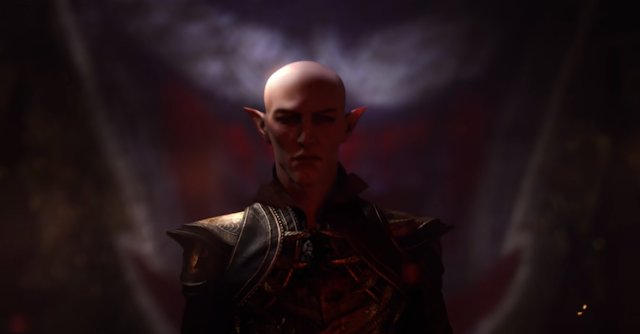
    "Dragon Age: Dreadwolf" Predictions & Ponderings (and "What's in a Name?" Redux)

    He doesn't call, he doesn't write, but finally, it looks like we might be hearing from Solas at last (2023?), as BioWare announces t...