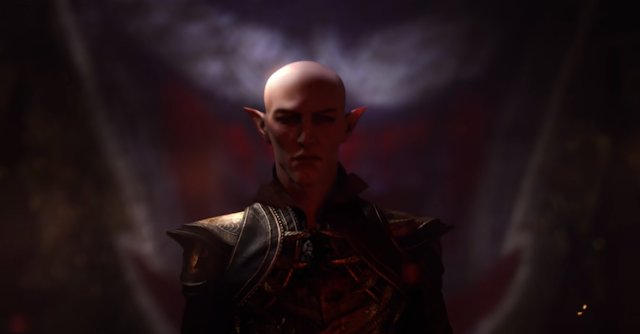
|
| Hey, sweetie... let's catch up before we go observe some playful wyverns in their natural environments... |
I've been inching along on Solas's romance analysis, and hey, we're almost there! And here we are, with our unsuspecting Lavellan alone with Solas in the Rotunda after the events of the Temple of Mythal, and on the precipice of that pivotal, terrible, lovely, Last Date.
But before they go off ambling amongst the wyverns, they take the time to talk in his office. And for me, it's a big deal, this moment. There's something genuinely electric and strange going on in this scene for me—something that feels (as with so much to do with Solas) hidden in plain sight. The brief conversations that precede that last fateful date can seem innocuous, yet they are actually among the most crucial in the Solas-Inquisitor game relationship (especially if romanced).
Which is the reason for this blog post, and why I keep finding more to say before the actual date itself—which, I swear, will be my next post. NO REALLY.
Yet as we reach this vital point in Solas's romance, I feel like it's important, given what follows, to take a look at where Solas is at this specific moment, in terms of his state of mind. For me, we can't fully appreciate what happens later on in Crestwood, if we don't take assessment his position right now, from a story and character point of view. So (with your patience) I'm gonna pause, and take some time to address the details—to take a few deep breaths before we move forward into all the lingering looks, intense close-ups, and regretful butt-grabs to come.
So here, ir abelas, let's take a brief look at Solas's situation before the break—at the changes he has undergone emotionally during the past year or more, and at who he is in this specific moment.
We have the gift of hindsight. So let's rewind, observe... and assess.
The Precipice (Beyond the Past, Before the Future)
At this point, as the Lavellan Inquisitor protagonist romancing Solas, we've achieved so much at this point in the storyline ourselves. (And it does feel, as always, like it's "us," doesn't it? Thanks to BioWare's superb handling of point of view. So that when the next major thing happens, on the date, it's... actually, personally, painful, for many players. Me included.)
But meanwhile, hey, we've stepped up. Been brave. Built the Inquisition. Closed rifts. Conquered masses, even while possibly losing every single member of our family and clan to a brutal massacre. We've also fought countless battles. Assembled a remarkable group of companions and advisors. We've played the Great Game and created alliances with Orlais at Halamshiral with charm and guile. We've further consolidated forces and achieved tangible military victories in the Arbor Wilds, and outraced Corypants through the eluvian to safety.
We also may very well have drunk from the sacred Well of Sorrows, accepting the geas that lay upon it (eternally bound to the will of Mythal herself) for the sake of knowledge and power. And in this very Rotunda, just moments before, had that last big debate with Solas after the fights, mysteries and discoveries of the Temple of Mythal, and that crucial conversation about choice, freedom, and what Lavellan might do with all that power if she drank from the well. Where, for better or for worse, most of our choices there seemed to convince Solas that his path is a righteous one.
In addition across that past year or so, of course, we've also managed to embark on an intense romance with—unknown to us—an ancient elven god (or the closest thing to it).
Now let's continue briefly on from the Well discussion, as Solas gives himself a mental shake, and moves forward in the moment, while I analyze every single tiny aspect. (Hey, it's what I do. Even though I know, somewhere, that those past and present Dragon Age writers who are kind enough to visit my blog are also surely shaking their heads and laughing over some of my conclusions and assumptions. I also occasionally imagine facepalm GIFs. Maybe some especially expressive eyeroll emojis too.)
The Pause Before the Storm
SOLAS: Forgive my melancholy. Corypheus has cost us much. The Temple of Mythal did not deserve such a fate. The orb he carries, and its stolen power… that, at least, we may still recover. With luck, some of the past may yet survive.
As always, there are so many double meanings to much of what Solas tells Lavellan here, even in this relatively brief statement. Examining each aspect of this line of dialogue—the Temple, the orb, its power, the recovery of the past... each element is vital to understanding Solas both now and in the future.
First, his comment about the Temple is intriguing. Sure, the Temple didn't deserve its fate—not recently—or millennia back, either. When Solas talks about what was 'deserved' at the Temple, isn't he speaking in layers again, and very likely also thinking of poor Abelas and his fellow ancient sentinel elves? The brief expression of regret is appropriate if they were in fact killed by the choice of the Inquisitor, but it's also similarly so in a quieter way even if they survived.
The Silent Temple
Despite its damage, the Temple of Mythal had managed to hold onto its ancient holiness and secrets, so that its sentinels lived still beyond all expectation, millennia later, protecting the holy waters of knowledge and sorrow in the name of Mythal herself. Whether through combat with the Inquisitor, or with the drinking from the Well, either way, that holiness is gone now.
It is a sad and beautiful idea, to think of the Temple of Mythal in this moment with Solas. The Temple itself has been pithed; it is empty and hollow now. No longer will proud ancient elven sentinels walk its shadowed corridors and protect its secrets. The Well of Sorrows is dry, and the flowers and trees that surrounded it will go untended, as well its gardens surrounding those lovely magical pathways. The eluvian is dead and dull. The whole place will simply fall gently into the surrounding jungles—what's one more elven ruin in a world filled with them, after all?
The idea reminds me a little of a key moment in Mary Stewart's beautiful novel The Hollow Hills (the second book in her marvelous Merlin trilogy, which I cannot recommend enough), when Merlin enters an ancient shrine as a young man, years after encountering its holiness in his youth, and realizes with grief that the holiness is now gone, the god that was honored there now fled and silent.
But what of those who served Mythal? What do they do now?
His Watch is Ended
I have to think, if Abelas survived, that despite the palpable sadness of Abelas's departure from the Temple as the sacred well was emptied, Solas may even be happy for Abelas on some complex level, perhaps even envious—after all, Abelas's job is done. He owes nothing further to anyone... not even to Mythal herself.
Solas may even see there an echo of his own freedom (at last) from his long watch over Thedas from the Fade. And just as Solas had traumas galore to recover from at that emergence, so, too, must Abelas.
What comes after duty? Is Abelas now free, at long last, to imagine living a flesh-and-blood life? (I mean, hey, judging by the fandom, I know there are hundreds or even thousands out there who would be happy to take Abelas out for the amusing meal and house wine...)
Me, I'm also wondering if Solas is thinking of the proud former Temple guardian and considering the fact that, years after he killed Felassan, hey, he does really need a new first lieutenant. Hmm...
The Open Falsehood
As far as the Orb? Let's face it, Solas is openly lying about the Orb as a "stolen" power, since we'll find out later on that he himself caused the Orb to reach Corypants, hoping that his tinkering would both unlock the Orb and kill him (a definite win-win for Solas).
And yet this realization is, paradoxically, why I do have sympathy for Solas when it comes to the devastation of the Breach, despite his own complicity and recklessness in handing over an ancient Orb of incredible power to our favorite grumpy, stripey-stockinged Darkspawn Magister. As with his long-ago raising of the Veil, which resulted inadvertently in the enslavement and devastation of the very people he was trying to save, I believe that Solas had no idea Cory would actually succeed with the Orb, much less create the Breach, rifts and untold horrors—or that, because of that moment, hundreds of thousands across Thedas would die.
I've seen a lot of Solavellan fans argue that Solas never lies, that his mistruths are more the product of avoidance and slippery wordplay. But I can't agree. As he does about the Orb here, Solas lies to our faces several times throughout the story of Inquisition (most notably, when directly queried about the Orb, the Conclave, or Skyhold). It's not something I'm angry with him for—I've found it really interesting, in fact, to try to imagine when Solas was most tempted to speak up and tell the truth, finding always that he was unable to do so.
Of course, we already know one major moment of temptation lies just moments ahead for him. But I think there have been others, too (I'd imagine the Fade Kiss was another one).
Awakening Dread
While the impending Last Date ends badly for us Lavellans, I think there's real agony and breakage in that ending on both sides. And I also believe that it's not there, but here in the Rotunda, where Solas begins to crack. I mentioned previously that I perceive the scene here as one in which Solas seems a little unstable (and I think Gareth David-Lloyd leans into this subtly in his performance)—Solas is by turns enraged, scared, arrogant, worried, and... perhaps most unsettling of all, euphoric. There are little potential moments in this conversation where he comes across, well, like a cult disciple who's just been served a brand-new dose of tasty Kool-Aid. (Oh, dear.)
Let's face it, Solas is a brilliant tactician and strategist, one who successfully defied the gods that once ruled multiple worlds, from the Fade to the layered kingdoms of Arlathan. He's a superb mage, with talents I believe he has kept tamped down and carefully hidden, once he began to regain his strength over the past year to eighteen months (Like, come on! He has to be able to shapeshift into a Dread Wolf. In my head it's already true, darn it). But he's also a flawed and sometimes arrogant man who cannot admit what he doesn't know, and he's blind in ways that are believable and self-perpetuating. Solas may have survived for millennia, but he did so with every one of his formidable flaws intact, as well as his equally formidable gifts. He also suffers from another flaw that only the immortal can assimilate: He has grown used to tragedy. Large-scale apocalypses may bum him out, but they are, for him, not that unusual at this point.
What writer Patrick Weekes has done with this situation in a literary sense is both tricky and subtle; they've let Solas's own failings sink and mark him, so that when Solas awakened from the Fade, all his careful plans fell to pieces like a house of cards, because everything had changed, because this world was alive after all. He might have emerged cold and certain, focused only on bringing it all back, the past he had doomed, but, well, one assumes that it wasn't as easy to kill up close, out of the dream-reality of the Fade.
I think this is an important detail. It was one thing, the dialogue implies, for Solas to plan for his actions from within the Fade. Even when those actions were cruel, he would allow them as necessary and regretful. He would take responsibility, feel grief, and yet continue forward. Better that, than to live with his own failure. At first, it may even have seemed easy—after all, it's apparent in hindsight that Solas for the longest time can't accept the current world state he finds, can't accept these other beings as people. It's "In Hushed Whispers" all over again. Everything must go. Nothing matters but that promise of restoration.
And for awhile he's managed himself mercilessly to stay on-path. The sad Fade-execution of Felassan at the end of The Masked Empire is notable both for its swiftness and for its implacability. Felassan knows before he meets Solas that he is already doomed. He already knows there is nothing he can say that Solas will hear... yet.
Until Solas stumbles into the living Thedas and finds within a few short months that, oh shit, Felassan was right. And he's sorry. He's really, really sorry.
A Different Story
One of my favorite writing tricks when it comes to character is to remind myself that every single character thinks that they are the center of the story. From Rosencrantz and Guildenstern, to Fredegar Bolger, Smeagol, Morrigan, Taryon Darrington, Squidward, E. B. Farnum, and beyond, when it comes to point of view, there are no bit players. We're all the heroes of our own stories. This is doubly (and literally) true for Solas, who not only understands far more than anyone else in DAI about what's really going on, he has to live with the fact that he was also the architect of several of those events.
For our Inquisitor, and for most characters we encounter, Inquisition is a story with a beginning, middle and even (thanks to "Trespasser") an ending of sorts. For Solas however, alone among our companions, the DAI story is merely an interlude, a chapter and diversion. He is living and reacting to an entirely different, hidden story.
There's a reason Solas bonds so closely with Cole in friendship, and it's not just because he loves Cole for his spirit-self (and may feel kinship there). I think it's also because, like Cole, Solas is a dead man walking—a vengeful, wounded ghost among the living.
Inquisition presents us with companions and advisors whose futures and fates each depend on a choice in a crucial moment. What's different with Solas's character arc is that his choice was made thousands of years ago, and he's been dealing with the aftermath ever since. Nothing we say or do can change that choice or threaten his goals.
Unless we get him to forget, for a little while. Unless he falls in love.
The Gift of Hindsight
As players, we get to be gods too, though. We see more clearly than those around Solas.
So when we replay the game, things get understandably more complex. We can see what Solas is trying for, what he's working towards. We can see the bitterness and self-judgment and guilt of his past actions. We can taste the loss of his own past even as he helps a Tal-Vashoth Bull find new hope. We hear his anguish (and envy) even as he provides friendship and family to Cole. We see him find peace with his past warrior-self with everyone from Varric, to Blackwall, to Cassandra as he accepts and befriends them and supports that with the right cause, a pen, a sword, a shield, can be noble.
And of course, we see him fall fatally, hopelessly in love. Not just with the Inquisitor. With Thedas. And all at once, this awful muffled world he hated before is now filled with light and color. He is alive again, and whole. He can still feel.
But. As with everything to do with Solas, this outcome must be measured, of course, against the potential chaos which might result from his own self-admitted, larger plans to tear down the Veil. He may not have intended this exact catastrophe, but at the moment he passes along that Orb, he's still taking concrete steps to remove the Veil and bring back the past, whether or not lives are lost in the process. So there's all this other emotional stuff going on with Solas, too—in every bantered conversation with companions, in every interaction, and (especially) in every scene in his romance. He's not just a humble mage, nor is he an ancient elven princeling, god, wolf, or trickster. He's a walking shadow filled with shame, guilt, sorrow, grief, self-hatred, trauma, and (unfortunately) certainty. But that's a post for another day, and I'll examine that complex ethical puzzle later on, in "Trespasser."
I also think there was another emotion when the Conclave exploded: relief. His plans were stalled. There was nothing he could do in the immediate moment. He was given a period of grace in which to watch, wait, acclimate, and... atone.
Lingering Questions
I've noted here before that I think that, emerging from the Fade and out of his "dark and dreaming sleep" into reality, Solas was concentrating on one step at a time, following a series of actions that would enable him to power-up back to his formidable evanuris-level skills. However, as always, the outcome far exceeded his expectations—or nightmares.
I also wonder, at this point, if Solas simply thought Corypants would use magic to try to unlock the Orb, or if he was aware that the unlocking would involve the ritual sacrifice of the Divine herself (I can't quite call Divine Justinia 'innocent,' since she was a Pope with her own spy network and lead assassin). If so, he implies fairly often in the banters with Blackwall and Sera later on that he would have accepted his culpability there, even while grieving the loss of life.
That's all assuming he's unshakably on-mission. Yet... my question, after the Breach, and for a long time is... but is he still?
I don't think so.
As we pause here in the Rotunda... I think for most of that 18-plus month period Solas spends with the Inquisition, that from the moment of the explosion at the Conclave and his meeting with the Inquisitor (especially a romanced Inky), that he was so off-balance, so traumatized, guilt-stricken, and confused, that for awhile he just let everything go. He knew he would need power. He also knew that he would have to help the Inquisition through this terrible interlude and try to fix his latest mistake. So he allowed himself to do that. And by doing so, he dropped his guard. He got seduced—by emotion, by empathy, by friendship and love, and by the beauty of this damaged yet still recognizable world.
Enough so that he's allowed himself kisses in the Fade, and dreamed up sensual walking tours of dramatic, wyvern-filled jungles with the woman he loves.
Until he can't anymore. Until he wakes up, again.
On the Brink
Thanks for letting me ramble! I wanted to take this pause, to do this analysis, because I wanted to both hold Solas accountable (most notably, for the Orb situation) and to express my conflicting feelings about his situation. I fear for what he plans to do, but I also think there's so much room for interpretation here that I can't judge him going forward until he acts. For now, I'm cautiously on the side of "antihero" versus "villain, so we'll see how it goes (I'll address his truly heroic acts in "Trespasser" later on, as well).
As a writer, I love and deeply enjoy the rich paradox of Solas as a character. In the beginning, he surprised me with his capacity for fire and feeling. Just as, in the end, he surprised me equally with his capacity for coldness. The fact that both opposing character elements are completely believable is a testament to the talents of the Dragon Age writing team, especially Weekes.
It's called Solavellan Hell for a reason, right? It's not fun examining this stuff. Because at this point in our story, we've walked with Solas and watched his reawakening from trauma, his slow realization that there is beauty, and courage, and worth, in this world, however stifling he had initially found it to be. I truly believe Solas loves Lavellan and at least some of her friends, that he has found real friendship, admiration and intimacy with his companions.
And then the last hurdle falls, and he feels admiration for the simple people of Thedas, for their courage. He feels this and accepts the shame that goes with it, because if his plans succeed, that courage won't matter, and many of those brave people may die or face a vastly different universe. When he makes that comment that he will remember their courage, he is talking about people he may already see as dead and gone. This past year has changed him, but what is a year or two among thousands? To someone who has lived millennia, everyone Solas meets are fireflies at best and ghosts at worst; already gone. Which is why his beautiful frescoes may be as much of an epitaph to Lavellan and the Inquisition as they are a gift or an homage to her story.
And that's why Solas's position in the story is so brilliant. Because that epilogue and its revelation about his true identity and true goals is a gut-punch. It hurts. And it should. Betrayal always does. Finding out you've been lied to always does. It's something Lavellan is about to experience firsthand.
The irony is that we can see, with our omniscient-player view of future and past alike, how Solas at this moment is poised on the brink, balanced between his past heroics and sins and his future potential apocalypses. Based on comments by Weekes about Solas's state of mind in Crestwood, I think Solas isn't planning on stomping on his beloved's vhenan at all. Right this second, he's feeling wonderful, victorious, and in love. He wants to take her to a place where magic prickles on the skin like electricity in thanks for what she has given him, and then further gift her with the truth. So that he can finally reveal himself and be honest, so that he can reveal the wolf who has walked beside her even when she was unaware. And to finally, I'm assuming, consummate their romance.
"Come with me, vhenan."
That's what's so perfect and terrible about this moment in the torchlight of Solas's tower room. He looks... happy. We should have known how terribly things were about to go.
Unfortunately, blessed with hindsight as we are, we already know that Solas's joys, like his victories, never last.
At this point, as the Lavellan Inquisitor protagonist romancing Solas, we've achieved so much at this point in the storyline ourselves. (And it does feel, as always, like it's "us," doesn't it? Thanks to BioWare's superb handling of point of view. So that when the next major thing happens, on the date, it's... actually, personally, painful, for many players. Me included.)
But meanwhile, hey, we've stepped up. Been brave. Built the Inquisition. Closed rifts. Conquered masses, even while possibly losing every single member of our family and clan to a brutal massacre. We've also fought countless battles. Assembled a remarkable group of companions and advisors. We've played the Great Game and created alliances with Orlais at Halamshiral with charm and guile. We've further consolidated forces and achieved tangible military victories in the Arbor Wilds, and outraced Corypants through the eluvian to safety.
We also may very well have drunk from the sacred Well of Sorrows, accepting the geas that lay upon it (eternally bound to the will of Mythal herself) for the sake of knowledge and power. And in this very Rotunda, just moments before, had that last big debate with Solas after the fights, mysteries and discoveries of the Temple of Mythal, and that crucial conversation about choice, freedom, and what Lavellan might do with all that power if she drank from the well. Where, for better or for worse, most of our choices there seemed to convince Solas that his path is a righteous one.
In addition across that past year or so, of course, we've also managed to embark on an intense romance with—unknown to us—an ancient elven god (or the closest thing to it).
Now let's continue briefly on from the Well discussion, as Solas gives himself a mental shake, and moves forward in the moment, while I analyze every single tiny aspect. (Hey, it's what I do. Even though I know, somewhere, that those past and present Dragon Age writers who are kind enough to visit my blog are also surely shaking their heads and laughing over some of my conclusions and assumptions. I also occasionally imagine facepalm GIFs. Maybe some especially expressive eyeroll emojis too.)
 |
| I appreciate the metaphor that Lavellan is talking with Solas just before her date while facing his fresco of the obliteration of the Conclave. The symmetry is painful but accurate. |
SOLAS: Forgive my melancholy. Corypheus has cost us much. The Temple of Mythal did not deserve such a fate. The orb he carries, and its stolen power… that, at least, we may still recover. With luck, some of the past may yet survive.
As always, there are so many double meanings to much of what Solas tells Lavellan here, even in this relatively brief statement. Examining each aspect of this line of dialogue—the Temple, the orb, its power, the recovery of the past... each element is vital to understanding Solas both now and in the future.
First, his comment about the Temple is intriguing. Sure, the Temple didn't deserve its fate—not recently—or millennia back, either. When Solas talks about what was 'deserved' at the Temple, isn't he speaking in layers again, and very likely also thinking of poor Abelas and his fellow ancient sentinel elves? The brief expression of regret is appropriate if they were in fact killed by the choice of the Inquisitor, but it's also similarly so in a quieter way even if they survived.
 |
| I've never seen this addressed (possibly because I am just that weird) but I always find it subtly sad that Mythal's Temple is now empty after the events at the Well of Sorrows. Now it's just one more elven ruin among many. |
Despite its damage, the Temple of Mythal had managed to hold onto its ancient holiness and secrets, so that its sentinels lived still beyond all expectation, millennia later, protecting the holy waters of knowledge and sorrow in the name of Mythal herself. Whether through combat with the Inquisitor, or with the drinking from the Well, either way, that holiness is gone now.
It is a sad and beautiful idea, to think of the Temple of Mythal in this moment with Solas. The Temple itself has been pithed; it is empty and hollow now. No longer will proud ancient elven sentinels walk its shadowed corridors and protect its secrets. The Well of Sorrows is dry, and the flowers and trees that surrounded it will go untended, as well its gardens surrounding those lovely magical pathways. The eluvian is dead and dull. The whole place will simply fall gently into the surrounding jungles—what's one more elven ruin in a world filled with them, after all?
The idea reminds me a little of a key moment in Mary Stewart's beautiful novel The Hollow Hills (the second book in her marvelous Merlin trilogy, which I cannot recommend enough), when Merlin enters an ancient shrine as a young man, years after encountering its holiness in his youth, and realizes with grief that the holiness is now gone, the god that was honored there now fled and silent.
But what of those who served Mythal? What do they do now?
 |
| Surely this hunk of ancient elven magnificence deserves to go forth and find love and happiness in the living world after a service of millennia, right? |
I have to think, if Abelas survived, that despite the palpable sadness of Abelas's departure from the Temple as the sacred well was emptied, Solas may even be happy for Abelas on some complex level, perhaps even envious—after all, Abelas's job is done. He owes nothing further to anyone... not even to Mythal herself.
Solas may even see there an echo of his own freedom (at last) from his long watch over Thedas from the Fade. And just as Solas had traumas galore to recover from at that emergence, so, too, must Abelas.
What comes after duty? Is Abelas now free, at long last, to imagine living a flesh-and-blood life? (I mean, hey, judging by the fandom, I know there are hundreds or even thousands out there who would be happy to take Abelas out for the amusing meal and house wine...)
Me, I'm also wondering if Solas is thinking of the proud former Temple guardian and considering the fact that, years after he killed Felassan, hey, he does really need a new first lieutenant. Hmm...
 |
| That Orb? Stolen. So, so stolen. Seriously. It's a crime that nobody caught Corypants, you know, in the act of stealing it. Is it hot in here? It's hot in here, right? Ouch. SO STUFFY IN HERE! |
As far as the Orb? Let's face it, Solas is openly lying about the Orb as a "stolen" power, since we'll find out later on that he himself caused the Orb to reach Corypants, hoping that his tinkering would both unlock the Orb and kill him (a definite win-win for Solas).
And yet this realization is, paradoxically, why I do have sympathy for Solas when it comes to the devastation of the Breach, despite his own complicity and recklessness in handing over an ancient Orb of incredible power to our favorite grumpy, stripey-stockinged Darkspawn Magister. As with his long-ago raising of the Veil, which resulted inadvertently in the enslavement and devastation of the very people he was trying to save, I believe that Solas had no idea Cory would actually succeed with the Orb, much less create the Breach, rifts and untold horrors—or that, because of that moment, hundreds of thousands across Thedas would die.
I've seen a lot of Solavellan fans argue that Solas never lies, that his mistruths are more the product of avoidance and slippery wordplay. But I can't agree. As he does about the Orb here, Solas lies to our faces several times throughout the story of Inquisition (most notably, when directly queried about the Orb, the Conclave, or Skyhold). It's not something I'm angry with him for—I've found it really interesting, in fact, to try to imagine when Solas was most tempted to speak up and tell the truth, finding always that he was unable to do so.
Of course, we already know one major moment of temptation lies just moments ahead for him. But I think there have been others, too (I'd imagine the Fade Kiss was another one).
 |
| Solas also suffers from another flaw that only the immortal being can truly assimilate: He has grown used to tragedy. Large-scale apocalypses may bum him out, but they are, for him, not that unusual at this point. |
While the impending Last Date ends badly for us Lavellans, I think there's real agony and breakage in that ending on both sides. And I also believe that it's not there, but here in the Rotunda, where Solas begins to crack. I mentioned previously that I perceive the scene here as one in which Solas seems a little unstable (and I think Gareth David-Lloyd leans into this subtly in his performance)—Solas is by turns enraged, scared, arrogant, worried, and... perhaps most unsettling of all, euphoric. There are little potential moments in this conversation where he comes across, well, like a cult disciple who's just been served a brand-new dose of tasty Kool-Aid. (Oh, dear.)
Let's face it, Solas is a brilliant tactician and strategist, one who successfully defied the gods that once ruled multiple worlds, from the Fade to the layered kingdoms of Arlathan. He's a superb mage, with talents I believe he has kept tamped down and carefully hidden, once he began to regain his strength over the past year to eighteen months (Like, come on! He has to be able to shapeshift into a Dread Wolf. In my head it's already true, darn it). But he's also a flawed and sometimes arrogant man who cannot admit what he doesn't know, and he's blind in ways that are believable and self-perpetuating. Solas may have survived for millennia, but he did so with every one of his formidable flaws intact, as well as his equally formidable gifts. He also suffers from another flaw that only the immortal can assimilate: He has grown used to tragedy. Large-scale apocalypses may bum him out, but they are, for him, not that unusual at this point.
What writer Patrick Weekes has done with this situation in a literary sense is both tricky and subtle; they've let Solas's own failings sink and mark him, so that when Solas awakened from the Fade, all his careful plans fell to pieces like a house of cards, because everything had changed, because this world was alive after all. He might have emerged cold and certain, focused only on bringing it all back, the past he had doomed, but, well, one assumes that it wasn't as easy to kill up close, out of the dream-reality of the Fade.
I think this is an important detail. It was one thing, the dialogue implies, for Solas to plan for his actions from within the Fade. Even when those actions were cruel, he would allow them as necessary and regretful. He would take responsibility, feel grief, and yet continue forward. Better that, than to live with his own failure. At first, it may even have seemed easy—after all, it's apparent in hindsight that Solas for the longest time can't accept the current world state he finds, can't accept these other beings as people. It's "In Hushed Whispers" all over again. Everything must go. Nothing matters but that promise of restoration.
And for awhile he's managed himself mercilessly to stay on-path. The sad Fade-execution of Felassan at the end of The Masked Empire is notable both for its swiftness and for its implacability. Felassan knows before he meets Solas that he is already doomed. He already knows there is nothing he can say that Solas will hear... yet.
Until Solas stumbles into the living Thedas and finds within a few short months that, oh shit, Felassan was right. And he's sorry. He's really, really sorry.
 |
| For Solas, the events of Dragon Age: Inquisition are, at most, a few chapters in a story spanning millennia. |
One of my favorite writing tricks when it comes to character is to remind myself that every single character thinks that they are the center of the story. From Rosencrantz and Guildenstern, to Fredegar Bolger, Smeagol, Morrigan, Taryon Darrington, Squidward, E. B. Farnum, and beyond, when it comes to point of view, there are no bit players. We're all the heroes of our own stories. This is doubly (and literally) true for Solas, who not only understands far more than anyone else in DAI about what's really going on, he has to live with the fact that he was also the architect of several of those events.
For our Inquisitor, and for most characters we encounter, Inquisition is a story with a beginning, middle and even (thanks to "Trespasser") an ending of sorts. For Solas however, alone among our companions, the DAI story is merely an interlude, a chapter and diversion. He is living and reacting to an entirely different, hidden story.
There's a reason Solas bonds so closely with Cole in friendship, and it's not just because he loves Cole for his spirit-self (and may feel kinship there). I think it's also because, like Cole, Solas is a dead man walking—a vengeful, wounded ghost among the living.
Inquisition presents us with companions and advisors whose futures and fates each depend on a choice in a crucial moment. What's different with Solas's character arc is that his choice was made thousands of years ago, and he's been dealing with the aftermath ever since. Nothing we say or do can change that choice or threaten his goals.
Unless we get him to forget, for a little while. Unless he falls in love.
The Gift of Hindsight
As players, we get to be gods too, though. We see more clearly than those around Solas.
So when we replay the game, things get understandably more complex. We can see what Solas is trying for, what he's working towards. We can see the bitterness and self-judgment and guilt of his past actions. We can taste the loss of his own past even as he helps a Tal-Vashoth Bull find new hope. We hear his anguish (and envy) even as he provides friendship and family to Cole. We see him find peace with his past warrior-self with everyone from Varric, to Blackwall, to Cassandra as he accepts and befriends them and supports that with the right cause, a pen, a sword, a shield, can be noble.
And of course, we see him fall fatally, hopelessly in love. Not just with the Inquisitor. With Thedas. And all at once, this awful muffled world he hated before is now filled with light and color. He is alive again, and whole. He can still feel.
But. As with everything to do with Solas, this outcome must be measured, of course, against the potential chaos which might result from his own self-admitted, larger plans to tear down the Veil. He may not have intended this exact catastrophe, but at the moment he passes along that Orb, he's still taking concrete steps to remove the Veil and bring back the past, whether or not lives are lost in the process. So there's all this other emotional stuff going on with Solas, too—in every bantered conversation with companions, in every interaction, and (especially) in every scene in his romance. He's not just a humble mage, nor is he an ancient elven princeling, god, wolf, or trickster. He's a walking shadow filled with shame, guilt, sorrow, grief, self-hatred, trauma, and (unfortunately) certainty. But that's a post for another day, and I'll examine that complex ethical puzzle later on, in "Trespasser."
I also think there was another emotion when the Conclave exploded: relief. His plans were stalled. There was nothing he could do in the immediate moment. He was given a period of grace in which to watch, wait, acclimate, and... atone.
Lingering Questions
I've noted here before that I think that, emerging from the Fade and out of his "dark and dreaming sleep" into reality, Solas was concentrating on one step at a time, following a series of actions that would enable him to power-up back to his formidable evanuris-level skills. However, as always, the outcome far exceeded his expectations—or nightmares.
I also wonder, at this point, if Solas simply thought Corypants would use magic to try to unlock the Orb, or if he was aware that the unlocking would involve the ritual sacrifice of the Divine herself (I can't quite call Divine Justinia 'innocent,' since she was a Pope with her own spy network and lead assassin). If so, he implies fairly often in the banters with Blackwall and Sera later on that he would have accepted his culpability there, even while grieving the loss of life.
That's all assuming he's unshakably on-mission. Yet... my question, after the Breach, and for a long time is... but is he still?
I don't think so.
As we pause here in the Rotunda... I think for most of that 18-plus month period Solas spends with the Inquisition, that from the moment of the explosion at the Conclave and his meeting with the Inquisitor (especially a romanced Inky), that he was so off-balance, so traumatized, guilt-stricken, and confused, that for awhile he just let everything go. He knew he would need power. He also knew that he would have to help the Inquisition through this terrible interlude and try to fix his latest mistake. So he allowed himself to do that. And by doing so, he dropped his guard. He got seduced—by emotion, by empathy, by friendship and love, and by the beauty of this damaged yet still recognizable world.
Enough so that he's allowed himself kisses in the Fade, and dreamed up sensual walking tours of dramatic, wyvern-filled jungles with the woman he loves.
Until he can't anymore. Until he wakes up, again.
 |
| Part of Solas's tragedy is his own age and perspective: To someone who has lived millennia, his companions and even the woman he loves are fireflies at best and ghosts at worst; already gone. |
Thanks for letting me ramble! I wanted to take this pause, to do this analysis, because I wanted to both hold Solas accountable (most notably, for the Orb situation) and to express my conflicting feelings about his situation. I fear for what he plans to do, but I also think there's so much room for interpretation here that I can't judge him going forward until he acts. For now, I'm cautiously on the side of "antihero" versus "villain, so we'll see how it goes (I'll address his truly heroic acts in "Trespasser" later on, as well).
As a writer, I love and deeply enjoy the rich paradox of Solas as a character. In the beginning, he surprised me with his capacity for fire and feeling. Just as, in the end, he surprised me equally with his capacity for coldness. The fact that both opposing character elements are completely believable is a testament to the talents of the Dragon Age writing team, especially Weekes.
It's called Solavellan Hell for a reason, right? It's not fun examining this stuff. Because at this point in our story, we've walked with Solas and watched his reawakening from trauma, his slow realization that there is beauty, and courage, and worth, in this world, however stifling he had initially found it to be. I truly believe Solas loves Lavellan and at least some of her friends, that he has found real friendship, admiration and intimacy with his companions.
And then the last hurdle falls, and he feels admiration for the simple people of Thedas, for their courage. He feels this and accepts the shame that goes with it, because if his plans succeed, that courage won't matter, and many of those brave people may die or face a vastly different universe. When he makes that comment that he will remember their courage, he is talking about people he may already see as dead and gone. This past year has changed him, but what is a year or two among thousands? To someone who has lived millennia, everyone Solas meets are fireflies at best and ghosts at worst; already gone. Which is why his beautiful frescoes may be as much of an epitaph to Lavellan and the Inquisition as they are a gift or an homage to her story.
And that's why Solas's position in the story is so brilliant. Because that epilogue and its revelation about his true identity and true goals is a gut-punch. It hurts. And it should. Betrayal always does. Finding out you've been lied to always does. It's something Lavellan is about to experience firsthand.
The irony is that we can see, with our omniscient-player view of future and past alike, how Solas at this moment is poised on the brink, balanced between his past heroics and sins and his future potential apocalypses. Based on comments by Weekes about Solas's state of mind in Crestwood, I think Solas isn't planning on stomping on his beloved's vhenan at all. Right this second, he's feeling wonderful, victorious, and in love. He wants to take her to a place where magic prickles on the skin like electricity in thanks for what she has given him, and then further gift her with the truth. So that he can finally reveal himself and be honest, so that he can reveal the wolf who has walked beside her even when she was unaware. And to finally, I'm assuming, consummate their romance.
"Come with me, vhenan."
That's what's so perfect and terrible about this moment in the torchlight of Solas's tower room. He looks... happy. We should have known how terribly things were about to go.
Unfortunately, blessed with hindsight as we are, we already know that Solas's joys, like his victories, never last.