Showing posts with label In Your Heart Shall Burn. Show all posts

Monday, September 4, 2017

Skyhold: The Gift of a Castle

"There is a place that waits for a force to hold it. There is a place where the Inquisition can build, grow...
"Skyhold."


NOTE: As always? SPOILERS SPOILERS SPOILERS on everything in the game, its story, conclusion, revelations, and identities. Seriously. SO many spoilers. You can't even imagine. Read at your own risk.


There is a place that waits for a force to hold it. There is a
place where the Inquisition can build, grow... Skyhold.
(Thank goodness we just happened to stumble upon it!)
The sequence in Dragon Age: Inquisition that takes place from "In Your Heart Shall Burn" through "The Dawn Will Come" and then, finally, through the discovery of Skyhold, represents an extraordinary series of unforgettable and powerful moments that propel the game and its storyline into a bold new reality.

And if Dragon Age: Inquisition is an interactive novel at its heart (and I truly think it is) then this is where the novel's first section ends, and the next begins. 

After the word "Skyhold," everything changes, yet again.

But let's not get ahead of ourselves. In the meantime, the conversation with Solas in the darkness in the previous scene, after "The Dawn Will Come" and under the ghostly glow of the blue mage torchlight, fades away into a pale, pink and brilliant new dawn in the mountains (a lovely, subtle callback to the hymn of the previous scene), as the strings of Trevor Morris's beautiful score surge up in a theme of epic hope and discovery. The Inquisitor starts this day by literally looking to the sky (as the hymn demanded), and yes, the dawn is here.

And Solas is just getting started. His moving and eloquent voiceover (another high point for voice actor Gareth David-Lloyd), as he urges the Inquisitor forward and onward to lead their people to safety, is one of the most striking and emotional events in the game. It also lives up to the whammy of the previous two sequences in a new yet very big way. And it's important on a story level, given what we discover later, that it is Solas telling us these things, that it is Solas orchestrating events. That it is Solas saying, "Oh, wow, a castle yonder, just empty and waiting! Talk about timing. Good thing I managed to wander over to it in my dreams last night!" 

Cough. The quiet elven mage, indeed.

Solas: By attacking the Inquisition, Corypheus has changed it, changed youScout to the North. Be their guide...

The long trek by our companions. And let's hear it for Mother
Giselle, who's obviously kept up with her cardio.
As Solas speaks, we see our followers walking slowly and thoughtfully through the snow, watching the Inquisitor, yet now serene and trusting to their faith. They are making steady progress, although honestly, I'd be hyperventilating, crawling dejectedly and asking to die—look at the slope of that mountain path. It's just not right.

Cassandra leads the pack, just steps behind the Inquisitor and Solas, then comes Cullen, trudging solidly and thoughtfully off to the side (although if this moment were truly portrayed accurately, there would also be a pretty long line of men and women walking behind Cullen, checking out that view). Then comes Leliana, lovely and calmly regal in her warrior-nun armor. Not far behind Leliana, next, is Mother Giselle, whose previous stint in the Hinterlands obviously included some cardio, because she's doing a bang-up job of hiking in the mountains despite wearing the equivalent of a confining cylindrical tent from head to toe.

I wish we could've seen Bull here, carrying a tired villager on each shoulder (or perhaps Sera!), or Dorian, distastefully picking his way through the snowdrifts and lamenting their effects on his outfit. But our focus is on our advisers and the survivors, as we then glimpse the rest of the villagers, the hundreds who survived Haven, as far as we can see... and all is quiet, orderly, and bright. The people walk calmly, supporting one another and shepherding their pack animals along. Somehow, everyone can feel that things are going our way once more.

As the music soars, we see the image of a hawk flying high
above the mountains. Revelation is near. And hopefully,
so is salvation.
Then at Solas's urging, the Inquisitor is running tirelessly forward, watching and analyzing the terrain and the majestic peaks around them. We're making progress, and Solas's stirring voice urges us irrepressibly forward. Then the score changes again, as a gorgeous solo female voice lifts above the music as a delicate harbinger of hope, as a single hawk flies high in the misty early sunlight. Then a warm, low surge of strings (very Coplandesque) signals the next change, as the people of the Inquisition walk together across the bare ground (an ancient path through its all-important, hidden mountain pass). We're close. We're almost home. 

Solas: There is a place that waits for a force to hold it. There is a place where the Inquisition can build, grow... Skyhold.

As Solas speaks, the confluence of words, voice, triumphant music and soaring imagery all combine to create a moment that is downright cinematic. It's easily one of Trevor Morris's most notable and lovely moments, among many in his beautiful and sweeping score for the game. For me, it's my favorite musical sequence in the entire game, barring the final devastating minutes of "Trespasser."

Meanwhile, I absolutely love the way this sequence ends, with the gorgeous sweeping view of the beautiful waiting castle, then the moment as the Inquisitor leaps forward right past Solas in their eagerness, as he pronounces the single, resonant name of this new home: "Skyhold." Followed by his rather pleased, secretly satisfied expression as he watches them.

What do my elven eyes see? Is that Mount Doom, far ahead?
And that expression... it's almost smug. Solas might as well be skywriting I DID THIS.

Just another reason why replaying this game is even more fun than the original playthrough. So many secrets and revelations! 
It truly is a pretty subtle, amusing moment that you can only truly appreciate on replay. Solas is in full control here. He's not surprised, he's cool, privately amused,  and perhaps charmed at the Inquisitor's eagerness. And I think he's also going, "Well that went well." He may also, if on a romance path with the Inquisitor, be thinking about how everything comes full circle, since he just gave the woman he loves a powerful and ancient stronghold. And not just any castle. His castle.

The place where it all went so terribly wrong. And where he now hopes to try again.

Hidden Memories, Hidden Meanings

That's right—Solas's castle. 

If you've played through DAI at least once before, this scene has layers upon layers. Because Solas isn't just helping the Inquisitor find a conveniently abandoned castle in the mountains. Again, he's leading her his very own ancient stronghold. 

There are numerous reasons to find this both lovely and also oddly tragic.

It's a terrific bit of symmetry. It's also quite wonderful metaphorically, if you believe, as I do, that this is another way in which Solas is seeking potential atonement. Or self-recrimination? Both are possible. 

Since his awakening, we know from The Masked Empire and DAI (and Trespasser) that Solas has been weak, terrified, grieving, and enraged, wandering and homeless for the past year or two since his physical awakening. That's why this moment affects me so much. Solas spent that time alone, homeless, sleeping under the stars or nestled in ruins, on hard stone beds and rejected by his own people. Then what does he give us? His very own ancient fortress, presented like a jewel in the heights, as if he's saying, "Here. Take it. Use it well."

Well, maybe. Hopefully. But I'll get to alternate meanings in a moment.

It's a spectacular contribution to the puzzle that is Solas. Yes, he is seeking to accomplish decidedly bad things in many ways. But he's also one of those people who—even in dueling you to the death—would pause to let you pick up your sword if you dropped it.

That's Solas. And there's a vulnerability to it, one I'm not sure he's even entirely aware of (although he does speak to a romanced or high-favor Inquisitor of his inclination to trust and say too much, in "Trespasser" later). This behavior—giving away the advantage to even the field—it's not Bull, and it's not Leliana. And I say that without judgment. Bull and Leliana are simply more ruthless, more jaded, and more absolutely willing to be more brutal when necessary because that's just part of waging war. For them, a win is a win. 

But, despite all the rumors and myths of his duplicity and tricksy tendencies... despite his confusion and despair at what he created... it is Solas. He will pause, extend the sword, then and only then resuming the fight. There is some kind of intrinsic and unbreakable honor there.

The Dread Wolf's Den

How do we know that Skyhold once belonged to Solas? The game gives us several subtle clues throughout...

In a note to us that can be reviewed from the Codex, the Archivist of Skyhold notes a fragment, an elven legend, perhaps, that was found scratched beneath a pillar:

Var'landivalis him sa'bellanaris san elgar
Melanada him sa'miras fena'taldin (word missing)
Nadasalin telerevas ne suli telesethenera
Tarasyl'an te'las vehn'ir abelath'vir (word missing)

He translates it, brokenly, as:

Our belief transformed into everything. (assertation/problem? uncertain)
All time is transformed into the final/first death (uncertain).
Inevitable/threatened victory and horrible/promised freedom in the untorn veils, (uncertain)
Where the sky is held up/back, where the people give/gain love that is an apology/promise from/to… (missing subject, uncertain)

Even brokenly translated, there are exciting implications here. An apology and a promise? Sounds about right, given the situation.

A Letter from Solas

Shortly afterward, we experience another Codex entry and a rather unusual event—a letter from Solas himself, to the Inquisitor. One imagines that his handwriting is, of course, as exquisite as his frescoes:

Your archivists have asked me how I came to know the name and location of Skyhold. To the latter, I may speak easily: when one walks in the Fade, any fortress that has seen enough battle shines as a beacon for spirits drawn to death and struggle, even after centuries of disuse. 

Side Note: I read this part, and yeah, I was facepalming all over the place, going, Oh, Solas. In the words of the immortal Leslie Knope, Solas, you beautiful, rainbow infused space unicorn... This is one of those rare moments where you're not deflecting or deceiving through omission or implication. You're just lying. Lying lying lying. WHY DO I STILL LOVE YOU.

Please excuse a slight pause here, for hugs, chocolate, an infusion of coffee (oh, all right, it's wine), and Dalish mantras.

Okay, great. I'm back. I can do this. Onward, and back to Solas's note:

As to the former, I myself cannot say for certain. The whispers of old memories carry a thousand such names upon their breath, and it is possible that this name belonged to some other keep in some other land. Still, it seems an auspicious name, for there is one peculiarity of language that your scholars seem to have missed. When the words reached my dreaming mind, Skyhold was not simply a fortress near the sky, nor was it some simplistic allusion to holding up the sky. Skyhold—Tarasyl'an te'las— was "the place where the sky was held back." Given your efforts against the Breach and our battle against a madman who seeks to assault the Black City in the Fade, I can only hope that the Inquisition’s new stronghold lives up to its name.

Again, I love all of this from a dramatic standpoint (and always think Bull would find it both fascinating and amusing as well, as our superlative lifelong spy). Why? Simply because how someone chooses to lie to us can sometimes be just as revealing as the truth they're actively trying to hide.

What does Solas reveal? What does he partially reveal? What does he omit outright?

You shouldn't have. I love it. Thanks, honey!
Well, a lot. He's subtly letting us know that, first off, Skyhold is certainly older than we perhaps assumed at first glance, and it appears to have metamorphosed or evolved over the years, to some extent. He doesn't address its possible ancient elven status (reinforced by other discoveries around the keep, such as the ancient elven arrow on one rooftop) nor what may have shaken its very foundations millennia back (the imprisonment of the Evanuris and formation of the Veil?).

And I'm fascinated by how bothered Solas seems to be by the idea that we may have mistranslated or misconstrued the meaning of "Skyhold." He seems genuinely irritated and worried that we may assume some simplistic human translation for the name. He wants us to know that the name isn't about our fortress being near or metaphorically holding up the sky. He seems intent that we understand that, instead, it was a place that physically held back that sky. That it is a place of magic. Force. Power. Barriers. Delicate manipulations from the Fade.


I can't help but also think that Solas is trying, perhaps, to tell us that Skyhold itself is magic (something Morrigan later basically implies from her research as well, while noting that even the walls of Skyhold are absolutely steeped with protective magic). That it carries special powers that will keep it pure and safe from harm. I even wonder if Solas isn't actively attempting to buffer or support that magic, on the sly. It's definitely possible. Or is there something self-serving about it, and is Solas using his return to this perhaps vital and magical location, to help himself recover and recharge his power? Those frescoes could be more than mere paint and plaster.

Meanwhile, all of this conjecture by Solas about Skyhold is great and helpful and fascinating despite the fact that darling Solas is once again, of course, lie-lie-lying his bald little head off. Skyhold is his place, a place he knows down to its bones. He once stood where we stand, breathing the crisp keen mountain air, tasting the snow on his tongue. While the structure may have changed, he once viewed these very peaks as their lord and master (and it may comfort him that this, at least, has changed little in the millennia in which he lay dreaming and in despair).

I think it's very telling that, as Solas begins to truly awaken to this new world, and all of its horror as well as its hidden beauty; as he begins to tentatively reach once more for companionship and even for love or desire, I think it's vital and elegantly plotted that it all begins with this moment—when he comes home.

There's No Place Like Home

As an elf noble of the ancient days, Skyhold wasn't Solas's first home, certainly, but it appears to have been one of the important ones, and in a vital and hidden way that we can't yet wholly define. Homecomings are popular scenarios in books and films for a reason. They bring out characters' vulnerabilities, strip them down, and show us who they really are—as well as who they were. Where we come from, after all, frequently shapes who we become. 

Home is also an emotional touchstone, a place where we're most defenseless. Where we may experience an emotional cocktail of love, loss, yearning, humor, confusion, anger, regret, and more... all at the same time. It's also, of course, why a simple Thanksgiving dinner can become a minefield. (Come on, we've all been there...)

As we discover Skyhold, Solas's plans are functioning well. But he's now more vulnerable, open, emotional and undefended, than he's been for a thousand years.  

Oops.

More Proof

In the DAI Trespasser DLC, the Archivist in the Sundered Hall of the Shattered Library shares with us the following crucial fragment of memory: "After he held back the sky to imprison the gods, the Dread Wolf disappeared." 

Which is pretty interesting for a number of reasons. It means, for one thing, Skyhold got its name from the very act that doomed the elves—and confirms that it was also the place where Solas created the Veil and caused a titanic cataclysm (as evidenced, as mentioned earlier, by the vestiges of some massive explosion in Skyhold's lower/prison areas). The result was that Solas then found himself sleeping and adrift in the Fade for over a millennium.

It's a pretty big reveal, if you think about it. It makes me wonder even more what Solas is thinking when he sees it again. Is there sadness, or at least ambivalence? Is this why he spent the year following his awakening trudging through Thedas and getting turned away by the Dalish—instead of facing the place where it all went wrong? If the attack on Haven had never happened, would he still have led us there? 

So many questions.

A Little DIY... (About Those Frescoes...)

I think it's interesting, however, to note that when we do find and take over Skyhold, Solas does not make himself too comfortable. His gorgeous little tower room glows with light, but it is not a home. He doesn't even have a bed, instead evidently napping on a lovely and immaculate golden couch. (Do you ever think it's funny that we never actually see Solas, our companion and King of the Fade, actually sleeping?)

Instead, he immediately begins to create his breathtaking and beautiful murals, panel by panel, across the walls of his rotunda in order to commemorate the Inquisitor's story. Each major story point is a subtle new gift from Solas (even to an Inquisitor he dislikes or disapproves of) in a priceless and gorgeous series of frescoes in the style of the ancient elves. It's as if he's putting the bow on the gift of his castle, saying, "This was your story." The room was never truly his—he was readying it for us. I also can't help but wonder if there's magic in that plaster and pigment—one more attempt to protect this place and its people.

Alternatively, there may be a darker meaning there, as well. The frescoes may  in fact very well be Solas's actual obituary or tribute to the Inquisitor, a kind of epitaph—a final tribute to the person (and companions) regrettably sacrificed when and if his plans are accomplished. It would be a believable step for a foe who, if nothing else, seems prepared to bear the guilt and responsibility fully of whatever catastrophes his decision to tear down the Veil will bring. And after all, it would be very like Solas to return to Skyhold upon the upheaval of the world... and to steadfastly stare at those panels each and every day as penance.

My next question is whether he plans to return. Does he see Skyhold's occupation by the Inquisition as a temporary interval until he reclaims it once more? And if so, does that mean he's simply doing a little home improvement—literally prepping his return by decorating the walls of his past and future home with a few snapshots of things he cannot bear to forget when the world's present state no longer exists? 

Let's face it—if it's "steeped in magic" as Morrigan suggested, Skyhold would be a good place from which to—once again—attempt to stage his plans in tearing down the Veil. It survived the attempt once before, after all.


This is an image of Solas totally not being sneaky, subversive,
duplicitous, smug, self-satisfied, or arrogant. Also, I love his
eyebrows. They are so eloquent, like facial parentheses.
"It was Mine, Once."

The final and most definitive evidence that Skyhold was Solas's is spoken to us by Solas himself, in a fascinating dialogue moment from Trespasser that is only witnessed by Inquisitors with low approval from Solas.

If, in discussing the finding of Skyhold, the Inquisitor responds sarcastically (the dialogue choice, "Thanks, I guess?"), Solas will reply simply with, "Enjoy it while you can, Inquisitor. It was mine once."

It's the final confirmation that yes, undeniably, Skyhold once belonged to Solas. And I loved this actual confirmation and all the mental images it conjured for me. Oh, the headcanons possible from this final revelation! Did he sit on a throne? Which room was his, way back when? (The Inquisitor's? Surely not the rotunda?) How long did he live there? What intermediate campaigns or struggles against the Evanuris did he helm from those immaculate peaks in the Frostback Mountains?

His reasons for passing along his own former battlements were undoubtedly complex, along with his feelings. After all, Solas may have disliked or feared our Inquisitor, admired or even loved us. 

And even if he did love us... he left. 

But he gave us a castle first, ensuring that the Inquisition (and the Inquisitor most of all) would have the home that he would seemingly eternally continue to deny himself. A fitting setting for what his pride had wrought.

Thursday, August 31, 2017

Everything Changes: Examining “In Your Heart Shall Burn”


My poor Inquisitor, way back in more innocent times when
the biggest question on her frazzled mind was to wonder why
Solas and Bull weren't flirting back.
When I first played Dragon Age: Inquisition, way, way back when I was a sweet Summer child who had no idea that she was about to fall into the biggest gaming obsession of her life, I’d spent maybe two dozen hours in the Hinterlands (jaunting occasionally over to the Storm Coast and Val Royeaux), picking elfroot, inadvertently blasting unwary wildlife, flirting with a disapproving Solas and an absolutely unimpressed Bull (thus far), and running screaming from a variety of bears. And I'd been having a blast. Life was good.

However, my advisers kept wanting me to move forward. They kept hinting that I really should take on that next quest, "In Your Heart Shall Burn."

I was skeptical. Was my game already drawing to a conclusion? What if I didn't want to end the game? What if I wanted to keep running around the Storm Coast and the Hinterlands? What if I liked running from bears, Templars, and rude apostates? So my Inky kept putting off “In Your Heart Shall Burn” until even sweet Josie was basically sending daily memos, Leliana was bombarding her with Raven-mail (even though her tent was just steps away from the Chantry), and poor Cullen just looked more clenched than usual. Even his hair.

Now, yes, I could have simply found a walkthrough that would have told me my game was nowhere near ending, but I don't like looking for help on new playthroughs, and was determined to muddle through alone (this is also why I emerged from "Wicked Eyes and Wicked Hearts" later on with the worst approval rating Orlais had ever seen). 

"Well... shit."
But in my defense, I could tell the quest was a big one, and I wasn’t ready to leave Thedas yet. Silly rabbit. (This is a great example, by the way, of how dim I can be for a relatively smart person.)

However, finally, after more horrible fruitless attempts to flirt with Bull (and Solas, ahem), after I’d exhausted all my conversations at Haven, I had to admit defeat. It was time to close the Breach. 

It was all so easy at first. Too easy. I closed the Breach, my Inquisitor survived, and she had her first nice bonding moment of friendship on the rooftop with Cassandra, as they watched their happy little Havenite friends dancing around like Ewoks. All was right with the world.

Then the darkness descended down from the mountains, the sky went black, and Corypheus showed up with a cast of thousands.

Losing Haven

Speaking from the big-picture, gaming perspective, right here is where everything in Dragon Age; Inquisition changes. 

We don’t really need Cole’s warning (although I always love it when he arrives here, since I usually play as a mage supporter)—we can see it for ourselves. Whatever happens after this, things will be different. For one thing, it's quickly apparent that Haven cannot possibly survive.

It’s a legitimately terrifying milestone in the story of Dragon Age: Inquisition, because the situation is visibly, absolutely hopeless. The Inquisition cannot hope to match the forces arrayed against it here. They can only hope to stand as long as possible—and that’s before the freaking dragon shows up.

Cullen at his most courageous and adorable. This scene
immediately caused me to add him to my "People I Must
Romance" list. With little hearts and sparkles.
With this in mind, watching the reactions of our trusted friends and companions in this terrible moment is poignant and touching—Cass is outraged and ready to fight; Bull makes light of a heavy situation (“I guess celebratory drinks are on hold?”), as do Sera and Dorian; Solas is predictably quiet and calm, Josie’s visibly rattled but determined to stay composed. Cullen, however, is at his best—cool, capable and in control. He assesses the situation, tells us the best strategy for fighting the first wave, and rallies the troops and mages to fight (“For the Herald!" he cries. "For your lives!”). It’s a gorgeous and downright cinematic moment that also undoubtedly fluttered the hearts of Cullen-shippers all over the world. I mean, I was dead-set on romancing Solas or Bull, and I wasn't a Cullen-shipper. But, darn it, my heart fluttered too.

The next events happen fast. We fight through several waves of bad guys and use our trebuchets, and thing are almost looking up. Until Corypheus’s dragon arrives (“Aw, that’s just messed up!” cries Bull, and I almost feel for him, because nobody loves dragons more than Bull, and now he can’t even enjoy this one). Then Cullen pulls everyone back behind the exterior gate. 

“Just make them work for it,” he says intensely, and our brave band proceeds to deal out damage and save as many beleaguered villagers as possible.

Saving the Villagers

I love this part where we save the villagers because it's a moment that echoes one of Solas's first comments to us, where he wonders "what kind of hero we'll be." This is one of those instances where you get to paint your Inquisitor's portrait in bold strokes. Do you save all of the villagers, just some of them, or do you leave them all behind and run for the gates? It's all up to you.

Me, I love saving the villagers, although in my first few playthroughs not everyone made it, and I was surprised at my own sadness at discovering (after his death at Haven), for instance, that grumpy apothecary master Adan had actually liked my Inquisitor after all. Evidently his grumpiness was reserved only for those he actually cared about. Which reminded me of myself, and then I was sad all over again.

Back to saving the villagers: I’m not really doing a strategy guide here, since my focus is always more on character, story and analysis, however I will point out that it’s much easier to save the villagers if we start with Harritt on the way back to the gates (mind blast, explosive shot or warrior smash to help him get his hammer back). Then SAVE (and save after each ensuing rescue), go up the stairs to the right and rescue Lysette, then run back left to the burning building to save Seggrit (the easiest way is to go up the ladder, over on the beam to the roof, then down, saving him and then bashing/blasting the door open from the inside).

After that, a lot of guides tell you to go help Flissa at the tavern – DON’T. Instead go forward, up, and to the right, accessing Solas's area from above, and rescue Adan and Minaeve as fast as possible. This is much easier to do this way (you get more time before their area goes up in flames), and it ensures that wonderful Minaeve survives the ordeal, along with her beautiful Irish accent. 

THEN you can run straight forward to the Tavern to trigger and rescue Flissa, and after that, your party can return to the front of the Chantry to rescue Threnn, and you’re ready to move on in the story.

If your rescues are successful, by the way, you get a ton of XP per villager. And if you rescue all six, you’ll get a big “Greatly Approves” (+20) approval boost from Varric if he’s with you, as well as solid Approval (+10) from Viv, if she’s in your party, as well. (And how interesting is it, by the way, that the fearsome Madame de Fer cares so much that we saved those lives? It’s a subtle character detail and a welcome reminder that Viv, too, has a heart. It's chilly. But it's there.)

Roderick’s Redemption

Chancellor Roderick ends up not only redeeming himself
and saving the village, but he actually demonstrates a
sense of humor even on his deathbed. That's hardcore.
Once back in the Chantry for another meeting, Chancellor Roderick Asignon arrives, mortally wounded (as Cole helpfully points out, "HE'S GOING TO DIE"), and winning back my heart already when he snarks back, “What a charming boy,” in response. 

But seriously – this is a great character note. Roderick has been a puffed-up, annoying antagonist so far, a zealot who was all too willing to send the Inquisitor to execution or imprisonment. But we also see here that, deep down (way, way deep down, as Sera would say), he’s actually a good man who truly believes. He simply let his arrogance and pettiness get in the way.

I love this kind of character detail, because it’s yet another way I consider Dragon Age: Inquisition to be as much a playable novel as it is a game. Pretty much every character offers at least some shades of grey—even Corypants, once or twice—and Roderick’s unexpected and moving arc here is both believable and complex.

But before that, we get this fabulous little glimmer of sly comedy:

Cole: I’ve seen an archdemon. I was in the Fade, but it looked like that!
Cullen (frustrated): I don’t care what it looks like. It’s cut a path for that army!
Cole: The Elder One doesn’t care about the village. He only wants the Herald. (to us) He wants to kill you. No one else matters, but he’ll crush them, kill them anyway.

A slight pause.

Cole: I don’t like him.

Cullen’s face is just hilarious here.

Cullen (bewildered): You don’t like – what?

Then of course things get serious again, as Cullen tells us point-blank that the situation is not survivable, but that suicide-by-trebuchet might at least deal a significant blow against Coryphennnus’s forces.

"If This Simple Memory Can Save Us..."

“We’re dying,” says Cullen flatly. “But we can decide how. Many don’t get that choice.”

At this point, Roderick tries to speak, and it’s very poignant that he can’t do so – he’s fading fast (and kudos to the art and animation team here, because poor Roderick’s bruised, drawn expression just kills me in this scene). He simply raises his eyes weakly, then looks to Cole, and Cole, reading his thoughts, speaks effortlessly for him.

Cole: Chancellor Roderick can help. He wants to say it before he dies.
Roderick (rallying): There is a path. You wouldn’t know it, unless you’d made the Summer Pilgrimage, as I have. The people can escape. She must have shown me. Andraste must have shown me, so I could… tell you. It was whim that I walked the path. I did not mean to start; it was overgrown. Now with so many in the Conclave dead, to be the only one who remembers… I don’t know. If this simple memory can save us, this could be more than mere accident. You could be more.

It's a quietly moving, wonderfully performed moment by Roderick's voice actor Christopher Godwin. Even if the Inquisitor responds a little less sympathetically than I would have liked (her “What are you on about, Roderick?” is pretty funny), but she can be forgiven considering the massive force that is about to crush her and all of her companions. Either way, she checks the idea with Cullen, who suddenly looks a lot less depressed as he agrees that they can definitely get the villagers to the path.

“But what about your escape?” he asks. The Inquisitor, being the honorable and brave (if clumsy, in my own Inky’s case) person that she is, valiantly doesn’t reply, and Cullen’s expression is immediately regretful and sad. He pauses for a moment in acceptance, not knowing how to respond. This entire conversation features just lovely pixellated acting, as well as voice acting (Jonny Rees is terrific as Cullen throughout the entire game, and this is definitely one of his most nuanced and layered moments). It’s even more moving if you’re playing the beginnings of a Cullenmance and he's realizing he's about to lose you before anything even started (which means you’ve also survived all of Cullen’s staggeringly awkward responses to your flirtations and have my sympathy). 

“Perhaps you will surprise it… find a way,” he says. Silence. Then Cullen moves on like the terrific commander he is, organizing the evacuation of the villagers behind Cole, who helps Roderick slowly lead the way. 

A giant army. Aaand... now there's a dragon. That's great.
That's just great. Game over, man, game over!
As he leaves, Roderick turns to the Inquisitor, and it’s a lovely final note that ends any hint of antagonism between them. “Herald, if you are meant for this… If the Inquisition is meant for this, I pray for you.” And off goes poor Roderick to his lovely and surprising redemption (with Cole almost certainly reminding him every few steps that he’s Going To Be Dead Soon).

Then Cullen turns back to the Inquisitor and details that the trebuchet will need to be ready on their signal. Then he looks both heroic and determined as he says, “If we are to have a chance – if you are to have a chance – let that thing hear you.”

(And yeah, okay, I admit it, this was definitely the scene in which I immediately added Cullen to my to-romance list, and yes, I may have mentally doodled "Mr. and Mrs. Cullen Rutherford" on my mental spiral notebook for 30 seconds and then decorated it with little hearts and glitter. Because, woof. I mean, I’m only human.)

But then Corypheus enters, pursued by a dragon, and everything changes yet again.

(Please check out part two of this post here. Thanks as always for checking it out!)

Saturday, July 8, 2017

DAI (Part 2): A Gaming Experience Gone Literary


If you read my previous post, now you know about my nerdly origins—as well as what these games came to mean to me, especially Dragon Age: Inquisition.

DAI offers stunning landscapes but it's the story
that will stay with you in the end.
But that's the thing: Dragon Age: Inquisition is so much more than a game. Even if it didn't build upon the beautiful and formidable foundation already presented in Dragon Age: Origins and Dragon Age II, the sheer amount of story, character development, language, design/visual creation, background, culture and history to DAI is simply an astonishing achievement, one I fully set within reach of Tolkien's legendary appendices to The Lord of the Rings. It's fantasy as a multi-volume set, not as the usual sketchily plotted game universe or standalone short story. Encompassing literally millions of words of dialogue, lore and codex entries at this point, DAI is gaming fantasy as you always wished it could be; it's a playable book (or playable multiple books); it's fantasy presented as a series of satisfyingly thick volumes, as a month or two of campfire tales and legends, not as a flimsy tale of a single night.


In Thedas, as in Los Angeles, you're nobody
unless you have a really big door
.
The thing about Dragon Age: Inquisition's worldbuilding is that it's complete, expansive, exhausting, and ultimately astonishing. It includes vast areas that are all exquisitely rendered and absolutely gorgeous. The game offers a breathtaking range of settings and experiences, and can be easily tailored to accommodate a multitude of playstyles. I'm one of those who likes to really do at least the majority of the quests and immerse myself, so at about 85 hours of gameplay on my first playthrough, I was still only at maybe 60% of the main plotline. When I finished my first playthrough, I'd spent over 150 hours in DAI—and I'd still missed huge amounts of content that included several quests, collections, areas, and opportunities. I've since completed five more playthroughs, and even on playthrough six (and at over 1000 hours played total), I'm still discovering new content constantly.

It's All About the Experience

Ultimately, DAI simply isn't built for the usual streamlined, linear "run to the final boss battle" approach, as something you can check off your to-do list. Instead, it's all about the experience. You can lose yourself for dozens of hours in each of the game's 10-12 regions alone, just wandering, doing minor quests, looting ore and materials, gawking at (or battling) dragons, and more. 


It's always a relief when playing Dragon Age to meet
an actual dragon. Suddenly, the stakes just got higher
.
My suspicion with games like DAI and so many other RPG titles from Bioware is that, sure, it's created to provide a satisfying game, a great series of mental and technical gaming challenges. But to me, in their secret hearts, each of these games is truly created to provide story, to tell the tale, to provide an immersive "choose your own adventure" experience that will vary from person to person, from choice to choice. 

And this most of all is the secret of the game's addictive qualities (and to those of the entire series), that realization that each and every playthrough can vary in a hundred different little ways that are built upon a vast, intelligent and often poetic foundation of lore.

Gameplay Nuts and Bolts

Combat in Dragon Age: Inquisition is fun, slightly simplified from DA2, and challenging in part for its limitations: You can only use eight skills from your skill tree in playing your character and companions. Another challenge to DAI combat that's new? Healing powers are kaput. This means, for mages, no more fast, easy healing abilities. Boom.

The lack of healing powers was a learning curve at first, but it was a strategic developer choice I actually really enjoyed once I got into the game—it made me rethink my mage, and caused me to revise the way I played her abilities. Suddenly, I was no longer just a magical Duracell constantly filling up health and mana in my companions, but was instead focusing on kicking ass and causing damage, striking terror in the digital hearts of my enemies. Without healing powers, and with only eight health potions available among myself and my three companions, combat strategy played a huge part in how we got through battles and survived them. Best of all, suddenly I was playing my mage as the battlemage she'd always secretly longed to be.

DAI combat is ultimately cleanly presented, logical and easy to master (and as always with Bioware, you can tailor gameplay from "Casual" to more hardcore combat settings like "Insanity" to win specific in-game achievements).

Making Choices and Charting Your Hero

Meanwhile, the quests and storylines of DAI are terrific, and several times, and, as with DAO and DA2, you'll be faced with complex and incredibly difficult choices that will have big in-game repercussions and that will permanently change your own story's progression and outcome.


Building your hero involves a variety of tough choices.
After this scene, should you put on sunglasses and
walk away in slow-mo? (Yes. Yes, you should.)
Each quest on the Inquisitor's main path contributes a new step forward in your campaign to defeat the evil Corypheus and the Rifts across the world, and each is ushered in with gorgeous montages, animations, and fanfare.  Some key primary quests in the game's main storyline that moved or surprised me most included the gorgeous, gobsmacking early milestone "In Your Heart Shall Burn," in which everything changes for your hero and their companions, and the witty and elegant "Wicked Eyes and Wicked Hearts," which takes place at the Winter Palace in Orlais, and which is far more about charm, strategy and intrigue than combat. I also loved the elegant gothic-horror atmosphere of "In Hushed Whispers," a time-bending  challenge in which you find yourself trapped in a castle with a strange and dashing new companion, Tevinter mage Dorian (whose mustache is practically a character on its own), while navigating a hellish alternate-universe timeline (if your companion The Iron Bull, one of my favorite characters in the game, is present, he looks alarmed when faced with Dorian's magnificence, growls, "Watch yourself. The pretty ones are always the worst.") By the end of that quest, especially, I was a mess, profoundly moved by a final sacrifice by a familiar character who gives her life—without hesitation—so that our Inquisitor can live.

There are also several worthwhile loyalty missions and secondary quests for companions throughout DAI that offer similarly moving or emotional moments, and all of those moments underscore the fact that, when it comes to the world of Dragon Age, while the gameplay is important, it's the story and its characters that always reign supreme. 

Check out my next post (number three of three) for the final section of my initial big-picture overview of Dragon Age: Inquisition.

"Dragon Age: Dreadwolf" Predictions & Ponderings (and "What's in a Name?" Redux)

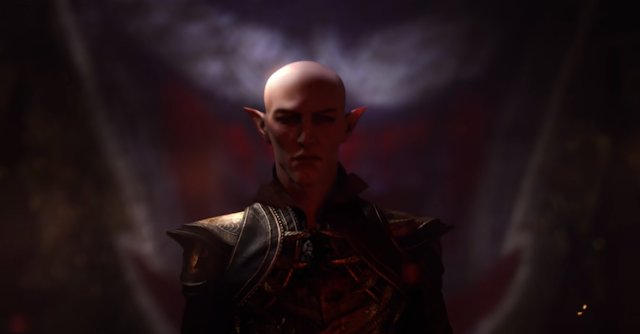
He doesn't call, he doesn't write, but finally, it looks like we might be hearing from Solas at last (2023?), as BioWare announces t...