|
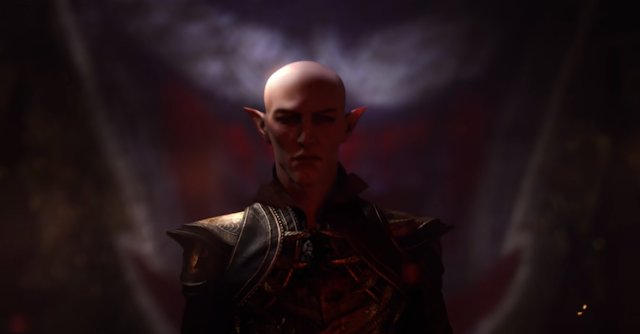
| Ghilan'nain? Girl, you've got some explaining to do! |
—From "The Horror of Hormak," DRAGON AGE: TEVINTER NIGHTS
WARNING: SPOILERS on TEVINTER NIGHTS! Please read at your peril!
So hello again, you beautiful Wardens, Hawkes and Inkies!
I hope you're well and safe out there—hopefully, wearing masks while pretending to be Orlesian, because why not? This is our time, people, let's be Orlesian!
As I noted in my previous post here, I wanted to offer some analyses on stories in TEVINTER NIGHTS that I felt specifically really advance the lore, which teach us valuable facts about the year (to year and a half or so) since the end of the events in "Trespasser." I loved the entire compilation, but my focus here is on stories that give us hints for plot points, characters, or directions we might find ourselves facing, also, in our long-awaited Dragon Age 4.
Which is why I'm back today with my notes and thoughts on John Epler's wonderful horror tale "The Horror of Hormak."
Please Note: I follow several amazing analysts, artists, and critics in the Dragon Age community, led by, first and foremost, Ghil'Dirthalen, who's brilliant, not to mention kind, funny and insightful. But to keep my ideas my own, I have not listened to anyone about TEVINTER NIGHTS. I do plan to do so after I've blogged about all of the stories that contribute to lore (and can't wait).
 |
| As I search for new clues from TEVINTER NIGHTS, we get a ton of lore in John Epler's story "The Horror of Hormak" |
So here we go!
The Story at a Glance
The story begins deep in the Nevarran Forest—that's all we get on location, but my guess is that it is specifically in or near the Northern part of the Planasene Forest, which is just north of the Waking Sea, and slightly West of Kirkwall.
Grey Wardens Ramesh and Lesha are investigating the whereabouts of a lost Grey Warden mining expedition led by Senior Warden Jovis, now lost for eight days and counting—and the clock is ticking on whether they can possibly still be alive. To complicate things, Jovis was a man Ramesh had once deeply loved and turned away from, losing a chance of real happiness, despite the hardships of Grey Warden life. He is now nearly desperate to save Jovis, and to undo his past decisions. Ramesh and Lesha seem to be heading East, which will bring them out of the forest eventually, and into the northwestern arc of the Vimmark Mountains.
Lesha is a young Tevinter mage—cocky and fearless, an Acolyte who has only been a Warden for a few years, while Ramesh, the commander, is a Senior Warden who is older and more careworn. He's been a Warden for 23 years and counting, and can almost taste that the Calling is upon him. But it's Lesha who is uneasy right away, who notes that "Something's wrong about these woods. Feels like the air hates me. Wants me to die." She's not wrong.
Again with that "seawater" theme. Also, ew, ew, ew, ew, ew! (I HAVE VOMIT ISSUES, PEOPLE!)
PARAPHRASED SEGUE: (to the TV show "Monk")
DOCTOR: So, Mr. Monk, you have been poisoned and I'm sorry to say are going to vomit copiously and then die in agony.
MONK: (weeps quietly)
MONK'S ASSISTANT NATALIE: He's upset about the vomiting.
That's... basically me. I have rarely so identified with a fictional character.
ANYWAY. In the aftermath, Ramesh is kind and supportive of the younger mage when she has difficulty processing the horror of the moment, but also adept at keeping her focused on their ultimate goals and loyalties. It's moving and believable.
On a side note, can I just say that I love stories like these, in which two adults are in close prolonged circumstances and that there is no stereotypical sexual tension? Yes, I love UST. But there's so much more to friendship, work, and other relationships, and it's lovely that Ramesh (who is, at this point, revealed as either gay, bi or pan) and Lesha have nothing but a warm, kind, mutually respectful, and entirely professional relationship from beginning to end. It's a signature of BioWare's inclusivity and general respect for individuals and relationships, and I love that. And let's hear it for yet another LGBTQ protagonist in the compilation!
 |
| The Deep Roads are always scary places for me. (I would have made a terrible Warden. I would have just run around screaming.) |
When the duo reaches the final chamber, it's revealed to be a massive, ancient chamber of horrors, a kind of "creation tank" of viscous, briny fluid powered by a huge lyrium crystal hanging above. They confront the biggest creature, a terrifying giant centipede merged with the torso of Warden Jovis, who, faced with his love, manages to retain his sanity for a few moments to relate what happened to his doomed company, and what "she" (Ghilan'nain, I believe) plans for this chamber.
Jovis asks Ramesh to destroy the chamber, then loses control permanently and the creature attacks. Lesha manages to save Ramesh, then gives him enough time to escape, sacrificing herself by destroying the lyrium crystal and exploding the chamber. Ramesh finishes the job by escaping far enough to use the lyrium charges (poignantly using the love note from Jovis as a fuse), and the entire mountain seems to come down behind him, burying the horrors of Hormok forever.
 |
| "The Horror of Hormak" adds to the implications we got in DAI that beneath the Deep Roads, are even deeper ones—and the elves were there first. |
What It Adds to the Lore (and Implies for Dragon Age 4)
- One of the things I really liked about this story was the atmosphere, the way it bridged the classic fantasy-horror of Dragon Age Origins with the lore and character progression (and larger world) of Dragon Age Inquisition. I also liked that all along, we're expecting war-tired, near-his-Calling Ramesh to die, but it's fresh-faced Lesha who doesn't survive. (Darn it.)
- We're told outright that the Wardens' numbers are dwindling ever since Ostagar, and then Adamant. To an alarming degree—that they don't even have the numbers to mount an actual rescue mission for situations like this (and which used to be routine). After this reference, and the rumblings of disquiet from Weisshaupt in "Trespasser," I definitely feel a "crisis of the Grey Wardens" is looming for us in Dragon Age 4.
- The presence of another prominent Tevinter character, Lesha (and that she's a Vint Warden!) tells me that yet again, Tevinter settings and characters are going to be really important in Dragon Age 4. John Epler also noted on Twitter that Ramesh is a person of color who in our world would be of Indian descent, so again, this suggests to me that he may be of Tevinter origin also.
- Lesha's intuition about the forest reminds me strongly of Myrion's reactions when they entered Arlathan Forest, but here it's less about a sense of hidden power and is more openly toxic and antagonistic. This, too, is the work of ancient elves. Just... angrier, more arrogant elves. (It's interesting to note that Nevarra's biggest forest, the Planasene Forest, carries the ancient name for Nevarrans. Once upon a time, if we go back far enough, this wasn't Nevarra—but was evidently a key location for the ancient elves themselves.)
- As soon as the two Wardens encounter hidden violence in the forest, there is a scent of "the sea on a stagnant day." As they are far from the sea and evidently nowhere near the coast (so are evidently pretty far north in the forest, if it is the Planasene), Ramesh is understandably freaked out.
- Ramesh notes that the Deep Roads are closer to the surface here than they are in most of the rest of Thedas. This is a fascinating detail for me. Did we know this before about Nevarra?
- Friedl, the rescued Warden, just says, over and over again: "We didn't know. And now we do. Oh, yes—we know better. They taught us, gave us a lesson." Hellooooo, Evanuris.
- After revealing that she has clawed out her own eyes (!), Friedl turns to Ramesh and says that they need to leave this place "to her, to them!" Oh, man. This is good stuff. To her: And of course, it seems obvious in retrospect that the "she, or her," is ancient elven Evanuris and semi-goddess Ghilan'nain.
 |
| Evidently not even the halla were safe from Ghilan'nain's experimentation... it's really upsetting! (Hush, little halla, you didn't hear this...) |
So let me count the ways:
- As we know, according to a Codex entry from the Temple of Mythal, Ghilan'nain was always a monster-maker, and she did actually make monsters, giants, and twisted creatures of air, earth and sea in the ancient days, that she later destroyed at Andruil's urging.
- However she did not obliterate all of the monsters, most notably, those of the deepest parts of the sea, and—wait for it—you guys, it's too perfect—"Pride stayed her hand." Pride!
I'm not sure this actually means SOLAS literally stopped Ghilan'nain from killing her sea monsters, but it's a fun idea -- maybe he just has a soft spot for giant squid?
MASKED WAITER: Table for Pride?
SOLAS: Oh, yeah, sure. Pride. That's me.
WAITER: Right this way!
SOLAS: Thank you.
WAITER: Would you like tea to start your meal?
SOLAS: NO. I despise tea.
WAITER: Dude, I make minimum wage and there's a pandemic on.
SOLAS: Please forgive my rudeness. Water would be fine. Also, I will be ordering the calamari appetizer.
WAITER: Very good, sir. - In some Dalish stories, Ghilan'nain is wounded and blinded by a hunter she cursed, and turned by Andruil into the first halla. Interestingly enough, only then is she raised from mortal to 'immortal' or godlike status. As always with the Dalish, we need to view this story as a twist or warped reflection of what actually happened.
- Further, Ramesh dreams of Jovis, and in the dream, Jovis is blinded just as Friedl had been.
- Don't forget that Ghilan'nain is also directly implicated (if we drank from the Well of Sorrows) in spurring a sacrilegious attempt by a 'sinner' who followed Dirthamen to take on the "forbidden" (draconic?) form of the gods. The act prompted swift anger and judgment from Mythal at levels unusual to her, so I always see this as one of the earliest attempts at active rebellion against Mythal, in which Ghilan'nain perhaps was testing the waters.
- Ghil was the beloved of Andruil, whom Mythal pretty famously punished in a post-abyssal beatdown and then mindwiped. For that and other reasons, I could totally see Ghil being one of the first Evanuri to join Andruil as a major antagonist to Mythal after that (given Andruil's legendary hatred of Fen'Harel, I think she has to be his primary antagonist).
- There is a symbol—the horns of a halla—repeating everywhere on the columns in the ancient elven chamber discovered by Lesha and Ramesh. The symbol seems to shift in a creepy and magical way out of the corner of the eye.
 |
| Just a reminder that the Qunari aren't the only ones capable of creating explosives... |
- Ramesh's emotions are so bittersweet and sad, and his regrets are palpable. Over and over again, he revisits his chances with Jovis, even still carrying around the last note of love and hope Jovis had once sent him. I find the emphasis on regret interesting, as it carries us forward nicely (and thematically) into the next story, Lukas Kristjanson's "Callback" (but more on that in a future entry).
- Lesha and Ramesh use ancient dwarven lyrium charges (like lyrium grenades) to access the deeper parts of Hormok's secrets. I completely forgot that we learned about these in Inquisition.
- As they begin the descent from dwarven ruins to ancient elven ones, Lesha notices ancient carvings of three figures—"a supplicant, a priestess, and a monster." Ramesh notes that the beings are elven, but Lesha notes that the carvings themselves are dwarven. The series of carvings changes subtly as they go along, so that the priestess looks more and more cruel in each one, and the monster more and more changed.
- For me, this story doubles down on the shared history of elves and dwarves that we glimpsed in DAI, as it notes casually that Wardens have always found a mixture of elven architecture way down in the Deep Roads, and further ties together and further bolsters my own theory that the dwarves were created as sort of mindless slave-worker bees for the elves themselves, meant to live lifetimes of toil underground, and perhaps only later freed by the death of a titan (my theory—the one that Mythal killed, which I posit was a self-sacrifice and mercy-killing). I further think this is what broke their 'hive mind' while also breaking their link to the Fade (alternative option: Mythal did it for them). But I haven't really organized those theories yet, so just ignore me.
- In the next-to-last chamber, a gigantic and beautiful, awe-inspiring place, Ramesh notes the exquisite wall carvings, bas-reliefs in three parallel bands around the entire chamber. As in the Temple of Mythal, these are actually mosaics of tiny gemstones.
Let's look at the carvings with Ramesh, shall we?
- The topmost band depicts noble ancient elven royalty and respectful supplicants.
- The middle band depicts elven mages apparently healing and comforting the sick and dying.
- The bottom-most band shows incredibly elaborate ancient aravels being pulled by armies toward the mountains (including the very mountains above them now).
- Upon closer examination, the bands begin to appear vaguely wrong and corrupt, even frightening. The halla have "too many horns" and look "insectile." The aravels are not grand landships after all, but are revealed to be prison vessels with barred windows. And the mages aren't healing people, but corrupting them. And the elven rulers are increasingly shown to be contemptuous, arrogant, and disgusted with their cowering and terrified subjects.
So let's look at these revelations: The Evanuris were imprisoning their own people and apparently dragging them to these different locations in order to corrupt and mutate them, building some kind of secret army. We already know from Inquisition that several of the 'gods' (Falon'Din, cough) also loved sacrificing large numbers of their subjects just for the fun of it. And of course, here, we also see that the Evanuris were also actively corrupting (not healing) their own people in further experimentation, leading massive armies to bring their prison ships to their doomed final destinations. Is the yellow-greenish lyrium an important clue here?
Nah, that's not disturbing at all. (Seriously, Evanuris people, what was WRONG with you?)
Wait, Where Have We Heard This Before...?
Last but not least on this thoughtline is that it offers perhaps the subtlest of hints on another race in Thedas: The Kossith/Qunari. Who also can have varying numbers of horns, and whose origins Bull mused about in Dragon Age: Inquisition, wondering if the Qunari shared some dragon blood somehow:
BULL: "Well, you know how we have horns? We kind of look more... dragony than most people. Maybe it's that.....But a few of the Ben-Hassrath have this crazy old theory. See, the tamassrans control who we mate with. They breed us for jobs like you'd breed dogs or horses. What if they mixed in some dragon a long time ago? Maybe drinking the blood, maybe magic. I don't know. But something in that dragon we killed... spoke to me."
To me, this is a pretty big potential additional hint that the Qunari may in fact be the descendants of one of Ghilan'nain's first experimentations at combining or corrupting races or species.

- The corrupted, insectile halla are disturbing to consider. If there is any animal supposedly sacred to Ghilan'nain, and to the elves past and present, it is the halla, and yet here we see that she even warped the halla into monstrosities. This hit me as a truly profane and grotesque act. Just imagine how the Dalish would react!
- The final chamber's lyrium glows with a "sickly" light that is, interestingly enough, not blue (or red), but yellow and green.
- There's a lot of body horror in the final chamber—monsters warped and assembled grotesquely out of 'parts' to create a corrupted and terrifying army. But we do learn that the Darkspawn monsters are changed/warped simply by contact with the viscous pool, whereas Jovis tells Ramesh that the Wardens (and presumably all thinking or higher beings) had to actually drink from it to be transformed.
- Jovis seems to imply that Ghilan'nain is doing all this with a purpose, but that she must be fought, and her chamber of horrors buried and destroyed: "She cannot have it. Not again. Locked for a reason."
Locked—by a certain Dread Wolf, one assumes. - It's interesting to note that if you examine a map of Thedas (here's one of my favorites, a fantastically detailed, zoomable version thanks to The Wyrd Sisters of Thedas), there is a Grey Warden Prison located in the central Vimmarks, just Northeast of the Planasene Forest. Which further makes me think that's the general area of this story's setting, as it involves multiple Grey Warden parties scouting the area. This also gives Ramesh a believable and easily accessible place to which he can return with his sad (and scary) news.
- Ramesh's horrified realization that this was just one of twelve different chambers of ancient horrors, and that there are eleven remaining under eleven other distinct mountain peaks, definitely gives me further food for thought.
Which mountains? My totally wild guesses, just using proximity of peaks/mountains to ancient elves, dwarves, or general Thin Veil Spots, might include:
 |
| Time to take a closer look at the mountains of Thedas... |
- A peak in the Hunterhorn Mountains in far Western Thedas (perhaps near Kal-Sharok and the Blasted Hills)
- The White Spire peak, North of Brynnlaw, and East of Arlathan Forest. (For me this one's almost a certainty. It's a lonely mountain near the most ancient elven location in all Thedas!)
- A mountain in the Gamordan Peaks in far Southwestern Orlais—perhaps even near Mont de Glace ("Ice Mountain"), another solo peak?
- In the Southern Frostback Mountains, perhaps farther East, towards Valammar? (I don't think there's one near Skyhold, because Solas would not have chosen an 'unclean' area for his castle.)
- Near Bownammar (Dead Trenches), Southeast of Lothering, Northwest corner of the Southron Hills. There are Elven ruins not far away to the Northeast, as well.
- A peak in The Hundred Pillars between Tevinter and Antiva. There's access to a ton of ancient elven locations to the West, and it's perfectly situated to cause trouble.
- Soldier's Peak (The Coastlands, Southeast of Highever, and directly West of Amaranthine)
- Talo's Eye, a lone peak in the Northeastern Anderfels
- Arl Dumat, a lone peak below the Urthemiel Plateau (Northwest of the Forbidden Oasis)
- Perhaps another near The Colossus and Kal Repartha in the Northwest Hissing Wastes
- With so many ancient ruins, there's got to be something near the Arbor Wilds, perhaps in the Uncharted Territories.
Final Musings
This last revelation of eleven more locations is quite the bombshell. If these things are scattered across Thedas in eleven other places, it's pretty freaking terrifying! It's basically eleven massive, ancient Elvhen bombs waiting to detonate. It would make the "Dragon's Breath" plot by the Qunari look like child's play in comparison. (NEW: The very smart and helpful Q. McLamore on Twitter also reminded me of the crucial lore that since Origins, we have heard rumor of "Twelve great Thaigs" in history past. Which is so exciting and maddening!)
All of this brings up further questions for me, as well. First and foremost, why were the Evanuris seeding terror, corruption and death across all of Thedas thousands of years ago, creating monstrous armies-in-waiting?
Was this in reaction to Mythal and Solas's division from their ranks? Or a reaction to something bigger, or something they simply anticipated? Remember, at this point, elves ruled everything. So why do this? What were they so afraid of? And why would beings that valued power, beauty, life and learning (according to the Shattered Library) so allow themselves to be twisted by arrogance that they would become creators of monstrous death? Or were they so bored with immortality at this point that it was just one more way to create drama and kick an anthill on the most massive scale?
All of this is possible. Especially since I've always believed that Andruil created (or sparked the awakening of) the Blight and Darkspawn after becoming blighted and insane in the Abyss. So it certainly sounds like she and monster-making Ghilan'nain were a match made in heaven, if so.
 |
| If nothing else, "Horror of Hormak" pretty definitively backs up Solas's account that the Evanuris were evil and needed to be stopped. |
This is especially important, to me, because it's continuing to keep Solas balanced between hero and villain, emphasizing Solas's complexity as a character (and confirming that his origins were pretty undeniably heroic). The people who created this chamber, who carved those carvings, who murdered Mythal, who enslaved their own people, who treated the dwarves like mindless things, who siphoned off the blood of Titans—these people deserved to be stopped.
The 'horror' of Hormok is that the ancient evanuris appear to be even worse than Solas described them. They were not gods, but monsters.
But what do you think?
Thanks as always for checking this out. I'll be taking a look at "Callback" next in the series (get out your handkerchiefs, people!). Meanwhile, stay safe out there.