Showing posts with label Andruil. Show all posts

Wednesday, May 13, 2020

TEVINTER NIGHTS Analysis: The Horror of Hormak


Ghilan'nain? Girl, you've got some
explaining to do!
"The expressions on the faces of those elven rulers betrayed a contempt that was almost palpable, the beatific smiles edged with disgust and disdain for the creatures at their feet. And the subjects, far from kneeling in reverence as Ramesh had first thought, seemed more to be cowering in terror."
—From "The Horror of Hormak," DRAGON AGE: TEVINTER NIGHTS

WARNING: SPOILERS on TEVINTER NIGHTS! Please read at your peril!

So hello again, you beautiful Wardens, Hawkes and Inkies!

I hope you're well and safe out there—hopefully, wearing masks while pretending to be Orlesian, because why not? This is our time, people, let's be Orlesian!

As I noted in my previous post here, I wanted to offer some analyses on stories in TEVINTER NIGHTS that I felt specifically really advance the lore, which teach us valuable facts about the year (to year and a half or so) since the end of the events in "Trespasser." I loved the entire compilation, but my focus here is on stories that give us hints for plot points, characters, or directions we might find ourselves facing, also, in our long-awaited Dragon Age 4.

Which is why I'm back today with my notes and thoughts on John Epler's wonderful horror tale "The Horror of Hormak."

Please Note: I follow several amazing analysts, artists, and critics in the Dragon Age community, led by, first and foremost, Ghil'Dirthalen, who's brilliant, not to mention kind, funny and insightful. But to keep my ideas my own, I have not listened to anyone about TEVINTER NIGHTS. I do plan to do so after I've blogged about all of the stories that contribute to lore (and can't wait). 


As I search for new clues from TEVINTER NIGHTS,
we get a ton of lore in John Epler's story "The
 Horror of Hormak"
So—in a nutshell, insights are my own, and mistakes are also my own here. If I'm excited about a revelation you've already been yawning over, hey, I'm late to the party. But ultimately, I'm just very careful about appropriation and want to present ideas (however goofy some of them are) that are really my own. And honestly it's just so much more fun for me that way, so thanks for bearing with me.

So here we go!

The Story at a Glance

The story begins deep in the Nevarran Forest—that's all we get on location, but my guess is that it is specifically in or near the Northern part of the Planasene Forest, which is just north of the Waking Sea, and slightly West of Kirkwall.

Grey Wardens Ramesh and Lesha are investigating the whereabouts of a lost Grey Warden mining expedition led by Senior Warden Jovis, now lost for eight days and counting—and the clock is ticking on whether they can possibly still be alive. To complicate things, Jovis was a man Ramesh had once deeply loved and turned away from, losing a chance of real happiness, despite the hardships of Grey Warden life. He is now nearly desperate to save Jovis, and to undo his past decisions. Ramesh and Lesha seem to be heading East, which will bring them out of the forest eventually, and into the northwestern arc of the Vimmark Mountains. 

Lesha is a young Tevinter mage—cocky and fearless, an Acolyte who has only been a Warden for a few years, while Ramesh, the commander, is a Senior Warden who is older and more careworn. He's been a Warden for 23 years and counting, and can almost taste that the Calling is upon him. But it's Lesha who is uneasy right away, who notes that "Something's wrong about these woods. Feels like the air hates me. Wants me to die." She's not wrong.


The story follows the two into the darkness of forest and nightmare, as they find a surviving Warden from Jovis's party, Warden-Recruit Friedl, a young woman, but she's been badly wounded and whatever she experienced has driven her mad enough to mutilate and blind herself. Ramesh and Lesha attempt to calm and save Friedl, even as they continue to pursue the mystery deeper into the forest, but eventually, Friedl kills herself. When Ramesh checks her dead body, it vomits gallons and gallons of a terrible, briny seawater-like substance. 

Again with that "seawater" theme. Also, ew, ew, ew, ew, ew! (I HAVE VOMIT ISSUES, PEOPLE!)
PARAPHRASED SEGUE: (to the TV show "Monk") 
DOCTOR: So, Mr. Monk, you have been poisoned and I'm sorry to say are going to vomit copiously and then die in agony. 
MONK: (weeps quietly) 
MONK'S ASSISTANT NATALIE: He's upset about the vomiting. 
That's... basically me. I have rarely so identified with a fictional character.

ANYWAY. In the aftermath, Ramesh is kind and supportive of the younger mage when she has difficulty processing the horror of the moment, but also adept at keeping her focused on their ultimate goals and loyalties. It's moving and believable.

On a side note, can I just say that I love stories like these, in which two adults are in close prolonged circumstances and that there is no stereotypical sexual tension? Yes, I love UST. But there's so much more to friendship, work, and other relationships, and it's lovely that Ramesh (who is, at this point, revealed as either gay, bi or pan) and Lesha have nothing but a warm, kind, mutually respectful, and entirely professional relationship from beginning to end. It's a signature of BioWare's inclusivity and general respect for individuals and relationships, and I love that. And let's hear it for yet another LGBTQ protagonist in the compilation!

The Deep Roads are always scary places for me. (I would have made a
terrible Warden. I would have just run around screaming.)
Onward! The two exit the forest into rocky terrain marked by three distinctive peaks (I'm again assuming these peaks are most likely in the Vimmarks BUT what makes them distinctive? Have we seen them before? It's killing me...) as they discover the entrance to the Deep Roads beneath them, littered with twisted Darkspawn bodies and blood (no Warden bodies), giving them hope of finding their companions alive. They bravely enter a finely carved doorway in the ancient dwarven style, runes above the entrance naming it as "Hormok" (So is this deliberate or is the title a typo? No judgment if so...). They descend, the passages glowing with lyrium, and discover great and beautiful chambers like the most ancient dwarven thaigs, and then, descending further, fight a fierce, brief battle with more twisted darkspawn before discovering a new descent into areas that are first dwarven, then obviously ancient and elven.

When the duo reaches the final chamber, it's revealed to be a massive, ancient chamber of horrors, a kind of "creation tank" of viscous, briny fluid powered by a huge lyrium crystal hanging above. They confront the biggest creature, a terrifying giant centipede merged with the torso of Warden Jovis, who, faced with his love, manages to retain his sanity for a few moments to relate what happened to his doomed company, and what "she" (Ghilan'nain, I believe) plans for this chamber. 

Jovis asks Ramesh to destroy the chamber, then loses control permanently and the creature attacks. Lesha manages to save Ramesh, then gives him enough time to escape, sacrificing herself by destroying the lyrium crystal and exploding the chamber. Ramesh finishes the job by escaping far enough to use the lyrium charges (poignantly using the love note from Jovis as a fuse), and the entire mountain seems to come down behind him, burying the horrors of Hormok forever.


"The Horror of Hormak" adds to the implications we got in DAI that
beneath the Deep Roads, are even deeper ones—and the elves were there first.
Ramesh resolves to carry his story—and warning—to the rest of the Wardens, even as he realizes with horror that the carvings below had depicted twelve different locations for aravels and prey (eleven plus the one just destroyed at Hormok). Meaning, the battle has just begun...

What It Adds to the Lore (and Implies for Dragon Age 4)

  • One of the things I really liked about this story was the atmosphere, the way it bridged the classic fantasy-horror of Dragon Age Origins with the lore and character progression (and larger world) of Dragon Age Inquisition. I also liked that all along, we're expecting war-tired, near-his-Calling Ramesh to die, but it's fresh-faced Lesha who doesn't survive. (Darn it.)
  • We're told outright that the Wardens' numbers are dwindling ever since Ostagar, and then Adamant. To an alarming degree—that they don't even have the numbers to mount an actual rescue mission for situations like this (and which used to be routine). After this reference, and the rumblings of disquiet from Weisshaupt in "Trespasser," I definitely feel a "crisis of the Grey Wardens" is looming for us in Dragon Age 4.
  • The presence of another prominent Tevinter character, Lesha (and that she's a Vint Warden!) tells me that yet again, Tevinter settings and characters are going to be really important in Dragon Age 4. John Epler also noted on Twitter that Ramesh is a person of color who in our world would be of Indian descent, so again, this suggests to me that he may be of Tevinter origin also.
  • Lesha's intuition about the forest reminds me strongly of Myrion's reactions when they entered Arlathan Forest, but here it's less about a sense of hidden power and is more openly toxic and antagonistic. This, too, is the work of ancient elves. Just... angrier, more arrogant elves. (It's interesting to note that Nevarra's biggest forest, the Planasene Forest, carries the ancient name for Nevarrans. Once upon a time, if we go back far enough, this wasn't Nevarra—but was evidently a key location for the ancient elves themselves.)
  • As soon as the two Wardens encounter hidden violence in the forest, there is a scent of "the sea on a stagnant day." As they are far from the sea and evidently nowhere near the coast (so are evidently pretty far north in the forest, if it is the Planasene), Ramesh is understandably freaked out.
  • Ramesh notes that the Deep Roads are closer to the surface here than they are in most of the rest of Thedas. This is a fascinating detail for me. Did we know this before about Nevarra?
  • Friedl, the rescued Warden, just says, over and over again: "We didn't know. And now we do. Oh, yes—we know better. They taught us, gave us a lesson." Hellooooo, Evanuris.
  • After revealing that she has clawed out her own eyes (!), Friedl turns to Ramesh and says that they need to leave this place "to her, to them!" Oh, man. This is good stuff. To her: And of course, it seems obvious in retrospect that the "she, or her," is ancient elven Evanuris and semi-goddess Ghilan'nain.
Why It's Ghilan'nain (It's SO TOTALLY Ghilan'nain)
Evidently not even the halla were safe from Ghilan'nain's experimentation...
 it's really upsetting! (Hush, little halla, you didn't hear this...)

So let me count the ways:

  • As we know, according to a Codex entry from the Temple of Mythal, Ghilan'nain was always a monster-maker, and she did actually make monsters, giants, and twisted creatures of air, earth and sea in the ancient days, that she later destroyed at Andruil's urging.
  • However she did not obliterate all of the monsters, most notably, those of the deepest parts of the sea, and—wait for it—you guys, it's too perfect—"Pride stayed her hand." Pride!


    I'm not sure this actually means SOLAS literally stopped Ghilan'nain from killing her sea monsters, but it's a fun idea -- maybe he just has a soft spot for giant squid? 

    MASKED WAITER: Table for Pride?
    SOLAS: Oh, yeah, sure. Pride. That's me.
    WAITER: Right this way!
    SOLAS: Thank you.
    WAITER: Would you like tea to start your meal?
    SOLAS: NO. I despise tea.
    WAITER: Dude, I make minimum wage and there's a pandemic on.
    SOLAS: Please forgive my rudeness. Water would be fine. Also, I will be ordering the calamari appetizer.
    WAITER: Very good, sir.
  • In some Dalish stories, Ghilan'nain is wounded and blinded by a hunter she cursed, and turned by Andruil into the first halla. Interestingly enough, only then is she raised from mortal to 'immortal' or godlike status. As always with the Dalish, we need to view this story as a twist or warped reflection of what actually happened.
  • Further, Ramesh dreams of Jovis, and in the dream, Jovis is blinded just as Friedl had been.
  • Don't forget that Ghilan'nain is also directly implicated (if we drank from the Well of Sorrows) in spurring a sacrilegious attempt by a 'sinner' who followed Dirthamen to take on the "forbidden" (draconic?) form of the gods. The act prompted swift anger and judgment from Mythal at levels unusual to her, so I always see this as one of the earliest attempts at active rebellion against Mythal, in which Ghilan'nain perhaps was testing the waters.
  • Ghil was the beloved of Andruil, whom Mythal pretty famously punished in a post-abyssal beatdown and then mindwiped. For that and other reasons, I could totally see Ghil being one of the first Evanuri to join Andruil as a major antagonist to Mythal after that (given Andruil's legendary hatred of Fen'Harel, I think she has to be his primary antagonist).
  • There is a symbol—the horns of a halla—repeating everywhere on the columns in the ancient elven chamber discovered by Lesha and Ramesh. The symbol seems to shift in a creepy and magical way out of the corner of the eye.
So yep. It's Ghil. Onward!


Just a reminder that the Qunari aren't the only ones
capable of creating explosives...
More Revelations
  • Ramesh's emotions are so bittersweet and sad, and his regrets are palpable. Over and over again, he revisits his chances with Jovis, even still carrying around the last note of love and hope Jovis had once sent him. I find the emphasis on regret interesting, as it carries us forward nicely (and thematically) into the next story, Lukas Kristjanson's "Callback" (but more on that in a future entry).
  • Lesha and Ramesh use ancient dwarven lyrium charges (like lyrium grenades) to access the deeper parts of Hormok's secrets. I completely forgot that we learned about these in Inquisition.
  • As they begin the descent from dwarven ruins to ancient elven ones, Lesha notices ancient carvings of three figures—"a supplicant, a priestess, and a monster." Ramesh notes that the beings are elven, but Lesha notes that the carvings themselves are dwarven. The series of carvings changes subtly as they go along, so that the priestess looks more and more cruel in each one, and the monster more and more changed.
  • For me, this story doubles down on the shared history of elves and dwarves that we glimpsed in DAI, as it notes casually that Wardens have always found a mixture of elven architecture way down in the Deep Roads, and further ties together and further bolsters my own theory that the dwarves were created as sort of mindless slave-worker bees for the elves themselves, meant to live lifetimes of toil underground, and perhaps only later freed by the death of a titan (my theory—the one that Mythal killed, which I posit was a self-sacrifice and mercy-killing). I further think this is what broke their 'hive mind' while also breaking their link to the Fade (alternative option: Mythal did it for them). But I haven't really organized those theories yet, so just ignore me.
  • In the next-to-last chamber, a gigantic and beautiful, awe-inspiring place, Ramesh notes the exquisite wall carvings, bas-reliefs in three parallel bands around the entire chamber. As in the Temple of Mythal, these are actually mosaics of tiny gemstones.

Let's look at the carvings with Ramesh, shall we?

  1. The topmost band depicts noble ancient elven royalty and respectful supplicants.
  2. The middle band depicts elven mages apparently healing and comforting the sick and dying.
  3. The bottom-most band shows incredibly elaborate ancient aravels being pulled by armies toward the mountains (including the very mountains above them now).
  4. Upon closer examination, the bands begin to appear vaguely wrong and corrupt, even frightening. The halla have "too many horns" and look "insectile." The aravels are not grand landships after all, but are revealed to be prison vessels with barred windows. And the mages aren't healing people, but corrupting them. And the elven rulers are increasingly shown to be contemptuous, arrogant, and disgusted with their cowering and terrified subjects.

    Is the yellow-greenish lyrium an important clue here?
    So let's look at these revelations: The Evanuris were imprisoning their own people and apparently dragging them to these different locations in order to corrupt and mutate them, building some kind of secret army. We already know from Inquisition that several of the 'gods' (Falon'Din, cough) also loved sacrificing large numbers of their subjects just for the fun of it. And of course, here, we also see that the Evanuris were also actively corrupting (not healing) their own people in further experimentation, leading massive armies to bring their prison ships to their doomed final destinations.

    Nah, that's not disturbing at all. (Seriously, Evanuris people, what was WRONG with you?)

    Wait, Where Have We Heard This Before...?

    Last but not least on this thoughtline is that it offers perhaps the subtlest of hints on another race in Thedas: The Kossith/Qunari. Who also can have varying numbers of horns, and whose origins Bull mused about in Dragon Age: Inquisition, wondering if the Qunari shared some dragon blood somehow:

    BULL: "Well, you know how we have horns? We kind of look more... dragony than most people. Maybe it's that.....But a few of the Ben-Hassrath have this crazy old theory. See, the tamassrans control who we mate with. They breed us for jobs like you'd breed dogs or horses. What if they mixed in some dragon a long time ago? Maybe drinking the blood, maybe magic. I don't know. But something in that dragon we killed... spoke to me."

    To me, this is a pretty big potential additional hint that the Qunari may in fact be the descendants of one of Ghilan'nain's first experimentations at combining or corrupting races or species.
More Lore Notes:
  • The corrupted, insectile halla are disturbing to consider. If there is any animal supposedly sacred to Ghilan'nain, and to the elves past and present, it is the halla, and yet here we see that she even warped the halla into monstrosities. This hit me as a truly profane and grotesque act. Just imagine how the Dalish would react!
  • The final chamber's lyrium glows with a "sickly" light that is, interestingly enough, not blue (or red), but yellow and green.
  • There's a lot of body horror in the final chamber—monsters warped and assembled grotesquely out of 'parts' to create a corrupted and terrifying army. But we do learn that the Darkspawn monsters are changed/warped simply by contact with the viscous pool, whereas Jovis tells Ramesh that the Wardens (and presumably all thinking or higher beings) had to actually drink from it to be transformed.
  • Jovis seems to imply that Ghilan'nain is doing all this with a purpose, but that she must be fought, and her chamber of horrors buried and destroyed: "She cannot have it. Not again. Locked for a reason."

    Locked—by a certain Dread Wolf, one assumes.
  • It's interesting to note that if you examine a map of Thedas (here's one of my favorites, a fantastically detailed, zoomable version thanks to The Wyrd Sisters of Thedas), there is a Grey Warden Prison located in the central Vimmarks, just Northeast of the Planasene Forest. Which further makes me think that's the general area of this story's setting, as it involves multiple Grey Warden parties scouting the area. This also gives Ramesh a believable and easily accessible place to which he can return with his sad (and scary) news.
  • Ramesh's horrified realization that this was just one of twelve different chambers of ancient horrors, and that there are eleven remaining under eleven other distinct mountain peaks, definitely gives me further food for thought.

Which mountains? My totally wild guesses, just using proximity of peaks/mountains to ancient elves, dwarves, or general Thin Veil Spots, might include: 
Time to take a closer look at the mountains of Thedas...


  1. A peak in the Hunterhorn Mountains in far Western Thedas (perhaps near Kal-Sharok and the Blasted Hills)
  2. The White Spire peak, North of Brynnlaw, and East of Arlathan Forest. (For me this one's almost a certainty. It's a lonely mountain near the most ancient elven location in all Thedas!)
  3. A mountain in the Gamordan Peaks in far Southwestern Orlais—perhaps even near Mont de Glace ("Ice Mountain"), another solo peak?
  4. In the Southern Frostback Mountains, perhaps farther East, towards Valammar? (I don't think there's one near Skyhold, because Solas would not have chosen an 'unclean' area for his castle.)
  5. Near Bownammar (Dead Trenches), Southeast of Lothering, Northwest corner of the Southron Hills. There are Elven ruins not far away to the Northeast, as well.
  6. A peak in The Hundred Pillars between Tevinter and Antiva. There's access to a ton of ancient elven locations to the West, and it's perfectly situated to cause trouble.
  7. Soldier's Peak (The Coastlands, Southeast of Highever, and directly West of Amaranthine)
  8. Talo's Eye, a lone peak in the Northeastern Anderfels
  9. Arl Dumat, a lone peak below the Urthemiel Plateau (Northwest of the Forbidden Oasis)
  10. Perhaps another near The Colossus and Kal Repartha in the Northwest Hissing Wastes
  11. With so many ancient ruins, there's got to be something near the Arbor Wilds, perhaps in the Uncharted Territories.

Final Musings

This last revelation of eleven more locations is quite the bombshell. If these things are scattered across Thedas in eleven other places, it's pretty freaking terrifying! It's basically eleven massive, ancient Elvhen bombs waiting to detonate. It would make the "Dragon's Breath" plot by the Qunari look like child's play in comparison. (NEW: The very smart and helpful Q. McLamore on Twitter also reminded me of the crucial lore that since Origins, we have heard rumor of "Twelve great Thaigs" in history past. Which is so exciting and maddening!)

All of this brings up further questions for me, as well. First and foremost, why were the Evanuris seeding terror, corruption and death across all of Thedas thousands of years ago, creating monstrous armies-in-waiting?

Was this in reaction to Mythal and Solas's division from their ranks? Or a reaction to something bigger, or something they simply anticipated? Remember, at this point, elves ruled everything. So why do this? What were they so afraid of? And why would beings that valued power, beauty, life and learning (according to the Shattered Library) so allow themselves to be twisted by arrogance that they would become creators of monstrous death? Or were they so bored with immortality at this point that it was just one more way to create drama and kick an anthill on the most massive scale? 


All of this is possible. Especially since I've always believed that Andruil created (or sparked the awakening of) the Blight and Darkspawn after becoming blighted and insane in the Abyss. So it certainly sounds like she and monster-making Ghilan'nain were a match made in heaven, if so.


If nothing else, "Horror of Hormak" pretty definitively backs up Solas's
account that the Evanuris were evil and needed to be stopped.
These revelations about the corruption and cruelty of the Evanuris also serve another purpose—they independently confirm Solas's revelations in "Trespasser" that he was fighting against beings who had become evil and corrupt with power. Which I already believed, based on what we were presented, and based on the revelations of the Codices, the Well of Sorrows, Solas's ancient tower mosaics, and the dialogues with Flemeth. However, whether or not Solas was telling the truth has still been a topic for frequent debate since "Trespasser"—understandably so—and yet here we have the Evanuris seemingly confirming those facts with their own hands, deeds, and mosaics.

This is especially important, to me, because it's continuing to keep Solas balanced between hero and villain, emphasizing Solas's complexity as a character (and confirming that his origins were pretty undeniably heroic). The people who created this chamber, who carved those carvings, who murdered Mythal, who enslaved their own people, who treated the dwarves like mindless things, who siphoned off the blood of Titans—these people deserved to be stopped.

The 'horror' of Hormok is that the ancient evanuris appear to be even worse than Solas described them. They were not gods, but monsters.

But what do you think?

Thanks as always for checking this out. I'll be taking a look at "Callback" next in the series (get out your handkerchiefs, people!). Meanwhile, stay safe out there.

Sunday, May 3, 2020

TEVINTER NIGHTS Analysis: Three Trees to Midnight

 "There are no more elves, no more humans. There are only bas, who must work to prove themselves worthy of serving the Qun."
—From "Three Trees to Midnight," DRAGON AGE: TEVINTER NIGHTS

WARNING: SPOILERS on TEVINTER NIGHTS! Please read at your peril!

So hello all you glorious people of Thedas,

I hope you're doing okay in this insane world, and most of all, that you are all staying safe and well.

I'm hoping to help provide an escape of sorts by analyzing all of the stories in TEVINTER NIGHTS that I feel specifically advance the lore.

So—please note. This doesn't mean I dislike or didn't enjoy stories I leave out, it just means that I want to actually try to note and discuss the new things we learn, and what aspects of those new stories might be subtly teaching us something that will bridge the gap (or even foreshadow) the potential game issues of Dragon Age 4.

With this in mind, I'm starting with Patrick Weekes's homage (for me, very real) to the classic story of THE DEFIANT ONES with a brief discussion of the overall story, and then some final tidbits noting what the story gives us in terms of new information. I will be doing this for many, although not all, of the stories in the anthology, slightly varying inclusion here and there if a theme emerges.

Please note—if I don't include a story you love, hit me up. My focus here is mainly on lore—what we get, what we learn, and and what will propel us forward. So I may love many stories but skip past if they don't give me tons of lore. 


Here goes!

The Story at a Glance

Put simply, the plot of "Three Trees to Midnight" is about a Tevinter mage named Myrion (hiding his talents for survival) who suddenly finds himself a Qunari prisoner, shackled to an elf named Strife (a Starkhaven city elf eventually adopted by the Dalish). After a brief and brutal journey by dreadnought, the two find themselves unwilling compatriots as they attempt to escape imprisonment with their lives in the misty forest of Arlathan, even as the Qunari elite pursue them at every step.

The scenario is timeless and irresistible—a trial by fire in which Myrion and Strife must match wits (and strides) to attempt to escape from the brutal prospect of slavery (or mindlessness) under the conquering Qunari. Each man considers his shackled partner a non-person then looks more closely to see themselves in each other's eyes.

"Filthy knife-ear," snarls Myrion at their first meeting.
"Lazy shem isn't used to working," sneers the elf right back.

Of course, it's a match made in heaven.

And of course, both of their assumptions about each other end up being oversimplifications and (mostly) outright wrong—both have lost loved ones in the recent battle, and both are better, braver men than they first appear to be to the other. And more loyal. Of course, they bond as they flee into the mysteries of Arlathan forest (and yes, I may have let out a delighted sigh when I realized where they were). In the end, they battle and evade their pursuers, bond over their shared danger and survival, and end with the prospect of a new life—however challenging—that awaits them.

What It Adds to the Lore (and Implies for Dragon Age 4)

"Three Trees to Midnight" starts off fast and never lets up, so it could be easy to skim past so many delightful new details and confirmations when it comes to the lore.

But here's what I felt was new information, so here goes:
  • Approximately a year after "Trespasser" (I think?), Ventus, "Jewel of the [Tevinter] Imperium," has fallen to the Qunari. This is an important detail because I think it's painting a picture of just how inexorable and inescapable Qunari world victory may be (without help). It's also worth noting that we find out later that "the Antaam had attacked the bas of the South without the blessing of the other Qunari..."
  • Another detail: One small ray of hope is that Strife's friend Thantiel had smuggled out information on the next Qunari invasion, and that's what Strife is able to recover and take with him. Based on comments from Strife, it looks like they are targeting Rivain, and Strife wants to help stop that, but he also simply wants to warn the clans before the attack (his friend Irelin appears to put that into motion instantly).
  • Qamek is more concisely defined—not just as a chemical potion that wipes minds, but as one that appears to be alchemical—a combination of drugs and magic that is a bitter, viscous brown liquid. We later realize (per a gleeful Bas-taar, happy at their absence) that the Ben-Hassrath "measure" qamek, implying that some lighter doses may be less debilitating or permanent.
  • We see qamek's effects firsthand (and that heavy doses are irreversible) first on Strife's friend Thantiel, and then (implied) on Myrion's friend (and perhaps lover) Jasecca. Turned into "walking corpses" by the drink, the only escape for those afflicted is death, and both Strife and Myrion provide that as all they can do for the qamek-cursed.
  • The Qun was already terrifying. But under more brutal commanders like Bas-taar (the self-styled "Keeper of Bas," i.e., people-as-things), all men are put into work camps and all mages are routinely mind-wiped via the Antaam (or at least this command). (AGHGHGH).
  • Another important element here is that we're introduced to the concept of the Qunari Huntmaster, an important figure who seems to straddle multiple worlds in the Qun, and who acts as a kind of freelance justicar. He's new to the Bas-taar's regiment and was sent (interestingly enough) directly by the Antaam to oversee him—it appears they are a bit concerned about his zealousness.
  • When Strife introduces himself to Myrion, I instantly thought of how elves will often rename themselves after moments of transformation or trial. I wondered if Strife might therefore be the name he had just adopted after the battle and his imprisonment. As a city elf who was welcomed by the Dalish, could he be someone we have met before?
  • At least some Dalish mages are shape-shifters, and the one featured in this story, Irelin, consistently appears as one of the halla, sacred to the Dalish and beloved of Ghilan'nain. She is also able to shapeshift at will into other animals, from falcons to bears and more.
  • The Huntmaster is a wonderful character—his black and white facial vitaar seems to imply that he exists between the two, and in his first scene, he reminds Bas-taar that "The path of the Qun does not call for needless violence," even as he spares a seagull he could have skewered effortlessly. Bas-taar does not understand this kind of subtlety—there is no difference for him between the seagull and the prisoners they took, and all deserve to be skewered and tortured.
  • The Huntmaster's facial markings are later revealed to symbolize sight, and his gift for empathy shows up in lovely details like when he notes (with "an edge") that the Bas-taar had killed all the mages he'd encountered—even those who surrendered and did not fight. It's interesting to further be reminded that the Ben-Hassrath would normally have judged which mages should have lived and died, offering the judgment of "No, this mage should live, do not hurt them more than necessary."

    Again, it all reminds us that—if we pay attention, this is a brutal Qunari conquest but not sanctioned by the Qun itself (reinforced when he attempts to break off the chase in Arlathan, as "there is too much we do not understand." Bas-taar refuses.
  • I like the reminder that Myrion is a mage who can function without a staff, it just requires his training, ability, and a more precise connection to the Fade.
  • Arlathan forest is reported to be haunted (not a huge surprise, given its brutal and shrouded history), and Strife remembers being told that in Arlathan, "Spirits remembered what had once been."
  • Cool detail: It appears that most of the Qunari do not speak Trade very well (an interesting detail that may be important later).
  • As he works to escape, Strife locks his thoughts to each of the elements of the Vir Tanadhal, the Dalish tenets legendarily passed down to them by Evenuris/goddess Andruil. Each tenet he recalls strengthens him and guides him forward—(1) Vir Bor'assan, the Way of the Bow, (2) Vir Assan, the Way of the Arrow, and (3) Vir Adahlen, the Way of the Forest.
  • For me, Strife reveals some verified elements of Dalish cultural details... it's an intriguing reminder of the Dalish love for Andruil, who frankly always terrified me, so it sets her in a better, gentler light than I am used to. The Vir Tanadhal was not universal however (and was in some ways directly opposed by Sylaise's quieter Vir Atish'an, "the Way of Peace") but it certainly helps Strife here. Strife also calls upon Ghilan'nain, too, and later warns a scoffing Myrion, "Be careful how you speak of the Lady of the Hunt while you stand in her forest."
  • Further on, what is a truly exciting is the revelation that Arlathan forest is protected across the ages, and that it lies under a mist of ancient elven magic that will actually feel the moods and emotions of interlopers, and respond automatically to threats, as we see here when a "forest guardian" (basically a huge elven golem of wood and stone, with blades of thick metal edged with lyrium) rises to combat the forest intruders. Strife later confirms that there aren't many of these golems, and that the guardians seem to be spaced by a day's march or more.
  • Strife speaks the standard "Andaran atish'an" greeting, but the Arlathan guardian golem doesn't back down the way he expects it to. A sign of the world 'moving on?' Or is Strife just wrong here?
  • Myrion gives us a rare glimpse into Tevinter mage tests, which appear to occur a bit earlier than the Harrowings in other parts of Thedas (he took his at 14, where he was tempted by a desire demon that took the form of a boy he had adored.
  • Later, the Huntmaster (who has been trying to help the fugitives in subtle ways) reveals that he is "Saarbrak, of the Ben-Hassrath," and that even opposed to Bas-taar, that he is deeply loyal to the Qun, and his job is in fact to "destroy those who threaten the Qun," even if they are... within the Qun itself. I love this. He further notes that he is not Antaam. He is something else.
  • “Some of the bas now call us monsters,” says the Huntmaster. He adds, "This is what threatens the Qun.” “Hass ebala-varaad nehraa,” he says after slaying Bas-taar in righteous judgment. Then translates for total understanding: “For those I watch, of which I am one.”
It begins in hatred, anger, and division. Yet it all ends with a realization of respect, of kindness, and (best of all) of freedom and found family, two of my favorite tropes across all fiction anywhere. What's not to love?

Meanwhile, what do you think? Did I miss any details?

Saturday, January 19, 2019

The Complete Guide to the Dalish Vallaslin (and Their Potential Meanings)

Cole: She is bare-faced, embarrassed, and she doesn't know. She thinks it's because of her.

Face paint? Or hidden secrets? Wait and see...
We see them so often... but what do the Dalish vallaslin designs represent? 

First off, let me state: I think or suspect Solas is being deliberately simplistic in the big "vallaslin scene" at Crestwood (also known as The Worst Date Ever). Probably deliberately so. He loves games, after all.

Like: Yes, I think he's telling the truth. The vallaslins became slave markings. But were they always

Evidence suggests not. Codices and other references, to me, seem to imply that the vallaslins may have started as markings of simple allegiance, of tribute. Which to me makes the idea of the vallaslins of Solas, Abelas, Ameridan, etc., a lot more believable. And which, to me, also ties with Legion of the Dead markings. I think they are linked: visibly. And ethically. Elves came first. But I also think those dwarven markings were, well, slave markings. DAMMIT ELVES.

And as far as Solas, if we buy his scenario, it's pretty clearly canon (per Cole) that he had and then removed Mythal's vallaslin for love and later for ethical reasons. Which again fits Solas.

But let's go further.

Are there secrets to be found in their images and icons? I've always wondered if they were simply beautiful abstractions or whether each vallaslin meant something else, tying the image to the god or goddess it represented.

Me? I vote yes... there are secrets to be found there.

I definitely think we can see real images and symbolism in the beautiful lines of the vallaslin that correspond to the personalities and aspects of the Dalish pantheon. Here we go! 

Mythal


Mythal's alternate (cheek-wings)
Mythal's vallaslin is a beautiful flowing of interlocking roots or veins that in the simplified versions either flower across the forehead alone or curve up each cheek like wings.  The simplified "wings under the eyes" Mythal vallaslin is probably most famous among the fandom as that of incredibly talented fan artist Nipuni's "Solavellan" Lavellan character, Nalia.

Mythal combined
In the complex version, it flowers up like a tree from the nose across the forehead, with the "wings" connected and gracefully circling back around and beneath each eye. There's also a separate pattern on the chin that is almost a smaller, mirrored reflection of the forehead piece (and if you look closely, the two may actually be linked in canon, down across the nose, through the lips, and straight down into the chin piece. The most obvious interpretation of the chin aspect is of roots for the "tree" of the forehead. I also want to update this post to note the lovely observation by Tee on Twitter that this beautiful branching vallaslin also obviously echoes the description of Mythal's grimoire, which features "a leafless tree" on its cover. Thanks, Tee!

However, to me, if you look closely at Mythal's vallaslin, it's not just roots or branches, but an actual, highly stylized dragon, with the pointed head over the wearer's nose, and with the wings enveloping the eyes.

In which case, is the chin pattern... the fire breathed by the dragon? Maybe.

Most important of all, though, is (I feel) the idea of roots, of tendrils, of growing things. Mythal is not about abomination or tyranny but about growth, life.

Elgar'nan Version 1
Elgar'nan

Elgar'nan's vallaslin variations are both interesting. The first is a bold, spiky interlocking series of branches almost like thorns that cover most of the face from chin to forehead.

The more complex version includes this same, heavily graphical and thorny branch configuration, but then adds a deep, dark tattoo covering half of the face vertically, with the 'thorns' pattern reversed (uninked).

Elgar'nan Alternate
To me, this is a clear visualization of darkness and light both literally (Elgar'nan was created out of the moment the sun hit the land), as well as figuratively (Elgar'nan was also violent and vengeful). 

There is even the slightest visual hint of forked lightning (another thing associated with Elgar'nan) as well here.


Falon'Din Version 1
Falon'Din

As the God of the Dead, and one I've surmised may be an actual spiritual entity rather than a physical twin to Dirthamen, this vallaslin is interesting and suggestive.
It's very clearly a tree (it almost looks like one of Fillory's clock-trees from Lev Grossman's The Magicians series), which to me is a clear evocation of the vallasdahlen, the life-trees planted by the Dalish on the graves of those who die.
Falon'Din 2 (complex)

I also think there's a potential owl-shape in there on the forehead as well, in the very center of the tree, along with a hidden figure-eight symbol within the forehead-tree that may symbolize both eternity/infinity or The Fade, since circles in elven graphics seem to reference the Fade or Beyond. This could be significant since, as I've noted elsewhere, it's very possible Falon'Din was born a spirit, not a fleshly being (which would also explain his ability to travel to and from the farthest reaches of the Fade with ease). And speaking of the Fade, that circle with the dot at its center is undoubtedly an image of the Fade, just as a similar circle and dot represented the Fade on Solas's fresco on The Siege of Adamant.

The central clock-tree element also strangely reminds me, just a little, of part of Solas's mural -- this time, the one that occurs after the Temple of Mythal. The rather spiky, stylized figure there is meant to represent Abelas. The "tree" here could almost be a similarly spiky figure, arms outstretched. Or perhaps I am again looking far too closely!

Meanwhile, the alternate Falon'Din vallaslin features those tendrils that reach toward the eyes, cheeks, neck, hairline, and around the eyes. Symbolizing the inexorability of death? Or of dreams?


Dirthamen Vallaslin
Dirthamen

As the Keeper of Secrets and Master of Ravens, as well as the god of Knowledge, Dirthamen's is fascinating because it's one of the easiest to parse -- the forehead graphic is fairly obviously a very stylized raven  in flight (Dirthamen famously had two ravens that he mastered, Fear and Deceit).

If you look closely, you can see the head and "beak" of the raven stretches down across the nose, with the wings arched back in flight on the forehead. Or... if you interpret differently, are the "wings" arched back on the cheeks? I do think either way, that this is a bird in flight.

And look at all the downward-facing triangles!

Are the triangles symbolic of secrets? Is that what all the countless downward-triangles may signify on the many frescoes we witness across Dragon Age: Inquisition and "Trespasser" (and now, in the new #TheDreadWolfRises teaser)?

Andruil
Andruil Version 2

I love Andruil's and it's so easy to figure out too, since it's a big, honking, giant bow right in the middle of the wearer's face with the readied arrow pointing up. 


Andruil Version 1
Yet. The more complex version of Andruil's vallaslin, with its branching, flowing lines, could actually also reference the Vir Tanadhal, the Way of Three Trees.

Andruil Mosaic
And those flowing 'rays' meanwhile that we see emitting from the bow in the complex version to the left -- I think these are another representation of the squiggly lines or "rays" we previously witnessed on Andruil's mosaic in the Temple of Mythal.

As for me, I think they may symbolize instability, insanity... or Blight.

Sylaise version 2

Sylaise

As the provider of fire, rope, and herbs among her gifts, Sylaise's beautiful simplified vallaslin looks to me like the curling smoke from a flame, which would be fitting since she brought fire to the people. 

The intertwining curls could also be a subtle reference to a graceful growing herb, as well—appropriate to her identity as a kind of spring or fertile goddess figure.
Sylaise version 1

The more complex version, meanwhile, turns these curves into a few very clear yet intertwining ropes or vines, some of which actively appear to be budding or flowering. These "vines" are leafier than those of the other gods, and are also multiple shades from light to dark. There's also something almost "dragonlike" about the vines at the top of the forehead, but I could be reading too much into things there (I usually do!).

June

First off, this one's notable as it's one of the only ones to go all the way down the neck of the wearer. To me, it's stylistically very evocative of the Legion of the Dead tattoos among the dwarven people -- could this be a hidden clue to add to that growing list that the lives of dwarves and elves in ancient times were intertwined? 


June Version 1
After all, June is the god of crafts and weapons (I'm picturing a very Hephaestos-like figure)... both beloved of the dwarves (especially those "fine dwarven crafts... direct from Orzammar!"). Even his mosaic in the Temple of Mythal includes a huge anvil glowing right before his figure. And yet it's also implied he didn't just craft weapons... remember the Anvil of the Void questline with Caridin in Dragon Age: Origins? What if June's was something similar -- but far more powerful? What if he actually forged... people, like Caridin? The dwarves themselves?


June Version 2
The rest of June's design could be seen as being a skeletal tree with roots, but to me the entire shape and the repeated curving lines at the forehead are reminiscent of armor, and specifically, of a faceplate. I love how the interlaced lines across the forehead actually evoke the lines of an armored visor.

And the strong vein that runs down the neck isn't plantlike to me, so much as veiny or blood-like. To me, it may represent heart's-blood. Or, the blood of the stone... lyrium?

Ghilan'ain Vallaslin
Ghilan'nain

Here we find one of my favorite vallaslins, the lyrical and stylized, flowing diadem that is a gorgeous abstraction of a halla head and its branching, flowing horns.

It's a very pretty and delicate vallaslin, and it's usually my favorite for my Lavellan Inquisitors. I used to choose it because I loved the look of it, and I felt that Ghilan'nain was among the gentler of the Dalish gods.

Of course, after heavy research on my part, I'm not entirely sure this is true. But I was so much younger then, a sweet summer child who had no idea that I'd eventually be one of those people who uses elven swear words or who is still microanalyzing everyone's dialogue for clues.

But that's Dragon Age for you! Meanwhile... what do YOU think the vallaslin symbolize? What have I missed?

Monday, December 10, 2018

"The Dread Wolf Rises" Teaser Breakdown Part 2: Burned Bridges, Trees, and Idols


We lost eternity and the ruined tree of the People
Time won’t help when the land of dreams is no longer our journey

Just a few more thoughts and ideas from our favorite new teaser trailer! Apologies as always for the length, rambles and walls of text... I hope you enjoy anyway, and find a few new ideas to consider.

The Mysteriously Cropped Mural

First off, I was sort of knocked out to realize that the officially shared mural is actually CROPPED.

So the mural I was doing all my initial hysterical analysis on... was cropped. Sneaky BioWare! There are actually three different versions out there.

Three.

Here's the "original" version as shared by BioWare:


Here's the image the BioWare mural artist Nick Thornborrow shared via Artstation:


And last but not least, here's a look at what appears to be the complete and entire mural:


New Elements from the Wider View

The figure I believe to be Solas is standing on an arched road, or what I believe to be a bridge. A burning bridge, to be exact (gotta love those sneaky metaphors), whose flames are burnished with bright gold.

Not only do we see the full tree behind him, but it is visibly burned, and there is something winding up the center of the trunk in a diagonal fashion. This makes me fairly certain the tree is a vhenadahl, one of the trees sacred to Elves, and which is frequently painted or decorated to celebrate the elves. 


According to this Codex entry from Dragon Age: Origins (by Sarethia, Hahren of the Highever Alienage), the vhenadahl was also a symbol of Arlathan, a fact increasingly forgotten by modern elves:
So it is with the vhenadahl, the tree of the people. Every alienage has one, I'm told. Or they used to. When I was a little girl, my mother told me the tree was a symbol of Arlathan, but not even she knew more. 
For extra echoes and gravitas, it's worth noting that, further, "Burn the Vhenadahl" is an actual quest in the Dragon Age:Origins DLC, "The Darkspawn Chronicles." And now here we are looking at an actual burned vhenadahl—is it a representation of destroyed Arlathan? Is it a representation of something more recent? Did the tree burn in the "raw chaos" of the destruction of the Veil (which we may be seeing now)? 

Last but not least, another tantalizing point was made by my friend Eryn Earls, who noted the tree may also reference the vallasdahlen, or "life-trees," the trees planted by the Dalish to honor and remember those who were gone (and that legendarily grew into a mighty wood). The term also references the Dalish practice of planting a tree on the grave of an elf as part of the funeral ritual (and possibly as a protective act against demons). And last but not least, I believe it may also subtly reference Andruil and the Vir Tanadhal, or "Way of Three Trees" (I'm telling you, Andruil is gonna have a big part to play in DA4. I'm convinced. Subtly, she's everywhere we look.)

Where Willows Wail

Speaking of lore, the ancient elven poem "Where Willows Wail" has some very intriguing elements, and one very important tree reference (please note that I have taken the liberty of smoothing out some of the translation here and that it is of course subjective in nature). It's fun to note that the opening stanza is in iambic tetrameter (or, in a series with four "feet," or unstressed/stressed syllables in a row)—it made me wonder if Patrick Weekes wrote this?

Let's take a closer look:

When waked, we walked where willows wail,
Whose withered windings want wassail.
We weary-worn with wited wale,
Were wavering with wanion ward.
When wishing waned, we wighters warred.
When wolfen wan, we wastrels warred.

We lost eternity and the ruined tree of the People
Time won’t help when the land of dreams is no longer our journey
We try to lead despite the eventual failing of our markings.
To the inevitable and troubling freedom we are committed.
When we could no longer believe, we lost glory to war.
When the Wolf won, we lost the People to war.

It's worth noting this for a few reasons: First off, for the pretty fascinating parallels buried within its lines, as quoted above.

I love all the hidden references to waking and dreaming—obviously, I believe, references to the Fade and to uthenera. I think most of the poem is actually spoken from the point of view of one of the ancient elven sentinels, like Abelas, both mourning the past and their own weakness (the "eventual failing of our markings"). The loss of eternity and tree is of course the loss of immortality, and the loss of the People in general (and Arlathan). It's interesting that they, like Solas, view their commitment to freedom as both necessary and troubling. And of course, in the end, they lost it all.

Solas, it might be argued, is the last sentinel elf. And the most vigilant. 

And now "the land of dreams is no longer [his] journey," which also echoes his final conversation with a romanced Inquisitor, when he tells her he now walks the path of death, the din'anshiral, and he would not have her see what he becomes. I feel like this mural's very title could be "The Din'anshiral."

The Possible Sera Connection

This poem is also important to note, however because it's the poem Sera quotes to a high-friendship or romanced Inquisitor as a bit of nonsense out of her Denerim childhood—nonsense that just happens to be an ancient piece of high elven lore! Now this could just be coincidence, but... I don't think it is.


If I add in these elements: Sera's echoing and intriguing connection to Andruil (complete with hidden signs and symbols on her Tarot), her reciting the poem that mourns the loss of Arlathan, and the fact that she is the only character to have red eyes on her Tarot beyond Solas's Dread Wolf, I think this deserves a second look.

Sera's red eyes in the Tarot. The red eyes of the Dread Wolf. Solas's red eyes here on the new fresco. Do they signify corruption by Red Lyrium? Or a connection to the Fade? Or simply to the divine?

I will always think there's something more there, beyond the Sera/Andruil Tarot parallels, and even here, we can see what are arguably elements of all three branches of the Vir Tanadhal: The Way of the Arrow, The Way of the Bow, and The Way of the Forest ("Together we are stronger than the one"—in this case, possibly by the Inquisition symbol itself).

On the flip side, all of this may even imply that Sera is going to be important in defeating Andruil, that she is in fact her antithesis (both cards with heavy Andruil subtext appear to include "flipped" elements—for instance, Andruil's bow is always pointed downward, and here's Sera, mirroring her, but in the absolute reversed position, although it did point down in the previous card (but we'll go over that again another day—I'm prepping a whole series of posts on the secrets of the Tarots).

The Hidden Country

Meanwhile, let's look at the mural again. 

The skies could be argued as being twilight, or a greenish, misty dark blue. Below those skies, high above Solas and the tree at left, we see the jagged shadowy shapes of what might be mountains (or the jagged walls of the physical Fade).

I'm voting that it's mountains because of the little visual trick at the beginning of the teaser, in which the edges of the idol look like mountains as the sun rises over the Frostbacks. I also think these are mountains here because of Solas's secret towers and hideouts in "Trespasser," at least one of which appeared to be hidden in the Vimmarks.


Between Solas and the sky, however, echoing the general flow of the tree branches, notice something else? There's a structure there, almost like the gabled roof of a building or temple—a straight and diagonal line, clearly edged and shadowed, that appears to come to a point offscreen above the central circle image of the Lyrium Idol.

What is this structure? Is it somewhere we've been before? Is it the Black/Golden City? Arlathan? Skyhold? 


Also, note the striped patterns on the bridge beneath Solas, and look at the romanced Tarot I've posted here farther down: Those same exact patterns appear on the earth behind Solas's feet. 

Solas is standing in the middle of a burning bridge. Behind him is the burned and destroyed symbol of Arlathan. Before him is the face he never wanted anyone to see—the savage dark face he wore "as a symbol of Pride," given by his enemies, those who enslaved their own people and marked them like animals.

And between them both is an image of grief, loss, and agony, of Blight and corruption, encircled by the divine reminder that once he was part of a group of eight, and that six of the seven who remained are sundered forever from him.

Even superficially, it's brilliant symbolism: a beautiful, subtle, terribly tragic grace note.

Subtle Differentiations and Lines of Power

As the video of the idol transforms to the fresco, some really interesting and subtle things begin to happen. The ending fresco image is not the same one we see in the flat fresco.

Look at the screen shot I've taken below from the teaser. The central idol remains the "real" one, not the painted version. And there are subtle, smoky lines of power, Blight or corruption emanating from Solas, his staff, and from the Dread Wolf.


The Dread Wolf, meanwhile, is markedly different from the flat fresco version—no circles or swirls, and it's subtle shimmering, transparent, smoky like the lines of power. We can actually see some of those lines through the wolf's face (it's much more transparent here than in the original fresco, which only has slight elements of it). Is this yet another clue that the Wolf is emblightened, exuding the Blight as the Archdemons once did?

Note: Several smart people on Twitter have been positing that this Wolf is not THE Wolf, and that, in fact, the representations of the Dread Wolf on frescoes across the games has actually been a misdirection in which we are seeing different wolves, perhaps Solas's "pack" of followers (even, Julie Taube suggests, some of the Forgotten Ones). I think this a pretty amazing idea, and I absolutely agree that this could be the case. 

But the thing that trips me up, as here, is the consistent presentation of the Pride Demon Eyes in all the Dread Wolves we've seen (save for the fluffy, almost coy White Wolf on Solas's Hierophant/Fool romanced Tarot card). 

For me this heralds the Wolves (and this one), on an intimate and personal level, as representations of Solas ("Pride") himself.

But I could, as always, be so, so wrong.

Meanwhile, there's something else interesting about both presentations of the Wolf here: It appears to be the only source of the red lyrium energy in the image. If we look closely, there are almost electric arcs and crackles of red energy around the Dread Wolf's head, extending up above the Idol Circle, and especially all around the Dread Wolf's head and mouth. And yet there are no cracks of red upon the Dread Wolf himself. Just that lolling red tongue (which was a distinctive greenish-blue in the Tower Tarot previously—scroll down to the end of this post for a refresher look). Is he the source of the Red Lyrium or corruption? Or is this simply another representation of Fade energy?

So it appears that the Wolf exudes two things at once: darkness (Blight?) and redness (corruption, lyrium, the Fade). Also, note the fact that in the flat artistic rendition of the fresco, just above the wolf's head and down into the area behind his jaw, we can see a fine network of cracks in the fresco, the only place they occur this deeply (except possibly also below the Wolf's jaw as well). Those cracks are notably missing from the final teaser video image.

Either way, all things considered, whether it was tame before, the Wolf now appears to be pretty clearly an element of chaos, corruption and destruction.

And is that now what Solas himself has become? The destroyer of all worlds? Or... their savior?

A Question of Hands

Those of us who have played "Trespasser" (in my case, sniffling my way through the final enjoyably heartbreaking moments with the help of wine, tissues and cookies) know that the Inquisitor lost the Mark and her left forearm when Solas took both in a magical (and evidently painless) amputation to save her life.


 So, Solas now has the Mark. And it may not just be something he possesses as a boost in power, but as something he can potentially wield. Because isn't it interesting, then, that Solas in this mural stands in a pose we saw dozens of times before from the Inquisitor as she closed Rift after Rift? I don't think it's an accident. He stands before the closed circles of the Idol, before the Dread Wolf, and all he has is an upraised hand. We don't see any spell emanating. It's almost as if he's confronting it through will alone.

Meanwhile, along these same lines, is the Wolf even a wolf anymore? It now appears to be more of an elemental being, a swirl of arching darkness. Where are its paws, for instance, which were so visible in the Tower Tarot (and with that lifted paw ironically echoing the romanced Solas's upraised hand from the previous card)?

I know I'm probably overanalyzing. But I also think these are good questions if we're going to solve this.

The Divided Self

One of the popular fan theories out there that I could never quite get behind was the idea that the Old Gods/Archdemons were literally also the Evanuris in some way. And I could never make that work.


But in our recent Twitch discussion (after shrieking over the new teaser), Stefanie White, Brian Bauer, and Jason Nosja posited that when the Veil came down, it divided Solas in some way just as it divided the world itself, freeing perhaps his Dread Wolf side in ways that would not otherwise have occurred.

I immediately loved this idea, and think there's something there. First off, even if it's not something that happens all the time, it takes the presentation of the wolf as an entity alongside Solas into the real world (or Fade) as something beyond metaphor.

But for me, more importantly, it solves the riddle of the Old Gods/Evanuris. If the Veil sliced down like a knife even as Solas imprisoned the spirits of the Evanuris in a kind of Fade Prison, their dragon-selves (the "divine shape" reserved for the gods alone) could have been created at the same time, similarly imprisoned and slumbering beneath the earth. The deaths of these sentient beings I believe did not kill the corresponding spirit selves of the Evanuris, but they did mean the loss of part of the soul of the Evanuris, an ancient connection Flemeth/Mythal was fairly desperate to save whenever she could (and it's worth noting that for all her calls for vengeance, she seems to genuinely want to protect the Old God Baby, and shows nothing but subtle love and empathy for Kieran when she meets him).


This also explains Solas's deep hatred for the Grey Wardens, as to him what they are doing is both fumbling, dangerous, uninformed, and crude. To Solas, if the archdemons are physical remnants of the divine (however corrupted), the idea that people now drink their Blighted blood in order to hunt them down, with their own souls destroyed in the act of killing the Archdemon, is understandably foul to him on multiple levels.

It even satisfyingly ties in, for me, most of the main religions across Thedas—from the ancient elves, to the ancient worshippers in Tevinter, to the Chantry.

Two Blights are Better Than One

Anyway, all of this is to preface my idea that we may be seeing a ravaged world dealing with not one but two Blights, as I noted in my last blog post on this. Since the Fall of the Magisters Sidereal and/or the awakening of Dumat, each Blight throughout history in Thedas has begun with the awakening of an Archdemon, or Old God.


We know there are two Blights remaining, and two Archdemons hidden beneath the earth. We also know five have been destroyed: Dumat, Zazikel, Toth, Andoral, and Urthemiel. 

All of this makes total sense to me if in fact, by tearing down the Veil, Solas frees the Evanuris, two of which join with their previously divided physical selves, the two remaining Archdemonic dragons, creating two Blights at once. Add in the potential chaos if the Veil is torn down, PLUS the potential madness as Tevinter and the Qunari attempt world conquest once again (I think it's inevitable), even if simply as an attempt to stabilize what's left of Thedas? This is pretty interesting stuff.

And even if the Veil doesn't come down, it's absolutely possible that one or all of the Evanuris (or the Blighted Forgotten Ones!) escapes in a different way, wreaking Blight and corruption and holy fire across Thedas in any number of other ways. If this happens, my bet for the major players in fiery vengeance are going to absolutely be Andruil and Falon'Din, alongside perhaps Dirthamen and Elgar'nan. I mean, we see their symbols and statues (hawks, owls, ravens, suns) over and over again in all three games—their mosaics, their altars, their holy places.

Etched in Gold

It's also interesting to note the use of gold leaf here and on the frescoes in general. It seems to almost exclusively gild the images of foci (which, by the way, have eight lines, not seven, as I noted last time—I goofed!), the borders of the frescoes, the mosaics in the Temples, and (possibly, here) the flames on the bridge.

I've been reading up on this, and evidently the main requirement for a manuscript to be referred to as "illuminated" was the use of gold leaf, which was a sign of "exalting" religious text, at least, according to Wikipedia. Which adds a nice subtext to all the elven frescoes we saw in DAI, "Trespasser," and here in the trailer: it's a nice, subtle reminder that their focus is something the artist saw as godlike or divine. (My jury's still out on whether those foci were in fact crafted from the hearts of defeated Titans...)


The use of gold leaf to 'burnish' art also reportedly dates back millennia to the Pharaohs of Egypt, where it was "the color of the gods," and it was also popular in China, and later on, in Italy, Greece and Europe. Halos, meanwhile, were used not just for religious figures, but to depict heroes and commanders as well.

What were the Evanuris? Heroes. Commanders. Then Gods. And what is burnished in gold here? The borders of the Fade (Circle). And the two images of the still-living 'divine' foci.

Flames of Fire, Flames of the Fade

I believe upon further examination of the teaser and the fresco, that there are two kinds of flames in the image: actual flames (again, perhaps the burning of the "raw chaos"), and then, much higher than Solas, the flame-colored essence of the Fade.

It's fun to use this image of Cole's Tarot for comparison here—there's a definite general similarity.

It's even more interesting for me to ponder this because my canon choice for Cole is for him to become "More Spirit," so that he returns to the Fade, knowing (even beyond Solas's mindwipes) that he will be needed in the future, and he must return to "help." And I so hope he can!


The New Darkness in Solas's Voice

I have one final additional detail to share here, and it absolutely killed me when I realized it: 

Solas isn't just sad or weary when he speaks those final words. He is in physical distress, possibly agony. If you listen very closely to the teaser, just as the music crescendoes then falls, you can actually hear Solas gasping for breath behind the music. It's very subtle but it's there. It culminates in a great indrawn gasping breath just before he says, "So."
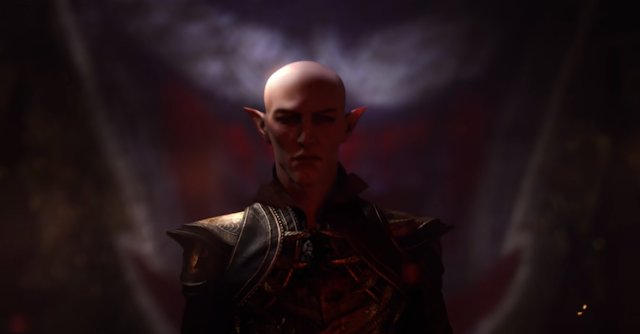
As others have already noted, it doesn't end there. Solas's voice is ever so slightly warped, lower, slower. Still beautiful (of course) but perhaps corrupted? Is it red lyrium after all? Or simple exhaustion and despair at last, after so much life, hubris, and struggle?

I still have questions. So, so many questions.

"Dragon Age: Dreadwolf" Predictions & Ponderings (and "What's in a Name?" Redux)

He doesn't call, he doesn't write, but finally, it looks like we might be hearing from Solas at last (2023?), as BioWare announces t...