Showing posts with label blight. Show all posts

Saturday, January 22, 2022

The Warden and the King: Analyzing Alistair

"The arl used to come here in the winter when I was small. I, uh... slept with the hounds."

"Yeeees?" asked Alistair, and I was smitten.
Well, you know what they say. You never forget your first love. And they're right.

When it comes to Dragon Age, my very first love was this guy. Yeah, him. The cutie over there to the right, with the slight goatee and the cowlick (I love the cowlick!) and the bewildered expression and the beautiful voice of a guy who got lost in a honeycomb and managed to remember how to chuckle about it later. And he'd do so in a manner that was incredibly charming and self-effacing, especially since he didn't actually seem to know it was charming. 

You remember this guy, everyone does.

The sweet, smart, funny, brave young guy in Dragon Age: Origins. You may know him as Alistair. Or as King Alistair. Or (ouch) as the bitter drunk guy in the bar in Dragon Age 2. Or, almost as tragically, as the Grey Warden who joined up and then may have sacrificed himself in Inquisition.

Rumors vary.

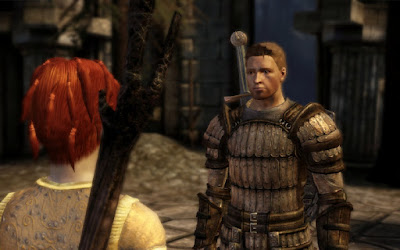
But I still remember when he gave my Warden a rose, out of nowhere. The world was so dark, the skies were as grimy and ugly as the landscape around us, and here was this sweet guy giving my little cynical, tired, nightmare-ridden elven mage Warden a rose.

It's a moment. Or rather, a Moment. It really is. Because he gives her this speech, and it's just lovely, and beautifully acted by Steve Valentine (who I got to TALK TO recently for Dragon Age Day! I know! I'm plotzing! I'll share links soon... he was an incredibly nice and generous interview.)

But yet—because the speech is so beautifully written and delivered, it somehow doesn't matter that we may be experiencing this touching moment covered in Dragon Age Origins gore, or when fighting the Broodmother, or (even more hilariously) in the middle of the confrontation about a possessed Connor (ask my good friend @ImaSithDuh about that one—it's a great story).

The thing is, no matter what, it's just a lovely moment in which Alistair pours out his whole heart, every pure thing within him, to the Warden, and whether or not she loves him back, the most beautiful thing about this scene for me is that the most innocent and lovely element in it is not the rose, but Alistair.

Take a picture of this moment. Save it like a snapshot.

Because, depending on our choices, this Alistair will not survive the Blight, either literally or figuratively.
A Tangled Tree of Potential Futures

Among all of the incredible characters across the world of Dragon Age, Alistair is one of those with the most varied and diverse array of potential futures.

Let's look at just a few: He may stay "soft" Alistair, or become more cynical and "hardened." He may  be someone whose first love is also his last—or he may rapidly progress to having a threesome with Isabela and the Warden. He may accept the Kingship or refuse it, and remain a Grey Warden. He may successfully woo the Warden or be turned down. If he does woo the Warden, he may marry them, dump them, be dumped by them, or take her as his mistress. Or he may end up married to Anora.

He may also quit the Grey Wardens if the Warden chooses to allow Loghain to be conscripted, and in that case, he may end a hopeless drunk, or (softened or hardened) he may accept the Kingship. 

He may refuse the Dark Ritual with Morrigan, or he may accept it, and find that he has fathered a child.

And, of course, regardless of any of his varied romantic paths, he may succeed in killing the Archdemon and survive... or sacrifice himself.

And if he lives, and continues as a Grey Warden, he may also survive only to sacrifice himself in the Fade, in Dragon Age: Inquisition.

Basically, Alistair's future paths are as complicated as he is, himself.

Luckily, it's Dragon Age. It's all going to be written and presented beautifully, and here, by no less than Origins worldbuilder David Gaider, who infuses Alistair with an unflagging joy, wit, and humor that it would take a stronger person than me to resist.

But hey, who wants to resist? Alistair is a sweetheart. He's just a good guy. A good, funny, brave guy.

And maybe doomed. Maybe not.

As always... it's up to us. What happens to this guy, who's so immediately engaging? In a way, it's a beautiful encapsulation of Dragon Age. He can be a hero, a true love, or a cad. He can end up at the heights of kingship or the depths of a Kirkwall alleyway (an outcome that always destroys me).

But he's still always Alistair. He's still the person who wouldn't hesitate to die for what he believes in. He just runs into trouble when what he believes in crumbles. That's his tragedy, and the beauty of his potential character arc. What does he have if he can't die for something anymore? If what he believes in lets him down? 
The Boy With the Hounds

For me, no matter what fate awaits him, Alistair's story is always tinged with just a little bit of sadness.

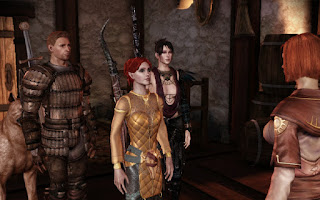
Let's start with his upbringing. Born in 9:10 Dragon, it's implied that even living under the wing of Arl Eamon, Alistair grew up pretty poor and humble, told in childhood that he was a King's bastard whose mother had been a maid who'd died giving birth to him. He spent much of his time among the animals and even slept with the hounds. He was cruelly treated by Eamon's wife Isolde, who wrongly thought Alistair might be her husband's son, and he was eventually sent away to the Chantry (in 9:20 Dragon, to the monastery at Bournshire).

And excuse me for interrupting my wall of text here, but REALLY, Eamon and Isolde? Sending this sweet, funny, affectionate kid to go hang out with the livestock and bed down with the hounds? Isolde because of that stupid thing where the wife blames the kid for her husband's imagined indiscretion? (Gah. I hate this so much. Hated it with Catelyn, for instance, in Game of Thrones. hate it here. And I hate even more that it's believable psychology that actually happens. What is WRONG with people?!) And Eamon, who does all this awful stuff simply to pacify Isolde?

Eamon. Isolde. You are terrible people. Terrible, terrible people. And execrable parents.

But back to our recap of Alistair's journey.
Finding a Place

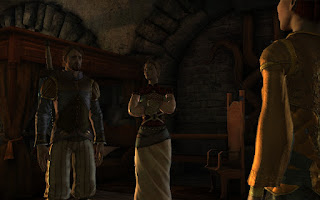
We soon discover, of course, that Alistair is actually the illegitimate child of King Maric and elven  Grey Warden mage Fiona, and that Arl Eamon had taken in Alistair at Teyrn Loghain Mac Tir's suggestion in order to shelter Alistair in Redcliffe, in part to protect the honor of Eamon's sister, Queen Rowan. Let's just say that Loghain's choice probably says something else about what an awful person he is, and as noted, I'm not a fan of Eamon's parenting skills, either.

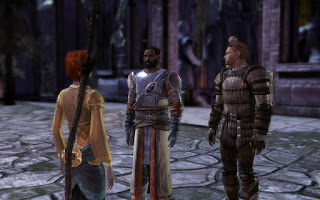
During his years with the Chantry, Alistair was trained to be a Templar, but he chafed under the demands of Chantry life. Now an impressionable young man eager to make his mark on the world, and deeply unhappy with monastery life, he was rescued from this both literally and figuratively when he met Duncan, Commander of the Grey, in 9:29. 

Alistair met Duncan and well, it was love at first sight. Instant hero worship. And who can blame him? Duncan was a commanding and charismatic figure, a living hero doing something brave and selfless for king and country. Adding to Alistair's adoration was the reality that he was just not doing very well at the monastery—he hated life there, he hated being constantly told what to do, and wanted more. He wanted to be out there, doing, fighting, achieving—not hanging out in a church.

Not long before it would be time for him to take his sacramental vows as templar, Alistair began to push himself further, training, competing, and making an impact in a tournament where he fought bravely, but was ultimately defeated by several notable templar champions, including Ser Eryhn, a superb female templar, and other renowned champions Ser Talrew, and Ser Kalvin. 

Even in defeat, Alistair's bravery and pluck made a definitive impression on Duncan, who decided the boy would be a huge asset to the Grey Wardens, and sought to officially recruit him. Alistair was enthusiastic about the chance, and both he and Duncan eventually won out against the Chantry, which didn't want to let him go—the Grand Cleric only conceded when Duncan invoked the Right of Conscription to remove Alistair from the templars and into the world of the Grey Wardens.

But let's pause for a second again.
The Worst Gift Ever

If you read this blog, you know that I'm occasionally a bit conflicted on the Grey Wardens and how they work. I admire them unreservedly for the bravery of what they do, of the sacrifice it requires for each of them, and the courage it takes to do so.

However. I'm... not such a fan of "Let's keep the risks of the Joining secret for PR reasons!" Or, hey, "Let's conscript a sweet naive kid with a hero crush into a dangerous secret organization whose induction ceremony involves a significant risk of instant death—and a 10-15 year lifespan even if you survive!"

Ahem.

But. I mean, would YOU do this to someone you loved? Would YOU look into the eyes of a sweet, starry-eyed, brave young man, and decide the very best thing you can do for him is bring him into an organization with a limited lifespan, a fellowship with its share of thieves and rough, condemned men and women, and a certain ending in madness and lonely, violent death beneath the earth?

This is where I just can't help but blame Duncan, at least a little. Despite his shallow and obvious  doomed hotness.

Sorry. It's just so brutal. I do think there's real love for Alistair there, but based on what we see in Origins, Duncan is absolutely ruthless when it comes to stocking the Grey Wardens. He needs bodies. And we quickly realize that he's willing to lie to people and deceive them to get them to the Joining. 

And this is understandable, to a degree. He's a commander under huge stress and impossible odds—a guy facing a worldwide Blight, an Archdemon, and an unexpected tyrant. And he's pragmatic enough to use whatever he can. This is also key to his personality later on, when he will suggest the conscription of Loghain to the Wardens—for Duncan, every person is a potential Grey Warden, a potential tool worth spending.

But still. I'll never quite understand him looking at this young man who is almost a surrogate son... and condemning him to the Grey Wardens.

I know the story demands it. But that doesn't mean I can't resent it for that. Just a little.

Alistair in the Grey Wardens

As far as Alistair's backstory, wow, it's a poignant and predictable scenario for Alistair, in some ways. He was semi-abandoned, starved for love, treated like a stray who was sent to sleep with the hounds. He was also a lonely child who worshipped the Grey Wardens and who dreamed of the chance for future heroism. Only his mentor Duncan made things bearable, providing the father figure he'd always dreamed of.

This mentorship can, of course, end tragically if we decide to conscript Loghain, and it's a life-changing moment for Alistair—a moment that will cause him to give up on his quest with the Grey Wardens entirely. He may end up a drunk or a King, but he will never be the same again.

Neither will we.

Still, that's in the future. For now, Alistair thrived much more under the Grey Wardens than he had with the templars and Chantry, and the lonely young man found himself his first family of fellow misfits.

And then the Blight hit—and we begin the events of Origins, joining Alistair as our first window into the Grey Wardens.

Fairy Tales and Other Outcomes

Alistair is our Warden's first friend among the Wardens, and our immediate first party member. He  gives us our introduction to how the Grey Wardens function, and is basically a soft and understanding companion who guides us into our entrance into fighting a dark and Blighted world, no matter what our chosen origin story.

The key thing about Alistair is that he's just this guy who's funny and kind, our first friend, this Grey Warden who's dedicated to the cause. But his is a journey we're going to watch, up close, firsthand, whether he's our friend or enemy, whether he's a lover or more than that, and whether we dump him or he dumps us.

He's still pretty much always ridiculously charming. But that charm is different if the sweet kid becomes a cynical man, which makes it more painful if we, for instance, happen to play an elven mage romancing him during the Origins story. If we support his path toward kingship, it's that much more devastating when he promptly dumps our Warden as no longer appropriate as a consort. And he's honestly, again depending on choices here, pretty surprisingly cruel about it—especially if doing so as "hardened" (the path for Alistair in which we tell him, after the confrontation with his "sister" Goldanna, that he needs to toughen up and accept the world as it is).

So it's a crapshoot. We may end up with our chosen happy ending as Queen or (for the more accepting and cynical, as mistress), or as companion to the Warden who renounced the kingship—or we may end up dumped... or, worse, mourning the death of our lover, ex, or best friend.

Alistair as Party Member

The fun part of Alistair in our party in Origins is, of course, how he interacts both with our Wardens and (most of all) with our party members. Every relationship is fascinating and instructive, and tells us about each person—both who they are, and who they may become.

With Morrigan he is antagonistic and distrustful, and while I wouldn't exactly want to watch it, I admit that their banters are the stuff of rom-com legend, and I can totally get those who ship them. The love/hate energy is absolutely present.

With Wynne, he's boyish, familial, and a little coy, begging for shirt-mending and sock-washing and support, blushing when she offers too much help. I love their relationship, it's bittersweet when you remember that he never actually had a loving mother figure before her—more on this in my upcoming Meaningful Banters post separately.

While with Sten, he's respectful and appropriately wary. He's openly intrigued with Zevran's world-weary and open sexual confidence (and a little abashed by it), and easy and charming with Leliana (and for me, at least, it's easy to ship both of them here), and amused and curious with both Oghren and Shale. He is, of course, as the boy from the hounds, an outstanding friend to Barkspawn.

It's all so much fun, and so fascinating. 

Immortal Alistairisms

Thanks to David Gaider's innate wit and wordplay, Alistair is always charming and fun to be around, and some of his lines are easily the most immortal across the series, especially, of course, such gems as "Swooping is bad," and "I'll just stand over here until the blushing stops."

"What? Lead? Me? No, no, no. No leading. Bad things happen when I lead. We get lost, people die, and the next thing you know I’m stranded somewhere without any pants."

"Yep. Beasties. Beasties are coming."

"Have you ever licked a lamp-post in winter?"

"That's what I'm here for. To deliver unpleasant news and witty one-liners."

"Andraste's flaming sword! I know where babies come from!"

And my personal favorite: "You know, one good thing about the Blight is how it brings people together."
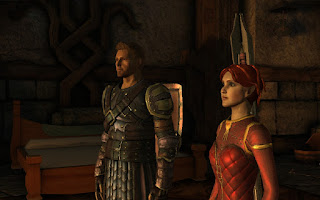
He's also predictably kind when delivering a notice of death: "I hope you like heroes, my lady, because your husband died like one." or "I'm sorry but your husband has fallen in battle. You have my condolences."

Basically, most conversations with Alistair feel like a warm hug with a chuckle at the end. It's incredibly disarming. It was also fun, later on, to see Gaider bringing a similar wit to Dorian, but of course with Dorian we're getting a much more sophisticated and self-aware character. But the same quick wit is still very much a throughline there.

My Journeys with Alistair 

I'm gonna be honest. I've resisted writing about Alistair because, although he was my first Dragon Age love, he also left me with some pretty conflicted feelings.

You know how it is with Dragon Age. These characters feel real. They sneak inside your heart.

And that's what happened with Alistair for me. As with so many of these characters.

My first playthrough ended happily enough, although it felt weird to me. My Warden romanced Alistair, he stayed softened (we gave Goldanna WAY too much money!), refused the Kingship, did the Dark Ritual (yes, everyone's doomed because of this, let's face it, at some point we're gonna have to PAY for this!), and they went off into the sunset together. But the odd thing was, I just didn't see it working out. I adored Alistair, but there was no way in my mind that these two people would ever last romantically. My Warden was too prickly and traumatized (city elf), and Alistair just felt too soft to me to survive her personality long-term. I was so convinced they wouldn't work out that I even wrote a fanfic about my headcanons, because honestly, by the end, I felt like she'd had a deeper connection (doomed, of course) with Sten.

I played other outcomes with Alistair after that, and weirdly that first playthrough was one of the happiest, although it played out oddly in my head. I did get another sweetheart of a playthrough with a Cousland where Alistair married her, and it was a lovely feeling to see our boy installed as King and yet happy in his new role, and with the woman he loved by his side.
The Darker Side of Alistair

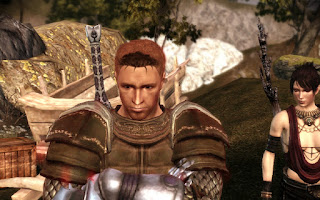
Of course, I also played other, less happy outcomes. And just as a Qun-loyal playthrough will show you an unexpected and colder darker side to The Iron Bull in Inquisition, if you make certain choices with Alistair in Origins, you also get glimpses of his darker side, too. He's pretty brutal if he decides to dump you for the kingship, and if you "hardened" Alistair it's definitely one of those "be careful what you wish for" scenarios, because this is miles away from the sweet boy who once gave you a rose.

Meanwhile, if you take Duncan successor Riordan up on his suggestion to conscript Loghain for the Grey Wardens (for me, it's the perfect punishment for Loghain), Alistair goes absolutely nuclear. Even if you are at 100% approval with him, even if you're romanced, if you choose this, Alistair shuts down completely, goes stone-cold, and severs all friendship with you. He will also walk away from the Wardens (and from fighting the Blight), which stunned me the first time I played it.

The most surprising aspect for me in this potential storyline was that even when we defeat the Archdemon, if he is King, Alistair will talk to us one more time, but nothing has changed. He is still unrelenting and unforgiving, and he basically coldly tells us we should have died, and he's suspicious and going to investigate why we didn't (very plainly implying that he wanted us to do so).

And look, I get it. Every one of us has something we cannot allow, forgive, or overcome. Every one of us has an edge of the map, a "here there be dragons," go-no-further point. For Alistair, who is normally a pretty forgiving person, that edge of the map is the idea that Loghain survives in any way. For Alistair, the only appropriate outcome for Loghain's treason is death—and it's certainly the standard punishment for that crime, especially in the magical medieval world around him.

But it still shocked me. During the whole epilogue at the castle, I remember how I kept trying to talk to Alistair again, to explain that I had done what Riordan had wanted, wanting to tell him why I felt becoming a Grey Warden was actually appropriate for Loghain (he becomes the very thing he betrayed and tried to destroy), and that 10-15 years of fighting Darkspawn, ending in a lonely death beneath the earth was far more suffering than a quick fall of the ax. But of course, I couldn't. Alistair isn't going to listen, you no longer exist for him, his heart is hard, and he has a kingdom to run.

Fairytales and Their Endings

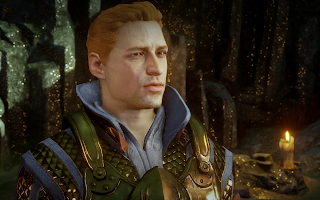
At heart, though, Alistair is a prince—a sweet guy who makes jokes even in the worst or most impossible situations, whistling in the dark. 

At his best, Alistair doesn't really want power, or kingship. Which is, of course, why I think he ends up being such a good king. It's always those who don't want the power who are best at handling it— the person who doesn't want to be king is usually much better and fairer than the person hungering for the throne. Even if he marries Anora, if he does so without taking the Warden as mistress, there is a sense (for me at least) that he's going to try to make the best of it, that he and Anora will try to find solace and companionship in each other. First, because it's expedient, and second, because, well, that's the way Alistair's built.

In the end, I really think he just wants to love and be loved. He's not just the giver of the rose that survives the storm, he's also that rose, himself—a delicate thing, whose survival was a kind of miracle.

But roses die. Princes, Wardens, and kings, die too, willingly sacrificing themselves against Archdemons or Fade monsters. Or they fade away as drunks in alleyways. Or maybe they just grow old, running a country next to a woman they may or may not love, or walking the darkness with fellow Wardens while their time runs out. In every one of these futures, Alistair is still going to be funny and charming; he's still going to say something fantastic and witty at just the right moment, no matter how much darkness or sadness is in his heart. Because that's also how he's built. He'll always try to add a bit of hope or sweetness where he can, to lighten the darkness.

Perhaps the most poignant lesson of Dragon Age: Origins is that the brightest lights are still capable of going dim. Roses bloom, even in darkness, but they also die. 

Sometimes, maybe it's enough that they ever bloomed at all.

Saturday, June 15, 2019

Meaningful Banters: Dog and Sten, Crime-Fighting Duo


"I'm a giant with a war dog. Either I am making a delivery, or I am besieging your fort. Hope for the former." Sten and Dog. Crime-fighting duo. And it is GLORIOUS.
STEN: (Resigned Sigh) ... Fine. Bring me the stick. But this is the last time, I swear it.

This is a silly, sweet, goofy post simply to celebrate the unspoken adoration between Sten and Dog in Dragon Age: Origins.

Because it deserves illustrations and blog posts and statues since it is, honestly, amazing. Sten seems to have a special affinity for delicate things. For flowers, kittens, animals. For creatures weaker than himself. And it's a lovely, hidden and very subtle character note.

He has an especially lovely relationship with the Warden's mabari ("Dog") if they saved the dog in one of their earliest quests.

Which is why I think we need to visit it here, since it is sweet and adorable and funny and we really need it, especially (if you're me) after analyzing the nihilism of the Qun for two weeks straight).

So here we go:

The first thing you must absolutely accept is that Sten does not like animals. Nope. Nope. Nope. He may pet kittens and play with them. He may talk seriously to our darling Dog (whom I call "Barkwise," called "Barkspawn" by the fandom) but oh, no, he does not care about them at all.

Nope.

Sten Hates Pets

However, late, late at night, if you are awake at the Warden's camp, you may witness a few cracks in Sten's armor when it comes to your faithful canine companion:

DOG: (peers up at Sten, tail wagging)
STEN (sternly): We don't have time for this now.
DOG: (Dog continues peering, a little more determined)
STEN: No, absolutely not.
DOG: (Whines)
STEN: There is no time. We have work to do.
Dog: (Whines)
STEN: (Resigned Sigh) ... Fine. Bring me the stick. But this is the last time, I swear it.
DOG: (Very Happy Bark!)

Meanwhile, back at Camp, Sten is pretending not to adore Dog and pay him allegiance. Because he is Sten and has a secretly chewy nougat center:

DOG: (Barks)
STEN: I don't understand you.
DOG: (Whines)
STEN: ... Are you trying to say something about a child in a well?
DOG: (Dog gives Sten a quizzical look)
STEN: No? Never mind, then...

Sten visits again another night at camp. Dog gazes into his eyes:

DOG: (Growls)
STEN: (Growls back)
DOG: (Growls)
STEN: (Growls back)
DOG: (Barks)
STEN: You are a true warrior and worthy of respect.
DOG: (Happy Bark)

There's a subtext of this -- that Sten appreciates a fellow warrior, even a wordless one. But let's face it. The tragedy and sweetness of Sten is that he loves animals. And they love him. Look at his little shy hidden moments with kittens, with talking to Barkwise (DOG) like he's an equal. It becomes apparent that the Qunari do not allow these indulgences, and as in most cases for me with Sten, it kind of breaks my heart.

Y'all, Sten just wants a pet. Or maybe a houseful. I know Cullen breaks the Internet as of Trespasser with his imaginary sweet home for retired mabari, but come on, Sten is more your total ASPCA guy, going:

STEN: You are here to adopt a pet.
VISITOR: Yes, sir.
STEN: What kind of an animal do you wish?
VISITOR (swallowing visibly) I wish... a dog.
STEN: Simply for use, or affection?
VISITOR: (squeakily) Affection?
STEN: That is doubtful due to your country's insistence upon canines primarily as useful agents of protection.
VISITOR: Fereldans love their dogs, sir. We do indeed.
STEN: As you should. Hmm... 

A break.

STEN: And how do you feel about felines? They too, require love and serve a purpose...
VISITOR: I would be open to a cat as well. But we need something to guard our homestead.
STEN: I see. Yet still, a feline that helped to guard your barn and surrounding areas would manage the vermin and give a home to a highly worthy animal. 
VISITOR: Ah... I...
STEN: And they are highly amusing, felines. Try dangling a piece of string. They respond with surprising enthusiasm.
VISITOR: Um.
STEN: It is... quite charming.

(SILENCE)

VISITOR: I'd love a cat and dog, please.
STEN: Thank you. Please sign here, here, and here. And please make sure you spay your feline after you have a litter to succeed her in your barn. I will be following up personally.
VISITOR: Ab—er, absolutely.


Sten, with genuine regret: "And now, I'm talking to an animal. I've been in this country too long."
Barkwise: "HAPPY BARK!"

Best. Mission. Ever.

So of course Sten chooses Dog for the Fort Drakon rescue of the Warden. And it is EVERYTHING:

They are challenged. Sten shrugs with all the centuries of Qunari assurance on his shoulders and in his visage. He is stern, calm, immovable:

STEN: I'm a giant with a war dog. Either I am making a delivery, or I am besieging your fort. Hope for the former.
DOG: (BARKS)
GUARD: I wasn't told we were getting a mabari.
STEN: Must I point out the obvious? I'm a large, impatient man with a war dog. Either let us in, or get someone who will.
DOG: (ANGRY BARKING)

The guard lets them in. Because, come on. Sten and Dog.

STEN (to DOG): This is pointless. We should simply go in fighting.
DOG: (WHINES)
STEN: And now, I'm talking to an animal. I've been in this country too long. 
DOG: (BARKS HAPPILY)
STEN: I am supposed to take this dog to the kennel!
GUARD (dubiously) You're a dog trainer?
STEN: ...I have a dog. What more do you want?
GUARD: I don't even know what you are. But you certainly don't belong in here.
STEN (to DOG): I didn't want to sneak in, anyway.
GUARD: Men! We're under attack!
DOG convincingly begins to shake, shudder, and retch.
GUARD: What's wrong with him?
STEN: I know nothing of... beasts. You are Fereldan, don't all you people keep dogs?
GUARD: I'm not poking and prodding no mabari to see what's wrong with him. I like not bleeding.

They are allowed entrance. And all is right with the world.

Sten and Dog, fighting crime. One dimwitted guard at a time. Coming soon to a network near you. OR IT SHOULD BE.

Sunday, June 3, 2018

The Wounded Veil (May 2018 Map and Lore Update)

As you may remember, I wrote back in January about the status of the Veil as of the end of "Trespasser," and about my theory that for Solas's plan to eradicate the Veil to succeed, in actuality, all he really has to do is... wait.

In the latest version here, I have updated my original map to reflect additional key locations in Tevinter, the Anderfels, the Storm Coast, the Hissing Wastes, the Blackmarsh, the Lost Temple of Dirthamen, Seheron, and a few others that I missed the first time, and which some fantastic folks on Twitter were nice enough to point out. I also clearly marked every mage circle location specified across Thedas (note: with the exception of the one in Antiva that's never specified as far as city).

Mending the Veil

Beyond Solas's ancient elven artifacts (which I do believe will genuinely help to strengthen and ward the Veil), I did a bit more research and reading, and there is, however real evidence that it's possible to further heal at least some of the Veil tears we encounter across the story.

For instance, in Dragon Age: Origins, a demonically possessed Sophia Dryden can openly heal a major Veil tear right in front of our Warden at Soldier's Peak, in a bargain with the Warden for her freedom. In the "Awakening" DLC, meanwhile, several spirits and demons are presented as actively keeping or holding Veil tears open. The Warden-Commander can then repair those by killing the demons or spirits responsible.

In the Dragon Age II "Mark of the Assassin" DLC movie spinoff Dragon Age: Redemption (about the further adventures of an elven Ben-Hassrath named Tallis, played by Felicia Day), a Qunari Saarebas is able to tear the Veil by using an artifact of the Dalish known as the Mask of Fen'Harel. By destroying the mask, Tallis is able to close the impending rip in the Veil.

These instances seem to be rare, however. In one of the Codices for Dragon Age: Origins, First Enchanter Wenselus is quoted as saying "Once the Veil is torn, it is extremely difficult to mend, some say impossible."

Damage to the Veil

Still, I continue to believe the Veil is doomed... I even continue to wonder if that's why Solas hasn't acted at the end of Trespasser. As I've noted in my Character analyses on Solas and his romance, I do think he's conflicted, and I don't think he is truly prepared to tear down the Veil and doom the world, flawed as it is, that he's grown to care for (much less the people he loves within it).


And let's face it... if I'm right, he won't have to anyway. The Veil is shredded. And I suspect it's actually in far worse shape across Tevinter than I'm showing here, simply because I feel like we have so little information about it as a location in general. But their use of blood magic is rampant and goes back ages, and it's a triple-whammy in terms of thinning the Veil because of the (1) magic use, (2) blood magic, and (3) death and bloodshed.

One of the other things I want to add in this update is that I realized upon further research that the Mage Circles across both Orlais, Ferelden and Tevinter weren't just locations where the Veil went thin through magic use (and in many cases, bloodshed). They were in fact chosen, in almost every case, because they were places where the Veil was already thin. Which is interesting because that's certainly more dangerous for mages and increases the potential for Abomination.

In other words, it's evident that the need for power supercedes the risk of Abomination, and I suppose I can see that when a Blight comes calling—that it's thought to be worth that risk to increase magic potency and strength even if the danger to the lives of mages went up. But then again, that's the tragedy, isn't it? Historically, nobody really values the lives of mages. They're simply tools, weapons to be kept locked away until it's time to use them.

The important thing is, this means that we started with a thin spot for each and every Circle. For each of the most important cultural Tevinter locations where magic use was involved. For each key ancient elven location.

And then it just proceeded to get thinner. 

In other words, it's not looking good for our friends in Thedas—I'm guessing from what we're looking at here that the Veil has less than a millennia of life left to it. Maybe even just centuries. 

Or maybe it's already poised to go up in flames, a potential bonfire just a single match away from conflagration. 

Will Tevinter light that match? Or the Qunari? I still don't think it will be Solas.

Meanwhile, what do you think? And did I miss anything else here? Are there any other factors I should include here? I'd look forward to your input, as always!

Saturday, August 12, 2017

Sera and Andruil: Echoes of the Huntress

Solas: We are not so far apart, you and I.
Sera: We will be.

Funny, brash, and maddening, Sera can be both charmingly sweet and occasionally, breathtakingly cruel. She's the impudent friend who's spent her life thieving (but who, like Robin Hood, never forgets to champion the little people), who drinks herself under the table, flashes her ass at prim and proper Vivienne, and who jokes with Bull and Blackwall. She also taunts Solas constantly—not for his secrets, but ironically, simply for embracing a shared heritage she has refused to acknowledge in herself.

Sera is a superb archer who's bold, slightly mad, loves women,
and who hates dragons, Solas, and injustice. She bears an
intriguing similarity to the Elvhen goddess Andruil.
However, Sera, out of all our companions, cares most about the common people of Thedas's world—the poor and abused who suffer most during the appearances of Breaches and Blights (although she has a definite fondness for breeches of another kind). Sera thumbs her nose at propriety, is wary about getting too close to people, hates her own "elfyness," and also deeply dislikes people writing songs about her skills at thievery and archery. Do that, and you just might get a lute over your head.

However, what's even more interesting about Sera is that while she hates and fears her own elven heritage, there are several mysterious hints within Dragon Age: Inquisition that she may in fact, like Flemeth, carry a spark of the Evanuris (ancient elven immortals) within her—specifically, in Sera's case, the "wisp" of the elven goddess of the hunt, Andruil. (Note: This has been a popular topic of discussion across the DA fanverse, but I wanted to write my theories before reading others. I've now gone through several outside debates on this as well, so I definitely want to credit Shaylyn Ispan, who started the discussion following some early Bioware posts—her original post and analysis is not only detailed and worth reading, it also includes the fantastic revelations of the Andruil Vallaslin superimposed over Sera's Tarot card.)

According to the tales and scraps of information we uncover in Dragon Age: Inquisition, the ancient Elvhen goddess Andruil was a superb archer, creating what was known as the "Vir Tanadhal," or "The Way of Three Trees." This Way involved three branches: The Vir Assan ("Way of the Arrow," a directive to, per the Dragon Age Wiki, "fly straight and do not waver"; the Vir Bor'assan ("The Way of the Bow," to bend without breaking), and last but not least, the Vir Adahlen, or "Way of the Forest," which involves the acceptance of the gifts of the hunt with humility and compassion.

Let's apply these to Sera: She lives and breathes the Way of the Arrow ("Arrows!" is her answer to most quandaries), she's a survivor, bending without breaking, and she gives generously of the hunt with compassion to the humblest in Thedas.

In other words, Sera shares an incredible number of similarities with Andruil: She's a superb natural archer whose abilities are commented on with amazement (along with the reminders that she achieved this with little to no training), she's both compassionate to the "little people" but also cranky and distrustful of authority figures. She's more comfortable on her own than in a group. Like Andruil, Sera is quite willing to act mercilessly in vengeance, and like the huntress, she does so swiftly and brutally. 

Also like Andruil, whose beloved was a woman named Ghilan'nain, Sera is gay, a woman who loves women, and she prefers a life that's fierce and free, untethered. Andruil's ambitions eventually drove her mad, and here again, Sera shows more than an occasional hint of mental instability. Another way Sera resembles Andruil is in her antagonism—just as Andruil once actively fought against Fen'Harel directly on more than one occasion, Sera clashes constantly and adversarially with Solas, as well as with Mythal (so this is probably a good moment to note that Sera's curiously drawn to fighting dragons—interestingly, Mythal's symbol is a dragon, and it's also Flemeth's alter-ego/shapechanging form).

Another potential similarity is the fact that Sera's greatest fear (as we discover in the Fade) is simply "nothingness." What was Andruil's greatest feat? Entering the forbidden Void in order to hunt the Forgotten Ones—a feat that drove her mad. (Eventually Mythal intervened and removed all knowledge of the Void's location from Andruil's mind).

Sparring with Solas

And this is where it gets really interesting. My feeling that Sera has an inner magic or presence isn't just based on her outer similarities to Andruil, but on her own acknowledgment that there's something else going on within her that scares her to death.

Interestingly enough, the person who brings this out in her? Solas. 
In her conversations with Solas in the game's banters, Sera suddenly shows outright terror and disturbance at something she can't define (she is shaking visibly). Solas asks her what's happening, and this is the conversation that follows:

Sera is terrified of acknowledging her "elfyness." What if her
fear is actually of awakening the ancient elven presence
within herself?
Sera: Weird.
Solas: Sera? What are you feeling?
Sera: Ugh, here we go. It’s nothing, it just feels like I've seen
this. Exactly this. It happens.
Solas: Not to everyone.
Sera: It’s not an elf thing. Inquisitor's not shaking (alt: You're not shaking). I suppose now you’ll switch to how I’m 

the same but different?
Solas: You are different. You are the furthest from
what you were meant to be.
Sera: Well I’ve definitely heard piss like this before. Hmph!

This is one of my favorite banters across the game—the moment in which Solas, quietly and without doubt, says to her, "You are the furthest from what you were meant to be." As if he knows exactly what or where that is. 

This moment is echoed again in a later banter, this time with Cole, as Sera feels that strange sense of deja vu again:

Sera: Have we been here? I mean right here, doing exactly this? It feels weird.
Cole: Yes. But not how you mean. In the soft thin places, spirits push with memories that didn't happen. Or did. Or might.

Meanwhile, Solas is even able to get Sera to expound on these moments later on, despite her unwillingness to engage with him:

Solas: What color is the sky when you look at it?
Sera: You know, blue mostly. Except for the Breachy bits.
Solas: And when you looked past the Breach? As perhaps
you were drawn to do?
Sera: Greenish? Then clear a long ways, and kind of... felt
like falling. Ugh! Makes my head hurt. You make my head hurt.
Solas: We are not so far apart, you and I.
Sera: We will be.

Solas makes several similar references in the course of his conversations with Sera—that Sera is far from herself, that she is "apart," and sundered from who she was meant to be. Is Andruil who she was meant to be? A proud elf, fierce and free, a hunter of men and beasts alike?

Calls From Past Millennia

Remember Flemeth's dialogue with Morrigan in the Fade near the end of the game? About the wisp of Mythal's awareness that became part of her, and of how a soul cannot be forced upon the unwilling? I think this is hugely important—not just to Solas's story, but also potentially to Sera's.

Is Sera hearing the voice of Andruil somewhere deep inside?
Could that actually be part of why she rejects and fears her
own elven heritage?
Millennia back, Mythal was murdered by the Evanuris—the act that caused Solas (Fen'Harel) to create the Veil, imprison the Evanuris (who were enslaving their own kind, while also making a pretty fair attempt at conquering the world), and to inadvertently damn or destroy the very people he was trying to save—the elves—for ensuing millennia. 

Mythal's consciousness, however, continued to live, until (centuries before the events of DAI), she made her presence known to Flemeth, a witch howling with loss, rage and a desire for vengeance against men. Flemeth heard and accepted Mythal's presence as a kind of wakened subconscious, as a new teammate in her desire to take retribution (and, I feel, once her anger had cooled, to "nudge" the events of men now and then in the right direction). Mythal's presence in Flemeth elevated the witch to something more than mortal, and she lived for centuries, arising even from death (if killed in her dragon form in DAO) only to live again in DA2 and DAI, providing rescue, counsel and insight at key moments.

Love and Death Among Immortals

From a writing standpoint, I think Mythal clarified this for us in DAI so that there was no mistake about the final scene in the epilogue between Flemeth and Solas (also a scene between Mythal and Fen'Harel, of course). But generally speaking—we see Flemeth send another of those familiar "wisps" of soul into her eluvian. Then she simply, calmly awaits Solas. When he arrives, their reunion is sorrowful and loving. Solas even notes that he is the one who should pay, but that he cannot leave his task undone. Mythal, meanwhile, seems to be nothing but supportive. She is either actively cooperative or passive as Solas then, sorrowfully, takes the wisp of life from Mythal. That light instantly glows in his own eyes, over her apparently lifeless body, but that still doesn't account for that wisp she sent through the Eluvian, so I'm totally in the camp going, "Flemeth/Mythal's not dead, guys" (and it's echoed again, smilingly by Solas in "Trespasser," when he admits, "The first of my people are not so easy to kill"). So, basically, Solas got a huge power-up (and I'd imagine the life of a goddess to be a significant boost, judging from his seriously terrifying powers in "Trespasser").

Now, the early dev notes (as posted by Reddit user Libito) do say that Solas is willing to kill Flemeth/Mythal there, so it's definitely possible that he was prepared to be ruthless there. But there's no need... and I like that the scene is presented so lovingly—it's actually sadder and more disturbing that way, and foreshadows the deep love between them that we hear about later in "Trespasser."

But let's get back to Sera—and here's where it gets interesting.

Wisps, Souls and Voices

Flemeth willingly, and in full awareness, accepted the wisp or spark of Mythal's soul. She further emphasizes to Morrigan that there is no real possession involved in the process and that it's entirely voluntarily. She later takes a similar wisp or spark from Kieran (presumably, the spark of the Old God Soul created in him when Morrigan did the Dark Ritual back in DAO). Kieran's wisp is one that I actually think may be more like Sera's -- it didn't seem to be a possessive consciousness for him so much as an additional awareness. (He does express regret to Morrigan that he will be lonely now, once the wisp is gone.)

In addition, remember that it's been established that the first of the Evanuris—at least, Mythal (and perhaps more) can speak to mortals in dreams, as we hear that Mythal has done after the game has ended, if we go back to Val Royeux. Once there, we can hear a woman talking confusedly about her dream-conversations with someone called Mythal—so once again, Mythal has defeated death (and is definitely not gone for good).

So what about Sera? Sera would never accept this kind of soul-subletting, not least with an ancient elven goddess. No way, no how.

A Whisper of a Presence (and a Tie to the Fade?)

With this in mind, my feeling is that Andruil is a dormant and probably inadvertent, trapped part of Sera's soul or subconscious—latent, not active, just whispering to her in dreams and perhaps around the edges of her life. For me, it's almost as if Sera is a distant reincarnation of Andruil, with her most distinctive traits mirroring those of the goddess even as she remains her own person. So she's a superb (almost preternatural) archer and huntress, she is a woman who loves women, she's subversive yet strongly traditional, actively opposing both the dragon (Mythal) and the wolf (Solas).

So my guess is that it's only around the very edges of Sera's life that Andruil whispers her presence—in dreams (another reason for Sera to hate and fear the Fade), or as when Sera grows dizzy looking into the Rifts, or when delving into herself for magic.

Cole also makes some very interesting observations that may denote Sera's inner divine spark as well, as when he tells her, "There are songs in every part of you, Sera. Soft silly sibilant, sighing in silence, waiting for you to hear them." Sera, in response, furiously refuses to listen further.

This would also explain Solas's constant fascination with Sera—a fascination that isn't romantic but which does appear to be intense and almost eager. As a person who is deeply lonely, with no companions from his era save Flemeth (who appears to have distanced herself after the disaster of the Orb and the Temple of Sacred Ashes), Solas would certainly be eager to see potential connections with his lost companions—even those who opposed him.

Does Solas therefore see the echoes of Andruil, his old antagonist, in Sera, and seek to draw her out in his loneliness and desire to reconnect with his ancient people? Even if—as is implied—he brought about her death?

It's a really interesting thought. My guarded answer right now is... Yes. I think he does.

It also provides another really believable answer for why Sera is so antagonistic to Solas (yet also why she is consistently drawn to answer him truthfully). He is pulling abilities and visions out of her that frighten her, and that she does not want awakened.

This is why I believe Solas remembers Andruil when he looks at Sera, and marvels: "You are different. You are the furthest from what you were meant to be." 

It's both sad and believable how, to Sera, this sounds like the Dread Wolf's worst curse of all.

"Dragon Age: Dreadwolf" Predictions & Ponderings (and "What's in a Name?" Redux)

He doesn't call, he doesn't write, but finally, it looks like we might be hearing from Solas at last (2023?), as BioWare announces t...