Showing posts with label Kieran. Show all posts

Tuesday, January 30, 2018

The Loneliest Hedge Witch

Morrigan is terrifying, cold, cruel, and yet, oddly lovable. She doesn't care
what you think. Except, of course, when she does. And it's heartbreaking.
Morrigan: My mother's stories curdled my blood and haunted my dreams. No little girl wants to hear about the Wilder men her mother took to her bed, using them till they were spent, then killing them. No little girl wants to be told that this is also expected of her, once she comes of age.
Leliana: I... uh... I see.
Morrigan: No, you don't. You really don't.

SPOILERS for Dragon Age, all three games, as always!

She's cold at first—haughty, rude, and distrustful. She has shaggy, silky black hair, chopped loosely around her face. She can take a variety of shapes but prefers often to fight as a spider, an incarnation of everything female and terrifying. She must certainly have a constant, low-grade temperature, since her everyday attire requires her to basically go topless twenty-four hours per day, and yet she uses this nakedness with casual disdain, like a weapon. Just as her mother, Flemeth, taught her to do.

Meet Morrigan, a complex woman disliked by as many Dragon Age players as those who patently adore her. 

Like Anders, Solas, Loghain and Blackwall, Morrigan is a deeply polarizing character. And I can certainly understand why.

Morrigan's not easy to know—or like. She's cold, cutting, unkind, acerbic, antisocial, and frequently pitiless. She distrusts her companions, as well as curiosity, kindness, gifts, and softness. She's operating on her own hidden agenda. And she, like so many companions in these games, is very often lying to us. And, again, as with those other characters we may adore across the trilogy, the lies have nothing to do with her love for us. She can love us and still absolutely refuse to tell us the truth. She therefore joins everyone from Zevran to Bull to Anders to Solas. Lying is, after all, just another survival skill.

But I admit it... I love her. Thanks to the genius of writer David Gaider, Morrigan's a complex, brittle, vulnerable, and beautifully written character. And best of all, she's voiced with complexity, heart and intelligence by the talented Claudia Black, whose rich, warm voice gives Morrigan the warmth she doesn't always evince visibly. And I love the way writer Gaider and performer Black give Morrigan a distinctive and deliberately Shakespearean vocal pattern. All those 'tises and 'twases are so wonderful and distinctive, both artificial and yet beguiling, the perfect character notes for someone who hides as much of herself as possible. And who may even be attempting to protect herself and her swamp rags with speech that would be acceptable in any court in the land.

It's as if Morrigan grew up in the swamps, but thanks to her terrifying mother's education, she also emerged with a fantastic and regal manner of elocution that would have allowed her to rule the world... from a throne, or from the stage... if she'd just been discovered! Although, now that I think of it, I think Morrigan would have found the entire idea repugnant... even if I think Flemeth would have gotten a kick out of eating hearts from the stage, herself. Let's face it, when it comes to Flemeth, that girl's got a dramatic flair that exceeds the known bounds of Thedas.

Note: I got to see incomparable Flemeth voice actor Kate Mulgrew and the rest of the original cast of the revival of Equus in 2008 on Broadway, including Daniel Radcliffe and Richard Griffiths, and it meant so much to me to see Mulgrew, especially, among a peerless cast, as I'd always adored her as an actress. Hearing that warm, purring voice live and in person will always be a theatrical hallmark for me.


But back to our own, prickly Morrigan...

A Dark Yet Vulnerable Heart
Morrigan is a kind of litmus test for how much Dragon Age players are willing
to invest in darker characters. Do we despise her cruelty and take it as-is? Or
do we attempt to affect, understand and change her?

Morrigan's a kind of subtle litmus test for Dragon Age players in many ways, I think. She's not easy. She's not kind. She will many times approve of the cruelest of choices (supporting, for instance, murder or even mass enslavement in the moment).


But, well, that's not all she is. Or even perhaps who she was meant to be. Even in her earliest days with Dragon Age, there's more there to Morrigan than just cruelty and distrust, and that's what makes her so tragic and yet lovable. The cruel-hearted hedge witch may be who she pretends to be at first... but is that who she ends up being? 

Is that who she really is all along?

I don't think so. I think she's more... or can be, depending on whether she has a supportive and high-approval relationship with the Warden. Someone to show her friendship and love, and who gives her the opportunity to look beyond the darkness in her own heart.

The Witch of the Wilds

I adore Flemeth in all her strength, fire and complexity, but as is appropriate to her inner elven evanuris persona, she is both terrifying and wonderful (and there is little in between). More than almost any other character in the series, I think Flemeth is a character who has shown herself to be both changeful and mercurial throughout the decade of events covered by the Dragon Age trilogy, depending on where her gaze was focused.

For instance, in terms of DAO, it's apparent that Morrigan was raised by a Flemeth who was all rage and vengeance, who was hard as stone. I believe the Flemeth of this period was perhaps more immersed in her connection to Mythal than before, and that she was perhaps focused almost to the point of blindness upon the greater events across Thedas (and Solas's upcoming awakening). Imagine growing up as a child in a little hut in a swamp with a woman whose every act was either centered on teaching a brutal lesson or on utterly ignoring your needs so that she could order to see (and "nudge") the great events of the world.

With this in mind, Flemeth raised little Morrigan in almost total isolation, and with an iron hand. Sometimes gentlemen entered that swamp (and Flemeth's bed) and then disappeared. Sometimes Morrigan herself acted as bait, luring the men to be dispatched by Flemeth. There were, apparently, no little moments of softness. No pretty things, no gifts of any kind. To me, it seems apparent that Morrigan was a tool—a knife, an arrow, something deadly and sharp that Flemeth was shaping to be part of her vengeance against men (and, perhaps against the resurgence of the sleeping gods who betrayed Mythal).

Talk about a tough childhood.
Morrigan grew up without love, without a single gift or softness.
It makes me incredibly sad for her. And it also makes me want to
throw things at Flemeth, who I normally adore.
It's interesting to note that just like Morrigan in their own ways, the Circle Mages too lived in a certain isolation and entrapment, and that even though Morrigan was herself a free child and young apostate for many years, she too eventually felt the bars of her cage on occasion as well.

The Wild Child

Yet Morrigan herself felt the occasional yearning for the outside world, just as the Circle Mages did. Take this beautifully written and intensely moving conversation with the Warden in Dragon Age: Origins:
Morrigan: A world full of people and buildings and things was all very foreign to me. If I wished companionship, I ran with the wolves and flew with the birds. If I spoke, it was to the trees.
Such simple pleasures will only enthrall for so long. I recall the first time I crept beyond the edge of the Wilds. I did so in animal form, remaining in the shadows and watching these strange townsfolk from afar. 
I happened upon a noblewoman adorned in sparkling garments the likes of which I had never before seen. I was dazzled. This to me seemed to be what true wealth and beauty must be. I snuck up behind her and stole a hand mirror from the carriage. 'Twas encrusted in gold and crystalline gemstones and I hugged it to my chest with delight as I sped back to the Wilds. 
She was not... Flemeth was furious with me! I was a child and had not yet come into my full power and I had risked discovery for the sake of a pretty bauble. To teach me a lesson, Flemeth took the mirror and smashed it upon the ground. I was heartbroken. 
Beauty and love are fleeting and have no meaning. Survival has meaning. Power has meaning. Without those lessons I would not be here today, as difficult as they might have been.
Perhaps my time in the Wilds was indeed lonely. But such was how it had to be. I find myself wondering at times what might have become of the girl with the beautiful golden mirror, but such fantasies have no place amidst reality.
Ultimately, if we speak to Morrigan frequently in DAO and work to befriend her, it becomes apparent that beneath that hard exterior she's incredibly lonely and insecure. I was so moved, for instance, by the moment when she literally doesn't know how to respond to the Warden simply giving her a gift and not expecting anything in return. Here, when the Warden, remembering her story, gives her a mirror similar to the one Flemeth destroyed so long ago, Morrigan breaks down and is genuinely moved:
Morrigan: What have you there, a mirror? It is just the same as the mirror which Flemeth mashed on the ground so long ago. it is incredible that you found one so like it. I am uncertain what to say. You must wish something in return, certainly.
Warden: It is simply a present.
Morrigan: I have never received a gift. Not one that did not also come with a price attached. But I would be a fool not to accept such a gesture with grace. Your gift is... most thoughtful. Thank you.
Morrigan can absolutely be cruel and pitiless. But she has been created to be
so. If we attempt to support her, surprising depths and revelations will emerge
.
Again, the revelation that Morrigan has never received a gift in her entire life is enormously touching to me. And it tells us everything about her capacity for cruelty and her ability to choose the dark outcomes... it's what Flemeth had her do her entire life. And it also explains the hard and protective shell she has built around herself, and the occasions on which she chooses cruel outcomes because she feels they are necessary. Morrigan, in a subtle way, it can be argued is ultimately herself a slave, subservient to a greater power forever (and even more so if she drinks from the Well in DAI). I think, or guess, that this is her baseline. Which in turn makes it far more understandable when she sides with slavers. She's simply making the cold choice, going, "I survived slavery, why can't you?" She is typically blind, not seeing what's really involved there beyond grim expediency.

And ultimately, Morrigan's stance on slavers and Dark Rituals and hard choices becomes much easier to understand once you realize she was raised to anticipate such choices, and to always choose such outcomes. To choose the scenarios in which fate might seem cruel but inevitable is written in Morrigan's DNA. However, these traits are also part of a ruthlessness we can, in part, heal, if we provide her with love and companionship.

Finding the Softer Side of Morrigan

I find Morrigan fascinating because she, much like Solas, is utterly not who she appears to be on the surface. On the surface, she's haughty and cool, difficult to approach, and wary. Yet this facade is so easy to crack it's tragic. Beneath the ice is an isolated woman who yearns for connection and fears rejection, even if she has been taught that such closeness is dangerous.

Take this conversation she has with Leliana (which directly leads to the exchange I quoted in the opening above). My favorite part is that Leliana (always searching for genuine connection) actually affects Morrigan enough that she ends the conversation through sheer emotion, to withdraw:
Leliana: Let me ask you this, then, Morrigan. What if there really was a Maker?
Morrigan: Then I would wonder why He has abandoned His creation. It seems terribly irresponsible of Him.
Leliana: He left us because we were determined to make our own way, even if we hurt outselves, and He could not bear to watch.
Morrigan: But how do you know? You cannot ask Him this. Perhaps He has gone to a new creation elsewhere, and abandoned this as a dismal failure, best forgotten.
Leliana: I do not need to know because I have faith. I believe in Him and feel His hope and His love.
Morrigan: "Faith." How quickly those who have no answers invoke that word.
Leliana: How can someone who practices magic have so little capacity to believe in that which she cannot see?
Morrigan: Magic is real. I can touch it and command it and I need no faith for it to fill me up inside. If you are looking for your higher power, there it is. 
Leliana: But only if you can control it. I do not envy the loneliness you must feel at times Morrigan.
Morrigan: I... leave me be. Loneliness would be preferred to this... endless chatter.
Morrigan also has an interesting conversation with Wynne where I thought what she revealed was genuinely fascinating—and surprising. She may pretend disdain and boredom, but she is, at her core, committed to saving the world:
Wynne: In response to your question, I know only that I died once. I do not know how much time I have left... only that it is very little.
Morrigan: That is not so very different from before, surely. You are an old woman. 
Wynne: One who keenly appreciates that our time in this world should be spent doing what is important.
Morrigan: I have always lived by such a philosophy.
Wynne: How reassuring.
I think Wynne misses something here: That Morrigan is serious. Which means that Morrigan thinks being here, right now, fighting alongside her, is important. And I think—I truly do—that she believes and does so beyond her mother's directives.


In DAI, Morrigan is kinder and softer now, more reachable.

The Court Enchanter

I adored Morrigan in DAO, and so was absolutely thrilled when she returned in DAI. She's a wonderful character—tough yet soft, prickly yet approachable. So I was delighted when she arrived near the end of our quest in "Wicked Eyes and Wicked Hearts" in Dragon Age: Inquisition. And yet, movingly and tragically, even there, she's still so sure she won't be accepted, or that you'll respond with anger when she tells you she's joining the team. Morrigan's vulnerability is once again front and center almost right away, waiting for us to mock at or laugh at her.


In a nutshell, Morrigan's conversations in Dragon Age: Inquisition reflect the vulnerability we once glimpsed in DAO, that fear that, yet again, she will be rejected. When she shows up the first time in "Wicked Eyes and Wicked Hearts" in Dragon Age: Inquisition, she is both predictably bold yet diffident:
Morrigan: Well, well, what have we here? The leader of the new Inquisition, fabled Herald of the Faith. Delivered from the grasp of the Fade by the hand of Blessed Andraste herself. What could bring such an exalted creature here to the Imperial Court, I wonder? Do even you know?
I am Morrigan. Some call me advisor to the Empress Celene on matters of the arcane. You have been busy this evening. Hunting in every dark corner of the Palace. Perhaps you and I hunt the same prey?
She and the Inky discuss the inherent threats to Celene. And she ends on a decisive and very predictable note that is pure Morrigan: 
There are sharks in the water. And I will not fall prey to them. Not now, not ever.
Then, after the events have landed in the Inquisition's favor:
Morrigan: Do you tire so quickly of their congratulations, Inquisitor? 'Tis most fickle, after all your efforts on their behalf.
Inquisitor: (NOTE: I always choose: "They ran out of punch"): I would have stayed, but the punch ran dry.
Morrigan: Indeed? Let us see if you take this piece of news as poorly (alternate version: "as well"). By Imperial decree, I have been named liaison to the Inquisition. Celene (NOTE: or whoever you backed) wishes to offer you any and all aid—including mine. Congratulations.
She hesitates, visibly, waiting for our reaction.
Inquisitor (after optional discussion on other aspects): Welcome to the Inquisition, Morrigan.
Morrigan: A most gracious response. I shall meet you at Skyhold.
As someone returning from DAO, this conversation always affects me. Morrigan is older, kinder, and softer now, palpably so. Less armor, more reachable. She's more vulnerable, older, afraid of outcomes she once would have mocked. Her fear of being laughed at is something she expresses openly. She is afraid we won't accept her, afraid we will be angry at her joining the Inquisition. She has, after all, suffered all those whispers and jeers in her years in Orlais.

I find it all very affecting. And it's all the more moving because this is Morrigan, our icy hedge witch, the woman who cares nothing for what others think.

Although... bullshit. Nobody cares more than Morrigan. And that's what I love about her. She craves connection. She has been taught to seem cold but she is, in fact, a warm and emotional person capable of fierce love and loyalty. If we give her the chance.


Kieran is everything Morrigan ever longed for—the family who, unlike Flemeth,
would give love back without strategy or reservation. Morrigan, to her credit,
would absolutely die for him in return, and proves this in a later scene
.
Morrigan and Kieran

Did you do the Dark Ritual in DAO? Or have a fling with Morrigan with your male Warden? If so, she'll return in DAI not just as an advisor, but with a mysterious and beautiful little dark-haired boy in tow, a little boy she plainly loves above all else, named Kieran. 


Kieran is a gift as a character—gentle, quiet and thoughtful, a beautiful child who echoes his mother's mysteriousness and (seemingly) her propensity for magic. And he seems to see the Inquisitor clearly and plainly—he comments poetically on the Inquisitor's origins, whether elven, Qunari, human, or dwarven. He is actually able to see into them and what the magic is doing to them. He sees the Anchor as both a good and terrible thing, and that's one of my favorite things about Kieran.

Beyond her fascinating child, Morrigan's newfound status as mother further evolves her character, and it's enormously satisfying to see. Look, I am a childless woman (deliberately so). But I respect anyone who chooses to have one, and know, as a daughter, friend and very proud aunt how profound the connections with children can be.

For me, though, Morrigan's motherhood isn't just about the cliched or magical fulfillment of a solitary woman through having a child. It is, more simply, the first time she has had someone who was hers, who loved her and was on her side, who depended on her and who allowed her both softness and love, unconditionally. 

So Kieran's not just important because he's Morrigan's child, it's because he's Morrigan's family. And one that will stay. For the first time, she has everything she ever wanted—a family, an absolute ally. Someone to love. Someone to protect. Someone to care for in perpetuity. Everything she ever wanted and needed and was starved to get. And that (tragically) she did not get from her own mother.

If you're playing the game, and you haven't played with Morrigan as a mother of Kieran, I strongly suggest you set the Dragon Age Keep to a Morrigan with a child (preferably one from the Dark Ritual) next time you play. It's enormously complex and satisfying. It's the thing that sets her forward... beyond her companionship with us, beyond Flemeth, beyond the Blight.

Mothers and Daughters

Ultimately, Morrigan is a wonderful and complex companion, and of course, Claudia Black's voice work is typically liquid, nuanced, often very funny, and moving, as well.

She's a great character, the witch men fear and want, the witch we need, the person who yearns for connections she is terrified to make. As for me, I love Morrigan. And while I mourn her choices with her daughter, I also love her horrible, intimidating, terrifying, wonderful mother, Flemeth, too. Flemeth, who is both common and divine, both earthy and airborne, a woman and a dragon, a witch and a goddess.

In the end, Morrigan may have seemed scary, and I'd assume that she is certainly so, for those who cross or threaten her. But ultimately, to me, she's actually heartbreaking, just an abused kid waiting to meet her first friend.

All the more reason that, when Morrigan cries after Flemeth not to leave her in DAI, in the Fade—and we see Flemeth's face show visible pain—it just breaks my freaking heart. I'll discuss this scene more later, but, oh, the missed opportunities. Especially if (as it appears) Flemeth dismissed Morrigan as a faulty implement and never considered the actual loss of a person, of her beautiful and brave, mercurial daughter. At least, not quite until that moment of loss and departure.

'Tis a Curious Thing...

If you like Morrigan, and yet only know her from DAI, please do play DAO—she's got a much bigger role there and her storyline is very complex and potentially touching. 

And—on a side note—I so wanted to romance Morrigan with my female Warden! Just as I'd done with Sten, I felt that with some Wardens at least, that it was a supportable headcanon that Morrigan was not just a friendship, but something more. The writing really made that connection for me, and honestly, while I liked Alistair and loved Zev, I liked Morrigan more, and the relationship felt more volatile and rich to me, more filled with potential insight and character growth.

Meanwhile, Morrigan still has a lovely moment with a befriended female Warden, where she admits to gratitude for her companionship while also alluding quietly to the fact that she is operating to some degree under false pretenses (with the Dark Ritual her ultimate goal):
Morrigan: 'Tis a curious thing. I do not know how else to describe it.
I am reminded of our first meeting in the Wilds. I had been in animal form for some time, watching your progress. I was intrigued to see such a formidable woman, obviously more potent than the men she traveled with. 
Yet I resented it when Flemeth assigned me to travel with you. I assumed that, at best, you would drive me from your company as soon as we left the Wilds.
I am aware that I have... little talent for forming friendships. To put it lightly, 'tis something I know nothing of, nor ever thought I needed. Yet when I discovered Flemeth's plans, you did not abandon me. Whatever your reasons, you fought what must have been a terrible battle without hope of real reward.
Warden: I did it because I am your friend.
Morrigan: And that is what I do not understand.
Of all of the things I could have imagined would have resulted when Flemeth told me to go with you, the very last would have been that I would find in you a friend. Perhaps even a sister.
I want you to know that while I may not always prove worthy of your friendship, I will always value it.

It's a very revealing moment, and of course what's most interesting, in typical Bioware fashion, is that in this scene it is entirely possible that your Warden and Morrigan are both lying to each other—Morrigan, about motives which she hasn't revealed, and the Warden, about the fact that (in my case, at least) she did not actually kill Flemeth at all as directed, but simply talked to her at her hut, then walked away with her Grimoire. (My canon Warden also talks to Flemeth as much as she'll allow in that scene—so much so that Flemeth hilariously tells her to stop talking and go away.)

The Night Before the End

As most know who play DAO, on the evening before the very end of the year-long struggle against the archdemon and the Blight, before the final battle that will change Thedas once again for good... Morrigan will come to the Warden with a choice. She will ask for the Dark Ritual, for either the Warden (if male) or a man in the party to come to her bed, willingly, to create a child who will both absorb the energy of the Old God (archdemon) and who will also prevent the Warden from dying automatically with the fatal blow against the monster (which is otherwise inescapable).

It's an interesting choice, and a deliberately dark and uncomfortable one. While the men in our party are certainly given the ability to choose yes or no in whether or not to sleep with Morrigan, the fact remains that, for instance, in Alistair's case, he absolutely doesn't want to do it (he and Morrigan loathe one another from the moment they meet), and will only end up doing so because the Warden asks him to. For those who romance Alistair, this leads to the most uncomfortable and tense conversation in the game story, in which the Warden is asking her lover to sleep with someone else (someone he can't stand) only because it may save his life. It's a weird situation.

Yet even before it was confirmed that this choice did not actually lead to evil, I still chose it. I felt by that point as if Morrigan (and Flemeth) were on a greater side... not making choices about men versus Darkspawn but actively making choices for the world, in a strange way—for nature, more or less. For Thedas. So I trusted that the choice was right, and so my wardens then talked to either Alistair or Loghain and went, "Look, it's up to you but I think you should do this." 

So they did. And Kieran was born, as I discovered much later in DAI.

It's interesting, though: If we don't do the Dark Ritual, Morrigan leaves, albeit with palpable sadness and grief. But... well, I get that. I don't think she's leaving because she didn't get what she wanted. I think she's leaving because she's caught between her mother and the Warden. She has risked her life (at this point, many many times) for us. She asks for recompense and is denied. So I definitely feel like her departure and actions can also be read through a more complex lens—for instance, that Morrigan does not leave simply out of pique, but that she also doesn't want to stay and watch the Warden die needlessly.

Do I think her leaving is childish and selfish? Yes. But I think Morrigan is—to a large degree—childish and selfish and cruel. I don't think she's ONLY those things, and that she is in fact capable of real love and friendship, but she's so terrified of them (and so warped by Flemeth) that she doesn't know how to handle or express them. So I still love her and find her a sad and interesting character.

Like so many characters we meet, know and love in Dragon Age, Morrigan is flawed, and guilty. But more than anything else, like most of our companions in the series, she's lonely. And that's the worst yet most seductive curse of all.

Friday, November 3, 2017

Fen'Harel Meets Mythal: Deconstructing DAI's Final, Crucial Scene

The site of the final, fateful meeting between Solas and Flemeth. Note the wolf
statue at left, and the dragon statue, at right. The wolf is triumphant; the
dragon bowed and sad. Also note the incredible size of the eluvian and statues
.
Flemeth: I am sorry too... Old friend.

This week, I'm going to jump around a bit so that we can take a close-up look at perhaps the most important and surprising scene in Dragon Age: Inquisition—the epilogue meetup between Solas and Flemeth.

This one scene and its revelations manages to change everything we thought we knew about the story we just witnessed, and it's a brilliant way to end the game. Perhaps no other game ending has ever, for me, compelled me so immediately or quickly to replay as that one single scene. How could I not? I just found out the quiet elven guy wandering around next to my Inky for the past 130 hours or so (yeah, I'm a slow player) was an actual ancient elven god. 

It should come as no surprise, therefore, that I had that new playthrough up and running within sixty seconds. (Although, okay, I didn't get going with the new Inquisitor for another 35 minutes or so, but then again, I'm notoriously slow with character creation.)

Is Flemeth hiding away a little piece of herself to live
onward, here? That's my take.
Meanwhile, while I've been progressing through DAI in my analyses here in a pretty linear, roughly sequential manner, the more I thought about this scene, the more I felt it was worthwhile to address it sooner rather than later, since it really offers so much opportunity for analysis and subtext, as well as massively changing forever what we thought we knew about both Solas and Flemeth.

So let's go to that mysterious Temple together, and take another look, shall we?

I'm going to split this analysis into two sections: Facts, and Guesses.

FACTS:

  • There is a wolf statue to the left of the Eluvian, and a dragon statue to the right of the eluvian. The wolf is on the left (as is Solas) and the dragon is to the right (behind Flemeth).

  • Not only do the wolf and dragon symbolically echo Solas and Flemeth's literal situation here, but they also call thematically and directly back to the unfinished mural in Solas's rotunda.

  • Interestingly, note the symbolism of the two statues here in how they appear. The wolf is triumphant and howling, nose to the sky, while (as with the statues at the Temple of Mythal) the dragon's head is bowed, its eyes lowered. The dragon appears either sorrowful, submissive, or defeated, depending on how you interpret its attitude.

  • The bowed head of the dragon is a reversal of the final panel that Solas painted—the wolf with its bowed head, in deference and grief for the slain dragon. Again, this shows that Solas knew or feared the task ahead of him—that Flemeth would in fact have to die (my guess is temporarily) to give him the power-up he needed.

  • The magic or life-force that flows into Solas from Mythal here appears to be of the same essence as what Mythal took from Kieran (if he was present earlier in your playthrough), as well as of what Mythal put into the eluvian. But this power is far greater, to the extent that Flemeth literally turns black (skin, clothing, everything) as Solas gently lays her down upon the ground upon her death. When Solas raises his eyes, there is magical smoke boiling from them—again, this is pretty powerful magic we're seeing.

Solas arrives repentant and sad. The prodigal son returns? Note the carved
'trees' of the Crossroads/eluvians—could this be the Temple of Fen'Harel?
GUESSES:

  • Based on the flooring, surroundings, vegetation, architecture, and eluvian, I'm certain that they're meeting in another temple in the Arbor Wilds. You can see the red jungle flowers, trees, and vegetation as Solas walks up.

  • It's apparent when Solas approaches Flemeth that they are in a temple similar to the Temple of Mythal, however here we have a wolf statue design we haven't seen in a major temple before, as far as I remember. The Temple of Mythal had Fen'Harel statues, but they were not of howling wolves, but rather the more benign "wolf at rest" statue varieties that we've seen standing guard all across previously elven areas of Thedas.

    For this reason, my guess is that we may very well be seeing the Temple of Fen'Harel. It's an exciting possibility, at least!

  • As Solas/Fen'Harel is also the walker of the Fade, here are a few other reasons I think this is his personal, actual temple:

    • The presence of the carved tree-pillar (with the globe-shaped branches) that we also saw in the Crossroads (and associated with various locations in Trespasser)—appropriate given that Solas now controls the eluvians (as I feel he did millennia back)

    • The presence of the massive eluvian with wolf and dragon on guard.

    • We saw in the Temple of Mythal (when Corypants was temporarily destroyed) that these statues can actually be activated to provide tremendous power. My guess is that, here, the key to activating this eluvian was the activation of both wolf and dragon, which Mythal would presumably have done before preparing to meet Solas.)
  • We see several elements here we once saw in the Temple of Mythal: The pale golden tiled floor, the orange flowers along the path.

  • When Solas comes close to Flemeth, we also glimpse the same pattern of overlapping concentric circles along the inside edge of the central mirror that we once saw in the Temple of Mythal. When the view goes wide (as Solas takes Mythal's power), you'll also see, at right, what looks like one of the steps or ledges we saw at the Temple of Mythal

  • Note that the eluvian we see here is shaped exactly like the one we see in the Temple of Mythal (the one by the Well of Sorrows). As there, this one is another three-paneled eluvian, with the  smaller right and left panels shattered, although the central eluvian is whole and obviously functioning. (Question: Where does this eluvian lead?)

  • It's interesting to note that the eluvian is active through the entire scene. It made me wonder if Mythal/Flemeth's soul was there, watching. The central eluvian is also absolutely gigantic (as are the flanking statues)—over 50 feet in height. We haven't seen any eluvians that size thus far in any of Dragon Age, as far as I know. Even in Trespasser, there are no eluvians anywhere near this size.

Next, let's look at the scene step by step.

A Meeting of Old Friends

Here's my rundown of exactly what happens in the scene, step by step:

A loving reunion, and a reluctant (yet accepted) outcome.
Flemeth puts a pale, glowing wisp into the eluvian. Subtle lines show the wisp's power being pulled away from Flemeth and into the eluvian.

Flemeth (without turning around): I knew you would come. You should not have given your Orb to Corypheus... Dread Wolf.


Solas walks up the path slowly, a look of sadness on his face.


Solas: I was too weak to unlock it after my slumber. The failure was mine.


He shows real grief here, and his voice trembles.


Solas: I should pay the price. But the People... they need me.


He lowers his head, and Flemeth reaches out and caresses his face. They lean toward one another, foreheads touching, and his hands encircle her face as well.


Solas (voice breaking): I am so sorry.
Flemeth (gently): I am sorry as well... old friend.

Solas pauses visibly for a moment. Then looks up to meet Flemeth's eyes, and as he does so, the magic begins and he is visibly pulling the same magical essence from Flemeth that Flemeth did (on a far smaller scale) earlier with Kieran (if he was present in your playthrough).

Solas gets a power-up in the worst possible way... from the death of the one
person he once tore apart the world to avenge.
The entire feeling of the scene is intimate, sorrowful and loving. These two people know each other so well that they touch one another with ease and deep affection. Solas is penitent, regretful, and visibly sad. Flemeth seems sorrowful as well, yet accepting.

The voice acting here by Gareth David-Lloyd (Solas) and Kate Mulgrew (Flemeth) is as always superb—the love and sadness between the two is really palpable here. But my favorite aspect of this scene is the physicality of it. I love the way Solas walks in—every line of the way he walks wearily up to Flemeth shows that he is grieving, regretful, guilty and sad (kudos to the Bioware artists and designers, especially those envisioning and handling character movement, because there's so much beautiful work here).

My Interpretations

I've seen so many interpretations of this scene's meanings, so I wanted to clearly set forth mine, as well.

After viewing this video several dozen times, here's what I think:

  • The meeting is prearranged.
  • The meeting is the next step in a series of steps already planned by Solas and Flemeth.
  • Therefore, both are aware that one of them will have to "power up" the other for the next stage of their plan. This is further backed up by Solas's unfinished fresco—he is aware of what he will have to do next.
  • This is why Solas seems so conflicted. Remember:
    • Solas loves Mythal. He once sealed away the Thedosian versions of  heaven and hell and shook the world to its foundations in order to avenge her murder.
    • Now his own mistake, in getting the Orb to Corypants, means that he himself will now have to take her life (or one of her lives—Mythal's like a cat!).
  • As he implies, Solas is willing to be the one to die here, but (I'm guessing) they have no choice, as he is the only one of the two of them with the power to: (1) control the eluvians, (2) walk/manipulate the Fade, and (3) restore the Veil.
  • Flemeth isn't surprised in the least. She does not fight, pull away or show any emotion other than loving regret. She is sorrowful but expected exactly this (hence, her saving a little piece of herself in the wisp in the eluvian). For me, this is yet another variation on her hiding herself in an amulet in the beginning of Dragon Age II.

The deed is done, ending in a moment of tenderness, grief, and respect as
the Dread Wolf bows to the fallen Dragon.
Ultimately, for me, the most important aspects to the scene are the strong implications that this meeting was planned, that Flemeth and Solas both knew what would take place, that Flemeth reacted without malice or anger at what came next (and she may yet survive, thanks to the wisp—and don't forget Solas's comment in "Trespasser:" "The First of my People are not so easy to kill."), and that there is palpable love between the two. 

Notice how this image is a symbolic representation of
Solas's final moments with Flemeth, above.
I also think it's important to note that Solas doesn't treat this as a moment of combat or victory. He embraces Flemeth gently as he takes her power (and there's a gorgeous wide shot where we can see him at the center of the whirlwind between the statues as the transference takes place), then lowers her body gently to the ground afterward. 

Solas then bows over her body in what I see as a clear moment of grief (and perhaps respect)—again, remember the unfinished fresco from the panel in Solas's rotunda, of the wolf bowing in grief over the body of the dead dragon! Here we see that moment (once symbolic) now literal.

Solas contains the new power and magic, even as smoke boils from his eyes.
It's worth remembering that a similar attempt at a power-up (at the Temple
of Mythal) destroyed Corypants and caused him to regenerate
Then Solas raises his head to show that his eyes are blazing with new power, and that's the end of DAI, giving us a whole lot more to think about.

Am I on or off-base here? 

How did you interpret the scene? I'd love your thoughts or comments!

Saturday, August 12, 2017

Sera and Andruil: Echoes of the Huntress

Solas: We are not so far apart, you and I.
Sera: We will be.

Funny, brash, and maddening, Sera can be both charmingly sweet and occasionally, breathtakingly cruel. She's the impudent friend who's spent her life thieving (but who, like Robin Hood, never forgets to champion the little people), who drinks herself under the table, flashes her ass at prim and proper Vivienne, and who jokes with Bull and Blackwall. She also taunts Solas constantly—not for his secrets, but ironically, simply for embracing a shared heritage she has refused to acknowledge in herself.

Sera is a superb archer who's bold, slightly mad, loves women,
and who hates dragons, Solas, and injustice. She bears an
intriguing similarity to the Elvhen goddess Andruil.
However, Sera, out of all our companions, cares most about the common people of Thedas's world—the poor and abused who suffer most during the appearances of Breaches and Blights (although she has a definite fondness for breeches of another kind). Sera thumbs her nose at propriety, is wary about getting too close to people, hates her own "elfyness," and also deeply dislikes people writing songs about her skills at thievery and archery. Do that, and you just might get a lute over your head.

However, what's even more interesting about Sera is that while she hates and fears her own elven heritage, there are several mysterious hints within Dragon Age: Inquisition that she may in fact, like Flemeth, carry a spark of the Evanuris (ancient elven immortals) within her—specifically, in Sera's case, the "wisp" of the elven goddess of the hunt, Andruil. (Note: This has been a popular topic of discussion across the DA fanverse, but I wanted to write my theories before reading others. I've now gone through several outside debates on this as well, so I definitely want to credit Shaylyn Ispan, who started the discussion following some early Bioware posts—her original post and analysis is not only detailed and worth reading, it also includes the fantastic revelations of the Andruil Vallaslin superimposed over Sera's Tarot card.)

According to the tales and scraps of information we uncover in Dragon Age: Inquisition, the ancient Elvhen goddess Andruil was a superb archer, creating what was known as the "Vir Tanadhal," or "The Way of Three Trees." This Way involved three branches: The Vir Assan ("Way of the Arrow," a directive to, per the Dragon Age Wiki, "fly straight and do not waver"; the Vir Bor'assan ("The Way of the Bow," to bend without breaking), and last but not least, the Vir Adahlen, or "Way of the Forest," which involves the acceptance of the gifts of the hunt with humility and compassion.

Let's apply these to Sera: She lives and breathes the Way of the Arrow ("Arrows!" is her answer to most quandaries), she's a survivor, bending without breaking, and she gives generously of the hunt with compassion to the humblest in Thedas.

In other words, Sera shares an incredible number of similarities with Andruil: She's a superb natural archer whose abilities are commented on with amazement (along with the reminders that she achieved this with little to no training), she's both compassionate to the "little people" but also cranky and distrustful of authority figures. She's more comfortable on her own than in a group. Like Andruil, Sera is quite willing to act mercilessly in vengeance, and like the huntress, she does so swiftly and brutally. 

Also like Andruil, whose beloved was a woman named Ghilan'nain, Sera is gay, a woman who loves women, and she prefers a life that's fierce and free, untethered. Andruil's ambitions eventually drove her mad, and here again, Sera shows more than an occasional hint of mental instability. Another way Sera resembles Andruil is in her antagonism—just as Andruil once actively fought against Fen'Harel directly on more than one occasion, Sera clashes constantly and adversarially with Solas, as well as with Mythal (so this is probably a good moment to note that Sera's curiously drawn to fighting dragons—interestingly, Mythal's symbol is a dragon, and it's also Flemeth's alter-ego/shapechanging form).

Another potential similarity is the fact that Sera's greatest fear (as we discover in the Fade) is simply "nothingness." What was Andruil's greatest feat? Entering the forbidden Void in order to hunt the Forgotten Ones—a feat that drove her mad. (Eventually Mythal intervened and removed all knowledge of the Void's location from Andruil's mind).

Sparring with Solas

And this is where it gets really interesting. My feeling that Sera has an inner magic or presence isn't just based on her outer similarities to Andruil, but on her own acknowledgment that there's something else going on within her that scares her to death.

Interestingly enough, the person who brings this out in her? Solas. 
In her conversations with Solas in the game's banters, Sera suddenly shows outright terror and disturbance at something she can't define (she is shaking visibly). Solas asks her what's happening, and this is the conversation that follows:

Sera is terrified of acknowledging her "elfyness." What if her
fear is actually of awakening the ancient elven presence
within herself?
Sera: Weird.
Solas: Sera? What are you feeling?
Sera: Ugh, here we go. It’s nothing, it just feels like I've seen
this. Exactly this. It happens.
Solas: Not to everyone.
Sera: It’s not an elf thing. Inquisitor's not shaking (alt: You're not shaking). I suppose now you’ll switch to how I’m 

the same but different?
Solas: You are different. You are the furthest from
what you were meant to be.
Sera: Well I’ve definitely heard piss like this before. Hmph!

This is one of my favorite banters across the game—the moment in which Solas, quietly and without doubt, says to her, "You are the furthest from what you were meant to be." As if he knows exactly what or where that is. 

This moment is echoed again in a later banter, this time with Cole, as Sera feels that strange sense of deja vu again:

Sera: Have we been here? I mean right here, doing exactly this? It feels weird.
Cole: Yes. But not how you mean. In the soft thin places, spirits push with memories that didn't happen. Or did. Or might.

Meanwhile, Solas is even able to get Sera to expound on these moments later on, despite her unwillingness to engage with him:

Solas: What color is the sky when you look at it?
Sera: You know, blue mostly. Except for the Breachy bits.
Solas: And when you looked past the Breach? As perhaps
you were drawn to do?
Sera: Greenish? Then clear a long ways, and kind of... felt
like falling. Ugh! Makes my head hurt. You make my head hurt.
Solas: We are not so far apart, you and I.
Sera: We will be.

Solas makes several similar references in the course of his conversations with Sera—that Sera is far from herself, that she is "apart," and sundered from who she was meant to be. Is Andruil who she was meant to be? A proud elf, fierce and free, a hunter of men and beasts alike?

Calls From Past Millennia

Remember Flemeth's dialogue with Morrigan in the Fade near the end of the game? About the wisp of Mythal's awareness that became part of her, and of how a soul cannot be forced upon the unwilling? I think this is hugely important—not just to Solas's story, but also potentially to Sera's.

Is Sera hearing the voice of Andruil somewhere deep inside?
Could that actually be part of why she rejects and fears her
own elven heritage?
Millennia back, Mythal was murdered by the Evanuris—the act that caused Solas (Fen'Harel) to create the Veil, imprison the Evanuris (who were enslaving their own kind, while also making a pretty fair attempt at conquering the world), and to inadvertently damn or destroy the very people he was trying to save—the elves—for ensuing millennia. 

Mythal's consciousness, however, continued to live, until (centuries before the events of DAI), she made her presence known to Flemeth, a witch howling with loss, rage and a desire for vengeance against men. Flemeth heard and accepted Mythal's presence as a kind of wakened subconscious, as a new teammate in her desire to take retribution (and, I feel, once her anger had cooled, to "nudge" the events of men now and then in the right direction). Mythal's presence in Flemeth elevated the witch to something more than mortal, and she lived for centuries, arising even from death (if killed in her dragon form in DAO) only to live again in DA2 and DAI, providing rescue, counsel and insight at key moments.

Love and Death Among Immortals

From a writing standpoint, I think Mythal clarified this for us in DAI so that there was no mistake about the final scene in the epilogue between Flemeth and Solas (also a scene between Mythal and Fen'Harel, of course). But generally speaking—we see Flemeth send another of those familiar "wisps" of soul into her eluvian. Then she simply, calmly awaits Solas. When he arrives, their reunion is sorrowful and loving. Solas even notes that he is the one who should pay, but that he cannot leave his task undone. Mythal, meanwhile, seems to be nothing but supportive. She is either actively cooperative or passive as Solas then, sorrowfully, takes the wisp of life from Mythal. That light instantly glows in his own eyes, over her apparently lifeless body, but that still doesn't account for that wisp she sent through the Eluvian, so I'm totally in the camp going, "Flemeth/Mythal's not dead, guys" (and it's echoed again, smilingly by Solas in "Trespasser," when he admits, "The first of my people are not so easy to kill"). So, basically, Solas got a huge power-up (and I'd imagine the life of a goddess to be a significant boost, judging from his seriously terrifying powers in "Trespasser").

Now, the early dev notes (as posted by Reddit user Libito) do say that Solas is willing to kill Flemeth/Mythal there, so it's definitely possible that he was prepared to be ruthless there. But there's no need... and I like that the scene is presented so lovingly—it's actually sadder and more disturbing that way, and foreshadows the deep love between them that we hear about later in "Trespasser."

But let's get back to Sera—and here's where it gets interesting.

Wisps, Souls and Voices

Flemeth willingly, and in full awareness, accepted the wisp or spark of Mythal's soul. She further emphasizes to Morrigan that there is no real possession involved in the process and that it's entirely voluntarily. She later takes a similar wisp or spark from Kieran (presumably, the spark of the Old God Soul created in him when Morrigan did the Dark Ritual back in DAO). Kieran's wisp is one that I actually think may be more like Sera's -- it didn't seem to be a possessive consciousness for him so much as an additional awareness. (He does express regret to Morrigan that he will be lonely now, once the wisp is gone.)

In addition, remember that it's been established that the first of the Evanuris—at least, Mythal (and perhaps more) can speak to mortals in dreams, as we hear that Mythal has done after the game has ended, if we go back to Val Royeux. Once there, we can hear a woman talking confusedly about her dream-conversations with someone called Mythal—so once again, Mythal has defeated death (and is definitely not gone for good).

So what about Sera? Sera would never accept this kind of soul-subletting, not least with an ancient elven goddess. No way, no how.

A Whisper of a Presence (and a Tie to the Fade?)

With this in mind, my feeling is that Andruil is a dormant and probably inadvertent, trapped part of Sera's soul or subconscious—latent, not active, just whispering to her in dreams and perhaps around the edges of her life. For me, it's almost as if Sera is a distant reincarnation of Andruil, with her most distinctive traits mirroring those of the goddess even as she remains her own person. So she's a superb (almost preternatural) archer and huntress, she is a woman who loves women, she's subversive yet strongly traditional, actively opposing both the dragon (Mythal) and the wolf (Solas).

So my guess is that it's only around the very edges of Sera's life that Andruil whispers her presence—in dreams (another reason for Sera to hate and fear the Fade), or as when Sera grows dizzy looking into the Rifts, or when delving into herself for magic.

Cole also makes some very interesting observations that may denote Sera's inner divine spark as well, as when he tells her, "There are songs in every part of you, Sera. Soft silly sibilant, sighing in silence, waiting for you to hear them." Sera, in response, furiously refuses to listen further.

This would also explain Solas's constant fascination with Sera—a fascination that isn't romantic but which does appear to be intense and almost eager. As a person who is deeply lonely, with no companions from his era save Flemeth (who appears to have distanced herself after the disaster of the Orb and the Temple of Sacred Ashes), Solas would certainly be eager to see potential connections with his lost companions—even those who opposed him.

Does Solas therefore see the echoes of Andruil, his old antagonist, in Sera, and seek to draw her out in his loneliness and desire to reconnect with his ancient people? Even if—as is implied—he brought about her death?

It's a really interesting thought. My guarded answer right now is... Yes. I think he does.

It also provides another really believable answer for why Sera is so antagonistic to Solas (yet also why she is consistently drawn to answer him truthfully). He is pulling abilities and visions out of her that frighten her, and that she does not want awakened.

This is why I believe Solas remembers Andruil when he looks at Sera, and marvels: "You are different. You are the furthest from what you were meant to be." 

It's both sad and believable how, to Sera, this sounds like the Dread Wolf's worst curse of all.

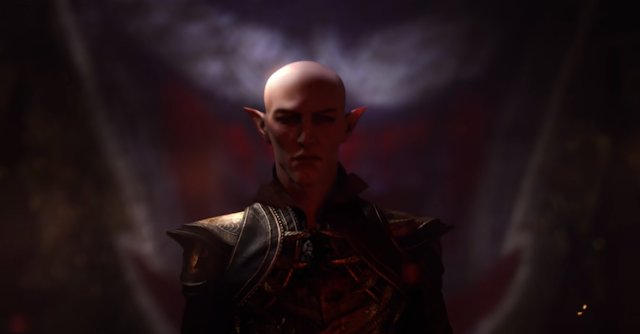
"Dragon Age: Dreadwolf" Predictions & Ponderings (and "What's in a Name?" Redux)

He doesn't call, he doesn't write, but finally, it looks like we might be hearing from Solas at last (2023?), as BioWare announces t...