Sunday, June 2, 2019

Romancing the Arishok (The Qun and DRAGON AGE II), "Asit tal-eb, Part 3"

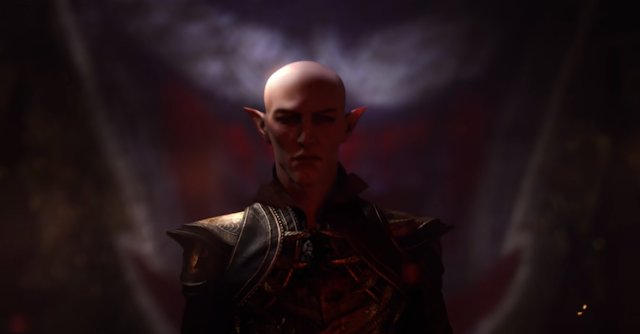
Everyone has a weakness. The Arishok is mine. Well, he's actually one of maybe 20-30 weaknesses of mine across the Dragon Age game trilogy, but you get the idea. (Wait, hey, Solas isn't reading this , is he...?) Also, props to the always-talented Nick Thornborrow for this beautiful fresco.
THE ARISHOK: We remain until we fulfill the demand of the Qun. Or until the demand changes.

So, like, okay, I admit it... there are certain Dragon Age characters I sometimes find it difficult to be objective about. Simply because of, well... basic, animal, um, hotness. 

For instance, consider my darling Arishok, from Dragon Age II. My Hawke walks up those stairs to him at the Qunari compound in Dragon Age II and I'm already doing a happy dance, delighted to see my big, bad, forbidden, kingly, Qunari pseudo-boyfriend again. Every time my Hawke reaches the top of those stairs for the first time, I sort of go into a daze, gazing at him with little hearts in my eyes and imagining our iconic Lady and the Tramp moment eating spaghetti together in a nice little dive restaurant in Kirkwall, shyly culminating in a kiss over a bad chianti candle and checkered tablecloth.

I mean, yes, okay, fine, he's terrifying. He's a zealot. BUT LOOK AT HIM.

Wait, where was I? 

DAMMIT.

Nope, nope, hold on. I can do this. I can write an objective column about the Arishok without my tongue unrolling like a party favor. No, really.

Here we go. Wish me luck.

It's not easy to be a ruthless, cruel, totalitarian yet magnetic leader with a noble and brooding profile. Especially one trapped in a back alley for years (and without Wi-Fi)... in Kirkwall, of all fricking places. KIRKWALL.
The Exhausted Zealot

When we meet the Arishok, he's tired, dignified, bored, and hanging out on a bench semi-sort-of tricked out to look like a throne.

He seems really unhappy to be stuck here in Kirkwall, and who can blame him? I mean. It's Kirkwall. My take on Kirkwall is that even ships in the vicinity find themselves violently sheering away from the harbor, reacting like living marine mammals and carrying their careless passengers far from its toxic seas and airs.

And, look, if I consider the Arishok's situation, I can find a surprising amount of sympathy for him, even given his brutal actions later on. The single most important relic of his people has been stolen, and he cannot return home without it. It's simply the code of his people, the requirement of his mission. So he's trapped. He must retrieve the relic, which means he's stuck in this vile, nasty powderkeg of a backwater, watching its Viscount crumble, its Commander go mad, and its mages and templars trade blows in an eternal conflict... and he can't do anything but hang out and watch Netflix.

He does seem to like this one person, Hawke. Hawke has charisma. Hawke is color-coordinated. Hawke is brave, honest and forthright. Hawke is also extremely attractive. (My Hawke is especially attractive, just so you know. This is important as far as my romantic subtext with the Arishok.)

But pretty early on, the frustratingly narrow-minded yet attractive Arishok begins to ponder the possibility of a date with Hawke (OH SHUT UP).

Meanwhile... talk by talk... we learn who the Arishok is... what he believes... and what he wants.


Aw, dammit, Arishok, GO HOME! Go home! And then CALL ME!
A Question of Honor

As our interactions with him begin, the Arishok has been shipwrecked and trapped for far too long. He is desperate for companionship and has completed all the jumbles, New York Times crossword puzzles, and Candy Crush updates, when Hawke shows up at his carefully barricaded Qunari compound in Kirkwall, which is why he is so interested and immediately invested in Hawke when she (my Hawke's gender) shows up to say hello.

HAWKE (among options): You won't honor your bargain [with Jevaris]?
ARISHOK: There is no bargain to honor. His offer for the gaatlok was refused, so he invented a task to prove his worth, when he has none.
JEVARIS: I broke my beard getting your outcasts killed.
ARISHOK: You hired someone more competent and now stand in their shadow pretending it is yours. You dishonor their accomplishment. Get out of my sight before I bother lifting my sword.
HAWKE (among options): Nevertheless, you have benefited from his actions.
ARISHOK: Do you think we are unable to hunt our own outcasts? This was interference, nothing more.
JEVARIS: So I get nothing for all this work?
ARISHOK: If anything, we have been denied the righteous application of the wisdom of the Qun. What payment should I exact for that? Go, dwarf, before I begin my tally.
At this point, Jevaris argues about being paid and that gaatlok is a product people want. The Arishok views his efforts as tiresome.

ARISHOK: There is no profit in empowering those not of the Qun. The means of creating the gaatlok is ours alone. It shall be dispensed only to our enemies, in the traditional manner.

And... Jevaris leaves in disgust. And the Arishok also is tired and irritable and pretty much done, and just wants everyone gone.

ARISHOK: You will leave as well, human. There is no more coin for you here.

He whispers to himself and this is a big moment... and it's pretty truly moving. He whispers to himself about what is right and wrong... a real question to his inner self. It's interesting, moving... and creepy. This is where the Qun becomes a religious calling even in an areligious context. Because the Arishok is admitting he feels that to leave Kirkwall unconquered, to leave its people outside the Qun... is wrong. 

ARISHOK: (to himself) We have a purpose, but when it's done, do we leave Kirkwall like this?

I think this is a key moment: The Arishok feels an actual duty to conquer this place, to bring it within the order of the Qun. It does not appear to be a need that arises from a wish for battle or conquest, but simply from his disgust for what he sees as needless chaos and disorder.

Then he looks down, and of course, typically, Hawke is still there. Brave, heedless, and waiting for more info. (Note: I'm going to boldface a few key lines of dialogue I think are directly tied to the Arishok's allegiance to the Qun.)

ARISHOK: Why do you bother me, human? I hire no blades and need no goods. Your kind thinks selfishness and want are normal. This city, all of it, leaves a bad taste.
HAWKE (among options): If you despise this place, why haven't you left?
ARISHOK: Since we arrived, I have seen nothing but greed and weakness. Dwarves, humans, elves—just... festering. No order, no goal. You are one of the few I have met with any ability. And yet this too was random, a result of selfishness. I cannot fathom how a mire like this can be justified. You say we should leave, but how can you bear to stay in this chaos?
HAWKE (among options): I agree. It's a mess.
ARISHOK: But you don't see that as a problem?
HAWKE (among options): I see it as an opportunity. And I intend to take full advantage.
ARISHOK: Karasten are soldiers. The Qun made it so. They can never vary from that assigned path, never be other than they are meant to be. But they are free to choose within that role. To accept and succeed, or deny and die. Glory is clear and defined. It is an undeniable certainty. What "full advantage" can you take without that authority? 
HAWKE: He's free to choose to obey? That isn't contradictory to you?
ARISHOK: He chooses to be. As do we all, long before any of your meaningless freedoms are presented. (a beat) I am not the one to educate you. I did not intend to land here. But this city may demand certainty. I suspect we are done, human.
HAWKE (among options): I don't think Kirkwall would do well under military rule.
ARISHOK: The rule of the Qun is not military. It is discipline and order.
HAWKE: How is that different?
ARISHOK: To your limited understanding, it is not. You fear soldiers that arrive to remove your pitiable vices. But they do not control Qunari. The triumvirate divides and governs. One is nothing without the others. 
HAWKE (among options): Can you tell me about the other two parts?
ARISHOK: No.
HAWKE: Then we can learn nothing.
ARISHOK: I am no more equipped to explain than you are to understand. Arishok, Arigena, Ariqun. Pillars of the Qunari, of the nation that must be. There is but one way to know these things, human. And I have yet to decide if it must be done.

This is one of my favorite little moments—both from Hawke, who is canny enough to point out that she is attempting to learn from him—and from the Arishok, who interestingly notes that he is not there to be her teacher, and he is not looking to evangelize or to convert her.

And then there is that chilling and disquieting moment: "There is but one way to know these things, human. And I have yet to decide if it must be done." He is, of course, talking about conquest. Purification and order through violence.

I think what's scariest here is that the Arishok speaks with that flat assurance we previously saw in Sten. He speaks about his actions without emotion, and with a flat affect, as if they are predestined. The residents of Kirkwall are not people to him, just things. Bas. And right now, they are in his way.

HAWKE (among options): You're a long way from home. Why did you come?
ARISHOK: To meet a demand of the Qun.
HAWKE: Which was?
ARISHOK: It is a matter only the Qunari understand. We remain until we fulfill the demand of the Qun. Or until the demand changes.
HAWKE (among options): How many Qunari have you lost to the Tal-Vashoth?
ARISHOK: None.
HAWKE: That seems unlikely.
ARISHOK: We lose nothing when weakness abandons the Qun. It is the Tal-Vashoth who have lost themselves.
HAWKE (among options): You guard your powder carefully. 
ARISHOK: It is a tool that can only be allowed to exist under the ordered authority of the Qun. 
HAWKE: It could benefit many people.
ARISHOK: It does now. Just as swords benefit warriors, but are not given to children. (a beat) Well... your children. 
HAWKE: Farewell.
ARISHOK: Panahedan, human.

I love the Arishok's final exchange here. There is the faintest ghost of a smile on the line about children and swords... and real, slight affection in the final, "Panahedan, human." Hawke is someone he has begun to care for.

MY HAWKE: How do you feel about dinner? Maybe the amusing glass of pinot grigio?

Alas, the Arishok does not hear me. Facepalm.


Oh, honey, no!
The Savage Within

I've taken great care to transcribe the Arishok's dealings with Hawke in Dragon Age II here, because they communicate the way the Qun's code and constructs are etched in stone. There is no stretching any meaning, no wishing for a more elastic outcome.

The Arishok, for instance, visibly likes and warms to Hawke in DA2. But this is not a happy tale, and everyone involved already seems aware of that. Hawke and the Arishok may respect one another. But they are also on a collision course with death; liking or no, the Arishok is also the person she is, in most cases, destined to kill, to be killed by, or (if Isabela is turned over) who simply postpones conquest for another, yet inevitable, day...

One key moment in the next meeting involves the Arishok's description of the theft of a decoy recipe for gaatlok that was in fact actually a recipe for saar-qamek, a poison gas. While the qunari are immune to it (interesting, given what it does), others who are exposed to it go into a blind, insane and savage rage.

HAWKE (among options): So how dangerous does this fake mixture become?
ARISHOK: It is not a threat to Qunari. For your kind, it is as dangerous as those who breathe it. 
HAWKE: Can you elaborate?
ARISHOK: The gas kills, but first it turns allies against their own in blind rage. So, the greater the skill of those sent against us, the more dangerous they become to their own people. 
HAWKE: Hard to control at the best of times.
ARISHOK: It is no longer our problem.
HAWKE (among options): Did you just leave the decoy lying around?
ARISHOK: We did not make it easy. Three Qunari died defending it. Enough to impart a sense of worth. If the real formula were at risk, the Qun would demand that we protect it to the last of us.
HAWKE (among options): I appreciate you bringing this to me.
ARISHOK: I have long thought this city would destroy itself. This would only hasten the inevitable. Panahedan, Hawke. I do not hope you die.

"I do not hope you die!" Come on, from the Arishok, that's practically a declaration of love!

My Hawke, courageous and slightly pumped after this passionate decree, bravely, suggests they act on their feelings:

MY HAWKE (casual): So, Ari, how about dinner? I know a great little Italian place down on the water. It's right under the really creepy left-hand statue of the guy writhing in agony, and the restaurant is run by a blood mage who makes an alfredo sauce that is literally magical.
ARISHOK: There is no point under the Qun in my meeting you for such an event. Also, I must admit that for me, cilantro tastes like soap.
HAWKE: Shit. I love you. Call me!
ARISHOK: Farewell, basalit-an. You are a strange creature.

Having struck out publicly, my Hawke walks away from him then, giving him a good look at the entire package, then looks back over her shoulder, shaking her pretty, pretty hair over her shoulders. Which, in DA2, actually moves fetchingly!

HAWKE: I know.

Mutual Respect

Still hopeful for a date, Hawke returns again to talk to the Arishok, this time with sincere news, truths, and regrets about the theft of the fake gaatlok recipe:

ARISHOK: They say we were careless with our trap, that this is our fault. But even without the saar-qamek, there would have been death. This elf was determined to lay blame at our feet. I admire conviction with a focus, but your kind are truly committed to weakness. 
HAWKE (among options): She was angry to see her people losing their culture by claiming yours.
ARISHOK: We accept those who submit to the Qun. The weak naturally seek the strong. It doesn't matter. We did not come equipped to indoctrinate. I am here to satisfy a demand you cannot understand. 
HAWKE: It's been a long time.
ARISHOK: It will take as long as needed. No ship is coming. There is no rescue from duty to the Qun. I am stuck here.
HAWKE (among options): That is not the understanding of city leaders and their... supporters.
ARISHOK: Let them rot. Filth stole from us. Not now, not the saar-qamek. Years ago. A simple act of greed has bound me. We are all denied Par Vollen until I alone recover what was lost under my command!

He stands, resolute and definitely scary. A loss of control we haven't seen until now.

ARISHOK: That is why this elf and her shadows are unimportant. That is why I do not simply walk from this pustule of a city! (with increasing heat) Fixing your mess is not the demand of the Qun! And you should all be grateful!

He calms himself visibly.

ARISHOK: Thank you, human, for your service. Leave.
MY HAWKE: How do you feel about Greek food?
ARISHOK: Leave me, human. No matter how deliciously prepared, grape leaves will not tempt me from my path.
HAWKE: Seriously?
ARISHOK: Yes.
HAWKE: You make me sad.

She leaves, giving him another view of her best side.

Still, she is hopeful. In her fatally optimistic mind, Kirkwall is simply the setting for one giant rom-com.

As she walks away, she smiles.

"Well, Shit."

And then it finally all just goes to hell. As it was always fated to do. Do you know that old Johnny Mercer song about what happens when an irresistible force meets an immovable object?

Yep. Something's gotta give. In this case... it's Kirkwall. 

The powderkeg finally ignites. And it's because of a pretty staggering and ugly situation in which a city guard raped an elven girl. When her family attempted to get justice, they were ignored and there was evidently not even the pretense of investigation. Her brothers then  took matters into their own hands, confronted the rapist, and the confrontation ended in his death. The two elves then went to the Qunari compound and offered themselves as converts to the Qun, to become viddathari.

At this point, Aveline is now self-righteously seeking to have the two elves returned to the city in order to receive justice, but I have to admit that I'm utterly uninvested in Aveline's feelings here, and her outrage is honestly pretty gross to me. There are definitely racist undertones to the situation—the fact that an elven girl was horrifically attacked by one of Aveline's own guards with zero outcome or punishment (Aveline carelessly refers to "rumors" about the crime), while her brothers' search for justice on the other hand requires the personal intervention of the Captain of the Guard and the risk of a political incident.

ARISHOK: The elves are now viddathari. They have chosen to submit to the Qun. They will be protected.
HAWKE (among options): Have they truly converted, or are they simply using you as a shield?
ARISHOK: They have chosen, and so have I. You have seen the corruption in this city, the suffering that is allowed. All to selfishly deny the truth of the Qun. Let us look at your "dangerous criminals." 

The elves enter, under Qunari guard.

ARISHOK: Speak, viddathari. Who did you murder, and why?
VIDDATHARI ELF: A city guard forced himself on our sister. We reported him... or tried to. But they did nothing about it, no matter what we said. So my brothers and I paid him a visit. 
AVELINE: That doesn't excuse murder.
HAWKE (among options -- my answer): Yes, it does.
HAWKE (among further options): Are these elves telling the truth?
AVELINE: There have been rumors. I will investigate, but they still took the law into their own hands.
ARISHOK (earning a fistpump from me): Sometimes that is necessary.
AVELINE: Like you avenged the Viscount's son? It was not right then, and it's not right now.
ARISHOK: Their actions are mere symptoms. Your society is the disease. They have chosen. The viddathari will submit to the Qun and find a path your way has denied them. 
AVELINE: You can't just decide that. You must hand them over.
ARISHOK: Tell me, Hawke: What would you do, in my place?
HAWKE (among options): As a guest in this city, I would keep the peace.
ARISHOK: I see. I cannot leave without the relic, and I cannot stay and remain blind to this dysfunction. There is only one solution.
AVELINE: Arishok... there is no need for—

Oh, dammit, Aveline. 

Lighting the Fire

Much as I usually love her elsewhere across the years in DA2, Aveline makes me pretty angry here in her moral relativism (her inability to understand or to, patently, believe the elves, is pretty gross). So when the Arishok here makes a magnificent "Talk to the hand" gesture, I give a fistpump. Seriously, it is perfection.

But then, of course, he takes it too far. It can't just be an exchange of ethics and viewpoints. This, at long last... is a matter for action. A demand of the Qun. He can no longer stand by and watch.

ARISHOK (to soldiers): Vinek kathas.

Aaaaghghg. "Seize them." It's come to this. So Hawke and buddies fight their way out. And at the last moment, Hawke exchanges a lingering glance with my adorable Arishok.

At this point, I mentally rush magically shrieking into my computer screen. Using my mage abilities, I blast into the screen and run up the steps to the Arishok.

ME: WAIT! STOP! LET'S TALK ABOUT THIS OVER DINNER!

Sadly, even in my imagination... the Arishok looks at me with contempt. I am, apparently, not his type. Even in my fantasies. Which is why I need about 351 more decades of therapy.

Onward. Everyone's doomed. My poor Hawke's self-image will not be the only casualty today.

The Arishok's Brief Victory

The story rolls onward mercilessly. The Qunari attack the city. All mayhem breaks loose. The Arishok tosses the head of the poor Viscount, although let's face it, he knows how to make an entrance...

ARISHOK: Here is your Viscount. 
RANDOM CITIZEN: You dare? You are starting a war!

Aaaand... a Qunari soldier kills him. Oops.

ARISHOK: Look at you. Like fat dathrasi, you feed, and feed, and complain only when your meal is interrupted. You do not look up. You do not see that the grass is bare. All you leave in your wake is misery. You are blind. I will make you see. 

MY HAWKE: Hey. Dude. No need to be sizeist.
ARISHOK: Bite me.
HAWKE: Promise?

Okay, okay. Hawke and friends have entered like the utter badasses they are. It isn't even slow-mo (but you totally get that impression anyway). My Hawke is of course deeply wishing for sunglasses as well.

ARISHOK: But we have guests. (a beat) Shanedan, Hawke. I expected you. Maraas toh ebra-shok. You alone are basalit-an. (to room) This is what respect looks like, bas. Some of you will never earn it. (to Hawke) So tell me, Hawke. You know I am denied Par Vollen until the Tome of Koslun is found. How would you see this conflict resolved without it?

MY HAWKE: Pizza?
ARISHOK: (eyeroll)

Sigh. So. Depending on choices, Isabela may enter with the Tome and give it to the Arishok at this point.

ARISHOK: The Tome of Koslun... (reverently)

If she has returned here, Isabela banters with Hawke about her vulnerability and realization that she had to do the right thing. And Hawke can either show support for Isabela here, or accuse her of betrayal, among varying options. Either way, eventually, in most cases, the Arishok hands the Tome to a soldier.

ARISHOK: The Relic is reclaimed. I am now free to return to Par Vollen. With the thief. 

Oops. Surprise from Isabela, irritation from Fenris. Outrage from my Hawke that he isn't talking about their impending date.

But seriously: Things aren't looking good for our pirate rogue.

Isabela in Chains

If you're playing a meaner, more renegade Hawke, you may choose to give Izzy back to the Qunari here, and it's pretty dramatic and sad:

ISABELA: What?
FENRIS: You thought you could strand them here for four years without consequence?
ARISHOK: She stole the Tome of Koslun. She must return with us.
HAWKE (among options): Sounds like you have something very specific in mind.
ARISHOK: She will submit to the Qun and the Ben-Hassrath. More than that, I will not say. 
HAWKE (among options): Take her, and go.
ARISHOK: Most wise.
ISABELA: No! Hawke, you bastard. I came back to help you!
HAWKE: You are helping.
ISABELA: Fight me, you coward. If you're going to send me off with them, fight me first.
ARISHOK: Hawke has denied you. You are not worthy of facing true basalit-an. 
HAWKE (among options): I'd love to, Isabela. But you heard the man.
ISABELA: This is what I get for believing you were different. That you... cared about me.  

Oh, honey. Isabela is dragged off fighting and cursing Hawke. It breaks my heart. I can't do this in my actual canon playthroughs. (And no, I can't give Fenris back either.) But as she leaves, the Arishok faces Hawke.

ARISHOK: The Qunari have what we came for. We will go. But know this: One day, we shall return. 

Isabela Stays

Or Hawke (yay!) refuses the request:

HAWKE: You have your relic. She stays with us.
VARRIC: I'm sure he'll take that well. Rivaini, you might want to move a bit this way.
ARISHOK: Then you leave me no choice. I challenge you, Hawke. You and I will battle to the death. With her as the prize. 
Isabela: No. If you're going to duel anyone, duel me.
ARISHOK: You are not basalit-an. You are unworthy.
HAWKE (among options): I accept your challenge.
ARISHOK: Maravas! So shall it be.

Inevitable Outcomes...

So Hawke and the Arishok fight. Depending on his feelings for your Hawke, you may either end up fighting party to party (you and your companions against a group with the Arishok), or in single combat if he finds you worthy and basalit-an. 

The fight, for me at least, is both deeply upsetting and deeply comic. Every single time I've played it, it encompasses my poor adorable and of course highly attractive Hawke running and running and running around the room, doing figure-eights around the pillars, her faithful hound nipping at the Arishok's delectable hindquarters, while shrieking "I JUST WANTED A DATE! A NICE DINNER! A CHANCE AT A RELATIONSHIP! WE COULD HAVE HAD SOMETHING BEAUTIFUL!"

The stupid freaking gorgeous Arishok, being stubborn and idiotic as noted, I am sorry to say, does not hear her, and he does not stop the battle and suggest that they work things out over a chessboard, a nice bottle of wine, and a game of strip poker.

Nope. He just keeps trying to skewer his true love and eventually she pummels him into submission. Except not in the fun way.

He's toast.

Then, my Hawke weeping copiously as he lies there on the steps, bleeding needlessly and near death, the Arishok gives her his final words...

ARISHOK: One day... we shall return.

My Hawke rolls her eyes at this continued evidence of stupidity, then sniffles and rallies. She faces him proudly.

HAWKE: When you do return... CALL ME!

Summoning his one single moment of coolness and humor, the Arishok gives her a faint thumbs-up.

Aaaand... the Qunari leave. And my poor Arishok almost-boyfriend is just sort of lying there, all dead and gorgeous on the steps. Seeping into the carpets and stuff.

DAMMIT.

Then Meredith comes in, yadda yadda yadda. Meredith being Meredith. The Qunari aspect of our story is done.

And my poor Hawke goes off to a group dinner with Izzy and her companions to celebrate her victory, while crying into her spaghetti and mourning her lost "Lady and the Tramp" moment. Varric walks her home and never talks about the fact that she may or may not have tried to kiss him. Hey, Varric's a gentleman.

Victory is in the Qun.

The Incorruptible Warrior: Sten Introduces the Qun (Asit tal-eb, Part 2)

To have affection for Sten is to discover, with heartbreak and surprise, what it feels like to care about something immovable and changeless. Like, say, a rock. He cannot be moved, swayed, or changed.
STEN: One day our ships will come to these shores. And the antaam will bring this land to the Qun. But it does no good to dwell on it.

This marks the second part of my series on the Qun—you can view the first, a "big picture" take, here

Meanwhile, if you're a regular reader of my blog, you already know I love Sten, even as I mourn the fact that he is a subtly tragic figure—someone trapped, indoctrinated, into a worldview from which he will never escape. 

Even the knowledge that (according to BioWare canon) Sten ultimately becomes one of the three leaders of the Qunari triumvirate as Arishok, succeeding the dead or disgraced Arishok of Dragon Age II, and who then works presumably alongside the Arigena and Ariqun to guide his people... even knowing that, it doesn't really assuage my sadness.

It's still tragic. Because, to me, Sten's destiny is an endless circle that begins and ends with a cage, and the Qun is the reason why. We rescued him (or may have chosen to do so, at least) in Dragon Age: Origins, offering him a chance at redemption and success in his mission for his people (to answer the question, "What is the Blight?" and to, presumably, help to address it).

Sten did this—with both loyalty and courage, with honor and with a kind of cautious, hidden gentleness. He learned about the world, demonstrating a kind of naivete we normally associate with youth (I was so surprised to realize Sten is middle-aged when I did my timeline!) as he was exposed to a greater world. It seemed to me that for the first time, he was allowed softness. He picked flowers and petted kittens when he thought no one was looking. He gazed at paintings and silently treasured even tattered, ruined works of art in his year of traveling with the Warden and companions. He developed a fondness for cookies. He may even, almost shockingly, have begun to demonstrate real feelings of friendship and care (or... more?) toward the Warden, or for Shale, calling them "Kadan," an endearment both romantic and non-romantic... designating in Qunlat "where the heart lies."

Witnessing all this, I was really invested in Sten. Not least because I have massive voice kink and he has one of the most beautiful and underappreciated voices across the trilogy, thanks to voice actor Mark Hildreth (and people: please watch The Looming Tower if you didn't already because it was amazing, and Hildreth is terrific among a superb cast).

But yeah: I cared about him. I watched his evolution with interest. I was, ultimately, truly invested in Sten! And playing DAO for the first time, I naively envisioned a zillion potential resolutions for Sten. I mean, I really, really expected them: That he'd die defeating the Archdemon. That he'd stay in Ferelden or the Free Marches if he lived, not returning to Par Vollen. That he might even fall in love with the Warden and allow himself to glimpse a wider world. 

But, no matter what outcome I envisioned... there was a common denominator to each: That Sten could not go back because he had seen too much.

Oh, I was so, so naive.

Because Sten of course does none of these things. Sten is affected by the world outside the Qun. He visibly moved and surprised by many of his relationships and revelations as the story progresses.

Right. And then he goes right back to serving the Qun. While maybe implementing a smuggling network to ensure he has access to cookies. And maybe also to kittens and paintings, too.

But nothing really changes for him. He is who he is. He serves who he pledged to serve. His loyalty was really never in doubt.


It is not a coincidence that we meet Sten in a cage. The subtle tragedy is, I believe, that Sten will never really leave it.
The Regretful Conquerer

So... sigh... Sten goes back.

He fricking goes back.

Which is tragic, maddening, and... true to character. Because that's what a good Qunari does. And Sten is a good Qunari. Despite his familial bonds with his companions, despite the camaraderie of those chilly nights around the fire, listening to the songs of Leliana, trading stories with his friends... he does not, as Bull does, create something lasting that he will carry with him and even replace his fealty to the Qun's demands. He does not give himself a name, or warm to a nickname given by others. He does not value the Qun above individuals.

To me this is inexpressibly sad. Sten, by the end, visibly loves his companions. Still, if the Viddasala appeared... he'd kill every single one of them on command. Because he is Sten of the Beresaad. He is one of many. He serves the Qun. And to the Qun he will always return.

This is my take. This does not mean I am remotely okay with this. NOPE. Honestly, this outcome for Sten affected me very strongly. I'd just been so sure! So sure he wouldn't go back. I'd been conditioned by movies, by fiction. Surely a Sten who had glimpsed the wide world of Thedas, who'd sniffed the delicate perfume of roses and daisies and violets... who'd played with little fragile kittens, shadowboxing gently with tiny paws... who'd realized the value of art for art's sake... surely this guy wouldn't go back to his totalitarian prison?

But he would; he does. And honestly? I can't blame him. It's what most people would do. It takes a tremendous, tremendous amount of change, loss, and courage to truly change who you are, what you want, what defines you, and what you view as safe. To discard your belief system and to change what you think you know and understand about the wide world.

There are some key moments, sure, where Sten reveals an affecting combination of wisdom, naivete, certainty, cruelty, and softness. Upon revisitation, however, the main emotion I view for Sten is... regret. Sadness and grief. Not at his impending departure from people he loves. But rather, at their impending conquest by his own people

Sten doesn't want to care for the Warden, or this world. He knows what the Qun will do to them. And he will do whatever he is asked to do to bring the Qun to these lands. But it becomes apparent, as with Bull later on, that he can feel these things without any actual joy in the potential for conquest.


Sten reminds us of a crucial fact that is apparently ever-present in his mind, even if not in ours: "One day, our ships will come to these shores. And the antaam will bring this land to the Qun. But it does no good to dwell on it."
"You Make Your Own World"

One of my favorite moments to exhibit this duality—this affinity for a people that (in his mind) is already conquered can be seen a beautiful monologue by Kirby and acted by Hildreth, where Sten describes his take on the world.

He speaks slowly and softly, and with more patience than is apparent at first glance. He is sharing something important to him, truly attempting to teach:
"My people have a tale: A great ashkaari during his travels came upon a village in the desert. There, he found the houses crumbling. The earth, so dry and dead that the people that the people tied themselves to each other, for fear that a strong wind would carry the ground out from under their feet. Nothing grew there except the bitter memory of gardens. 
"The ashkaari stopped the first man he saw, and asked, What happened here?
"Drought came, and the world changed from prosperity to ruin, the man told him.
"Change it back, the ashkaari replied.
"The villager became angry then, believing the Ashkaari mocked him, for no one could simply change the world on a whim.
"To which the ashkaari answered, Then change yourself. You make your own world."
If the Warden questions him here, he answers:
"Are you sure of that? Tell me, when you awakened after Ostagar, was the world the same as it had been before?
"Believe in whatever you like: Absent creators, or whimsical gods. Follow prophets, or ashkaari, or omens in the earth and sky. You will find wisdom only if you seek it."
 A moment later, Sten seems to realize that he did not communicate the lesson he desired. He sighs, then explodes in frustration and sadness. "Parshaara!" he cries out. "We should move on."

The main aspect here is that Sten is truly and obviously upset by this conversation here, and feeling genuine emotion. 

WARDEN (Optional): You think the Qunari are coming to convert us?
STEN: One day our ships will come to these shores. And the antaam will bring this land to the Qun. But it does no good to dwell on it. 

He ends in exasperation and hidden sadness, as he so often does: "Parshaara!" he laments, as he always does. "We should move on."

The Memory Apart

As I revisited Sten as a character in my last DAO playthrough, I realized something: That his time with the Warden and companions was something he saw from both the ferocious present and from the regretful future.

In other words, he was never going to leave the Qun. Nor was he tempted to do so. On a subtle level, and rather horribly, Sten was simply regretting the atrocities that would be required to bring these people under the code and rule to which he subscribed. He was seeing their future suffering, and regretting not that they would suffer, but that their suffering would be necessary at all.

Compare this to Bull's admission in DAI to Solas, that Sera, for instance, would not be able to function under the Qun. Bull is being honest there; he's not cloaking the realization in regret. He is able to eventually go Tal-Vashoth precisely because for him the glass orb of the Qun's world is cracking; he does not lie to himself about the foreseeable tragedy of what he sees, nor does he excuse the Qun's part in that tragedy. For all his superb gifts for subterfuge, despite his Hissrad self... Bull is willing to be honest with Solas there. And I think it's one of many reasons he is able to be rescued, if we take that chance to do so.

It's a timely comparison, as I've already noted that, among our leading characters, Bull for instance is certainly formidable at compartmentalization. But so, it turns out, is Sten. To illustrate this, I've assembled a few banters that provide a further taste of this (purposely omitting most of those I covered in my other article on Sten here). Here goes:

LELIANA: Are there Qunari bards?
STEN: Why wouldn't there be?
LELIANA: I don't know. You don't seem like very musical people to me.
STEN: You base this on me? I am a soldier. The antaam does not do battle with lutes.

I love this one above, because it's a reminder that there's so much we simply do NOT know about the Qunari people and their culture. Personally, I suspect that Qunari music would echo the music of the Soviet Union and other rigid, more militaristic cultures—in other words, heavy on the use of music as a useful tool for marching, inspiration, and formal celebration. I'd suspect we'd get lots of drums and percussion, lots of hymns and battle songs, and incorporating wind instruments that are easy to play and transport into battle. 

But we'll never know so far, because, dammit, Sten does not reveal more than this.

The Warrior and the Rogue

Meanwhile, Zevran is characteristically curious and fearless on the topic of the viddathari, and I love the way he hones in immediately on how the elves as viddathari take a place within the culture:

ZEVRAN: Hm. Yes. Well, I've heard that the Qunari actually put the elves in charge? Over the humans? Is that true?
STEN: Some of them.
ZEVRAN: Only some? Which ones are they?
STEN: The ones who belong in charge. That is the way of the Qun.
ZEVRAN: How does this Qun determine who belongs in charge?
STEN: The tamassrans evaluate everyone and place them where their talents merit.
ZEVRAN: But elves, in general, merit higher places than humans in Qunari society?
STEN: Some of them.
ZEVRAN: Back where we began. It's like talking to a water wheel.

It's interesting that, later on, it is not Zevran who sparks the conversation, but Sten himself, who is remembering someone for whom he once felt pity:

STEN: I knew one of your countrymen once, elf.
ZEVRAN: Oh? Have you been to Antiva, then?
STEN: No. Until I came to Ferelden, I had never left the islands. She came to Seheron twice a year with the traders who bought spices from the northern jungle. Only she among the traders would speak to the antaam. Questions about the rainforest, its depths, and the things to be seen there. We humored her. She was... an unfortunate soul.
ZEVRAN: Unfortunate in what way?
STEN: She was a Crow, as you were. Sent to assassinate the kithshoks, leaders of the army of Seheron, for the Tevinter Imperium. We knew this, and pitied her.
ZEVRAN: I'm surprised you did not simply slay her.
STEN: There was no need. Her questions were meant to show her the way through the jungle towards our fortifications. And so one day, she snuck into the jungle to find her target. We found the pieces of her body in a tree, where the spotted cats kept them for later. We had never told her that our kithshoks were the ones who negotiated all the trades at the port.
ZEVRAN: Then she was a fool. That's not very sympathetic, I'm afraid.
STEN: It was her ignorance we pitied, not her mistake. She believe we hoarded things we cared for as her own people do. We were sorry for her, that she thought only some people were important.

I find this exchange both illuminating, ironic, and deeply sad. Sten admits that he and his brethren pitied the elven woman, even as they set her up to die. Meanwhile, he ends on a whopper: "We were sorry for her, that she thought only some people were important."

I mean, Sten. Dude. Darling. Isn't that exactly everything that is wrong with the Qun? That "only some people [are] important?" That some people aren't even people, but things? Talk about unconscious irony.


Many of Sten's truths to Shale are pretty heartbreaking upon examination. For instance, the implication that there is no place for them at all, as in this admission to Shale: "We accept beings of all walks of life, so long as they are willing to accept their place in the world." My question: Or... lack of place?
The Ballad of Sten and Shale

But beyond his conversations with the Hero of Ferelden and his increasing potential respect for them... for me, it's Sten's conversations with Shale (voiced by the fabulous Geraldine Blecker) that are, in some ways, the most moving and bittersweet, because he openly adores her, yet he also acknowledges that his own people might not value or allow her admittance (even though she herself shows a total willingness to convert to the Qun):

SHALE: What do you estimate are the chances of success, Qunari?
STEN: For the Grey Warden? Little to none.
SHALE: So, why does it follow? I do not risk death, but it does.
STEN: My mission is no different from the Grey Warden's. I must see this through to the end.
SHALE: It would rather perish than give up its quest?
STEN: Indeed. There is honor to be salvaged in such a quest, no matter its chances.
SHALE: Honor is a curious thing. It is far better to be practical.
STEN: What use is practicality when it leads to cowardice and emptiness? It is better to live well, than to live.
SHALE: An, uh... interesting theory.
STEN: There is worth in your life, Shale. There is value, but only if it is used.

The implication above, to me, is that Sten latches onto the wrong aspect, and that Shale is somewhat disappointed by his misinterpretation. And then the stakes ramp up a bit, as below:

SHALE: I have a question of religion, Qunari.
STEN: For you, kadan, I will answer.
SHALE: Would its "Qun" accept a convert that was a golem?
STEN: I do not know. It has never happened. We accept beings of all walks of life, so long as they are willing to accept their place in the world.
SHALE: And what place is that?
STEN: One of equality. Within the Qun, an individual exists to serve.
SHALE: Hmm. That is less appealing. Would it consider birds to be its equal as well?
STEN: Birds? Birds are... but animals. Enlightenment does not await them.
SHALE: Excellent. That sounds very promising.

Poor Shale. Years of dealing with bird shit while immobilized would certainly create a hatred for guano... and birds in general.

It's really charming and funny. However, if you really want to start feeling a tug at your heart, here's the one that gets me, where Sten is openly afraid to share with Shale... that she has no probable place under the Qun:

SHALE: I have heard an interesting tale of the Qunari.
STEN: Speak, kadan.
SHALE: I am told that the Qunari put mages on leashes. Leashes! What a delightful concept!
STEN: It is not something that one should take pleasure in. It is done because it is necessary.
SHALE: Why not put them out of their misery? Crush their skulls and be done with it. Fast. Efficient. Fun.
STEN: You have been offended by such men, so your bloodlust can be forgiven. But these ones you speak of are to be pitied. Even so, they must serve, just as any other must serve. All must find their place within the Qun.
SHALE: It does sound like a delightful place where it comes from. Mages on leashes. What will they think of next?
STEN: I can not say that they would not wish to put a leash on you as well, kadan.
SHALE: Hmm... That does sound less fun. Yes.

Shale is naive on equality. She's terrifyingly without ethics, but she's also kind of adorable. And as far as equality, Shale's amusingly fine on a lack of it for others, as long as she herself isn't at the bottom on that issue:

SHALE: The Qunari mentioned something of equality when we last spoke.
STEN: I said that all were equal under the Qun, yes.
SHALE: What of humans? Surely they would not be as equal as others.
STEN: All who accept the Qun have their place, as any other. In the lands we occupy, even the Elves have come to embrace this concept.
SHALE: And if this place is at the bottom?
STEN: If that is where one belongs, then that is where one should be.
SHALE: The Qunari are a very practical people, Sten.
STEN: It is as I have always said. But I thank you.

Like, okay, yes, as above... Shale's kind of horrible in terms of her lack of ability for empathy or kindness... and yet, let's face it—also hilarious, and wonderful, as long as one is not a bird. 

Uncomfortable Revelations

But moving forward, I wonder if Sten felt genuinely sad upon reflection after this next conversation. Where, friends, Shale basically divulges that she lusts after Sten and enjoys watching him fight on a physical and sexual level. And, I mean, she basically implies that she is, well, probably in love with him, also.

And all... just a few moments after he praises her as... a construct. A thing. (Cries.)

It's everything that's wrong with the Qun in a single conversation:

SHALE: I wish to say that it has been pleasant fighting at the Qunari's side.
STEN: I feel the same. You are a remarkable construct, kadan. A warrior to be feared.
SHALE: No more than the Qunari, surely. The way it strikes down its foes, marvelous!
STEN: I smile each time you roar a battle cry, knowing our foes tremble.
SHALE: I could watch you fight all day long—the skill you display, the form, how the light plays on its muscles... I mean... yes. Well done. With the fighting.
STEN: You, as well.
SHALE: Right.

The worst part: Shale, his kadan, is openly admitting to lust for Sten here... and he's just as obviously completely oblivious to that fact. And it's so touching and painful.

Which is why, even if this is a ship that sails too rarely, let's face it, there's a part of me that wants Shale to return in DA4 after reattaining her female dwarven form, and then for her to walk down the streets of Par Vollen, approach Sten's throne, and go, "Hi honey! Miss me?"

If she does, much as I ship Sten and my canon Warden and dream that, in some realities, he follows her to their own choice of a life and land apart... I will be equally delighted if Sten merely looks down at this wonderful new version of Shale, living and whole, as she returns to him... and smiles.

I know it's a vain hope. It comes from the same place as my conviction that Sten could never possibly return to the Qun after the defeat of the Archdemon. 

But it makes me happy to believe the lie.

Just a little.

The Blows of the Chisel: Your Place in the Qun (Asit tal-eb, Part 1)


Under the Qun, individual identity is immaterial. It's only valued for its contribution to the whole. Above, the Qunari warriors could (at least) console themselves that they are now artistic and exciting additions to Solas's garden. Woo-hoo!
THE IRON BULL: It's like being a block of stone with a sculptor working on you. One day, the last of the crap gets knocked off, and you can see your real shape, what you're supposed to be.

Shok ebasit hissra. Meraad astaarit, meraad itwasit, aban aqun. Maraas shokra. Anaan esaam Qun. "Struggle is an illusion. The tide rises, the tide falls, but the sea is changeless. There is nothing to struggle against. Victory is in the Qun."
—QUNARI TENET

Shanedan, intrepid Thedosians! So... as always, I started to write one column and analysis, aaaaand... found myself falling down the rabbit hole.

It's Dragon Age, right? It's easy to do. After all, this entire blog is, to some extent, my fall down that very same rabbit hole.

But this was a pretty big tangent, so just a note of explanation.

See, I started my post by writing about Bull's pivotal loyalty quest in Dragon Age: Inquisition, "The Demands of the Qun." But as I began to write my analysis, I realized that I needed to preface that post, to lay a kind of foundation. Before I talked about the demands of the Qun... and what they would ask of Bull... shouldn't I take a look at the Qun itself, and what it demands of its adherents? Shouldn't I place that quest in some sort of context? After all, what does it matter that Bull must meet the Qun's demands, unless we have a better idea of what those demands actually are?

Besides, not gonna lie... it's really fascinating to go back and look at the Qun across the trilogy.

So here we are. First off, I'm going to post this overview of the Qun, and what I think it asks of those who follow it, as well as how it's presented across the Dragon Age trilogy.

After that, I'll also be posting some interesting revelations and revisits with my darling Sten, as well as transcriptions with my equally adored yet (yes) terrifying Arishok, including several dialogues I transcribed from Dragon Age II.

And then we'll get to "The Demands of the Qun." Eventually.


"Struggle is an Illusion"

Ever since Dragon Age: Origins, I've always been fascinated by the Qun... and more than a little terrified by it.

Any belief system that requires participants to act only for the big picture, an inherently Fascist doctrine, and utterly disregarding the individual... should terrify anyone. It does me.

And this is life under the Qun, where people act in support of their world order, without care for individual harm, loss or effect. Under the Qun, the individual identity is immaterial and utterly without merit. It is only valued for its contribution to the whole.

What I love about the progression of its presentation across Dragon Age is how each Qunari character presents a new and more complex, different aspect of understanding the Qun:
Sten, Dragon Age: Origins: As the true believer, Sten is the perfect introduction to the Qun philosophy and societal construct. Sten is the soldier, the steadfast subscriber, and the perfect introduction to Qun 101. The Qun is who he is. Sten only falls apart, notably, when he has lost that identity (via the loss of his sword).
Sten has no quandaries about his identity or his place, and finds the outer world deeply troubling and confusing. Although he is charmed by a few little indulgences (kittens, flowers, paintings, and cookies), Sten ends his adventures relatively unchanged. He ends as he began, viewing all outside points of view as counterproductive and alien to the Qun. He will return to his people, mission accomplished, unchanged (but not unaffected).
The Arishok, Dragon Age II: Enter the Arishok. As one of the three main rulers within the Qun's world, the Arishok provides a much bigger, starker view of what the Qun demands—essentially a flipped view from that of ordinary soldier Sten. And yet, like Sten, the Arishok's focus is rigid, narrow, and as confined as his quarters in that Kirkwall alley. He's genuinely scary (and so hot! OH SHUT UP) because he's not simply a tyrant or conqueror. He's desperate, trapped, and trying to recover the single most important artifact of his people across the ages. While tempted to intervene many times in what he sees as a disturbing and decadent chaos, he sits out the conflicts in Kirkwall for several years before breaking and deciding to "save" its inhabitants violently for the Qun. It does not end well for anyone. And no, I'm still not okay.
Tallis, Dragon Age II: Mark of the Assassin (DLC): Played by criminally charming geek goddess Felicia Day, Tallis is a lovable yet deadly agent of the Ben-Hassrath seeking simply to fulfill a mission that involves both love and loyalty. While I felt this mission slightly simplified both the Qun and especially the Ben-Hassrath, casting them in a rosier glow than they perhaps deserve, I enjoyed it as an up-close vision of a person simply trying to do the right thing under its regime. From the extremes of Sten and the Arishok, Tallis is a welcome middle-ground character.
The Iron Bull, Dragon Age: Inquisition: The Iron Bull is a wonderful culmination of Qun-loyal characters, because he exists in both realities when it comes to the Qun. He's in, he's out. He's loyal, he's Ben-Hassrath. No matter what you choose as a player, as a spy and sleeper agent, Bull is deeply entrenched in both the worlds of the Ben-Hassrath and Inquisition, and he acts accordingly. Whether we earn his loyalty or don't, whether we romance him or don't... we inevitably learn volumes about the Qun thanks to Bull, and in a truly unique new way.
And for all his bluff, for all his inner questions, Bull's still a true believer when we meet him. Which is why I find his C.S. Lewis simile about the blows of the chisel so affecting (and about which I will have much more to say in a later post)—he wants to be carved. He wants to be shaped. He is fully willing to be altered, repaired, moved, sculpted... to meet the challenges asked of him. And the outcome of his story, depending on our choices, is both personal and devastating in "Trespasser." 

What the Qun Demands

As a world order, the Qun is undeniably pretty scary.

And yet, I can also understand those I know who find the fantasy of the Qun oddly comforting. The structure, the knowledge of your own place in the larger picture. The immutable changelessness of it. As one friend put it, "You'd never have to worry about your own safety. You'd never worry about hunger, or shelter, or abuse, or unemployment. You'd be treated with inherent respect by everyone in your society no matter what your role. And you'd know your life had purpose."

I get this. But of course I also have to always counter this point of view by naming the price for this safety: An absolute lack of personal agency (which is probably the one thing that scares me more than anything in the world). Under the Qun, you'd be safe, sure:
  • But your body will not belong to you.
  • You will do what you're told.
  • You will be analyzed from babyhood and assigned for maximum usefulness. If this occurs, you may be trained in warfare, spycraft and more, while still in childhood.
  • You will perform the job you are given efficiently... whether you enjoy it or not.
  • You will go where you're sent.
  • You will not marry or partner with a romantic interest.
  • You will have sexual relations with whoever you are commanded to mate with for breeding purposes.
  • You will then be required to give birth, if female, to any resulting child.
  • If you do give birth, your child will be taken away to be raised in a group setting by a Tamassran, indoctrinated in groupthink before it cuts its first tooth or grows its first little stubs of horns.
  • Your primary social relationships will be with those you work with (no mates, lovers, family units allowed).
  • You will agree to reeducation and brainwashing if you ask too many questions, or if you show yourself to be mentally fragile.
  • If you manifest magical abilities, you will submit to being leashed, enslaved, your tongue may be removed, and your mouth may be sewn shut.
  • If you become unable to do your current job, you may be put to work in menial labor until you are no longer physically functional... and then executed.
I mean, holy totalitarianism, Batman. That's a heavy price for safety.

The Qun accepts everyone. That's great. Except that it then demands everything they are, everything they have, everything they dream or want or desire.
Chaos Into Order

As an important and complex aspect of Thedas's diverse assortment of belief systems—as well as the code that has driven the Qunari characters we have met and cared for over the past three games—the Qun is a wonderful fictional construct. Its primary inventors (as far as I know—please correct me if I'm inaccurate here) in the BioWare creative Qunari triumvirate seem to have included resident Qun expert Mary Kirby (who wrote Sten in DAO, and laid the foundation), and with additional insight and expansion by David Gaider in DAO, and further in DA2 with Kirby, as well as by Patrick Weekes in Dragon Age: Inquisition as he wrote for The Iron Bull.

The Qun, to me, as noted, seems to combine multiple potential philosophies and belief systems, but it's important to call out the fact that while it seems restrictive and confining, everyone is welcome. This is vital, scary, and (well) effective for recruitment and public relations. It's especially attractive, I would imagine, for many elves, who are still seeking for identity and a larger meaning. Anyone of any race can join, anyone can become viddathari and in fact ascend in the hierarchy to significant degrees, as they prove their worth.

This is all part of the important bigger picture: There is no deity to the Qun. While the Qun seems at first glance to be religious in nature, I think that's kind of a metaphysical feint; I think it's really not at all religious, and that belief in anything higher would in fact be antithetical to the Qun itself. So to me, ultimately, it's areligious—more philosophical and fatalistic, more authoritarian and political. There's a lot more of Confucius and Communism than Christ to the Qun, after all.

And as a code of conduct and series of rules for daily life, the Qun is basically a belief system that creates a perfect totalitarian melting pot of societal entrapment.

The Tome of Koslun

The Qun seemed to start harmlessly enough, and with peaceful intent. Based upon the writings of Kossith philosopher Ashkaari (Qunlat for "One who seeks") Koslun, in the beginning it appeared to be a code created, at its most basic, to operate out of the desire to soothe the inner savage lurking in every Kossith. Koslun yearns for order, and his teachings reflect a belief that structure is the only possible rational response to chaos, whether internal or external.

His writings therefore counsel and soothe, offering not so much a code for peace, as for order, as a potential antithesis to the savagery that slept in the heart of every one of his brethren, who were rechristened as "the Qunari," i.e., "the People of the Qun."

This origin certainly lends credence to Bull's fears of a loss of control, of his inner savage, and to his stories of other Tal-Vashoth as beings who had gone brutal and cruel, without boundary or logic. Under the teachings of Koslun, there's real belief in the potential violence in the hearts of these magnificent horned giants. Is it something to do with their mysterious origins? Were they engineered, after all, long ago, perhaps by the Evanuris themselves? Is that inner savagery due to their dreams of dragon blood and kinship? 

Why do the Qunari fear their inner capacity for violence above all else? Why is a self-administered system of suffocation and entrapment the only answer?

It's a good question. One I suspect has still not been entirely answered. Yet.

Oh, Izzy. Stealing treasures and wreaking havoc and not really calculating outcomes...
The World and Self are One

Koslun wrote all his observations and tenets down, painstakingly and in great and poetic detail, in a volume that became known as The Tome of Koslun. The book became the single most revered relic among the Qunari, was lost during the Qunari Wars, and eventually was locked away in Orlais until 9:31 Dragon, when it was stolen by Isabela.

I wish I'd understood when playing DA2 how absolutely staggering the scope of Isabela's deed was here. We're talking about pretty much the only sacred artifact the Qunari possess. And she stole it. Of course, on the plus side, this also makes DA2 incredible fun to revisit, as well as the Omnibus, where we get a poignant glimpse of what exactly Isabela suffered, and why she pursued her revenge in that way.

And after all those revelations, I definitely get why. Izzy was forced into marriage, abused, traumatized, and basically enslaved, and the Qunari chapter of her life was a big part of that. But looking back, I still wince at what she chose to do here, not just because it affected thousands (and potentially tens of thousands) of innocent lives in Kirkwall, but because she was willing to up-end the Qunari people's one single artifact. Surely there were other things to steal? Easier things? 

Still, it's not like she was going to do something small to make a statement. That wouldn't be true to Isabela on any level. 

"Esit Tal-eb."

Regardless, the Qunari got their relic back, one way or another, depending on your decisions in Dragon Age II. And the teachings of Koslun remained a continued reminder to seek inner peace, and to accept what cannot be changed:

When the Ashkaari looked upon the destruction wrought by locusts,
He saw at last the order in the world.
A plague must cause suffering for as long as it endures,
Earthquakes must shatter the land.
They are bound by their being.
Asit tal-eb. It is to be.
For the world and the self are one.
Existence is a choice.
A self of suffering, brings only suffering to the world.
It is a choice, and we can refuse it.
—An excerpt from The Qun, Canto 4

I find this both disturbing and comforting. The ability to accept the world as it is, to stop fighting the tide and to flow with it instead, can certainly be viewed as reassuring on some levels. But, all words aside, suffering isn't truly a choice is it? It is something we endure. And suffering is, for most of us, transitory. Temporary. Life is not usually a series of extremes. We all muddle through somewhere in the middle, after all. Suffering is just a part of the deal.

But—still—I get why adages like these might be attractive for those seeking to find meaning in life, and who turn to the Qun for support. Because this hearkens right back to the comfort I brought up earlier. Under the Qun, we need not question who we are, what our purpose is, right? We wouldn't need to wonder why we exist. What our suffering is worth. The Qun provides persuasive answers to that, even if in most cases, those answers would be pretty suppressive.

A Search for Peace

It's pretty apparent that Koslun wasn't a bad guy. There is a beautiful balance to his idea that the only answer to chaos is order. I don't think it's terribly practical or enforceable in the long term, however. Is the only answer to a wildfire a determination to stomp out all fire in perpetuity? It just seems a little extreme.

Still, so Ashkaari believed. And so the Qun was realized and brought into the world.

The result was a mighty fantastical regime powerfully reminiscent of real-world regimes like those of the Soviet Union, the Nazis, and North Korea (as well as with a smattering of Imperialist China due to the presence of gunpowder and "gaatlok" explosives). 

The Qun operates like a smooth, well-oiled machine... as long as all the components stay components. As long as everyone remembers their place. As long as everyone acts for the greater good. As long as nobody sticks out too much. As long as square pegs contort themselves into round holes. And of course, with a distrust of magic, and with a deep distrust for demons, spirits, and magical entities of all kinds, which is understandable in a culture where reality and nature are revered above what cannot be seen.

There is no you under the Qun. There is no individual Sten. Or Bull. Or... anyone... under the Qun. The individual is immaterial. And yet the system does offer that connection, to something that is not exactly divine, but which is simply more. The Qun asks you to serve something larger than yourself. And to reach inward, with your inner eye, to become your truest, best self. The Qun's core tenet is to ask people and objects alike to simply be what they are, to display their wonder and difference in the light of the sun.

I think of Gatt a lot here. Imagine being abused, terrified, enslaved, and then being rescued. Imagine being avenged, finding acceptance and friendship, and as you learn of your new society, imagine discovering genuine interest, support, and comfort from the Qunari. Imagine seeking a destiny supported by your rescuers, the reinforcement that you are essential. Imagine finding your place—not as a slave, not as as reviled elf, but as a man. And in doing so, finding even greater service and connection under the Qun.

It's why I can't blame Gatt, ever. Gatt's just trying to survive. And to honor those who saved him.

As of Dragon Age: Inquisition, the Qun ebbs and flows like a tide across Thedas, gaining and losing sands but always maintaining a calm and terribly certain center.
Under the Qun's Eye

As of Dragon Age: Inquisition, the Qun can be argued to be at its height. It is an empire that ebbs and flows like a tide across Thedas, gaining and losing sands but always maintaining a calm and terribly certain center. And it does so without the stigma of magic (or blood magic) or obvious enslavement practiced by Tevinter. I can see how this would be attractive to those who maybe don't look too close. Or who are so desperate for peace, for answers, that any order is better than chaos.

After all, the Qunari are patient teachers. If you're conquered, it's true that they don't see you as an actual person... but hey, they really do hope you'll convert, so that they can finally see you as one.

And that's where we are as of DAI and "Trespasser." As Sten predicted, there is every sign that the Qunari are seeking to expand their scope, their areas of conquest, their impetus to "help" Thedas and compel order. They are poised, at long last, to arrive on our shores... even as Solas assembles his own army and matures his plans.

And this is what I fully expect to be the reality of Dragon Age 4.

The Future of the Qun in Dragon Age

After Blights, after Rifts and demons and magical warfare... the Qun may come across to many as comforting. Safe. After all, as its formidable warriors carve their paths across Thedas, the Qun is a belief system that does not ask people to follow gods or deities or supernatural beings. Instead, and persuasively, it asks them to seek an inner sense of order and calmness. It argues, in fact, that if you cannot find that inner peace... the Qun will provide it.

The Qun does not require that you believe in the Maker. In the elven pantheon or the Evanuris. It simply asks you to be your best self. And to put all effort of that self into the vision of something larger. If you do so, you are complimented because you are a person, not a thing. You are a respectable being. Not a bas, a nonperson, a sub-person, a thing. You are special. You are, in fact, never alone, because you are a part of something greater:


Solitude is illusion. Alone in the darkness,
I was surrounded on all sides.
The starlight dripped from the petals
Of cactus flowers,
A chorus of insects sang across the dunes.

How much abundance the world carries
If every fistful of sand
Is an eternity of mountains.
—An excerpt from The Qun, The Body Canto

Hey. It's persuasive stuff. It's why people join cults. It's why Bull glories in the suffering he endures under the Qun, secure in the idea that these are the blows of the chisel, each one improving him, revealing his true form and bringing him closer to perfection.

I think it's human (and nonhuman) nature to seek acceptance. To see comfort, and safety, and structure. The Qun offers a seductive option for many people that I actually think would be surprisingly popular today, both legislatively and socially. Which is why, next game... if the elves aren't choosing Solas, I'm betting they'll be heading to the Qun in greater numbers than ever before.

At its core, the Qun scares me. It's repugnant to me. I can't help but believe, much like Solas, that free will is essential for society. I also think this is deliberately built into the idea of the Qun and its place in the Dragon Age saga. Yes, it's powerful, fascinating, even seductive. But it can't survive. Ultimately, the demands of the Qun are unsustainable. As context, I can understand someone moving to another country and finding its laws and ethics more to their liking, especially in the world we find today. I can understand people choosing cultures and climates that work for them. What I cannot quite get is the idea of choosing a belief system in which unbelievers are no longer people. 

But of course we see it now, every day, in the real world, right this very moment. That compartmentalization of people into two groups: Those who matter. And those who do not.

So it's brilliant and timely, certainly, that we explore that divide here in the fictional setting Thedas provides across the massive Dragon Age trilogy, novels, and graphic novels—not just via the Qun, but with the Chantry. With the conflicts between templars and mages. With the dissolution of the Seekers. With the desperate destruction of Anders. And with Solas, too.

Nothing is worth a universe in which life is valued only for a precious few. Which is why the Qun cannot live indefinitely. People aren't automatons. We can serve greater ideas, but not without appreciation for our separate, individual lives and selves. 

The Qun will always be doomed to fail. In the end, the individual cannot be ignored.

We are not things.

"Dragon Age: Dreadwolf" Predictions & Ponderings (and "What's in a Name?" Redux)

He doesn't call, he doesn't write, but finally, it looks like we might be hearing from Solas at last (2023?), as BioWare announces t...