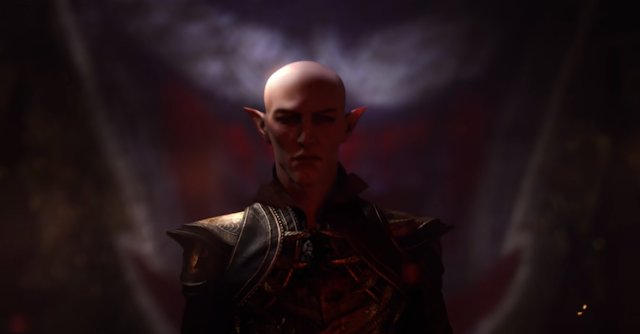
Showing posts with label DAO. Show all posts

Sunday, June 2, 2019

The Incorruptible Warrior: Sten Introduces the Qun (Asit tal-eb, Part 2)

To have affection for Sten is to discover, with heartbreak and surprise, what it feels like to care about something immovable and changeless. Like, say, a rock. He cannot be moved, swayed, or changed.
STEN: One day our ships will come to these shores. And the antaam will bring this land to the Qun. But it does no good to dwell on it.

This marks the second part of my series on the Qun—you can view the first, a "big picture" take, here

Meanwhile, if you're a regular reader of my blog, you already know I love Sten, even as I mourn the fact that he is a subtly tragic figure—someone trapped, indoctrinated, into a worldview from which he will never escape. 

Even the knowledge that (according to BioWare canon) Sten ultimately becomes one of the three leaders of the Qunari triumvirate as Arishok, succeeding the dead or disgraced Arishok of Dragon Age II, and who then works presumably alongside the Arigena and Ariqun to guide his people... even knowing that, it doesn't really assuage my sadness.

It's still tragic. Because, to me, Sten's destiny is an endless circle that begins and ends with a cage, and the Qun is the reason why. We rescued him (or may have chosen to do so, at least) in Dragon Age: Origins, offering him a chance at redemption and success in his mission for his people (to answer the question, "What is the Blight?" and to, presumably, help to address it).

Sten did this—with both loyalty and courage, with honor and with a kind of cautious, hidden gentleness. He learned about the world, demonstrating a kind of naivete we normally associate with youth (I was so surprised to realize Sten is middle-aged when I did my timeline!) as he was exposed to a greater world. It seemed to me that for the first time, he was allowed softness. He picked flowers and petted kittens when he thought no one was looking. He gazed at paintings and silently treasured even tattered, ruined works of art in his year of traveling with the Warden and companions. He developed a fondness for cookies. He may even, almost shockingly, have begun to demonstrate real feelings of friendship and care (or... more?) toward the Warden, or for Shale, calling them "Kadan," an endearment both romantic and non-romantic... designating in Qunlat "where the heart lies."

Witnessing all this, I was really invested in Sten. Not least because I have massive voice kink and he has one of the most beautiful and underappreciated voices across the trilogy, thanks to voice actor Mark Hildreth (and people: please watch The Looming Tower if you didn't already because it was amazing, and Hildreth is terrific among a superb cast).

But yeah: I cared about him. I watched his evolution with interest. I was, ultimately, truly invested in Sten! And playing DAO for the first time, I naively envisioned a zillion potential resolutions for Sten. I mean, I really, really expected them: That he'd die defeating the Archdemon. That he'd stay in Ferelden or the Free Marches if he lived, not returning to Par Vollen. That he might even fall in love with the Warden and allow himself to glimpse a wider world. 

But, no matter what outcome I envisioned... there was a common denominator to each: That Sten could not go back because he had seen too much.

Oh, I was so, so naive.

Because Sten of course does none of these things. Sten is affected by the world outside the Qun. He visibly moved and surprised by many of his relationships and revelations as the story progresses.

Right. And then he goes right back to serving the Qun. While maybe implementing a smuggling network to ensure he has access to cookies. And maybe also to kittens and paintings, too.

But nothing really changes for him. He is who he is. He serves who he pledged to serve. His loyalty was really never in doubt.


It is not a coincidence that we meet Sten in a cage. The subtle tragedy is, I believe, that Sten will never really leave it.
The Regretful Conquerer

So... sigh... Sten goes back.

He fricking goes back.

Which is tragic, maddening, and... true to character. Because that's what a good Qunari does. And Sten is a good Qunari. Despite his familial bonds with his companions, despite the camaraderie of those chilly nights around the fire, listening to the songs of Leliana, trading stories with his friends... he does not, as Bull does, create something lasting that he will carry with him and even replace his fealty to the Qun's demands. He does not give himself a name, or warm to a nickname given by others. He does not value the Qun above individuals.

To me this is inexpressibly sad. Sten, by the end, visibly loves his companions. Still, if the Viddasala appeared... he'd kill every single one of them on command. Because he is Sten of the Beresaad. He is one of many. He serves the Qun. And to the Qun he will always return.

This is my take. This does not mean I am remotely okay with this. NOPE. Honestly, this outcome for Sten affected me very strongly. I'd just been so sure! So sure he wouldn't go back. I'd been conditioned by movies, by fiction. Surely a Sten who had glimpsed the wide world of Thedas, who'd sniffed the delicate perfume of roses and daisies and violets... who'd played with little fragile kittens, shadowboxing gently with tiny paws... who'd realized the value of art for art's sake... surely this guy wouldn't go back to his totalitarian prison?

But he would; he does. And honestly? I can't blame him. It's what most people would do. It takes a tremendous, tremendous amount of change, loss, and courage to truly change who you are, what you want, what defines you, and what you view as safe. To discard your belief system and to change what you think you know and understand about the wide world.

There are some key moments, sure, where Sten reveals an affecting combination of wisdom, naivete, certainty, cruelty, and softness. Upon revisitation, however, the main emotion I view for Sten is... regret. Sadness and grief. Not at his impending departure from people he loves. But rather, at their impending conquest by his own people

Sten doesn't want to care for the Warden, or this world. He knows what the Qun will do to them. And he will do whatever he is asked to do to bring the Qun to these lands. But it becomes apparent, as with Bull later on, that he can feel these things without any actual joy in the potential for conquest.


Sten reminds us of a crucial fact that is apparently ever-present in his mind, even if not in ours: "One day, our ships will come to these shores. And the antaam will bring this land to the Qun. But it does no good to dwell on it."
"You Make Your Own World"

One of my favorite moments to exhibit this duality—this affinity for a people that (in his mind) is already conquered can be seen a beautiful monologue by Kirby and acted by Hildreth, where Sten describes his take on the world.

He speaks slowly and softly, and with more patience than is apparent at first glance. He is sharing something important to him, truly attempting to teach:
"My people have a tale: A great ashkaari during his travels came upon a village in the desert. There, he found the houses crumbling. The earth, so dry and dead that the people that the people tied themselves to each other, for fear that a strong wind would carry the ground out from under their feet. Nothing grew there except the bitter memory of gardens. 
"The ashkaari stopped the first man he saw, and asked, What happened here?
"Drought came, and the world changed from prosperity to ruin, the man told him.
"Change it back, the ashkaari replied.
"The villager became angry then, believing the Ashkaari mocked him, for no one could simply change the world on a whim.
"To which the ashkaari answered, Then change yourself. You make your own world."
If the Warden questions him here, he answers:
"Are you sure of that? Tell me, when you awakened after Ostagar, was the world the same as it had been before?
"Believe in whatever you like: Absent creators, or whimsical gods. Follow prophets, or ashkaari, or omens in the earth and sky. You will find wisdom only if you seek it."
 A moment later, Sten seems to realize that he did not communicate the lesson he desired. He sighs, then explodes in frustration and sadness. "Parshaara!" he cries out. "We should move on."

The main aspect here is that Sten is truly and obviously upset by this conversation here, and feeling genuine emotion. 

WARDEN (Optional): You think the Qunari are coming to convert us?
STEN: One day our ships will come to these shores. And the antaam will bring this land to the Qun. But it does no good to dwell on it. 

He ends in exasperation and hidden sadness, as he so often does: "Parshaara!" he laments, as he always does. "We should move on."

The Memory Apart

As I revisited Sten as a character in my last DAO playthrough, I realized something: That his time with the Warden and companions was something he saw from both the ferocious present and from the regretful future.

In other words, he was never going to leave the Qun. Nor was he tempted to do so. On a subtle level, and rather horribly, Sten was simply regretting the atrocities that would be required to bring these people under the code and rule to which he subscribed. He was seeing their future suffering, and regretting not that they would suffer, but that their suffering would be necessary at all.

Compare this to Bull's admission in DAI to Solas, that Sera, for instance, would not be able to function under the Qun. Bull is being honest there; he's not cloaking the realization in regret. He is able to eventually go Tal-Vashoth precisely because for him the glass orb of the Qun's world is cracking; he does not lie to himself about the foreseeable tragedy of what he sees, nor does he excuse the Qun's part in that tragedy. For all his superb gifts for subterfuge, despite his Hissrad self... Bull is willing to be honest with Solas there. And I think it's one of many reasons he is able to be rescued, if we take that chance to do so.

It's a timely comparison, as I've already noted that, among our leading characters, Bull for instance is certainly formidable at compartmentalization. But so, it turns out, is Sten. To illustrate this, I've assembled a few banters that provide a further taste of this (purposely omitting most of those I covered in my other article on Sten here). Here goes:

LELIANA: Are there Qunari bards?
STEN: Why wouldn't there be?
LELIANA: I don't know. You don't seem like very musical people to me.
STEN: You base this on me? I am a soldier. The antaam does not do battle with lutes.

I love this one above, because it's a reminder that there's so much we simply do NOT know about the Qunari people and their culture. Personally, I suspect that Qunari music would echo the music of the Soviet Union and other rigid, more militaristic cultures—in other words, heavy on the use of music as a useful tool for marching, inspiration, and formal celebration. I'd suspect we'd get lots of drums and percussion, lots of hymns and battle songs, and incorporating wind instruments that are easy to play and transport into battle. 

But we'll never know so far, because, dammit, Sten does not reveal more than this.

The Warrior and the Rogue

Meanwhile, Zevran is characteristically curious and fearless on the topic of the viddathari, and I love the way he hones in immediately on how the elves as viddathari take a place within the culture:

ZEVRAN: Hm. Yes. Well, I've heard that the Qunari actually put the elves in charge? Over the humans? Is that true?
STEN: Some of them.
ZEVRAN: Only some? Which ones are they?
STEN: The ones who belong in charge. That is the way of the Qun.
ZEVRAN: How does this Qun determine who belongs in charge?
STEN: The tamassrans evaluate everyone and place them where their talents merit.
ZEVRAN: But elves, in general, merit higher places than humans in Qunari society?
STEN: Some of them.
ZEVRAN: Back where we began. It's like talking to a water wheel.

It's interesting that, later on, it is not Zevran who sparks the conversation, but Sten himself, who is remembering someone for whom he once felt pity:

STEN: I knew one of your countrymen once, elf.
ZEVRAN: Oh? Have you been to Antiva, then?
STEN: No. Until I came to Ferelden, I had never left the islands. She came to Seheron twice a year with the traders who bought spices from the northern jungle. Only she among the traders would speak to the antaam. Questions about the rainforest, its depths, and the things to be seen there. We humored her. She was... an unfortunate soul.
ZEVRAN: Unfortunate in what way?
STEN: She was a Crow, as you were. Sent to assassinate the kithshoks, leaders of the army of Seheron, for the Tevinter Imperium. We knew this, and pitied her.
ZEVRAN: I'm surprised you did not simply slay her.
STEN: There was no need. Her questions were meant to show her the way through the jungle towards our fortifications. And so one day, she snuck into the jungle to find her target. We found the pieces of her body in a tree, where the spotted cats kept them for later. We had never told her that our kithshoks were the ones who negotiated all the trades at the port.
ZEVRAN: Then she was a fool. That's not very sympathetic, I'm afraid.
STEN: It was her ignorance we pitied, not her mistake. She believe we hoarded things we cared for as her own people do. We were sorry for her, that she thought only some people were important.

I find this exchange both illuminating, ironic, and deeply sad. Sten admits that he and his brethren pitied the elven woman, even as they set her up to die. Meanwhile, he ends on a whopper: "We were sorry for her, that she thought only some people were important."

I mean, Sten. Dude. Darling. Isn't that exactly everything that is wrong with the Qun? That "only some people [are] important?" That some people aren't even people, but things? Talk about unconscious irony.


Many of Sten's truths to Shale are pretty heartbreaking upon examination. For instance, the implication that there is no place for them at all, as in this admission to Shale: "We accept beings of all walks of life, so long as they are willing to accept their place in the world." My question: Or... lack of place?
The Ballad of Sten and Shale

But beyond his conversations with the Hero of Ferelden and his increasing potential respect for them... for me, it's Sten's conversations with Shale (voiced by the fabulous Geraldine Blecker) that are, in some ways, the most moving and bittersweet, because he openly adores her, yet he also acknowledges that his own people might not value or allow her admittance (even though she herself shows a total willingness to convert to the Qun):

SHALE: What do you estimate are the chances of success, Qunari?
STEN: For the Grey Warden? Little to none.
SHALE: So, why does it follow? I do not risk death, but it does.
STEN: My mission is no different from the Grey Warden's. I must see this through to the end.
SHALE: It would rather perish than give up its quest?
STEN: Indeed. There is honor to be salvaged in such a quest, no matter its chances.
SHALE: Honor is a curious thing. It is far better to be practical.
STEN: What use is practicality when it leads to cowardice and emptiness? It is better to live well, than to live.
SHALE: An, uh... interesting theory.
STEN: There is worth in your life, Shale. There is value, but only if it is used.

The implication above, to me, is that Sten latches onto the wrong aspect, and that Shale is somewhat disappointed by his misinterpretation. And then the stakes ramp up a bit, as below:

SHALE: I have a question of religion, Qunari.
STEN: For you, kadan, I will answer.
SHALE: Would its "Qun" accept a convert that was a golem?
STEN: I do not know. It has never happened. We accept beings of all walks of life, so long as they are willing to accept their place in the world.
SHALE: And what place is that?
STEN: One of equality. Within the Qun, an individual exists to serve.
SHALE: Hmm. That is less appealing. Would it consider birds to be its equal as well?
STEN: Birds? Birds are... but animals. Enlightenment does not await them.
SHALE: Excellent. That sounds very promising.

Poor Shale. Years of dealing with bird shit while immobilized would certainly create a hatred for guano... and birds in general.

It's really charming and funny. However, if you really want to start feeling a tug at your heart, here's the one that gets me, where Sten is openly afraid to share with Shale... that she has no probable place under the Qun:

SHALE: I have heard an interesting tale of the Qunari.
STEN: Speak, kadan.
SHALE: I am told that the Qunari put mages on leashes. Leashes! What a delightful concept!
STEN: It is not something that one should take pleasure in. It is done because it is necessary.
SHALE: Why not put them out of their misery? Crush their skulls and be done with it. Fast. Efficient. Fun.
STEN: You have been offended by such men, so your bloodlust can be forgiven. But these ones you speak of are to be pitied. Even so, they must serve, just as any other must serve. All must find their place within the Qun.
SHALE: It does sound like a delightful place where it comes from. Mages on leashes. What will they think of next?
STEN: I can not say that they would not wish to put a leash on you as well, kadan.
SHALE: Hmm... That does sound less fun. Yes.

Shale is naive on equality. She's terrifyingly without ethics, but she's also kind of adorable. And as far as equality, Shale's amusingly fine on a lack of it for others, as long as she herself isn't at the bottom on that issue:

SHALE: The Qunari mentioned something of equality when we last spoke.
STEN: I said that all were equal under the Qun, yes.
SHALE: What of humans? Surely they would not be as equal as others.
STEN: All who accept the Qun have their place, as any other. In the lands we occupy, even the Elves have come to embrace this concept.
SHALE: And if this place is at the bottom?
STEN: If that is where one belongs, then that is where one should be.
SHALE: The Qunari are a very practical people, Sten.
STEN: It is as I have always said. But I thank you.

Like, okay, yes, as above... Shale's kind of horrible in terms of her lack of ability for empathy or kindness... and yet, let's face it—also hilarious, and wonderful, as long as one is not a bird. 

Uncomfortable Revelations

But moving forward, I wonder if Sten felt genuinely sad upon reflection after this next conversation. Where, friends, Shale basically divulges that she lusts after Sten and enjoys watching him fight on a physical and sexual level. And, I mean, she basically implies that she is, well, probably in love with him, also.

And all... just a few moments after he praises her as... a construct. A thing. (Cries.)

It's everything that's wrong with the Qun in a single conversation:

SHALE: I wish to say that it has been pleasant fighting at the Qunari's side.
STEN: I feel the same. You are a remarkable construct, kadan. A warrior to be feared.
SHALE: No more than the Qunari, surely. The way it strikes down its foes, marvelous!
STEN: I smile each time you roar a battle cry, knowing our foes tremble.
SHALE: I could watch you fight all day long—the skill you display, the form, how the light plays on its muscles... I mean... yes. Well done. With the fighting.
STEN: You, as well.
SHALE: Right.

The worst part: Shale, his kadan, is openly admitting to lust for Sten here... and he's just as obviously completely oblivious to that fact. And it's so touching and painful.

Which is why, even if this is a ship that sails too rarely, let's face it, there's a part of me that wants Shale to return in DA4 after reattaining her female dwarven form, and then for her to walk down the streets of Par Vollen, approach Sten's throne, and go, "Hi honey! Miss me?"

If she does, much as I ship Sten and my canon Warden and dream that, in some realities, he follows her to their own choice of a life and land apart... I will be equally delighted if Sten merely looks down at this wonderful new version of Shale, living and whole, as she returns to him... and smiles.

I know it's a vain hope. It comes from the same place as my conviction that Sten could never possibly return to the Qun after the defeat of the Archdemon. 

But it makes me happy to believe the lie.

Just a little.

Saturday, February 2, 2019

From Companions to Advisors... How Inquisition Raised the Stakes


The road to ambassador from companion may be a telling one... and difficult to travel.
LELIANA: I want to know who pines for our Commander. We can use this to our advantage.
CULLEN: I'm not bait! 
LELIANA: Hush! Just look pretty...

When Dragon Age: Inquisition begins, we question our companions. We wonder about the pale, quiet mage, Solas. The companionable dwarf, Varric. The fiery yet kind warrior Cassandra.

We get to know our Companions quickly. But who are the advisors we find awaiting? Josie, Leliana, and Cullen? 

Let's take a look...


When DAI added advisors to the mix, our protagonists could flirt both at home as well as away. While dealing with consequences across the entire trilogy.

Companions for the Field, Advisors for the War Room...

In Dragon Age: Inquisition, we're provided with a diverse and lovable assortment of rogues, mages and warriors—nine companions who are brave potential friends, enemies, and lovers—along with three advisors (two of which are romanceable) who stay back from the fray and provide their wisdom and insights.

My favorite thing about Inquisition's formula is that it mixed up the "camp/home flirtations" formula of Origins and DA2 and gave it new life. As always a few companions weren't romanceable at all (excuse me while I shed a few tears over the lost yet fascinating potentialities of the might-have-been romances with Sten, Nathaniel, Varric, Aveline, and Viv, among others). But plenty were (and are). 

Then DAI added the advisors to the mix. Now our protagonists could flirt both at home as well as away. We weren't just pursuing friendships or romantic relationships with people who fought alongside us, but with people whose histories we knew (in the case of Cullen and Leliana), or who offered a new central role in connecting us to the world.

The Path from Companion to Advisor

The divisions between advisor and companion are interesting, and historically (at least, based on the paths in Dragon Age: Inquisition), in the next chapter of the game for Dragon Age 4, it looks like characters will move from companion to advisor once they've evolved and grown through a series of events or traumas, often witnessed firsthand by us, as with Leliana and Cullen.

So let's examine how that formula works, first and foremost, in DAI, where the advisors tend to be quieter, more tired, battle-scarred, and for good reason. Look at Leliana and Cullen, for instance—we've known them across the trilogy. 


When we find Leliana again in Inquisition, she's still beautiful, but now the blossom is all steel through and through. 
From Bard to Spymaster

When we first met Leliana, she was a devout, pretty and charming young woman—like a soft and lovely blossom with a hidden stalk of steel. One moment, she might be singing around the campfire or talking about her faith in the Maker, the next she'd be coolly talking about her life as a bard who was also a seductive assassin. By the end of Origins, Leliana's fate may range from violent death in the Temple of Sacred Ashes, to celebratory survival, to something in between.

We next may have caught Leliana briefly in Dragon Age II, either on Tallis's mission, or in the final moments with Cassandra, which foreshadow the founding of the Inquisition. 

Then comes Inquisition, and Leliana is back (potentially even after violent death), and oh, how our girl has changed. She's still beautiful, but now the blossom is all steel through and through. She's no longer gregarious and chatty, and the veneer of sweet silliness is wholly gone, replaced by a calm, capable intensity. She's courteous and even kind, still with that charming and deceptively light voice (thanks to the nuanced voice work of the returning Corrine Kempa), but to say that Leliana is guarded and changed by the years is an understatement. 

As someone who loved her in Origins, I remember how shocked I was to see the forbidding, beautiful and slightly terrifying woman Leliana had become in Inquisition, although I was reassured a little during "Wicked Eyes and Wicked Hearts," when she was almost her old self, purring in the corner over fashion, shoes, and the machinations of the great Game. 

Although, I have to admit... that having supported the mages and played "In Hushed Whispers," I still wasn't entirely okay—because Leliana in that chapter of DAI is quite simply extraordinary. A wraith, a survivor, a living corpse... she is in this chapter of the story someone who is, terrifyingly, already dead. And she knows it. Even so, she's pure strength, pure vengeance, and pure faith. Yet even with a little tenderness intact in this brief nightmare future, Leliana has absolutely zero mercy left. No softness. Nothing left but the fire of retribution and belief. And then she burns both as she extinguishes herself and her life so that we can live... quoting the Chant in a purity that, strikingly, brought back the memory to me from Origins of the sweet, soft girl who'd once talked of the Maker and the rose. And even as we escape, she dies, without hesitation. She had just arrows enough (Sera would have understood).

By the end of DAI, we can soothe Leliana and protect just a little of the remnant of that girl she was, saving a little of that softness and vulnerability. Or we can 'harden' her (meaning, we support her colder, more merciless side), making her more ruthless than ever as DAI concludes.

Until "Trespasser" and its decidedly mixed outcomes. Until she may be a resolute member of the new team within the ashes, deep beneath Haven... or she may fly away on the wings of the lyrium magic that once brought her back to life.

And then there's Cullen.


DAI gives us a new and introspective Cullen, now an advisor. Cullen's advice is strict, often militaristic, but not extreme (unlike darling Murder Nun Leliana). He's not cruel, just straightforward, as if he's tired of games. 
The Grieving Templar

Unquestionably one of the most popular characters across Dragon Age, Cullen began his journey in Dragon Age: Origins as a naive Templar (who may or may not have had a shy and innocent crush on a Circle Mage Warden). By the end of DAO, however, young Cullen's been tortured, traumatized, and disillusioned. He may even have supported the wholesale slaughter of the Kinloch Hold mages in the Right of Annulment. Rumors at the end of DAO (ultimately proven false) imply that Cullen went mad and then went on a killing spree. But rumors are cheap, and we eventually learn that he simply took a sabbatical, recovered from his experiences, and then continued his commitment to the Templars. At least in the short term. But at least for a few moments, Cullen took a respite from the world.

Until Dragon Age II begins, when a sadder, wiser Cullen is now installed at the worst and most corrupt circle in Kirkwall, and you can't spit without hitting a secret blood mage. Poor Cullen. Talk about the opposite of a corrective experience! He's more beautiful here, golden-haired and pale, a Templar archangel, but he's also red-eyed and haunted, shadowed, as if he hasn't slept in millennia.


And then we see him again in DAI, and helloooo Cullen, because, dude. He's obviously recovered from Kirkwall by attending the same spa as Flemeth before DA2, because he looks utterly amazing. The only throughline? The poor guy still looks like he hasn't slept (and as a diehard mage rights supporter, even as a happy Cullenmancer, I admit that I didn't entirely mind, at least at first).

Regardless, DAI gives us a genuinely new and introspective Cullen, now installed, like Leliana, as an advisor. Cullen's advice is strict, often militaristic, but not extreme (unlike darling Murder Nun Leliana). He's not cruel, just straightforward, as if he's tired of games. He is in fact cautious with himself and others. Most of all, he simply seems tired. Tired of ordering soldiers to their deaths, tired of his own fears and traumas, tired of magic, tired of tyrants and corruption. Which is why Cullen's  poignant, quiet romance actually I think works best with him as advisor. Cullen at that point is simply exhausted, cynical, and old while he's still young. He's still a talented warrior, a skilled Commander, but all of that has begun to pale for him—not least because of the guilt he carries, for both Kinloch Hold, and for Kirkwall.

Ultimately, Cullen and Leliana are both moving and effective in these new DAI advisor roles in different ways because they are advisors.  They're not fellow warriors, or party mates. They're back at home, trapped and moving the chesspieces—both hating and loving that fact.

Because... they have left the fray. Because they have, at some point, understandably tired of those who simply spent lives and ordered soldiers into battle to die where they needed them to. 

Because, in some ways, life hasn't precisely defeated them, but it has taught them harsh lessons. They have learned to fear... not just others—not just war, or Blight, or famine... but themselves most of all.


At her heart, Josie's just... kind. Not cruel. She believes she's working for the greater good. She believes in statesmanship versus violence. She believes in words, not warfare. She believes in a peaceful solution.
The Disney Princess

And then there's Josie.

As our intrepid Ambassador, Josephine's a contradiction on many levels. At first glance, my initial impulse when meeting beautiful Josephine Montilyet in DAI is always simply to get her out of there, to protect her. When set against Cullen's stoic Commander or Leliana's ruthlessness, Josephine seems like an impossible combination, a hare among the beasts.

And then I reevaluate that impulse, when Josie shows herself to be flintier and tougher than she first appears. My favorite thing about Josie, aside from the gentleness that is truly a part of her, is that she may seem weak but she's not remotely so. She is aware of human cruelty and weakness; she sees it, open-eyed and clearly, and she will act accordingly. And yet. She has reserved pieces of herself. She maintains a sense of hope, optimism and compassion. She truly believes that words can change the world. How can a writer not adore her?

It's an important lesson: While Josie is gentle, she is not weak. Compassion does not remove her ability to judge swiftly and fairly when the need arises.

Josie is ultimately the balance in the advisory equation, the person who calms and cools, who believes in patience. When we do our quests at the War Table, our choices tend to fall thus:

LELIANA: I can send in some assassins.
CULLEN: I'm sure the troops would be effective.
JOSEPHINE: Let's talk to them. Talk! To! Them! (does her best imitation of Cass's frustrated noise)

But as sweet as Josie is, she understands the brutality of Thedas, as we quickly discover. One of my favorite moments in DAI is when my Inquisitor, new to Skyhold, walks its main hall for the first time. Even in shambles, the place is grand, beautiful, filled with the possibilities of cathedral arches and new beginnings.

In the scene, Josie leads the Inquisitor down the hall to its end, to the point where a throne sits. An actual throne. The Inquisitor meets this revelation with either eagerness or dismay. My Inky's reaction? Total dismay:

JOSEPHINE: [This] is where the Inquisition will sit in judgment. Where you will sit in judgment. At your leisure, Inquisitor. The throne will wait until you are ready.

The Inquisitor balks. She's seen too much death. And Josie is characteristically firm and kind in response:

INQUISITOR (among options): Do I really need to oversee even more death? I'm nearly at capacity.
JOSEPHINE: Justice has many tools. If their application is clever, execution may even seem merciful by comparison.

Josie is showing her statecraft here, her toughness. She may be sweet and charming, but she's a noble. A bard. She's seen enough diplomacy, death and judgment to know that death is not the worst outcome. 

I loved this. Josie, arguing for execution and death as mercy. It's unexpected, a bit shocking, and... well, it's also part of being a bard. They learn expedience young. Expedience and gamesmanship.

But it's more than that, I think. Truly. At her heart, Josie's just... not cruel. She believes she's working for the greater good. She believes in statesmanship versus violence. She believes in words, not warfare. She believes in a peaceful solution. And it's why her romance is beautifully envisioned not just as pansexual but as (arguably) asexual. She doesn't judge for race or gender. She just wants comfort. A fabulous, wholly sweet kiss (complete with leg-pop) worthy of a Disney cartoon. Sweet, restful, appreciative moments before the fire. No pressure for more. No pressure, anywhere. She takes care of an entire family and its ancient hopes, and she does it because it's kind. And right. And while doing so, she appreciates whatever moments in life she gets. She's seen enough of the world to know what a gift that is.

That's Josie. She's sweet and vulnerable enough to hope for love... and flinty enough to know that it doesn't solve anything.

So it makes perfect sense when you think about it. When it comes to our advisors, these people have all evolved, suffered, and (some more easily than others) arrived at a way to live with themselves.

Which brings me to their DAI fates and outcomes.


"How do we live with ourselves?" Both Leliana and Cullen ask this pretty blatantly throughout Inquisition... Even in the end, the answer's not clear.

The Endgame...

What Dragon Age: Inquisition does with the characters who become our advisors is almost diabolical in its complexity to me, and in the best way. It's subtle but it's brutal.

Why? Because it asks us to examine the toll of negotiation and politics on those who participate. What happens to those who tire of the Game? What happens to a Commander who is no longer willing to send his people into battle on his behalf? Who no longer even believes in the order to which he once pledged his life and body? What happens to a bard who once killed with seductive kindness in the shadows, when she loses her taste for blood?

Ultimately, the subtle throughline is there, the lingering eternal question: Not just what do they do, how do they survive, but... how do they live with themselves? Both Leliana and Cullen ask this pretty blatantly throughout Inquisition. They're both tired, traumatized, dedicated to duty, and colder than they'd like. They have no more answers now than a decade past. And yet they cannot help but ask.

They're just older. Tougher. More willing to weigh lives. More willing to judge themselves when they fail. And, of course, it still won't bring anyone back.

And so. For me, this is where Josie comes in and proves her worth.

When it comes to battle fatigue, Josie's not on the same level as Cullen, or at the same level as Leliana. But I believe she's not meant to be Leliana's equal; she's her spiritual daughter. For Leliana, I believe, Josie is the true diplomat, the ambassador, the perfect bard—the one who still regrets the moment of the kill.

Josie's not despairing like Cullen, or cold like Leliana. Their edges are honed, their boundaries forged. Josie's the one they want to save. The one they think can do what they do without losing sleep (or, well... much).

It's not easy giving advice. Much less receiving it.

Luckily, they have Josie. Who, thanks to her talents in playing with dolls, can envision scenarios. Work out treaties. Figure out fabulous, impeccably costumed, and peaceful solutions. While still believing people can be mostly good at heart.

And that's what I'll bet on, going into DA4. Josie and her humanity. Josie and her dolls. Josie, who still believes in peace—and not a Blighted Doll Apocalypse.

I think this is ultimately the key to the roles of our advisors in Inquisition; I think it's why Leliana brought Josie into the fray, even as a slightly vulnerable and less experienced bard—and why she continues to protect her. Only those without it understand the value of real goodness and innocence; how innocence can save us all.

Tuesday, January 30, 2018

The Loneliest Hedge Witch

Morrigan is terrifying, cold, cruel, and yet, oddly lovable. She doesn't care
what you think. Except, of course, when she does. And it's heartbreaking.
Morrigan: My mother's stories curdled my blood and haunted my dreams. No little girl wants to hear about the Wilder men her mother took to her bed, using them till they were spent, then killing them. No little girl wants to be told that this is also expected of her, once she comes of age.
Leliana: I... uh... I see.
Morrigan: No, you don't. You really don't.

SPOILERS for Dragon Age, all three games, as always!

She's cold at first—haughty, rude, and distrustful. She has shaggy, silky black hair, chopped loosely around her face. She can take a variety of shapes but prefers often to fight as a spider, an incarnation of everything female and terrifying. She must certainly have a constant, low-grade temperature, since her everyday attire requires her to basically go topless twenty-four hours per day, and yet she uses this nakedness with casual disdain, like a weapon. Just as her mother, Flemeth, taught her to do.

Meet Morrigan, a complex woman disliked by as many Dragon Age players as those who patently adore her. 

Like Anders, Solas, Loghain and Blackwall, Morrigan is a deeply polarizing character. And I can certainly understand why.

Morrigan's not easy to know—or like. She's cold, cutting, unkind, acerbic, antisocial, and frequently pitiless. She distrusts her companions, as well as curiosity, kindness, gifts, and softness. She's operating on her own hidden agenda. And she, like so many companions in these games, is very often lying to us. And, again, as with those other characters we may adore across the trilogy, the lies have nothing to do with her love for us. She can love us and still absolutely refuse to tell us the truth. She therefore joins everyone from Zevran to Bull to Anders to Solas. Lying is, after all, just another survival skill.

But I admit it... I love her. Thanks to the genius of writer David Gaider, Morrigan's a complex, brittle, vulnerable, and beautifully written character. And best of all, she's voiced with complexity, heart and intelligence by the talented Claudia Black, whose rich, warm voice gives Morrigan the warmth she doesn't always evince visibly. And I love the way writer Gaider and performer Black give Morrigan a distinctive and deliberately Shakespearean vocal pattern. All those 'tises and 'twases are so wonderful and distinctive, both artificial and yet beguiling, the perfect character notes for someone who hides as much of herself as possible. And who may even be attempting to protect herself and her swamp rags with speech that would be acceptable in any court in the land.

It's as if Morrigan grew up in the swamps, but thanks to her terrifying mother's education, she also emerged with a fantastic and regal manner of elocution that would have allowed her to rule the world... from a throne, or from the stage... if she'd just been discovered! Although, now that I think of it, I think Morrigan would have found the entire idea repugnant... even if I think Flemeth would have gotten a kick out of eating hearts from the stage, herself. Let's face it, when it comes to Flemeth, that girl's got a dramatic flair that exceeds the known bounds of Thedas.

Note: I got to see incomparable Flemeth voice actor Kate Mulgrew and the rest of the original cast of the revival of Equus in 2008 on Broadway, including Daniel Radcliffe and Richard Griffiths, and it meant so much to me to see Mulgrew, especially, among a peerless cast, as I'd always adored her as an actress. Hearing that warm, purring voice live and in person will always be a theatrical hallmark for me.


But back to our own, prickly Morrigan...

A Dark Yet Vulnerable Heart
Morrigan is a kind of litmus test for how much Dragon Age players are willing
to invest in darker characters. Do we despise her cruelty and take it as-is? Or
do we attempt to affect, understand and change her?

Morrigan's a kind of subtle litmus test for Dragon Age players in many ways, I think. She's not easy. She's not kind. She will many times approve of the cruelest of choices (supporting, for instance, murder or even mass enslavement in the moment).


But, well, that's not all she is. Or even perhaps who she was meant to be. Even in her earliest days with Dragon Age, there's more there to Morrigan than just cruelty and distrust, and that's what makes her so tragic and yet lovable. The cruel-hearted hedge witch may be who she pretends to be at first... but is that who she ends up being? 

Is that who she really is all along?

I don't think so. I think she's more... or can be, depending on whether she has a supportive and high-approval relationship with the Warden. Someone to show her friendship and love, and who gives her the opportunity to look beyond the darkness in her own heart.

The Witch of the Wilds

I adore Flemeth in all her strength, fire and complexity, but as is appropriate to her inner elven evanuris persona, she is both terrifying and wonderful (and there is little in between). More than almost any other character in the series, I think Flemeth is a character who has shown herself to be both changeful and mercurial throughout the decade of events covered by the Dragon Age trilogy, depending on where her gaze was focused.

For instance, in terms of DAO, it's apparent that Morrigan was raised by a Flemeth who was all rage and vengeance, who was hard as stone. I believe the Flemeth of this period was perhaps more immersed in her connection to Mythal than before, and that she was perhaps focused almost to the point of blindness upon the greater events across Thedas (and Solas's upcoming awakening). Imagine growing up as a child in a little hut in a swamp with a woman whose every act was either centered on teaching a brutal lesson or on utterly ignoring your needs so that she could order to see (and "nudge") the great events of the world.

With this in mind, Flemeth raised little Morrigan in almost total isolation, and with an iron hand. Sometimes gentlemen entered that swamp (and Flemeth's bed) and then disappeared. Sometimes Morrigan herself acted as bait, luring the men to be dispatched by Flemeth. There were, apparently, no little moments of softness. No pretty things, no gifts of any kind. To me, it seems apparent that Morrigan was a tool—a knife, an arrow, something deadly and sharp that Flemeth was shaping to be part of her vengeance against men (and, perhaps against the resurgence of the sleeping gods who betrayed Mythal).

Talk about a tough childhood.
Morrigan grew up without love, without a single gift or softness.
It makes me incredibly sad for her. And it also makes me want to
throw things at Flemeth, who I normally adore.
It's interesting to note that just like Morrigan in their own ways, the Circle Mages too lived in a certain isolation and entrapment, and that even though Morrigan was herself a free child and young apostate for many years, she too eventually felt the bars of her cage on occasion as well.

The Wild Child

Yet Morrigan herself felt the occasional yearning for the outside world, just as the Circle Mages did. Take this beautifully written and intensely moving conversation with the Warden in Dragon Age: Origins:
Morrigan: A world full of people and buildings and things was all very foreign to me. If I wished companionship, I ran with the wolves and flew with the birds. If I spoke, it was to the trees.
Such simple pleasures will only enthrall for so long. I recall the first time I crept beyond the edge of the Wilds. I did so in animal form, remaining in the shadows and watching these strange townsfolk from afar. 
I happened upon a noblewoman adorned in sparkling garments the likes of which I had never before seen. I was dazzled. This to me seemed to be what true wealth and beauty must be. I snuck up behind her and stole a hand mirror from the carriage. 'Twas encrusted in gold and crystalline gemstones and I hugged it to my chest with delight as I sped back to the Wilds. 
She was not... Flemeth was furious with me! I was a child and had not yet come into my full power and I had risked discovery for the sake of a pretty bauble. To teach me a lesson, Flemeth took the mirror and smashed it upon the ground. I was heartbroken. 
Beauty and love are fleeting and have no meaning. Survival has meaning. Power has meaning. Without those lessons I would not be here today, as difficult as they might have been.
Perhaps my time in the Wilds was indeed lonely. But such was how it had to be. I find myself wondering at times what might have become of the girl with the beautiful golden mirror, but such fantasies have no place amidst reality.
Ultimately, if we speak to Morrigan frequently in DAO and work to befriend her, it becomes apparent that beneath that hard exterior she's incredibly lonely and insecure. I was so moved, for instance, by the moment when she literally doesn't know how to respond to the Warden simply giving her a gift and not expecting anything in return. Here, when the Warden, remembering her story, gives her a mirror similar to the one Flemeth destroyed so long ago, Morrigan breaks down and is genuinely moved:
Morrigan: What have you there, a mirror? It is just the same as the mirror which Flemeth mashed on the ground so long ago. it is incredible that you found one so like it. I am uncertain what to say. You must wish something in return, certainly.
Warden: It is simply a present.
Morrigan: I have never received a gift. Not one that did not also come with a price attached. But I would be a fool not to accept such a gesture with grace. Your gift is... most thoughtful. Thank you.
Morrigan can absolutely be cruel and pitiless. But she has been created to be
so. If we attempt to support her, surprising depths and revelations will emerge
.
Again, the revelation that Morrigan has never received a gift in her entire life is enormously touching to me. And it tells us everything about her capacity for cruelty and her ability to choose the dark outcomes... it's what Flemeth had her do her entire life. And it also explains the hard and protective shell she has built around herself, and the occasions on which she chooses cruel outcomes because she feels they are necessary. Morrigan, in a subtle way, it can be argued is ultimately herself a slave, subservient to a greater power forever (and even more so if she drinks from the Well in DAI). I think, or guess, that this is her baseline. Which in turn makes it far more understandable when she sides with slavers. She's simply making the cold choice, going, "I survived slavery, why can't you?" She is typically blind, not seeing what's really involved there beyond grim expediency.

And ultimately, Morrigan's stance on slavers and Dark Rituals and hard choices becomes much easier to understand once you realize she was raised to anticipate such choices, and to always choose such outcomes. To choose the scenarios in which fate might seem cruel but inevitable is written in Morrigan's DNA. However, these traits are also part of a ruthlessness we can, in part, heal, if we provide her with love and companionship.

Finding the Softer Side of Morrigan

I find Morrigan fascinating because she, much like Solas, is utterly not who she appears to be on the surface. On the surface, she's haughty and cool, difficult to approach, and wary. Yet this facade is so easy to crack it's tragic. Beneath the ice is an isolated woman who yearns for connection and fears rejection, even if she has been taught that such closeness is dangerous.

Take this conversation she has with Leliana (which directly leads to the exchange I quoted in the opening above). My favorite part is that Leliana (always searching for genuine connection) actually affects Morrigan enough that she ends the conversation through sheer emotion, to withdraw:
Leliana: Let me ask you this, then, Morrigan. What if there really was a Maker?
Morrigan: Then I would wonder why He has abandoned His creation. It seems terribly irresponsible of Him.
Leliana: He left us because we were determined to make our own way, even if we hurt outselves, and He could not bear to watch.
Morrigan: But how do you know? You cannot ask Him this. Perhaps He has gone to a new creation elsewhere, and abandoned this as a dismal failure, best forgotten.
Leliana: I do not need to know because I have faith. I believe in Him and feel His hope and His love.
Morrigan: "Faith." How quickly those who have no answers invoke that word.
Leliana: How can someone who practices magic have so little capacity to believe in that which she cannot see?
Morrigan: Magic is real. I can touch it and command it and I need no faith for it to fill me up inside. If you are looking for your higher power, there it is. 
Leliana: But only if you can control it. I do not envy the loneliness you must feel at times Morrigan.
Morrigan: I... leave me be. Loneliness would be preferred to this... endless chatter.
Morrigan also has an interesting conversation with Wynne where I thought what she revealed was genuinely fascinating—and surprising. She may pretend disdain and boredom, but she is, at her core, committed to saving the world:
Wynne: In response to your question, I know only that I died once. I do not know how much time I have left... only that it is very little.
Morrigan: That is not so very different from before, surely. You are an old woman. 
Wynne: One who keenly appreciates that our time in this world should be spent doing what is important.
Morrigan: I have always lived by such a philosophy.
Wynne: How reassuring.
I think Wynne misses something here: That Morrigan is serious. Which means that Morrigan thinks being here, right now, fighting alongside her, is important. And I think—I truly do—that she believes and does so beyond her mother's directives.


In DAI, Morrigan is kinder and softer now, more reachable.

The Court Enchanter

I adored Morrigan in DAO, and so was absolutely thrilled when she returned in DAI. She's a wonderful character—tough yet soft, prickly yet approachable. So I was delighted when she arrived near the end of our quest in "Wicked Eyes and Wicked Hearts" in Dragon Age: Inquisition. And yet, movingly and tragically, even there, she's still so sure she won't be accepted, or that you'll respond with anger when she tells you she's joining the team. Morrigan's vulnerability is once again front and center almost right away, waiting for us to mock at or laugh at her.


In a nutshell, Morrigan's conversations in Dragon Age: Inquisition reflect the vulnerability we once glimpsed in DAO, that fear that, yet again, she will be rejected. When she shows up the first time in "Wicked Eyes and Wicked Hearts" in Dragon Age: Inquisition, she is both predictably bold yet diffident:
Morrigan: Well, well, what have we here? The leader of the new Inquisition, fabled Herald of the Faith. Delivered from the grasp of the Fade by the hand of Blessed Andraste herself. What could bring such an exalted creature here to the Imperial Court, I wonder? Do even you know?
I am Morrigan. Some call me advisor to the Empress Celene on matters of the arcane. You have been busy this evening. Hunting in every dark corner of the Palace. Perhaps you and I hunt the same prey?
She and the Inky discuss the inherent threats to Celene. And she ends on a decisive and very predictable note that is pure Morrigan: 
There are sharks in the water. And I will not fall prey to them. Not now, not ever.
Then, after the events have landed in the Inquisition's favor:
Morrigan: Do you tire so quickly of their congratulations, Inquisitor? 'Tis most fickle, after all your efforts on their behalf.
Inquisitor: (NOTE: I always choose: "They ran out of punch"): I would have stayed, but the punch ran dry.
Morrigan: Indeed? Let us see if you take this piece of news as poorly (alternate version: "as well"). By Imperial decree, I have been named liaison to the Inquisition. Celene (NOTE: or whoever you backed) wishes to offer you any and all aid—including mine. Congratulations.
She hesitates, visibly, waiting for our reaction.
Inquisitor (after optional discussion on other aspects): Welcome to the Inquisition, Morrigan.
Morrigan: A most gracious response. I shall meet you at Skyhold.
As someone returning from DAO, this conversation always affects me. Morrigan is older, kinder, and softer now, palpably so. Less armor, more reachable. She's more vulnerable, older, afraid of outcomes she once would have mocked. Her fear of being laughed at is something she expresses openly. She is afraid we won't accept her, afraid we will be angry at her joining the Inquisition. She has, after all, suffered all those whispers and jeers in her years in Orlais.

I find it all very affecting. And it's all the more moving because this is Morrigan, our icy hedge witch, the woman who cares nothing for what others think.

Although... bullshit. Nobody cares more than Morrigan. And that's what I love about her. She craves connection. She has been taught to seem cold but she is, in fact, a warm and emotional person capable of fierce love and loyalty. If we give her the chance.


Kieran is everything Morrigan ever longed for—the family who, unlike Flemeth,
would give love back without strategy or reservation. Morrigan, to her credit,
would absolutely die for him in return, and proves this in a later scene
.
Morrigan and Kieran

Did you do the Dark Ritual in DAO? Or have a fling with Morrigan with your male Warden? If so, she'll return in DAI not just as an advisor, but with a mysterious and beautiful little dark-haired boy in tow, a little boy she plainly loves above all else, named Kieran. 


Kieran is a gift as a character—gentle, quiet and thoughtful, a beautiful child who echoes his mother's mysteriousness and (seemingly) her propensity for magic. And he seems to see the Inquisitor clearly and plainly—he comments poetically on the Inquisitor's origins, whether elven, Qunari, human, or dwarven. He is actually able to see into them and what the magic is doing to them. He sees the Anchor as both a good and terrible thing, and that's one of my favorite things about Kieran.

Beyond her fascinating child, Morrigan's newfound status as mother further evolves her character, and it's enormously satisfying to see. Look, I am a childless woman (deliberately so). But I respect anyone who chooses to have one, and know, as a daughter, friend and very proud aunt how profound the connections with children can be.

For me, though, Morrigan's motherhood isn't just about the cliched or magical fulfillment of a solitary woman through having a child. It is, more simply, the first time she has had someone who was hers, who loved her and was on her side, who depended on her and who allowed her both softness and love, unconditionally. 

So Kieran's not just important because he's Morrigan's child, it's because he's Morrigan's family. And one that will stay. For the first time, she has everything she ever wanted—a family, an absolute ally. Someone to love. Someone to protect. Someone to care for in perpetuity. Everything she ever wanted and needed and was starved to get. And that (tragically) she did not get from her own mother.

If you're playing the game, and you haven't played with Morrigan as a mother of Kieran, I strongly suggest you set the Dragon Age Keep to a Morrigan with a child (preferably one from the Dark Ritual) next time you play. It's enormously complex and satisfying. It's the thing that sets her forward... beyond her companionship with us, beyond Flemeth, beyond the Blight.

Mothers and Daughters

Ultimately, Morrigan is a wonderful and complex companion, and of course, Claudia Black's voice work is typically liquid, nuanced, often very funny, and moving, as well.

She's a great character, the witch men fear and want, the witch we need, the person who yearns for connections she is terrified to make. As for me, I love Morrigan. And while I mourn her choices with her daughter, I also love her horrible, intimidating, terrifying, wonderful mother, Flemeth, too. Flemeth, who is both common and divine, both earthy and airborne, a woman and a dragon, a witch and a goddess.

In the end, Morrigan may have seemed scary, and I'd assume that she is certainly so, for those who cross or threaten her. But ultimately, to me, she's actually heartbreaking, just an abused kid waiting to meet her first friend.

All the more reason that, when Morrigan cries after Flemeth not to leave her in DAI, in the Fade—and we see Flemeth's face show visible pain—it just breaks my freaking heart. I'll discuss this scene more later, but, oh, the missed opportunities. Especially if (as it appears) Flemeth dismissed Morrigan as a faulty implement and never considered the actual loss of a person, of her beautiful and brave, mercurial daughter. At least, not quite until that moment of loss and departure.

'Tis a Curious Thing...

If you like Morrigan, and yet only know her from DAI, please do play DAO—she's got a much bigger role there and her storyline is very complex and potentially touching. 

And—on a side note—I so wanted to romance Morrigan with my female Warden! Just as I'd done with Sten, I felt that with some Wardens at least, that it was a supportable headcanon that Morrigan was not just a friendship, but something more. The writing really made that connection for me, and honestly, while I liked Alistair and loved Zev, I liked Morrigan more, and the relationship felt more volatile and rich to me, more filled with potential insight and character growth.

Meanwhile, Morrigan still has a lovely moment with a befriended female Warden, where she admits to gratitude for her companionship while also alluding quietly to the fact that she is operating to some degree under false pretenses (with the Dark Ritual her ultimate goal):
Morrigan: 'Tis a curious thing. I do not know how else to describe it.
I am reminded of our first meeting in the Wilds. I had been in animal form for some time, watching your progress. I was intrigued to see such a formidable woman, obviously more potent than the men she traveled with. 
Yet I resented it when Flemeth assigned me to travel with you. I assumed that, at best, you would drive me from your company as soon as we left the Wilds.
I am aware that I have... little talent for forming friendships. To put it lightly, 'tis something I know nothing of, nor ever thought I needed. Yet when I discovered Flemeth's plans, you did not abandon me. Whatever your reasons, you fought what must have been a terrible battle without hope of real reward.
Warden: I did it because I am your friend.
Morrigan: And that is what I do not understand.
Of all of the things I could have imagined would have resulted when Flemeth told me to go with you, the very last would have been that I would find in you a friend. Perhaps even a sister.
I want you to know that while I may not always prove worthy of your friendship, I will always value it.

It's a very revealing moment, and of course what's most interesting, in typical Bioware fashion, is that in this scene it is entirely possible that your Warden and Morrigan are both lying to each other—Morrigan, about motives which she hasn't revealed, and the Warden, about the fact that (in my case, at least) she did not actually kill Flemeth at all as directed, but simply talked to her at her hut, then walked away with her Grimoire. (My canon Warden also talks to Flemeth as much as she'll allow in that scene—so much so that Flemeth hilariously tells her to stop talking and go away.)

The Night Before the End

As most know who play DAO, on the evening before the very end of the year-long struggle against the archdemon and the Blight, before the final battle that will change Thedas once again for good... Morrigan will come to the Warden with a choice. She will ask for the Dark Ritual, for either the Warden (if male) or a man in the party to come to her bed, willingly, to create a child who will both absorb the energy of the Old God (archdemon) and who will also prevent the Warden from dying automatically with the fatal blow against the monster (which is otherwise inescapable).

It's an interesting choice, and a deliberately dark and uncomfortable one. While the men in our party are certainly given the ability to choose yes or no in whether or not to sleep with Morrigan, the fact remains that, for instance, in Alistair's case, he absolutely doesn't want to do it (he and Morrigan loathe one another from the moment they meet), and will only end up doing so because the Warden asks him to. For those who romance Alistair, this leads to the most uncomfortable and tense conversation in the game story, in which the Warden is asking her lover to sleep with someone else (someone he can't stand) only because it may save his life. It's a weird situation.

Yet even before it was confirmed that this choice did not actually lead to evil, I still chose it. I felt by that point as if Morrigan (and Flemeth) were on a greater side... not making choices about men versus Darkspawn but actively making choices for the world, in a strange way—for nature, more or less. For Thedas. So I trusted that the choice was right, and so my wardens then talked to either Alistair or Loghain and went, "Look, it's up to you but I think you should do this." 

So they did. And Kieran was born, as I discovered much later in DAI.

It's interesting, though: If we don't do the Dark Ritual, Morrigan leaves, albeit with palpable sadness and grief. But... well, I get that. I don't think she's leaving because she didn't get what she wanted. I think she's leaving because she's caught between her mother and the Warden. She has risked her life (at this point, many many times) for us. She asks for recompense and is denied. So I definitely feel like her departure and actions can also be read through a more complex lens—for instance, that Morrigan does not leave simply out of pique, but that she also doesn't want to stay and watch the Warden die needlessly.

Do I think her leaving is childish and selfish? Yes. But I think Morrigan is—to a large degree—childish and selfish and cruel. I don't think she's ONLY those things, and that she is in fact capable of real love and friendship, but she's so terrified of them (and so warped by Flemeth) that she doesn't know how to handle or express them. So I still love her and find her a sad and interesting character.

Like so many characters we meet, know and love in Dragon Age, Morrigan is flawed, and guilty. But more than anything else, like most of our companions in the series, she's lonely. And that's the worst yet most seductive curse of all.

"Dragon Age: Dreadwolf" Predictions & Ponderings (and "What's in a Name?" Redux)

He doesn't call, he doesn't write, but finally, it looks like we might be hearing from Solas at last (2023?), as BioWare announces t...