Showing posts with label Dalish. Show all posts

Sunday, May 3, 2020

TEVINTER NIGHTS Analysis: Three Trees to Midnight

 "There are no more elves, no more humans. There are only bas, who must work to prove themselves worthy of serving the Qun."
—From "Three Trees to Midnight," DRAGON AGE: TEVINTER NIGHTS

WARNING: SPOILERS on TEVINTER NIGHTS! Please read at your peril!

So hello all you glorious people of Thedas,

I hope you're doing okay in this insane world, and most of all, that you are all staying safe and well.

I'm hoping to help provide an escape of sorts by analyzing all of the stories in TEVINTER NIGHTS that I feel specifically advance the lore.

So—please note. This doesn't mean I dislike or didn't enjoy stories I leave out, it just means that I want to actually try to note and discuss the new things we learn, and what aspects of those new stories might be subtly teaching us something that will bridge the gap (or even foreshadow) the potential game issues of Dragon Age 4.

With this in mind, I'm starting with Patrick Weekes's homage (for me, very real) to the classic story of THE DEFIANT ONES with a brief discussion of the overall story, and then some final tidbits noting what the story gives us in terms of new information. I will be doing this for many, although not all, of the stories in the anthology, slightly varying inclusion here and there if a theme emerges.

Please note—if I don't include a story you love, hit me up. My focus here is mainly on lore—what we get, what we learn, and and what will propel us forward. So I may love many stories but skip past if they don't give me tons of lore. 


Here goes!

The Story at a Glance

Put simply, the plot of "Three Trees to Midnight" is about a Tevinter mage named Myrion (hiding his talents for survival) who suddenly finds himself a Qunari prisoner, shackled to an elf named Strife (a Starkhaven city elf eventually adopted by the Dalish). After a brief and brutal journey by dreadnought, the two find themselves unwilling compatriots as they attempt to escape imprisonment with their lives in the misty forest of Arlathan, even as the Qunari elite pursue them at every step.

The scenario is timeless and irresistible—a trial by fire in which Myrion and Strife must match wits (and strides) to attempt to escape from the brutal prospect of slavery (or mindlessness) under the conquering Qunari. Each man considers his shackled partner a non-person then looks more closely to see themselves in each other's eyes.

"Filthy knife-ear," snarls Myrion at their first meeting.
"Lazy shem isn't used to working," sneers the elf right back.

Of course, it's a match made in heaven.

And of course, both of their assumptions about each other end up being oversimplifications and (mostly) outright wrong—both have lost loved ones in the recent battle, and both are better, braver men than they first appear to be to the other. And more loyal. Of course, they bond as they flee into the mysteries of Arlathan forest (and yes, I may have let out a delighted sigh when I realized where they were). In the end, they battle and evade their pursuers, bond over their shared danger and survival, and end with the prospect of a new life—however challenging—that awaits them.

What It Adds to the Lore (and Implies for Dragon Age 4)

"Three Trees to Midnight" starts off fast and never lets up, so it could be easy to skim past so many delightful new details and confirmations when it comes to the lore.

But here's what I felt was new information, so here goes:
  • Approximately a year after "Trespasser" (I think?), Ventus, "Jewel of the [Tevinter] Imperium," has fallen to the Qunari. This is an important detail because I think it's painting a picture of just how inexorable and inescapable Qunari world victory may be (without help). It's also worth noting that we find out later that "the Antaam had attacked the bas of the South without the blessing of the other Qunari..."
  • Another detail: One small ray of hope is that Strife's friend Thantiel had smuggled out information on the next Qunari invasion, and that's what Strife is able to recover and take with him. Based on comments from Strife, it looks like they are targeting Rivain, and Strife wants to help stop that, but he also simply wants to warn the clans before the attack (his friend Irelin appears to put that into motion instantly).
  • Qamek is more concisely defined—not just as a chemical potion that wipes minds, but as one that appears to be alchemical—a combination of drugs and magic that is a bitter, viscous brown liquid. We later realize (per a gleeful Bas-taar, happy at their absence) that the Ben-Hassrath "measure" qamek, implying that some lighter doses may be less debilitating or permanent.
  • We see qamek's effects firsthand (and that heavy doses are irreversible) first on Strife's friend Thantiel, and then (implied) on Myrion's friend (and perhaps lover) Jasecca. Turned into "walking corpses" by the drink, the only escape for those afflicted is death, and both Strife and Myrion provide that as all they can do for the qamek-cursed.
  • The Qun was already terrifying. But under more brutal commanders like Bas-taar (the self-styled "Keeper of Bas," i.e., people-as-things), all men are put into work camps and all mages are routinely mind-wiped via the Antaam (or at least this command). (AGHGHGH).
  • Another important element here is that we're introduced to the concept of the Qunari Huntmaster, an important figure who seems to straddle multiple worlds in the Qun, and who acts as a kind of freelance justicar. He's new to the Bas-taar's regiment and was sent (interestingly enough) directly by the Antaam to oversee him—it appears they are a bit concerned about his zealousness.
  • When Strife introduces himself to Myrion, I instantly thought of how elves will often rename themselves after moments of transformation or trial. I wondered if Strife might therefore be the name he had just adopted after the battle and his imprisonment. As a city elf who was welcomed by the Dalish, could he be someone we have met before?
  • At least some Dalish mages are shape-shifters, and the one featured in this story, Irelin, consistently appears as one of the halla, sacred to the Dalish and beloved of Ghilan'nain. She is also able to shapeshift at will into other animals, from falcons to bears and more.
  • The Huntmaster is a wonderful character—his black and white facial vitaar seems to imply that he exists between the two, and in his first scene, he reminds Bas-taar that "The path of the Qun does not call for needless violence," even as he spares a seagull he could have skewered effortlessly. Bas-taar does not understand this kind of subtlety—there is no difference for him between the seagull and the prisoners they took, and all deserve to be skewered and tortured.
  • The Huntmaster's facial markings are later revealed to symbolize sight, and his gift for empathy shows up in lovely details like when he notes (with "an edge") that the Bas-taar had killed all the mages he'd encountered—even those who surrendered and did not fight. It's interesting to further be reminded that the Ben-Hassrath would normally have judged which mages should have lived and died, offering the judgment of "No, this mage should live, do not hurt them more than necessary."

    Again, it all reminds us that—if we pay attention, this is a brutal Qunari conquest but not sanctioned by the Qun itself (reinforced when he attempts to break off the chase in Arlathan, as "there is too much we do not understand." Bas-taar refuses.
  • I like the reminder that Myrion is a mage who can function without a staff, it just requires his training, ability, and a more precise connection to the Fade.
  • Arlathan forest is reported to be haunted (not a huge surprise, given its brutal and shrouded history), and Strife remembers being told that in Arlathan, "Spirits remembered what had once been."
  • Cool detail: It appears that most of the Qunari do not speak Trade very well (an interesting detail that may be important later).
  • As he works to escape, Strife locks his thoughts to each of the elements of the Vir Tanadhal, the Dalish tenets legendarily passed down to them by Evenuris/goddess Andruil. Each tenet he recalls strengthens him and guides him forward—(1) Vir Bor'assan, the Way of the Bow, (2) Vir Assan, the Way of the Arrow, and (3) Vir Adahlen, the Way of the Forest.
  • For me, Strife reveals some verified elements of Dalish cultural details... it's an intriguing reminder of the Dalish love for Andruil, who frankly always terrified me, so it sets her in a better, gentler light than I am used to. The Vir Tanadhal was not universal however (and was in some ways directly opposed by Sylaise's quieter Vir Atish'an, "the Way of Peace") but it certainly helps Strife here. Strife also calls upon Ghilan'nain, too, and later warns a scoffing Myrion, "Be careful how you speak of the Lady of the Hunt while you stand in her forest."
  • Further on, what is a truly exciting is the revelation that Arlathan forest is protected across the ages, and that it lies under a mist of ancient elven magic that will actually feel the moods and emotions of interlopers, and respond automatically to threats, as we see here when a "forest guardian" (basically a huge elven golem of wood and stone, with blades of thick metal edged with lyrium) rises to combat the forest intruders. Strife later confirms that there aren't many of these golems, and that the guardians seem to be spaced by a day's march or more.
  • Strife speaks the standard "Andaran atish'an" greeting, but the Arlathan guardian golem doesn't back down the way he expects it to. A sign of the world 'moving on?' Or is Strife just wrong here?
  • Myrion gives us a rare glimpse into Tevinter mage tests, which appear to occur a bit earlier than the Harrowings in other parts of Thedas (he took his at 14, where he was tempted by a desire demon that took the form of a boy he had adored.
  • Later, the Huntmaster (who has been trying to help the fugitives in subtle ways) reveals that he is "Saarbrak, of the Ben-Hassrath," and that even opposed to Bas-taar, that he is deeply loyal to the Qun, and his job is in fact to "destroy those who threaten the Qun," even if they are... within the Qun itself. I love this. He further notes that he is not Antaam. He is something else.
  • “Some of the bas now call us monsters,” says the Huntmaster. He adds, "This is what threatens the Qun.” “Hass ebala-varaad nehraa,” he says after slaying Bas-taar in righteous judgment. Then translates for total understanding: “For those I watch, of which I am one.”
It begins in hatred, anger, and division. Yet it all ends with a realization of respect, of kindness, and (best of all) of freedom and found family, two of my favorite tropes across all fiction anywhere. What's not to love?

Meanwhile, what do you think? Did I miss any details?

Friday, July 12, 2019

Meaningful Banters: Cole and Bull after "Demands of the Qun"


COLE: I remember the little boy, too wise, eager to help. Words break in small secret spaces. He got away. He got away.

Since my Part 2 post on "Demands of the Qun" was already reaching critical mass, I decided to note some of the banters with Cole that occur afterward here, in a separate rundown below. They're revealing and, of course, often terribly sad.

Aftershocks

No matter what choice was made, there are several conversations and banters with Bull and his companions later on, depending on the choices made during his loyalty quest, and most are fairly straightforward—sympathies for his loss if the Chargers were sacrified, or sympathy for his newfound status as Tal-Vashoth. 

However, some offer intriguing and real insights into Bull, like those with Cole.

"He Got Away..."

Cole has always known what the Chargers mean to Bull; he has talked often about Krem. But he also gives us a later "you are there" moment that's really vital:

IRON BULL: Hey, Cole. Quick! What number am I thinking of?
COLE: Raw and hot, trying to open it, but just darkness. How bad, how bad? No, done now, no sense worrying. The man they hurt coughs, shaking, but sits up. Eyes wide. No, not a man, a woman, clothes torn. "You're safe now. I'm Iron Bull. What do you want me to call you?"
IRON BULL (dryly): Twelve. The number I was thinking of was "twelve."

I love this, because it's putting us inside Bull's head in the moment he saved Krem... right as Bull realizes he's lost his left eye. In typical Bull fashion, as I've noted before, Bull assesses, then moves on. Can't be helped, no sense worrying. The first thing Bull says to Krem is his name. And I'm betting everything here that it's not the name of a "role." It is who he knows himself to be in that moment.

It's a beautiful symmetry, since we know that ever after, while Krem lives, he watches that blind spot for the man who saved him. It's why Krem is always to the left of Bull, in that corner of the Tavern, after all.

But Cole's not done. He subtly supports Bull again, later on, letting him know his Tama is happy for his escape:

COLE: "Tama, how will I follow the Qun?" Her hands, strong but gentle, ruffles stubs where the horns will be. "You are strong, and your mind is sharp. You will solve problems others cannot." She smiles, but sadly.
IRON BULL: Looks like my old Tamassran was wrong. Bet she's pissed one of her kids went Tal-Vashoth.
COLE: Agents with hushed tones. Eyes stinging, forms to fill out, course corrections, reduce risk of similar losses. I remember the little boy, too wise, eager to help. Words break in small secret spaces. He got away. He got away.
IRON BULL: How could you know that? You've never even met her.
COLE: Your hurt touches hers.
IRON BULL: Well, that's, uh, creepy. But... thanks.

In "Trespasser," Cole gives us one last glimpse into Bull's mind -- at his relief that his family still lives, by saying: "Salt-spray smell of Seheron. Lost in smoke from a burning ship. Guilt at not feeling guiltier."

It's one final reminder that Bull wanted to save the Chargers. He wanted to leave the Qun. He feels guilty... because he doesn't feel guilty, deep down. He is free. He got away.


"Horns Pointing Up..."

Meanwhile, if the dreadnought is saved and the Chargers are lost, Cole still tries to do his part, to show support, especially as he realizes Bull has been torturing himself with imagined recriminations, with the imagined anger of his men, and especially of Krem:

COLE: Blood, crash of metal, but silent underneath—the horn didn't blow! That one-eyed bastard, I knew he'd betray us!
IRON BULL: Oh good, you're doing your thing again.
COLE: They died fighting. In your mind, they hated you, but you're doing it wrong! That isn't what Krem thought!
IRON BULL (slowly, unwilling to admit he wants to know): Well, then... what did he think?
COLE: "Horns pointing up."

It's a really sad moment, because even though it's better than the rage Bull is envisioning... it's worse. Bull thinks of the song he could not finish quoting up on the battlements, and dies a little more inside. Cole is upset to realize he didn't help.

IRON BULL: Oh... yeah.
COLE: No, that didn't help—I tugged on the tangle and tore it—
IRON BULL: It's all right. I'm good.

Cole gives a further, and more complex revelation later on however, in "Trespasser," letting us know that Krem never ever gave up—never stopped waiting for Bull to come back to save them: "Copper on the lips. Dalish lies dead-eyed beside me. He'll come, he'll call, he won't leave us... Horns pointing up."

But Bull never came back. And now he's gone for good. Later on, after the terrible moment in "Trespasser" when Bull reveals to us that he did exactly what we told him to (to stay loyal to the Qun), and dies for it... Afterward (if we survived, mind you, since it's a fantastic fight), Cole reveals that there was no regret in Bull's mind at all. He was calm, cold, pithed. 

Of course he was. The dreadnought may have survived, but The Iron Bull died on a hilltop on The Storm Coast. Everything after that was just theatre.

Such are the demands of the Qun.

Sunday, May 27, 2018

The Quiet Apostate: Romancing Solas in Dragon Age: Inquisition (Pt. 1)


Inquisitor: We are both of the same people, Solas.
Solas: The Dalish I met felt… differently... on the subject.


Perhaps the greatest irony to Solas's romance with the Inquisitor is how quietly
he enters the scene in the beginning of Dragon Age: Inquisition.
Massive SPOILERS across all of Dragon Age!

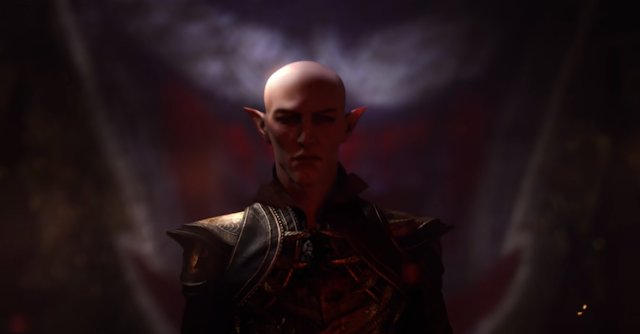
He's so easy to overlook, at first. A humbly dressed companion in homespun, a male elven mage apostate with no vallaslin—with no markings to note allegiance to clan or god. He is a rather curious figure—pale, bald, and thoughtful, neither old nor young, and with a precise and mellifluous voice and a slightly reserved, cool demeanor. He's not especially buff, loud, or commanding. He speaks softly. He's nobody—not really remarkable at first glance. At least not in any obvious kind of way. 

And he certainly isn't your typical heartthrob.

Meet Solas. And given the sheer emotional heights of his final scenes in both Dragon Age: Inquisition and particularly in the DLC "Trespasser," perhaps the greatest irony to Solas's romance with the Inquisitor is how quietly he enters the scene in the beginning.

And I love that. It's just so smart from a dramatic standpoint. Because, when we meet Solas, we barely get the chance to register him in all the tumult—we've been thrown into a world of war and terror that's raining green fire and demons, we're still intermittently begging Cassandra not to throw us back in chains, and we hastily meet Varric and Solas within minutes of battling our first demons and closing our first rift.

In other words, it's all chaos and mess. Everyone's a stranger. Our Inquisitor (whom I'll refer to in the Lavellan character choice since that's the only person who can romance Solas) is confused and scared and tired. Either way, meeting Solas doesn't look or feel all that noteworthy, not in the moment—not least because it's also overshadowed by the return of our wonderful DA2 friend Varric, who's chatty and warm and instantly willing to befriend. Solas is by comparison relatively easy to overlook. Besides, again, we're still traumatized and learning on the run. We exchange a few quiet words and introductions, and then we're fighting onward, through snow and blizzard, through demons and fire, through derision and distrust.

So it's understandable that many of us, we barely look over, especially in a first playthrough, at the quiet elven guy next to us.

And that's exactly what he wants.

The One You Least Suspect

I know plenty of fans keep looking longingly back to the disparate and richly varied race-gated introductions to Origins, but the introduction to DAI is so effective for me because it drops us into the action as an unknown, solitary protagonist who is whoever and whatever we create them to be—into a raw, violent yet beautiful world in which up is down and right is left. We start the story with no one—no family, no friends (we're not the Warden of DAO or the Hawke of DA2). We have 
no past beyond our near-death and resurrection as events begin. Nobody questions this, and it means a hellish introduction for our characters (especially our Lavellans) in the beginning, and we're further accorded scant support or empathy at first by those around us.

Surprisingly, Solas seems to empathize, however, and he even hints at his own isolation when we first speak on the way to the forward camp:
Solas: You are Dalish, but clearly away from the rest of your clan. Did they send you here?
Inquisitor: (my take: OMG YES BUT I DIDN'T WANT TO AND WTF IS HAPPENING). Bioware version: What do you know of the Dalish?
Solas: I have wandered many roads in my time, and crossed paths with your people on more than one occasion.
Inquisitor (among other options): We are both of the same people, Solas. (Personal subtext: OMG I'M SO CONFUSED AND I REALLY NEED A FRIEND AND SUDDENLY I REALLY MISS MY CLAN)
Solas: The Dalish I met felt… differently on the subject
Inquisitor (in my mind): Sorry. Seriously. Also: Crap. Crap. Crap.
  
It's a foreshadowing of our later discovery, in which we learn later on that Solas's awakening (or, rather, his reentry into modern Thedas proper) was very similar in some ways to our own. In other words, our situation, perhaps, mirrors his.

In a romanced Lavellan, this parallel loneliness and isolation is something I find potentially really moving and fascinating. I believe it also contributes to a greater intensity in the relationship that develops between them, if that's the foundation, as well. They are lonely, cut off, yearning for connection they can never achieve. The parallels and implications are powerful, rich and startling.


On the Outskirts

But even as we are thrown center stage, whether we wish to be or not, Solas keeps to the edges. Even after we arrive at Haven, Solas just hangs out over by his modest village hut, far from the Chantry building or the center of camp. He's there if we want to seek him out (and they're some of the most beautiful and lyrical conversations of the story if we do), but otherwise, he's pretty much invisible until it comes time to heal the Breach. He's barely noticeable, off to the side. Someone to provide some unexpected conversation if we run off to the edges of the village to talk to him.

Again, it's perfect.

I mean, consider it: Our first meeting with Bull, when we encounter this larger-than-life figure carving his way through a swathe of bad guys in the midst of storm and thunder as the surf pounds beside him, it's downright mythic. Our first glimpse of Dorian is as beautiful and vivid as a fever dream in a shadowed future. Vivienne's entrance is all exquisite drama and masks and glitter and ice. Sera steps from the shadows like an arrow from the string; a spirit of vengeance against the abused weak and small.

So many others, too, we meet in these florid, vivid, highly emotional moments. So I just love the fact that we meet one of the most important characters in the entire story in this rather casual, offhand way. It is also, notably, one of the few times in the game that Solas is not alone.


Solas's romance is sneaky on every level. You start out talking to the quiet
pale bald guy for three minutes, then catching your breath and going, "Wait...
wait... WAIT. When did he get so hot?"
Taking Notice

But that's Dragon Age. Nothing is quite as simple as it appears to be. For instance, if you're me, you start out by thinking, "Well, obviously I'm romancing Cullen because he's so handsome that it's kind of difficult to even stare directly at him—it's like looking into an eclipse or something" (and don't even get me started on Dorian or Cassandra or Varric or Sera, either), but then you end up talking to the quiet pale bald guy for three minutes, then catching your breath and going, "Wait... wait... WAIT. When did he get so hot?"

Which just makes them seem even more realistic. For me, this first DAI playthrough, I ended up romancing Bull (who as I've already noted, I'd also found utterly unattractive at first, until I fell flat for him and realized how amazing he was, which was even better). I loved everything about it and have posted many, many walls of text about my reactions. Bull absolutely remains one of my favorite characters across Dragon Age.

Still... I'd never quite gotten over my surprise crush on Solas, and even before I'd gotten to that final, powerful meeting between Solas and Flemeth, I knew I was going to romance Solas in the next playthrough.

A Date with Gaming Destiny

And then, of course, as I've described previously here on the blog, I finished the game and then did a fair amount of shrieking—in delight, horror, and frustration at the Fen'Harel revelation as well as at what happened to my darling, adored Flemeth (who is OKAY, dammit, she's FINE, she simply needs another trip to the spa LA LA LA CAN'T HEAR YOU).

And, yeah, I've never restarted a game so fast in my life.

I was determined. My next playthrough would be my canon. I'd play a Dalish elf again, but a quieter one, and I'd romance Solas. I'd pay attention to every single conversation, and enjoy my relationship with my lonely, elegant, brilliant, pixellated crush of the moment.

I thought I knew everything, and that it would be fun. The best part of Solas's romance is, unless you romance him, you actually know very little. Because that's who he is; he doesn't show himself to just anyone. Even those he likes (or loves) as companions. So you have to romance him to really know him. And then, of course, it's too late. 

NOTE: Feel free to use this moment to cheerfully curse the genius of Solas writer Patrick Weekes (but please do so lovingly, because the poor guy does get a ton of flack simply for writing a character so complex and realistic that thousands of people fell in love with his character (NOT HIS FAULT), and to also add a hex on the tea-filled flask of our wonderful David Gaider, who (it turns out) came up with the entire diabolical idea of making Solas romanceable. Because he's a genius that way. And then Weekes was the perfect person to make that idea a reality.

In a horrible way. In a horrible, wonderful way.

Anyway. (PS, read Feeder. And then his Rogues trilogy. And everything. And don't miss Gaider's series of beautiful DA novels. Read. Them.)

The end result is that, like thousands of other unspoiled Solas-mancers, I had no idea what I was in for. No idea at all.

And then it happened.

Subverting the Formula

Thanks to Bioware, the romances in the Dragon Age trilogy are always as varied and unique as the characters and stories themselves. You can seduce Alistair in the first blush of adolescent love, find blazing, reckless  passion with Anders or Fenris, duel gallantly for Josie's honor, tease and dally with Isabela, heal Dorian's bruised heart, embark on a hot if slightly detached sexual adventure with Bull, you can kiss Cullen on the battlements (after you edge his silently adoring Jim out of the way, of course), or romance Cassandra with moonlight and poetry...

...All this, alongside a dozen other terrific and entertaining romantic choices across the game trilogy.

Each of these romances has been created with real thought, care, and attention to detail, with each further illuminating both the love interests as characters, and the protagonist you're playing for, as a hero with his or her own fears, flaws, and strengths. And they're all beautifully written, designed and brought to life. No romance exists in a vacuum in Dragon Age, and each further enhances our knowledge of the other characters as well as of our own protagonists and who we shape them to become.

For me, for sheer, lyrical complexity and emotion, the most entertaining,
immersive, and devastating of any romance across the trilogy... is Solas's
.
But for me, for sheer, lyrical complexity and emotion, by far the most entertaining, immersive, and purely devastating of any romance across the trilogy... is Solas's.

Because, well... it gives us all things, in a storyline that's not just tied to the core story, it's braided to it, entrenched in it. 

With Solas, we get the many-sided fractal that is all the depth, connection, pain, love, fear, sensuality, loss and potential heartbreak of so many other Dragon Age romances in a single story if we romance him. His romance means love and loss, passion and high drama, sexual tension held to the very breaking point in conjunction with intense fear, conflict, belief, courage, and mutual depth of feeling. It's all romantic proclamations and doomed whispers; it's sorrowful glances and unexplained disconnect; it's all of this and more. It's love and connection in a world where magic still exists, and it feels private and pure until one of the most shocking moments in the game (if you're lucky enough to experience it, as I did, unspoiled).

And it's all weirdly perfect, because Solas himself is a paradox, a creature of extremes—someone who's both spirit and flesh, hot and cold, gentle and fierce, abstemious and yet deeply sensual. And, of course, he's ultimately both cruel and kind.

And cruel.

And kind.

The worst things he could possibly be at once. But we'll get to that one later on. For now, let's look at his introduction.

The Quiet Apostate

Solas is a wonderfully designed character (and kudos to the Bioware artists who did so) because his beauty, as with his secret identity, is hidden in plain sight.

For those who don't look closely, Solas is just this bald, pale elven mage of medium height who wanders around with us and who maybe gets a little lofty and condescending from time to time.

But for those who look closely, he's beautiful, unique, and unmistakable—a man in the prime of his life, slimly built, with a long nose and a distinctive, elegantly tapered jaw that both subtly echo his wolf-aspect, and with deep-set pale hazel eyes under straight, heavy auburn brows. His skin is pale and lightly freckled, and the portrait is completed with a beautifully shaped mouth and a cleft chin. His ears are also positioned, again, in this way that perfectly yet subtly evokes something of the wolf when Solas is viewed from straight-on. And of course he finishes the portrait with the ancient wolf jawbone he wears around his neck on a thin cord of leather. 

It's both clue and curse; it's who Solas was... and who he must always be.

In other words, it's awful. And it's gorgeous.

Ultimately, for me, in a visual sense, Solas is like one of those picture-puzzles you have to look away from, and then back, to see the hidden picture hiding beneath the picture. Once you do that, you'll suddenly see a collection of seemingly unrelated things turn into a wonderful image you never expected—a tree, a profile, a visage, et cetera, and this was also how I felt about recognizing Solas's handsomeness. And then you add Patrick Weekes's poetic and layered dialogue. Plus one of the most gorgeous and subtle voices in creation, with the voice contributions of talented Welsh actor Gareth David-Lloyd.

It's a pretty volatile combination. Especially for the unprepared.

To echo the old quote from Aristotle, let's just say, when it comes to lethal attractiveness, the whole is greater than the sum of its parts. (And then you add ancient elven armor, maybe, and, um, fall out of your chair. Don't tell me I was the only one. Don't you dare.)

Anyway. Sorry. ONWARD.

Starting the Dialogue
There's a quiet subtext to Solas's earliest discussions that for me only becomes apparent upon replay or revisitation, which is primarily centered on his definitions of those he may or may not perceive as 'real.' This moment can be incredibly impactful based on what we know of Solas, what our relationship is with him in-story, and how open we have chosen to be with him.

For instance, in my own story experience... One minute, I was talking to Solas in Haven, making the rounds as I talked to all the companions, and we began to discuss the Dalish. The character I was building in my Dalish protagonist was proud of her heritage, and Solas followed up on his initial story on the way to the forward camp (in which he'd admitted that the Dalish had attacked and expelled him when he had tried to share his knowledge with them) by expressing further suspicion and contempt for the Dalish people:
Inquisitor: I’d be interested in hearing your opinions on elven culture.
Solas: I thought you’d be more interested in sharing your opinions of elven culture.
He pauses, pointedly.
Solas: You are Dalish, are you not?
Inquisitor (among several options): Yes, I am. The Dalish are the best hope for preserving the culture of our people.
Solas: “Our people.” You use that phrase so casually. It should mean more… but the Dalish have forgotten that. Among other things.
Inquisitor: Oh, but you know the truth, right?
Solas: While they pass on stories, mangling details, I walk the Fade. I have seen things they have not.
Dammit.

Suddenly, for a few minutes, I was as immersed in the game and moment as deeply as I can ever be captured by a book, a film, a piece of art. Suddenly, I was having an argument with a character in a video game who had also somehow managed to get under my skin and irritate me.

I then chose to have my character answer unexpectedly however—not with a counterattack, but with a plea for knowledge and understanding, and Solas's unexpectedly generous and thoughtful response remains one of my favorite story moments in the game:
Inquisitor: Ir abelas, Hahren. If the Dalish have done you a disservice, I would make that right. What course would you set for them that is better than what they know now?
Solas seems like he might continue in anger, then pauses, and in a lovely subtle performance note by voice actor Gareth David-Lloyd, he sighs.
Solas: You are right, of course. The fault is mine, for expecting what the Dalish could never truly accomplish. Ir abelas… da’len. If I can offer any understanding, you have but to ask.
Loss, Syntax and Ancient Sweeties

This is one of my favorite dialogue exchanges in the game. I especially love that Lavellan, instinctively, moves to use the formal elven here, falling back on her Dalish origins (but in a way he will share and respond to), to both apologize for the Dalish's treatment of him, and to ask, with respect, what she and they can learn from him. For me, it's a key, lovely moment, as is his use of elven to answer her in kind. It's incredibly important: It's Solas admitting, despite himself and his previous outbursts one intrinsic fact: That, yes, we are alike, you and I.

Then their potential romance truly begins. At least, for me. In terms of my own story and protagonist, it's the first moment at which I feel the two realize they are more alike than different, and I still support the curriculum enough to keep them in mind.

In addition, I'm always touched that he calls her da'len, or 'young one,' here, as well, in the formal response. It's less an expression of youthful inequality (although, of course, the disparity in their ages here is one of actual millennia) than one of, to me, addressing the forms. Responding within the ritual, as she has spoken to him.


In Solas's awareness, the most dangerous thing that can happen is exactly what
does... when he realizes the Inquisitor is more than a shadow or sacrifice
.
My favorite aspect of this exchange is the sudden, complex and precipitous drop in tension. Solas is visibly surprised and moved by the Inquisitor's respectful plea for understanding. And then undone by the realization that, wait, this person is not an enemy. This person is listening to him. This. Person. And a dawning realization, appreciation, and terror, of that awareness surely accompanies this, right?

He's already on the precipice.

Because, for the first time, when Solas argues a point, when he expresses anger or frustration in this hostile and ugly, muffled new world in which he has found himself, someone else responds with love, acceptance and with a plea for better understanding. 

The only problem is, it's someone who's not supposed to intrude on his private circle of reality. They aren't supposed to do that. They aren't supposed to persuade. Or tempt. Or move him.

No. No. No.

In his world, the person who responds isn't real. They're a shadow, a shimmer, a ghost. Not real. Never that.

Except... now, this. The possibility. A sudden kinship, a flashing awareness, a connection.

And he is, after all, so lonely.

Solas is a passionate and intensely feeling man. I think, right here, if there's a romance brewing, it's here when he falls flat. And it's therefore that much more believable that here is when the walls simply come down. And when they do, he thinks of Felassan.

As he must. As he should. But more on that later.

The Romance at the Core

Meanwhile, ultimately, to me, Solas's romance is the best of all worlds, offering a little bit of everything, with the open sensuality of Bull's, the sweet, slight awkwardness and hesitance of Dorian's or Cullen's, the doomed passion of Anders, the hidden dramas, conflicts and guilts of Fenris or Blackwall's romances, and the sheer poetry and lyricism of Cassandra's or Alistair's.

However, what makes Solas's romance wholly unique and different from those of the other companions across the trilogy, for me, is that it's the only way we'll really get the complete portrait of Solas, of who he is at his most open and unguarded. This isn't the case with the other characters—if you have high friendship, approval (or even rivalry), even if you don't romance Bull, or Anders, or Alistair, or Leliana, or dozens of others, you'll still walk away knowing who they are, even if, depending on your choices, Bull's romance does provide an unexpected glimpse of both his capacity for tenderness (or ruthlessness, depending on your choices), just as Sera's illuminates her capacity for both playfulness and cruelty if you're playing an 'elfy' Dalish Inquisitor.

Hidden in the Heart

Nevertheless, there's not the disconnect with other companions that we get with Solas—we still get those glimmers of who we already know them to be, with or without the romance. 

But this isn't really the case with Solas, who's careful and reserved with every word, every glance, every touch.

With Solas, you have to reach out. Talk. Open up. There's no other way.

In other words, to know him, you have to be brave. Connect. There's no other way. Otherwise you never get past the barriers.

If we don't romance or befriend Solas, we'll never really know how complicated he truly is. We won't see him lose control, whether in a kiss he cannot bring himself to break, or in his anguish at the prejudicial and senseless death of a friend. Instead, he comes across as a much more distanced character. He remains self-contained, cold, dismissive, and predictable. The elven mage who thought he knew too much, and who needed no one.

Or so he thought.

Because distances can be bridged. Awarenesses can dawn. And love can awaken empathy, admiration, desire and understanding beyond imagining.

But I'll take a look at that in my next post on Solas's romance...

For those of you who romanced Solas... how soon did you look over and realize? Were you as slow as me, or did you notice him sooner?

Saturday, February 3, 2018

The Inquisitor's Seduction: Romancing The Iron Bull, Part 1

Bull's romance is something completely different from almost any other
RPG romance you'll encounter. In a great (if slightly surprising) way.

THE IRON BULL:
Qunari love our friends like anyone does, but we don't have sex with them.


Spoilers for all of Dragon Age: Inquisition, as always!


You never exactly think an RPG game is going to challenge your beliefs, assumptions, or your perceptions of real-world relationships... but then there's Bioware. And Dragon Age. And the somewhat controversial, yet terrifically drawn romance, for instance, between The Iron Bull and the Inquisitor in Dragon Age: Inquisition.

First, a little backstory: Bull's romance was the first one I ever played in DAI, And it certainly offers complexity, maturity and candid sexuality in spades.
I still remember when Bull showed up in his first scene at the Storm Coast. It's still very clear for me, because I looked at him and felt a few conflicting things immediately: Disappointed regret, alongside paradoxical interest. Regret, because I instantly wrote him off as a romance. I'm not into super-muscular guys as a general rule in real life.

And yet I also felt a little fascination too. Because, while Bull was massive and musclebound and slightly loud and disconcerting, he was also so interesting visually, and wonderfully unpretty! He had these strange horns. He was scarred everywhere (seriously: everywhere) and slightly scary, with an eyepatch over a missing eye. His body managed to be powerful but the muscles actually weren't traditionally beautiful, more utilitarian. His face was all angles and edges, like his humor. He just wasn't handsome, and in fact he bordered for me (at the time) on being downright homely.


When it comes to his romance, Bull's entire persona is about drawing
you in. He doesn't pursue you... he gets you to pursue him
.

Reevaluating Bull
Then my Inky talked to him, and I was tempted again. He had a rich, deep and beautiful voice (thanks to the always talented Freddie Prinze, Jr., who was a total chameleon in this role), and whether I found Bull attractive physically or not, when he spoke I melted a little. And he was smart and seriously funny. And better yet, he also seemed to be charmingly transparent, and (awesomely) like the Worst Spy Ever. All pluses in my book.

(I KNOW, right? I was so, so young.)

Although, in my own defense, not finding Bull handsome was, weirdly a plus for me. I liked it. So I paused and thought about my adorable princessy blonde Inquisitor and went, "Wait, wait, I've got to romance this guy... It's like Beauty and the Beast! He even has horns!" (I write a lot of fantasy novels and stories with fairytale elements, so that was catnip to me... I'm weak that way.)

Besides, I was kind of intrigued. I'd played lots of RPGs and romanced plenty of obviously beautiful people in Bioware games: Alistair, Zevran, Thane, Liara, etc. Maybe it would be fun to romance this big hulk of a guy who wasn't obviously gorgeous. And besides, he was so smart, funny and interesting! Most of all, he seemed like he'd be fun. I was playing a big huge adventure game, and a romance with a little fun sounded just perfect to me.

So within a few hours of gameplay and conversation, I reconsidered my immediate decision not to romance Bull, and flipped back just as fast to "Huh. Wait. I totally need to do this."

With this thought, I dismissed my earlier flirtations with Solas (who'd been an unexpected and genuine temptation because of his smarts and smoothness) as well as with Cullen (who's luckily gorgeous because his flirts made my own real-life disasters look positively elegant and Clooney-esque in comparison), and off I went.

I'd decided.

I was going to win the heart of The Iron Bull.


Since my very first Inky was an ice princess outside and a jokester inside,
I adored her pairing with Bull. And visually, it was the perfect fairytale
.
Second Impressions

When I began to romance Bull in DAI, however, one thing that I discovered fairly quickly is that I got taken, my friends. Because once you get talking to Bull, he's not at all the simple, slightly silly, open-book guy you thought you were recruiting. He's quiet, genial but cool, he's adept at keeping people at arms' length, and he's a heck of a lot smarter than he first appears.

And while I may have found Bull ugly in my first few meetings with him, I soon realized that I was in a decided minority on that front. Bull offered his own charms (and knew it), and thousands across Thedas were already desperately dialing him up, going, "How YOU doin'?"

In other words, my initial dismissal of Bull's hotness was, frankly, pretty hilarious.

More Than Meets the Eye

The best part of this dawning awareness was that it quickly and completely dismantled my initial take on his romance, which had been (somewhat naively) that Bull would be easy to catch, and that he'd be a rather kooky, funny romantic object who'd be, well, happy to have the attention.

Writing this today, I find the idea that I ever found Bull to be even remotely simple as a character to be pretty laughable. However, it was definitely entertaining to start to realize just how wrong I was, as Bull talked to my Inquisitor and carefully pieced out those tantalizing little bits of information about himself and life under the Qun.

All too quickly, meanwhile, I began to really like the guy. I began to recognize the other aspects to Bull that were so irresistible to others—and believably so. He wasn't just sharp and crudely funny, he was also capable of considerable subtlety and charm. He revealed himself to be downright brilliant when it came to reading people, and he was also possessed of an incredible amount of charisma and self-confidence. Maybe he wasn't conventionally beautiful to me, but I began to find myself looking for his reactions in all our scenes and cutscenes. A few overheard conversations around the Inquisition further communicated that Bull was fabulous in bed, had zero hangups about sex, and was both respectful, discreet and accomplished in that arena.

Hearing the discussions about these dates, this was where my Inquisitor began to evince actual jealousy and soon went from casual interest to basically throwing herself at Bull on a constant basis. I had her take every available chance to talk to Bull, she took him along on missions, and she flirted incessantly with him. I had her do all of this with a yawn, secure in my assumption that eventually he'd respond with a knowing wink or a rascally kiss and off they'd go.

And then I began to realize the horrifying truth: that Bull might flirt with the world (and sleep with a decent contingent as desired), but he was utterly uninterested in my Inquisitor's attempts at flirtation.

Panic ensued.

The Iron Bull Slightly Freaking Approves

As I mentioned here, when you flirt with most characters in Dragon Age: Inquisition, they respond in a variety of ways, and they're almost always interesting, funny and charming. Cullen, Cassandra, and Josie are adorably flustered by the attention (as is Blackwall, albeit more broodingly and beardily), while Solas and Dorian are much smoother and cooler (as, somewhat surprisingly, is Sera). Cole, Viv, and Varric are all unromanceable (especially tragic in Varric's case, given his wit, handsomeness, and that always-fantastic chest hair).


Bull is the only character in the game who doesn't respond when we flirt
with him. I mean, at all. We get a "slightly approves" and that's it.

But the point is, everybody else responds. Everyone. They react visibly to flirtation and attention. Solas parries your flirtations smoothly with a surprising amount of sophistication and sly sexiness, even as you can tell he's totally falling for your Inquisitorial cuteness (if you're elven). Sera is amused but interested (if you're female). Dorian is charmed, yet cautious (if you're male). Cullen looks mortified yet even mysteriously more ridiculously handsome as he tries to disappear into his own armor. Cass makes noises, growls, draws her gorgeous eyebrows and looks suspicious, but eventually she's hilariously flustered at almost Cullen-levels of adorable awkwardness.

Not Bull. He doesn't say a word. Not once. No change in expression beyond, occasionally, the slight smile that goes along with the notification that "The Iron Bull slightly approves."

Slightly approves. And I was using all my best flirts.

The angels wept.

In all seriousness, for me, The Iron Bull's crushing lack of response to our flirtations may be maddening, but's also absolutely true to character. And for me it's one of the smartest, funniest and most perceptive aspects of his romance, for a number of reasons.

This is because Bull's situation is more complex than it appears. He might be the freewheeling pansexual dynamo yearned after across Orlais, Haven and Skyhold, but he's also a man on a mission.

His loyalties, in other words, are complicated, to say the least.

Sex, the Qun, and The Iron Bull

As far as his baseline goes, Bull is certainly uninhibited, famously skilled and casual about sex. He has zero hangups or shame associated with consenting sexual behavior between adults of any gender or race, as, under the Qun, sex for Bull, as for almost all Qunari, is something purely, solely physical—a need to be filled, an itch to be scratched. It's an act, for many Qunari, which is usually accomplished by their Tamassrans, who treat these interludes almost clinically, as sex workers. Beyond that, there's no romantic love or long-term commitment recognized under the Qun, and those under its regime live existences in which their sex lives (and choices) are often, in fact, not their own, as different pairs of men and women are frequently matched up solely for breeding purposes.

It's all just part of accepted life under the Qun, as Bull notes in an early dialogue with a curious Inquisitor:

Bull: Qunari love our friends like anyone does but we don't have sex with them.
Inquisitor: You don't have sex?!
Bull (laughing quietly): Oh, we definitely have sex. There are Tamassrans who pop your cork whenever you need it. It's not a big deal like it is here. It's like, I don't know, going to see a healer. Sometimes it's this long involved thing, it takes all day, leaves you walking funny. Other times you're in and out in 5 minutes—"Thank you, see you next week!"
(Later, after the Inquisitor asks more questions...)
Bull: No drama. (Pause) Still, it's more fun here. Fewer rituals, more making it up as you go along. Plus, you folk have redheads. Redheads.
After childhood, Bull spent years in the Ben-Hassrath, where he would have learned to use sex as both an enjoyable outlet for pleasure and stress relief as well as, of course, as just one more valuable psychological weapon. I then assume that he further honed his skills in the bedroom during his decade in Orlais as an undercover agent, where (according to the DAI Codices), his sexual escapades were the frequent and notorious topics of avid interest, speculation, envy and discussion among the nobles there. As I've noted before, I also think this is where Vivienne would have picked up on him as a player of the Great Game, and become an amused admirer of his subtlety and gamesmanship from afar.

It's no coincidence that Bull (here flanked by his loyal Krem at left) always
positions himself in the best place for picking up news and gossip. In Haven, he's
between the outer gate and stables, able to see and hear pretty much everything
.
The Quiet Strategist

When Bull joins the Inquisition, he seamlessly installs himself as a fixture near the central areas of gossip and discussion, every time. It's beautifully casual, and such a smart and appropriate character note. At Haven, he's between the main gate and stable at the outer wall, right where he'd be able to observe who's in and out on missions (as well as viewing plainly their moods and reactions), and he'd also be able to overhear plenty of important conversations without alerting suspicion, as well (Note: I previously and incorrectly said he was outside the Chantry—many thanks to Elana for the correction!). He installs himself into an even more ideal spot later on, in the Herald's Rest at Skyhold, where he also becomes an enthusiastic participant in its social life.

But as far as Bull's romance, at Haven, almost immediately we overhear accounts of Bull's casual bedroom encounters in a few funny, eavesdropped conversations, as well as through discussions with Bull himself once we reach Skyhold. He's obviously not lacking for company (and by all accounts he's also, ahem, a pleaser—which certainly fits with his core personality as someone programmed to give people what they need).

Yet here he is, barely responding when the Inquisitor, possibly the hottest, bravest, most fascinating person in Thedas (let's just assume it's a given, right?), flirts with him over the first several months of his time with the organization.

Why?

Like I said: He's not looking for a date. He's a man on a mission. And he's playing the long game.

The Devastating Attractiveness of Complete Disinterest

I was, of course, as frustrated as anyone else when I realized that The Iron Bull wasn't going to fall at my Inquisitor's feet. And yet, the fact that he didn't do so quickly became part of the fun. I became increasingly intrigued... then realized that this is exactly the reaction Bull's aiming for. And now here I was, making constant heart-eyes at this big, bluff, funny ox-man and waiting for him to finally notice my protagonist character. To quote "Buffy the Vampire Slayer," the subtext was rapidly becoming text. The psychology of Bull's romance—and the accuracy of its eye on human nature—was a lot of fun, even as I found myself amused at my own reactions to it.

Remember—at first, I'd found Bull somewhat ugly—striking and imposing, sure, but not beautiful (aside from that gorgeous deep voice). Then, like I said, I'd started actively pursuing him, and somewhere at about the 30% mark of the game, a number of things had happened:


  • I was no longer remotely interested in romancing anyone else
  • I'd forgotten why I ever found him ugly
  • I was hanging on every conversation with him like a wistful groupie
  • I'd realized he was not just the big lug with the ax and the mug of maraas-lok, but that he was actually one of the smartest, subtlest, and most perceptive characters in the game (rivaled only by Solas and Leliana).
And despite dozens of hours of adventuring by my adorable Inky (several months in Thedas-time), Bull scarcely returned her glances.

It was downright depressing.

But, true to human nature since time immemorial, of course, with every disinterested look or implied shrug, I just fell harder. The result was that my Inquisitor was energetically throwing herself at Bull by the time we got to Skyhold, and—of course—(at least mentally) writing his name in her Inquisitorial parchment-notebook with lots of little hearts and arrows and cute curly initials everywhere.

And the thing is, I loved it. I loved the fact that I was playing for a character who suddenly found herself frustrated and insecure, who wasn't being handed her desired relationship on a silver virtual platter. Suddenly, and gorgeously, Dragon Age: Inquisition was defying my expectations. While I'd loved the other two games, nobody here was handing me roses or making speeches about how hard it was to resist my charms. Instead, its relationships were challenging, complex and frustrating. Just like life.

Playing Hard to Get...

Meanwhile, as my Inquisitor went on casting pining looks in Bull's direction (inciting a few more paltry "The Iron Bull slightly approves" reactions, curses), she did all of the quests that would get her approval as high as possible with him in the meantime. So she helped the poor common folk of the Hinterlands, she did the quests that included valuable soldier's skills (like the horse races at Dennet's farm to demonstrate horsemanship), she decimated the dragon population across Thedas specifically for the additional approval from Bull (and felt more than a little guilty in the process), and waited for him to look her way.

And, bless her little heart, she waited a long time. Here's an approximate rundown of how many flirts Bull required before he made his move:

  • 2 flirts in Haven
  • 2 flirts in Skyhold tavern
  • 1 flirt at the dragon celebration (maraas-lok for everyone!)
  • 2 flirts on the rooftop (after "The Demands of the Qun," either outcome)
Now, these numbers are a bit fluid because Bull's interest is also absolutely predicated on approval numbers (not just flirts), and my Inky #1 didn't always choose outcomes or judgments Bull loved (he tends to approve the more ruthless, soldier-like, solutions). For instance, I know some players who are able to move forward with him almost immediately after arriving at Skyhold, while it took me a few dozen hours further. But I'd say that my experience was pretty common, at least, and I like what it says about Bull as a character, so I'm including the flirt counts here just for fun.

I mean, compared to Bull, most of our other love interests in DAI are pushovers—it takes maybe two or three flirts with Solas to get the Fade kiss (and we make the first move). It takes about the same for Cullen. The only other similar holdout in DAI is actually Sera, who is amused, but also surprisingly reserved, at interest from the Inquisitor, and who takes her own sweet time in deciding whether or not to trust them.

However, there are good reasons for Bull to behave this way that aren't just about playing coy or hard to get.

I mean, again... he's undercover. At least, to start.

And maybe for even longer than that, depending on our own loyalties and choices...


Think about it. If Bull openly sought the Inquisitor's affections, he'd be
met with skepticism or even outright suspicion (he is, after all, a spy). But
if he gets us to pursue him, his agenda is much easier to hide.
Secrets and Lies

As you already know from some of my previous analyses of The Iron Bull, my take is that Bull is reserved and circumspect for most of the game's first 30-40% because he's in a pretty complicated position as a potential sleeper agent. Therefore, it's all to his advantage for the Inquisitor to do the chasing. For him to chase the Inquisitor, he risks either alienating them or alerting suspicion.

Why is Bull so reluctant? Let's take a look at the big-picture possible reasons:

  • He may be understandably skeptical of the Inquisitor, the organization, and Thedas. 
  • He may be waiting you out to see what kind of person you actually are. 
  • He may be reluctant to complicate a professional relationship with a sexual one. 
  • He's cautious and it takes him awhile to become interested. 
Or... my take:
  • He's being strategic, despite being interested from day one (or at least attracted, because, again, see Inquisitor and most gorgeous interesting person ever). 
  • He's also under orders from the Qun to get close to the Inquisitor. 
  • He may even be under direct orders to seduce (or to attempt to seduce) the Inquisitor (and oh, I definitely think he is). 
  • He's got to proceed with caution—each step must be conducted perfectly (after all, we're talking about the Qun's goal of world domination, complicated by the added stress that the Rifts themselves pose a threat to the end of that world). 
For me, it's that second bullet list. It's simply a matter of Bull understanding human nature, and to a scary, almost microscopic degree. In other words, he's slightly cool and unattainable because that just makes him even more desirable to the Inquisitor. He can't exactly pursue the Inquisitor—doing so would be far too obvious, and it would immediately raise a few red flags (with Leliana, certainly, among others).

So Bull spends half his seduction game doing a careful dance—timing every smile, every discussion, every move. Always teasing forward, then edging back, drawing the Inquisitor in. Turning down half a dozen opportunities and simply biding his time.

In a more cliche-ridden story, the next step—Bull's seduction of the Inquisitor—would be a charming or comedic scene as Bull finally makes his move.

So it's interesting, yet again, that what's presented here doesn't fit into any of those categories. It's not charming. It's not light. It's... risky. It's dark. It's disconcerting. It may be hot, yes, but it's also, in fact, pretty cold.

Delicious, but cold. 
But more on that in the next part of my analysis... when Bull finally makes his move.

"Dragon Age: Dreadwolf" Predictions & Ponderings (and "What's in a Name?" Redux)

He doesn't call, he doesn't write, but finally, it looks like we might be hearing from Solas at last (2023?), as BioWare announces t...