Showing posts with label romance. Show all posts

Saturday, June 22, 2019

The Temptation of Hissrad: The Demands of the Qun, Part 1

What do you do when you realize that your country may have wronged you, lied to you, and used you to kill, capture, and brainwash hundreds of potentially innocent people? Bull faces this potential reality in "The Demands of the Qun."
THE IRON BULL: My people don't pick leaders from the strongest, or the smartest, or even the most talented. We pick the ones willing to make the hard decisions... and live with the consequences.

Greetings, fellow Thedosians! Gird your loins, this is gonna be a long one...  Welcome to my fourth piece in my series on the Qun and its mysteries, thanks to the beautiful and brilliant minds of Mary Kirby, David Gaider, and Patrick Weekes. In previous weeks, I've attempted to examine the Qun's foundations in Dragon Age: Origins, thanks to Kirby and Gaider, as well as analyzing its representations in the trilogy, from Sten and the Arishok, to a newer and more complex representation of a Qunari character in DAI's The Iron Bull.

This post marks Part 1 of 2 in my in-depth examination of The Iron Bull's loyalty quest: "The Demands of the Qun," where Weekes's interpretation takes center stage with Bull, and I'll be following this with a final post and analysis to complete my thoughts on the entire quest itself.

Onward. Aaaand here we go!

So... What does it mean, to abandon your faith, your country, your people? To realize that every truth you grew up with, each fact you never questioned, each comforting assumption... may have been wrong? And not just wrong, but horrifically, tragically wrong? When every righteous blow of your weapon may have gone astray and killed those who had simply desired freedom?

What do you do when you realize, in fact, that your country may have wronged you, lied to you, and used you to kill, capture, and brainwash hundreds of potentially innocent people?

That's pretty heavy stuff. And that's what The Iron Bull is faced with in his loyalty quest, appropriately entitled "The Demands of the Qun."

It's a pretty dramatic and emotional scenario, not least because Bull isn't the only one asking those questions and making those decisions. As his leader, commander and Inquisitor, we're making them too. And he will judge us for our choices.

Oh, boy, will he judge us.


Bull admits why the Qun drives him: "It's like being a block of stone with a sculptor working on you."
The Blows of the Chisel

I mentioned this in my opening examination of the Qun, but I love that, in one of our earliest conversations with The Iron Bull, Bull tells us a key fact about what moves him and inspires him as a part of the Qun:
"It's like being a block of stone with a sculptor working on you. One day, the last of the crap gets knocked off, and you can see your real shape, what you're supposed to be."
Bull is no stranger to pain or strife. Give Bull a challenge and he smiles that narrow smile and charges right for it. So I love the idea that writer Weekes has presented us with this as a part of Bull's core identity, that for him pain under the Qun is simply the process of turning his imperfection into perfection, of sculpting him into who he was meant to be.

It's a terrific simile for Bull to use, and an expression of an idea that would certainly be believably attractive to the kind of person Bull reveals himself to be—to one who seeks improvement, who wants to be challenged to realize their best and most capable self. And it makes sense that Bull, a lifelong adherent, soldier and spy, would find it comforting. "This hurts," he would think, "But it's worth it."

The concept of this pain as the price of perfection irresistibly reminds me of C. S. Lewis's famous observations about God. He felt that pain was simply God's way of crafting each of us into a better person. Lewis famously said:
"I suggest to you that it is because God loves us that he gives us the gift of suffering. Pain is God's megaphone to rouse a deaf world. You see, we are like blocks of stone out of which the Sculptor carves the forms of men. The blows of his chisel, which hurt us so much, are what make us perfect."
Pain Equals Perfection

Lewis's idea is certainly an interesting and persuasive concept, and it has been a favorite of mine since I was very young, even though (while I was raised Catholic, and also had a brief Amy Grant phase in college), I am nonpracticing when it comes to religious faith—I'm pretty hardcore atheistic, with just a single filament of hopeful agnostic, at this point. Although I support whatever faith gets my friends and loved ones through their days, I just can't quite get there all the way to belief, myself.

But I've always loved Lewis's writings and essays even so, and I remember in the past, when faced with hard choices and the terminal illnesses of loved ones, I did seek a higher meaning, a higher power or awareness... and I held onto Lewis's words tightly, wanting to believe there was meaning in pain. It was a comforting idea—not one I was able to sustain long-term, although I do believe that adversity and suffering can make us kinder and more empathetic to others overall.

But it was a beautiful simile. Almost too beautiful.

Either way, it's notable and interesting that this sustains Bull, and it also seems to me to echo Sten's similar "I am their work" statement back in Dragon Age: Origins. This thinking is exactly what the Qun encourages, that each citizen is simply a tool, a thing for the Qun to hone and use for its own good. 

And this way, according to Bull's thinking, the Qun is always there for him, and his pain, trauma and grief are simply tests of his own worthiness. The blows of the chisel, making him perfect.

Until the break in the sky.


When he joins the Inquisition, Bull's a definite paradox. He talks a good game, but he's also spent the past decade as far away from Par Vollen as he could possibly get. 
The Broken Tool

As we make our way through the story of Dragon Age: Inquisition, and witness the many amusing banters between The Iron Bull and the rest of our companions, it's no surprise that a number of those conversations (as well as those initial talks with the Inquisitor) circle continuously around the question of Bull's adherence to the Qun and its tenets. Bull expects this, and is genial if guarded, and he's also openly amused at how alien his concepts seem—especially in the conversations about sex and parenting.

It's interesting right away—remember, Bull encourages the idea publicly that he's his own person, since it's useful to his work as a mercenary and spy, even if he doesn't go so far as to actively play Tal-Vashoth. But when he joins the Inquisition he's a definite paradox, as he talks a good game of Qun loyalty, but (let's be honest) he's also spent the past decade as far away from Par Vollen as he could possibly get. When you look at his actions in the big picture, he certainly seems like a man desperate for safe haven (ahem, sorry).

And yet he doesn't show that outwardly. He's assured, confident, charismatic and casual when it suits him (and when it's most strategically advantageous). There's no sign externally of a man on the run, of a warrior who seeks shelter. It's arguably written all over him for the first major chunk of the DAI story, yet it's never ever spoken by him, save for a slightly weary admission to Solas during their endless early bickering that not everyone in the Inquisition would fare well under the Qun (like Sera)—and this includes people he has grown to care about.

The Liar

But despite the fact that Bull may have his own private reservations about his place in the Qun, as far as we can tell within the Inquisition in those early days, he's a secure, superb and nimble propagandist, parrying with Solas on the nature of free will, and deftly shrugging off any implications that he harbors even a fleeting disloyalty. He's proud, after all, of the fact that he once turned himself in to the reeducators after his traumatic breakdown after Seheron. He wanted them to "fix him," they seemed to do so, and then sent him far, far away. And he was more than happy to oblige—and too relieved at the change in his circumstances—to question what was actually happening there.

But Bull is smart. He may be a superb liar, but I don't think he lies to himself.

So at some point, late, late at night... in those taverns after last call. Or after a little welcome release and oblivion with any one of a number of partners in little rooms above the bar... Bull would have had to face facts: He'd been thrown away. He was inches away from being a bas, a thing, and a defective one. A broken tool. And now the Qun had sent him off to do what little they thought he was still capable of doing, until he fractured all the way.

In those complex moments, Bull had to have known the crossroads was approaching. And he'd know that he'd have two choices when that moment arrived: To prove his loyalty (no matter what the cost), or to break away, for real. And for all time.


It's no coincidence that the first things Bull does upon departing Par Vollen are to choose a glorious new name and then to gather a family for himself.
The Good Soldier

So as we prepare for "The Demands of the Qun," the Qun has largely left Bull. In sending him off to roam Thedas, they've thrown him out like an unruly pet... but with a string attached to that collar of his... just in case they need to yank him back.

The problem here is that Bull is nothing if not stubborn to the ends of the earth. And loyal. He doesn't admit to being tossed aside. He's not resentful of his superiors or of the Qun itself. He's just sorry he didn't live up to the task he was asked to accomplish—it doesn't matter that he lasted five times longer than anyone else on that Seheron detail. He just sees that he failed, got patched up, and allowed himself to be sent back out into the wide world while he could still be of some use to the Qun.

At this point, Bull departs Par Vollen for a decade, charging joyously forth across Thedas in order to gather information (and coin), to take down foes in skirmishes, help the little people, and to rebuild some kind of life for himself. And I believe it's no coincidence that the first things he seems to do are to choose a new name (something new, something glorious), and then to gather a family.


It's no coincidence that even as he seems to acquiesce to the Qun on his journeys, Bull nevertheless embarks on a series of subconsciously rebellious actions against the core demands of the Qun itself.
Divisions of Loyalty

As I've referenced earlier in my examinations of the Qun, an important concept in the Qun is the idea of "Asit tal-eb"—"It is to be": the idea that everything and everyone in the world has a nature, acts accordingly, and that all these things come together to form a proper order—such as a beast killing its prey, the locust devouring crops, or the water flowing to the sea.

What's sort of ironic to me, then, is that Bull, post-Seheron, goes on a roundabout journey of self-actualization... a journey in which I would argue that he is actually, to some extent, simply becoming his true self. Which, rather ironically, is not against the demands of the Qun. Bull was right about his potential to change, just wrong about the source: It is not the Qun that transforms Bull, but rather himself and his capacity to feel... his grief, loss, loyalty and love—first for Krem, then for the Chargers.

So when you analyze Bull's actions after Seheron, it's not a coincidence to me that even as he seems to acquiesce to the Qun on his journeys, he nevertheless embarks on a series of subconsciously rebellious actions against the core demands of the Qun itself:
  • The Qun doesn't use names. Bull gives himself a name. And further names his loved ones.
  • The Qun breaks up family units, recognizing their danger to the whole. Bull builds a family.
  • The Qun sees people as things, tools, implements. Bull seeks out real, emotional connection on a constant basis.
  • The Qun does not allow sex and love to commingle. Bull may seek and find a potentially, genuinely fulfilling romance, either with Dorian or the Inquisitor.
It's a theme with Bull, and very interesting as his loyalty quest approaches: His words and demeanor give us nothing but a passionate adherence to the Qun. I think he truly believes this... well, in the topmost part of his mind.

And yet...


I wrote once about how Solas in DAI is a man in a waking dream—of what might be, of potential happiness. In yet another parallel between the two very different men, I believe the same is true for Bull, too, in the first half of DAI's story events. 
A Servant of Two Masters

Bull nevertheless covers his bases, and does it well. Many (if not all) of Bull's actions are those of a deeply divided man. He continues to be a terrific and no doubt informative spy living and working in plain sight. He reports to the Qun regularly. He apparently continues his progress to seduce the Inquisitor—a task that we know in hindsight to be both potentially effective as a gamble, and (at least, at first) remarkable for its combination of heat and coldness.

We only learn most of this later, but looking back, it appears to me that for much of the first half of Inquisition's story, Bull is walking both worlds. He's marking time, speaking both sides, and doing so pretty well. Bull has already shown himself to be adept at compartmentalization, and all his training enables him to do so now, with incredible skill. So he can be the good spy... as well as a truly good guy willing to die for the people of Haven.

Yet also... basically, I think... until "Demands of the Qun," divided or not, compartmentalized or not... I do think The Iron Bull feels a true kernel of real hope, albeit unspoken and unacknowledged, when he joins the Inquisition. And that, when he seduces the Inquisitor (or Dorian), therefore, I think he also does so out of at least some genuine attraction and interest.

I wrote once about how Solas in DAI is a man living a waking dream—a dream of what might be, of potential happiness. In yet another parallel between the two very different men, I believe the same is true for Bull here, as well. After all, what better way to sell a lie than to believe it yourself?

And so for a little while, Bull's a man who can play the game, give lip service where required... while reserving his heart.

Meanwhile, rescue by rescue, Bull saves who he can, just as he did when leaving Par Vollen: the brave loners, the misfits, the forgotten ones—just as he'd saved Krem, then Dalish, Grim, Stitches, so many others in the Chargers. People who had themselves been abandoned. And he makes them his family. Ever since his childhood as little Ashkaari, he was a person drawn to saving and protecting others. No wonder then, that he wholeheartedly approves of the work to help restore Thedas, and of his role in helping the poor, lost, wounded, and disenfranchised.

That's who Bull is. At his very best self... at least.


Sometimes the rescued can become the rescuer. Such is the case with Krem.
Rescuing the Rescuer

For me, this is vital to understanding Bull's position as we approach his loyalty quest here, and his mindset. He has, at least physically, left the Qun—a feat he's also explored at least to some degree mentally, even if he cannot even admit to himself yet. He has given himself a name, a family, a place, even the chance for potential redemption from the past deeds that haunt him and from the inner savage he fears.

Sometimes, the most beautiful thing about being rescued is that you yourself can become the rescuer. Which is why I love the symmetry that Krem, Bull's first rescue, the person who would become his spiritual son, is the person who gets Bull to join the Inquisition. As if Krem himself knew Bull would need a new outlet, a new place to establish himself. As if Krem was seeking for some way to save the big-hearted captain who'd saved him.

And it worked. After building himself up with Fisher's Bleeders and eventually creating his own mercenary force with the Chargers, Bull joined the Inquisition, at Krem's direct urging, bringing along the rest of Bull's joyful, raucous Chargers family. 

It's interesting here to note that Bull instantly tells the Inky about his dual allegiances. "Hey, I'm a spy!" I think he does so because it's expedient and smart to instantly build trust and present a picture of amiable incompetence, but also (I'd argue through my rose-colored glasses) because he wants to be real. What if he simply wants to tell the truth where he can? What if he got tired of roaming, and wanted to find some semblance of a home? By the time the Inquisition has reached Skyhold, even with the breaks in the sky, life is suddenly warm and welcoming for Bull and the Chargers. They have a home base, a purpose, plenty of money, warm beds, and companions and friends always ready to raise a glass or spin a tale. 

And presto, Bull finds himself with at least the possibility of a new life, all thanks to Krem. It's pretty safe to hypothesize that Krem probably wanted Bull to at least consider leaving the Qun permanently, if he could bring himself to go Tal-Vashoth. Krem probably saw far more clearly than Bull how damaged he had been by his former life.


It's implied that Krem not only got Bull to join the Inquisition, but that he may have done so in a loving and active attempt to save Bull—to get him away from the Qun for good. Were the other Chargers part of this, as well?
Building the Chargers

There's a little kernel of a hidden story to how Bull came to join the Inquisition, if we pay attention to dialogue from Bull, Krem, and even Vivienne. If we do so, we get a clearer presentation of how events proceeded for Bull and the Chargers: First, the Breach appeared, with Bull and the Chargers on missions in or around Orlais. Then the Inquisition formed, and Krem then went to Bull and actively, deliberately suggested the Chargers do their part. 

Here's how Bull summarizes events in the Fade later on, if we bring him along on "Here Lies the Abyss":

The Iron Bull (as Krem): "Hey, Chief. Let's join the Inquisition! Good fights for a good cause!" 
The Iron Bull (as himself): I don't know, Krem, I hear there are demons.
The Iron Bull (as Krem): "Ah, don't worry about the demons, Chief! I'm sure we won't see many!"
The Iron Bull (as himself): Asshole.

Still, all later grumbling about demons aside, Krem had convinced Bull, and he'd agreed. Something about the situation called him to answer. Bull would have then reached out to Par Vollen and gotten permission (and, it's implied, additional orders—to infiltrate the Inquisition organization, to get close to the Inquisitor, etc.), then sent Krem to offer their services.

So to get back to my main point, what touches me about this scenario is the implication that Krem not only got Bull to join the Inquisition, but that he may have done so in a loving and active attempt to save Bull—to get him away from the Qun for good. It's tempting to wonder if this wasn't just Krem, but a collective attempt by the other Chargers, as well.

And then Gatt shows up at Skyhold, and here we are. When the Qunari yank that string and remind Bull that you can leave Par Vollen, but that it takes a lot more than that to be out of sight of the Qun... so of course it's fitting that the fate of Krem and the Chargers themselves will lie in the balance. Will Bull save his self-made family, or recommit once and for all to the Qun?

It's a cruel scenario, and its impact is irrevocable. And our choice there will depend upon whether we simply—like the Qun—view Bull (and the Chargers) as disposable tools, as things... or whether we value them as something more than bas.

Meanwhile... I'll resume this further in my post to follow, when we find Bull on that painful rainy hillside on the Storm Coast in Part 2...

Thank you as always for reading!

Saturday, February 16, 2019

The All-Time Most Romantic Dragon Age Moments


Oh, Cullen. Your love for the Inky is sweet, hesitant, and a reminder of how much our Dragon Age characters can evolve across one of gaming's best trilogies.
Varric: Look, Seeker, if you love a character, you give them pain, ruin their lives, make them suffer. Maybe even throw in a heroic death.
Cassandra: That makes no sense!
Varric: You care enough to argue. If she had a nice afternoon and took a nap, you'd stop reading.

Happy (Late) Valentine's Day!

So, I wanted to post this a few days ago. And of course, life and work intervened. But still... better late than never, right? Hawke would forgive me instantly. The Warden would roll her eyes. And the Inquisitor would look at her watch.

Or so I headcanon. But onward...

The lovely thing about pixels is, they never let you down. If we love them, they love us. And because we are all fabulous Dragon Age fans here, let's face it, no matter who we are, we've all had a perfect romantic moment with the companions we love.

So instead of a ranking of romances, which I just feel wouldn't be productive and wonderful, I'd rather provide a rundown of my personal favorite sexiest, most romantic and most poignant moments across Dragon Age, for all companions.

Here goes!

Dragon Age: Origins


A rose by any other name just wouldn't be the rose given by Alistair to his adored Warden. It almost makes a Blighted world worth navigating...
Alistair
Alistair is a lovely Prince Charming, especially when he begins to face the Blight-ridden world he's supposed to save, and grows up. He's sweet, brave, and bashful, and his declaration of love for the Warden, giving her a rose in a world of darkness, really moved me the first time, and always will. It's one of my favorite-ever romance moments in Dragon Age: He's young and vulnerable but he's not wrong to use this one moment in a time of tragedy and torment to declare his feelings. It's just lovely (and beautifully acted by Steve Valentine).

For me it's Alistair's most beautiful, literate and genuinely poetic moment: 

Here. Look at this. Do you know what this is?

I picked it in Lothering. I remember thinking, 'How could something so beautiful  exist in a place with so much despair and ugliness? I probably should have left it alone but I couldn't. The Darkspawn would come and their Taint would just destroy it. So I've had it ever since. I thought that I might... give it to you, actually. In a lot of ways, I think the same thing when I look at you.

(Warden replies among several options)

I'm glad you like it. I was just thinking... here I am, doing all this complaining, and you haen't exactly been having a good time of it, yourself. You've had none of the good experience of being a Grey Warden since your Joining, not a word of thanks or congratulations. It's all been death, and fighting, and tragedy. 

I thought maybe I could say something. Tell you what a rare, and wonderful thing you are to find amidst all this... darkness.

Morrigan has literally been raised to distrust closeness, kindness, and generosity. Her romance therefore reveals a vulnerability and sweetness that is doubly charming.
Morrigan
For a scary swamp witch who can turn into a spider at will, Morrigan is surprisingly lovable. I adore her. I know she's controversial but to me she's a peanut-butter-tart with a soft and creamy center.

Wait. That sounded more sexual than I meant it. Although yes, I wanted to romance her with my female Warden and am still not okay that I couldn't.

Morrigan's romance, however, is genuinely lovely—she's tentative on emotion, forceful on passion, as you might suspect, and yet... the emotion is always there. It means something to her. Her acknowledgement of the Warden's feelings is moving because we know it's one of the only times she's ever done so in her life. Ever.

She seems like one of the sweetest characters in Dragon Age, but Leliana has a core of stone and steel to see her through the greatest crises of world or heart. And yet, no one is braver or more faithful.
Leliana
Oh, Leliana, Leliana, where do I start.

Romancing Leliana in DAO is like admiring the grace of a beta fish and not knowing it was a shapeshifter fish. It was not swirly and cute and pretty and inoffensive. It was a swordfish. Ha. But the joke's on you. It wasn't a swordfish, either: It was a shark all along. A beautiful GORGEOUS awesome, smart, subtle shark, but... yeah.

But that shark still has the soft little feathery feelings of the beta fish. As it should.

The best part is that she is unshakably faithful: If she romanced the Warden in DAI and Trespasser, she's still present, faithful, and loving there. It's the best thing ever.

Leliana: "Here, with you, knowing the freedom of the road and the uncertainty of tomorrow, I feel alive again." And a bit later... "It comforts me to know that the stars will remain untouched by the Blight. That whatever happens down here, they will shine eternally, their light undimmed."

Leliana is a combination of sweetness, softness, and steel. Leliana is amazing.

He's the rogue with the tongue of velvet and the heart of silk. Zevran is well worth romancing, and he's one of the funniest and most moving characters across the trilogy.
Zevran
I love Zev. Because his romance isn't "Yay! We're in love! Let's have sex!" and more, "Yay! We've had sex! Now we navigate the minefield of... feelings?!"

Ahem. But you get it. 

Like Bull, Zevran makes sex simple and only the emotions that follow anything complex or challenging. For him, they are a series of puzzles, a cipher. A product of incredible abuse thanks to an upbringing among brothels and assassins (wait, who does this remind you of?), poor Zev came through with his joy and sensuality intact. After a recent devastating loss of both life and faith, he has decided to kill himself, and it's only the Warden's mercy that spares him (or not).

And so there we are, with a wonderful character who thinks nothing of sex and who guards his own secrets like gold. Beautifully and humorously voiced by the talented Jon Curry, Zev is a character to adore or to kill and discard as too dangerous to live. Me, I've never ever been able to kill him or send him away.

And it's fitting for such a textured, rich character that one of his most devastating moments is when he's absolutely stone-cold serious and his heart is breaking:

"By your side I would willingly storm the gates of the Dark City itself."

Dragon Age II

Merrill cannot find her way around her own alienage even after years of residence, but she knows her own heart, and she's wiser than she seems.
Merrill
Secrets of Dragon Age blogging: Look. I love Merrill. I love her like I love relatives. Pets. Because (cringeworthy admission): She is the most like me. Of any DA character, she's who I understand, who I love, who I know. I have to respect and adore someone who can understand and parse complex magic and metaphysics while also finding herself lost in a simple neighborhood setting. BINGO. I get this.

And I think she's vastly underestimated. She's a goofball but she's also wise, and brave, and clear-eyed. (I'm not saying I am any of those things: But she is undoubtedly smart and yet in life, she is often... not. And I identify with that.)

But here's my favorite example of her feelings for a romanced Hawke, because they show that little thread of metal at her core, and as always it's a gorgeously voiced scene by Merrill's voice actor Eve Myles. Merrill is darling, but she does not mess around:

Aveline: I didn't expect you to stick around for this mess Merrill. This has nothing to do with your elves.
Merrill: I love Hawke, I wouldn't go anywhere.
Aveline: But it's not your fight.
Merrill: I love Hawke.
Aveline: You said that.
Merrill: I say it a lot. It makes things clearer, takes away doubt when everything is crazy and people are dying.
Aveline: I understand.
Merrill: Oh, good. Someone should.

That's Merrill for you. Funny when you expect her to break your heart. And heartbreaking just when you expect her to make you laugh.

Sexy, confident and complex, Isabela's suffered much. And she's softer at heart than she seems.
Isabela
I loved Isabela's romance. It's surprising, funny, sexy, and warm. It's also complex and it often zigs just when we think it will zag.

Isabela isn't always an easy character to love. She's tough, tenacious, pragmatic, and a pretty challenging, frightening life that included enslavement, rape, forced marriage, servitude, and imprisonment has taught her to be all right with cold, even callous choices. (Evidenced by her behavior over the Tome of Koslun throughout Dragon Age II.)

But there's more to Isabela, and she often shows us real charm and sweetness beneath the tough swaggering sailor-captain. She puts up with Aveline's constant yelps of "Whore!" and still sees beneath the warrior's puritanical knee-jerk reactions to the slightly scared, socially uncomfortable woman beneath.

As Izzy's terrific voice actor, Victoria Kruger's voice is rich and gorgeous, and it provides Isabela with something that externalizes who she is at her core—her generosity and warmth. As when she looks out for Merrill and calls her "Kitten." There's something to Isabela that's fine and pure, when she allows herself to be vulnerable.

My favorite moment for Isabela's romance is the very first one, when she shows up at Hawke's door for a little quality time. Since I was playing this with my FemHawke, I had no idea Izzy was, er, propositioning my girl for a little sex, and I was stupid enough to go, "Sure! Let's have girly time!" I was picturing more mani-pedis, but was also sort of delighted, nevertheless, that she was proposing something entirely different. My Hawke's reaction: Well, all righty, then! (Mani-pedis are, after all, overrated.)

Needless to say, the next scene, of Izabela and my Hawke happily making out while tossing off a dozen daggers apiece, remains one of the funniest, sexiest scenes in Dragon Age for me. I've seen it with a male Hawke too, but somehow it's better and funnier with the two women. Maybe because it's just so empowered, so strong, and so freaking funny.

I know many, many fans will disagree with me, but for me, Anders deserves every tiny little moment of happiness he can get. And somebody still needs to go find Ser Pouncealot. (Talk to the hand.)
Anders
Oh, Anders. The angst! The drama! The italicized proclamations!

Here's the deal: I love Anders. I know he's over the top. But I know how much he's been through. I know what he's suffered. I know he's spent his entire life running from people trying to isolate and control him.

So the fact that he's able to still feel so much in Dragon Age II, to be so passionate, is kind of a miracle to me. Let's not forget that our earliest outing for him literally involves our mercy-killing the first person he ever loved romantically.

So I love Anders's romance, with all its dramatic proclamations, doomed portents, and breathless kisses. His romance is one of my favorites across Dragon Age, and always will be.

I know people favor the dramatic "drown us in blood" quote, but the one that always gets me with Anders is quieter, and it broke my heart into little slivers:

"No mage I know has ever dared to fall in love... This is the rule I will most cherish breaking."

This. This is everything that's wrong with the mage/templar system. And it's doubly tragic given Anders's choices in this story path. But it will always move me.

Hey, if they took away his damn cat (don't get me started on Ser Pouncealot's fate!), the least Anders deserves is a night with the person he loves.

Abused, enslaved, and traumatized, the beautiful Fenris is a terrifying warrior who's able to reach right in and grab your heart. Both literally and metaphorically.
Fenris
"That night... I remember your touch as if it were yesterday. I should have asked your forgiveness long ago. I hope you can forgive me now."

Oh, Fenris. Such a tease.

I mean, I understand. And I know he has good reason—and isn't even always aware of how or why. As with Solas, he's close then not-close; near then far—not because he's consciously being a jerk, but because of the incredible trauma he's navigating.

And nobody has more trauma than poor Fenris, who has endured impossible sufferings in captivity, enslavement, rape, and further trauma, and all of it has—tragically and predictably—left him with a wellspring of real damage, sadness, hatred, vengeance, and suspicion.

He shares a night with Hawke, but he's then instantly conflicted as hidden memories surface, and he's undone by the vulnerability of real love and sex. While poor Hawke is devastated, Fenris's return is lovely and truly romantic:

"Nothing could be worse than the thought of living without you," he says. He goes on to say, poignantly, "If there is a future to be had, I will walk into it gladly at your side."

Sigh.

Dragon Age: Inquisition

Cassandra is a strong woman and superb warrior, but she's just as susceptible as any of us to a sweet moment of poetry. And that's a very, very good thing.

Cassandra

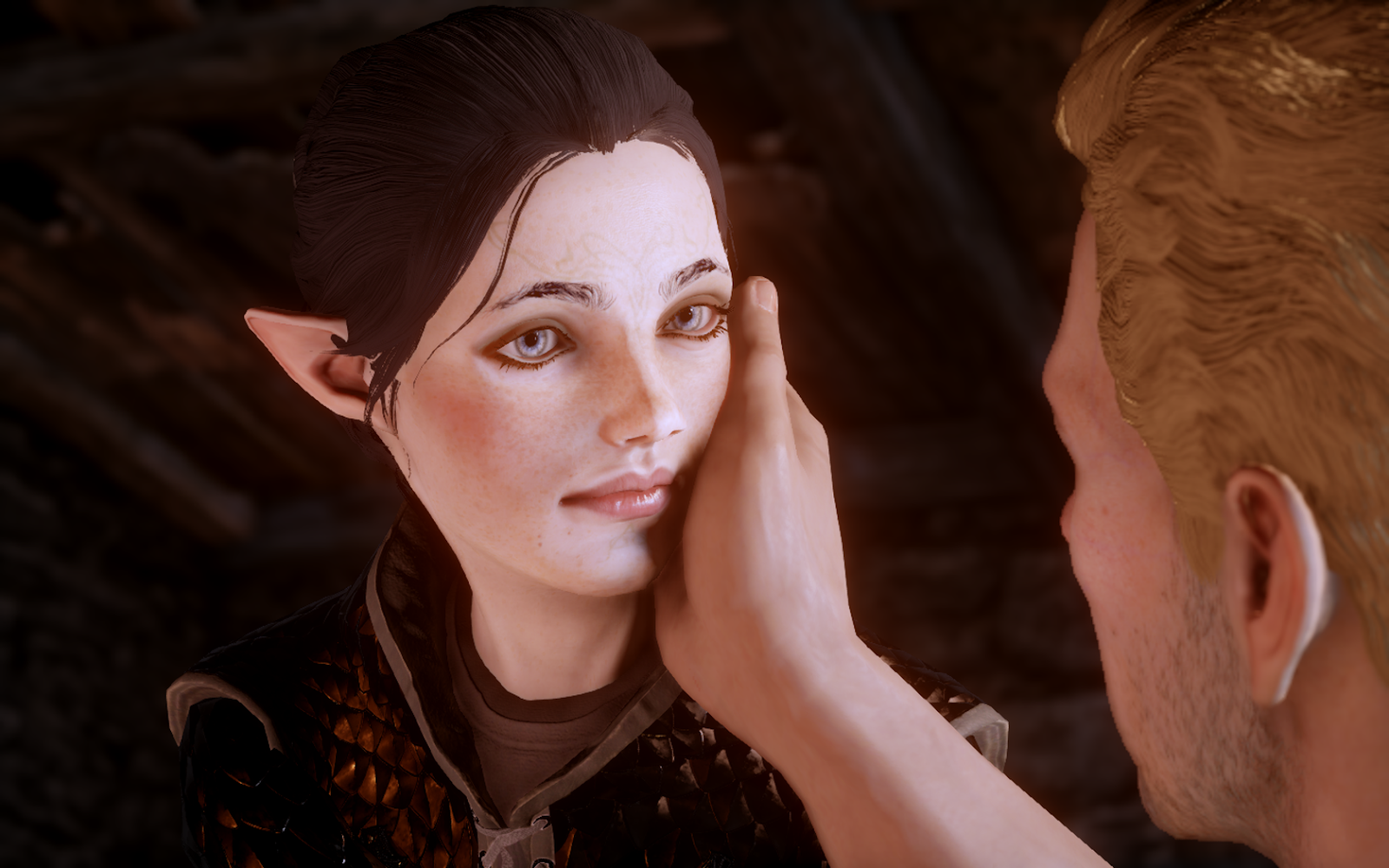
In a grove just outside of Skyhold, the Inquisitor calls to Cass with a line of lit candles through the trees, with poetry to bring her into the space.

He declaims the poem, "Carmenum di Amatus" and she teases him about it then quotes from it on her own lips:

His lips on mine speak words not voiced, a prayer.
Which travels down my spine like flames that shatter night.
His eyes reflect the heaven's stars, the Maker's light
My body opens, filled and blessed, my spirit there.

And the moment when the Inquisitor circles around behind Cass to join in on the poetic moment she finishes those final lines, his breath on her neck, her face inches from his. It's just so lovely and delicate, and everything our romance-loving Cass could wish.

"Not merely housed in flesh," he says. "But brought to life."

It's pretty sexy. It's even better that Cassandra's romance-loving heart of course adores every single minute.

What happens when sex turns to something more? Iron Bull's romance explores this conundrum with humor, edge and charm (and a surprising amount of poignance).
Iron Bull
It's a challenge to pick a romantic moment from the guy who shows NO RESPONSE AT ALL when we flirt with him, hopelessly, over and over and over again. Who views sex as a purely physical thing, a release and then boom, done.

Until he begins to think there might be more.

That's a relationship with the Iron Bull. For me, despite many romantic moments with our challenging and edgy Hissrad across the relationship, the one moment that stays with me as the loveliest and heart-meltiest, is during the postcoital "watchword" discussion scene. 

And here, for me, the final wonderfulness is a tie, when we can either tell Bull we love him (and Bull, acted beautifully by Freddie Prinze Jr., responds poignantly with a soft, "I love you too," or we can tell him we fear the outcome and that we may not make it through, and for the first and only time, Bull breaks down. 

He actually breaks, and responds softly, with "Katoh. I can't..." And that's the moment, you guys. It absolutely kills me. Kudos to Patrick, Freddie, and BioWare because I cry every single time I've seen it.

NOTE: And of course, I'm talking Tal-Vashoth Bull for maximum romance. Because, do not even start me on the alternative. Nope. We're not going there. KREM LIVES, you bastards!

Cullen's romance is sweet and unexpectedly moving, but it's his faith that adds a dash of pathos and real emotion.
Cullen
DAI's pensive Templar is one of my favorite characters across the trilogy, not least because he has a complex path through youth and into redemption and self-acceptance.

When I first played DAI, I remember assuming Cullen was mid- to late-thirties, just one of those ridiculous men who become more and more handsome as time passes. Except when fleeing our Warden's flirtations in DAO, he always seems like a guy who knows who he is, and who is certain of his own feelings.

But y'all. The reality is so much sadder.

The reality is actually more tragic to me—Cullen's a teenager in DAO, and in DA II he's just a traumatized guy in his twenties who really needed a vacation but who was instead sent to the worst possible place in the world for his next assignment: Kirkwall, where every bad opinion of mages he'd formed was confirmed. Where every corner contained a magical conspiracy.

Although barely 30, the Cullen of DAI knows better. He has finally realized how wrong he was, how corruptible even the best people are, and he has gone from confidence in his own infallibility to fear of causing harm for anyone under his watch: Mage, Templar, elf, qunari, human, dwarf, or otherwise.

Which is why, for me, Cullen's romance is sweet, hesitant, and sensitive. It's sexy but also realistic; there's the sense of real people dancing hesitantly toward each other here. He's someone old before his time; he's tired, self-doubting, and disillusioned. So the romance brings him back to himself in some lovely ways, while also reminding him of the importance of abandoning former hypocrisies and bigotries when it comes to mages or other races.

The most moving scene in Cullen's romance for me is the final one, when he desperately embraces a romanced Inquisitor in the chapel, both certain of his faith and fearful of her future.

Josie wants love, but she gives us the sense that she's not exactly seeking it out or expecting it. She's not chasing the physical, and is a fantastic ace option for Dragon Age: Inquisition protagonists.
Josephine
If you want an innocent romance, especially one with lovely, gently ace overtones, Josie's is the perfect choice for you, and it's a wonderful example of how different Josephine can be in her own quiet way.

As our resident Disney Princess, Josie seems like a typical privileged player of the Great Game, but she's so much more. She's quieter and gentler than Leliana, and still haunted by the one death that ever resulted at her own hands.

Josie wants love, but she gives us the sense that she's not exactly seeking it out or expecting it. She's not a physically outgoing person or after sensual pleasures. She's surprised and hesitant when flirted with, and disarmingly lovely simply for a few fairytale-worthy time-outs with the Inquisitor.

The culimination of Josie's romance is a dashing duel for her heart with the arranged suitor who will steal her hand in marriage, and my favorite moment of the entire situation is when Josie storms in, in a fit of temper, and tells everyone to calm down and control themselves. When the Inquisitor declares love, Josie is surprised and outright disbelieving:

Josephine: Why risk everything we've built? Why risk your life?
Inquisitor: Because I love you!
Josephine: You... you do?
Rival (best moment ever): He does?!
Inquisitor: I do.

And then the delighted kiss at the end, complete with leg-pop. It's the best possible fairytale ending you could ask for.

Blackwall believes he is doomed and does not deserve love. Of course, this makes him irresistible. 


Blackwall
I always love the characters who are so starved for love, for acknowledgement and redemption, and Blackwall's romance is deliciously angst-ridden, and oddly sweet. At every turn, he's blatant in his adoration of the Inquisitor and that he doesn't deserve her love. 

Blackwall's the romantic Knight-Errant ideal personified, the man with the tragic past who feels he cannot deserve his maiden, who cannot face his past actions. It makes his yearning for Josie sweet and sad, and his feelings for a romanced Inquisitor really quietly lovely.

So for me, my favorite romantic scene for him isn't the love scene (DUDES, he left me in a HAYLOFT. NAKED. NOPE.). It's when (earlier) he shyly shows up to the Inquisitor's quarters, and can't help but declare his feelings, and the kiss there. And of course he tells her she shouldn't love him, he shouldn't be there, and shouldn't kiss her.

That moment made me actively root for him and his redemption. And of course also made me love him more. Basically, every single time a pixellated character says, "Don't love me," I JUST LOVE THEM MORE.

It's human nature. And BioWare knows us all too well.

Dorian would run across vistas into his own arms to romance himself. Wouldn't we all?
Dorian
Okay, I'm biased here, because I love the "surprise kiss" more than life itself as a trope, and I am loud and proud, right here, with it. 

And Dorian's soft, surprising kiss to a romanced male Inquisitor, shortly after the revelations about his family and struggles, is so personal, so sweet and intimate and surprising, that I'm... y'all... it's just gorgeous. It's soft and sexy and prolonged just the right amount. 

The scene is also genuinely emotional, following Dorian's soft, sad account of his relationship with his father. The moment begins with him at the window at Skyhold, light falling on his impeccable profile, the Tevinter haircut more distinct here than anywhere else -- the shaved high sideburns, the dark curls of hair above. It's almost priestly in appearance.

And then he tells us about his father's shame over his choices. And then the poor guy has to immediately face Mother Giselle's innuendos about his relationship with the Inquisitor. Which, thank goodness, we can either allay or confirm (in all the best ways).

Inquisitor: Do you always answer a question with a question?
Dorian: Would you like me to answer in some other fashion?
Inquisitor: If you're capable.

Dorian rushes in, and... sigh. SHOOT ME, I'm not made of stone, people.

Sera's romance is sexy, exuberant, funny, combative and charming. Just don't go too 'elfy' and you'll be fine.
Sera
My poor darling Sera gets a bad rap. She's called out all the time for being rude, biased, or mean, and to me she's just tough and traumatized and trying to protect her little sweet taffy-soft heart.

Sera's romance is tough if you're an elfy-elf, and those are often what I've tended to play. But once you get past her flinty and protective exterior, she's soft and sweet and just as adorable as you might expect. 

Sera's romance is exuberant, funny, combative and charming. She knows her own mind, she loves women, she's decisive and fierce, and it's best if you're an Adaar and worst if you're a mage-friendly elfy-elf (please don't do it, just don't). 

Yes, she's intimidating (surprisingly so). But I love how smooth she is—for me, she's right up there with Solas as one of the smoothest companions when it comes to flirts. She openly calls our female Inky as pretty and shows only amusement at early flirtation attempts. 

Sera has a big moment mid-romance that's one of my favorite speeches across the trilogy. It's just so characteristic and real:

You don't act like nobles. I love that.
You don't hide. I love that.
(Varied) You don't like cookies. Convenient. Love that.
(Adaar) And just... look at you. Just... love that.
But seeing this really hurts. I'm fighting to make things better and learn truth and shit, and it just keeps getting scarier.

And when she called my Adaar "honey-tongue," um, it's really, really sexy. And I love her love scenes and how playful they are.

Solas's romance is high romance in the grandest Shakespearan tradition, where the best matches yearn hopelessly from afar, where sex occurs only rarely or just before death, and where outcomes usually end with "and with a kiss, I die." And I wouldn't have it any other way. Even as I tremble at the prospect of DA4 and what it will do to my poor heart.
Solas
Oh, he loves us. Yet he hides a terrible, tragic secret. Has there been any formula more deadly or more irresistible since time immemorial?

No. Nope. No, there hasn't. Just ask the thousands of happily weeping Solasmancers out there.

Solas's romance is high romance in the grandest Shakespearan tradition, where the best matches yearn hopelessly from afar, where sex occurs only rarely or just before death, and where outcomes usually end with "and with a kiss, I die."

I know it will shock blog readers (I KNOW!) but I love almost all of Solas's scenes, especially the romantic ones, but for me the biggest romantic zinger will always be the Fade Kiss.

I love all the other Solas Kisses (and it's a high bar, because, people, as a fictional character, it is highly apparent that the dude knows how to kiss), but there's something new and surprised there that always still gets me every time. I love all the others (I DO), but there, he's settled into the lie, he knows how to live there, sort of—but the Fade Kiss is the one discombobulated moment where Solas is literally going "HOLY CRAP, OKAY FINE, KISS ME YOU GORGEOUS THING."

So I do. And that's my favorite moment. Not just the kiss—but the kiss when he dives back in and goes for it.

We should all want that, right? The lover for whom one kiss is not enough. Solas may fight against this very thing, but let's face it... he doesn't fight that fricking hard, right? Not at first at least. Not for many many months. Until the endgame (and goodbye) looms and he faces the hardest choice of all.

But that's fantasy.

As far as reality, I'll wish you Fade romances, today and every day. Whether real or pixellated, I hope you romance a mage, a warrior, a rogue, a misfit, a lover, and get the love you deserve. And all the best kisses and cookies in the world.

And my work here is done. 

Happy Valentine's Day and beyond, you beautiful creatures! Thank you as always for reading!


Sunday, February 18, 2018

Meaningful Banters: Tied and Tantalized (Companions on the Iron Bull's Romance)

The War Table? It's evidently quite sturdy.
Cole: She submits, but you serve.

NOTE: This post is part of a continuing series ("Meaningful Banters"), in which I shine a spotlight on especially important or revealing moments that occur between companions in banter, during the course of the games. As I've been writing a series of pieces on character romances, and most recently, The Iron Bull's, I thought this would be a fun and timely companion piece (and that it might cheer you up if you happened to just read the romance analysis segment discussing a Qun-Loyal Bull).


CONTENT AND TRIGGER WARNING: This post has NSFW elements and includes some frank dialogue referencing The Iron Bull's BDSM relationship with a romanced Inquisitor.

Bull's romance is one of the most complex in the Dragon Age universe, and as it evolves, Cole may perform his usual mind-reading magic to illustrate some of the relationship's more private elements—to the slightly embarrassed dismay of Bull and the Inquisitor, and to the delight of the rest of the companions.

I analyzed the Iron Bull's romance with the Inquisitor in more detail herehere, and here, but Cole's banter conversations about Bull and the Inquisitor's romance are also incredibly revealing about the dynamics of the relationship in the minds of both the Inquisitor and Bull—and are more than a little blushworthy (please note as always that I'm referring to my Inquisitor by the gender of my own Bull-romancer): 
Cole: She almost says the word sometimes. Katoh. She tastes it in her mouth, sweet release a breath away, tongue tying it tenderly like you tie her. But she doesn't. For you, and for her because it makes it mean more. A fuller feeling, a brighter burst.
Iron Bull: Yeah. (Coughs.) How's she feel about you saying this in front of everybody?
The Inquisitor can then respond with or without embarrassment, or matter-of-factly, and all the choices result in some funny reactions from our companions (I admit it, I usually take option #2—it's funnier, and more apropos): 

Inquisitor (Answer Option #2): If a rift opened up right now and swallowed me, I'd be fine with that.
Solas (if present): Provided it tied you down first, one assumed.
Varric (if present): Listen, do whatever works for you. You don't have to act restrained in front of us.

If your Inquisitor romances Bull, Cole will eventually broadcast several
of your most intimate thoughts to any companions in the vicinity!
 
This is just another one of those little character moments that I love in the game, because Varric's not the only one being mischievous; quiet, proper Solas is once again reminding us that he's possibly a lot naughtier in the sack than he may appear to be, as well.

Inquisitor (Answer Option #1): Bull and I are consenting adults, and there's nothing wrong with what we choose to do in bed.
Cole: Not just in bed. Sometimes it's up against the wall. Once on the War Table.
Sera (if present): (Laughs.) Hope you took her right up the Dales.
Dorian (if present): (Laughs.) Ahem.
Blackwall (if present): I look forward to informing Cullen!
Or the Inquisitor ends the conversation without further delay:
Inquisitor (Answer Option #3): Moving on.
Cassandra (if present): I could not agree more.
Vivienne (if present): Please do.
Cole: Oh, sorry.
Cole brings up the romance again later on, and again, it's unexpectedly revealing, on both sides:
Cole: You act like you're in charge, The Iron Bull, but it's really her. She decides when, and you measure it carefully, enough to enjoy, to energize, but never to anger. She is tied, teased, tantalized, but it's tempered to what she wants. She submits, but you serve.
Iron Bull: Do you mind, kid? If you take away all the mystery, it's not quite as hot.
Inquisitor (Answer #1): Bull? Yes it is.
Iron Bull: Right! My mistake. Carry on, kid.
Cole: What's an Orlesian Tickler?
Iron Bull: I'll tell you when you're older.
Cole: No, you won't.
Iron Bull: No, I won't.
What I think is amusing here is that Bull is pretty obviously very much aware of the psychology Cole is describing. He just maybe isn't too keen on having it revealed to the Inquisitor (or their companions).

Or depending on our reply, we get this option:
Inquisitor (Answer #2): Bull, is he right?
Iron Bull: The kid? Please. (Pause) Next time we're alone, I'm going to pin you down and do things your body won't believe.
Cole: But...
Iron Bull: Ahem.
Cole: Sorry.
It's interesting that Bull's fine with all the teasing and banter about his
relationship with the Inquisitor, but when asked for actual details by Varric,
he refuses, noting, "That room is for her and me. No one else invited."
The Iron Bull's romance is discussed with other companions too, and as always, these little moments can be surprisingly insightful about specific characters. Take Varric's request for information, below—Bull's completely not okay with that. He wasn't kidding when he said that what happens in the Inquisitor's bedroom stays there:
 

Varric: So, Bull. You and the Inquisitor, huh?
Iron Bull: Mm-hmm.
Varric: I'd love some impressions. Imagery. Something for my next book.
Iron Bull: Sorry. That room is for her and me. No one else invited.
Varric: Safe harbor from the storm outside?
Iron Bull: All right, now you're just making it weird.

Then Sera gets in on the discussion, later, as well:

Sera: You're bedding the Inquisitor.
Iron Bull: Sometimes. Usually it's just against the wall.
Inquisitor: (Laughter.)
Sera: What's so funny? Ooh, because you do it standing. Pfft. 
Or:
Inquisitor: Bull! No!
Bull: She sort of asked.
Sera: Ooh, because you do it standing. Pfft.
Cassandra: Moving on.
Varric: I usually describe a fireplace by this point.

Bull and Cass also banter again later a few more times, and it's as charming and funny as always:
Iron Bull: That was some solid work back there, Seeker.
Cassandra: You, as well.
Iron Bull: The way you backhanded that guy with your shield and then damn near chopped him in half?
(Then, if romancing the Inquisitor): Any chance I could have the Boss borrow your armor later? For, uh, personal reasons.
Cassandra: No.
Iron Bull: I'd clean it after.
Cassandra: Absolutely not.
Iron Bull: (frustrated sigh)

And then again later, in which Bull notes his commitment to his relationship with the Inquisitor (a detail I love, considering Bull comes from a culture in which that kind of commitment is utterly foreign):
Iron Bull: You know, Seeker, your style doesn't have to be so defensive.
Cassandra: Excuse me?
Iron Bull: You've got armor. Let someone scratch the paint a bit. You can wind up for a shot that will really ring their bell. Some part of you wants to just cut loose. I can feel the frustration in your swings.
(If romancing the Inquisitor) I'd offer to help you get rid of that frustration but, you know... I'm in a committed relationship.
Cassandra: Unlucky me.

And Cassandra has more to say, after the interruption incident (when she, Cullen and Josie walked in on the tryst between the Inquisitor and Bull):
Cassandra: You are aware her room has a lock, Bull?
Iron Bull: Sure.
Cassandra: Some people might find that useful. In future.
Iron Bull: I'd rather focus on--
Cassandra: Yes. I'm sure the room and its... contents... are very distracting. Thank you.

Although Cassandra notes to Bull that (after interrupting their liaison earlier)
the Inquisitor's room has a lock on it, what's fun to point out is that the room
where they were discovered was plainly not the Inquisitor's quarters
.
The funniest thing here is that the room Bull and the Inquisitor were caught in was visibly not the Inquisitor's quarters at all, but in actuality appeared to be the cluttered, empty room around the corner from the top floor of the Herald's Rest. (The one with the ax in the headboard). So this also made me headcanon that perhaps there was a period in the early days of the Inquisitor and Bull's romance where they were basically getting caught all over the place.

It's funny to envision—especially if you imagine Leliana and poor Josie having to actually sit the Inquisitor and Bull down and lecture them like naughty teenagers on which locations at Skyhold are less appropriate for, ahem, romantic moments.

Taarsidath-an halsaam!

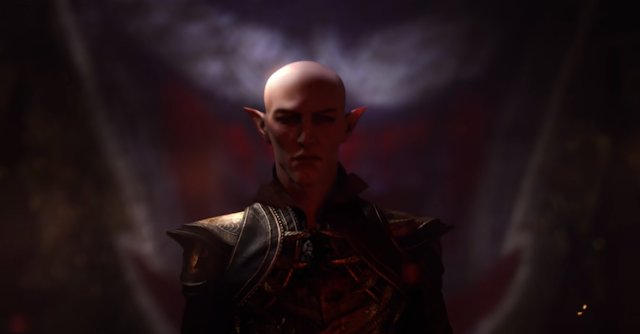
"Dragon Age: Dreadwolf" Predictions & Ponderings (and "What's in a Name?" Redux)

He doesn't call, he doesn't write, but finally, it looks like we might be hearing from Solas at last (2023?), as BioWare announces t...