Showing posts with label RPG. Show all posts
Showing posts with label RPG. Show all posts
Friday, November 30, 2018
YouTube Channel Launch (Law and Order: Thedas)
Be afraid, be very afraid—I've officially launched my Dumped, Drunk and Dalish YouTube Channel! Because I'm an incredible doofus, my first video is... yeah... it's pretty dumb.
But it was fun.
Thedas is made up of two kinds of people -- those who believe magic is dangerous, and those who believe it is simply a tool like any other. These are their stories. Welcome to... LAW & ORDER THEDAS.
Yeah, I did it. I couldn't help it! If you've been following on Twitter, the idea has haunted me for a month or two now -- I just thought Bull and Solas would be fun together in a "Law & Order" parody (if you check the video out, you can probably tell that I originally edited it to the actual "Law & Order" theme, but unfortunately even in parody, I felt I needed to take a "better safe than sorry" route on the music, so I used a stock sound-alike instead (it's not as good, but it works).
Anyway, it's dumb, but I hope you enjoy it. And if you like this, I'll be posting more videos in the future (and yes, most of them will be smarter than this one). I'll be offering both lore analysis videos as well as fun fan videos like this one. Thanks for checking it out!
(And don't forget to help us celebrate #Dragon4geDay on Twitter and across the web on Tuesday, December 4, 2018!)

Sunday, February 18, 2018
Meaningful Banters: Tied and Tantalized (Companions on the Iron Bull's Romance)
 |
| The War Table? It's evidently quite sturdy. |
NOTE: This post is part of a continuing series ("Meaningful Banters"), in which I shine a spotlight on especially important or revealing moments that occur between companions in banter, during the course of the games. As I've been writing a series of pieces on character romances, and most recently, The Iron Bull's, I thought this would be a fun and timely companion piece (and that it might cheer you up if you happened to just read the romance analysis segment discussing a Qun-Loyal Bull).
CONTENT AND TRIGGER WARNING: This post has NSFW elements and includes some frank dialogue referencing The Iron Bull's BDSM relationship with a romanced Inquisitor.
Bull's romance is one of the most complex in the Dragon Age universe, and as it evolves, Cole may perform his usual mind-reading magic to illustrate some of the relationship's more private elements—to the slightly embarrassed dismay of Bull and the Inquisitor, and to the delight of the rest of the companions.
I analyzed the Iron Bull's romance with the Inquisitor in more detail here, here, and here, but Cole's banter conversations about Bull and the Inquisitor's romance are also incredibly revealing about the dynamics of the relationship in the minds of both the Inquisitor and Bull—and are more than a little blushworthy (please note as always that I'm referring to my Inquisitor by the gender of my own Bull-romancer):
Cole: She almost says the word sometimes. Katoh. She tastes it in her mouth, sweet release a breath away, tongue tying it tenderly like you tie her. But she doesn't. For you, and for her because it makes it mean more. A fuller feeling, a brighter burst.
Iron Bull: Yeah. (Coughs.) How's she feel about you saying this in front of everybody?The Inquisitor can then respond with or without embarrassment, or matter-of-factly, and all the choices result in some funny reactions from our companions (I admit it, I usually take option #2—it's funnier, and more apropos):
Inquisitor (Answer Option #2): If a rift opened up right now and swallowed me, I'd be fine with that.
Solas (if present): Provided it tied you down first, one assumed.
Varric (if present): Listen, do whatever works for you. You don't have to act restrained in front of us.
 |
| If your Inquisitor romances Bull, Cole will eventually broadcast several of your most intimate thoughts to any companions in the vicinity! |
Inquisitor (Answer Option #1): Bull and I are consenting adults, and there's nothing wrong with what we choose to do in bed.
Cole: Not just in bed. Sometimes it's up against the wall. Once on the War Table.
Sera (if present): (Laughs.) Hope you took her right up the Dales.
Dorian (if present): (Laughs.) Ahem.
Blackwall (if present): I look forward to informing Cullen!
Or the Inquisitor ends the conversation without further delay:
Inquisitor (Answer Option #3): Moving on.
Cassandra (if present): I could not agree more.
Vivienne (if present): Please do.
Cole: Oh, sorry.
Cole brings up the romance again later on, and again, it's unexpectedly revealing, on both sides:
Cole: You act like you're in charge, The Iron Bull, but it's really her. She decides when, and you measure it carefully, enough to enjoy, to energize, but never to anger. She is tied, teased, tantalized, but it's tempered to what she wants. She submits, but you serve.
Iron Bull: Do you mind, kid? If you take away all the mystery, it's not quite as hot.
Inquisitor (Answer #1): Bull? Yes it is.
Iron Bull: Right! My mistake. Carry on, kid.
Cole: What's an Orlesian Tickler?
Iron Bull: I'll tell you when you're older.
Cole: No, you won't.
Iron Bull: No, I won't.What I think is amusing here is that Bull is pretty obviously very much aware of the psychology Cole is describing. He just maybe isn't too keen on having it revealed to the Inquisitor (or their companions).
Or depending on our reply, we get this option:
Inquisitor (Answer #2): Bull, is he right?
Iron Bull: The kid? Please. (Pause) Next time we're alone, I'm going to pin you down and do things your body won't believe.
Cole: But...
Iron Bull: Ahem.
Cole: Sorry.
 |
| It's interesting that Bull's fine with all the teasing and banter about his relationship with the Inquisitor, but when asked for actual details by Varric, he refuses, noting, "That room is for her and me. No one else invited." |
Varric: So, Bull. You and the Inquisitor, huh?
Iron Bull: Mm-hmm.
Varric: I'd love some impressions. Imagery. Something for my next book.
Iron Bull: Sorry. That room is for her and me. No one else invited.
Varric: Safe harbor from the storm outside?
Iron Bull: All right, now you're just making it weird.
Then Sera gets in on the discussion, later, as well:
Sera: You're bedding the Inquisitor.
Iron Bull: Sometimes. Usually it's just against the wall.
Inquisitor: (Laughter.)
Sera: What's so funny? Ooh, because you do it standing. Pfft.Or:
Inquisitor: Bull! No!
Bull: She sort of asked.
Sera: Ooh, because you do it standing. Pfft.
Cassandra: Moving on.
Varric: I usually describe a fireplace by this point.
Bull and Cass also banter again later a few more times, and it's as charming and funny as always:
Iron Bull: That was some solid work back there, Seeker.
Cassandra: You, as well.
Iron Bull: The way you backhanded that guy with your shield and then damn near chopped him in half?
(Then, if romancing the Inquisitor): Any chance I could have the Boss borrow your armor later? For, uh, personal reasons.
Cassandra: No.
Iron Bull: I'd clean it after.
Cassandra: Absolutely not.
Iron Bull: (frustrated sigh)
And then again later, in which Bull notes his commitment to his relationship with the Inquisitor (a detail I love, considering Bull comes from a culture in which that kind of commitment is utterly foreign):
Iron Bull: You know, Seeker, your style doesn't have to be so defensive.
Cassandra: Excuse me?
Iron Bull: You've got armor. Let someone scratch the paint a bit. You can wind up for a shot that will really ring their bell. Some part of you wants to just cut loose. I can feel the frustration in your swings.
(If romancing the Inquisitor) I'd offer to help you get rid of that frustration but, you know... I'm in a committed relationship.
Cassandra: Unlucky me.
And Cassandra has more to say, after the interruption incident (when she, Cullen and Josie walked in on the tryst between the Inquisitor and Bull):
Cassandra: You are aware her room has a lock, Bull?
Iron Bull: Sure.
Cassandra: Some people might find that useful. In future.
Iron Bull: I'd rather focus on--
Cassandra: Yes. I'm sure the room and its... contents... are very distracting. Thank you.
 |
| Although Cassandra notes to Bull that (after interrupting their liaison earlier) the Inquisitor's room has a lock on it, what's fun to point out is that the room where they were discovered was plainly not the Inquisitor's quarters. |
It's funny to envision—especially if you imagine Leliana and poor Josie having to actually sit the Inquisitor and Bull down and lecture them like naughty teenagers on which locations at Skyhold are less appropriate for, ahem, romantic moments.
Taarsidath-an halsaam!
Sunday, December 10, 2017
From Alistair to Cullen: Fairytale Romances and Dragon Age

Let's talk romance. Emotions! Chocolates! Kisses! Flowers! Not to mention those itty bitty little pieces of stomped hearts and emotional shrapnel!
I heard someone say recently that RPG romances actually elicit the same reactions in the brain that real romances do. I have no idea if that's scientifically true, but when it comes to Dragon Age, it certainly feels true.
For me, as for many, RPGs tap into emotions that can be intriguingly close to real. We play a character for what can be dozens or even hundreds of hours. We flirt with other characters. They flirt back. And eventually declare their love. We love them back. And often, not just via avatar—it's not just my Inquisitor, for instance, who loves Solas, or Bull, or Zevran, or Anders, and all my other romanced characters. I absolutely love them, too. And in a way that's more personal and less remote than, say, my crush on Aragorn when rereading The Lord of the Rings. Because let's face it, Aragorn doesn't look right over at me and proclaim his adoration back. In an RPG romance, however? Yeah, he totally would.
And that's where they get you.
It's both embarrassing yet visceral, how emotional that can be. And each choice in an RPG like Dragon Age further ensures that our choices will make us unique, make US worth the love and accolades from our chosen objects. No matter that thousands of other people have lived it—you can know this intellectually, yet emotionally, the game relationships still feel all too real, immediate, and personal. It's one of the greatest lures of the gaming world, that sense that YOUR playthrough is the only one that truly matters, and it's intoxicating when accomplished by a team as talented as Bioware, for instance, on the Dragon Age series.
Predictable Patterns
However, when you've played your share of RPGs, as I have, you can also kind of get jaded; lulled into certain patterns. You especially become used to the romances going a certain way—you flirt with your potential love interests, they're charmed, bold or bashful, and they flirt back. If you're playing a good (or "paragon") character, you won't break their hearts and they won't break yours. There's not a ton of suspense—they will love you. It's assured.
You then progress through the game story, and eventually there are heart-eyes and kissage, followed eventually by a scene where you finally spend the night together in pixellated soulmate bliss. Well, hey, for a moment or two.
Aaaand... Fade to black.
And, well, basically, that's it. You got your happy ending, or, alternatively, basically, what I call, the phase that is "Welcome to the End of Your RPG Romance."
 |
| Alistair is a funny, sweet guy, he's an exiled prince who gives a female Warden his inexperienced and vulnerable heart, and it's all seriously adorable. |
First off, there can be something really reassuring about the less complicated romances. They can be terrific fun, and a welcome change from real life.
The base template for me on this in Dragon Age, for instance, will probably always be Alistair's romance in Dragon Age: Origins, at least, as I had played it. I'd ended up with a triumphant female elf Warden wandering off hand in hand with a Grey Warden Alistair after defeating the Archdemon and waving goodbye to a pregnant Morrigan. (Note: You can get an even happier ending if you played a female human noble, because then you can marry Alistair, he becomes King, and you ascend the throne alongside him to become his queen.)
I'd liked the Alistair romance, although it hadn't quite been my cup of tea. It had seemed a little vanilla and predictable, to me, even though it was (being Bioware) also indisputably charming. Alistair is a funny, sweet guy, he's an exiled prince who gives a female Warden his inexperienced and vulnerable heart, and it's all seriously adorable. The moment when he gave my poor sweet Warden a rose remains a milestone for me in my memory of my first DAO playthrough.
Or... Not...
Alistair's romance isn't predictable, though. That's where I was wrong. It can end in half a dozen different brutal and tragic ways. So I was truly amused later to realize how many different choices I'd actually happened to luck into that had resulted in that bright and sunny fairytale ending!
I mean, come on, this is Bioware. I was stupid. Sunny endings, I should have remembered, are... rare and precious. Never a given.
But I was careless, and had innocently assumed my Disney outcome was the norm. (Really? Was I ever that young? Evidently I was. Once.)
But my entire awareness of that moment (and happy ending) was actually a lie, and, as I've noted, it wasn't the only possibility at all. Ironically, Alistair's romance most definitely isn't happy-happy. It isn't "someday my prince will come." It can, in fact, end in incredible bleakness—with the Warden dumped, left, abandoned, or dead, and with Alistair despairing and drunk, executed, or heroically dead from his own fatal blow against the Archdemon.
Flipping the Formula
I'd had no idea of this in my first playthrough. I only began to realize its possibilities in discussions with other Dragon Age players I know.
And I'd definitely had no idea that an Alistair playthrough could be so much more complex and dark. The first time I played Dragon Age: Origins, my Warden had encouraged Alistair not to become King because she wasn't a fan of people being pushed into roles they didn't want, so she inadvertently ensured that they got their happy ending out of simple selfishness. Which was even more ironic because, for me, I didn't actually think my Warden protagonist's romance with Alistair would even last. She'd had conflicting feelings for assassin Zevran (then broke it off because poor Alistair was really difficult to break up with, honestly), and had also had a wordless if doomed yearning for Qunari warrior Sten (at least in my own headcanon).
So I got my "Disney Prince" romance even if at the end I kind of went, "Oh, sweeties... it will never, ever last," to the couple I ended up with.
 |
| Merrill's one of the sweetest characters across the Dragon Age series, and so is her romance. Players who dump Merrill get coal in their stockings at Christmas. |
Still, the standard formula's pretty timeless and proven throughout the ages. Flirt, kiss, sex, happy ending, boom. Done.
This fairytale type of formula means that your typical romance often takes up a fraction of the game story, while also hitting those predictable necessary romance points... the courtship, the glances, the kiss, the sex, the aftermath (if there is one). Most formulas in fact eschew the aftermath and just end the relationship there in a haze of assumed present and future bliss. This always disappoints me, because of course, relationships don't end with sex, and they actually get a lot more interesting after that point.
Romances adhering to this formula in Dragon Age might include, depending on story arc, the following characters:
Alistair
Leliana
Merrill
Cullen
Josephine
Cassandra
However, of course, this being Bioware, any one of the above romances can end sadly and even tragically as well. It just depends on the choices you make. Alistair, Leliana, and Merrill can all end up abandoned or dead at the hand of the very person who loves them, while Cullen's romance can also end in one of the most heartbreaking revelations in the Trespasser DLC, depending on your choices for him. Josie and Cass survive no matter what, but they may do so with some serious broken hearts.
Thank goodness, though, it doesn't have to go that way. So if you go for the fairytale, and you make the choices that support true love and sweetness, you'll usually get it in the above scenarios. Alistair's, Leliana's and Merrill's romances are more innocent, and Josephine's is positively Disney Princess (and utterly adorable). Cassandra's is lovely, and provides a glimpse of her softer side—my only complaint about hers is that it's a bit light on content, and it's pretty much set forth according to that formula where the story's basically over after the sex.
 |
| Cullen may be gorgeous, but he's also a genuinely rich and complex character, and his romance is surprisingly touching. |
Cullen's, meanwhile, is probably my favorite of the fairytale romances in Dragon Age, not least because it doesn't end with the hookup, but instead actually explores Cullen's journey across the entire trilogy. It's especially satisfying if you romance him with a mage, since Cullen's story back in Dragon Age: Origins began with a traumatic experience that left him with a bias that he was still working through even in Dragon Age II and on into Dragon Age: Inquisition.
In DAI, Cullen is therefore wrestling with a search for redemption based on over a decade of backstory if we've played the entire trilogy. His emotional inner conflicts result in a romanced relationship with the Inquisitor that can be really rich and poignant, as his feelings for her are depicted in a lovely and often wordless progression of simple, believable little moments (both funny and sexy) that genuinely communicate intimacy. As his romance evolves, we're shown Cullen's more vulnerable side, as well as how deep his sense of religious faith really is. I remember being surprised and moved at a simple scene near the end in which Cullen simply embraced the Inquisitor and held her, expressing for the first time how deeply he feared losing her.
In DAI, Cullen is therefore wrestling with a search for redemption based on over a decade of backstory if we've played the entire trilogy. His emotional inner conflicts result in a romanced relationship with the Inquisitor that can be really rich and poignant, as his feelings for her are depicted in a lovely and often wordless progression of simple, believable little moments (both funny and sexy) that genuinely communicate intimacy. As his romance evolves, we're shown Cullen's more vulnerable side, as well as how deep his sense of religious faith really is. I remember being surprised and moved at a simple scene near the end in which Cullen simply embraced the Inquisitor and held her, expressing for the first time how deeply he feared losing her.
There are plenty of other happy romances in Dragon Age, but they're not as straightforward. These romances, however, meet the basic needs of the formula and provide a general prospect of romantic happiness for those who make the right choices.
If you want hearts and flowers, in other words? These romances are a good place to start.
Meanwhile, next up, I'll take a look at some of the romances that don't really follow that fairytale formula... and which ones in that assortment that I loved most.
What about you? Do you prefer the fairytale romance formula, yourself? Who was your favorite romance, if so?
Meanwhile, next up, I'll take a look at some of the romances that don't really follow that fairytale formula... and which ones in that assortment that I loved most.
What about you? Do you prefer the fairytale romance formula, yourself? Who was your favorite romance, if so?
Friday, July 14, 2017
The Warrior, the Thief, the Bull, and the Mages... (Dragon Age: Inquisition Overview, Part 3)
 |
| Vivienne is gorgeously terrifying, but if you're brave enough, she'll be a valuable companion in DAI. Just don't piss her off. |
As Dragon Age: Inquisition unfolds, just as in DAO and DAII, the Companions and advisers to our protagonist in Dragon Age: Inquisition all share a few basic qualities: They're all brave, gifted, desperately seeking redemption... and lonely.
Each companion is, most of all, desperately alone in some intrinsic fashion that goes down to their very soul. Each is seeking connection, a cause, something and someone to believe in. And each—we'll soon learn—is at a crossroads, whether of faith, alignment, loyalty, or belief.
Hello, Old Friends...
 |
| Cassandra's back! And as in DA2, she's a formidable warrior—as well as a secret fan of romantic drama. |
Possibly no transformation or character arc is as startling or as moving as Leliana's—the charming young woman who was once our Warden's sweet, optimistic companion in Dragon Age: Origins is now a subtle and ruthless assassin who lives and breathes secrets, and whose delight in intrigue is exceeded only by her ruthlessness. Yet there are still signs of the girl we knew—Leliana still shows flashes of humor and sweetness, she still raises nugs as pets, and she still sings like an angel. She's also fiercely loyal, and while her inner circle is small, she would die for any of them without hesitation.
Cassandra, meanwhile, hasn't changed nearly as much (thank goodness). As DAI begins, she's still beautiful, blunt, fierce, and stubborn, but as always her loyal heart, tenderness and romanticism reveal themselves early on, even during the first early journeys with the Inquisitor. Cassandra's initial overzealousness is even revealed to be the product of a secret and understandable grief later on. As always with our DA companions, nothing—and no one—is ever quite what they seem to be at first glance.
 |
| It's always great to see Thedas's top dwarven hack writer. But alas, Varric's still not romanceable (a tragic waste of chest hair). |
The New Crew
Also traveling alongside Varric is a new character, an elven apostate named Solas, who very quickly demonstrates complex knowledge about the terrible breach in the sky (as well as about the magic/dream world of The Fade leaking through it). Solas is unassuming and quiet, but for those who look closely, he's already a fascinating and mysterious character. He's not Dalish (he wears no traditional face-tattoo) but is obviously not a city elf, either. He's proudly self-taught and is actually surprisingly confrontational in initial spirited debates with an elvish Inquisitor, revealing that he's not especially supportive of the Dalish OR the other elvish groups currently eking out segregated existences in alienages (conversations that are pretty sparky, challenging and fun if you decide to romance him). It's our first clue that Solas is someone who is worth exploring further as a character.
 |
| "This world is full of wonders for those who seek them." Elven mage Solas is a fascinating companion who likes long walks and spirited debates, but he's not a fan of group singalongs. |
 |
| Sera's funny and vulnerable—an expert archer whose favorite word is "shite" and who shouts things like "Eat it! Ate it!" in battle. (Just don't call her 'elfy.') |
At about the same time you meet and recruit Sera, you also meet her polar opposite, the icy and elegant Circle mage Vivienne. Voiced by the always fantastic Indira Varma, Vivienne is at first easily pegged as a snooty courtesan who strategically avoided the real hardships of mages by scheming and sleeping her way into a life of nobility, but as always with Bioware characters, yes, she's cold and focused, but she has real depths, fears, loves, and prejudices of her own.
Shortly after our return from the game's first major negotiation in Val Royeaux, we can go search for Grey Warden Blackwall in the Hinterlands, and we also receive an intriguing invitation to visit the Storm Coast to recruit the mercenary captain, The Iron Bull (marvelously voiced by Freddie Prinze, Jr.). And now I'm gonna have difficulty reining myself in, because Bull, like Solas, turns out to be one of the most subtle, complex, rewarding and mercurial characters in the Dragon Age universe (and I'm gonna have a lot more to say about him in upcoming blog posts about him alone).
The Captain of the Chargers
 |
| "I do some fighting, and drinking," says Bull, admitting he's a Ben-Hassrath spy for the Qunari. "And then once in a while I tell Par-Vollen about it." Turns out he's just a bit more complicated than that—and one of the game's best characters. |

At first glance, Bull's simply the obvious muscle. He's this big, bluff mountain of a man, a horned giant of the Qunari (the formidable warrior race we've met twice now, in DAO and DA2) who helms a likable, superbly capable band of misfit mercenaries called "The Chargers" as his personal combat unit. At first glance, Bull seems like a genial, if transparent, asset—he's so apparently open and honest that he tells you right away that he's a spy: "It might piss you off," he admits," but then he all but winks, just to allay our fears, calling out to his crew to pack up the booze and get ready to move. And it's all fine. He's funny, he's honest, he's a visibly capable captain and warrior, and he's on your side now. Don't worry about it.
But Bull's so much more than that. He's more complex, more subtle, and infinitely more intelligent than he first appears. He's a contradiction in terms—he's everything he appears to be, to a degree—he IS a caring, capable commander, he is incredibly funny, affable and fun to have around. He's just also working several agendas at once, answering to both the Qunari back at headquarters in Par Vollen, as well as to you and the Inquisition—all while balancing his own private fears and yearnings to truly leave the Qun and go rogue (or "Tal-Vashoth"). Bull's defining loyalty quest, "The Demands of the Qun," is therefore an especially brilliant moment, as it's one of those quests that catches a character at their breaking point. your decision there will either evolve Bull into one of the game's most joyful and fully realized characters or will send him into a chilling emptiness with devastating consequences in the DAI final chapter, the DLC "Trespasser."
 |
| "I want to stay," says the strange, shy and spiritual assassin named Cole. "I want to help." |

These are your companions as your game gets underway, and depending on your character's choices, they will be your Inquisitor's advisers, friends, lovers, adversaries or enemies.
Approvals and Judgments
The companions in DAI were easily the key to my falling in permanent love with the game, because they're all so richly drawn, beautifully written, and vividly acted. The game's approval system means that these people are all judging you, and will have varying approval or disapproval reactions to your quests, conversations, judgments, and actions.
In other words, if you help a needy family in the Hinterlands? Bull, Solas and Sera—all constant supporters of alleviating misery and helping the common people—they will wholeheartedly approve every time. If you side with the templars, for example? Apostate mage Solas will disapprove. But if you side with the mages? Cassandra and Cullen will both voice their fears of the outcome. You cannot please everyone all the time, and navigating those opinions means that you will often have to wrestle with making decisions that feel right to your character, but which will also have tangible effects on their relationships.
Meanwhile, the game's relationship approval levels range from "slightly approves/disapproves" across the gamut to "greatly approves/disapproves." This approval system is a vast improvement on DAO's rather simplistic "gifting" approval system (in which you could simply bribe companions with gifts to increase approval), and is also more subtle than DA2's "friendship/rivalry" system, as well. In addition, thanks to the game's occasionally inconsistent but beautiful banter system, complex and continuing conversations between your party members will evolve as the game's story goes along. The result? Some will discover mutual respect and companionship, some will fall in love, and others will turn active prejudice into a more subtle respect. Even your advisers feel like they have outside concerns and passions, revealing little moments of worry, fear, kindness, or cruelty during your War Table missions.
 |
| Dorian is the handsomest mage in Thedas, and his mustache has superpowers. |

In the end, as in any great stories, it's the characters you'll remember most. DAI understands that, as games, shows or films all too seldom do.
Monday, July 3, 2017
The Low Place in the Hedge: How Gaming Saved Me
Solas: "Survive the first thirty heartbeats, and you'll already have won."
 |
| Eluvians are magical portals in the Dragon Age world. If I'd found one in the sixth grade? Or seventh? Eighth? Yeah. You wouldn't be reading this. |
Which existed, by the way. I knew this in my soul. Especially when it came to Tolkien's world. Even by 13, I'd tried and tried to find passage in every way I could. The certainty of his world felt like a knowledge thrumming just under my skin, a realization that magic in fact existed in the world, hidden only for the very most worthy. I couldn't give it up. The right combination, of course, would prove me vindicated.
Unfortunately, the world happened. And adulthood. And all the predictable yucky stuff. And ultimately, I realized, oh, right. This was what being a grownup was like. When you stopped looking into closets for Narnia. When the dawning awareness hit you that maybe you should stop elven calligraphy or Tolkien linguistics or Lewis research or just generally Doing That... if you ever truly wanted to succeed in life.
Mind you, I hadn't realized. I'd grown up an outcast. I'd been born with cerebral palsy and was a misfit who spent elementary school days wrapped in leg braces, corrective shoes, loneliness, occasional poverty, and the absolute best air of outward uncaring I could possibly manufacture. Inside, I was dying for connection. Outside, I was the human equivalent of a side-eye and a chilly shrug. People who attempted to connect with me were, ironically, most apt to be on the receiving end of a sarcastic quip and a dismissive glance. Hugs were not encouraged. I trusted few. My castle had to stay strong.
Further complicating my situation, from first to fourth grade, I had a series of eye surgeries that included a full year of wearing a real, actual, incredibly ugly and flesh-colored eyepatch to school. The eyepatch got sweaty in summer and the string made an indentation in my already terrible bowl-haircut hairline.
 |
| Being a nerd is only lonely on this side of the PC. It's the foundation of all RPG games and fandoms. |
In the big-picture sense, I was incredibly lucky overall—all of this was part of an incredibly mild case of CP (the brain damage I'd suffered at birth had been so much less severe than it might have been), and I valued and recognized that luck constantly. However, I still hated myself every waking minute. I looked funny. Walked funny. Thought funny. If I didn't monitor myself consciously, I walked like a chicken, hunched over and tentative, arms and legs drawn in close to my torso (and classmates often held contests to see who could best walk like me).
But fantasy saved me. Every time things got bad, I just closed my eyes and floated away to Narnia, to Meg and Proginoskes, to Arthur and Merlin, to Bilbo and Frodo and Middle Earth (where I was a capable, brisk and beautiful female hobbit named Falin who knew exactly how to avoid trolls and navigate Mirkwood). Even better was the time I discovered Eowyn, and she became my mental avatar and avenging angel.
And then I was okay.
The real world was stickier. Despite my efforts, everything was noticed. And until I reached the eighth grade and had learned some social skills Bull himself (and the Ben-Hassrath) would have valued, I honestly thought school was supposed to be as hellish as it was. In fact, I was so constantly thrown down stairs, knocked down, shoved in lockers, punched, hit, mocked, pissed on, and constantly abused in seventh grade that my principal apologized to me almost weekly, calling me into his office personally on an ongoing basis to apologize. Then I'd thank him, shrug, try to get through the rest of the day, and go home to read Tolkien or Poe in my bedroom while listening to ABBA (a strange yet potent combination).
I eventually learned to adapt, to say funny things at just the right times, to deflect, and blend. Thank goodness. (Although I'm deeply grateful that I didn't live in a time of social media, because I cannot say that I would have survived if the bullying had proceeded 24/7.)
The Secret Hobbit Companion
The good news is, while I was learning how to get along, I had my books. I had my music. I knew the value of dreams.
In fact, until I was 11 or so, I'd actually kept a backpack packed deep within the recesses of my closet, positive I was another Jill Pole, in preparation for the certain day when Gandalf would ultimately rap on my door and tell me my destiny (which of course he would). And then, see, I knew... I knew I'd panic, yet still I'd hastily throw together my backpack and hooded cloak (you have to have one if you're going adventuring), and I'd follow him out and away, jumping over the low place in the hedge and chasing the magical destiny that I knew had always awaited me.
I think the secret power of being a nerd is... like Quentin Coldwater in Lev Grossman's The Magicians, you never quite outgrow that belief in magic. You're always looking for the glitch, the subtext, the secret that will take you away. It's there. It has to be there. And even when the trick is revealed, and you're told, over and over again, "No, it's just a book/game/film," you still privately always believe it exists. Even when the world has hammered it out of you (or so it thinks). Just ask Quentin.
Me, I still believed. At 20. At 30. At 40. And, ahem, beyond... So when Gandalf didn't show up, I waited. Wrote my own stories. Consoled myself with games, TV, movies, and all the fiction I could wallow in. But I was still waiting.
Then I played LOTRO (the lovely and lore-rich MMORPG of The Lord of the Rings Online), and later on, the Mass Effect and Dragon Age series (and most especially Dragon Age: Inquisition) and that's where the miracle happened. Time somehow unspooled and ran backwards. I was whole again, magical and hopeful. I remembered my secret wonderful hidden old hobbity/dwarfly backpack. And in a flash, I knew that long-ago backpack had been dark green in color. And that there had been a rough spot on the lower left-hand side. That I had stuffed it with random household foods that wouldn't be missed for the trip (from apple-pie filling to Cheetos). Everything flooded back in a moment of pure, visceral flashback.
In other words, playing Dragon Age: Inquisition was the first time in my life I ever felt like, "Wait... I think I've actually found the magic wardrobe. Even if I don't quite get to go there." It wasn't just an escape. It enabled me to write a story and then enact its outcome, to create a hero or heroine that lived and breathed there, who fell in love, who lived and even (potentially) died. From there, I also found all sorts of wonderful discussion groups and boards, filled with people who were equally passionate about the world of Thedas, and who saw nothing odd in arguing about the hidden meanings of the quest "The Demands of the Qun," for instance, for hours at a time.
I'd experienced this before, of course, to some degree, most especially with friends who were fellow Tolkien fans. But this went beyond that, in an odd and intense way. Because games are present-tense and of the moment, and because the DA fandom is almost always involved in a replay of some part of the trilogy, there's a part of you that's wherever you are in the game. You're out in the real world, doing real-world things, but somewhere, beyond the eluvian, your Hawke is attempting to make peace between the mages and the templars. Or your Warden's trying to decide whether or not to do the Dark Ritual. Or your Inquisitor is trying to get the hang of her spooky new ability to shoot green flame from her hand. Your hero or heroine is always out there, simply waiting for you to continue the adventure.
Thanks to Dragon Age, the low place in the hedge was right there in the computer. And it was real. A single RPG game had reminded me of the magic, reminded me of the little kid I'd been, the one who'd dreamed of adventures with Bilbo and who'd kept that backpack in her closet, ready and waiting for the knock at the green door.
I was not alone.
A World on Fire: Dragon Age: Inquisition (Part 1)
If Dragon Age: Origins unfurled the map. Dragon Age II lit the fuse. And in Dragon Age; Inquisition, the map is most certainly ablaze.
Dragon Age: Inquisition starts with a bang. The final events of Dragon Age II—the destruction of the Kirkwall Chantry and the outright bloodshed between the mages and templars—have set off a conflict that is now tearing across Thedas and dividing its people. Magefire by rogue apostates rages through the land, even as their opposing templars have gone equally insane, burning houses, forests, fields and villages in retribution. Worst of all? The one hope of the world for peace—a Conclave where mages and templars were to meet with Divine Justinia (the leader of the Chantry) to negotiate a cease-fire—has just been blasted to smithereens, the Chantry is leaderless, and the sky, too, is now sundered and filled with flame.
And that's where we begin... or rather, where our poor hapless Inquisitor steps onto the stage, fleeing out of the Fade from a horde of demons and awakening in a prison cell with partial amnesia, vague memories of a near-death experience, and a mysterious and fiery green mark in the palm of her hand. It's quite literally a hell of an entrance.
The Subtext Becomes Text
In Dragon Age: Origins, I'd played a Circle Mage in my very first playthrough, and that has always stayed with me as my default, "headcanon" setting for the universe, providing me with a beautifully dramatic way to enter the Dragon Age story and its mages/templars tensions. Right away I'd been faced with a benignly imprisoned young elf mage protagonist and the templars who guarded her, including our old friend Cullen, who was in love with her. (Demonstrating early on his staggering lack of basic social or flirting skills, Cullen had shown his affection for my elf by telling her he was very happy he hadn't had to kill her and cut off her head after her Harrowing. My elf's response? "Thanks! Wanna make out?" And then he'd fled. Because: Cullen.)
Meanwhile, my elf's defense of a fellow mage directly led to her conscription by the Grey Wardens and set her on a course that would eventually end in tragedy (as it does for all Grey Wardens), even if she survived the final battle with the Archdemon.
Then came Dragon Age II and there again, as in DAO, my female Hawke protagonist was a mage—it felt most appropriate to me for the storyline, although it was kind of hilarious that so few people ever seemed to notice that she was an illegal apostate openly carrying a ginormous magical staff (and, sadly, no templar ever asked her if that was a staff in her pocket or was she just happy to see him, an omission I consider to be seriously tragic). Regardless, as the events of DA2 unfolded over its seven-year span, the tension between mages and templars was no longer simmering just beneath the surface—it was thrumming through an entire city, culminating in a stunning moment of terrorism and irrevocable violence that would touch off a world war.
When Dragon Age: Inquisition begins, that war is already underway across Thedas, with mages and templars battling each other openly as well as (even more tragically) abusing and decimating the poor everyday citizens simply trying to stay out of the fray.
It's Raining Demons
DAI definitely presents a grim world at first—not least because the vast majority of your fights aren't against simplistic baddies like demons or darkspawn (although, yes, you'll fight your share of those). Nope, the most common enemy you'll face this time around is human, whether mage, templar, bandit, or mercenary, and they're all busily fighting and killing and dying in the ferment even as they ignore the fact that the skies above them are raining demons and boiling a livid green.
It's a surprisingly believable scenario—okay, not the demon-raining part, but the one in which people squabble over trivialities and vanities, ignoring the fact that the world is falling down around them.
And this is the world your protagonist enters. Imprisoned and held for questioning at first because of the strange circumstances of your survival by two familiar faces (a returning Cassandra Pentaghast and Leliana, and it's so nice to see them again!), you'll have to allay their suspicions, join them in a journey to Haven, and begin to show them what kind of a hero you will (or won't) be. You're quickly joined on this journey by a returning Varric Tethras (now with even more glorious chest hair), along with a quiet elven mage apostate named Solas, and in true Dragon Age fashion, within 15 minutes, you're already asked to make tough choices—do you take the mountain path and potentially rescue the lost scouts? Or do you charge directly to the Temple? Either way, it's clear that there will be some casualties.
No matter what your choice, you eventually find yourself at the blast site with the rest of your companions. The Temple of Sacred Ashes, the place where the Conclave was held, and destroyed, is now a hellscape filled with fire, ash, and the twisted remains of victims who perished in agony. It's a sobering moment that sets the stage and propels you forward to the Inquisition headquarters at Haven, where you meet up once again with your new advisors, Leliana, Cullen, and Josephine. (As always in each new installment of Dragon Age, Cullen's hotness has once again increased exponentially, and he's so gorgeous at this point that, in my first playthrough I'd pause occasionally simply to gaze at him, wearing the kind of goopy, dreamy expression on my face I'd once reserved for a skinny blond boy named Brett in the sixth grade. Good times!)
The Adventures Begin...
The quests and storylines of DAI remain accessible and thematically tied together thanks to a brilliant new innovation in the game called the War Table. With the War Table, the Inquisitor will periodically interact with the advisors while addressing a variety of quests, political measures or favors, and world events. Each one of these can be resolved in a variety of ways (and time-frames), with each outcome dependent on the advisor you chose. For instance, Josephine's resolutions tend to be diplomatic and nonviolent, while Cullen would simply like to send in some troops to stomp their way through the problems, and Leliana, by far the coldest and most bloodthirsty, is perfectly happy to maim, kidnap or assassinate as needed, unless you hold her back.
For example, in response to a rather trivial matter in which a rival bard is saying unkind things about our own tavern bard, Maryden, Leliana coolly notes that "A minstrel with no tongue can tell no lies." (This was the point at which I actually yelled at my computer screen: "LELIANA! What HAPPENED to you?") Let's just say the sweet little bard of Dragon Age: Origins is gone, and it's all more than a little tragic—she's now a terrifying, secretive and complex woman with icewater in her veins. Even if (reassuringly) she at least still adores and raises nugs (the adorable little rabbit-pig creatures you find across Thedas).
As you carry out your missions and assignments from the War Table and on behalf of your advisors, meanwhile, your team of potential Companions continues to grow. In addition to Varric, Solas and Cassandra, you will also have the opportunity to meet and add such characters as The Iron Bull (a big, brash Qunari mercenary captain who's much more than meets the eye), court enchanter Vivienne, Red Jenny rogue leader Sera, dashing Dorian, the gentle and mysterious Cole, and solitary Grey Warden Blackwall. These nine Companions will accompany you on your quests across Ferelden and Orlais, and are your Inquisitor's potential friends, enemies, and lovers, along with Josie and Cullen (and there was much rejoicing). Varric, however, still has a crush on that darned crossbow of his, so he's unromanceable, as is Cole (who is too innocent and vulnerable for the task), and Vivienne, who is the mistress of a powerful Duke. But everyone else? Fair game, and those romances add immeasurably, as always, to the texture, atmosphere and story of Dragon Age: Inquisition.
An Array of Vast Landscapes for Fantasy Adventurers
As your efforts to help restore order to the world begin to have a tangible effect on Ferelden's landscape, you'll soon have the opportunity to view more than death, destruction, and chaos. Increasingly revealed in each new location you discover, the beauty of Ferelden and Orlais within Dragon Age: Inquisition's open world is frequently staggering, bringing you vistas as varied as the mountains and streams of the Hinterlands, the gorgeously inclement Storm Coast, the vibrant Orlesian city Val Royeaux, the tragic verdant loveliness of The Emerald Graves, the elegant winterscapes of Emprise du Lyon, the desolate swamplands of The Fallow Mire, the endless sands of The Hissing Wastes and The Western Approach, and many more. And Dragon Age: Inquisition's Open World concept means that you can explore these vast areas to your heart's content, ferreting out secrets and finding new opportunities for treasure or lore as the opportunities arise.
Please check out the second part of my initial look at DAI to follow. And please do check out my Twitter feed at @DrunkDalish. Thanks!
 |
| There's a Rift in the sky... and that's not good. |
And that's where we begin... or rather, where our poor hapless Inquisitor steps onto the stage, fleeing out of the Fade from a horde of demons and awakening in a prison cell with partial amnesia, vague memories of a near-death experience, and a mysterious and fiery green mark in the palm of her hand. It's quite literally a hell of an entrance.
The Subtext Becomes Text
 |
| Mages don't have it easy in DAI. (But do they ever?) |
Meanwhile, my elf's defense of a fellow mage directly led to her conscription by the Grey Wardens and set her on a course that would eventually end in tragedy (as it does for all Grey Wardens), even if she survived the final battle with the Archdemon.
Then came Dragon Age II and there again, as in DAO, my female Hawke protagonist was a mage—it felt most appropriate to me for the storyline, although it was kind of hilarious that so few people ever seemed to notice that she was an illegal apostate openly carrying a ginormous magical staff (and, sadly, no templar ever asked her if that was a staff in her pocket or was she just happy to see him, an omission I consider to be seriously tragic). Regardless, as the events of DA2 unfolded over its seven-year span, the tension between mages and templars was no longer simmering just beneath the surface—it was thrumming through an entire city, culminating in a stunning moment of terrorism and irrevocable violence that would touch off a world war.
When Dragon Age: Inquisition begins, that war is already underway across Thedas, with mages and templars battling each other openly as well as (even more tragically) abusing and decimating the poor everyday citizens simply trying to stay out of the fray.
It's Raining Demons
 |
| Leliana's back! She's not romanceable, but since she'd kill you in your sleep, it's probably for the best. |
It's a surprisingly believable scenario—okay, not the demon-raining part, but the one in which people squabble over trivialities and vanities, ignoring the fact that the world is falling down around them.
And this is the world your protagonist enters. Imprisoned and held for questioning at first because of the strange circumstances of your survival by two familiar faces (a returning Cassandra Pentaghast and Leliana, and it's so nice to see them again!), you'll have to allay their suspicions, join them in a journey to Haven, and begin to show them what kind of a hero you will (or won't) be. You're quickly joined on this journey by a returning Varric Tethras (now with even more glorious chest hair), along with a quiet elven mage apostate named Solas, and in true Dragon Age fashion, within 15 minutes, you're already asked to make tough choices—do you take the mountain path and potentially rescue the lost scouts? Or do you charge directly to the Temple? Either way, it's clear that there will be some casualties.
 |
| Cullen's back for DAI, and he's finally achieved maximum hotness (it's the hair) |
The Adventures Begin...
The quests and storylines of DAI remain accessible and thematically tied together thanks to a brilliant new innovation in the game called the War Table. With the War Table, the Inquisitor will periodically interact with the advisors while addressing a variety of quests, political measures or favors, and world events. Each one of these can be resolved in a variety of ways (and time-frames), with each outcome dependent on the advisor you chose. For instance, Josephine's resolutions tend to be diplomatic and nonviolent, while Cullen would simply like to send in some troops to stomp their way through the problems, and Leliana, by far the coldest and most bloodthirsty, is perfectly happy to maim, kidnap or assassinate as needed, unless you hold her back.
 |
| At last, Cullen's romanceable! Please note: He's terrible at flirting, talking, dancing, chess, and basic socialization but who cares. Look at him. |
For example, in response to a rather trivial matter in which a rival bard is saying unkind things about our own tavern bard, Maryden, Leliana coolly notes that "A minstrel with no tongue can tell no lies." (This was the point at which I actually yelled at my computer screen: "LELIANA! What HAPPENED to you?") Let's just say the sweet little bard of Dragon Age: Origins is gone, and it's all more than a little tragic—she's now a terrifying, secretive and complex woman with icewater in her veins. Even if (reassuringly) she at least still adores and raises nugs (the adorable little rabbit-pig creatures you find across Thedas).
As you carry out your missions and assignments from the War Table and on behalf of your advisors, meanwhile, your team of potential Companions continues to grow. In addition to Varric, Solas and Cassandra, you will also have the opportunity to meet and add such characters as The Iron Bull (a big, brash Qunari mercenary captain who's much more than meets the eye), court enchanter Vivienne, Red Jenny rogue leader Sera, dashing Dorian, the gentle and mysterious Cole, and solitary Grey Warden Blackwall. These nine Companions will accompany you on your quests across Ferelden and Orlais, and are your Inquisitor's potential friends, enemies, and lovers, along with Josie and Cullen (and there was much rejoicing). Varric, however, still has a crush on that darned crossbow of his, so he's unromanceable, as is Cole (who is too innocent and vulnerable for the task), and Vivienne, who is the mistress of a powerful Duke. But everyone else? Fair game, and those romances add immeasurably, as always, to the texture, atmosphere and story of Dragon Age: Inquisition.
An Array of Vast Landscapes for Fantasy Adventurers
 |
| Aside from all the death and demons, DAI offers gorgeous vistas you'd kill to explore in person. If they didn't kill you first. |
Please check out the second part of my initial look at DAI to follow. And please do check out my Twitter feed at @DrunkDalish. Thanks!
Saturday, June 24, 2017
Surviving the Joining: Thoughts on 'Dragon Age: Origins'
If you really want to understand the world of Dragon Age,
then Dragon Age: Origins is simply essential, because when it
comes to worldbuilding, DAO sets up the chessboard
beautifully. It introduces you to Thedas, and to the Dragon Age universe's main
regions and races, their politics, religions, and strifes.
DAO also tosses you headlong into the fray by making your first protagonist a Grey Warden.
The Burden of the Wardens
Grey Wardens are a grim, highly honored, elite cadre of fighters who either join the order out of ambition and pride, or who are forcibly conscripted. Much like GRRM's Night's Watch in the Game of Thrones universe, Dragon Age's Grey Wardens do an often thankless job around the fringes of Thedas's world, fighting darkspawn, haunted by the "Taint," and doomed to die within two or three decades. They're often a disparate mix of nobles and criminals and everything in between, because, as with the Night's Watch, once you become a Grey Warden, your past crime no longer exists.
The Burden of the Wardens
 |
| DAO features fascinating characters, like the lonely slightly amoral hedge witch Morrigan (left), as well as a world that's equally complex. |
Grey Wardens are a grim, highly honored, elite cadre of fighters who either join the order out of ambition and pride, or who are forcibly conscripted. Much like GRRM's Night's Watch in the Game of Thrones universe, Dragon Age's Grey Wardens do an often thankless job around the fringes of Thedas's world, fighting darkspawn, haunted by the "Taint," and doomed to die within two or three decades. They're often a disparate mix of nobles and criminals and everything in between, because, as with the Night's Watch, once you become a Grey Warden, your past crime no longer exists.
Those wishing to become Grey Wardens must first undergo the Joining, a ritual that involves drinking a concoction of darkspawn blood, and which the majority of potential Wardens do not survive. Those who do survive are now Grey Wardens—respected throughout the land but doomed to live shorter lives due to the "Taint," and marred by a constant awareness of, and connection to, the darkspawn (a hellish, twisted, mostly mindless race that lives beneath the surface, and which can infect those in contact with them).
At least you're not alone in
your newfound Grey Wardenship. You're immediately paired up with Grey Warden
Alistair, a witty, slightly naive young man who has the potential to be either
a friend, lover or foe as your adventures evolve.
The stage of DAO is then perfectly set with
the reappearance of the one thing everyone in Thedas dreads: the appearance of
an Archdemon. Archdemons are fell forces in dragon form, and each time they
appear, they lead the darkspawn in something called the Blight, in which the
darkspawn rage to the surface in massive, frenzied numbers as they attempt to
take over the world of the living, obliterating whole villages, settlements and
kingdoms. The Blight is basically a kind of infection that's both biological
and metaphysical, in which those infected either die of the infection or slowly
turn into darkspawn themselves.
An Endless Circle of Conflict: the Mages and the Templars
The other main tensions are between mages and templars, and these tensions not only affect the game and its choices in DAO, but they will be increasingly vital in shaping each new chapter of the trilogy as it progresses.
In the Dragon Age universe, mages are innately talented with magic, yet they're also dangerous because each time they use magic, they open a tiny channel to the Fade (the otherworld/dreamworld that is also the source of all magic), allowing for the possibility for demons to sneak through and possess them, turning them into powerful, evil Abominations. Mages are for this reason tested for this weakness in a Fade-based ritual known as "The Harrowing," and if they fail, the templars in the room will execute them immediately.
Those templars, meanwhile, are soldiers who guard, watch and imprison the mages, and who keep them in isolated towers known as 'Circles,' ostensibly for their own protection. Some Circles are gently managed, and there's real camaraderie between the mages and Templars (along with a healthy degree of sly hooking up), and a system that mostly works, even if I still intensely dislike any system that requires imprisonment for a talent people were, you know, born with. Other Circles, as we'll find as we move through the trilogy, however, are not kind, gentle, havens, but are horrifying prisons in which mages are starved, abused, raped, and more, without consequence or oversight. Mages who flee are often punished with death or a kind of spiritual lobotomy known as "Tranquility," in which the mage's connection to the Fade is severed, and they lose all capacity for emotion.
The first Circle we encounter is fairly gentle, however, and it includes a character we'll come to know very well as the trilogy progresses—the templar Cullen, who here in DAO is a shy young boy who cannot even stand a moment of flirtation with your female mage protagonist without running away. It's part of the reason I really recommend playing DAO at least once as a Circle mage, as you'll encounter plenty of drama and prejudice—even more so if you play a Dalish or city elf, as elves in this universe are a fallen people, distrusted, enslaved, and treated with active cruelty and prejudice. And you'll learn about the central conflict (mages versus templars) that will evolve with each new game or chapter as you progress through the trilogy.
A Hero's Journey Begins
The other main tensions are between mages and templars, and these tensions not only affect the game and its choices in DAO, but they will be increasingly vital in shaping each new chapter of the trilogy as it progresses.
In the Dragon Age universe, mages are innately talented with magic, yet they're also dangerous because each time they use magic, they open a tiny channel to the Fade (the otherworld/dreamworld that is also the source of all magic), allowing for the possibility for demons to sneak through and possess them, turning them into powerful, evil Abominations. Mages are for this reason tested for this weakness in a Fade-based ritual known as "The Harrowing," and if they fail, the templars in the room will execute them immediately.
Those templars, meanwhile, are soldiers who guard, watch and imprison the mages, and who keep them in isolated towers known as 'Circles,' ostensibly for their own protection. Some Circles are gently managed, and there's real camaraderie between the mages and Templars (along with a healthy degree of sly hooking up), and a system that mostly works, even if I still intensely dislike any system that requires imprisonment for a talent people were, you know, born with. Other Circles, as we'll find as we move through the trilogy, however, are not kind, gentle, havens, but are horrifying prisons in which mages are starved, abused, raped, and more, without consequence or oversight. Mages who flee are often punished with death or a kind of spiritual lobotomy known as "Tranquility," in which the mage's connection to the Fade is severed, and they lose all capacity for emotion.
The first Circle we encounter is fairly gentle, however, and it includes a character we'll come to know very well as the trilogy progresses—the templar Cullen, who here in DAO is a shy young boy who cannot even stand a moment of flirtation with your female mage protagonist without running away. It's part of the reason I really recommend playing DAO at least once as a Circle mage, as you'll encounter plenty of drama and prejudice—even more so if you play a Dalish or city elf, as elves in this universe are a fallen people, distrusted, enslaved, and treated with active cruelty and prejudice. And you'll learn about the central conflict (mages versus templars) that will evolve with each new game or chapter as you progress through the trilogy.
A Hero's Journey Begins
 |
| DAO choices can lead to surprising outcomes. I never expected to be standing next to Loghain, for instance (although I'd envisioned standing ON him). |
No big deal, right? It's a
great journey, and full of adventures across a complex and often beautiful
array of regions and landscapes. Even better, you'll encounter some amazing characters, societies, and stories along the way—from werewolves to enchantresses, from dragons to demons.
And, as always with RPGs, you get to choose how—and who—you
play. Are you a hero? Or a villain? Or a wisecracking rogue somewhere in between? It's all up to
you. You can court—or kill—pretty much all of your companions. The choices are
complex and often surprising, frightening, and even moving, and Origins ensures that the dialogues are consistently complex, engrossing, and genuinely interesting and fun to navigate.
Meanwhile, DAO is about far
more than the hero—it also offers incredible characters. I loved the richness
and complexity of the apostate witch Morrigan, the guilt-stricken Qunari Sten,
the charming Alistair (hiding some secrets of his own), the Crow assassin
Zevran, the devout former bard Leliana, senior mage Wynne, the golem Shale, and
others. The characters are—all—beautifully performed, especially by Sten's dry,
yet secretly heartfelt Mark Hildreth, Morrigan's sarcastic, vulnerable Claudia
Black, Kate Mulgrew as the mysterious Flemeth, and more. I grew to love them.
The plot thickens... DAO is only the beginning.
Subscribe to:
Posts (Atom)
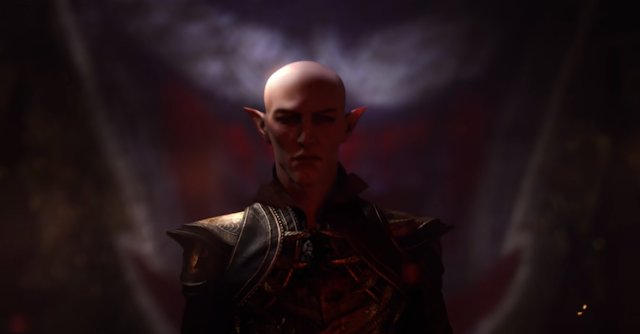
"Dragon Age: Dreadwolf" Predictions & Ponderings (and "What's in a Name?" Redux)
He doesn't call, he doesn't write, but finally, it looks like we might be hearing from Solas at last (2023?), as BioWare announces t...
-
 Cole: She is bare-faced, embarrassed, and she doesn't know. She thinks it's because of her. Face paint? Or hidden secrets? Wait ...
 -
 And here it is—my attempt at a Tolkien-style Tale of Years, in its entirety, for the world of Thedas! SPOILER WARNING : Pretty much ev...
 -
 Skyhold has not just been claimed time and again, but sacked as well. We've managed to uncover some remnants, including a scra...