Showing posts with label gaming. Show all posts
Showing posts with label gaming. Show all posts
Friday, November 30, 2018
YouTube Channel Launch (Law and Order: Thedas)
Be afraid, be very afraid—I've officially launched my Dumped, Drunk and Dalish YouTube Channel! Because I'm an incredible doofus, my first video is... yeah... it's pretty dumb.
But it was fun.
Thedas is made up of two kinds of people -- those who believe magic is dangerous, and those who believe it is simply a tool like any other. These are their stories. Welcome to... LAW & ORDER THEDAS.
Yeah, I did it. I couldn't help it! If you've been following on Twitter, the idea has haunted me for a month or two now -- I just thought Bull and Solas would be fun together in a "Law & Order" parody (if you check the video out, you can probably tell that I originally edited it to the actual "Law & Order" theme, but unfortunately even in parody, I felt I needed to take a "better safe than sorry" route on the music, so I used a stock sound-alike instead (it's not as good, but it works).
Anyway, it's dumb, but I hope you enjoy it. And if you like this, I'll be posting more videos in the future (and yes, most of them will be smarter than this one). I'll be offering both lore analysis videos as well as fun fan videos like this one. Thanks for checking it out!
(And don't forget to help us celebrate #Dragon4geDay on Twitter and across the web on Tuesday, December 4, 2018!)

Monday, July 3, 2017
The Low Place in the Hedge: How Gaming Saved Me
Solas: "Survive the first thirty heartbeats, and you'll already have won."
 |
| Eluvians are magical portals in the Dragon Age world. If I'd found one in the sixth grade? Or seventh? Eighth? Yeah. You wouldn't be reading this. |
Which existed, by the way. I knew this in my soul. Especially when it came to Tolkien's world. Even by 13, I'd tried and tried to find passage in every way I could. The certainty of his world felt like a knowledge thrumming just under my skin, a realization that magic in fact existed in the world, hidden only for the very most worthy. I couldn't give it up. The right combination, of course, would prove me vindicated.
Unfortunately, the world happened. And adulthood. And all the predictable yucky stuff. And ultimately, I realized, oh, right. This was what being a grownup was like. When you stopped looking into closets for Narnia. When the dawning awareness hit you that maybe you should stop elven calligraphy or Tolkien linguistics or Lewis research or just generally Doing That... if you ever truly wanted to succeed in life.
Mind you, I hadn't realized. I'd grown up an outcast. I'd been born with cerebral palsy and was a misfit who spent elementary school days wrapped in leg braces, corrective shoes, loneliness, occasional poverty, and the absolute best air of outward uncaring I could possibly manufacture. Inside, I was dying for connection. Outside, I was the human equivalent of a side-eye and a chilly shrug. People who attempted to connect with me were, ironically, most apt to be on the receiving end of a sarcastic quip and a dismissive glance. Hugs were not encouraged. I trusted few. My castle had to stay strong.
Further complicating my situation, from first to fourth grade, I had a series of eye surgeries that included a full year of wearing a real, actual, incredibly ugly and flesh-colored eyepatch to school. The eyepatch got sweaty in summer and the string made an indentation in my already terrible bowl-haircut hairline.
 |
| Being a nerd is only lonely on this side of the PC. It's the foundation of all RPG games and fandoms. |
In the big-picture sense, I was incredibly lucky overall—all of this was part of an incredibly mild case of CP (the brain damage I'd suffered at birth had been so much less severe than it might have been), and I valued and recognized that luck constantly. However, I still hated myself every waking minute. I looked funny. Walked funny. Thought funny. If I didn't monitor myself consciously, I walked like a chicken, hunched over and tentative, arms and legs drawn in close to my torso (and classmates often held contests to see who could best walk like me).
But fantasy saved me. Every time things got bad, I just closed my eyes and floated away to Narnia, to Meg and Proginoskes, to Arthur and Merlin, to Bilbo and Frodo and Middle Earth (where I was a capable, brisk and beautiful female hobbit named Falin who knew exactly how to avoid trolls and navigate Mirkwood). Even better was the time I discovered Eowyn, and she became my mental avatar and avenging angel.
And then I was okay.
The real world was stickier. Despite my efforts, everything was noticed. And until I reached the eighth grade and had learned some social skills Bull himself (and the Ben-Hassrath) would have valued, I honestly thought school was supposed to be as hellish as it was. In fact, I was so constantly thrown down stairs, knocked down, shoved in lockers, punched, hit, mocked, pissed on, and constantly abused in seventh grade that my principal apologized to me almost weekly, calling me into his office personally on an ongoing basis to apologize. Then I'd thank him, shrug, try to get through the rest of the day, and go home to read Tolkien or Poe in my bedroom while listening to ABBA (a strange yet potent combination).
I eventually learned to adapt, to say funny things at just the right times, to deflect, and blend. Thank goodness. (Although I'm deeply grateful that I didn't live in a time of social media, because I cannot say that I would have survived if the bullying had proceeded 24/7.)
The Secret Hobbit Companion
The good news is, while I was learning how to get along, I had my books. I had my music. I knew the value of dreams.
In fact, until I was 11 or so, I'd actually kept a backpack packed deep within the recesses of my closet, positive I was another Jill Pole, in preparation for the certain day when Gandalf would ultimately rap on my door and tell me my destiny (which of course he would). And then, see, I knew... I knew I'd panic, yet still I'd hastily throw together my backpack and hooded cloak (you have to have one if you're going adventuring), and I'd follow him out and away, jumping over the low place in the hedge and chasing the magical destiny that I knew had always awaited me.
I think the secret power of being a nerd is... like Quentin Coldwater in Lev Grossman's The Magicians, you never quite outgrow that belief in magic. You're always looking for the glitch, the subtext, the secret that will take you away. It's there. It has to be there. And even when the trick is revealed, and you're told, over and over again, "No, it's just a book/game/film," you still privately always believe it exists. Even when the world has hammered it out of you (or so it thinks). Just ask Quentin.
Me, I still believed. At 20. At 30. At 40. And, ahem, beyond... So when Gandalf didn't show up, I waited. Wrote my own stories. Consoled myself with games, TV, movies, and all the fiction I could wallow in. But I was still waiting.
Then I played LOTRO (the lovely and lore-rich MMORPG of The Lord of the Rings Online), and later on, the Mass Effect and Dragon Age series (and most especially Dragon Age: Inquisition) and that's where the miracle happened. Time somehow unspooled and ran backwards. I was whole again, magical and hopeful. I remembered my secret wonderful hidden old hobbity/dwarfly backpack. And in a flash, I knew that long-ago backpack had been dark green in color. And that there had been a rough spot on the lower left-hand side. That I had stuffed it with random household foods that wouldn't be missed for the trip (from apple-pie filling to Cheetos). Everything flooded back in a moment of pure, visceral flashback.
In other words, playing Dragon Age: Inquisition was the first time in my life I ever felt like, "Wait... I think I've actually found the magic wardrobe. Even if I don't quite get to go there." It wasn't just an escape. It enabled me to write a story and then enact its outcome, to create a hero or heroine that lived and breathed there, who fell in love, who lived and even (potentially) died. From there, I also found all sorts of wonderful discussion groups and boards, filled with people who were equally passionate about the world of Thedas, and who saw nothing odd in arguing about the hidden meanings of the quest "The Demands of the Qun," for instance, for hours at a time.
I'd experienced this before, of course, to some degree, most especially with friends who were fellow Tolkien fans. But this went beyond that, in an odd and intense way. Because games are present-tense and of the moment, and because the DA fandom is almost always involved in a replay of some part of the trilogy, there's a part of you that's wherever you are in the game. You're out in the real world, doing real-world things, but somewhere, beyond the eluvian, your Hawke is attempting to make peace between the mages and the templars. Or your Warden's trying to decide whether or not to do the Dark Ritual. Or your Inquisitor is trying to get the hang of her spooky new ability to shoot green flame from her hand. Your hero or heroine is always out there, simply waiting for you to continue the adventure.
Thanks to Dragon Age, the low place in the hedge was right there in the computer. And it was real. A single RPG game had reminded me of the magic, reminded me of the little kid I'd been, the one who'd dreamed of adventures with Bilbo and who'd kept that backpack in her closet, ready and waiting for the knock at the green door.
I was not alone.
A World on Fire: Dragon Age: Inquisition (Part 1)
If Dragon Age: Origins unfurled the map. Dragon Age II lit the fuse. And in Dragon Age; Inquisition, the map is most certainly ablaze.
Dragon Age: Inquisition starts with a bang. The final events of Dragon Age II—the destruction of the Kirkwall Chantry and the outright bloodshed between the mages and templars—have set off a conflict that is now tearing across Thedas and dividing its people. Magefire by rogue apostates rages through the land, even as their opposing templars have gone equally insane, burning houses, forests, fields and villages in retribution. Worst of all? The one hope of the world for peace—a Conclave where mages and templars were to meet with Divine Justinia (the leader of the Chantry) to negotiate a cease-fire—has just been blasted to smithereens, the Chantry is leaderless, and the sky, too, is now sundered and filled with flame.
And that's where we begin... or rather, where our poor hapless Inquisitor steps onto the stage, fleeing out of the Fade from a horde of demons and awakening in a prison cell with partial amnesia, vague memories of a near-death experience, and a mysterious and fiery green mark in the palm of her hand. It's quite literally a hell of an entrance.
The Subtext Becomes Text
In Dragon Age: Origins, I'd played a Circle Mage in my very first playthrough, and that has always stayed with me as my default, "headcanon" setting for the universe, providing me with a beautifully dramatic way to enter the Dragon Age story and its mages/templars tensions. Right away I'd been faced with a benignly imprisoned young elf mage protagonist and the templars who guarded her, including our old friend Cullen, who was in love with her. (Demonstrating early on his staggering lack of basic social or flirting skills, Cullen had shown his affection for my elf by telling her he was very happy he hadn't had to kill her and cut off her head after her Harrowing. My elf's response? "Thanks! Wanna make out?" And then he'd fled. Because: Cullen.)
Meanwhile, my elf's defense of a fellow mage directly led to her conscription by the Grey Wardens and set her on a course that would eventually end in tragedy (as it does for all Grey Wardens), even if she survived the final battle with the Archdemon.
Then came Dragon Age II and there again, as in DAO, my female Hawke protagonist was a mage—it felt most appropriate to me for the storyline, although it was kind of hilarious that so few people ever seemed to notice that she was an illegal apostate openly carrying a ginormous magical staff (and, sadly, no templar ever asked her if that was a staff in her pocket or was she just happy to see him, an omission I consider to be seriously tragic). Regardless, as the events of DA2 unfolded over its seven-year span, the tension between mages and templars was no longer simmering just beneath the surface—it was thrumming through an entire city, culminating in a stunning moment of terrorism and irrevocable violence that would touch off a world war.
When Dragon Age: Inquisition begins, that war is already underway across Thedas, with mages and templars battling each other openly as well as (even more tragically) abusing and decimating the poor everyday citizens simply trying to stay out of the fray.
It's Raining Demons
DAI definitely presents a grim world at first—not least because the vast majority of your fights aren't against simplistic baddies like demons or darkspawn (although, yes, you'll fight your share of those). Nope, the most common enemy you'll face this time around is human, whether mage, templar, bandit, or mercenary, and they're all busily fighting and killing and dying in the ferment even as they ignore the fact that the skies above them are raining demons and boiling a livid green.
It's a surprisingly believable scenario—okay, not the demon-raining part, but the one in which people squabble over trivialities and vanities, ignoring the fact that the world is falling down around them.
And this is the world your protagonist enters. Imprisoned and held for questioning at first because of the strange circumstances of your survival by two familiar faces (a returning Cassandra Pentaghast and Leliana, and it's so nice to see them again!), you'll have to allay their suspicions, join them in a journey to Haven, and begin to show them what kind of a hero you will (or won't) be. You're quickly joined on this journey by a returning Varric Tethras (now with even more glorious chest hair), along with a quiet elven mage apostate named Solas, and in true Dragon Age fashion, within 15 minutes, you're already asked to make tough choices—do you take the mountain path and potentially rescue the lost scouts? Or do you charge directly to the Temple? Either way, it's clear that there will be some casualties.
No matter what your choice, you eventually find yourself at the blast site with the rest of your companions. The Temple of Sacred Ashes, the place where the Conclave was held, and destroyed, is now a hellscape filled with fire, ash, and the twisted remains of victims who perished in agony. It's a sobering moment that sets the stage and propels you forward to the Inquisition headquarters at Haven, where you meet up once again with your new advisors, Leliana, Cullen, and Josephine. (As always in each new installment of Dragon Age, Cullen's hotness has once again increased exponentially, and he's so gorgeous at this point that, in my first playthrough I'd pause occasionally simply to gaze at him, wearing the kind of goopy, dreamy expression on my face I'd once reserved for a skinny blond boy named Brett in the sixth grade. Good times!)
The Adventures Begin...
The quests and storylines of DAI remain accessible and thematically tied together thanks to a brilliant new innovation in the game called the War Table. With the War Table, the Inquisitor will periodically interact with the advisors while addressing a variety of quests, political measures or favors, and world events. Each one of these can be resolved in a variety of ways (and time-frames), with each outcome dependent on the advisor you chose. For instance, Josephine's resolutions tend to be diplomatic and nonviolent, while Cullen would simply like to send in some troops to stomp their way through the problems, and Leliana, by far the coldest and most bloodthirsty, is perfectly happy to maim, kidnap or assassinate as needed, unless you hold her back.
For example, in response to a rather trivial matter in which a rival bard is saying unkind things about our own tavern bard, Maryden, Leliana coolly notes that "A minstrel with no tongue can tell no lies." (This was the point at which I actually yelled at my computer screen: "LELIANA! What HAPPENED to you?") Let's just say the sweet little bard of Dragon Age: Origins is gone, and it's all more than a little tragic—she's now a terrifying, secretive and complex woman with icewater in her veins. Even if (reassuringly) she at least still adores and raises nugs (the adorable little rabbit-pig creatures you find across Thedas).
As you carry out your missions and assignments from the War Table and on behalf of your advisors, meanwhile, your team of potential Companions continues to grow. In addition to Varric, Solas and Cassandra, you will also have the opportunity to meet and add such characters as The Iron Bull (a big, brash Qunari mercenary captain who's much more than meets the eye), court enchanter Vivienne, Red Jenny rogue leader Sera, dashing Dorian, the gentle and mysterious Cole, and solitary Grey Warden Blackwall. These nine Companions will accompany you on your quests across Ferelden and Orlais, and are your Inquisitor's potential friends, enemies, and lovers, along with Josie and Cullen (and there was much rejoicing). Varric, however, still has a crush on that darned crossbow of his, so he's unromanceable, as is Cole (who is too innocent and vulnerable for the task), and Vivienne, who is the mistress of a powerful Duke. But everyone else? Fair game, and those romances add immeasurably, as always, to the texture, atmosphere and story of Dragon Age: Inquisition.
An Array of Vast Landscapes for Fantasy Adventurers
As your efforts to help restore order to the world begin to have a tangible effect on Ferelden's landscape, you'll soon have the opportunity to view more than death, destruction, and chaos. Increasingly revealed in each new location you discover, the beauty of Ferelden and Orlais within Dragon Age: Inquisition's open world is frequently staggering, bringing you vistas as varied as the mountains and streams of the Hinterlands, the gorgeously inclement Storm Coast, the vibrant Orlesian city Val Royeaux, the tragic verdant loveliness of The Emerald Graves, the elegant winterscapes of Emprise du Lyon, the desolate swamplands of The Fallow Mire, the endless sands of The Hissing Wastes and The Western Approach, and many more. And Dragon Age: Inquisition's Open World concept means that you can explore these vast areas to your heart's content, ferreting out secrets and finding new opportunities for treasure or lore as the opportunities arise.
Please check out the second part of my initial look at DAI to follow. And please do check out my Twitter feed at @DrunkDalish. Thanks!
 |
| There's a Rift in the sky... and that's not good. |
And that's where we begin... or rather, where our poor hapless Inquisitor steps onto the stage, fleeing out of the Fade from a horde of demons and awakening in a prison cell with partial amnesia, vague memories of a near-death experience, and a mysterious and fiery green mark in the palm of her hand. It's quite literally a hell of an entrance.
The Subtext Becomes Text
 |
| Mages don't have it easy in DAI. (But do they ever?) |
Meanwhile, my elf's defense of a fellow mage directly led to her conscription by the Grey Wardens and set her on a course that would eventually end in tragedy (as it does for all Grey Wardens), even if she survived the final battle with the Archdemon.
Then came Dragon Age II and there again, as in DAO, my female Hawke protagonist was a mage—it felt most appropriate to me for the storyline, although it was kind of hilarious that so few people ever seemed to notice that she was an illegal apostate openly carrying a ginormous magical staff (and, sadly, no templar ever asked her if that was a staff in her pocket or was she just happy to see him, an omission I consider to be seriously tragic). Regardless, as the events of DA2 unfolded over its seven-year span, the tension between mages and templars was no longer simmering just beneath the surface—it was thrumming through an entire city, culminating in a stunning moment of terrorism and irrevocable violence that would touch off a world war.
When Dragon Age: Inquisition begins, that war is already underway across Thedas, with mages and templars battling each other openly as well as (even more tragically) abusing and decimating the poor everyday citizens simply trying to stay out of the fray.
It's Raining Demons
 |
| Leliana's back! She's not romanceable, but since she'd kill you in your sleep, it's probably for the best. |
It's a surprisingly believable scenario—okay, not the demon-raining part, but the one in which people squabble over trivialities and vanities, ignoring the fact that the world is falling down around them.
And this is the world your protagonist enters. Imprisoned and held for questioning at first because of the strange circumstances of your survival by two familiar faces (a returning Cassandra Pentaghast and Leliana, and it's so nice to see them again!), you'll have to allay their suspicions, join them in a journey to Haven, and begin to show them what kind of a hero you will (or won't) be. You're quickly joined on this journey by a returning Varric Tethras (now with even more glorious chest hair), along with a quiet elven mage apostate named Solas, and in true Dragon Age fashion, within 15 minutes, you're already asked to make tough choices—do you take the mountain path and potentially rescue the lost scouts? Or do you charge directly to the Temple? Either way, it's clear that there will be some casualties.
 |
| Cullen's back for DAI, and he's finally achieved maximum hotness (it's the hair) |
The Adventures Begin...
The quests and storylines of DAI remain accessible and thematically tied together thanks to a brilliant new innovation in the game called the War Table. With the War Table, the Inquisitor will periodically interact with the advisors while addressing a variety of quests, political measures or favors, and world events. Each one of these can be resolved in a variety of ways (and time-frames), with each outcome dependent on the advisor you chose. For instance, Josephine's resolutions tend to be diplomatic and nonviolent, while Cullen would simply like to send in some troops to stomp their way through the problems, and Leliana, by far the coldest and most bloodthirsty, is perfectly happy to maim, kidnap or assassinate as needed, unless you hold her back.
 |
| At last, Cullen's romanceable! Please note: He's terrible at flirting, talking, dancing, chess, and basic socialization but who cares. Look at him. |
For example, in response to a rather trivial matter in which a rival bard is saying unkind things about our own tavern bard, Maryden, Leliana coolly notes that "A minstrel with no tongue can tell no lies." (This was the point at which I actually yelled at my computer screen: "LELIANA! What HAPPENED to you?") Let's just say the sweet little bard of Dragon Age: Origins is gone, and it's all more than a little tragic—she's now a terrifying, secretive and complex woman with icewater in her veins. Even if (reassuringly) she at least still adores and raises nugs (the adorable little rabbit-pig creatures you find across Thedas).
As you carry out your missions and assignments from the War Table and on behalf of your advisors, meanwhile, your team of potential Companions continues to grow. In addition to Varric, Solas and Cassandra, you will also have the opportunity to meet and add such characters as The Iron Bull (a big, brash Qunari mercenary captain who's much more than meets the eye), court enchanter Vivienne, Red Jenny rogue leader Sera, dashing Dorian, the gentle and mysterious Cole, and solitary Grey Warden Blackwall. These nine Companions will accompany you on your quests across Ferelden and Orlais, and are your Inquisitor's potential friends, enemies, and lovers, along with Josie and Cullen (and there was much rejoicing). Varric, however, still has a crush on that darned crossbow of his, so he's unromanceable, as is Cole (who is too innocent and vulnerable for the task), and Vivienne, who is the mistress of a powerful Duke. But everyone else? Fair game, and those romances add immeasurably, as always, to the texture, atmosphere and story of Dragon Age: Inquisition.
An Array of Vast Landscapes for Fantasy Adventurers
 |
| Aside from all the death and demons, DAI offers gorgeous vistas you'd kill to explore in person. If they didn't kill you first. |
Please check out the second part of my initial look at DAI to follow. And please do check out my Twitter feed at @DrunkDalish. Thanks!
Saturday, June 24, 2017
Surviving the Joining: Thoughts on 'Dragon Age: Origins'
If you really want to understand the world of Dragon Age,
then Dragon Age: Origins is simply essential, because when it
comes to worldbuilding, DAO sets up the chessboard
beautifully. It introduces you to Thedas, and to the Dragon Age universe's main
regions and races, their politics, religions, and strifes.
DAO also tosses you headlong into the fray by making your first protagonist a Grey Warden.
The Burden of the Wardens
Grey Wardens are a grim, highly honored, elite cadre of fighters who either join the order out of ambition and pride, or who are forcibly conscripted. Much like GRRM's Night's Watch in the Game of Thrones universe, Dragon Age's Grey Wardens do an often thankless job around the fringes of Thedas's world, fighting darkspawn, haunted by the "Taint," and doomed to die within two or three decades. They're often a disparate mix of nobles and criminals and everything in between, because, as with the Night's Watch, once you become a Grey Warden, your past crime no longer exists.
The Burden of the Wardens
 |
| DAO features fascinating characters, like the lonely slightly amoral hedge witch Morrigan (left), as well as a world that's equally complex. |
Grey Wardens are a grim, highly honored, elite cadre of fighters who either join the order out of ambition and pride, or who are forcibly conscripted. Much like GRRM's Night's Watch in the Game of Thrones universe, Dragon Age's Grey Wardens do an often thankless job around the fringes of Thedas's world, fighting darkspawn, haunted by the "Taint," and doomed to die within two or three decades. They're often a disparate mix of nobles and criminals and everything in between, because, as with the Night's Watch, once you become a Grey Warden, your past crime no longer exists.
Those wishing to become Grey Wardens must first undergo the Joining, a ritual that involves drinking a concoction of darkspawn blood, and which the majority of potential Wardens do not survive. Those who do survive are now Grey Wardens—respected throughout the land but doomed to live shorter lives due to the "Taint," and marred by a constant awareness of, and connection to, the darkspawn (a hellish, twisted, mostly mindless race that lives beneath the surface, and which can infect those in contact with them).
At least you're not alone in
your newfound Grey Wardenship. You're immediately paired up with Grey Warden
Alistair, a witty, slightly naive young man who has the potential to be either
a friend, lover or foe as your adventures evolve.
The stage of DAO is then perfectly set with
the reappearance of the one thing everyone in Thedas dreads: the appearance of
an Archdemon. Archdemons are fell forces in dragon form, and each time they
appear, they lead the darkspawn in something called the Blight, in which the
darkspawn rage to the surface in massive, frenzied numbers as they attempt to
take over the world of the living, obliterating whole villages, settlements and
kingdoms. The Blight is basically a kind of infection that's both biological
and metaphysical, in which those infected either die of the infection or slowly
turn into darkspawn themselves.
An Endless Circle of Conflict: the Mages and the Templars
The other main tensions are between mages and templars, and these tensions not only affect the game and its choices in DAO, but they will be increasingly vital in shaping each new chapter of the trilogy as it progresses.
In the Dragon Age universe, mages are innately talented with magic, yet they're also dangerous because each time they use magic, they open a tiny channel to the Fade (the otherworld/dreamworld that is also the source of all magic), allowing for the possibility for demons to sneak through and possess them, turning them into powerful, evil Abominations. Mages are for this reason tested for this weakness in a Fade-based ritual known as "The Harrowing," and if they fail, the templars in the room will execute them immediately.
Those templars, meanwhile, are soldiers who guard, watch and imprison the mages, and who keep them in isolated towers known as 'Circles,' ostensibly for their own protection. Some Circles are gently managed, and there's real camaraderie between the mages and Templars (along with a healthy degree of sly hooking up), and a system that mostly works, even if I still intensely dislike any system that requires imprisonment for a talent people were, you know, born with. Other Circles, as we'll find as we move through the trilogy, however, are not kind, gentle, havens, but are horrifying prisons in which mages are starved, abused, raped, and more, without consequence or oversight. Mages who flee are often punished with death or a kind of spiritual lobotomy known as "Tranquility," in which the mage's connection to the Fade is severed, and they lose all capacity for emotion.
The first Circle we encounter is fairly gentle, however, and it includes a character we'll come to know very well as the trilogy progresses—the templar Cullen, who here in DAO is a shy young boy who cannot even stand a moment of flirtation with your female mage protagonist without running away. It's part of the reason I really recommend playing DAO at least once as a Circle mage, as you'll encounter plenty of drama and prejudice—even more so if you play a Dalish or city elf, as elves in this universe are a fallen people, distrusted, enslaved, and treated with active cruelty and prejudice. And you'll learn about the central conflict (mages versus templars) that will evolve with each new game or chapter as you progress through the trilogy.
A Hero's Journey Begins
 |
| DAO choices can lead to surprising outcomes. I never expected to be standing next to Loghain, for instance (although I'd envisioned standing ON him). |
No big deal, right? It's a
great journey, and full of adventures across a complex and often beautiful
array of regions and landscapes. Even better, you'll encounter some amazing characters, societies, and stories along the way—from werewolves to enchantresses, from dragons to demons.
And, as always with RPGs, you get to choose how—and who—you
play. Are you a hero? Or a villain? Or a wisecracking rogue somewhere in between? It's all up to
you. You can court—or kill—pretty much all of your companions. The choices are
complex and often surprising, frightening, and even moving, and Origins ensures that the dialogues are consistently complex, engrossing, and genuinely interesting and fun to navigate.
Meanwhile, DAO is about far
more than the hero—it also offers incredible characters. I loved the richness
and complexity of the apostate witch Morrigan, the guilt-stricken Qunari Sten,
the charming Alistair (hiding some secrets of his own), the Crow assassin
Zevran, the devout former bard Leliana, senior mage Wynne, the golem Shale, and
others. The characters are—all—beautifully performed, especially by Sten's dry,
yet secretly heartfelt Mark Hildreth, Morrigan's sarcastic, vulnerable Claudia
Black, Kate Mulgrew as the mysterious Flemeth, and more. I grew to love them.
The plot thickens... DAO is only the beginning.
Falling Flat for Thedas...
 |
| Dragon Age offers gamers a world that's magical, gorgeously rendered, and endlessly adaptable. |
Sure, I'd gotten a little obsessed now and then—I still remember basically living three months in the world of Mass Effect while playing the entire trilogy. Or at least that's how I remember it.
Then came the world of Dragon Age. First, I played Dragon Age: Origins (or DAO for short), and was entranced with the richness and complexity of the game's world and its mythology. Each time I started up the game and that haunting music played, I felt that I was climbing through a window into another world—a deeply magical world.
After Origins, I (stupidly) skipped Dragon Age 2 (a mistake I later rectified), mainly because I was so excited to finally get to play Dragon Age: Inquisition. And it was with Inquisition that I fell in love. I fell flat. I fell like cartoon characters fall, complete with sound effects.
By the end of Inquisition, I was in love. I loved the game and its world. I loved it like I loved books. Coffee. Narnia. His Dark Materials. Eggnog. Hedgehogs. Cats. Astronomy.
I mean, I loved it like I loved Tolkien. This was serious.
And three years later, I'm just as obsessed as ever. Probably more so—because the DA world is rich enough to withstand endless replays, explorations, discussions, and microscopic scrutiny. Thanks, to Dragon Age: Inquisition, I got dumped by an in-game love interest for the first time (dammit, Solas!) and was actually so incensed by the experience that I ended up writing a fan-fiction comedic play, "Dumped, Drunk and Dalish," about my Inquisitor's drunken aftermath just to process it! (Please note—it's idiotic but fun, and you're welcome to check it out at Archive of Our Own here: http://archiveofourown.org/works/5705719.)
And that's why I'm here. As a fantasy writer, I basically had too many thoughts about Dragon Age, at this point, to keep to myself, and wanted a platform where I could share and discuss whatever moved or inspired me about the games, novels, and their world.
So welcome to my blog, complete with ramblings from my perch at the Herald's Rest. Thanks for stopping by! The next round of maraas-lok is on me.
Subscribe to:
Posts (Atom)
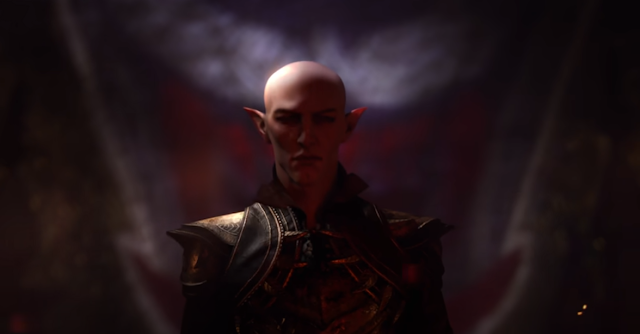
"Dragon Age: Dreadwolf" Predictions & Ponderings (and "What's in a Name?" Redux)
He doesn't call, he doesn't write, but finally, it looks like we might be hearing from Solas at last (2023?), as BioWare announces t...
-
 And here it is—my attempt at a Tolkien-style Tale of Years, in its entirety, for the world of Thedas! SPOILER WARNING : Pretty much ev...
-
 Cole: She is bare-faced, embarrassed, and she doesn't know. She thinks it's because of her. Face paint? Or hidden secrets? Wait ...
-
 Skyhold has not just been claimed time and again, but sacked as well. We've managed to uncover some remnants, including a scra...